Appendix E
Reporting and Interpreting Investments in
Other Corporations
ANSWERS TO QUESTIONS
1. A short-term investment is one that meets the two tests of (1) ready marketability
and (2) management intention to convert it to cash in the short run. In contrast, a
2. For passive investments in bonds, companies may report the investment at
unamortized cost if the intent is to hold the bonds until maturity. Otherwise, the
investments in bonds are to be accounted for using the same fair value method
as is used for passive investments in equity securities. Each year end, the
3. Only bonds that management has the plans and ability to hold until maturity can
be reported in the held-to-maturity portfolio. The investment in held-to-maturity
4. When shares of capital stock of another company are purchased as an
investment, they are measured and recorded at cost in accordance with the cost
6. Under the equity method, investment revenue is measured on a proportionate
basis by the investor company when earnings are reported by the affiliate
company, rather than when the dividends are received. This is because the equity
7. Under the equity method, dividends received from the affiliate company (the other
company) are not recorded as revenue because to record the dividends as
revenue would involve double counting. There would be double counting because
8. The identifiable assets and liabilities of the acquired company are recorded at
their fair values on the date of acquisition. This is called the acquisition method.
9. Goodwill is only recorded when one company purchases a controlling interest in
another. Goodwill is equal to the purchase price minus the fair value of the
Financial Accounting, 8/e Appendix E-3
MULTIPLE CHOICE
1. b
Authors’ Recommended Solution Time
(Time in minutes)
Mini-exercises
Exercises
Problems
Alternate
Problems
Cases and
Projects
No.
Time
No.
Time
No.
Time
No.
Time
No.
Time
1
3
1
10
1
20
1
20
1
20
2
3
2
15
2
30
2
30
2
15
3
6
3
20
3
45
3
45
3
30
4
6
4
20
4
40
4
40
4
20
5
6
5
20
5
40
5
20
5
10
6
6
6
20
6
40
6
20
6
20
7
6
7
25
7
20
8
*
8
6
8
10
8
20
9
5
9
10
9
20
Continuing Case
10
10
10
10
10
30
1
20
11
5
11
15
11
20
* Due to the nature of this project, it is very difficult to estimate the amount of time
students will need to complete the assignment. As with any open-ended project, it is
possible for students to devote a large amount of time to these assignments. While
students often benefit from the extra effort, we find that some become frustrated by
the perceived difficulty of the task. You can reduce student frustration and anxiety by
making your expectations clear. For example, when our goal is to sharpen research
Financial Accounting, 8/e Appendix E-5
MINI-EXERCISES
ME–1.
D
1. Less than 20 percent ownership.
D
2. Current fair value.
C
3. More than 50 percent ownership.
B
4. At least 20 percent but not more than 50 percent ownership.
A
5. Bonds held to maturity.
A
6. Original cost less any amortization of premium or discount associated with the
purchase.
B
7. Original cost plus proportionate part of the income of the affiliate less
proportionate part of the dividends declared by the affiliate.
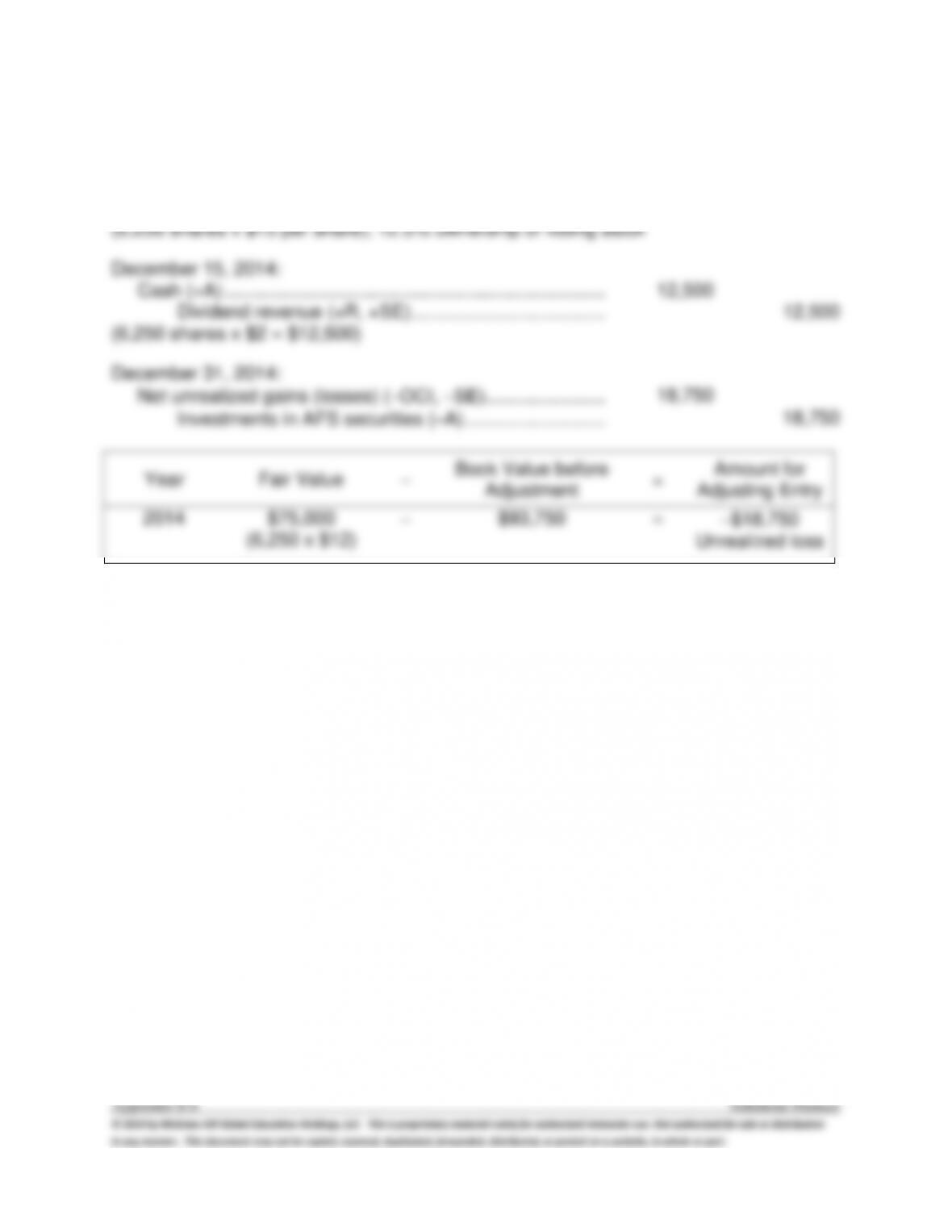
ME –2.
Bond investments (+A)* ………………………………………………..
900,000
Cash (−A) ………………………………………………………………..
900,000
*Since the exercise does not state the intent of the purchaser, the bonds may be
classified as
• Held-to-maturity – if the intent is to hold the bonds until the maturity date
• Trading security – if the intent is to hold the bonds for a short time in a trading
capacity
• Available-for-sale – if the intent is not to hold the bonds until maturity or in a
trading capacity.
ME –3.
December 2, 2014:
Investments in AFS securities (+A) …………………………….
93,750
Cash (−A)………………………………………………………….
93,750
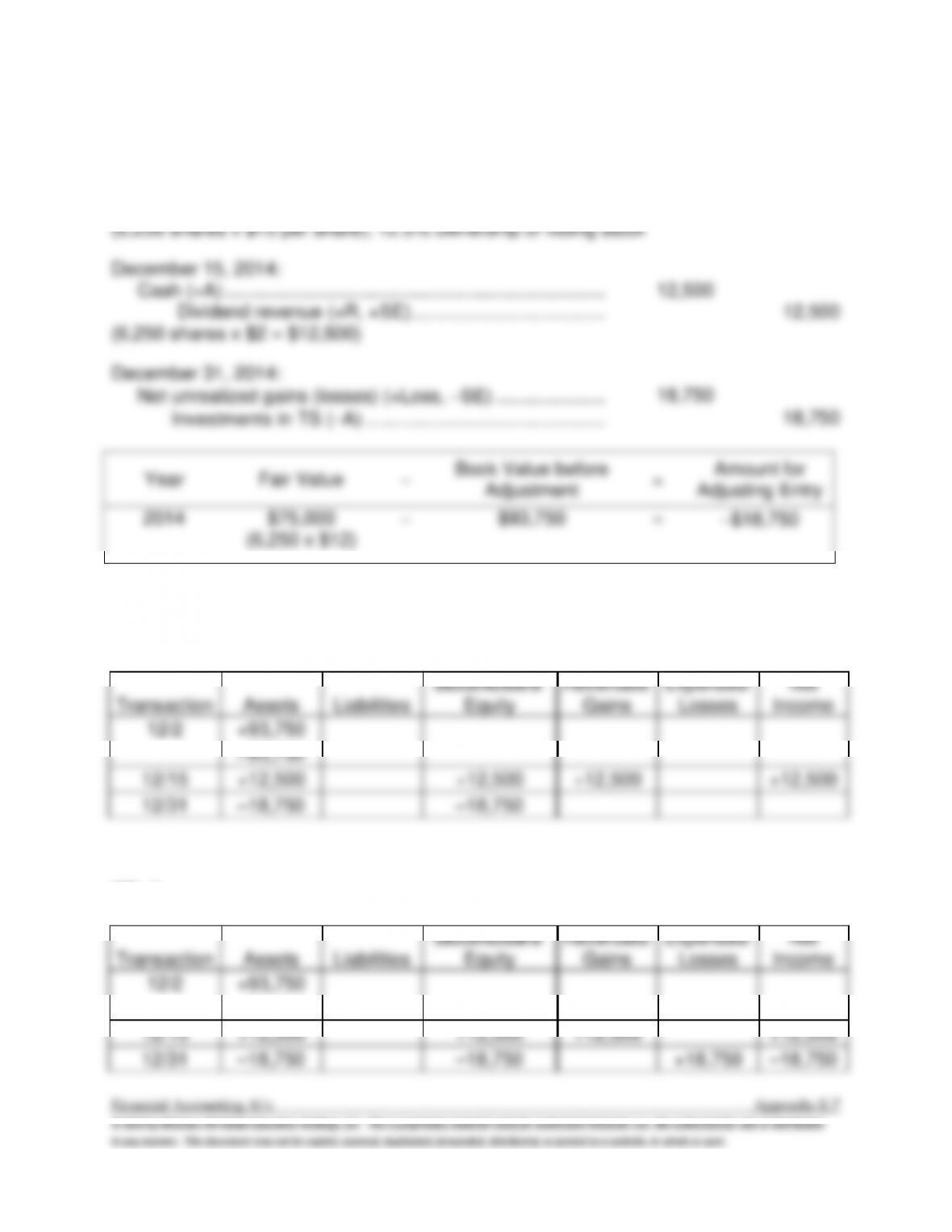
(6,250 shares x $15 per share); 12.5% ownership of voting stock
December 15, 2014:
Cash (+A) ……………………………………………………………….
12,500
Dividend revenue (+R, +SE) ……………………………….
12,500
(6,250 shares x $2 = $12,500)
Investments in AFS securities (−A) ………………………
18,750
ME–4.
December 2, 2014:
Investments in TS (+A) ……………………………………………..
93,750
Cash (−A)………………………………………………………….
93,750
(6,250 shares x $15 per share); 12.5% ownership of voting stock
December 15, 2014:
Cash (+A) ……………………………………………………………….
12,500
Dividend revenue (+R, +SE) ……………………………….
12,500
(6,250 shares x $2 = $12,500)
Investments in TS (−A) ……………………………………….
18,750
Equity
Equity
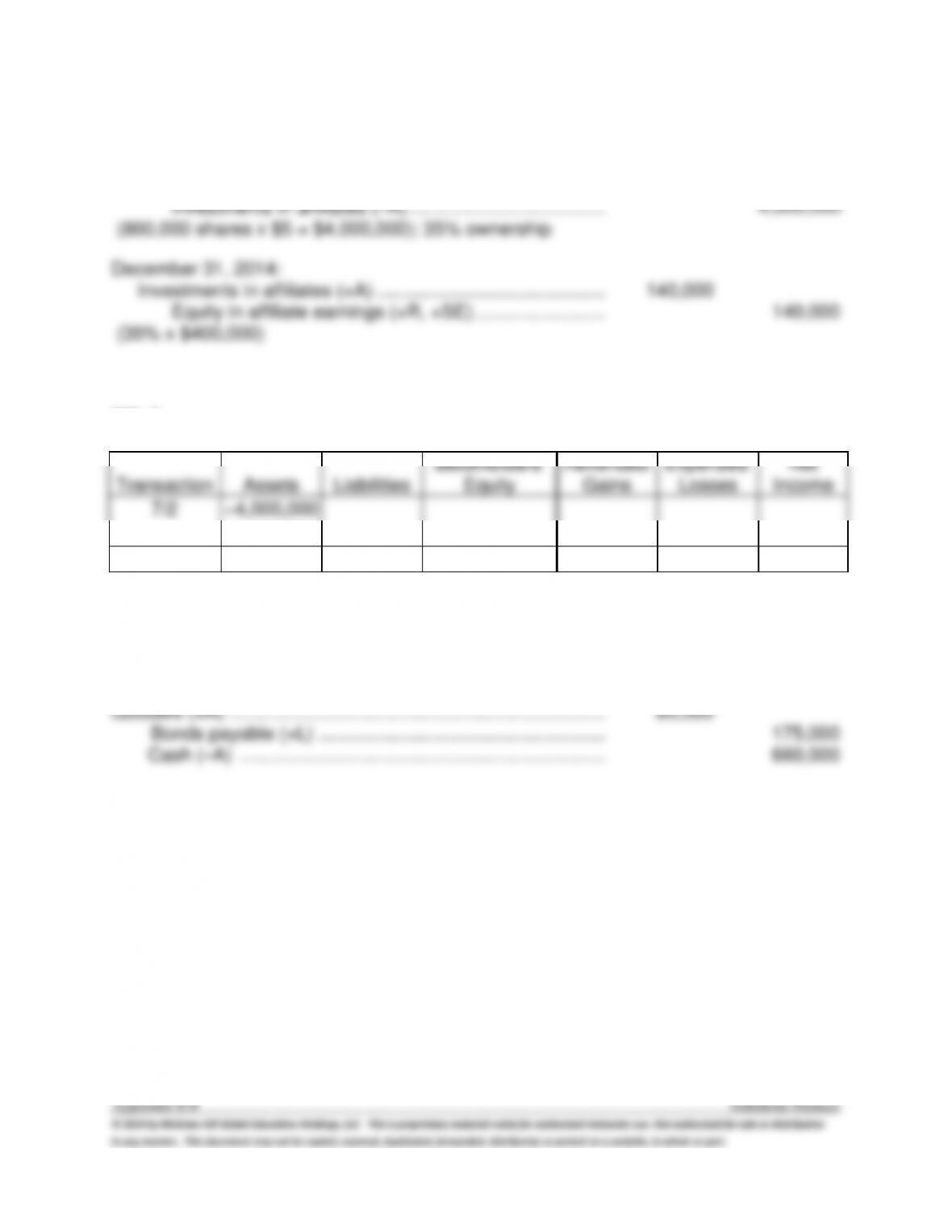
ME–7.
July 2, 2014:
Cash (+A) ……………………………………………………………….
4,000,000
Investments in affiliates (−A) ………………………………..
4,000,000
(800,000 shares x $5 = $4,000,000); 35% ownership
Investments in affiliates (+A) ……………………………………..
140,000
Equity in affiliate earnings (+R, +SE) …………………….
140,000
(35% x $400,000)
ME–8.
Balance Sheet
Income Statement
Transaction
Assets
Liabilities
Stockholders’
Equity
Revenues/
Gains
Expenses/
Losses
Net
Income
7/2
+4,000,000
–4,000,000
12/31
+140,000
+140,000
+140,000
+140,000
ME–9.
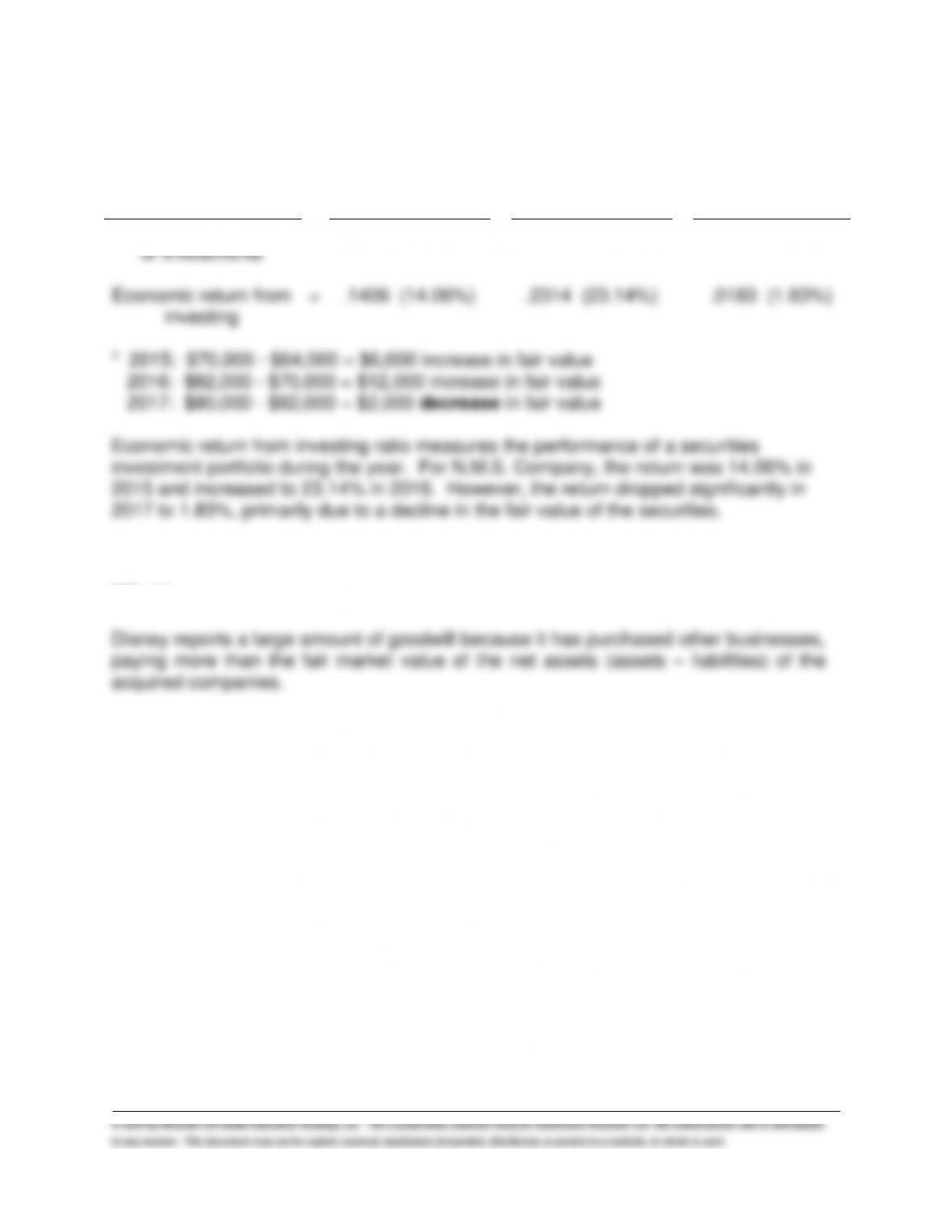
Property and equipment (+A) …………………………………………
750,000
Goodwill (+A) ………………………………………………………………
85,000
Bonds payable (+L) ……………………………………………….
175,000
Cash (–A) …………………………..………………………………..
660,000
Financial Accounting, 8/e Appendix E-9
ME–10.
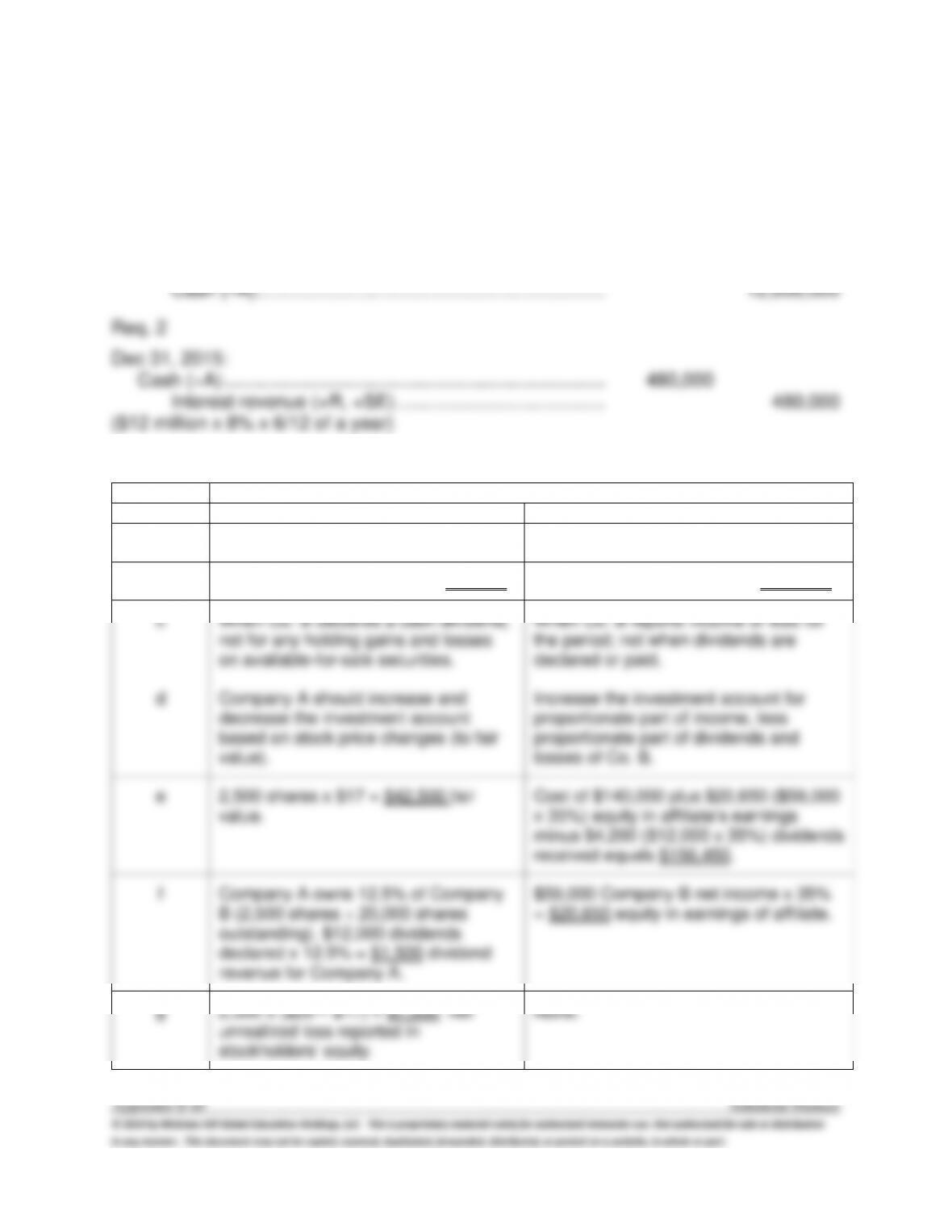
2015
2016
2017
Dividends + Change
in Fair Value*
$3,000 + $6,000
$4,200 + $12,000
$3,500 – $2,000
Beginning Fair Value
of Investments
$64,000
$70,000
$82,000
Economic return from
investing
=
.1406 (14.06%)
.2314 (23.14%)
.0183 (1.83%)
* 2015: $70,000 – $64,000 = $6,000 increase in fair value
2016: $82,000 – $70,000 = $12,000 increase in fair value
2017: $80,000 – $82,000 = $2,000 decrease in fair value
Economic return from investing ratio measures the performance of a securities
investment portfolio during the year. For N.M.S. Company, the return was 14.06% in
2015 and increased to 23.14% in 2016. However, the return dropped significantly in
2017 to 1.83%, primarily due to a decline in the fair value of the securities.
ME–11.
EXERCISES
EE–1.
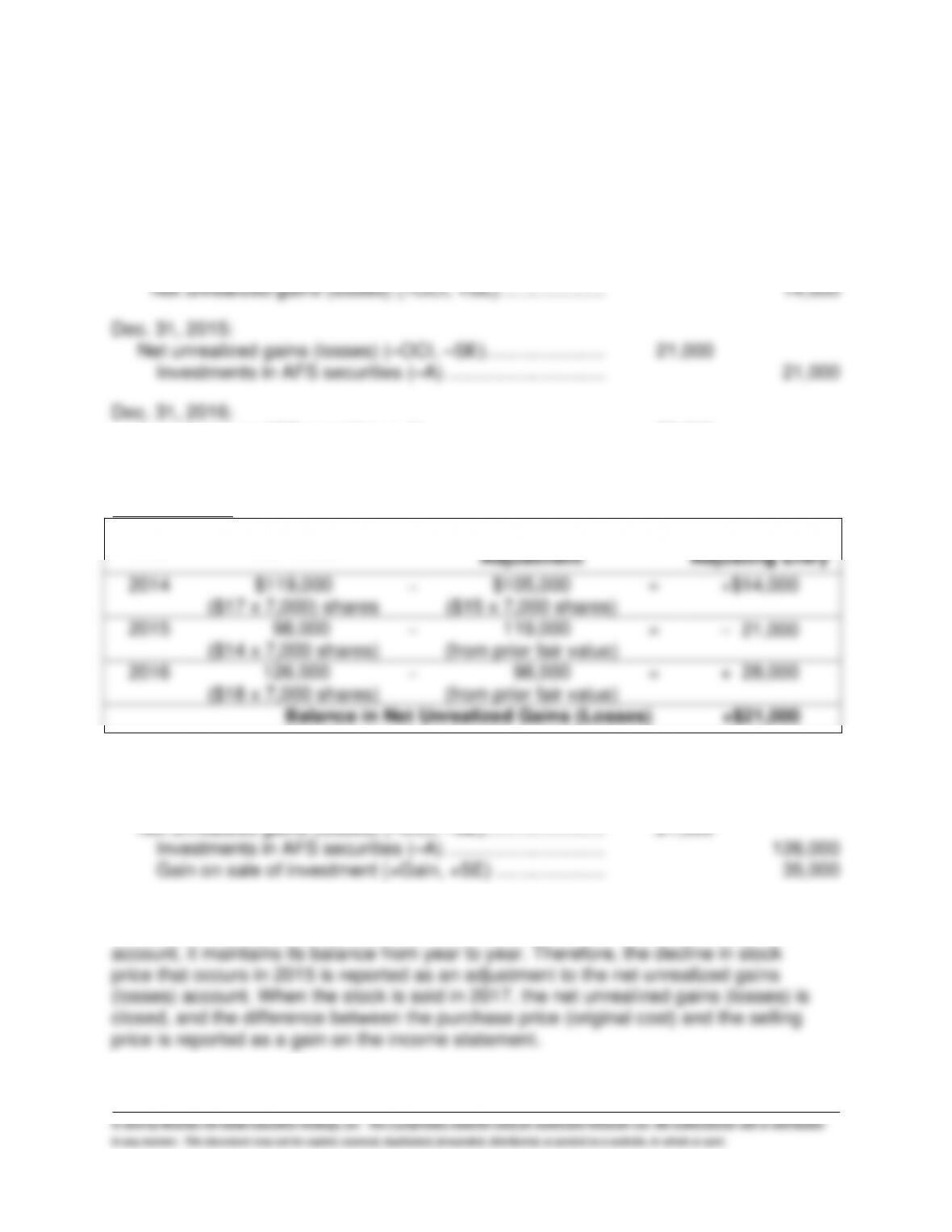
Req. 1
July 1, 2015:
Held-to-maturity investments (+A) ………………………………
12,000,000
Cash (–A)………………………………………………………….
12,000,000
Cash (+A) ……………………………………………………………….
480,000
Interest revenue (+R, +SE) ………………………………….
480,000
($12 million x 8% x 6/12 of a year)
EE–2.
Questions
Method of Measurement
Fair value Method
Equity Method
a
Less than 20%.
At least 20% but not more than 50%.
b
At cost: 2,500 shares x $20 = $50,000.
At cost: 7,000 shares x $20 = $140,000.
c
When Co. B declares a cash dividend;
not for any holding gains and losses
on available-for-sale securities.
When Co. B reports income or loss for
the period; not when dividends are
declared or paid.
d
Company A should increase and
decrease the investment account
based on stock price changes (to fair
value).
Increase the investment account for
proportionate part of income, less
proportionate part of dividends and
losses of Co. B.
e
2,500 shares x $17 = $42,500 fair
value.
Cost of $140,000 plus $20,650 ($59,000
x 35%) equity in affiliate’s earnings
minus $4,200 ($12,000 x 35%) dividends
received equals $156,450.
f
Company A owns 12.5% of Company
B (2,500 shares ÷ 20,000 shares
outstanding). $12,000 dividends
declared x 12.5% = $1,500 dividend
revenue for Company A.
$59,000 Company B net income x 35%
= $20,650 equity in earnings of affiliate.
g
2,500 x ($20 – $17) = $7,500 net
unrealized loss reported in
stockholders’ equity.
None.
Financial Accounting, 8/e Appendix E-11
EE–3.
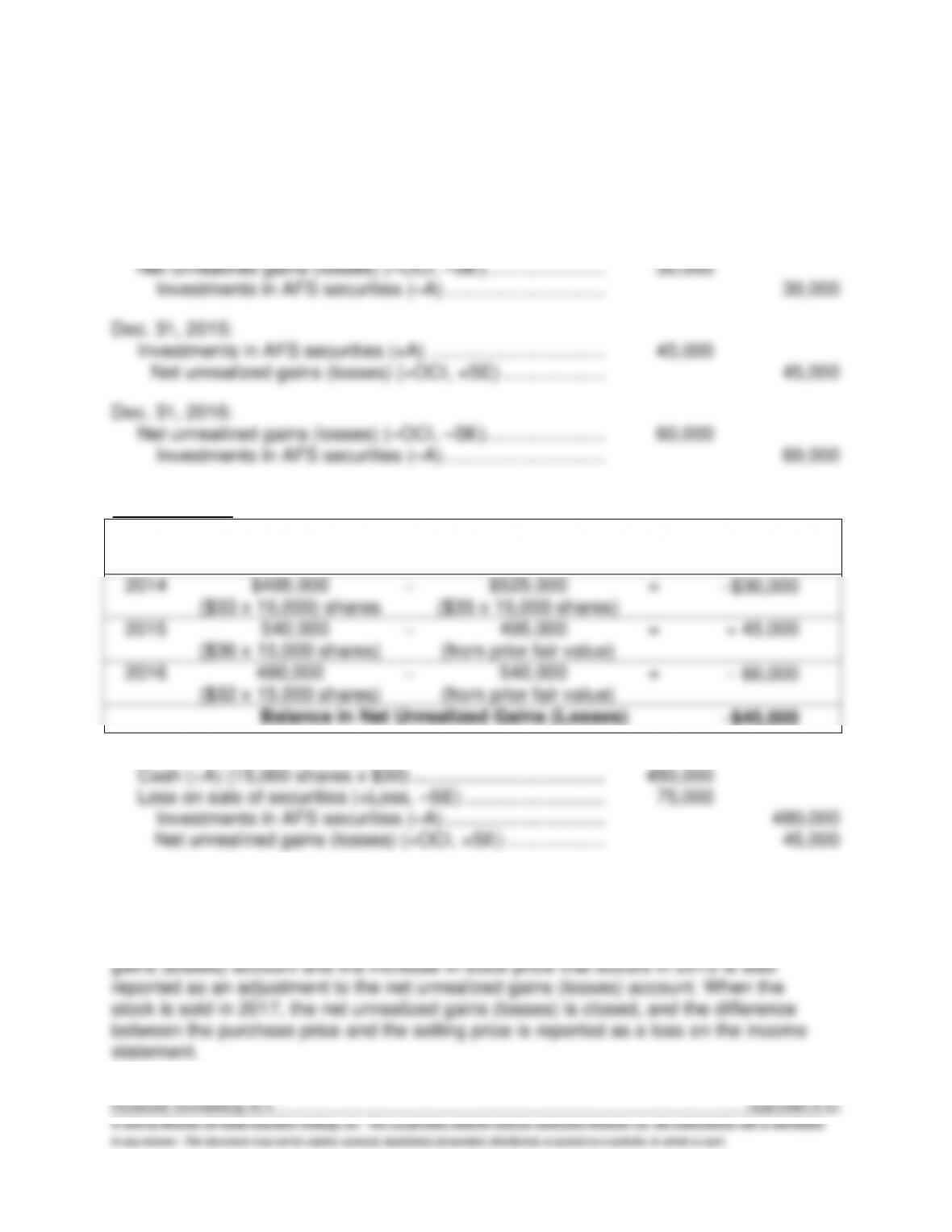
June 30, 2014:
Investments in AFS securities (+A) (7,000 shares x $15)
105,000
Cash (–A) ……………………………………………………………
105,000
Dec. 31, 2014:
Investments in AFS securities (+A).. …………………………..
14,000
Net unrealized gains (losses) (+OCI, +SE) ………………..
14,000
Net unrealized gains (losses) (–OCI, –SE) …………………..
21,000
Investments in AFS securities (–A). …………………………
21,000
Dec. 31, 2016:
Investments in AFS securities (+A). …………………………...
28,000
Net unrealized gains (losses) (+OCI, +SE) ………………..
28,000
Computations:
Year
Fair Value
−
Book Value before
Adjustment
=
Amount for
Adjusting Entry
2014
$119,000
($17 x 7,000) shares
−
$105,000
($15 x 7,000 shares)
=
+$14,000
2015
98,000
($14 x 7,000 shares)
−
119,000
(from prior fair value)
=
− 21,000
2016
126,000
($18 x 7,000 shares)
−
98,000
(from prior fair value)
=
+ 28,000
Balance in Net Unrealized Gains (Losses)
+$21,000
Feb. 14, 2017:
Cash (+A) (7,000 shares x $20). ………………………………..
140,000
Net unrealized gains (losses) (–OCI, –SE) …………………..
21,000
Investments in AFS securities (–A). …………………………
126,000
Gain on sale of investment (+Gain, +SE) …………………
35,000
Note: The net unrealized gains (losses) account is a balance sheet account. It does
not affect the computation of net income each year. Because it is a balance sheet
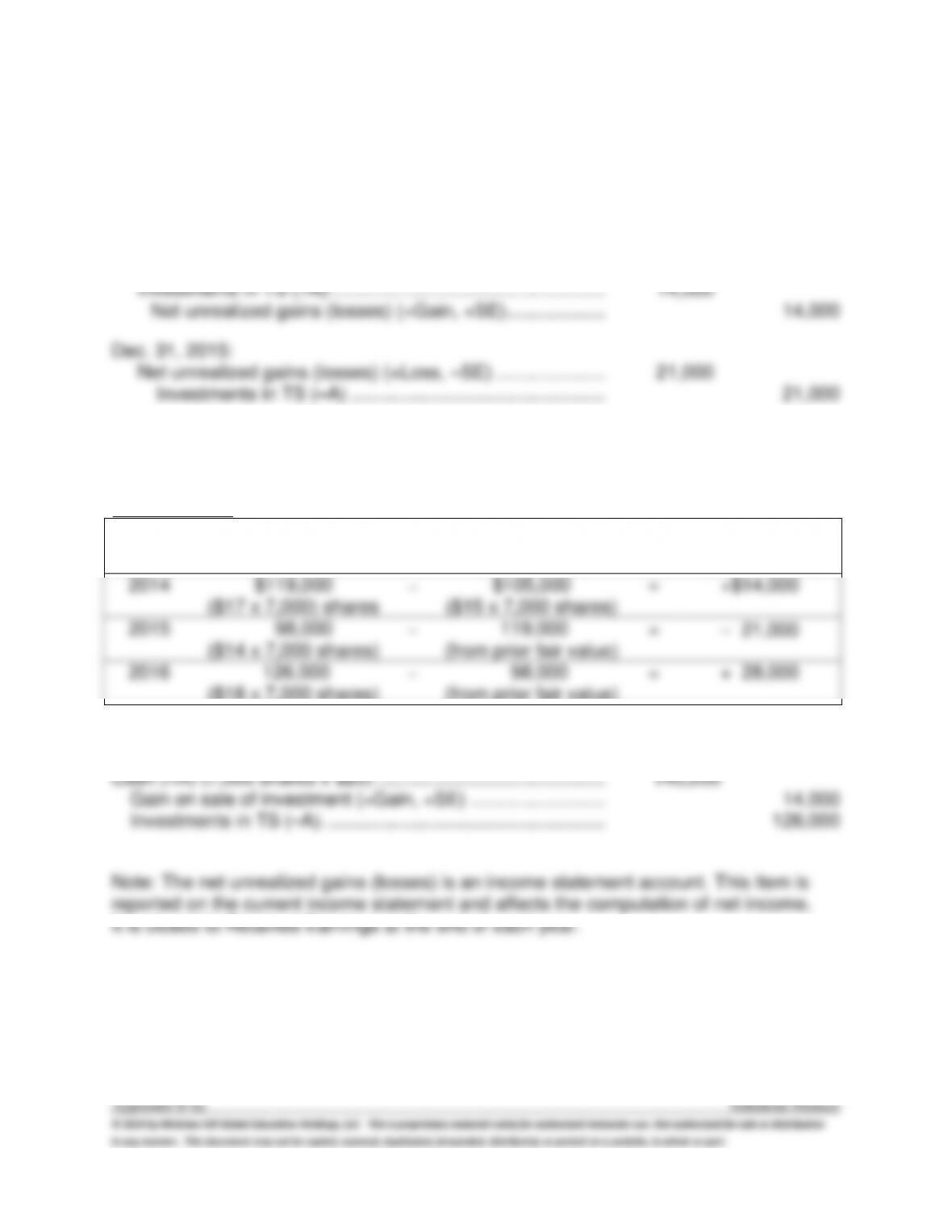
EE–4.
June 30, 2014:
Investments in TS (+A) ……………………………………………..
105,000
Cash (–A) ……………………………………………………………
105,000
(7,000 shares x $15 per share)
Dec 31, 2014:
Investments in TS (+A) ……………………………………………..
14,000
Net unrealized gains (losses) (+Gain, +SE) ……………….
14,000
Investments in TS (–A) ………………………………………….
21,000
Investment in TS (+A). ……………………………………………..
28,000
Net unrealized gains (losses) (+Gain, +SE) ……………….
Cash (+A) (7,000 shares x $20) ……………………………………..
Gain on sale of investment (+Gain, +SE) ……………………..
14,000
EE–5.
March 10, 2014:
Investments in AFS securities (+A) (15,000 shares x $35)
525,000
Cash (–A) ……………………………………………………………
525,000
Dec. 31, 2014:
Net unrealized gains (losses) (–OCI, –SE) …………………..
30,000
Investments in AFS securities (–A) ………………………….
30,000
Dec. 31, 2015:
Investments in AFS securities (+A) …………………………….
45,000
Net unrealized gains (losses) (+OCI, +SE) ………………..
45,000
Dec. 31, 2016:
Net unrealized gains (losses) (–OCI, –SE) …………………..
60,000
Investments in AFS securities (–A) ………………………….
60,000
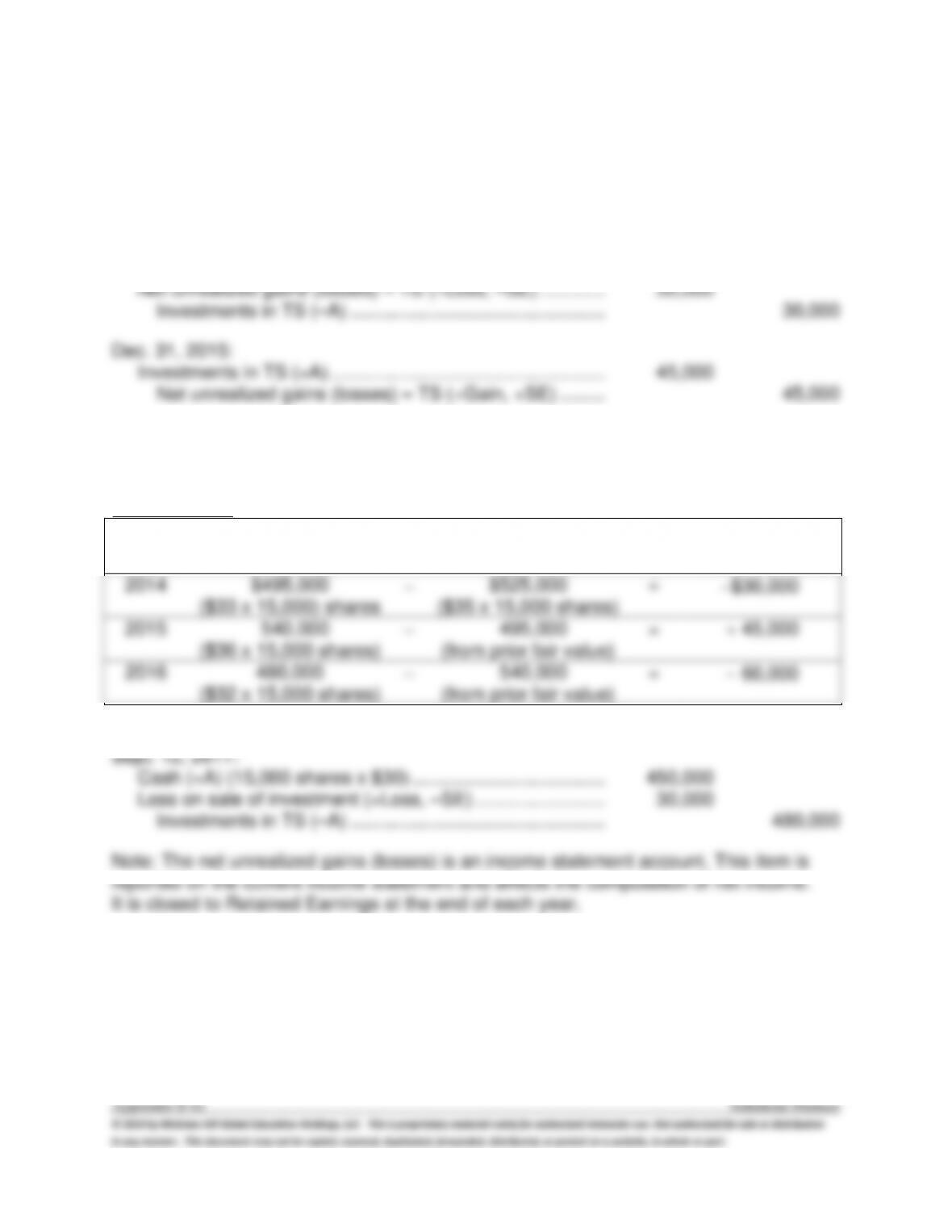
Computations:
Year
Fair Value
−
Book Value before
Adjustment
=
Amount for
Adjusting Entry
2014
$495,000
($33 x 15,000) shares
−
$525,000
($35 x 15,000 shares)
=
−$30,000
2015
540,000
($36 x 15,000 shares)
−
495,000
(from prior fair value)
=
+ 45,000
2016
480,000
($32 x 15,000 shares)
−
540,000
(from prior fair value)
=
− 60,000
Balance in Net Unrealized Gains (Losses)
−$45,000
Sept. 12, 2017:
Cash (+A) (15,000 shares x $30) ……………………………….
450,000
Loss on sale of securities (+Loss, –SE) ………………………
75,000
Investments in AFS securities (–A) ………………………….
480,000
Net unrealized gains (losses) (+OCI, +SE) ……………….
45,000
Note: The unrealized gains (losses) account is a balance sheet account. It does not
affect the computation of net income each year. Because it is a balance sheet
account, it maintains its balance from year to year. Therefore, the decline in stock
price that occurs in 2014 and 2016 is reported as an adjustment to the net unrealized
EE–6.
March 10, 2014:
Investments in TS (+A) ……………………………………………..
525,000
Cash (–A) ……………………………………………………………
525,000
(15,000 shares x $35 per share)
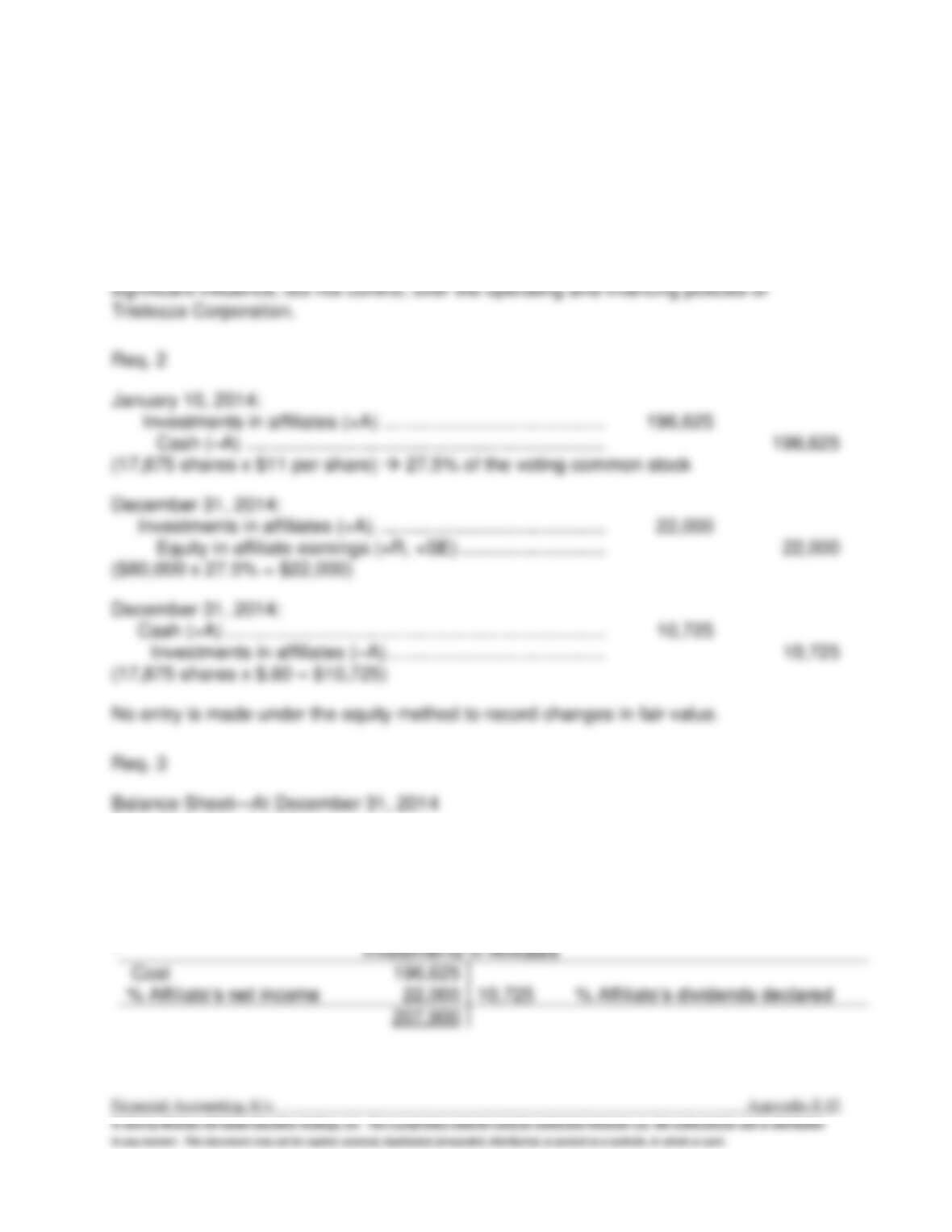
Dec. 31, 2014:
Net unrealized gains (losses) – TS (+Loss, –SE) ………….
30,000
Investments in TS (–A) ………………………………………….
30,000
Net unrealized gains (losses) – TS (+Gain, +SE) ………
45,000
Net unrealized gains (losses) – TS (+Loss, –SE) ………….
60,000
Investments in TS (–A) ………………………………………….
60,000
Cash (+A) (15,000 shares x $30) ……………………………….
450,000
Loss on sale of investment (+Loss, –SE) …………………….
Investments in TS (–A) ………………………………………….
480,000
EE–7.
Req. 1
The equity method must be used because the company owns 27.5% (17,875 ÷
65,000) of the total shares outstanding of Tristezza Corporation. The equity method
must be used when there is at least 20% but not more than 50% ownership in
existence. The Gioia Company must use the equity method because it can exercise
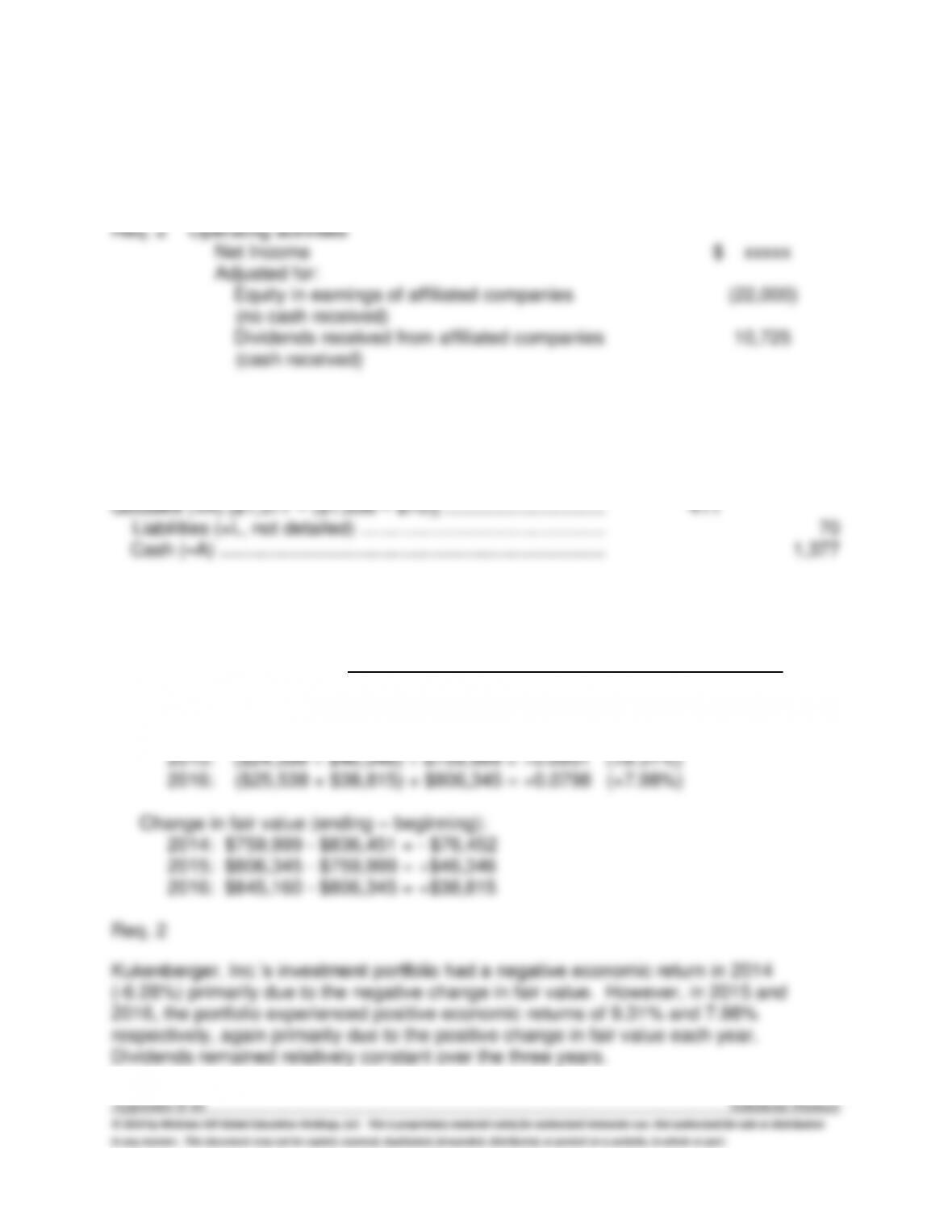
EE–8.
Req. 1 Investing activities
Purchase of investments in affiliated companies (196,625)
EE–9.
(in millions)
Assets (+A, not detailed). ………………………………………………
1,036
Goodwill (+A) [$1,377 – ($1,036 – $70)] ………………………….
411
Liabilities (+L, not detailed) ………………………………………..
70
Cash (–A) ………………………………………………………………..
1,377
EE–10.
Req. 1
Economic Return = Dividends Received + Change in Fair Value*
from Investing Beginning Fair Value of Investment Portfolio
2014: ($23,906 – $76,452) ÷ $836,451 = -0.0628 (-6.28%)
EE–11 (Supplement A)
Req. 1
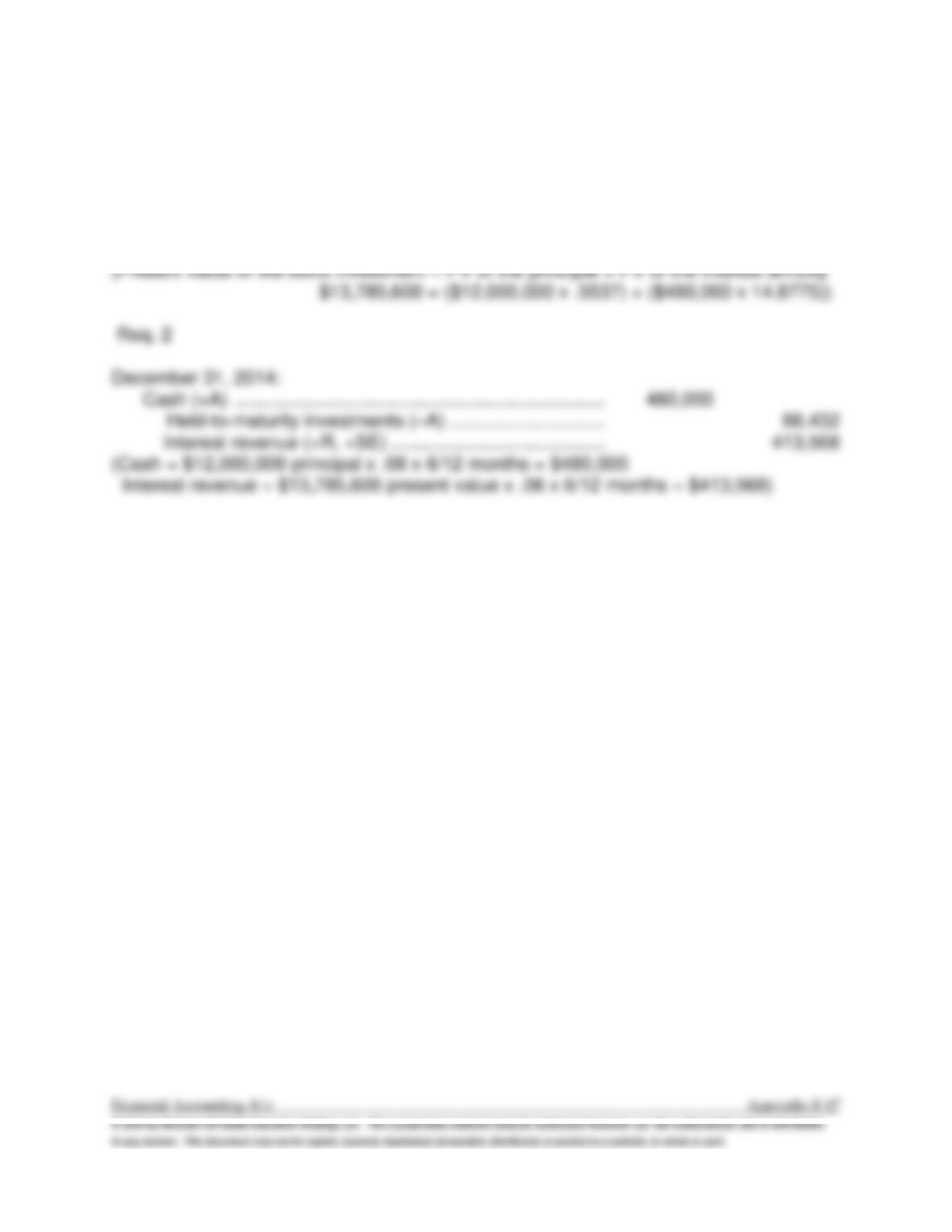
July 1, 2014:
Held-to-maturity investments (+A) ……………………………..
13,785,600
Cash (–A) ………………………………………………………….
13,785,600
(Present value of the bond investment = PV of the principal + PV of the interest annuity
$13,785,600 = ($12,000,000 x .5537) + ($480,000 x 14.8775))
Req. 2
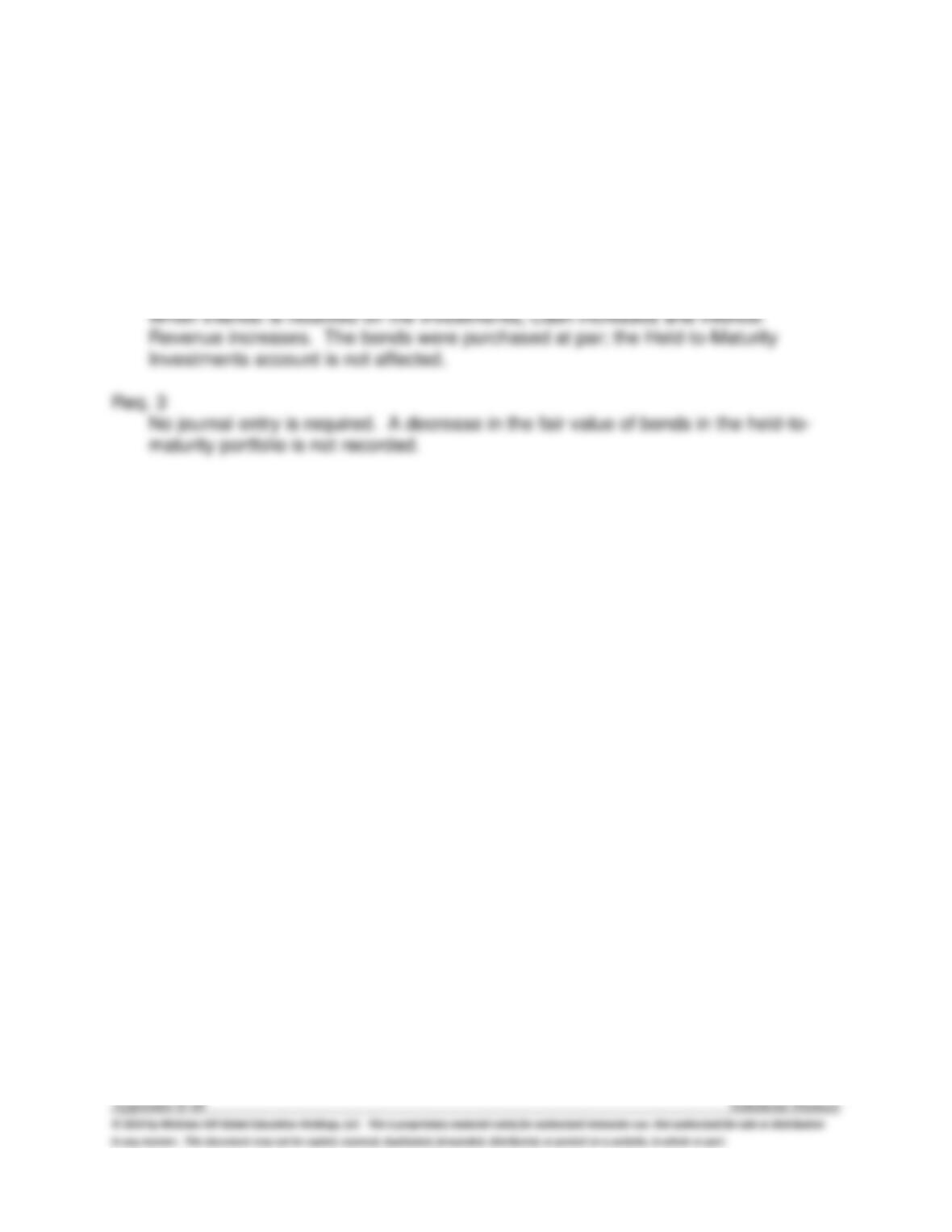
December 31, 2014:
Cash (+A) ……………………………………………………………..
480,000
Held-to-maturity investments (–A) …………………………
66,432
Interest revenue (+R, +SE) …………………………………..
413,568
(Cash = $12,000,000 principal x .08 x 6/12 months = $480,000
Interest revenue = $13,785,600 present value x .06 x 6/12 months = $413,568)
PROBLEMS
PE–1.
Req. 1
When the bonds are purchased, the company increases Held-to-Maturity
Investments and decreases Cash.
Req. 2
Financial Accounting, 8/e Appendix E-19
PE–2.
Req. 1
March 1, 2014
Investments in TS (+A) (20,000 shares x $10 per share) .
200,000
Cash (–A) ……………………………………………………………
200,000
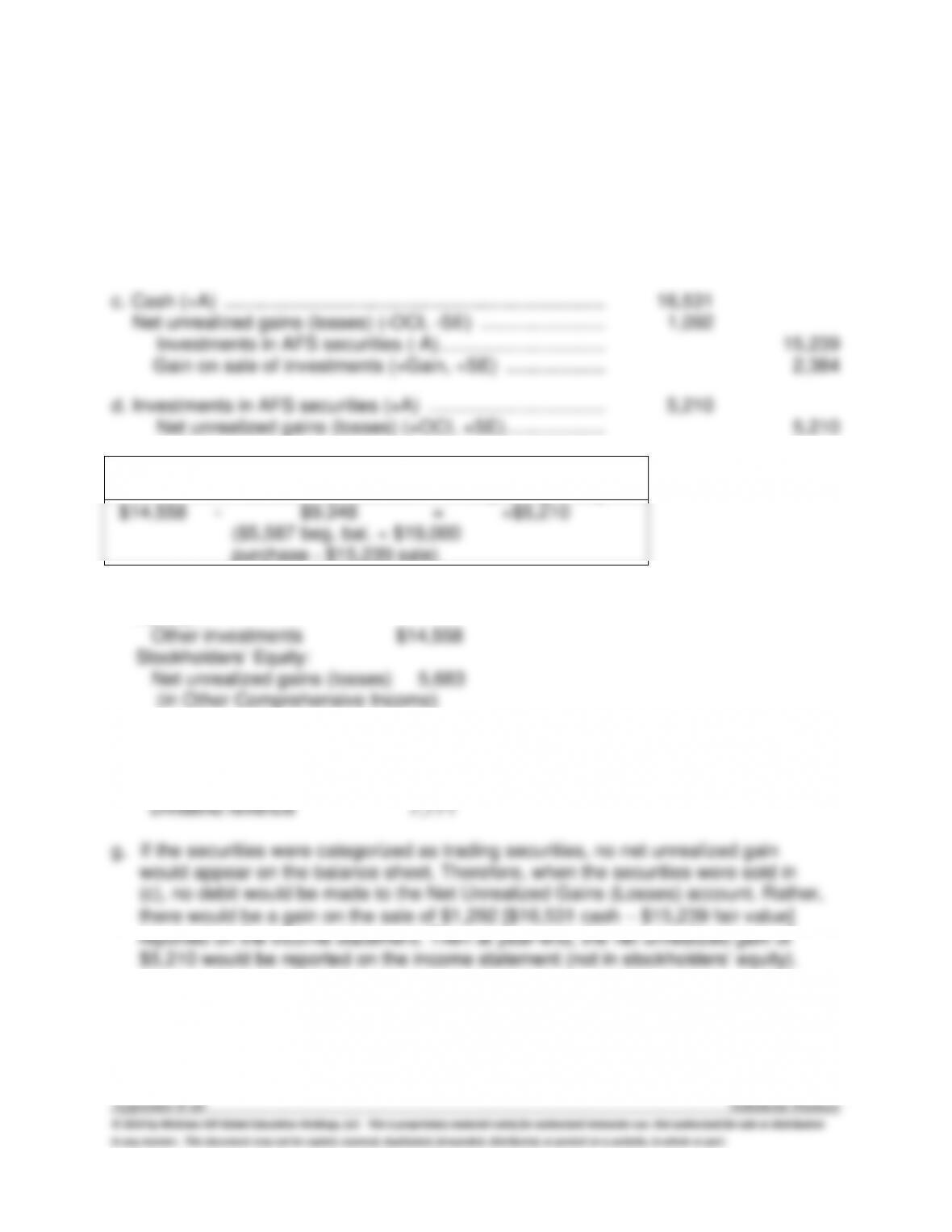
Dec. 31, 2014
Net unrealized gains (losses) (+Loss, –SE) …………………
40,000
Investments in TS (–A) ………………………………………….
40,000
Investments in TS (+A) ……………………………………………..
120,000
Net unrealized gains (losses) (+Gain, +SE) ……………….
120,000
Investments in TS (+A) ……………………………………………..
60,000
Net unrealized gains (losses) (+Gain, +SE) ……………….
60,000
Req. 2
March 1, 2014
Investments in AFS securities (+A) …………………………….
200,000
Cash (–A) ……………………………………………………………
200,000
Net unrealized gains (losses) (–OCI, –SE) …………………..
40,000
Investments in AFS securities (–A) ………………………….
40,000
Investments in AFS securities (+A) …………………………….
120,000
Net unrealized gains (losses) (+OCI, +SE) ………………..
120,000
Dec. 31, 2016
Investments in AFS securities (+A) …………………………….
60,000
Net unrealized gains (losses) (+OCI, +SE) ………………..
60,000
Computations:
Year
Fair Value
−
Book Value before
Adjustment
=
Amount for
Adjusting Entry
2014
$160,000
($8 x 20,000) shares
−
$200,000
($10 x 20,000 shares)
=
−$40,000
2015
280,000
($14 x 20,000 shares)
−
160,000
(from prior fair value)
=
+ 120,000
2016
340,000
($17 x 20,000 shares)
−
280,000
(from prior fair value)
=
+ 60,000
Balance in Net Unrealized Gains (Losses) for AFS Securities
+$140,000
PE–3.
a. Investments in AFS securities (+A) …………………………….
19,000
Cash (–A) ……………………………………………………………
19,000
b. Cash (+A) ……………………………………………………………….
7,771
Dividend revenue (+R, +SE) …………………………………..
7,771
c. Cash (+A) ……………………………………………………………….
16,531
Net unrealized gains (losses) (-OCI, –SE) ……………………
1,092
Investments in AFS securities (-A) …………………………..
15,239
Gain on sale of investments (+Gain, +SE) ……………….
2,384
d. Investments in AFS securities (+A) …………………………….
5,210
Net unrealized gains (losses) (+OCI, +SE) ……………….
5,210
Fair
Book Value
Amount of
Value
–
Before Adjustment
=
Adjusting Entry
$14,558
–
$9,348
=
+$5,210
($5,587 beg. bal. + $19,000
purchase – $15,239 sale)
e. Balance Sheet
Assets:
f. Income Statement
Other Items:
Gain on sale of investments $ 2,384