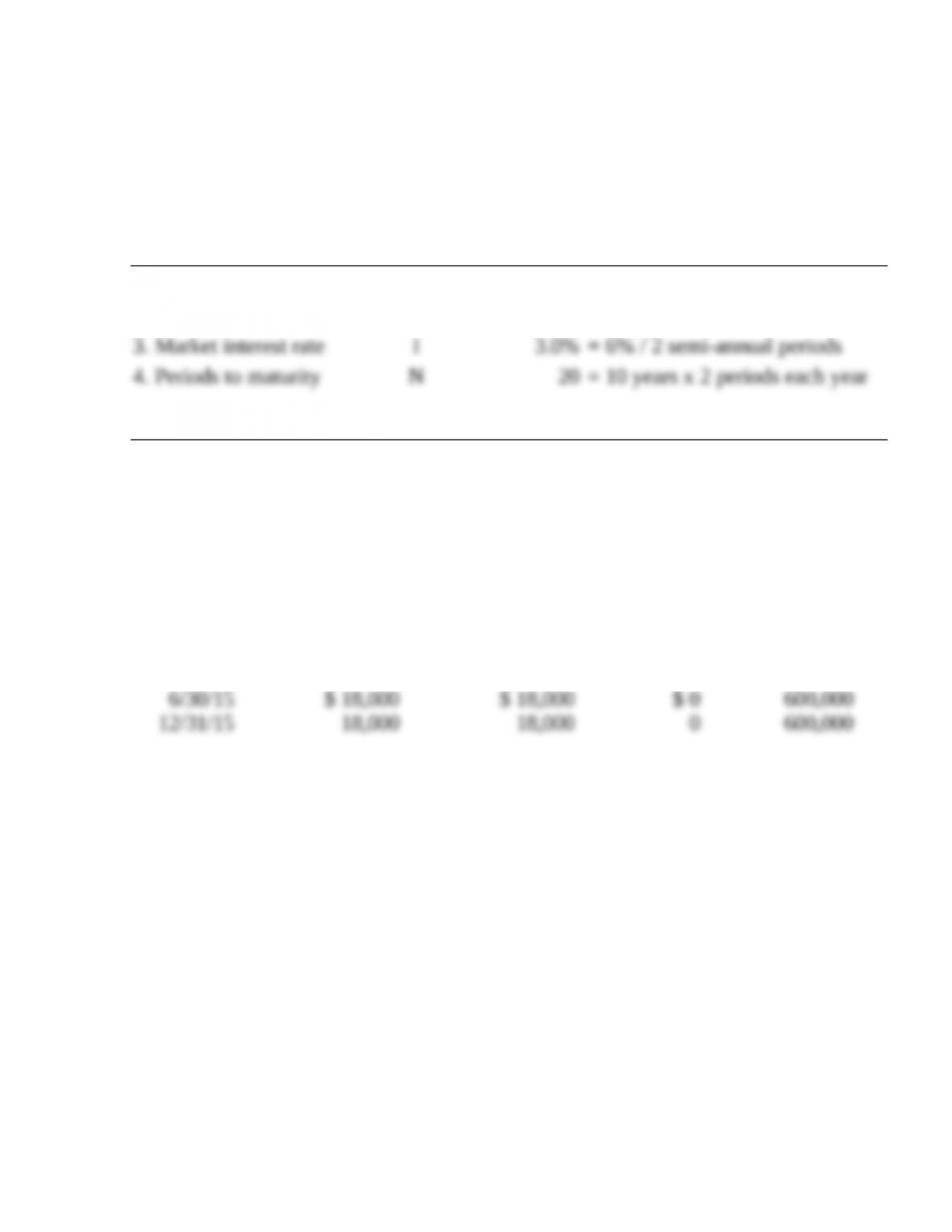
Requirement 1
Face amount. The issue price is $600,000.
Calculator Input
Bond
Characteristics Key Amount
1. Face amount FV $600,000
2. Interest payment PMT $18,000 = $600,000 x 6% x ½ year
Calculator Output
Issue price PV $600,000
(1)
Date
(2)
Cash
Paid
(3)
Interest
Expense
(4)
Increase in
Carrying
Value
(5)
Carrying
Value
Face Amount
x Stated Rate
Carrying Value
x Market Rate (3) – (2)
Prior Carrying
Value + (4)
1/ 1 /15 $ 600,000
Problem 9-1C
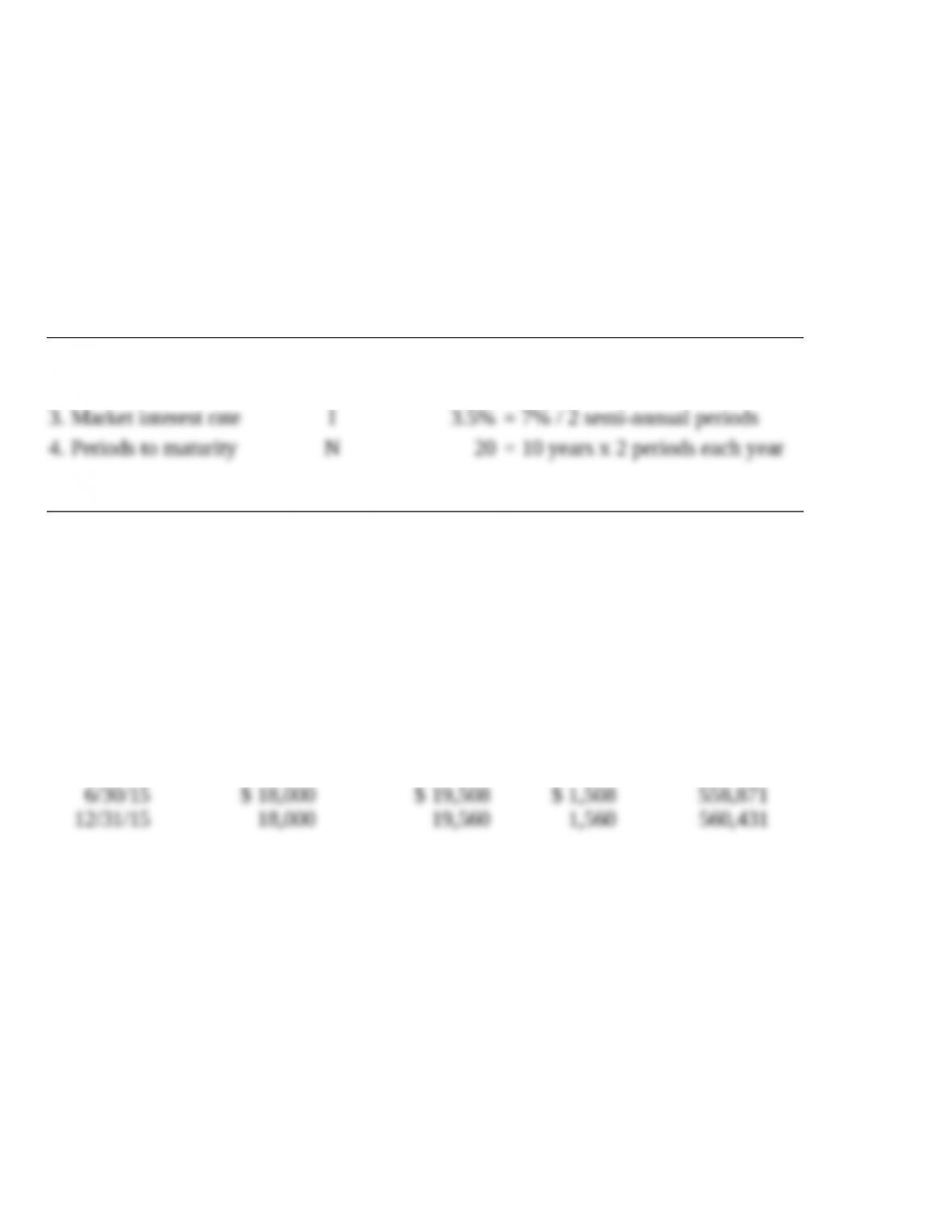
Requirement 2
Discount. The issue price is $557,363.
Calculator Input
Bond
Characteristics Key Amount
1. Face amount FV $600,000
2. Interest payment PMT $18,000 = $600,000 x 6% x ½ year
Calculator Output
Issue price PV $557,363
(1)
Date
(2)
Cash
Paid
(3)
Interest
Expense
(4)
Increase in
Carrying
Value
(5)
Carrying
Value
Face Amount
x Stated Rate
Carrying Value
x Market Rate (3) – (2)
Prior Carrying
Value + (4)
1/ 1 /15 $ 557,363
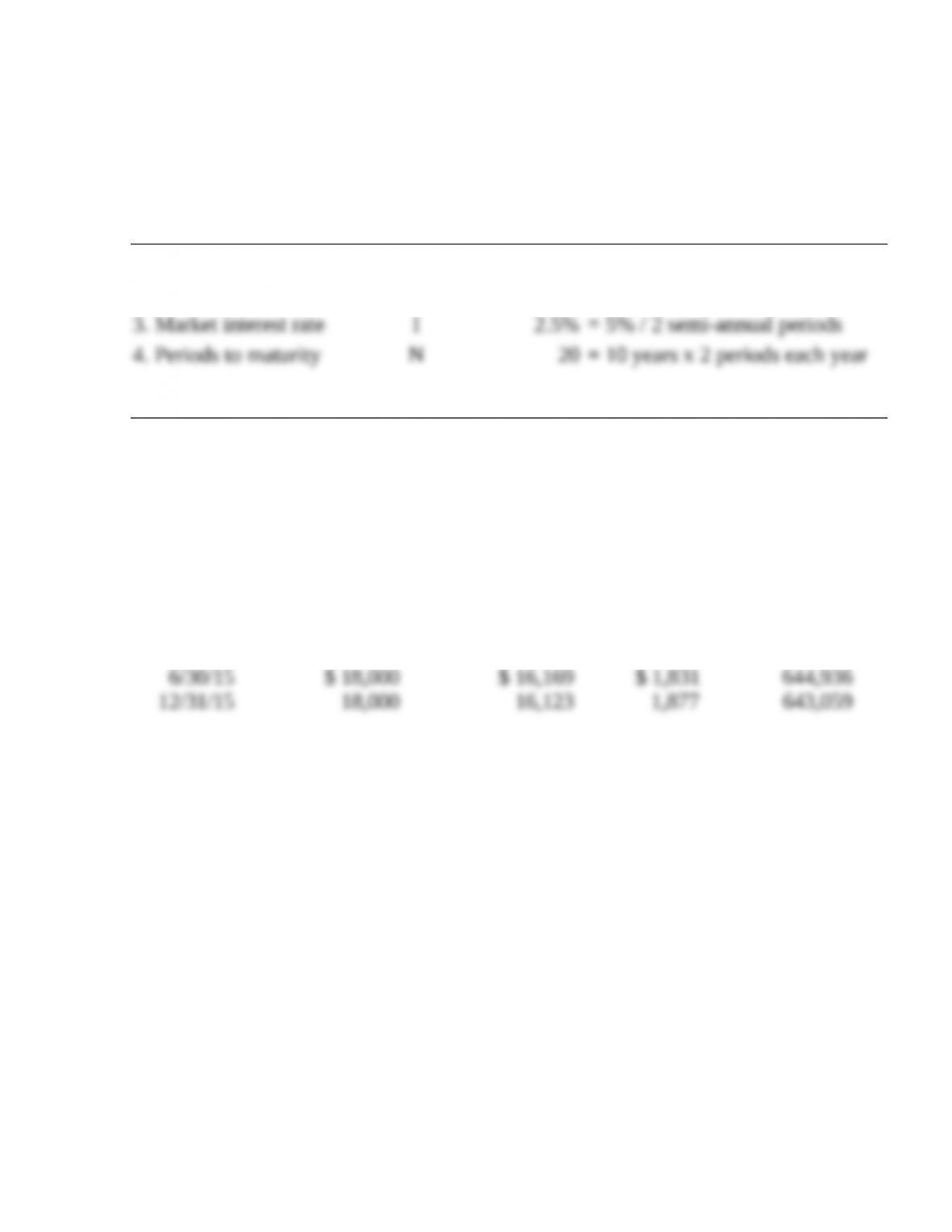
Requirement 3
Premium. The issue price is $646,767.
Calculator Input
Bond
Characteristics Key Amount
1. Face amount FV $600,000
2. Interest payment PMT $18,000 = $600,000 x 6% x ½ year
Calculator Output
Issue price PV $646,767
(1)
Date
(2)
Cash
Paid
(3)
Interest
Expense
(4)
Decrease in
Carrying
Value
(5)
Carrying
Value
Face Amount
x Stated Rate
Carrying Value
x Market Rate (2) – (3)
Prior Carrying
Value – (4)
1/ 1 /15 $ 646,767
Problem 9-2C
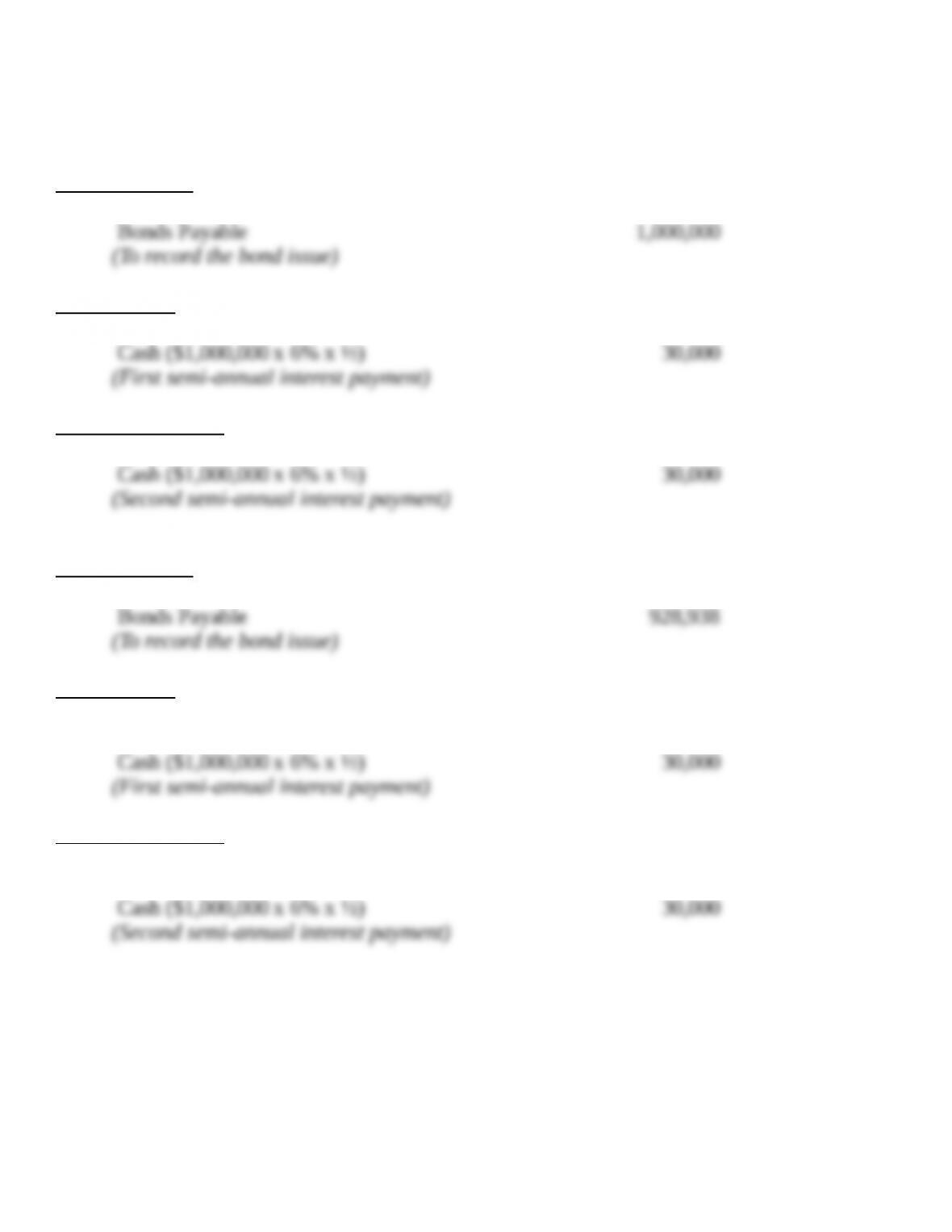
Requirement 1
January 1, 2015
Cash 1,000,000
June 30, 2015
Interest Expense 30,000
December 31, 2015
Interest Expense 30,000
Requirement 2
January 1, 2015
Cash 928,938
June 30, 2015
Interest Expense ($928,938 x 7% x ½) 32,513
Bonds Payable (difference) 2,513
December 31, 2015
Interest Expense ([$928,938+2,513] x 7% x ½) 32,601
Bonds Payable (difference) 2,601
Requirement 3
January 1, 2015
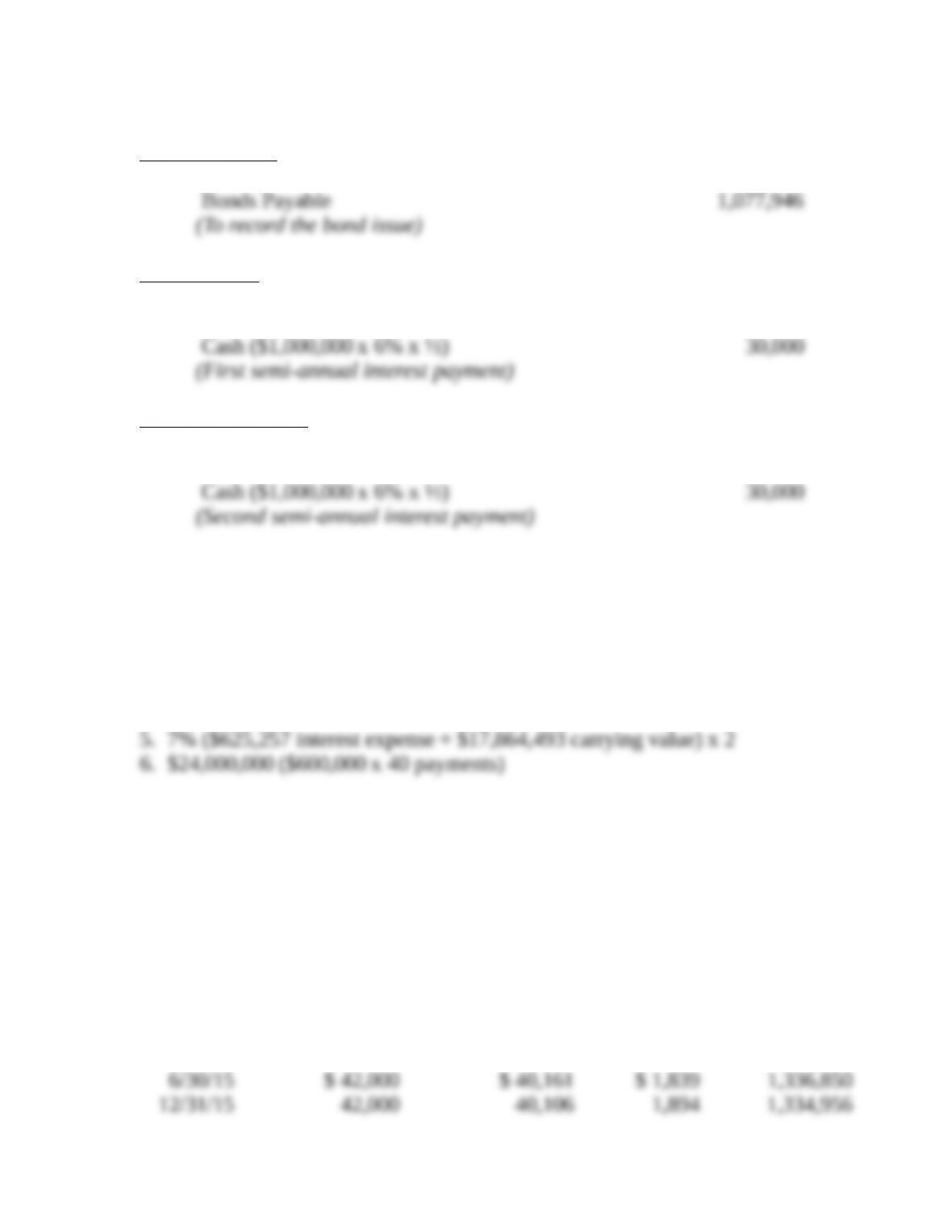
Cash 1,077,946
June 30, 2015
Interest Expense ($1,077,946 x 5% x ½) 26,949
Bonds Payable (difference) 3,051
December 31, 2015
Interest Expense ([$1,077,946-$3,051] x 5% x ½) 76,872
Bonds Payable (difference) 3,128
Problem 9-3C
1. Discount
2. $17,864,493
3. $20,000,000
4. 6% ($600,000 cash paid ÷ $20,000,000 face value) x 2
Problem 9-4C
Requirement 1
(1)
Date
(2)
Cash
Paid
(3)
Interest
Expense
(4)
Decrease in
Carrying
Value
(5)
Carrying
Value
Face Amount
x Stated Rate
Carrying Value
x Market Rate (2) – (3)
Prior Carrying
Value – (4)
1/ 1 /15 $ 1,338,689
Requirement 2
January 1, 2015
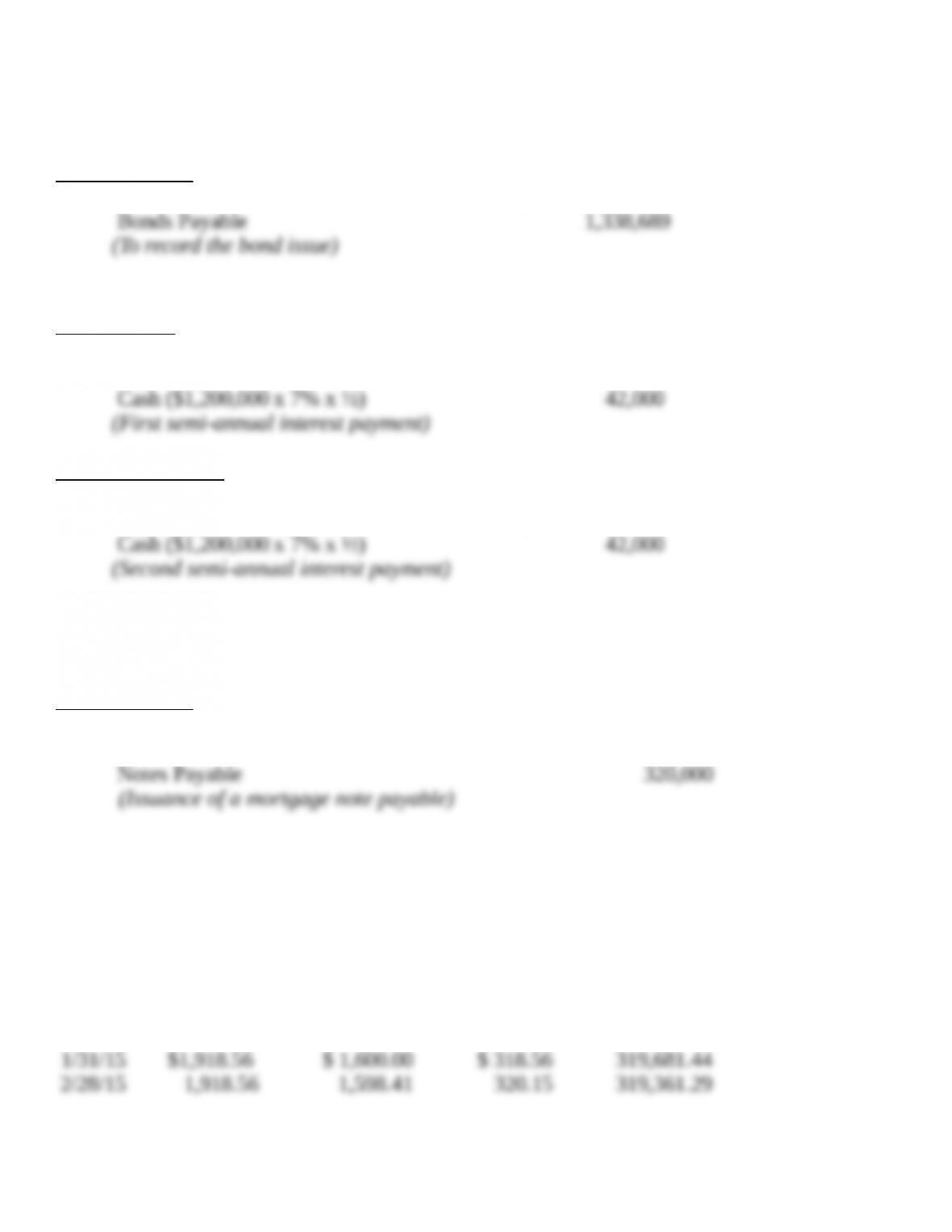
Cash 1,338,689
Requirement 3
June 30, 2015
Interest Expense ($1,338,689 x 6% x ½) 40,161
Bonds Payable (difference) 1,839
December 31, 2015
Interest Expense ($1,336,850 x 6% x ½) 40,106
Bonds Payable (difference) 1,894
Problem 9-5C
January 1, 2015
Buildings 400,000
Cash 80,000
(1)
Date
(2)
Cash
Paid
(3)
Interest
Expense
(4)
Decrease in
Carrying
Value
(5)
Carrying
Value
Carrying Value
x .06 x 1/12 (2) – (3)
Prior Carrying
Value – (4)
1/1/15 $ 320,000.00
Requirement 1
Requirement 2
Requirement 3
January 31, 2015
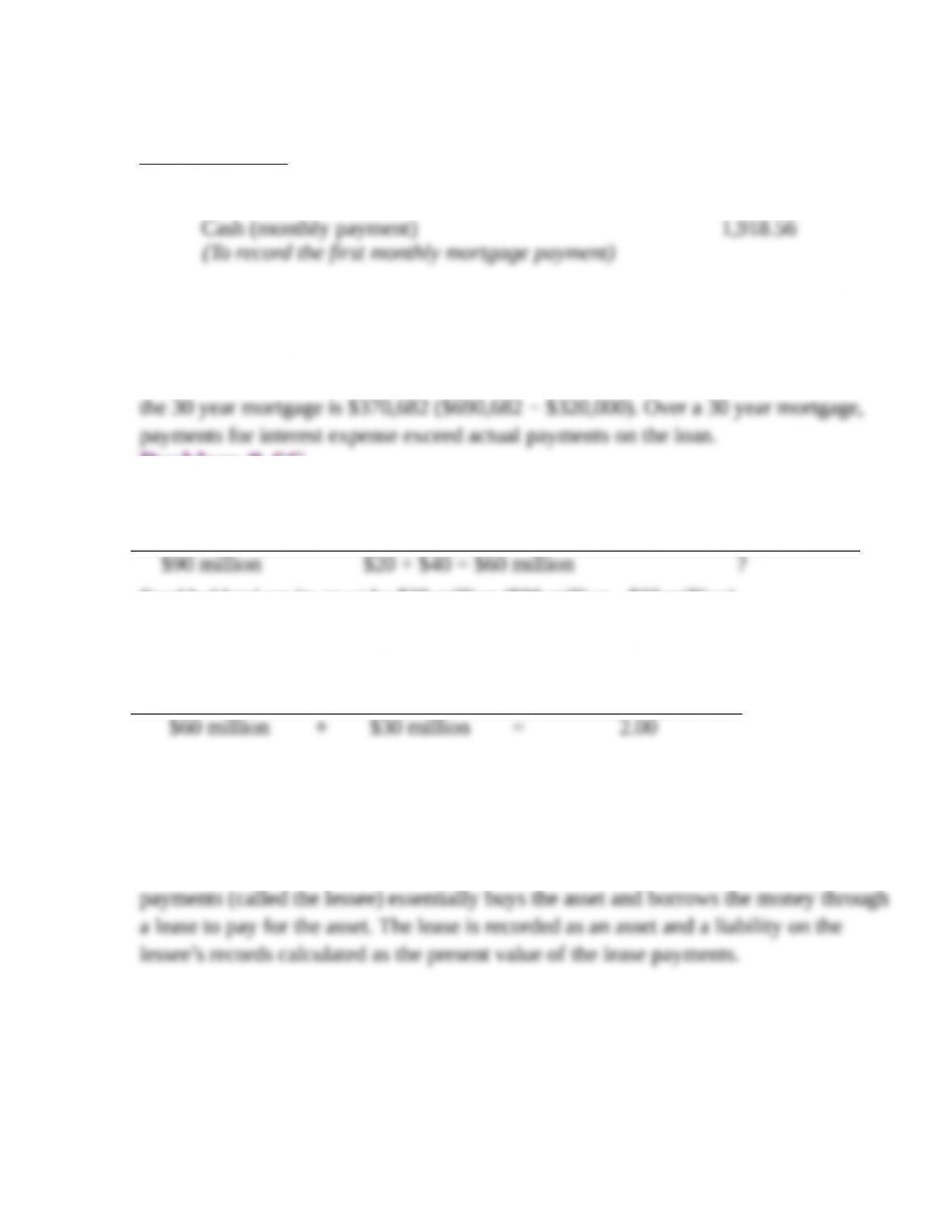
Interest Expense ($320,000 x 6% x 1/12) 1,600.00
Notes Payable (difference) 318.56
Requirement 4
Problem 9-6C
Requirement 1
Assets = Liabilities +
Stockholders’
Equity
Stockholders’ equity must be $30 million ($90 million – $60 million).
Requirement 2
Total
Liabilities ÷
Stockholders’
Equity = Debt to Equity Ratio
Requirement 3
An operating lease is like a rental. Over the lease term, the company making the lease
payments records rent expense and the company receiving the rent payments records
rent revenue. A capital lease is different. In a capital lease, the company making lease
Requirement 4
In the first monthly payment, $1,600.00 goes to interest expense and only $318.56
goes to reducing the carrying value of the loan.
The actual payments on the loan are $320,000. Therefore, total interest expense over
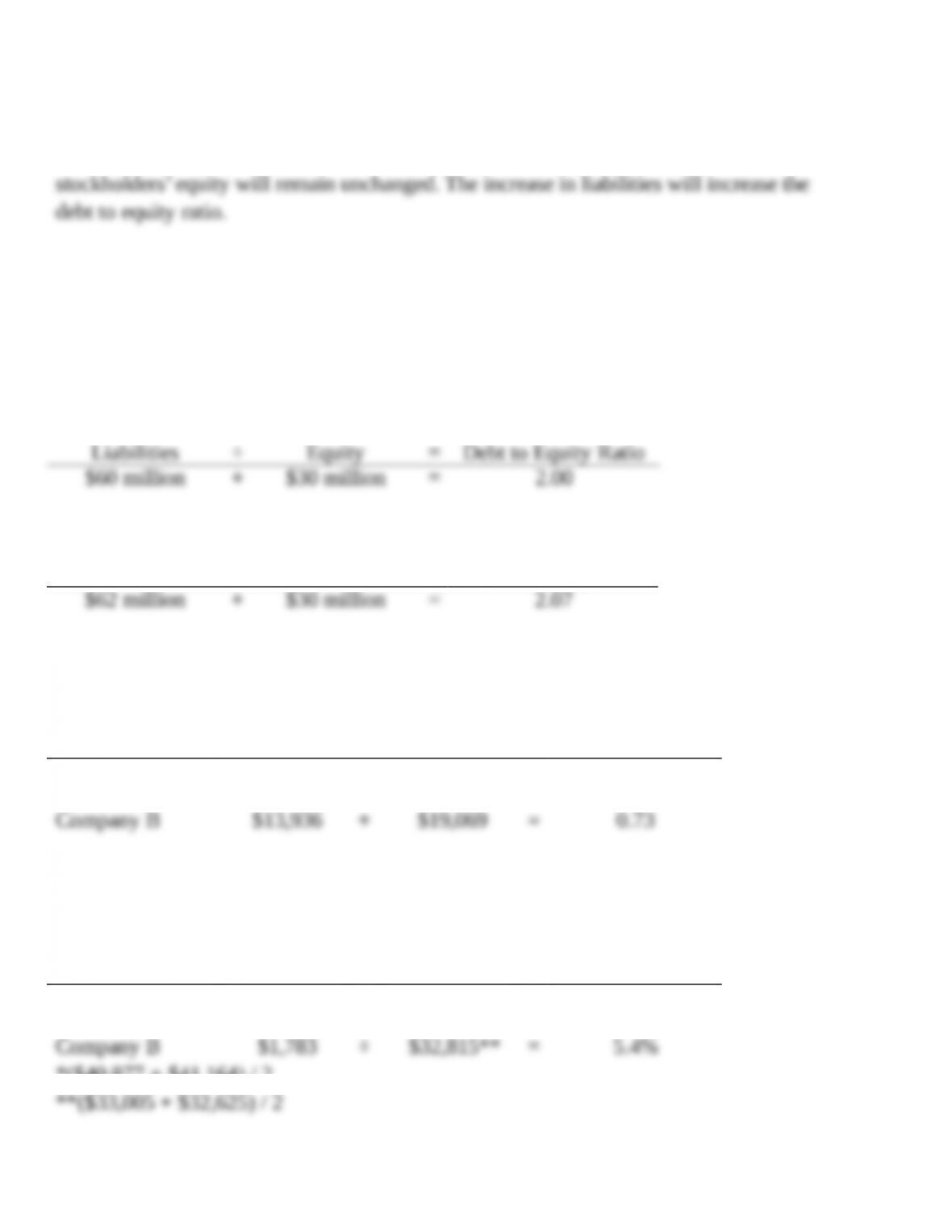
Yes. The debt to equity ratio will not be affected under an operating lease. However,
under a capital lease, assets and liabilities will both increase $2 million while
Requirement 5
The debt to equity ratio will not be in violation (exceed 2.0) under an operating lease,
but will be in violation (exceed 2.0) under a capital lease. Therefore, Super Slides has
a strong incentive to structure the lease agreement as an operating lease.
Operating lease
Total
Stockholders’
Capital lease
Total
Liabilities ÷
Stockholders’
Equity = Debt to Equity Ratio
Problem 9-7C
Requirement 1
($ in millions)
Total
Liabilities ÷
Stockholders’
Equity =
Debt to Equity
Ratio
Company A $21,484 ÷ $19,393 = 1.11
Company A has a higher debt to equity ratio than Company B.
Requirement 2
($ in millions)
Net
Income ÷
Average Total
Assets =
Return on Assets
Ratio
Company A $2,661 ÷$41,021* = 6.5%
*($40,877 + $41,164) / 2
($ in millions)
Net
Income
÷
Average
Stockholders’
Equity
= Return on Equity
Ratio
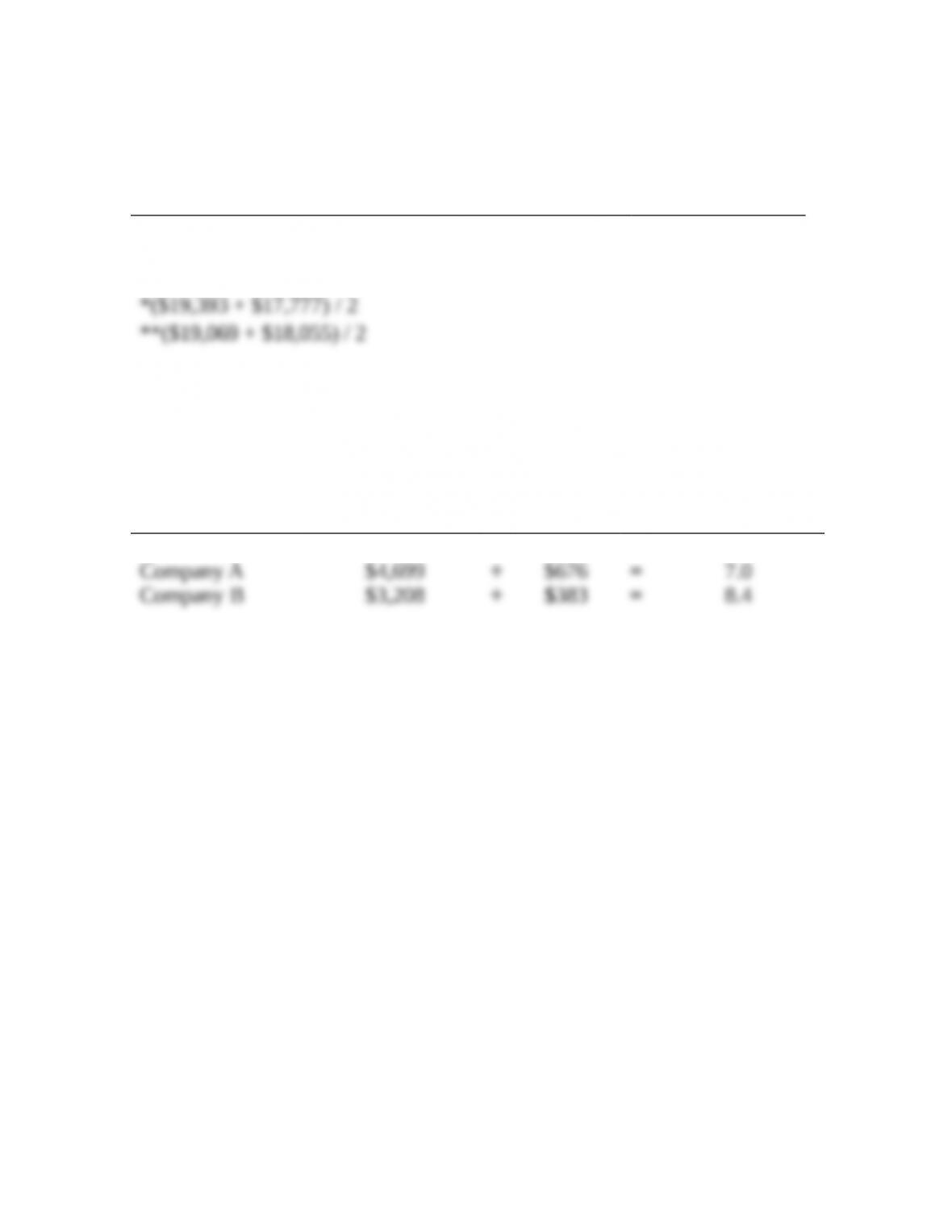
Company A $2,661 ÷$18,585* = 14.3%
Company B $1,783 ÷ $18,562** = 9.6%
Company A has better profitability ratios than Company B.
Requirement 3
($ in millions)
Net Income +
Interest + Taxes ÷ Interest =
Times Interest
Earned Ratio
Company B, with a times interest earned ratio of 8.4, is better able to meet interest
payments as they become due than Company A with a ratio of 7.0.