Question 8-1
Liabilities have three essential characteristics. Liabilities are: (1) probable future sacrifices of
economic benefits; (2) arising from present obligations to other entities; (3) resulting from past
Question 8-2
In most cases, current liabilities are payable within one year and long-term liabilities are
payable more than one year from now. Current liabilities are usually, but not always, due within
Question 8-3
Distinguishing between current and long-term liabilities is important in helping investors and
creditors assess the riskiness of a business’ obligations. Given a choice, most companies would
Question 8-4
Current liabilities common to the airline industry include payroll liabilities, unearned revenue
Question 8-5
The accrual basis requires expenses to be recorded when incurred. The cash basis requires
expenses to be recorded when the cash is paid. Financial accounting requires use of the accrual
Question 8-6
A line of credit is an informal agreement that permits a company to borrow up to a
prearranged limit without having to follow formal loan procedures and paperwork. The line of
answers to Questions (continued)
Question 8-7
If a company borrows from another company rather than from a bank, the note is referred to
as commercial paper. The interest rate is often lower for commercial paper than a bank loan as
Chapter 8
Current LiabilitiesQUESTIONS
Question 8-8
Four items commonly withheld from employee payroll checks include (1) federal and state
income taxes, (2) Social Security and Medicare, (3) health, dental, disability, and life insurance
Question 8-9
Four common employer costs in addition to the employee’s salary include (1) federal and
state unemployment taxes, (2) the employer portion of Social Security and Medicare, (3)
Question 8-10
Both the employer and the employee pay equal portions of social security taxes. Employers
withhold from employee paychecks a 6.2% Social Security tax up to a maximum base amount
and a 1.45% Medicare tax with no maximum. Therefore, the total FICA tax is 7.65% (6.2% +
Question 8-11
When a company receives cash in advance through the sale of gift cards, it debits cash and
Question 8-12
(a) When Business Week sells magazine subscriptions, they debit cash and credit unearned
answers to Questions (continued)
Question 8-13
The sales tax rate for Hollister is 6.5% calculated as $325 in sales taxes divided by sales of
Question 8-14
Dell will include $10 million as a current note payable and the remaining $120 million as
Question 8-15
A contingent liability is an existing, uncertain situation that might result in a loss. Examples
Question 8-16
The likelihood of the loss occurring can be probable, reasonably possible, or remote.
Question 8-17
A loss contingency is recorded only if a loss is probable and the amount can be reasonably
Question 8-18
If the likelihood of loss is reasonably possible rather than probable, we record no entry but
Question 8-19
If one amount within a range of potential losses appears more likely than other amounts
answers to Questions (continued)
Question 8-20
In a pending lawsuit, one side—the defendant—faces a loss contingency, while the other side
—the plaintiff—has a gain contingency. The $2 million is a gain contingency and the outcome,
Question 8-21
Liquidity measures the ability of a company to pay current liabilities as they come due.
Question 8-22
Working capital is simply the difference between current assets and current liabilities. The
current ratio is calculated by dividing current assets by current liabilities. The acid-test ratio is
similar to the current ratio but is based on a more conservative measure of current assets
Question 8-23
(a) The purchase of inventory with cash would have no effect on the current ratio as one
current asset (inventory) would increase while another current asset (cash) would
decrease. The purchase of inventory with cash would decrease the acid-test ratio due
to the decrease in cash. (b) The sale of inventory for more than its cost would increase
BRIEF Exercises
Brief Exercise 8-1
November 1 Debit Credit
Cash 4,000,000
December 31
Interest Expense (4,000,000 x .06 x 2/12) 40,000
Brief Exercise 8-2
November 1 Debit Credit
Notes Receivable 4,000,000
December 31
Interest Receivable 40,000
Brief Exercise 8-3
Interest
Expense =Face
value XAnnual
interest rate XFraction
of the year
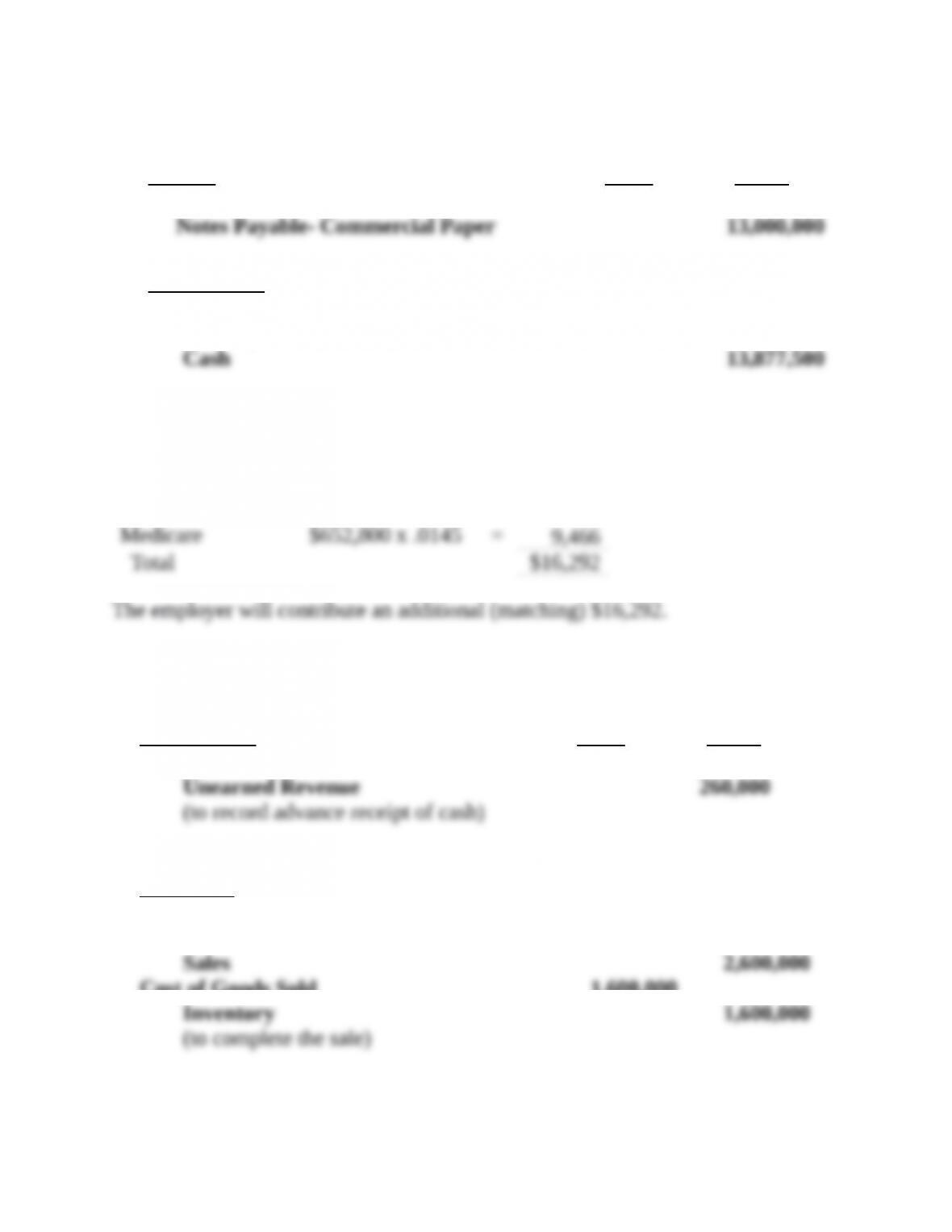
Brief Exercise 8-4
April 1 Debit Credit
Cash 13,000,000
December 31
Notes Payable- Commercial Paper 13,000,000
Interest Expense ($13,000,000 x .09 x 9/12) 877,500
Brief Exercise 8-5
Total withheld for:
Social Security $110,100 x .062 = 6,826
Brief Exercise 8-6
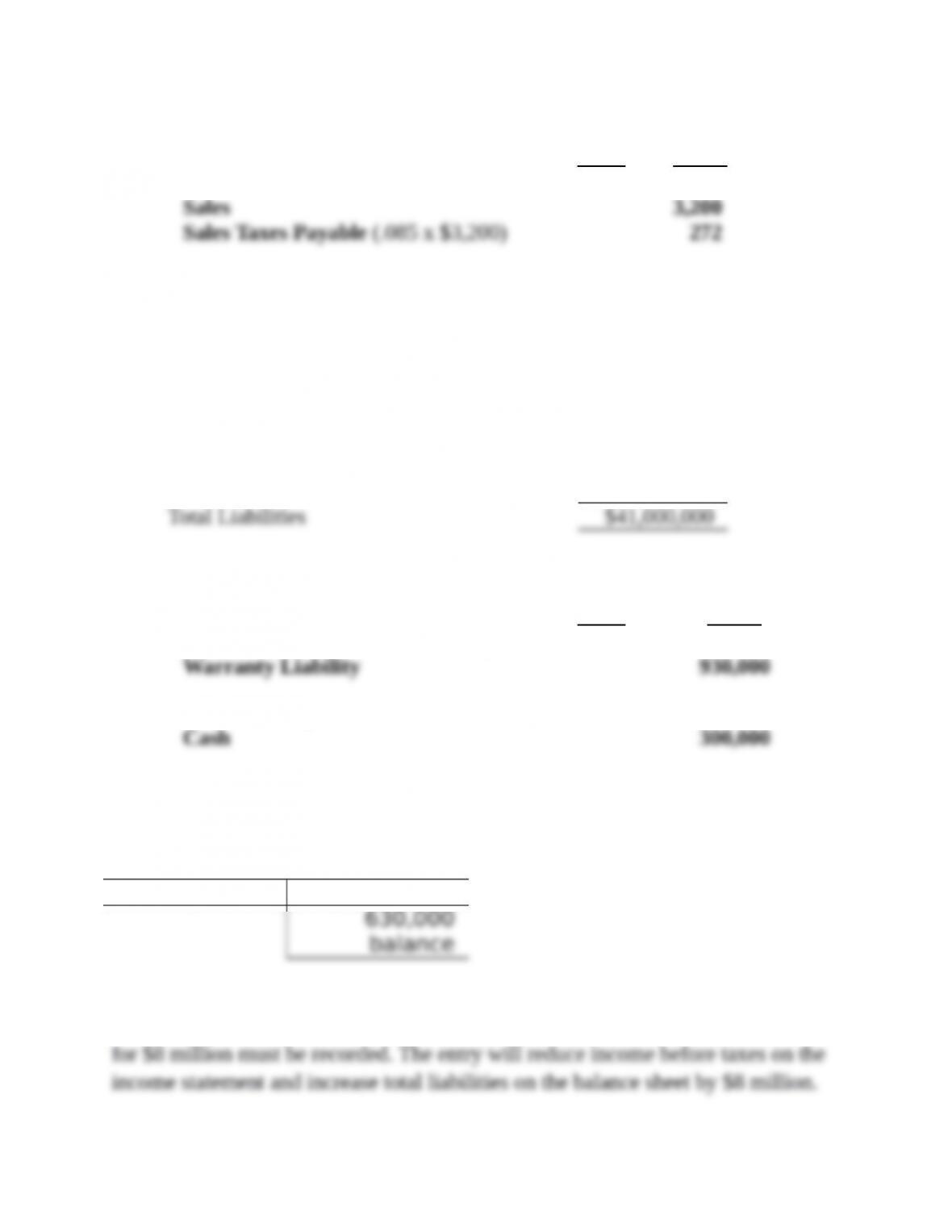
December 18 Debit Credit
Cash 260,000
January 23
Cash 2,340,000
Unearned Revenue 260,000
Cost of Goods Sold 1,600,000
Brief Exercise 8-7
Debit Credit
Accounts Receivable 3,472
Brief Exercise 8-8
Southwest Airlines
Partial Balance Sheet
December 31, 2015
Current Liabilities:
Current portion of long-term debt $ 10,000,000
Long-Term Liabilities:
Notes payable $31,000,000
Brief Exercise 8-9
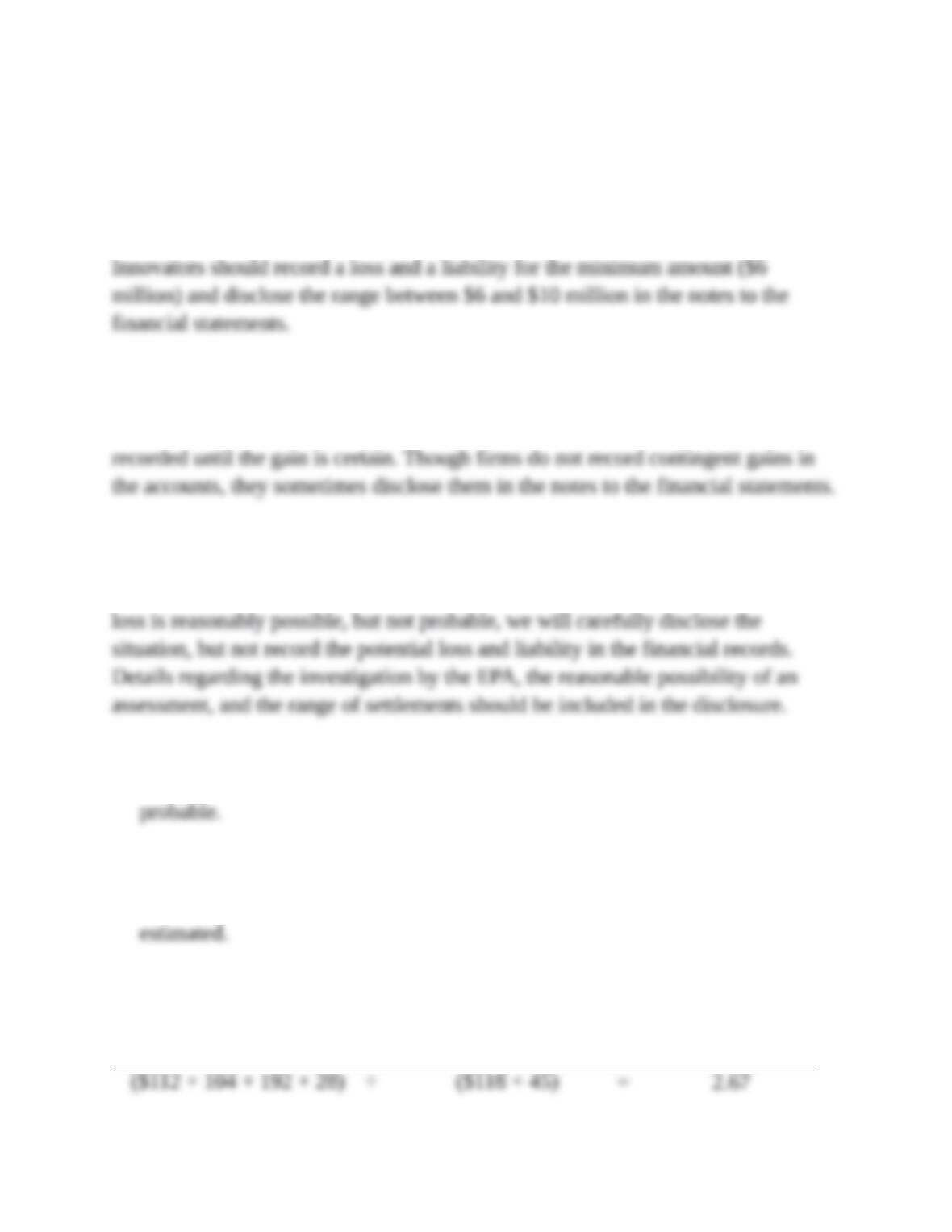
Debit Credit
Warranty Expense ($31,000,000 x 3%) 930,000
Warranty Liability 300,000
The Warranty Liability at the end of the year is $630,000, calculated using a
T-account as follows:
Warranty Liability
300,000 930,000
Brief Exercise 8-10
The loss contingency is probable and reasonably estimable, so a loss and a liability
Brief Exercise 8-11
Electronic Innovators has a contingent liability that is probable and can be
reasonably estimated within a range between $6 and $10 million. Electronic
Brief Exercise 8-12
Aviation Systems has a contingent gain that is probable and can be reasonably
estimated within a range between $6 and $10 million. Contingent gains are not
Brief Exercise 8-13
Northwest Forest Products has a contingent liability that is reasonably possible and
can be reasonably estimated within a range between $20 and $30 million. Since the
Brief Exercise 8-14
(1) Not recorded (disclosure only) as the loss is reasonably possible, but not
(2) Not recorded (disclosure only) as the loss cannot be reasonably estimated.
(3) Recorded because the warranty costs are probable and can be reasonably
Brief Exercise 8-15
Current Assets ÷ Current Liabilities = Current Ratio
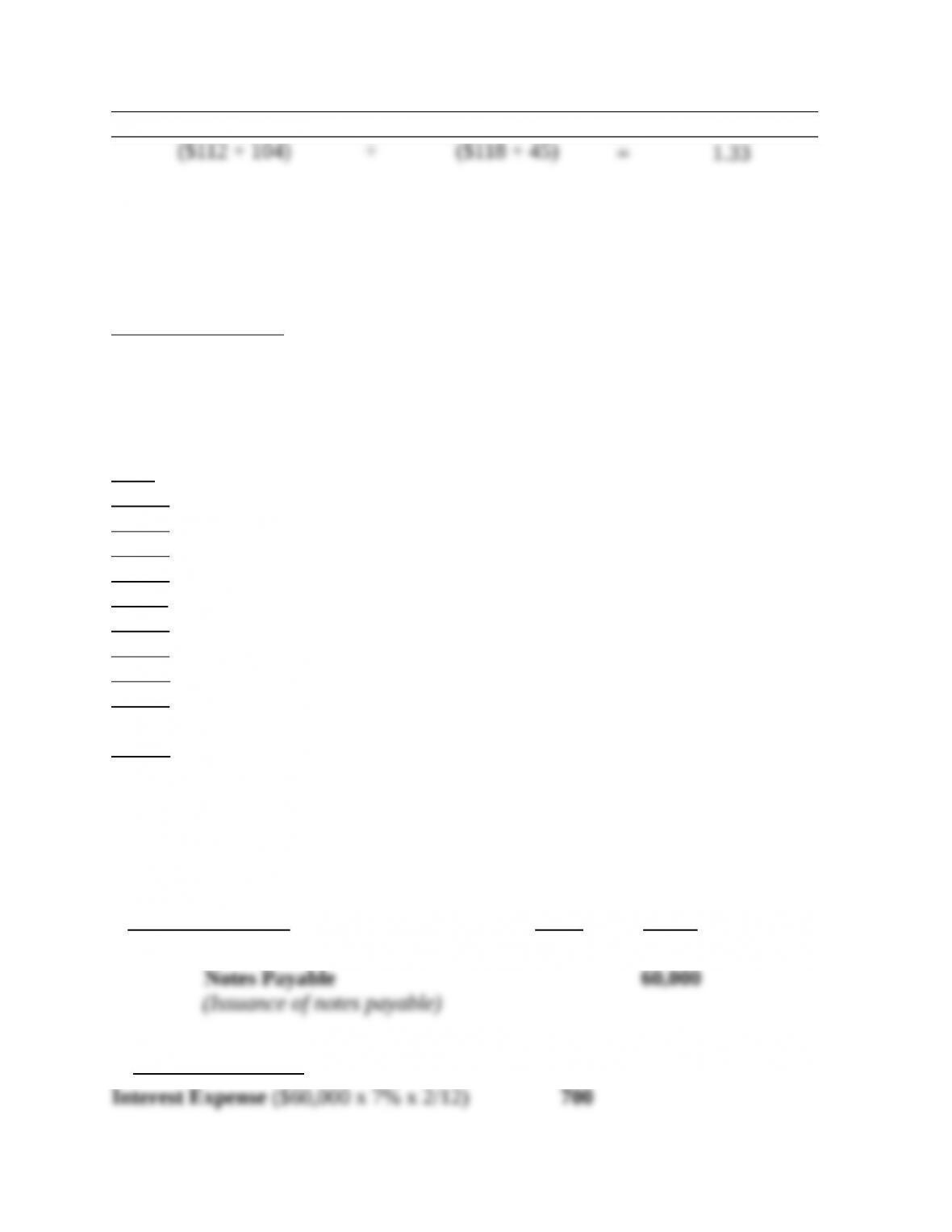
Quick Assets ÷ Current Liabilities = Acid-Test Ratio
Exercise 8-1
Reporting Method
C. Current liability
L. Long-term liability
D. Disclosure note only
N. Not reported
Item
__C__ 1. Accounts payable.
__C__ 2. Current portion of long-term debt.
__C__ 3. Sales tax collected from customers.
__C__ 4. Notes payable due next year.
__L__ 5. Notes payable due in two years.
__C__ 6. Customer advances.
__C__ 7. Commercial paper.
__D__ 8. Unused line of credit.
__C__ 9. A loss contingency that is probable of occurring within
the next year and can be estimated.
__D__ 10. A loss contingency that is reasonably possible of
occurring within the next year and can be estimated.
Exercise 8-2
1. November 1, 2015 Debit Credit
Cash 60,000
2. December 31, 2015
EXERCISES
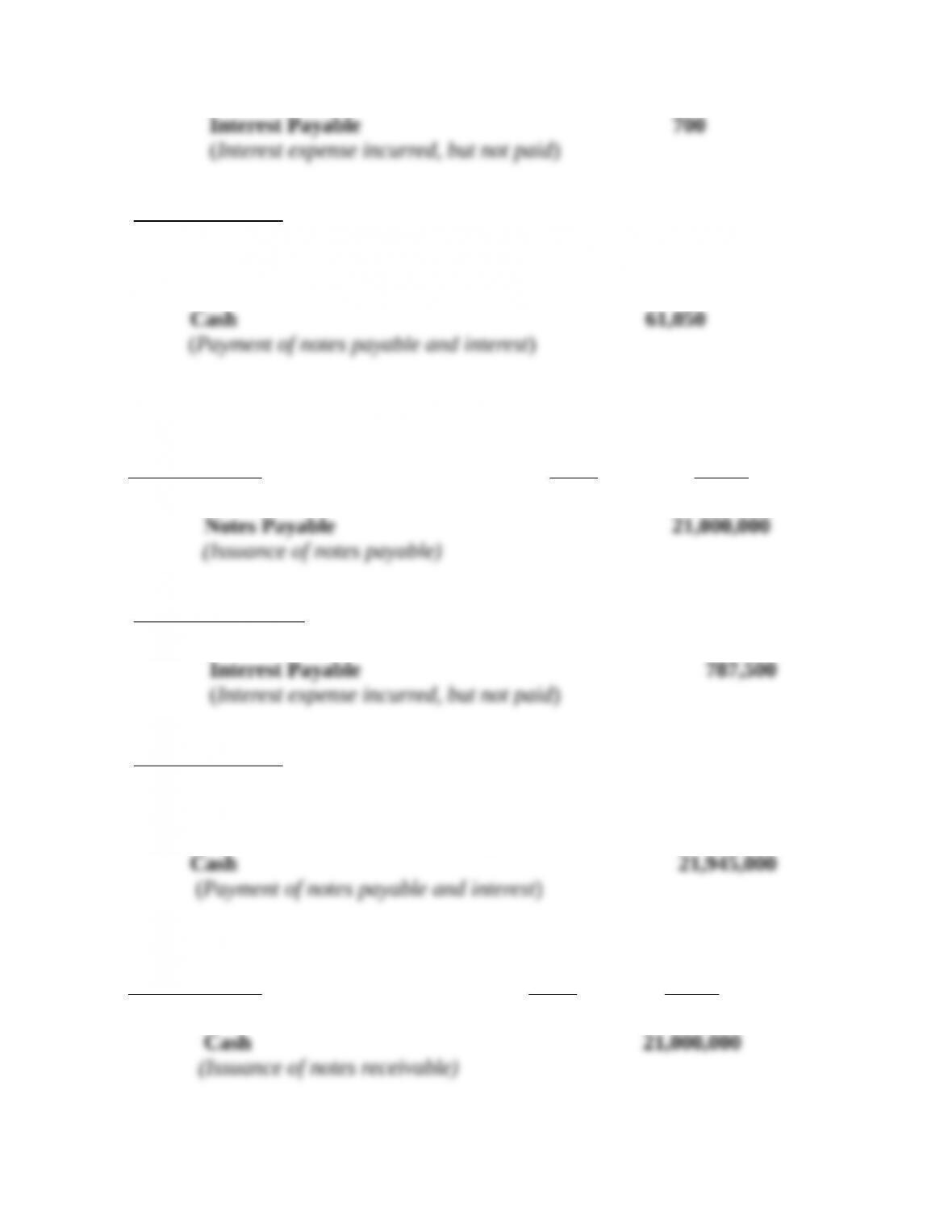
3. January 31, 2016
Notes Payable 60,000
Interest Expense ($60,000 x 7% x 1/12) 350
Interest Payable ($60,000 x 7% x 2/12) 700
Exercise 8-3
1. August 1, 2015 Debit Credit
Cash 21,000,000
2. December 31, 2015
Interest Expense ($21 million x 9% x 5/12) 787,500
3. January 31, 2016
Notes Payable 21,000,000
Interest Expense ($21 million x 9% x 1/12) 157,500
Interest Payable ($21 million x 9% x 5/12) 787,500
Exercise 8-4
1. August 1, 2015 Debit Credit
Notes Receivable 21,000,000
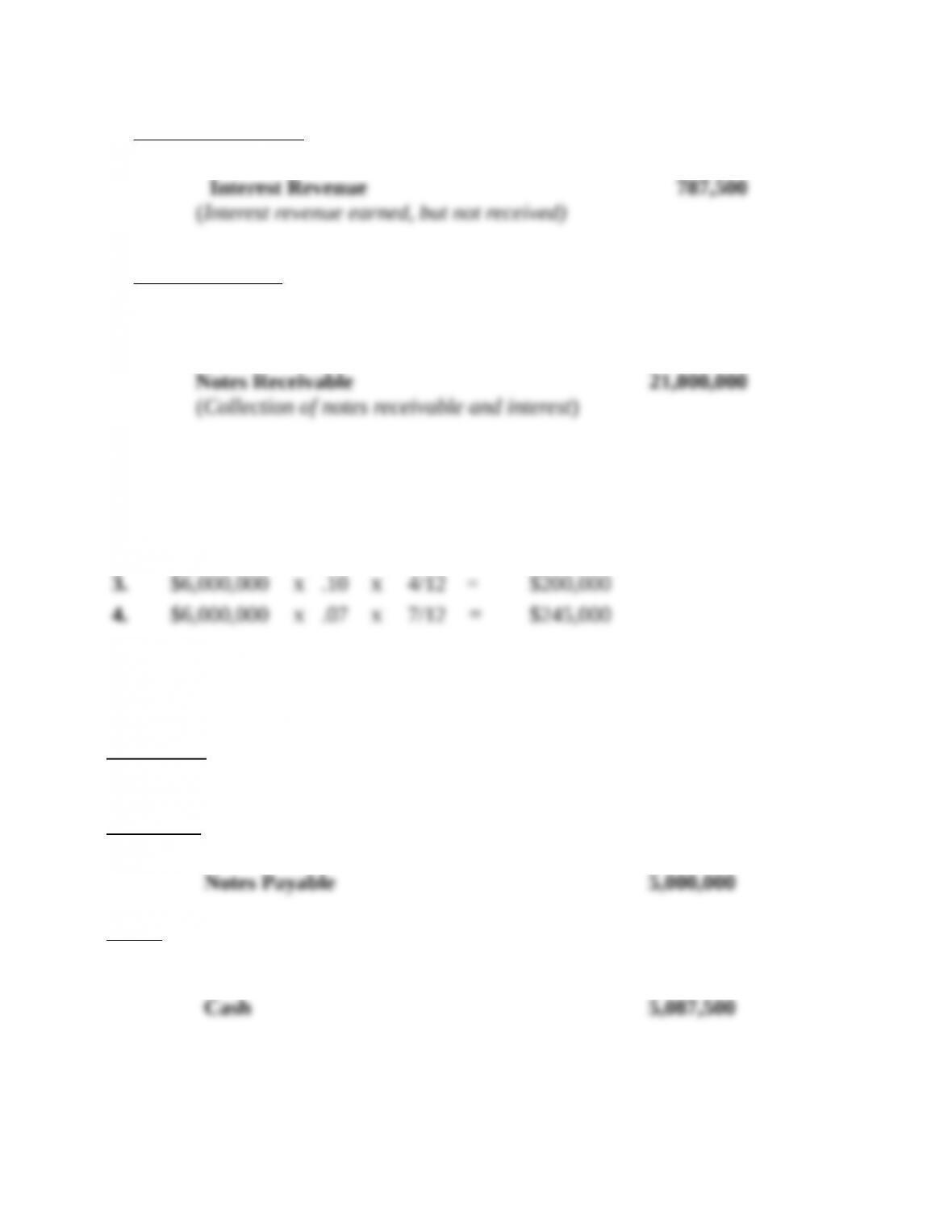
2. December 31, 2015
Interest Receivable ($21 x 9% x 5/12) 787,500
3. January 31, 2016
Cash 21,945,000
Interest Revenue ($21 x 9% x 1/12) 157,500
Interest Receivable ($21 x 9% x 5/12) 787,500
Exercise 8-5
1. $6,000,000 x .11 x 6/12 = $330,000
2. $6,000,000 x .09 x 3/12 = $135,000
Exercise 8-6
January 13
No Entry
February 1
Cash 5,000,000
May 1
Notes Payable 5,000,000
Interest Expense (5,000,000 x .07 x 3/12) 87,500