Exercise 7-4 (LO 7-1, 7-4)
1. Land is not depreciated. However, depreciation on the building is
tax-deductible. If management allocates less of the purchase price to land
2. If the true allocation should have been 20% to land and 80% to building,
then the allocation of 10% to land and 90% to building, for the express
purpose of reducing taxes, is not ethical. Who is harmed? The government
Exercise 7-5 (LO 7-2)
Debit Credit
Legal Fees Expense 9,000
Patents 42,500
Salaries Expense 80,000
Exercise 7-6 (LO 7-2)
(amounts in millions)
Purchase price $30
Less:
Fair value of assets acquired 45
Less: fair value of liabilities assumed (20)
Exercise 7-7 (LO 7-2)
1. Patent costs capitalized
Legal fees for patent application $ 79,000
Legal fees for successful defense 39,000
2. Expense items on income statement
Basic research to develop the technology $3,900,000
Engineering design work 1,180,000
Development of prototype device 590,000
3. Purchased intangible assets are usually capitalized. Internally developed
intangible assets are usually expensed.
Exercise 7-8 (LO 7-2, 7-4)
List A List B
__f_ 1. Depreciation
__e_ 2. Goodwill
__g_ 3. Amortization
__d_ 4. Natural
resources
__a_ 7. Trademark
a. Exclusive right to display a word, a symbol, or an
emblem.
b. Exclusive right to benefit from a creative work.
c. Assets that represent contractual rights.
d. Oil and gas deposits, timber tracts, and mineral
f. The allocation of cost for plant and equipment.
Exercise 7-9 (LO 7-3)
1. Equipment $250,000
2. Building $750,000
3. Repairs and Maintenance Expense $24,000
Exercise 7-10 (LO 7-4)
1. Straight-line
ning-balance
3. Activity-based
Depreciation
Requirement 2
Double-declining-balance
Calculation End-of-Year Amounts
Year
Beginning
Book Value XDepreciation
Rate* =Depreciation
Expense
Accumulated
Depreciation
Book
Value**
1 36,000 0.50 18,000 18,000 18,000
* 2 / 4 years = 0.50 per year
Depreciation
expense
** $36,000 cost minus accumulated depreciation
Requirement 3
Activity-based
Calculation End-of-Year Amounts
Year
Miles
Used XDepreciation
Rate* =Depreciation
Expense
Accumulated
Depreciation
Book
Value**
1 40,000 x $0.20 8,000 8,000 28,000
* ($36,000 – $6,400)/ 148,000 miles = $0.20/mile
Exercise 7-12 (LO 7-4)
Year
Exercise 7-13 (LO 7-4)
Year
2015 ($21,600 – $1,200) = $3,400 x 3/12 = $8506 years
2016 ($21,600 – $1,200) =$3,4006 years
Exercise 7-14 (LO 7-4)
Cost of the equipment $19,000
Less: Accumulated depreciation (Years 1 and 2) (8,000)*
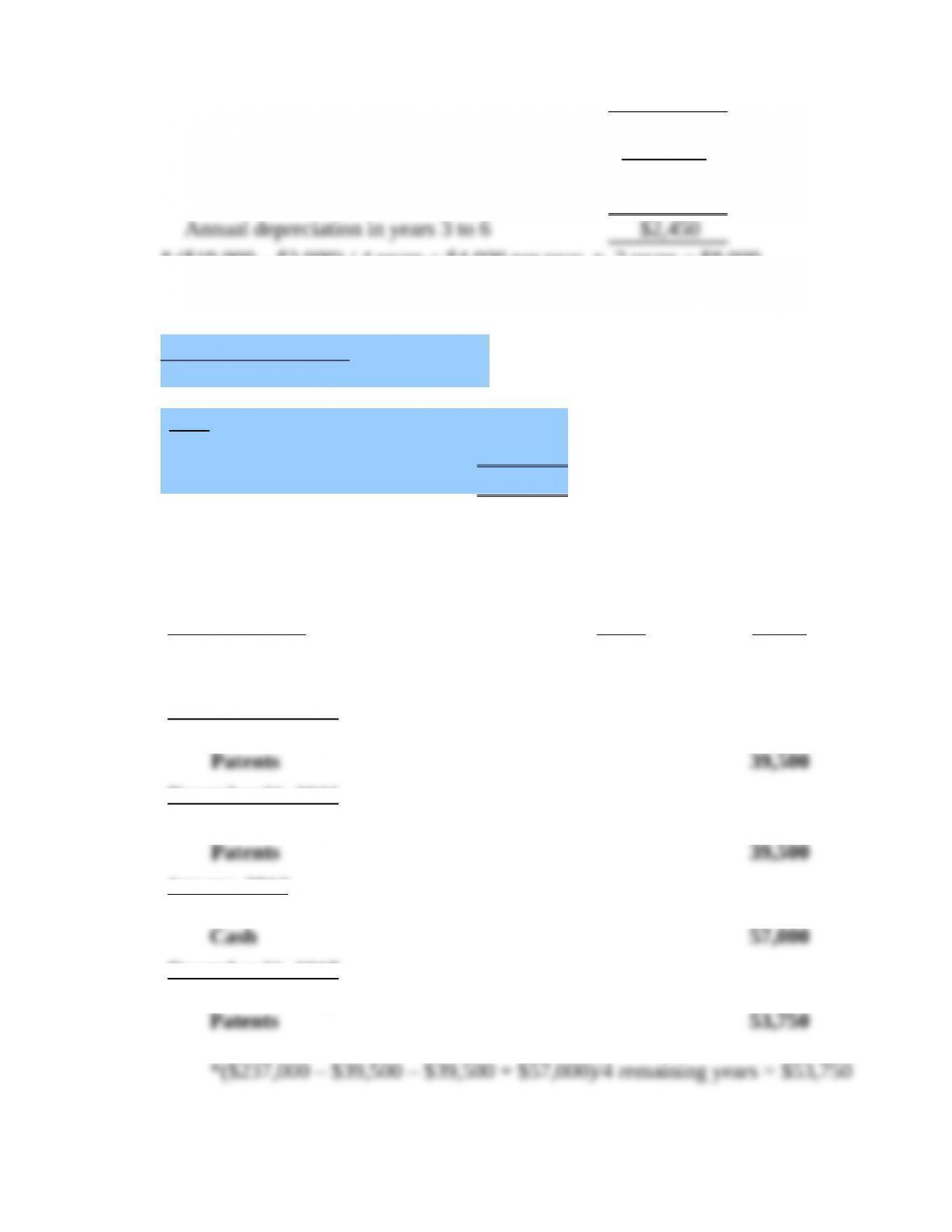
Book value, end of year 2 11,000
Less: New residual value (1,200)
New depreciable cost 9,800
Remaining service life 4
* ($19,000 – $3,000) / 4 years = $4,000 per year x 2 years = $8,000
Exercise 7-15 (LO 7-4)
($21,500 – $2,500) = $0.19/mile
100,000
Year
2015 5,000 miles x $0.19 $ 950
2016 19,000 miles x $0.19 $3,610
Exercise 7-16 (LO 7-5)
Requirement 1
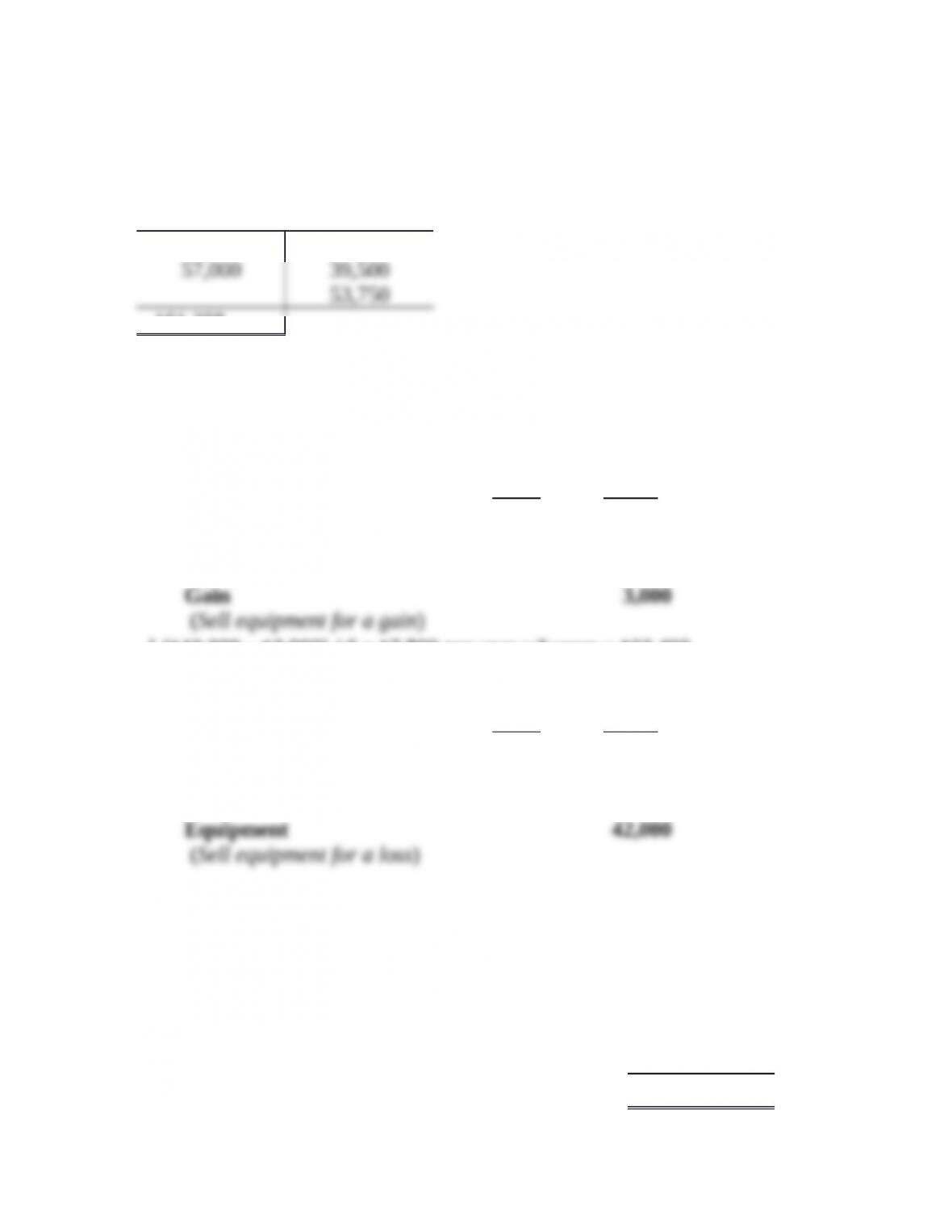
January 1, 2015 Debit Credit
Patents 237,000
Cash 237,000
December 31, 2015
Amortization Expense 39,500
December 31, 2016
Amortization Expense 39,500
January, 2017
Patents 57,000
December 31, 2017
Amortization Expense* 53,750
Requirement 2
Balance in Patent account
Patents
237,000 39,500
161,250
Exercise 7-17 (LO 7-6)
Requirement 1
Debit Credit
Cash 21,600
Accumulated Depreciation 23,400*
Equipment 42,000
* ($42,000 – $3,000) / 5 = $7,800 per year x 3 years = $23,400
Requirement 2
Debit Credit
Cash 13,600
Accumulated Depreciation 23,400
Loss 5,000
Exercise 7-18 (LO 7-6)
Requirement 1
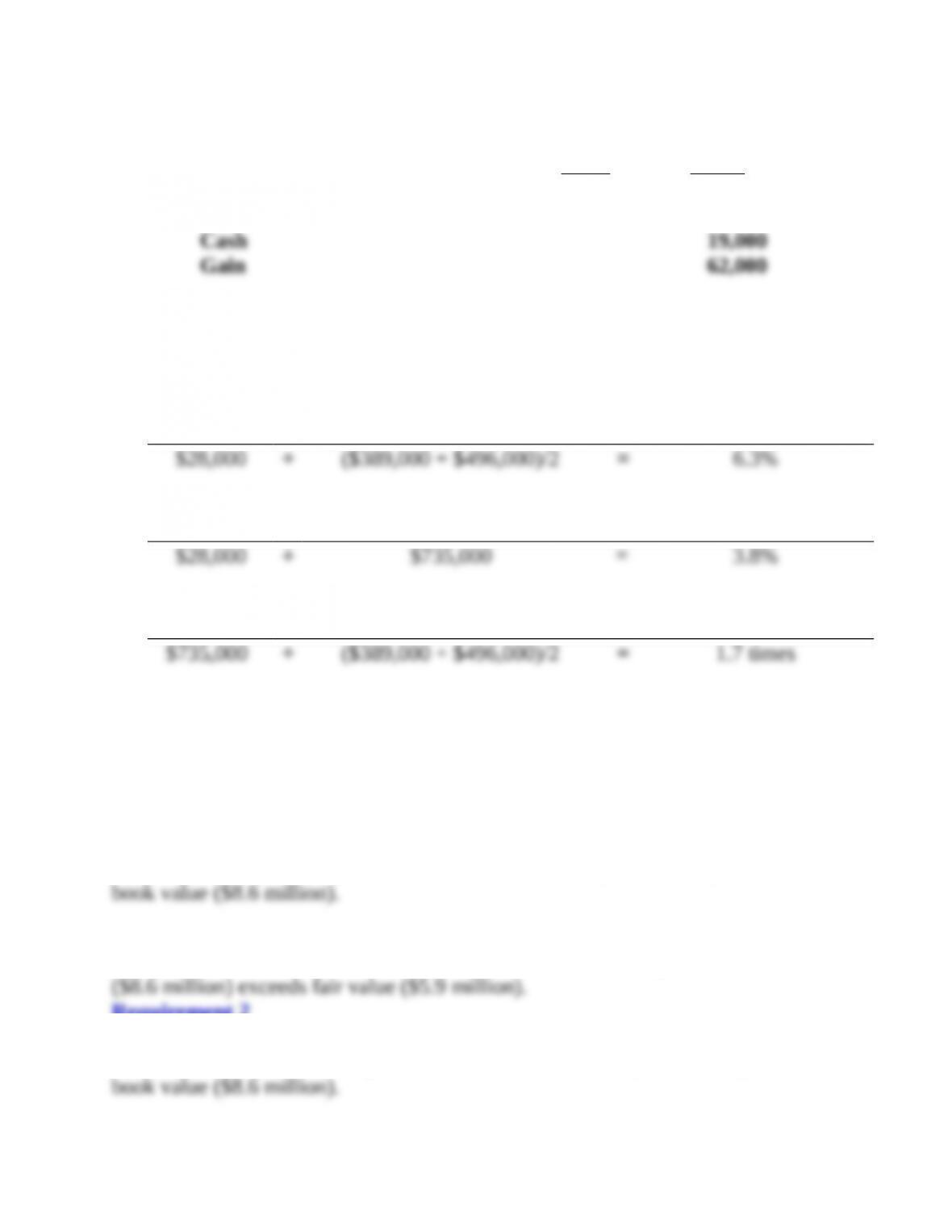
Fair value of the old land $132,000
Cash paid to complete the purchase 19,000
Fair value of the new land $151,000
Requirement 2
Debit Credit
Land, New 151,000
Land, Old 70,000
Exercise 7-19 (LO 7-7)
Net
Income ÷
Average
Total Assets =
Return
on Assets
Net
Income ÷ Sales =
Profit
Margin
Sales ÷
Average
Total Assets =
Asset
Turnover
Exercise 7-20 (LO 7-8)
Requirement 1
Step 1: Test for Impairment
The long-term asset is impaired since future cash flows ($7.1 million) are less than
Step 2: If Impaired, Record Loss
The impairment loss is $2.7 million calculated as the amount by which book value
Requirement 2
Step 1: Test for Impairment
The long-term asset is not impaired since future cash flows ($10 million) exceed
Step 2: If Impaired, Record Loss
Since the asset does not meet the first test for impairment, no impairment loss is
Problems: Set a
Problem 7-1A (LO 7-1)
Land Building
Purchase price of land $70,000
Demolition of old building 9,000
Sale of salvaged materials (1,100)
Legal fees (for title investigation of land) 3,000
Building construction costs 600,000
Interest costs related to the construction 23,000
The property taxes on the land of $4,000 will be recorded as property tax
Problem 7-2A (LO 7-1)
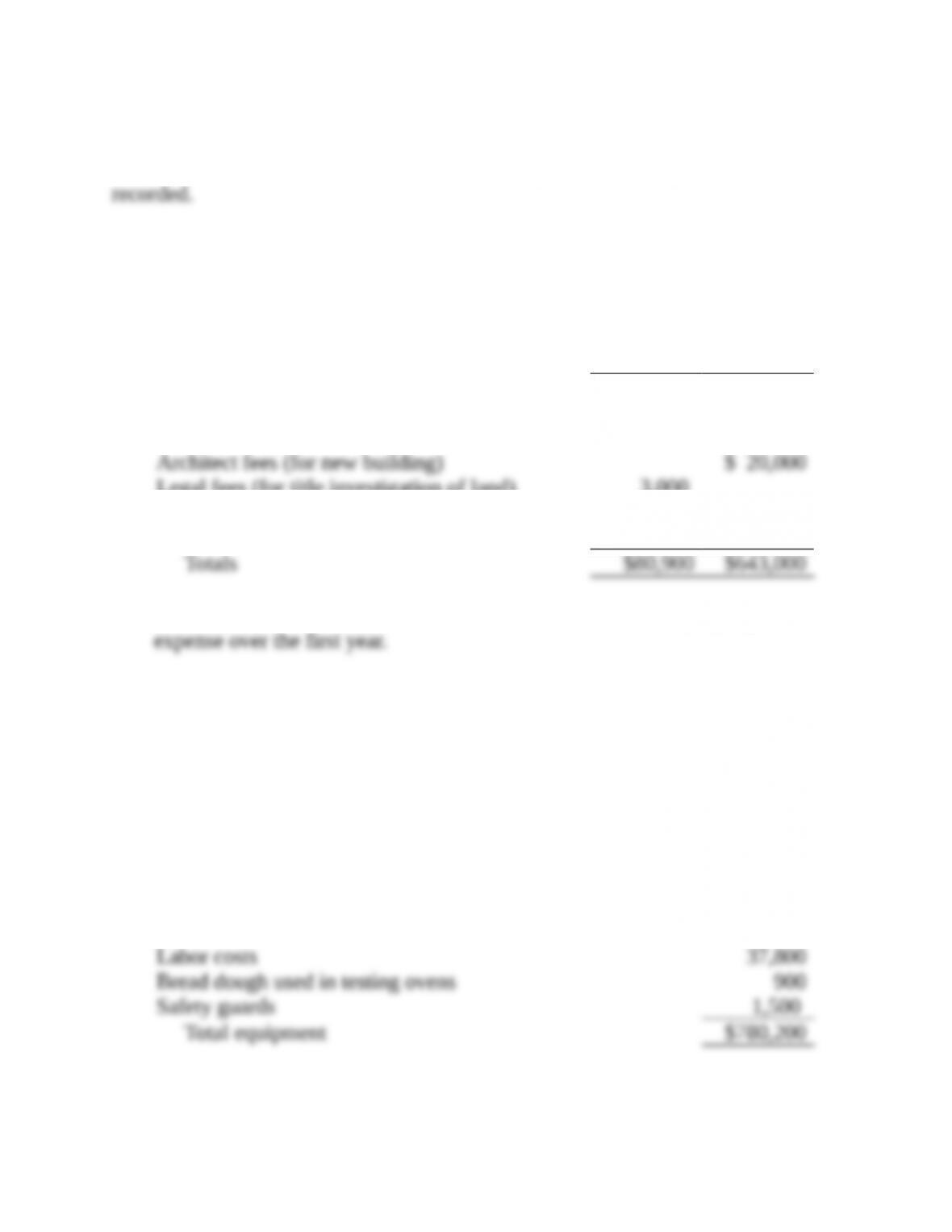
Requirement 1
The ovens should be recorded in the equipment account as detailed in the
following schedule:
Purchase price $700,000
Freight costs 35,000
Electrical connections 5,000
Requirement 2
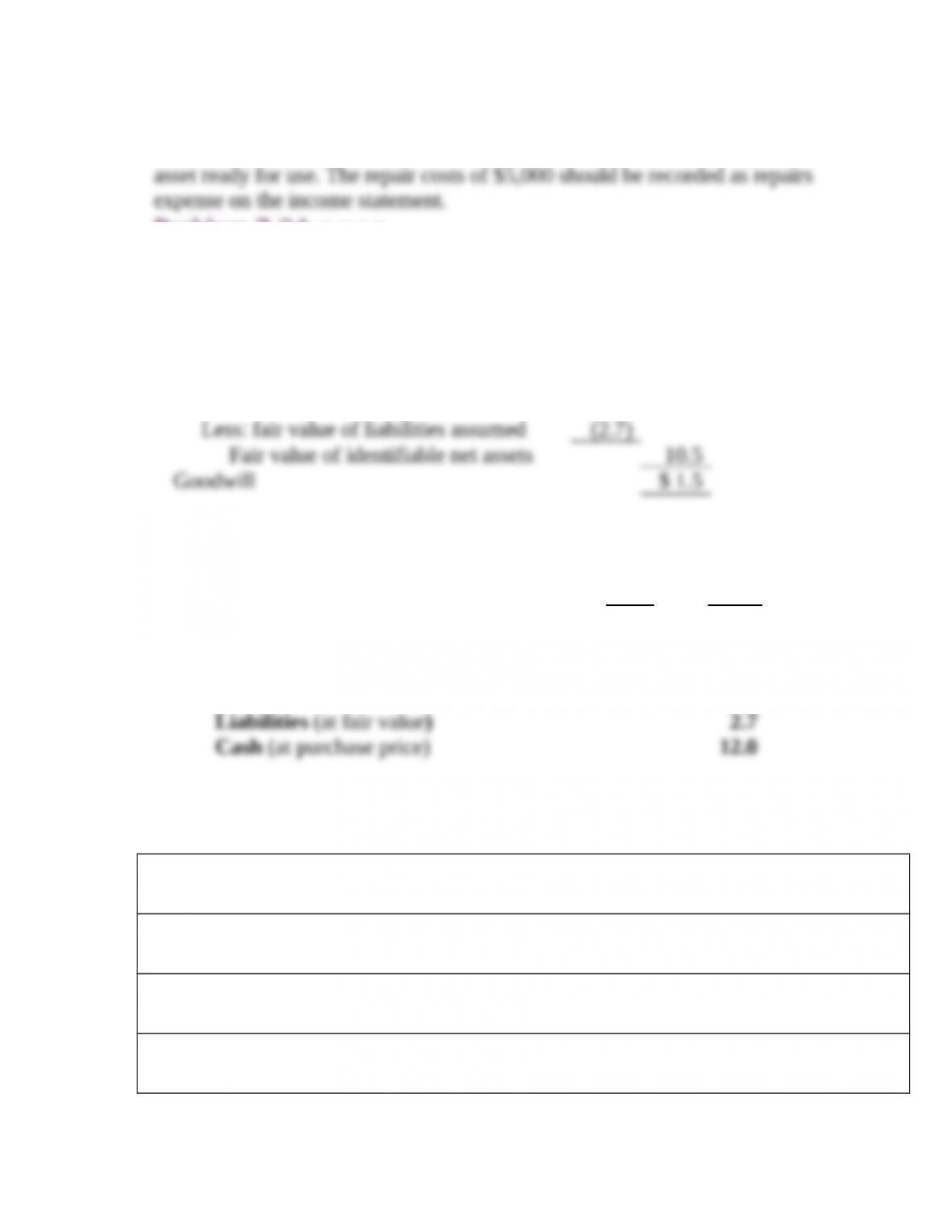
The repair costs of $5,000 for the oven damaged during installation should not
be included in the equipment account as this is not a normal cost to get the
Problem 7-3A (LO 7-2)
1. The amount Fresh Cut paid for goodwill is $1 million calculated
as follows:
(in millions)
Purchase price $12.0
Less:
Fair value of assets acquired 13.2
2.
(in millions) Debit Credit
Receivables (at fair value) 1.6
Property, Plant, and Equipment (at fair value) 9.9
Intangible Assets (at fair value) 1.7
Goodwill (remaining purchase price) 1.5
Problem 7-4A (LO 7-3)
1. Capitalize
2. Expense
3. Capitalize
4. Capitalize
5. Expense
6. Expense
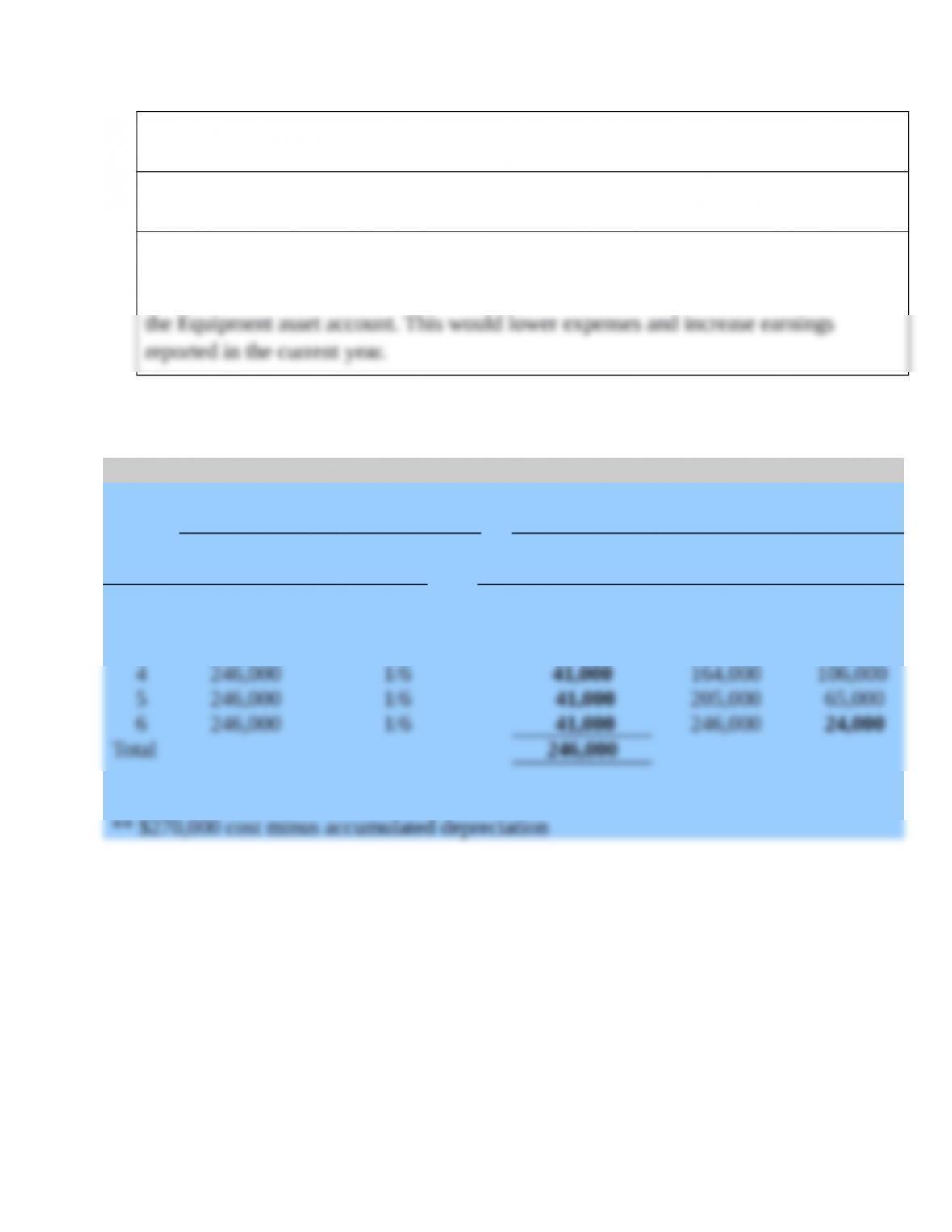
Health Services could increase reported earnings by improperly recording expenses as
assets. For example, Health Services could record maintenance and repair expense to
Problem 7-5A (LO 7-4)
Requirement 1 Straight-Line
University Car Wash
Calculation End of Year Amounts
Year
Depreciable
Cost* XDepreciation
Rate =Depreciation
Expense
Accumulated
Depreciation
Book
Value**
1 246,000 1/6 41,000 41,000 239,000
2 246,000 1/6 41,000 82,000 188,000
3 246,000 1/6 41,000 123,000 147,000
* $270,000 – $24,000 = $246,000