Question 7-1 (LO 7-1)
WorldCom recorded assets on the balance sheet that should have been recorded as expenses
on the income statement. When WorldCom uses the telecommunication lines of another
Question 7-2 (LO 7-1)
The two major categories for long-term assets are (1) property, plant, and equipment and (2)
intangible assets. Property, plant, and equipment include land, land improvements, buildings,
7-3 (LO 7-1)
We initially record a long-term asset at its cost plus all expenditures necessary to get the asset
ready for use. Thus, the initial cost of a long-term asset might be more than just its purchase
Question 7-4 (LO 7-1)
Recording an expense incorrectly as an asset will overstate net income on the income
statement. If University Hero initially records an expense incorrectly as an asset, expenses are
understated or too small. Since expenses are subtracted from revenues in arriving at net income,
Question 7-5 (LO 7-1)
Costs Little King might incur to make the land ready for its intended use include the purchase
price plus closing costs such as fees for the attorney, real estate agent commissions, title, title
search, and recording. Little King also includes the cost of removing the old building as an
additional cost in making the land ready for its intended use. If any cash is received from selling
Question 7-6 (LO 7-1)
We don’t depreciate land because its service life never ends. Land improvements are
additional amounts spent to improve the land such as a parking lot, paving, temporary
Chapter 7
Long-Term AssetsREVIEW QUESTIONS
Question 7-7 (LO 7-1)
Costs we might incur to get equipment ready for use include sales tax, shipping, delivery,
Question 7-8 (LO 7-1)
We report natural resources on the balance sheet as part of property, plant, and equipment.
Question 7-9 (LO 7-2)
We value purchased intangible assets at their original cost plus all other costs, such as legal
and filing fees, necessary to get the asset ready for use. Reporting intangible assets developed
Question 7-10 (LO 7-2)
A patent is an exclusive right to manufacture a product or to use a process. A copyright is an
exclusive right of protection given to the creator of a published work, such as a song, film,
Question 7-11 (LO 7-2)
We record goodwill as an intangible asset on the balance sheet only when we purchase it as
part of the acquisition of another company. In this case, the acquiring company records goodwill
equal to the purchase price less the fair value of the net assets acquired. The fair value of the net
Question 7-12 (LO 7-3)
We capitalize a particular cost as an asset if it increases future benefits, whereas we expense a
Answers to Review Questions (continued)
Question 7-13 (LO 7-3)
We expense repairs and maintenance expenditures which maintain a given level of benefits,
in the period incurred. We capitalize as assets more extensive repairs that increase the future
benefits of the delivery truck, such as a new transmission or an engine overhaul. An addition
Question 7-14 (LO 7-3)
If a firm successfully defends an intangible right, it should capitalize the litigation costs and
amortize them over the remaining useful life of the related intangible. If the defense of an
Question 7-15 (LO 7-4)
The dictionary definition of depreciation is a decrease in value of an asset, whereas the
Question 7-16 (LO 7-4)
We must estimate the service life (also called useful life) of the asset as well as its residual
Question 7-17 (LO 7-4)
The service life tells how long the company expects to obtain benefits from the asset before
disposing of it. Under the straight-line method we determine service life in units of time. Under
Question 7-18 (LO 7-4)
Residual value, also referred to as salvage value, is the amount the company expects to
receive from selling the asset at the end of its service life. The allocation base is the asset’s cost
Question 7-19 (LO 7-4)
Straight-line creates an equal amount of depreciation each year. Double-declining-balance
Answers to Review Questions (continued)
Question 7-20 (LO 7-4)
Little King Sandwiches uses straight-line depreciation that creates an equal amount of
depreciation each year. In contrast, University Hero uses double-declining balance depreciation
that takes more depreciation in earlier years and less depreciation in later years. By taking more
Question 7-21 (LO 7-4)
University Hero depreciates over a shorter service life (20 years) and therefore will take more
depreciation expense per year. By taking more depreciation expense per year, University Hero
Question 7-22 (LO 7-4)
Most companies use the straight-line method for financial reporting and the Internal Revenue
Service’s prescribed accelerated method (called MACRS) for income tax purposes. Companies
choose straight-line for financial reporting for several reasons. Many probably believe they
Question 7-23 (LO 7-5)
No. Just as we don’t depreciate land because it has an unlimited life, we don’t amortize
intangible assets with unlimited useful lives such as goodwill and most trademarks. For most
other intangible assets that have a finite useful life, we allocate the asset’s cost less any estimated
Question 7-24 (LO 7-6)
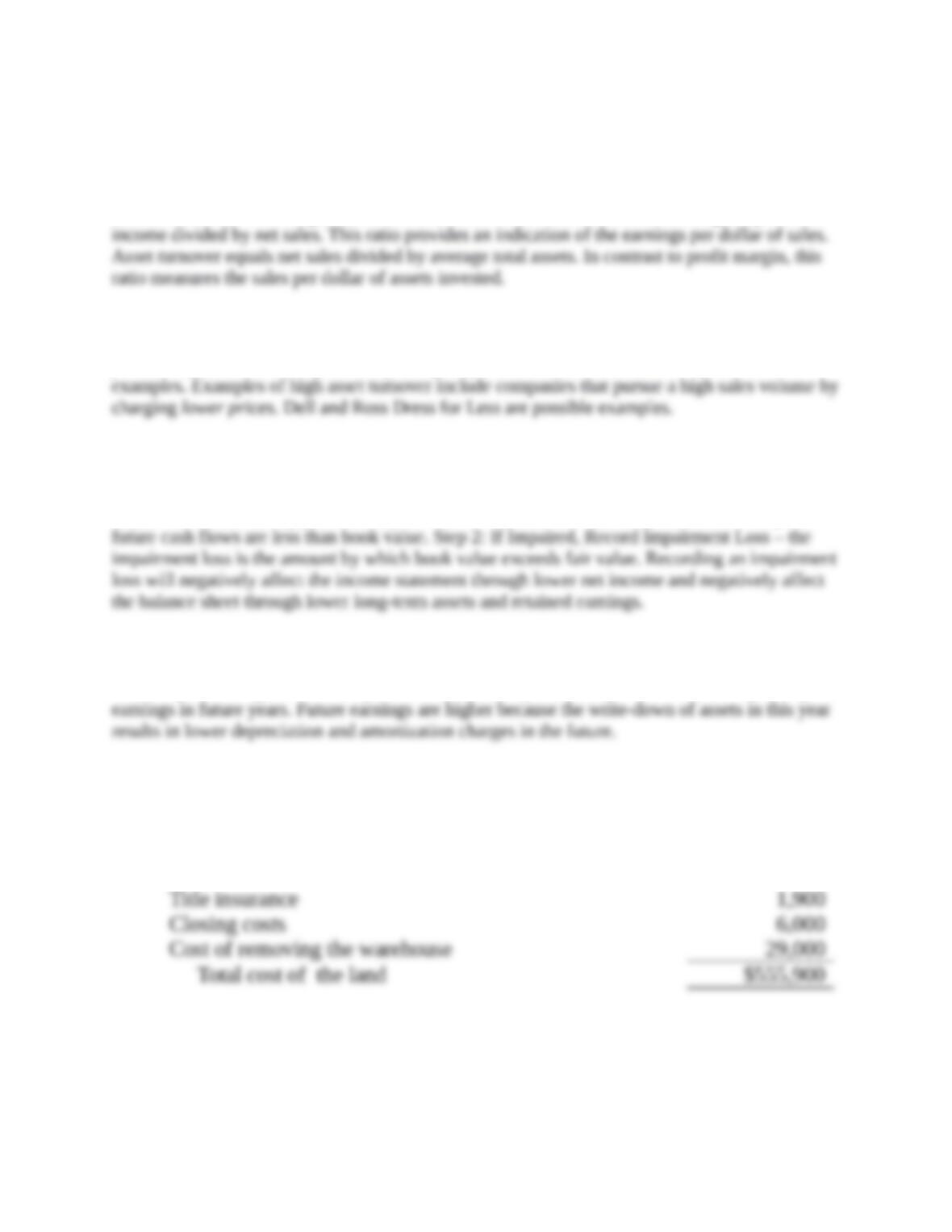
Book value is the cost of the asset minus accumulated depreciation. We record a gain if we
Answers to Review Questions (continued)
Question 7-25 (LO 7-7)
Return on assets equals net income divided by average total assets. Return on assets indicates
the amount of net income generated for each dollar invested in assets. Profit margin equals net
Question 7-26 (LO 7-7)
Examples of high profit margin include companies that pursue a higher profit margin through
product differentiation and premium pricing. Apple and Saks Fifth Avenue are possible
*Question 7-27 (LO 7-8)
An asset impairment occurs when the future cash flows (future benefits) that we estimate a
long-term asset will generate, fall below its book value (cost minus accumulated depreciation).
Impairment is a two-step process. Step 1: Test for Impairment – the long-term asset is impaired if
*Question 7-28 (LO 7-8)
A big bath is when a company records all losses in one year to make a bad current year even
worse. By recording additional expenses in the current year, management is able to report higher
BRIEF Exercises
Brief Exercise 7-1 (LO 7-1)
Purchase price of land (and warehouse to be removed) $490,000
Broker’s commission 29,000
Brief Exercise 7-2 (LO 7-1)
Purchase price $30,000
Freight 2,000
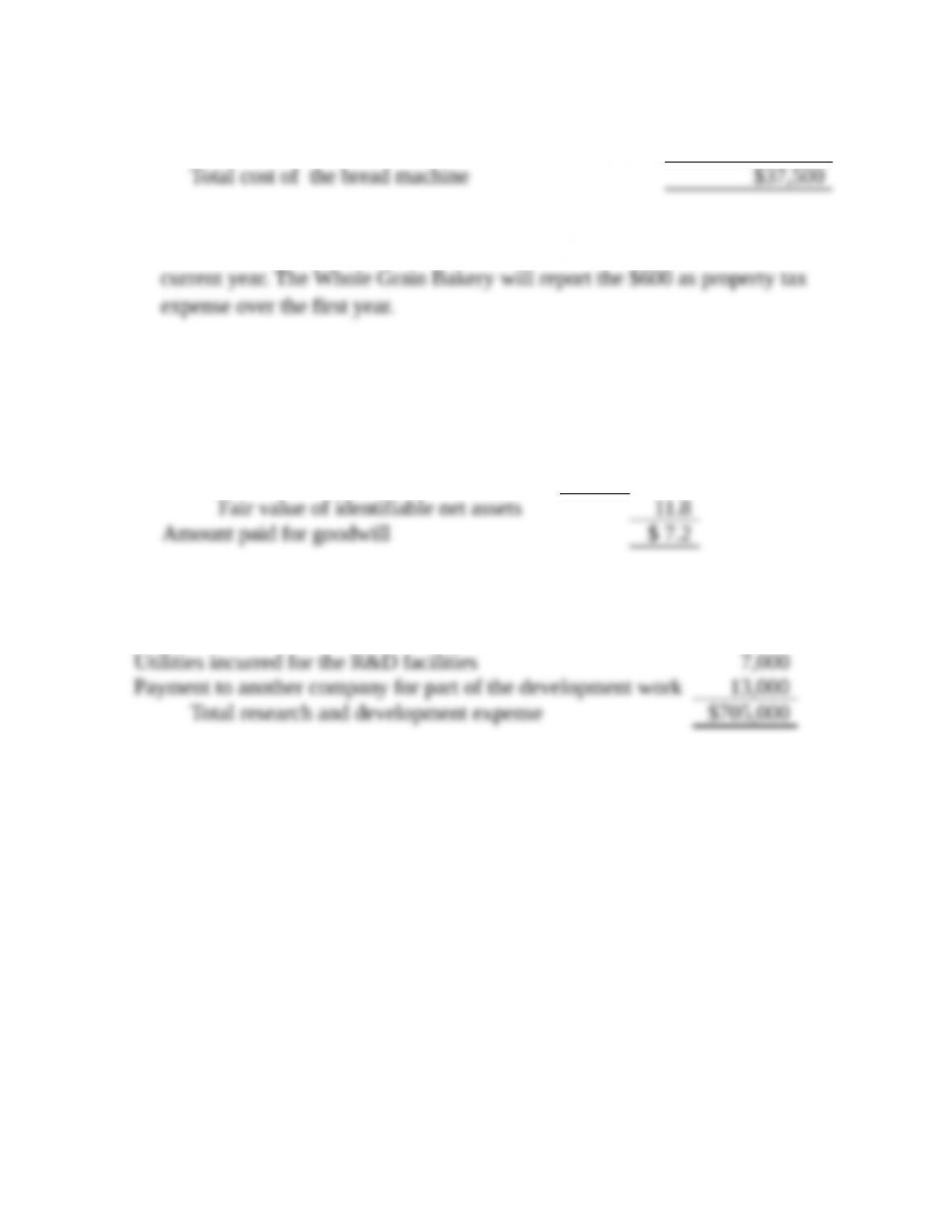
Installation 4,000
Testing 1,500
The $600 property tax is a recurring cost that benefits the company in the
Brief Exercise 7-3 (LO 7-2)
(in millions)
Purchase price $19.0
Less:
Fair value of assets acquired 14.3
Less: fair value of liabilities assumed (2.5)
Brief Exercise 7-4 (LO 7-2)
Technician salaries for R&D $540,000
Depreciation on R&D facilities and equipment 145,000
The $27,000 in patent filing and related legal costs are recorded to the patent
intangible asset account.
Brief Exercise 7-5 (LO 7-3)
(1) Expense in the period incurred.
(2) Capitalize and depreciate over the useful life of the asset.
(3) Capitalize and depreciate over the useful life of the asset.
(4) Capitalize and depreciate over the useful life of the asset.
Brief Exercise 7-6 (LO 7-4)
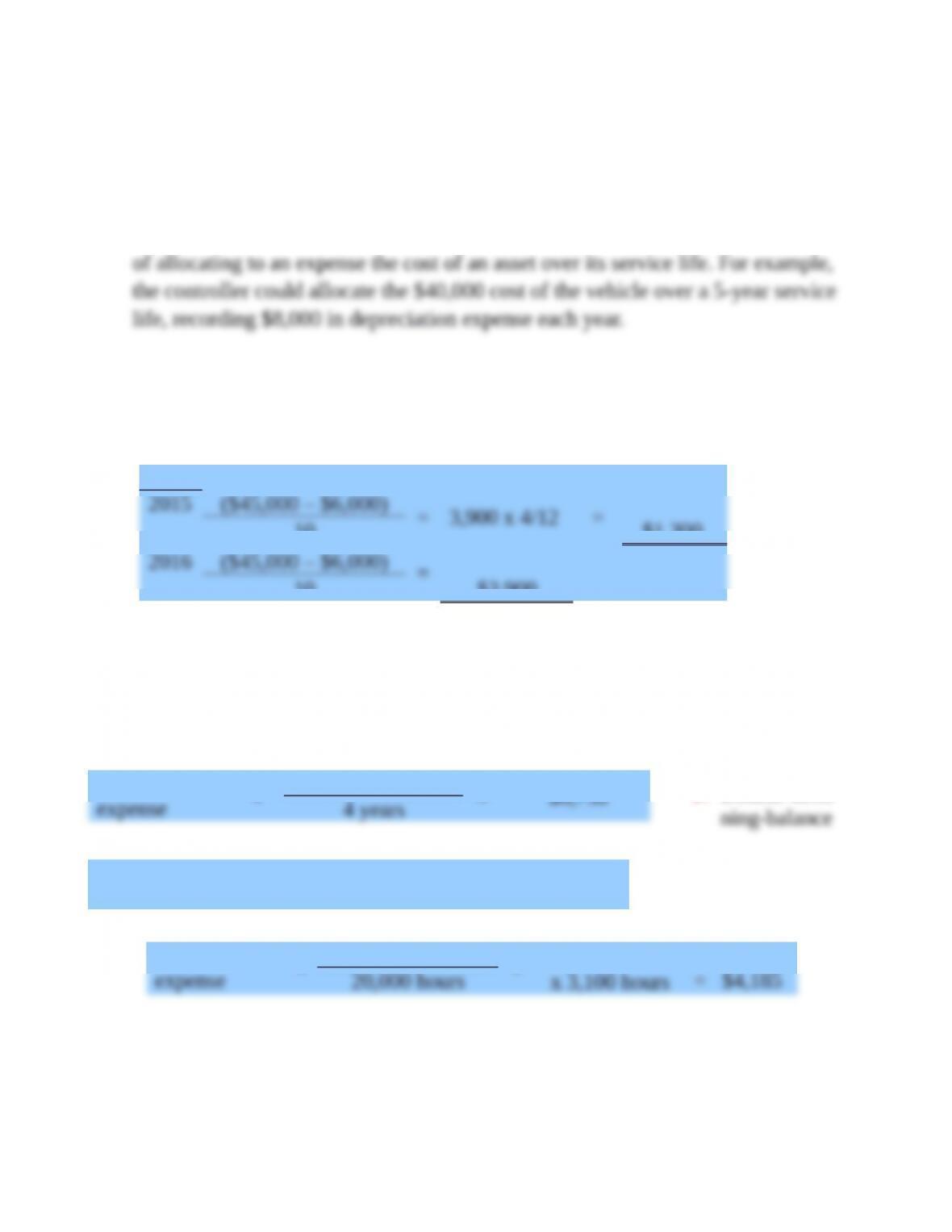
The company controller’s approach to measuring depreciation is based on the
dictionary definition of depreciation – decrease in value of an asset.
Depreciation in accounting is different. Depreciation in accounting is the process
Brief Exercise 7-7 (LO 7-4)
Year
Brief Exercise 7-8 (LO 7-4)
1. Straight-line
2. Double-decli
ning-balance
3. Activity-based
Depreciation
expense =$30,000 – $3,000 =$1.35 per hour
x 3,100 hours = $4,185
20,000 hours
Depreciation
expense =$30,000 – $3,000 = $6,750
4 years
Depreciation
expense
= $30,000 x 2/4 = $15,000
Brief Exercise 7-9 (LO 7-5)
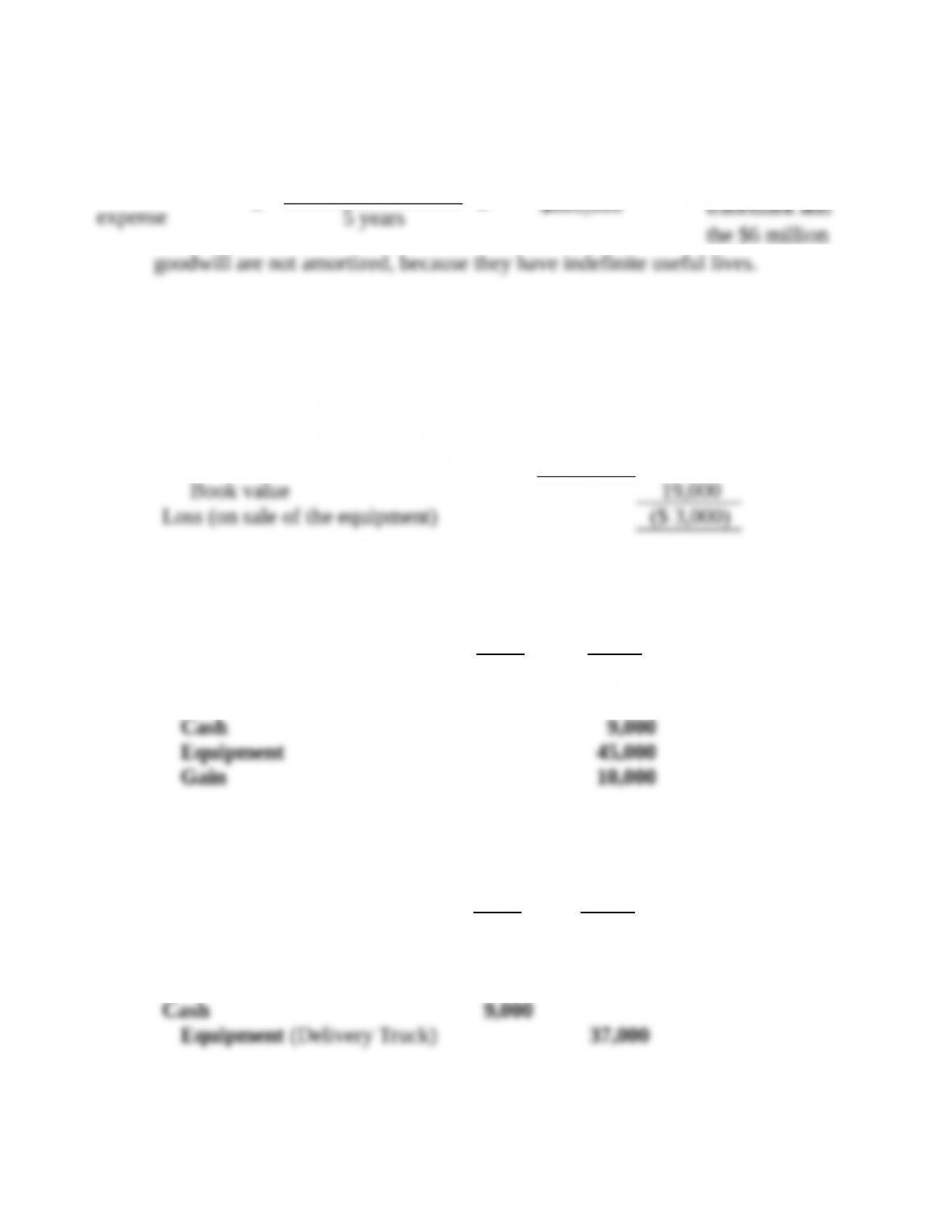
The $5 million
trademark and
the $6 million
Brief Exercise 7-10 (LO 7-6)
Sale amount $16,000
Less:
Cost of the ice cream equipment 90,000
Less: Accumulated depreciation (71,000)
Brief Exercise 7-11 (LO 7-6)
Debit Credit
Equipment (Delivery Truck) 31,000
Accumulated Depreciation 33,000
Brief Exercise 7-12 (LO 7-6)
Debit Credit
Equipment 22,000
Accumulated Depreciation 4,400
Loss 1,600
Amortization
Brief Exercise 7-13 (LO 7-7)
Net income = 20%
Net income
= 20%$885,000
*Brief Exercise 7-14 (LO 7-8)
Step 1: Test for Impairment
The long-term asset is not impaired since future cash flows ($38 million) are
Step 2: If Impaired, Record Loss
Since the asset does not meet the first test for impairment, no impairment loss
is recorded.
*Brief Exercise 7-15 (LO 7-8)
Step 1: Test for Impairment
The long-term asset is impaired since future cash flows ($32 million) are less
Step 2: If Impaired, Record Loss
The impairment loss is $3.5 million, calculated as the amount by which book
Exercises
Exercise 7-1 (LO 7-1)
Purchase price of land (and building to be removed) $1,000,000
Title insurance 3,000
Back property taxes 9,000
Cost of removing the building 50,000
For property taxes, $5,000 relates only to the current period and we expense it in
the current period. All of the other costs, including the $9,000 in back property
Exercise 7-2 (LO 7-1)
Purchase price $75,000
Sales tax 6,000
Shipping 1,000
With the exception of the $700 annual insurance, each of the expenditures
described is necessary to bring the machine to its condition and location for use.
Debit Credit
Equipment 84,000
Prepaid Insurance 700
Exercise 7-3 (LO 7-1)
Estimated
Fair Value
Allocation
Percentage
Amount of
Basket Purchase
Recorded
Amount
Land $ 175,000 $175,000/$700,000 = 25% X $600,000 $150,000
Building 455,000 $455,000/$700,000 = 65% X $600,000 390,000