
Chapter 7
Long-Term Assets
Purchase price of land (and building to be removed) $400,000
Title insurance 3,000
Back property taxes 4,000
Cost of removing the building 25,000
Less: Salvaged materials (2,000)
Level the land 6,000
EXERCISES
Exercise 7-1
Purchase price $45,000
Sales tax 3,000
Shipping 500
Installation 1,200
For property taxes, $2,000 relates only to the current period and we expense it in the
current period. All of the other costs, including the $4,000 in back property taxes,
Exercise 7-2
Debit Credit
Equipment 49,700
Prepaid Insurance 300
Cash 2,000
With the exception of the $300 annual insurance, each of the expenditures described is
necessary to bring the machine to its condition and location for use. Orion will
initially report the $300 insurance amount as prepaid insurance and expense over the
first year of coverage.
Estimated
Fair Value
Allocation
Percentage
Amount of
Basket Purchase
Recorded
Amount
Land $ 150,000 $150,000/$1,000,000 = 15% X $900,000 $135,000
Building 600,000 $600,000/$1,000,000 = 60% X $900,000 540,000
Equipment 250,000 $250,000/$1,000,000 = 25% X $900,000 225,000
Exercise 7-3
Debit Credit
Legal Fees Expense 7,000
Patents 23,000
Salaries Expense 30,000
Exercise 7-4 (LO 7-1, 7-4)
1. Land is not depreciated. However, depreciation on the building is
tax-deductible. If management allocates less of the purchase price to land and
2. If the true allocation should have been 40% to land and 60% to building, then
the allocation of 20% to land and 80% to building, for the express purpose of
reducing taxes, is not ethical. Who is harmed? The government is clearly
Exercise 7-5
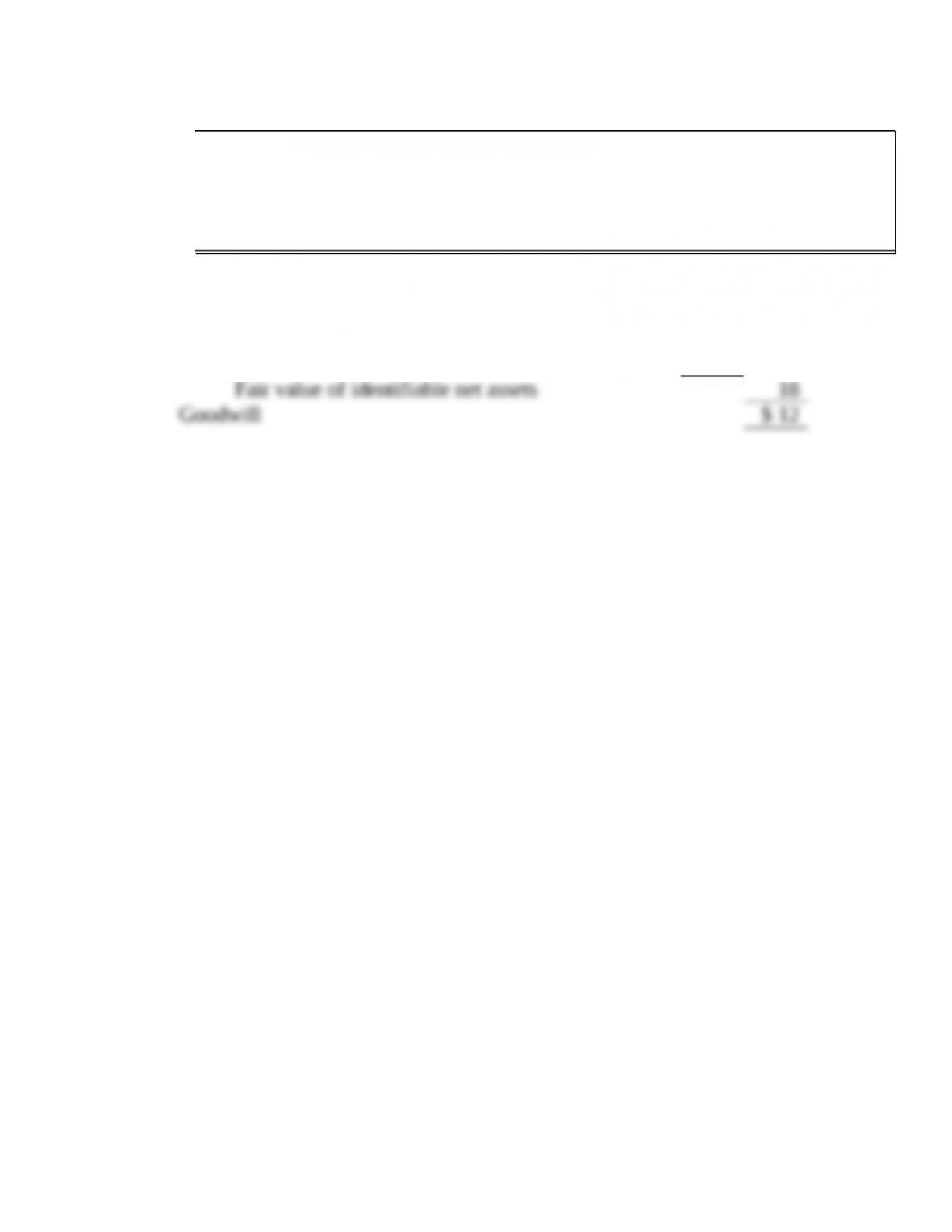
(amounts in millions)
Purchase price $30
Less:
Fair value of assets acquired ($11 + $21 + $2) 34
Less: fair value of liabilities assumed ($6 + $10) (16)
Exercise 7-6
1. Patent costs capitalized
Legal fees for patent application $ 50,000
Legal fees for successful defense 30,000
Exercise 7-7
2. Expense items on income statement
Basic research to develop the technology $2,000,000
Engineering design work 1,100,000
Development of prototype device 400,000
Testing and modification of the prototype 200,000
List A List B
____f___ 1. Intangible assets a. Oil and gas deposits, timber
____e___ 2. Amortization b.Purchase price less fair market
____g___ 3. Depreciation c. Exclusive right to display a
____b___ 4. Goodwill d.Exclusive right to benefit from
____a___ 5. Natural resources e. The allocation of cost for in-
____c___ 6. Trademark f. Assets that represent contrac-
____d___ 7. Copyright g.The allocation of cost for plant
3. Purchased intangible assets are usually capitalized. Internally developed
intangible assets are usually expensed.
Exercise 7-8
1. Equipment $40,000
2. Building $250,000
3. Repairs and Maintenance Expense $84,000
Exercise 7-9
Depreciation
$85,000 – $5,000
$16.00 per
Exercise 7-10
1. Straight-lin
e
Depreciation
Expense
= $85,000 -$5,000 = $16,000
5 years
2. Double-declining-bala
nce
Expense
3. Activity-ba
sed
Straight-line
Depreciation
Exercise 7-11
Requirement 1
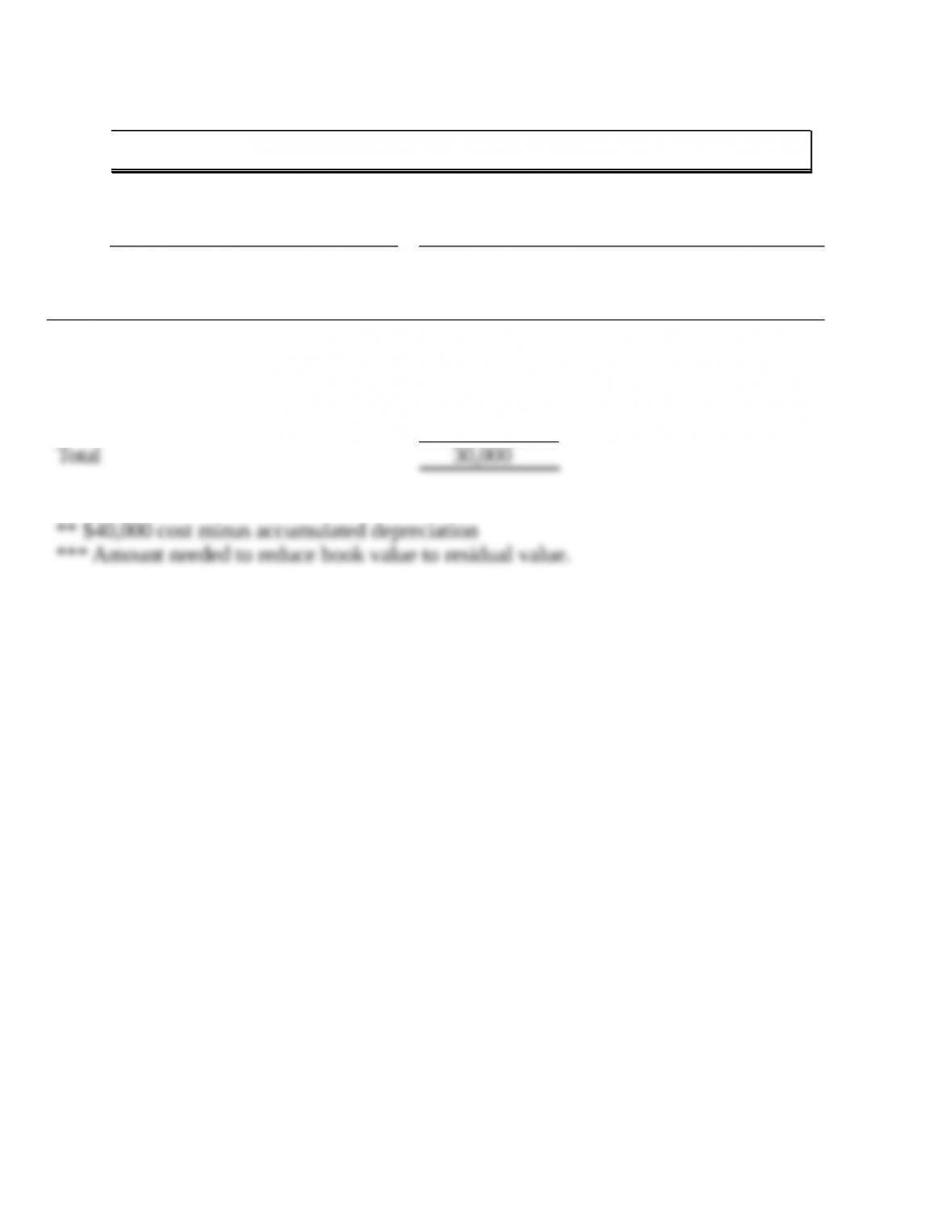
Double-declining Balance
Calculation End of Year Amounts
Year
Beginnin
g
Book Value
XDepreciation
Rate* =
Depreciation
Expense
Accumulated
Depreciation
Book
Value**
1 40,000 0.40 16,000 16,000 24,000
2 24,000 0.40 9,600 25,600 14,400
3 14,400 0.40 4,400*** 30,000 10,000
4 10,000 0
5 0
* 2 / 5 years = 0.40 per year
Requirement 2
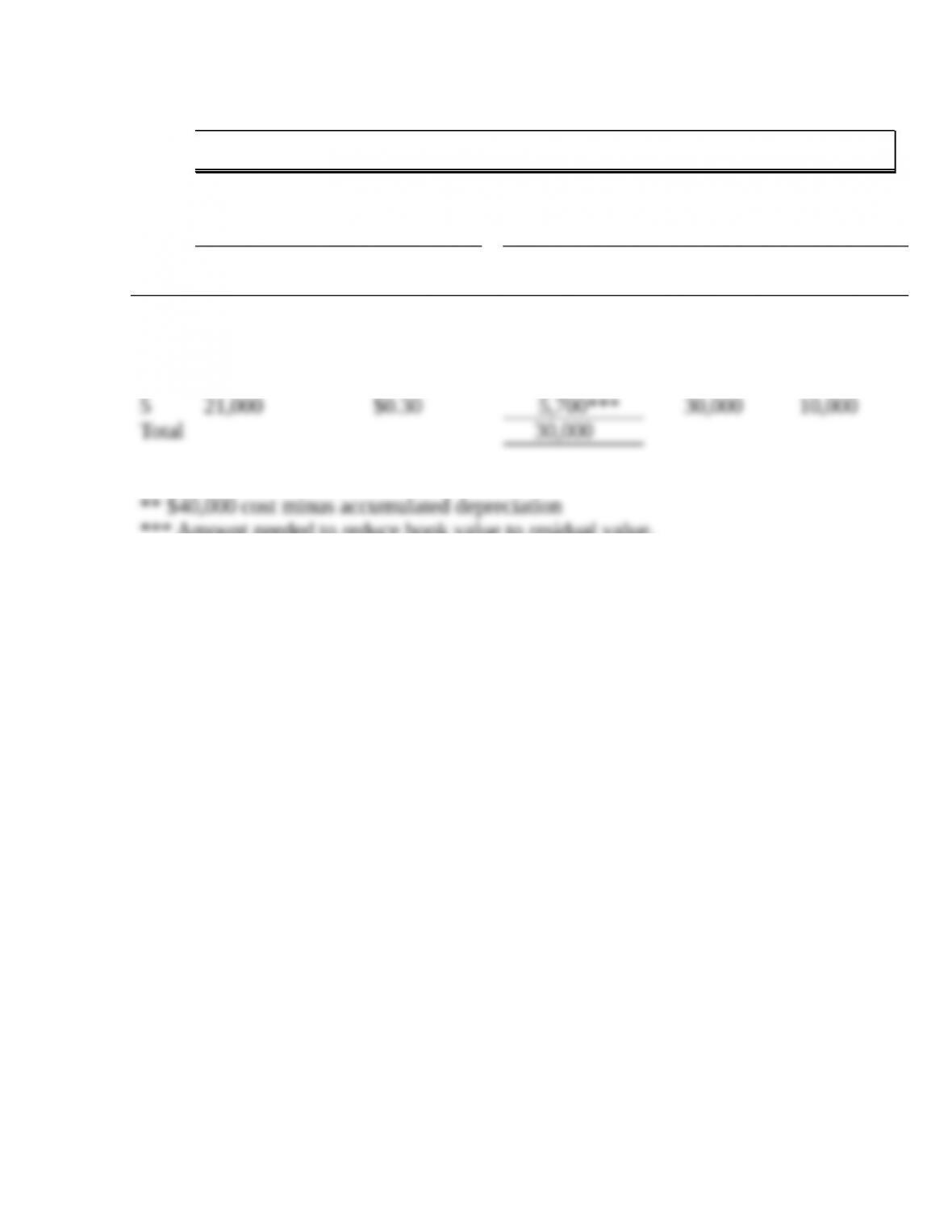
Activity Based
Calculation End of Year Amounts
Year
Miles
Used XDepreciation
Rate* =Depreciation
Expense
Accumulated
Depreciation
Book
Value**
1 23,000 $0.30 6,900 6,900 33,100
2 17,000 $0.30 5,100 12,000 28,000
3 19,000 $0.30 5,700 17,700 22,300
4 22,000 $0.30 6,600 24,300 15,700
* ($40,000 – $10,000)/ 100,000 miles = $.30/mile
*** Amount needed to reduce book value to residual value.
Requirement 3
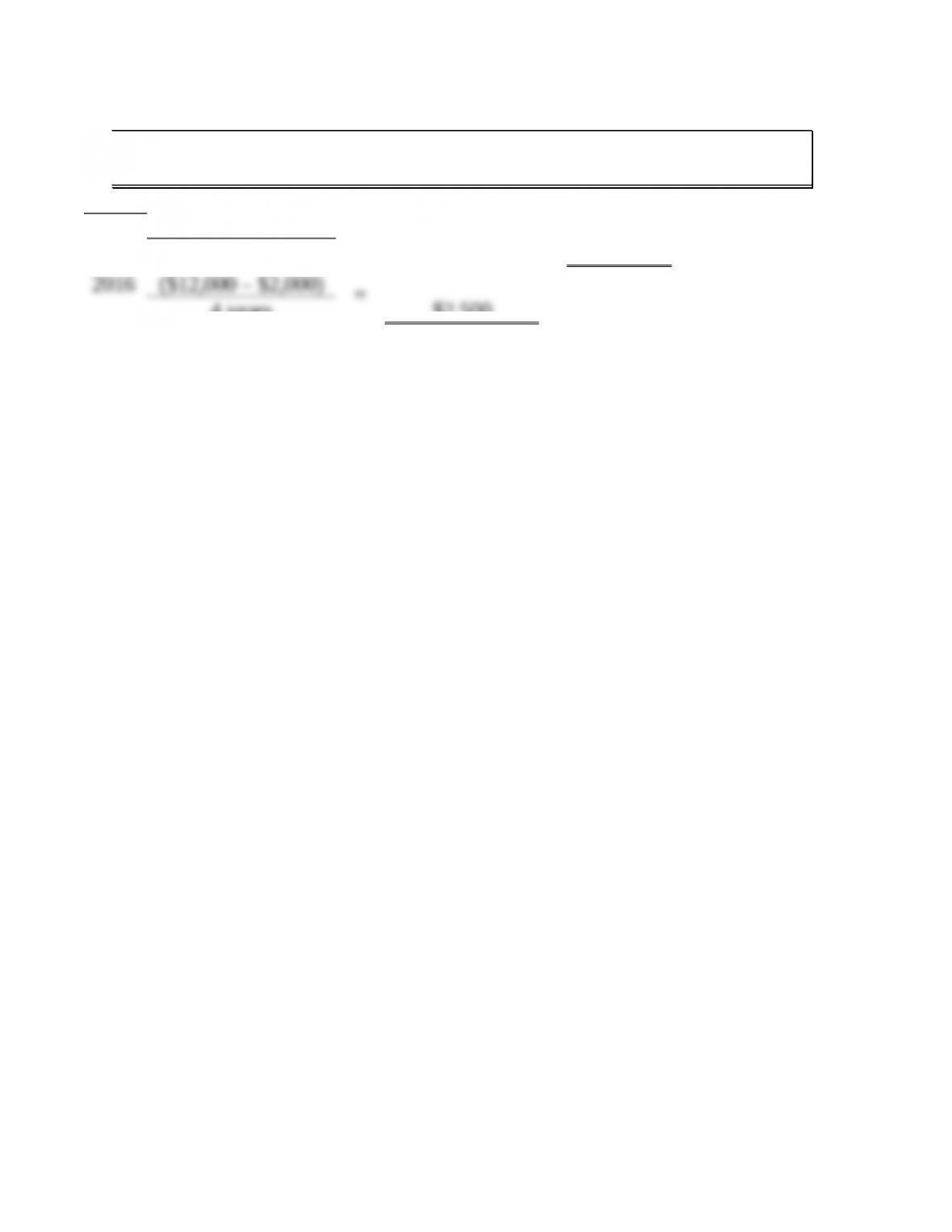
Year
2015 ($12,000 – $2,000) = $2,500 x 3/12 = $6254 years
Exercise 7-12
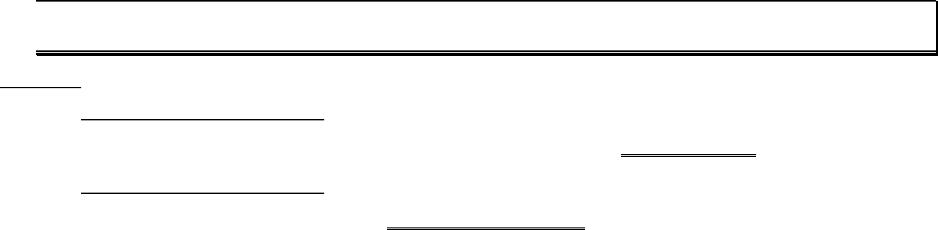
Year
2015 ($22,000 – $2,000) = $4,000 x 4/12 = $1,3335 years
2016 ($22,000 – $2,000) =$4,0005 years
Exercise 7-13
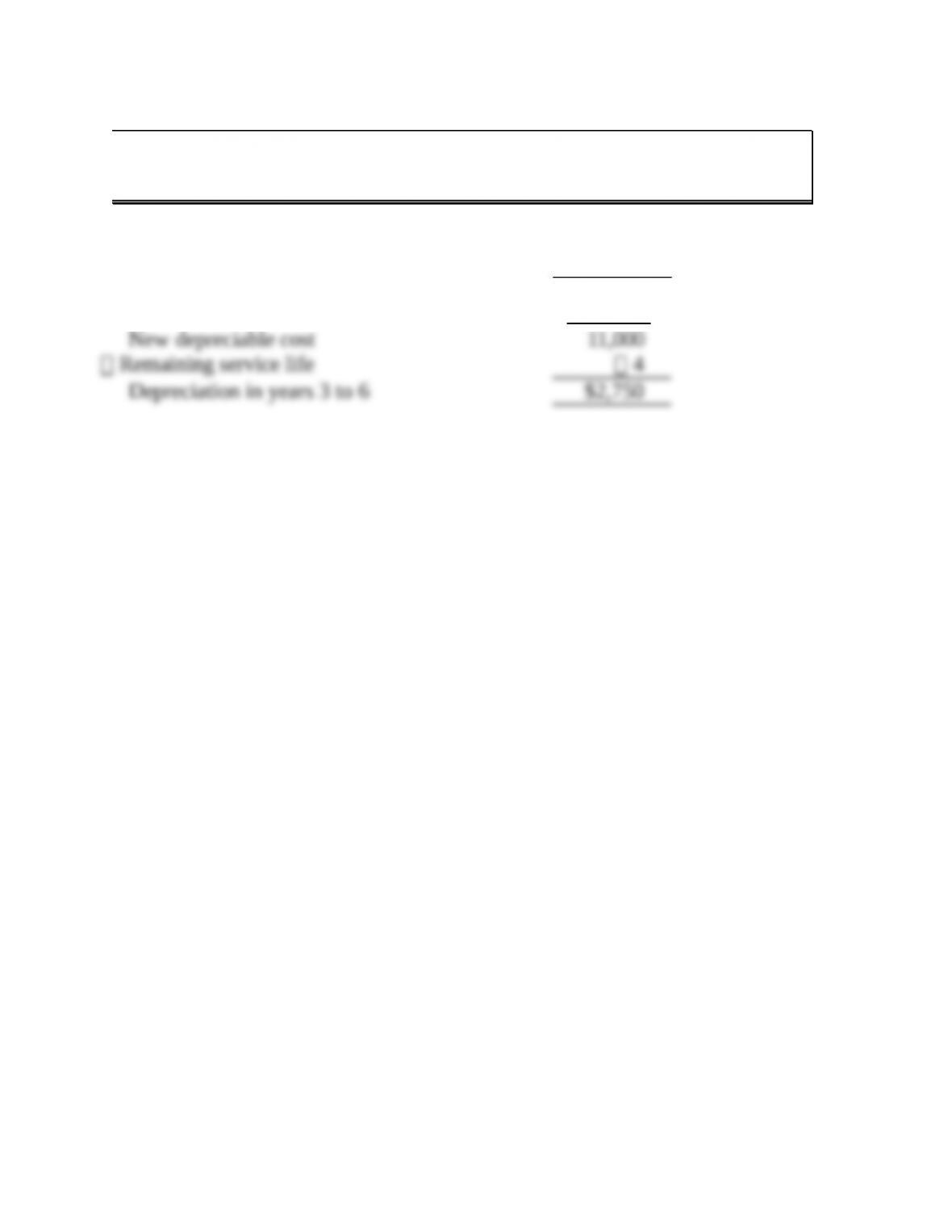
Cost of the equipment $20,000
Less: Accumulated Depreciation (Years 1 and 2) (8,000)*
Book value, end of year 2 12,000
Less: New residual value (1,000)
Exercise 7-14
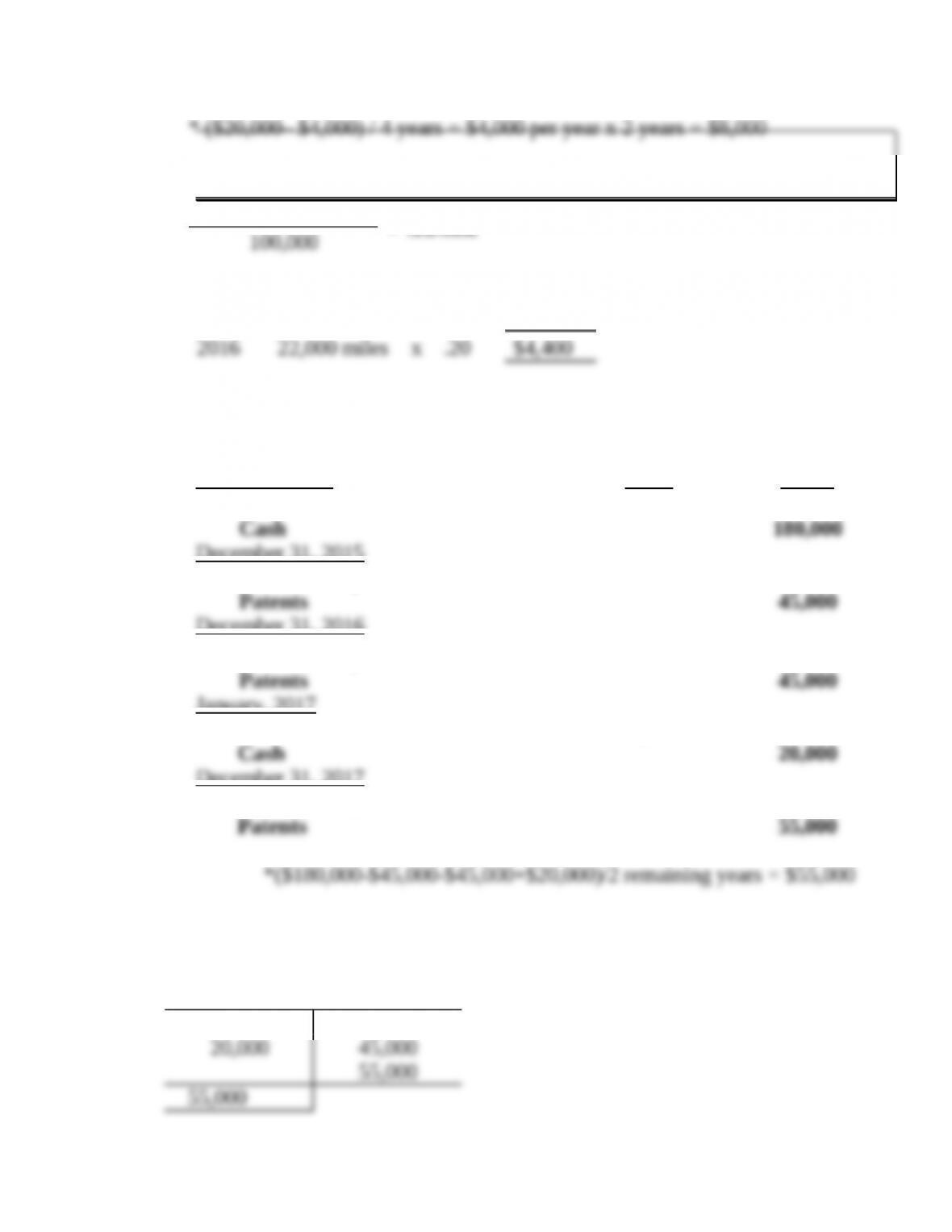
($22,000 – $2,000) = .20/mile
Year
2015 6,000 miles x .20 $1,200
January 1, 2015 Debit Credit
Patents 180,000
December 31, 2015
Amortization Expense 45,000
December 31, 2016
Amortization Expense 45,000
January, 2017
Patents 20,000
December 31, 2017
Amortization Expense* 55,000
Balance in patent account
Patents
180,000 45,000
20,000 45,000
55,000
55,000
* ($20,000– $4,000) / 4 years = $4,000 per year x 2 years = $8,000
Exercise 7-15
Exercise 7-16
Requirement 1
Requirement 2
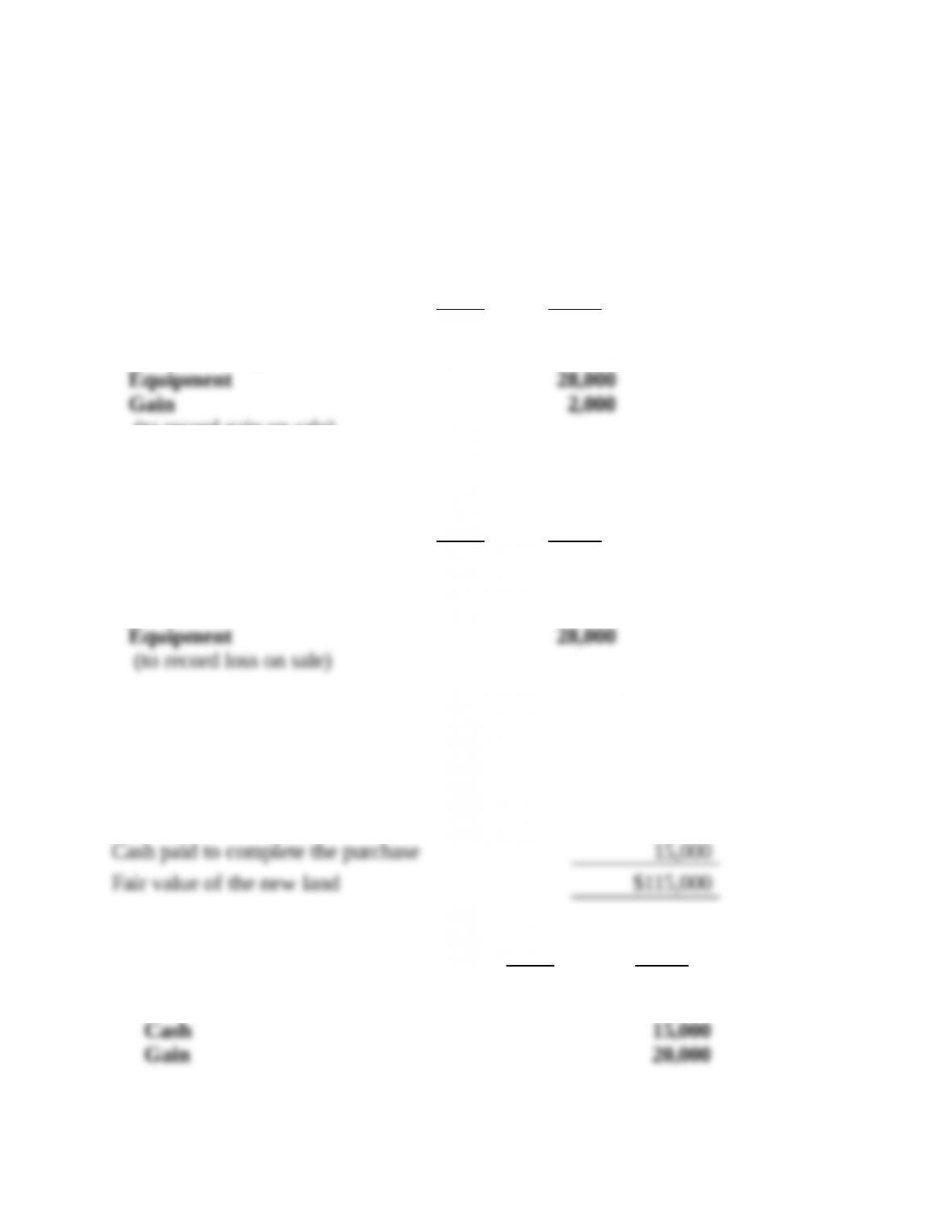
The entry to record the sale is as follows:
Debit Credit
Cash 15,000
Accumulated Depreciation 15,000*
(to record gain on sale)
The entry to record the sale is as follows:
Debit Credit
Cash 11,000
Accumulated Depreciation 15,000
Loss 2,000
Find the fair value of the new land
Fair value of the old land $100,000
Journal entry to record exchange Debit Credit
Land, new 115,000
Land, old 80,000
Exercise 7-17
Requirement 1
* ($28,000 – $3,000) / 5 = $5,000 year x 3 years = $15,000
Requirement 2
Exercise 7-18
Requirement 1
Requirement 2
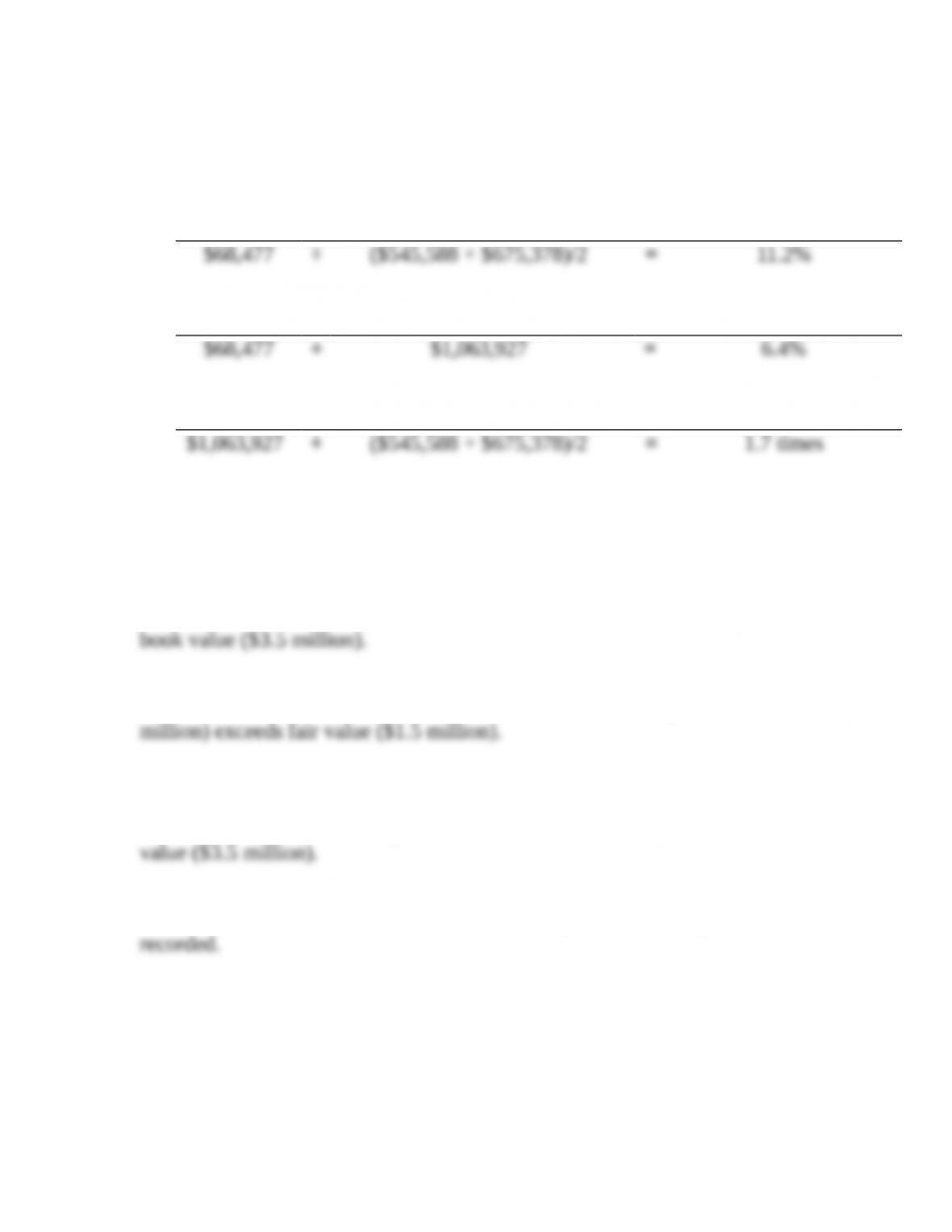
Net
Income ÷
Average
Total Assets =
Return
on Assets
Net
Income ÷ Sales =
Profit
Margin
Sales ÷
Average
Total Assets =
Asset
Turnover
Requirement 1
Step 1: Test for Impairment
The long-term asset is impaired since future cash flows ($3.0 million) are less than
Step 2: If Impaired, Record Loss
The impairment loss is $2 million calculated as the amount by which book value ($3.5
Requirement 2
Step 1: Test for Impairment
The long-term asset is not impaired since future cash flows ($4.0 million) exceed book
Step 2: If Impaired, Record Loss
Since the asset does not meet the first test for impairment, no impairment loss is
Exercise 7-19
Exercise 7-20