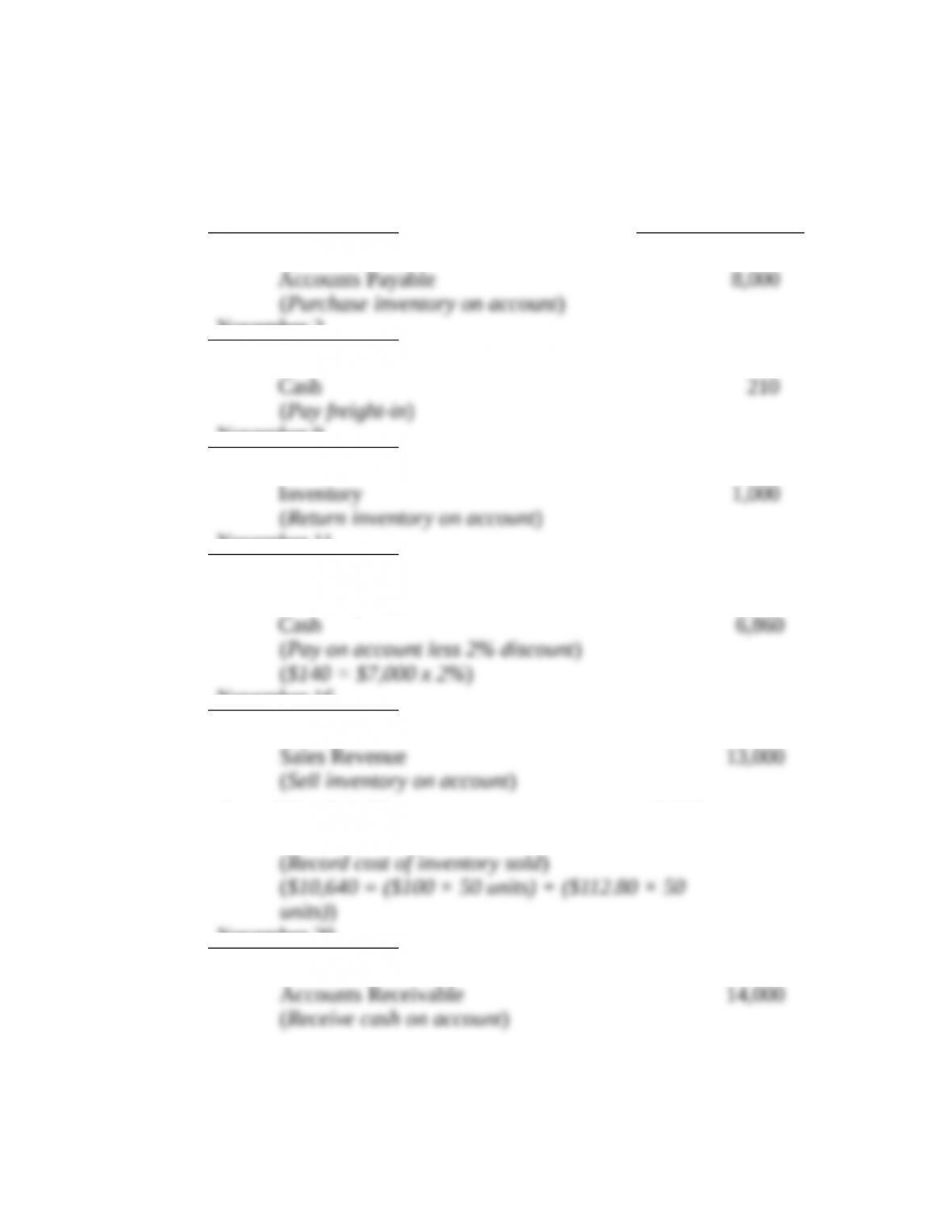
November 2 Debit Credit
Inventory 8,000
November 3
Inventory 210
November 9
Accounts Payable 1,000
November 11
Accounts Payable 7,000
Inventory 140
November 16
Accounts Receivable 13,000
Cost of Goods Sold 10,640
Inventory 10,640
November 20
Cash 14,000
Problem 6-6C
Requirement 1
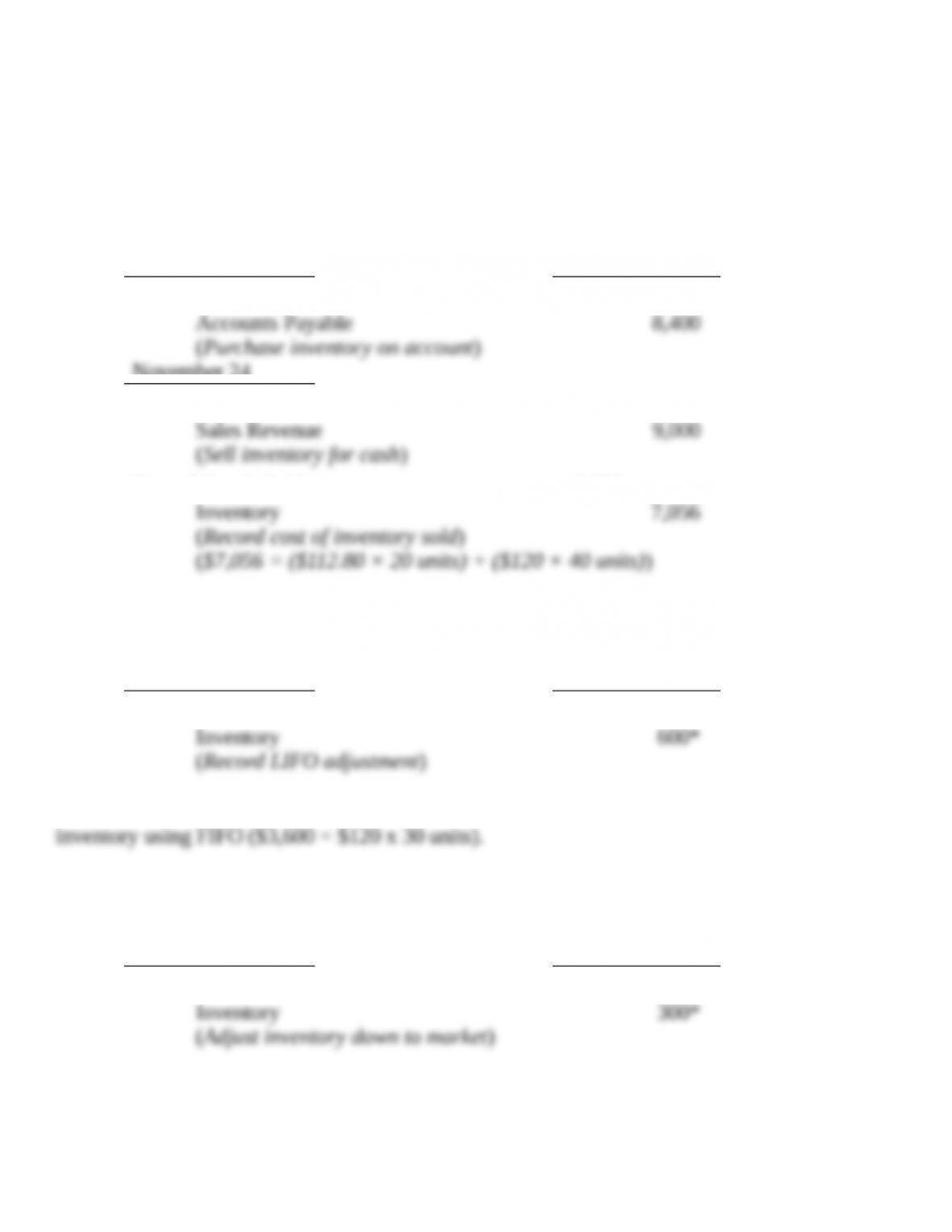
November 21 Debit Credit
Inventory 8,400
November 24
Cash 9,000
Cost of Goods Sold 7,056
November 30 Debit Credit
Cost of Goods Sold 600
November 30 Debit Credit
Cost of Goods Sold 300
Problem 6-6C (continued)
Requirement 1 (continued)
Requirement 2
* Ending inventory using LIFO ($3,000 = $100 x 30 units) is $600 less than ending
Problem 6-6C (concluded)
Requirement 3
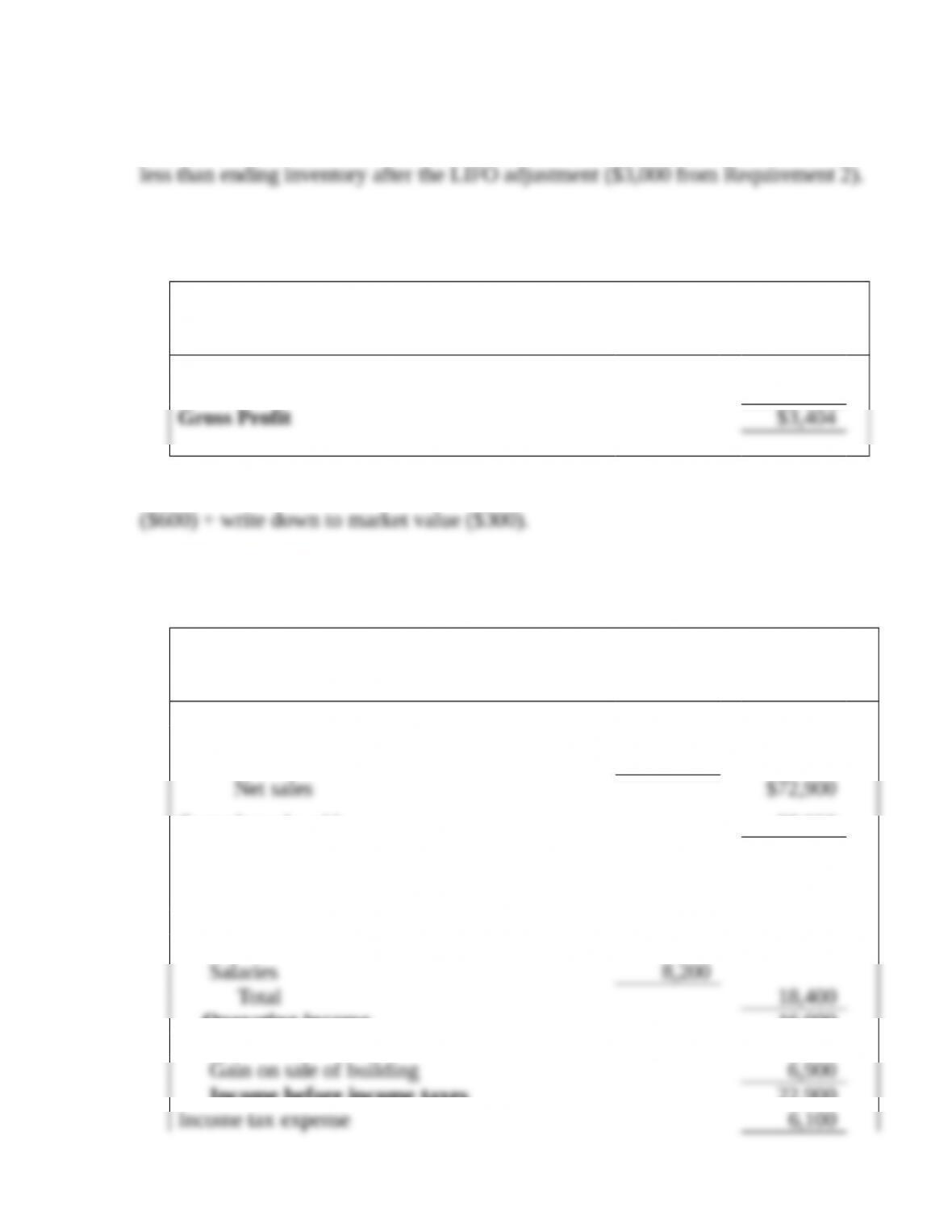
Yoshi Inc.
Multiple-step Income Statement (partial)
For the month of November
Net sales $22,000
Cost of goods sold* 18,596
Party Store
Multiple-step Income Statement
For the month of March, 2015
Net sales:
Total sales revenue $75,800
Less: Sales discounts (2,900)
Cost of goods sold 38,500
Gross Profit 34,400
Operating expenses:
Advertising 5,200
Rent 3,300
Insurance 1,700
Operating income 16,000
Non-operating items:
Income before income taxes 22,900
* The market value of ending inventory ($2,700 = $90 market value x 30 units) is $300
Requirement 4
* Cost of goods sold equals the cost of the units sold ($17,696) + LIFO adjustment
Problem 6-7C
Requirement 1

Net income $16,800
Inventory
turnover
ratio
=Cost of goods sold =$38,500
Average inventory ($2,200 + $1,800) /2
Gross
profit
ratio
=Gross profit =$34,400
Net sales $72,900
Company 1 Company 2
Inventory
turnover
ratio
=Cost of goods sold =$46,000 $80,000
Average inventory $23,000 $20,000
Problem 6-7C (concluded)
Requirement 2
This ratio will likely be higher in December when inventory is being sold at a much
faster pace due to the holiday season.
Requirement 3
Problem 6-8C
Requirement 1
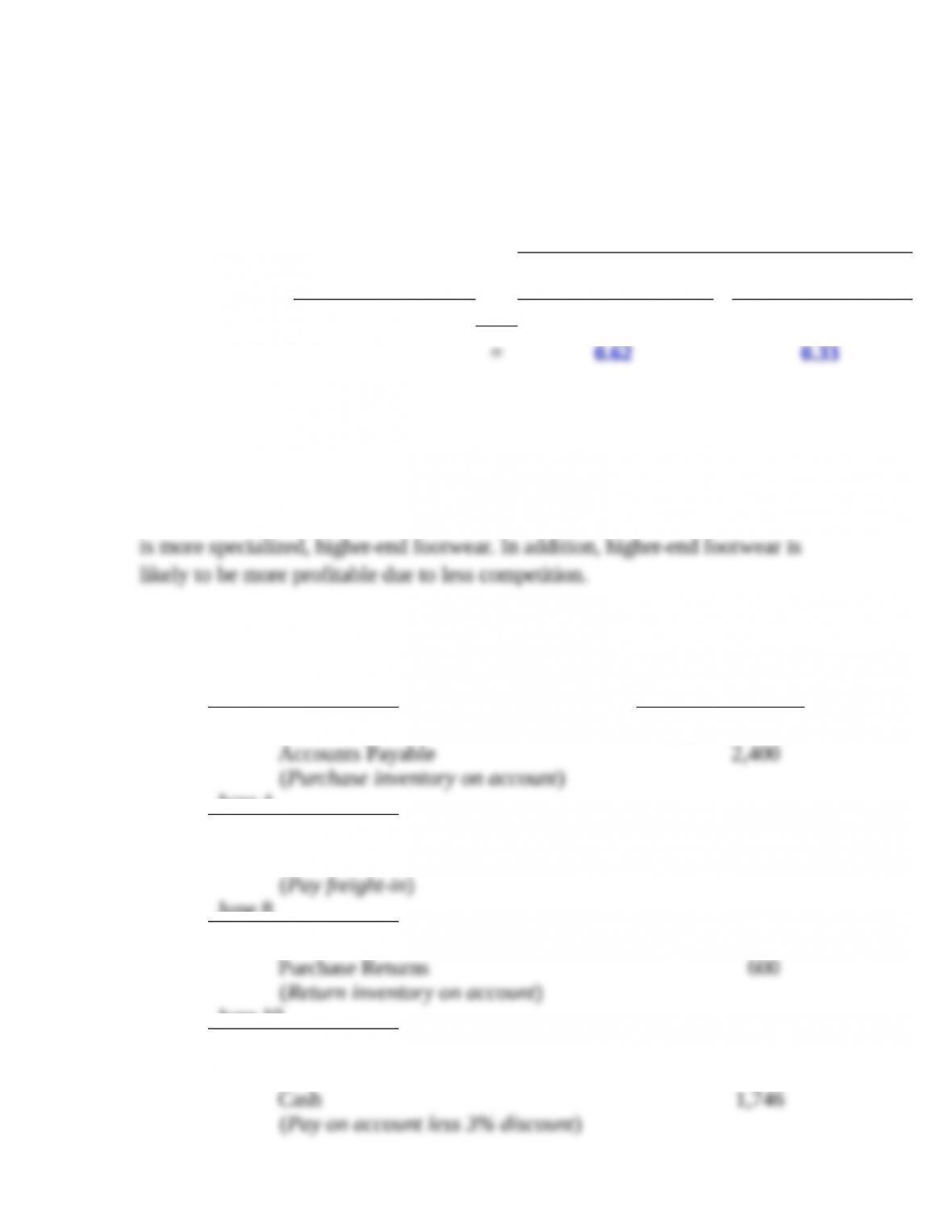
Company 1 Company 2
Gross
profit
ratio
=Gross profit =$74,000 $40,000
Net sales $120,000 $120,000
June 2 Debit Credit
Purchases 2,400
June 4
Freight-In 400
Cash 400
June 8
Accounts Payable 600
June 10
Accounts Payable 1,800
Purchase Discounts 54
Requirement 2
Requirement 3
Company 1 is likely Fancy and Company 2 is likely Thrift. The reason is that
common, lower-to-middle priced footwear is likely to sell more quickly than
Problem 6-9C
Requirement 1
June 11
Accounts Receivable 5,000
June 18
Cash 3,100
June 20 Debit Credit
Purchases 3,300
June 23 Debit Credit
Cash 4,800
June 26
Accounts Payable 300
June 28
Accounts Payable 3,000
Cash 2,910
July 31 Debit Credit
Inventory (ending) 656
Cost of Goods Sold 6,500
Purchase Returns 900
Problem 6-9C (continued)
Requirement 1 (concluded)
Requirement 2
Purchase Discounts 144
Purchases 5,700
Freight-In 400
Chow Company
Multiple-step Income Statement (partial)
For the month of July
Net sales $9,800
Cost of goods sold:
Add: Purchases
5,700
Less: Purchase returns
(900)
Cost of goods available for sale 7,156
Less: Ending inventory (656)
Gross Profit $3,300
Date Transaction
Number
of units
Unit
cost
Ending
Inventory
Oct. 29 Purchase 25 $39 $975
Date Transaction
Number
of units
Unit
cost
Cost of
Goods Sold
Jan. 1 Beginning Inventory 28 $33 $ 924
Apr. 14 Purchase 72 35 2,520
Aug. 22 Purchase 115 37 4,255
Problem 6-9C (concluded)
Requirement 3
Problem 6-10C
Requirement 1
Date Transaction
Number
of units
Unit
cost
Ending
Inventory
Oct. 29 Purchase 21 $36 $819
Date Transaction
Number
of units
Unit
cost
Cost of
Goods Sold
Jan. 1 Beginning Inventory 28 $33 $ 924
Apr. 14 Purchase 72 35 2,520
Aug. 22 Purchase 115 37 4,255
a First 280 units purchased are assumed sold
Requirement 2
* First 284 units purchased are assumed sold (including the 4 lost units)
Requirements 3 and 4
2015 2016
(a) ending inventory Overstate No Effect
(b) retained earnings Overstate No Effect