Problem 6-1B (concluded)
Requirement 3 LIFO
Date Transaction
Number
of units
Unit
cost
Ending
Inventory
Date Transaction
Number
of units
Unit
cost
Cost of
Goods Sold
Jun. 1 Beginning inventory 2 $350 $ 700
Jun. 12 Purchase 10 340 3,400
Jun. 24 Purchase 10 330 3,300
Jun. 29 Purchase 9 320 2,880
* Last 31 units purchased are assumed sold
Requirement 4 Weighted average
Date Transaction
Number
of units
Unit
cost
Total
Cost
Jun. 1 Beginning inventory 16 $350 $ 5,600
Jun. 12 Purchase 10 340 3,400
Jun. 24 Purchase 10 330 3,300
Weighted-average cost = $15,180 / 45 units = $337.3333 (rounded)
Ending inventory = 14 units × $337.3333 = $4,722.67
Problem 6-2B (LO 6-3, 6-4, 6-5)
Requirement 1 Specific identification
Date Transaction
Number
of units
Unit
cost
Ending
Inventory
Aug. 1 Beginning inventory 2 $160 $ 320
Aug. 11 Purchase 2 150 300
Date Transaction
Number
of units
Unit
cost
Cost of
Goods Sold
Aug. 1 Beginning inventory 5a$160 $ 800
Aug. 11 Purchase 8b150 1,200
Aug. 1 Beginning inventory 1c160 160
Aug. 20 Purchase 10c140 1,400
a From the August 4 sale; b From the August 13 sale; c From the August 26 sale.
Requirement 2 FIFO
Date Transaction
Number
of units
Unit
cost
Ending
Inventory
Aug. 20 Purchase 4 $140 $ 560
Aug. 29 Purchase 11 130 1,430
Date Transaction
Number
of units
Unit
cost
Cost of
Goods Sold
Aug. 1 Beginning inventory 8 $160 $1,280
Aug. 11 Purchase 10 150 1,500
* First 24 units purchased are assumed sold
Problem 6-2B (connued)
Requirement 3 LIFO
Date Transaction
Number
of units
Unit
cost
Ending
Inventory
Aug. 1 Beginning inventory 8 $160 $1,280
Aug. 11 Purchase 7 150 1,050
Date Transaction
Number
of units
Unit
cost
Cost of
Goods Sold
Aug. 11 Purchase 3 $150 $ 450
Aug. 20 Purchase 10 140 1,400
Aug. 29 Purchase 11 130 1,430
* Last 24 units purchased are assumed sold
Requirement 4 Weighted average
Date Transaction
Number
of units
Unit
cost
Total
Cost
Aug. 1 Beginning inventory 8 $160 $1,280
Aug. 11 Purchase 10 150 1,500
Aug. 20 Purchase 10 140 1,400
Aug. 29 Purchase 11 130 1,430
Weighted-average cost = $5,610 / 39 units = $143.8462 (rounded)
Ending inventory = 15 units × $143.8462 = $2,157.69
Problem 6-2B (concluded)
Requirement 5
Specific
Identification FIFO LIFO
Weighted-ave
rage
Cost
Sales revenue $5,795 $5,795 $5,795 $5,795.00
Cost of goods sold 3,560 3,620 3,280 3,452.31
Requirement 6
FIFO provides the more meaningful measure of ending inventory. The amount of
ending inventory reported using FIFO ($1,990) compared to LIFO ($2,330) be3er
Requirement 7
August 31 Debit Credit
Inventory 340
The LIFO reserve equals the difference in inventory reported using FIFO ($1,990)
versus using LIFO ($2,330). The LIFO reserve equals −$340.
Problem 6-3B (LO 6-2, 6-5)
Requirement 1
June 2 Debit Credit
Inventory 2,700
June 4
Inventory 400
June 8
Accounts Payable 400
June 10
Accounts Payable 2,300
Inventory 23
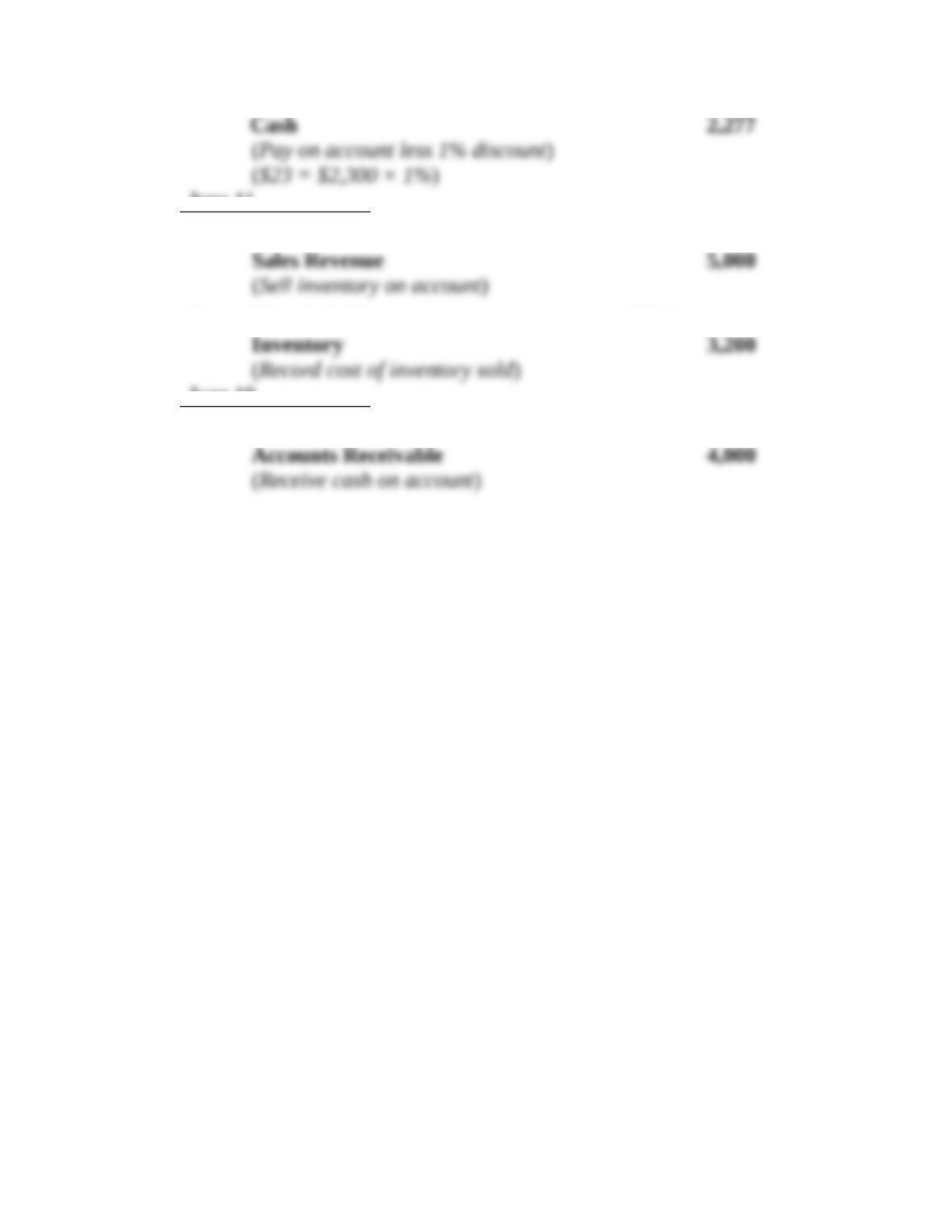
June 11
Accounts Receivable 5,000
Cost of Goods Sold 3,200
June 18
Cash 4,000
Problem 6-3B (concluded)
Requirement 1 (con7nued)
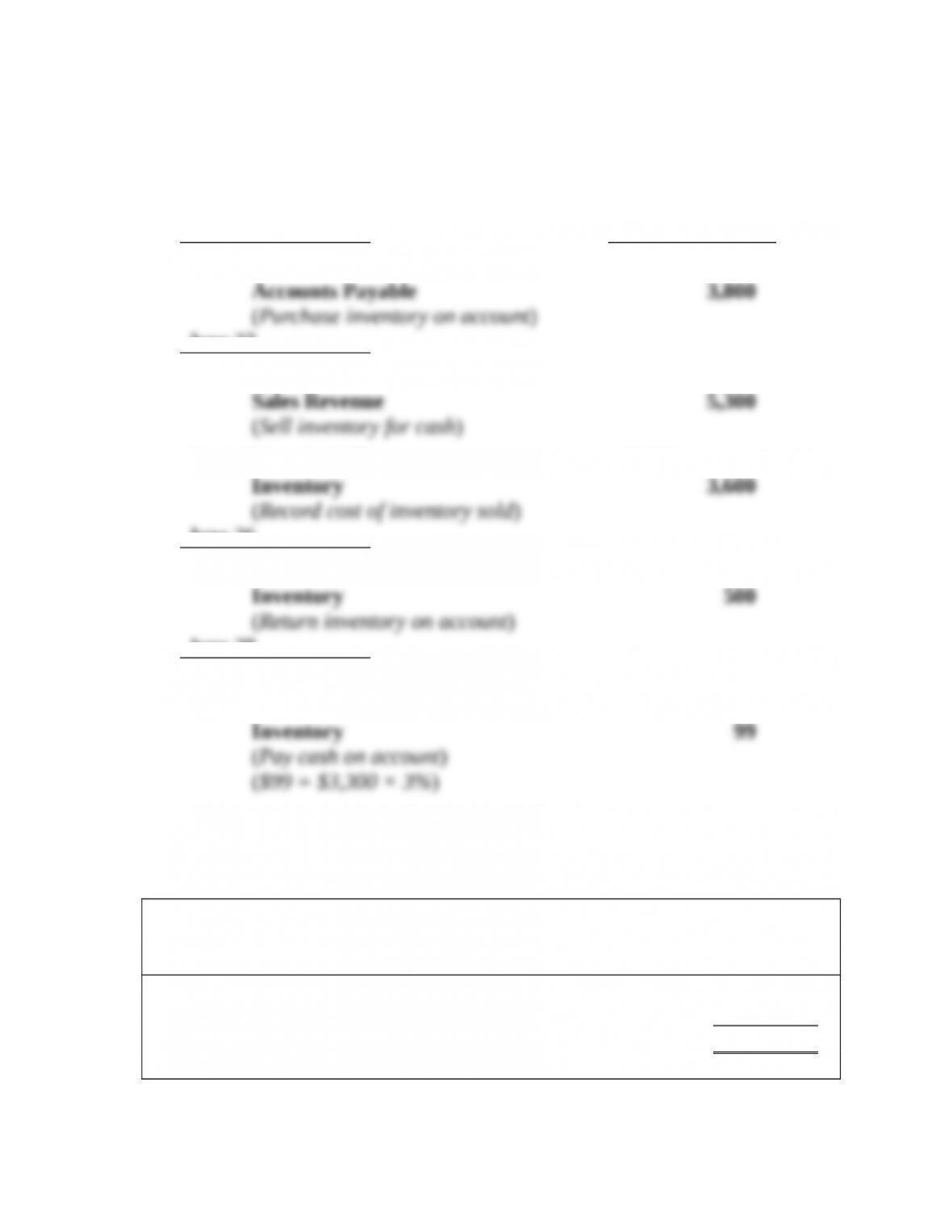
June 20 Debit Credit
Inventory 3,800
June 23
Cash 5,300
Cost of Goods Sold 3,600
June 26
Accounts Payable 500
June 28
Accounts Payable 3,300
Cash 3,201
Requirement 2
Circuit Country
Multiple-step Income Statement (partial)
For the month of June
Net sales $10,300
Cost of goods sold 6,800
Gross profit $ 3,500
Problem 6-4B (LO 6-6)
Requirement 1
Inventory items Quantity
Cost
Per unit
Total
Cost
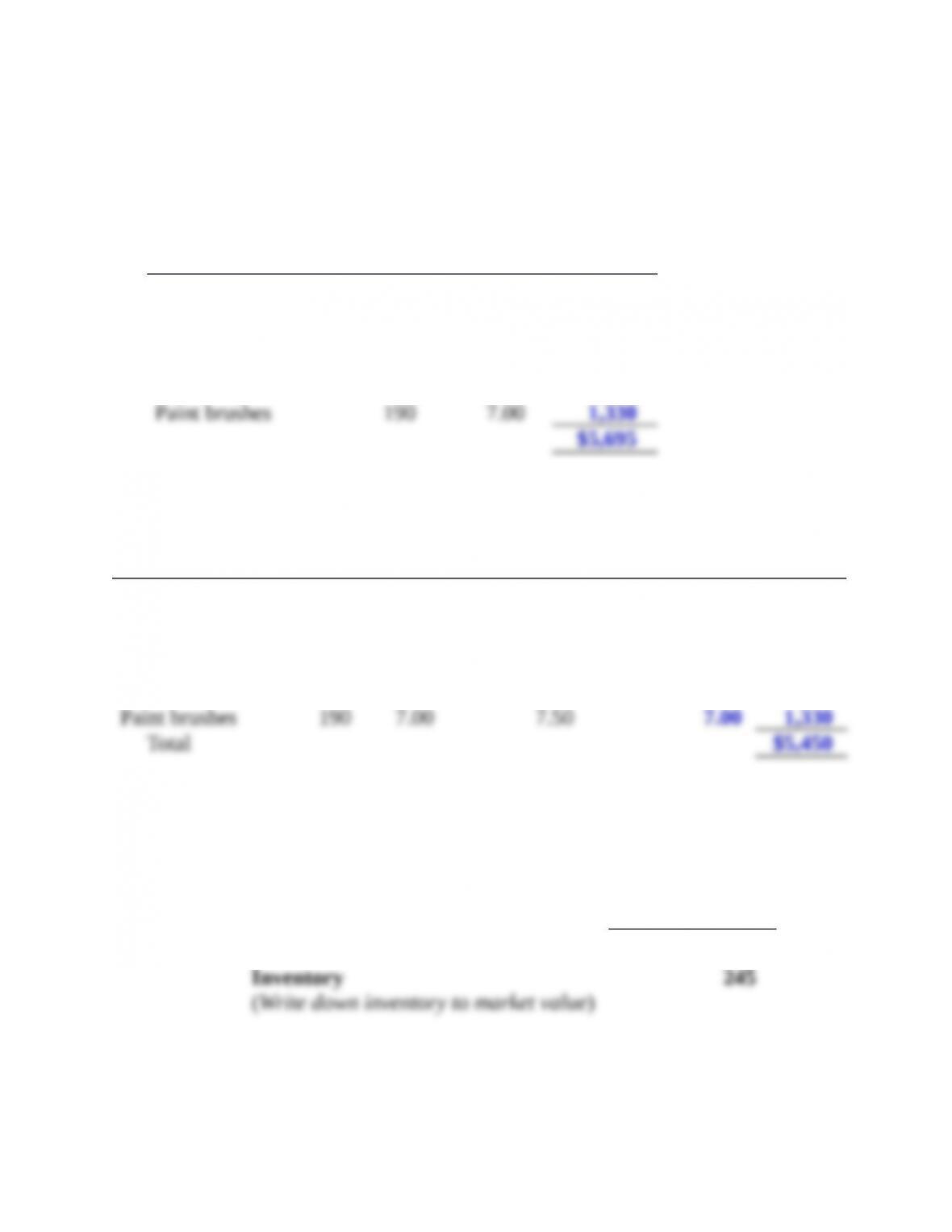
Hammers 110 $ 8.00 $ 880
Saws 60 11.00 660
Screwdrivers 140 3.00 420
Drills 50 26.00 1,300
1-gallon paint cans 170 6.50 1,105
Requirement 2
Inventory items Quantity
Cost
Per unit
Market
(replacement cost)
per unit
Lower-
of–cost-or-
market Total
Hammers 110 $ 8.00 $ 8.50 $ 8.00 $ 880
Saws 60 11.00 10.00 10.00 600
Screwdrivers 140 3.00 3.60 3.00 420
Drills 50 26.00 24.00 24.00 1,200
1-gallon paint cans 170 6.50 6.00 6.00 1,020
Requirement 3
Because the total of lower-of-cost-or-market ($5,450) is less than total cost
($5,695), inventory is written down for the difference ($245).
Debit Credit
Cost of Goods Sold 245
Requirement 4
The write-down of inventory from cost to market value reduces total assets and
increases total expenses, leading to lower net income and lower retained earnings.
Problem 6-5B (LO 6-3, 6-6)
Requirement 1 FIFO
Date Transaction
Number
of units
Unit
cost
Ending
Inventory
Date Transaction
Number
of units
Unit
cost
Cost of
Goods Sold
Jan. 1 Beginning inventory 20 $500 $10,000
Apr. 9 Purchase 30 520 15,600
a First 52 units purchased are assumed sold
Requirement 2 LIFO
Date Transaction
Number
of units
Unit
cost
Ending
Inventory
Jan. 1 Beginning inventory 9 $500 $4,500
Date Transaction
Number
of units
Unit
cost
Cost of
Goods Sold
Jan. 1 Beginning inventory 11 $500 $ 5,500
Apr. 9 Purchase 30 520 15,600
a Last 52 units purchased are assumed soldProblem 6-5B (concluded)
Requirement 3
Ending Inventory
Cost Market
Lower-of-cost-
or-market
FIFO $4,950a$3,150 $3,150
LIFO 4,500b3,150 3,150
a Ending inventory from Requirement 1 above.
b Ending inventory from Requirement 2 above.
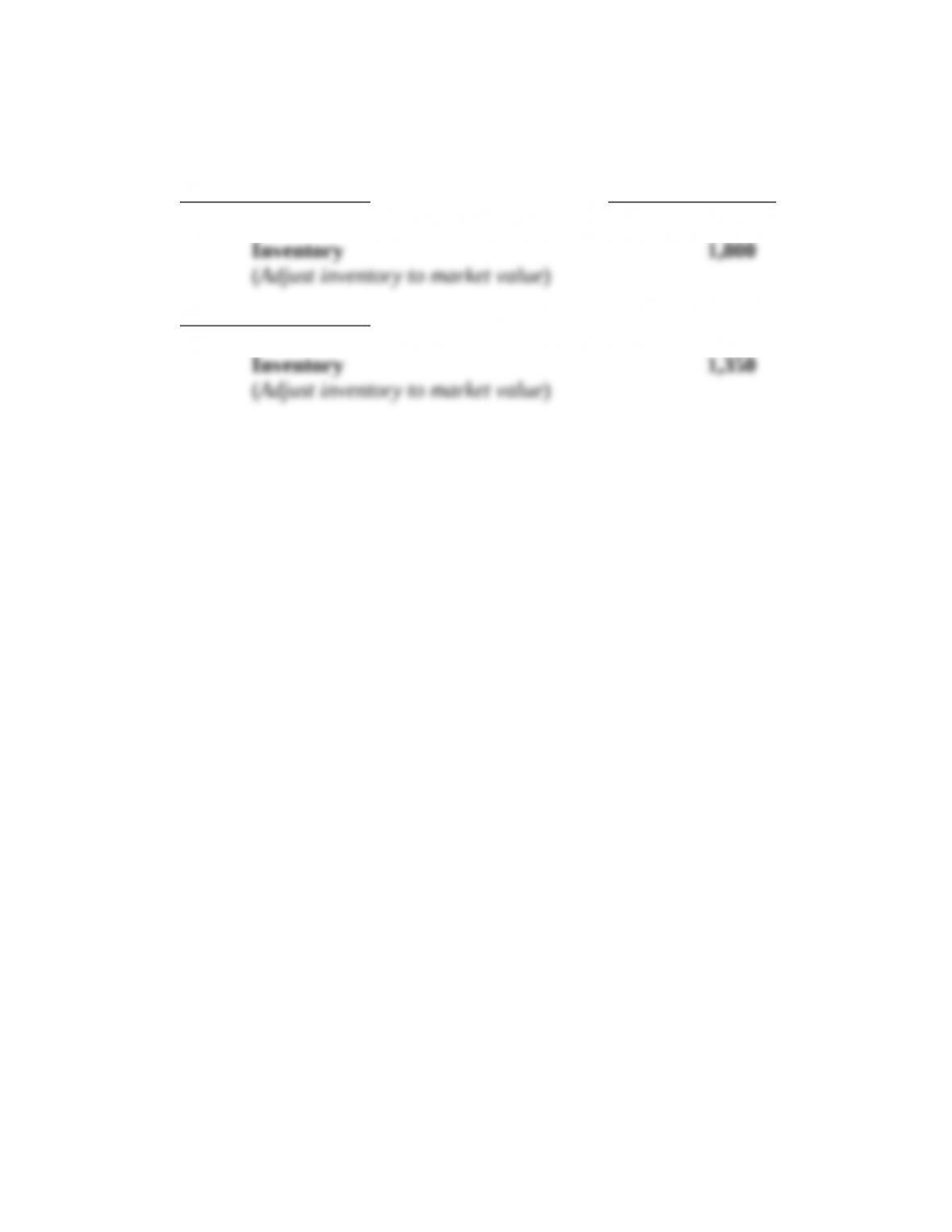
(a) FIFO Debit Credit
Cost of Goods Sold 1,800
(b) LIFO
Cost of Goods Sold 1,350
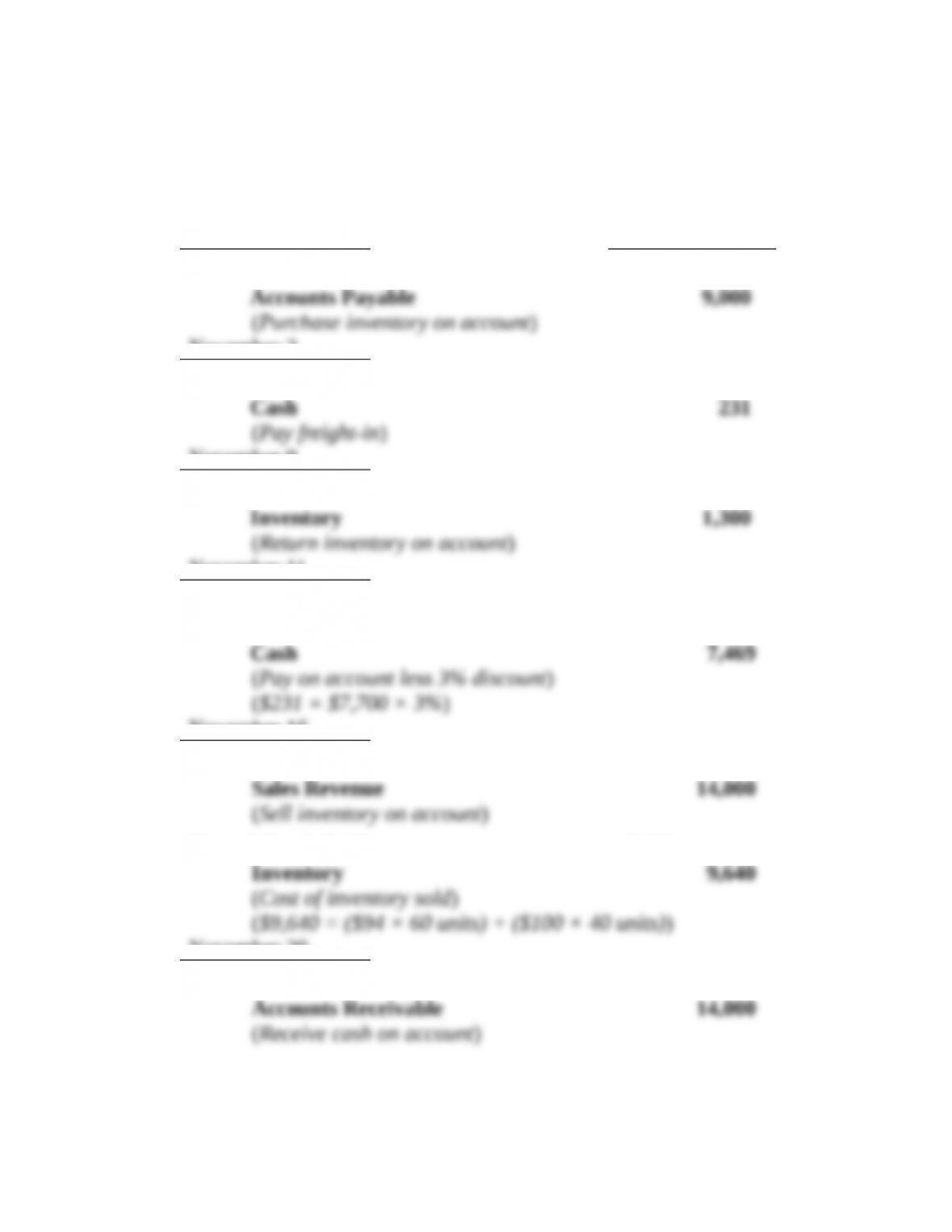
Problem 6-6B (LO 6-2, 6-3, 6-4, 6-5, 6-6)
Requirement 1
November 2 Debit Credit
Inventory 9,000
November 3
Inventory 231
November 9
Accounts Payable 1,300
November 11
Accounts Payable 7,700
Inventory 231
November 16
Accounts Receivable 14,000
Cost of Goods Sold 9,640
November 20
Cash 14,000