Question 6-1 (LO 6-1)
Inventory includes items a company intends for sale to customers. Inventory also includes items
that are not yet finished products. The cost of inventory that has not been sold by the end of the
Question 6-2 (LO 6-1)
Service companies earn revenues by providing services to their customers. Manufacturing or
Question 6-3 (LO 6-1)
Raw materials inventory includes the cost of components that will become part of the finished
product but have not yet been used in production. Work-in-process inventory refers to the
products that have started the production process but are not yet complete at the end of the
Question 6-4 (LO 6-2)
The cost of goods (or inventory) available for sale equals the cost of beginning inventory plus
additional purchases during the reporting period. By subtracting the cost of ending inventory at
Question 6-5 (LO 6-2)
The balance of cost of goods sold in the income statement represents the cost of inventory sold
during the period. For a company like Radio Shack, this would include inventory sold such as
Question 6-6 (LO 6-2)
A multiple-step income statement reports multiple levels of profitability. Gross profit equals net
sales minus cost of goods sold. Operating income equals gross profit minus operating expenses.
Chapter 6
Inventory and Cost of Goods SoldReview Questions
Answers to Review Quesons (connued)
Question 6-7 (LO 6-3)
Because of the large number of inventory transactions for most companies and the high volatility
Question 6-8 (LO 6-3)
The three most common inventory cost flow assumptions are FIFO (first-in, first-out), LIFO
(last-in, first-out), and weighted-average cost. These methods provide assumptions as to which
Question 6-9 (LO 6-4)
FIFO results in the highest reported amount for ending inventory when inventory costs are rising.
Question 6-10 (LO 6-4)
FIFO results in the highest reported amount of net income when inventory costs are rising. The
reason is that under the FIFO method, the oldest (or first) items are sold first and these are the
Question 6-11 (LO 6-4)
Since FIFO assumes the first purchases sell first, the amount it reports for ending inventory (in
the balance sheet) better approximates the current cost of inventory. LIFO assumes the last
purchases are sold first, reporting the most recent inventory cost in cost of goods sold (in the
Question 6-12 (LO 6-4)
LIFO generally results in lower income taxes payable when inventory costs are increasing
Question 6-13 (LO 6-5)
The perpetual inventory system maintains a continual – or perpetual – record of inventory

Question 6-14 (LO 6-5)
Freight charges add to the cost of inventory, while purchase discounts and purchase returns
Answers to Review Quesons (connued)
Question 6-15 (LO 6-6)
We report inventory using the lower-of-cost-or-market method, that is, at cost (specific
identification, FIFO, LIFO, or weighted-average cost) or market value (normally, replacement
Question 6-16 (LO 6-6)
The cost of inventory is determined using specific identification, FIFO, LIFO, or
Question 6-17 (LO 6-6)
The entry to adjust from cost to market for inventory write-downs includes a debit to cost of
goods sold (increase to expenses) and a credit to inventory (decrease to assets). The adjustment
has the following effects:
(a) assets (inventory) = decrease
(b) liabilities = no effect
Question 6-18 (LO 6-6)
Firms are required to report the falling value of inventory but not allowed to report the increasing
value of inventory. Conservative accounting implies that there is more potential harm to users of
Question 6-19 (LO 6-7)
The inventory turnover ratio equals cost of goods sold divided by average inventory. The ratio
shows the number of times the firm sells its average inventory balance during a reporting period.
Answers to Review Questions (continued)
Question 6-20 (LO 6-7)
Gross profit equals net sales minus cost of goods sold. The gross profit ratio equals gross profit
divided by net sales. The gross profit ratio measures the amount by which the sale price of
Question 6-21 (LO 6-8)
Under the periodic system, the sale of inventory is recorded by increasing an asset account (cash
or accounts receivable) and increasing sales revenue. Under the perpetual system, two
Question 6-22 (LO 6-8)
The purposes of the period-end adjustment are to (1) update the balance of inventory for its
Question 6-23 (LO 6-9)
Understating ending inventory in the current year will have the following effects in the current
year:
(a) assets (inventory) = understated
(b) liabilities = no effect
(c) stockholders’ equity (or retained earnings) = understated
Question 6-24 (LO 6-9)
Understating ending inventory in the current year will have the following effects in the following
year:
(a) assets (inventory) = no effect
(b) liabilities = no effect
(c) stockholders’ equity (or retained earnings) = no effect
BRIEF Exercises
Brief Exercise 6-1 (LO 6-1)
1. b.
2. a.
3. c.
Brief Exercise 6-2 (LO 6-1)
1. c.
2. a.
3. b.
Brief Exercise 6-3 (LO 6-2)
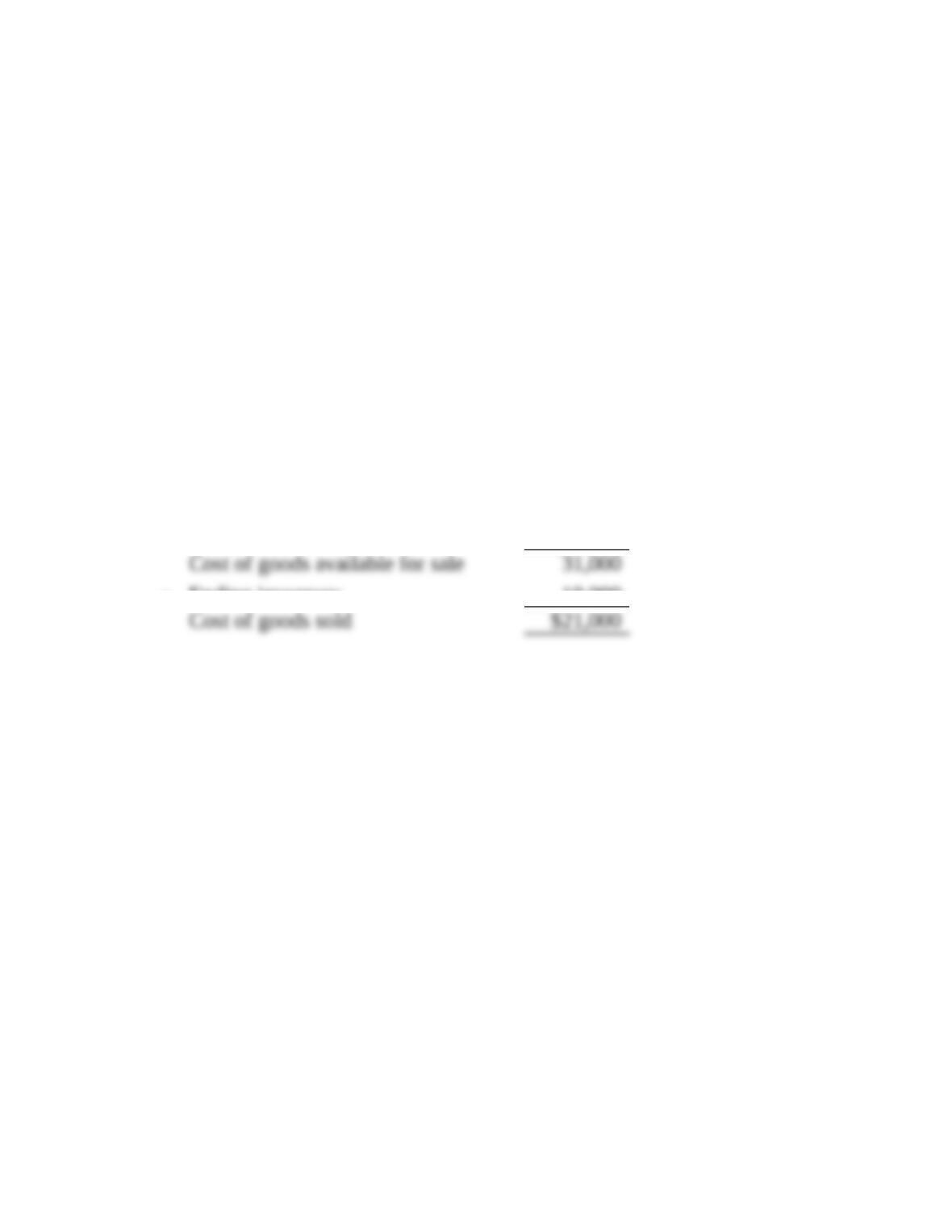
Beginning inventory $ 8,000
+ Purchases 23,000
− Ending inventory 10,000
Brief Exercise 6-4 (LO 6-2)
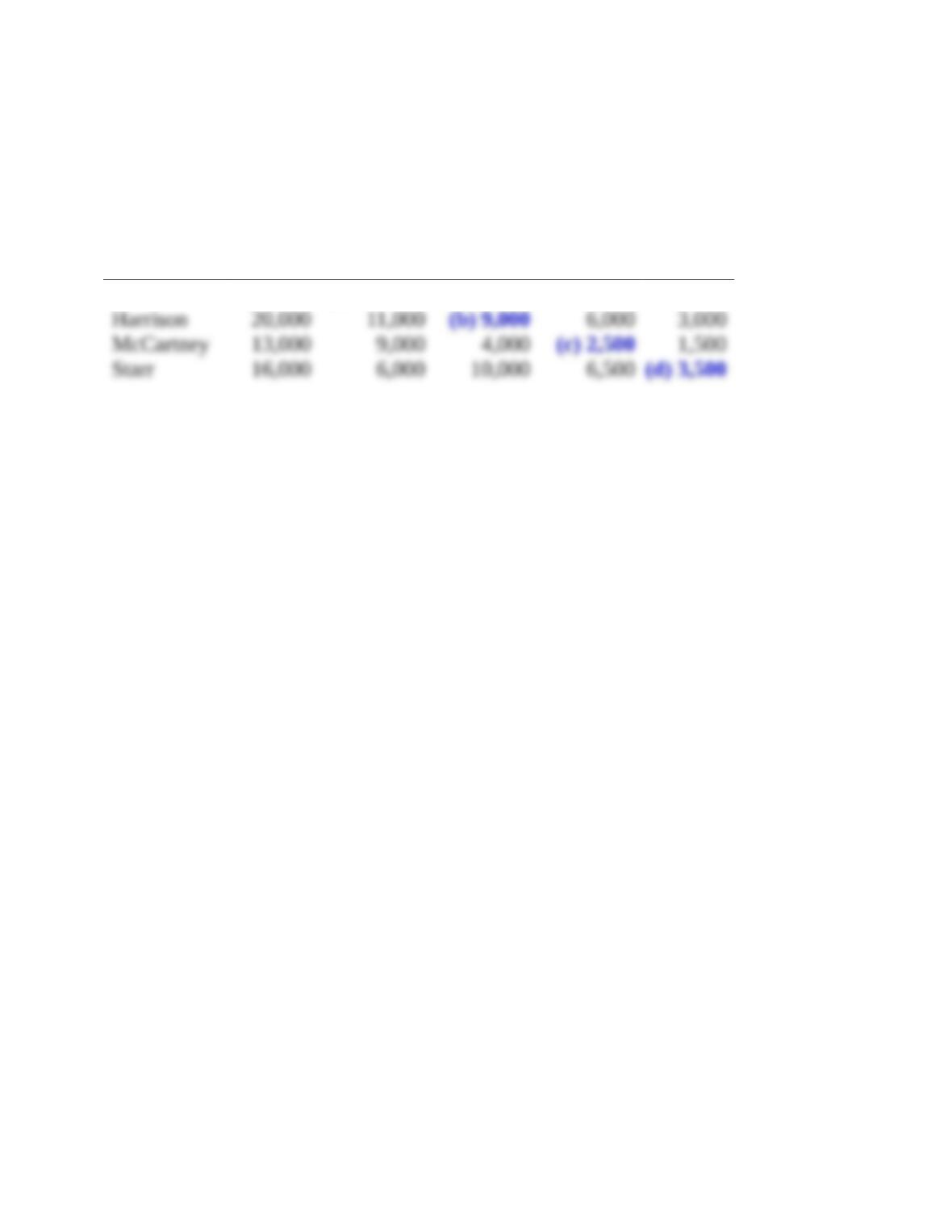
Company
Sales
revenue
Cost of
goods sold
Gross
profita
Operating
expenses
Net
incomeb
Lennon $18,000 (a) $10,000 $ 8,000 $3,500 $4,500
a Gross profit = Sales revenue − Cost of goods sold
b Net income = Gross profit − Operating expenses
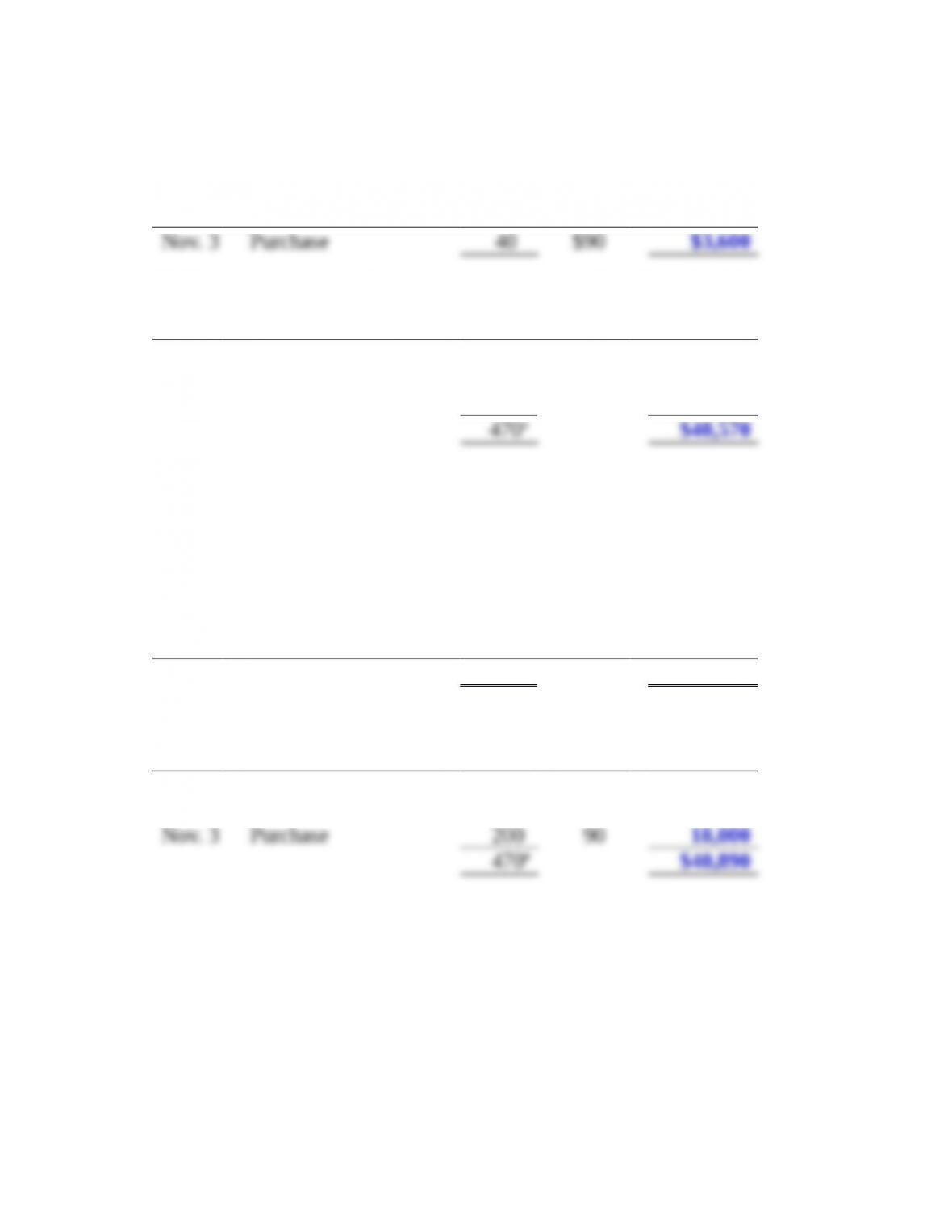
Brief Exercise 6-5 (LO 6-3)
Date Transaction
Number
of units
Unit
cost
Ending
Inventory
Date Transaction
Number
of units
Unit
cost
Cost of
Goods Sold
Jan. 1 Beginning inventory 60 $82 $ 4,920
May 5 Purchase 250 85 21,250
Nov. 3 Purchase 160 90 14,400
a First 470 units purchased are assumed sold
Brief Exercise 6-6 (LO 6-3)
Date Transaction
Number
of units
Unit
cost
Ending
Inventory
Jan. 1 Beginning inventory 40 $82 $3,280
Date Transaction
Number
of units
Unit
cost
Cost of
Goods Sold
Jan. 1 Beginning inventory 20 $82 $ 1,640
May 5 Purchase 250 85 21,250
a Last 470 units purchased are assumed sold
Brief Exercise 6-7 (LO 6-3)
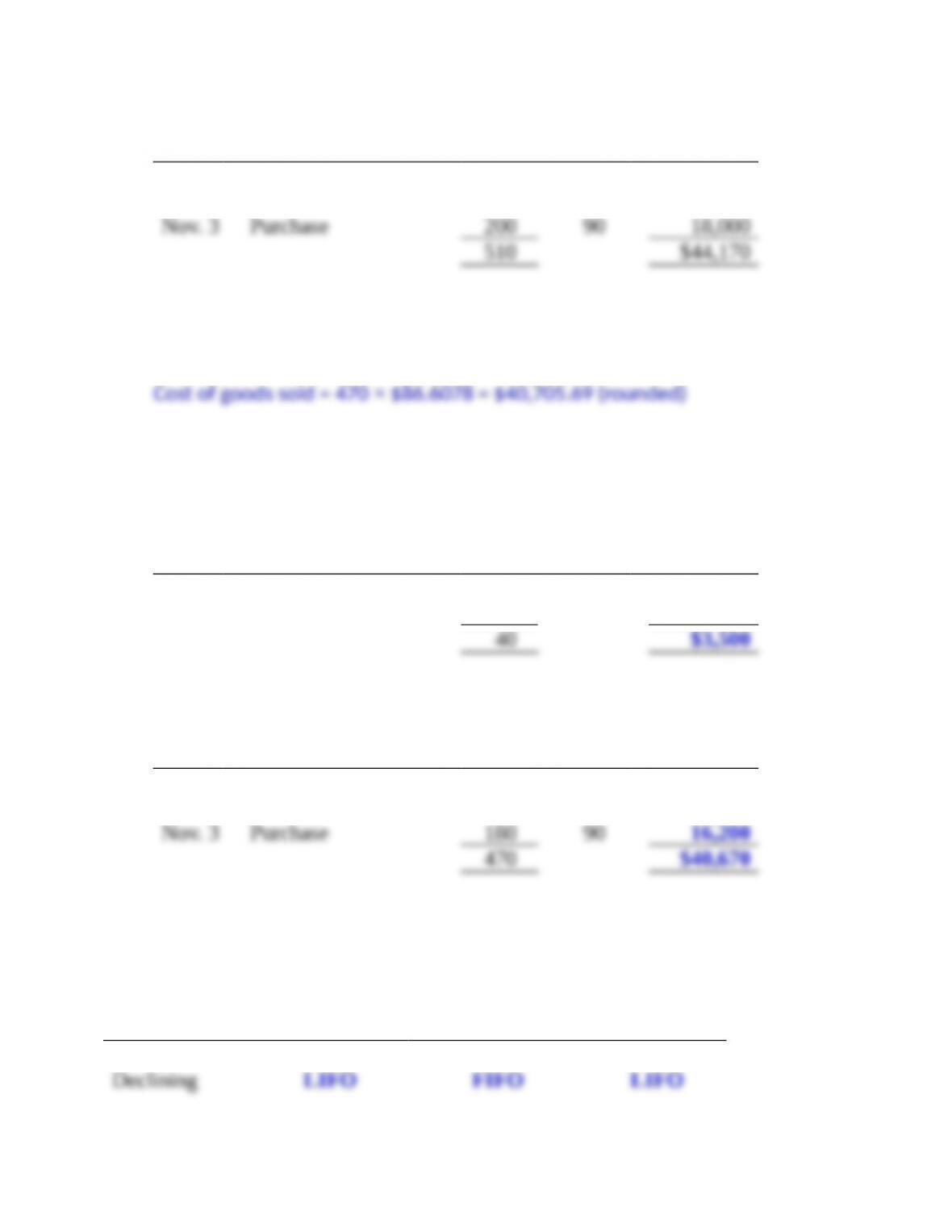
Date Transaction
Number
of units
Unit
cost
Total
Cost
Jan. 1 Beginning inventory 60 $82 $ 4,920
May 5 Purchase 250 85 21,250
Weighted-average cost = $44,170 / 510 units = $86.6078 / unit
Ending inventory = 40 × $86.6078 = $3,464.31
Brief Exercise 6-8 (LO 6-3)
Date Transaction
Number
of units
Unit
cost
Ending
Inventory
May 5 Purchase 20 $85 $1,700
Nov. 3 Purchase 20 90 1,800
Date Transaction
Number
of units
Unit
cost
Cost of
Goods Sold
Jan. 1 Beginning inventory 60 $82 $ 4,920
May 5 Purchase 230 85 19,550
Brief Exercise 6-9 (LO 6-4)
Inventory
Costs
Higher
total assets
Higher
cost of goods sold
Higher
net income
Rising FIFO LIFO FIFO
Brief Exercise 6-10 (LO 6-5)
February 2, 2015 Debit Credit
Inventory 40,000
March 17, 2015 Debit Credit
Accounts Receivable 60,000
Cost of Goods Sold 40,000
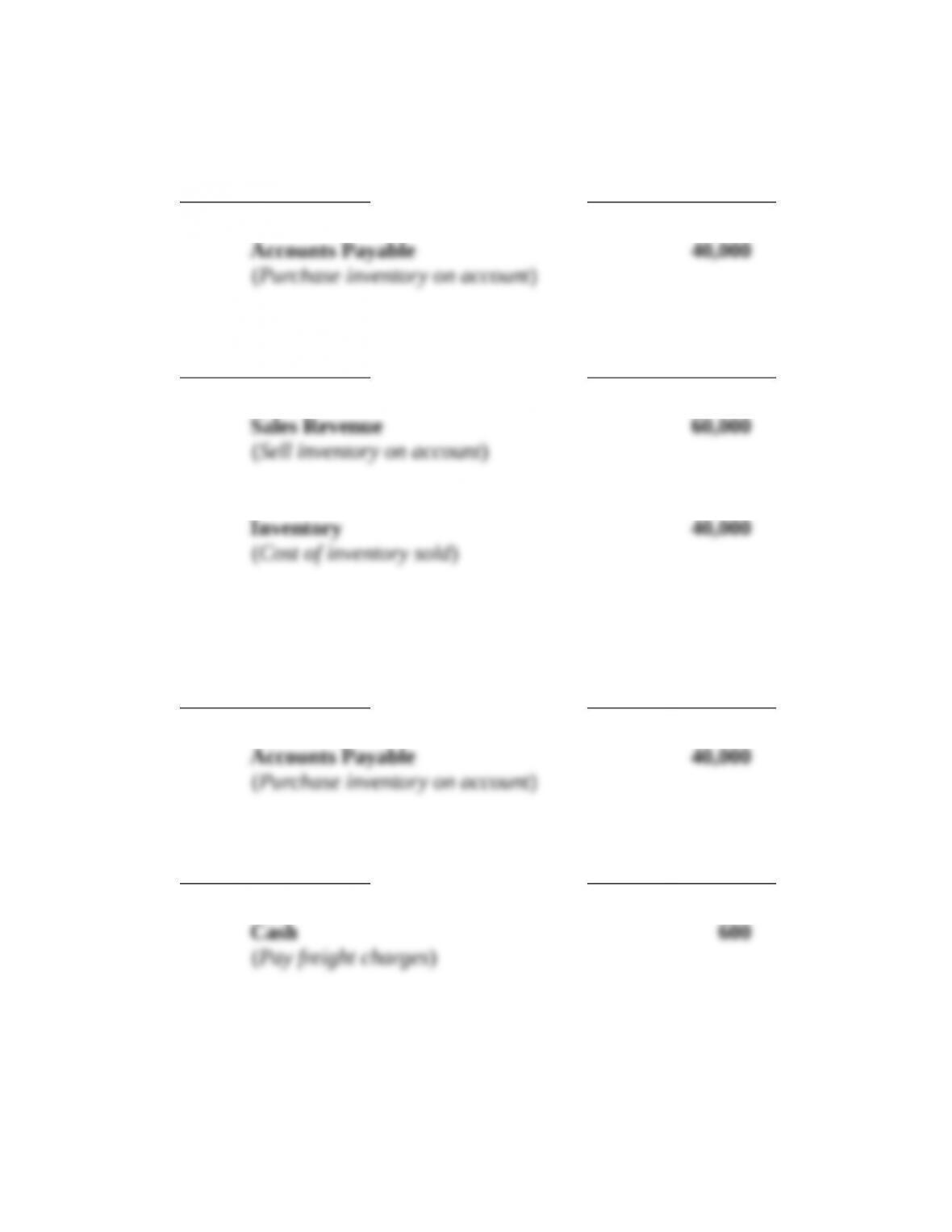
Brief Exercise 6-11 (LO 6-5)
February 2, 2015 Debit Credit
Inventory 40,000
February 2, 2015 Debit Credit
Inventory 600
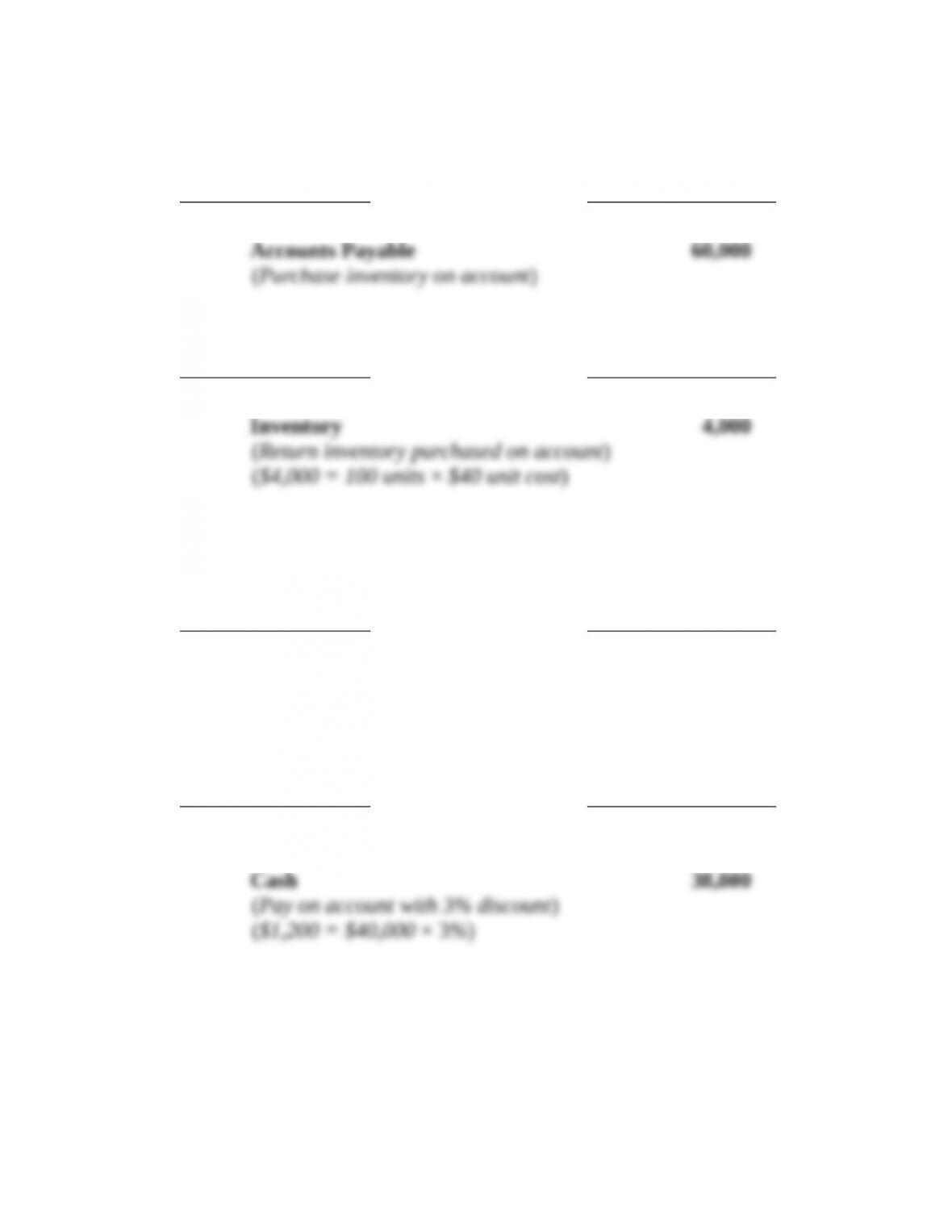
Brief Exercise 6-12 (LO 6-5)
February 2, 2015 Debit Credit
Inventory 60,000
February 5, 2015 Debit Credit
Accounts Payable 4,000
Brief Exercise 6-13 (LO 6-5)
February 2, 2015 Debit Credit
Inventory 40,000
Accounts Payable 40,000
(Purchase inventory on account)
February 10, 2015 Debit Credit
Accounts Payable 40,000
Inventory 1,200