Question 5-1 (LO 5-1)
When recording a credit sale, we debit accounts receivable. Accounts receivable are reported
Question 5-2 (LO 5-1)
Trade receivables are amounts receivable from customers due to credit sales. Nontrade
receivables are receivables from those other than customers and include tax refund claims,
Question 5-3 (LO 5-2)
Trade discounts represent a reduction in the listed price of a product or service. A sales
discount represents a reduction, not in the selling price of a product or service, but in the amount
Question 5-4 (LO 5-2)
Sales returns and allowances are contra revenue accounts and therefore have normal debit
balances. Sales returns occur when a customer returns a product. Sales allowances occur when
Question 5-5 (LO 5-2)
An example of earning revenue at one point would be selling a car. An example of earning
Question 5-6 (LO 5-3)
Companies should account for uncollectible accounts receivable using the allowance method.
Question 5-7 (LO 5-3)
The two purposes include reducing accounts receivable to their net realizable value (or
Answers to Review Questions (continued)
Question 5-8 (LO 5-3)
Chapter 5
Receivables and SalesREVIEW QUESTIONS
Credit sales represent revenue from selling products and services on account in the current
period. One of the costs associated with credit sales is bad debts. Therefore, to properly match
Question 5-9 (LO 5-3)
The two financial statement effects of establishing an allowance for uncollectible accounts
Question 5-10 (LO 5-3)
The year-end adjustment to record the allowance for uncollectible accounts includes a debit
to bad debt expense and a credit to the allowance for uncollectible accounts. The amount of the
Question 5-11 (LO 5-3)
A debit balance in the allowance for uncollectible accounts before adjustment could occur if
Question 5-12 (LO 5-3)
Net realizable value is the amount of cash the firm expects to collect. Net realizable value is
Question 5-13 (LO 5-4)
The age of accounts receivable refers to how far past due accounts are. The older the account,
the less likely it is to be collected. The aging method estimates uncollectible accounts receivable
Question 5-14 (LO 5-5)
Question 5-15 (LO 5-5)
A credit balance occurs in the Allowance for Uncollectible Accounts before adjustment when
Answers to Review Questions (continued)
Question 5-16 (LO 5-6)
The allowance method requires companies to estimate future bad debts and record those
estimates in the current period as a reduction in accounts receivable and an increase in bad debt
expense. The direct write-off method makes no attempt to estimate future bad debts. Instead, the
Question 5-17 (LO 5-7)
One common difference is that notes receivable commonly require the borrower to pay
interest. Also, notes receivable typically arise not from sales to customers, but from loans to
Question 5-18 (LO 5-7)
Face value – amount of the note.
Annual interest rate – the interest charged by the lender to the borrower stated on an annual
(twelve month) basis.
Fraction of the year – the proportion of the year that the note is outstanding.
Question 5-19 (LO 5-7)
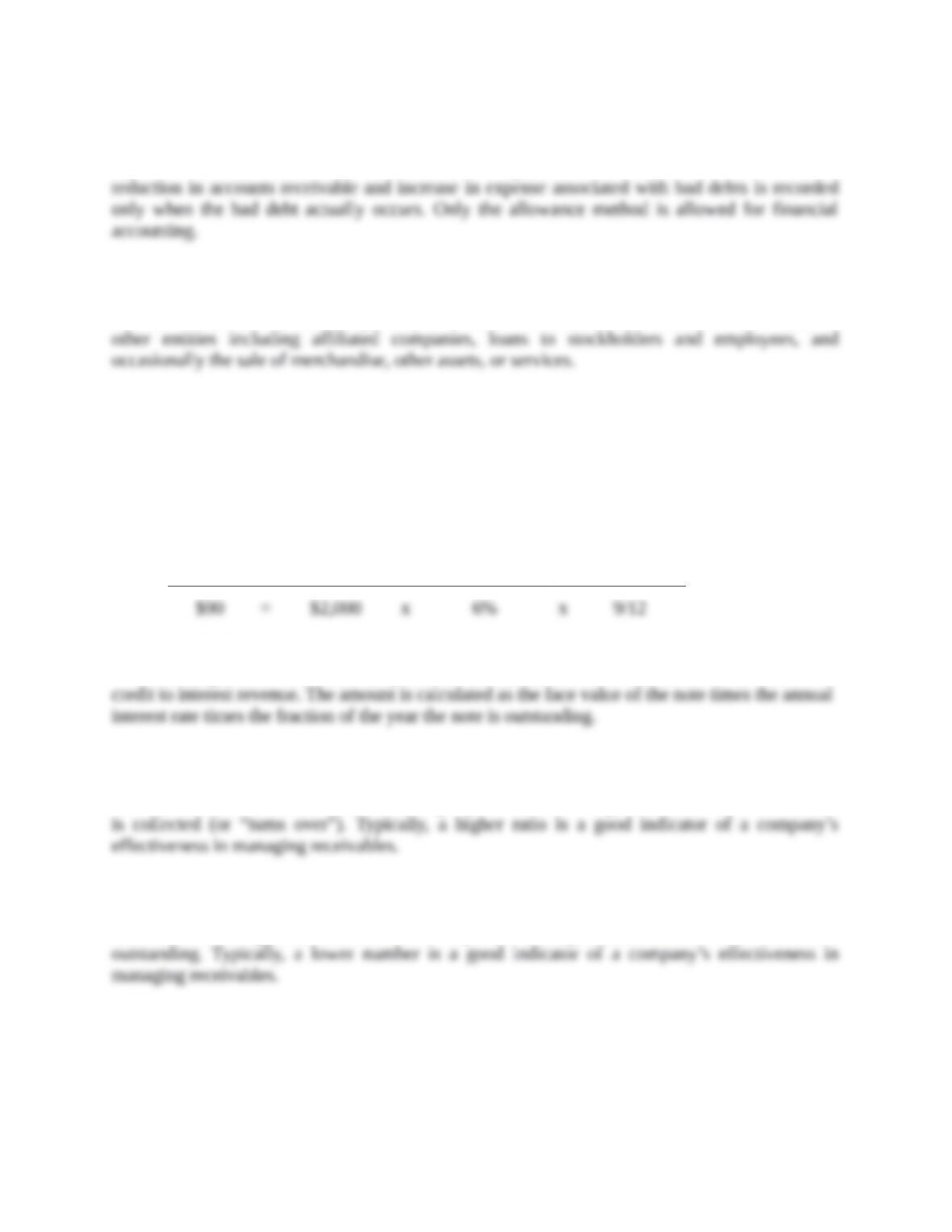
Interest = Face
value xAnnual
interest rate xFraction of
the year
Question 5-20 (LO 5-7)
Recording interest earned but not yet received includes a debit to interest receivable and a
Question 5-21 (LO 5-8)
The receivables turnover ratio equals net credit sales divided by average accounts receivable.
The ratio shows the number of times during a year that the average accounts receivable balance
Question 5-22 (LO 5-8)
The average collection period equals 365 days divided by the receivables turnover ratio. The
ratio shows the approximate number of days the average accounts receivable balance is
Answers to Review Questions (continued)
Question 5-23 (LO 5-8)
A company can attempt to boost sales, and thereby increase its value, by allowing customers
to purchase products and services on account. Some customers may be unwilling or unable to
purchase products and services in the current period if immediate cash payment is required.
Question 5-24 (LO 5-9)
The percentage of receivables method is commonly used in practice. Financial accounting
rules require accounts receivable to be stated at their net realizable value, and this is better
Question 5-25 (LO 5-9)
The percentage of receivables method estimates future bad debts based on a balance sheet
account – accounts receivable. The percentage of credit sales method estimates future bad debts
based on an income statement account – credit sales. The current emphasis on better
Brief Exercise 5-1 (LO 5-2)
Debit Credit
Accounts Receivable 3,080
Accounts Receivable 700
BRIEF EXERCISES
Brief Exercise 5-2 (LO 5-2)
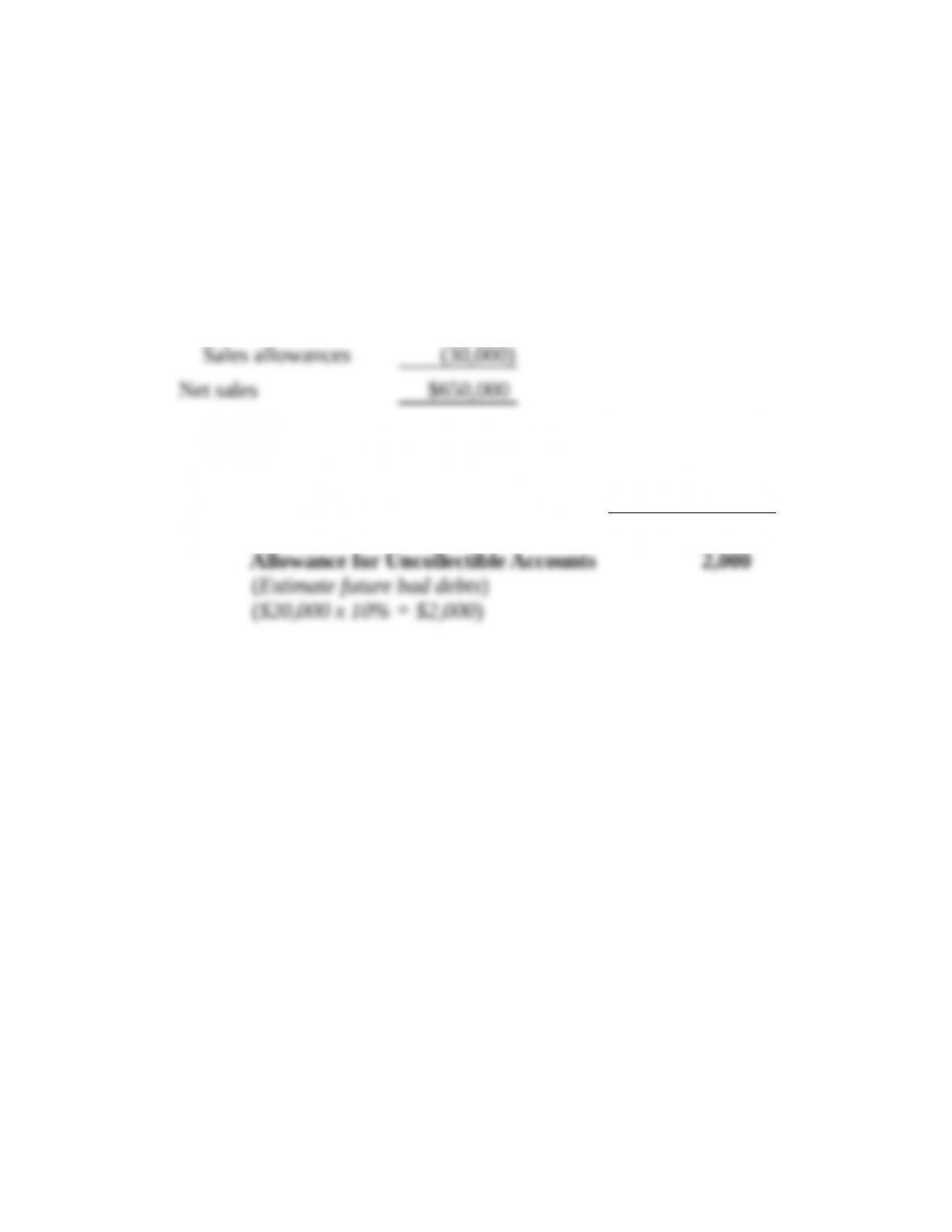
Total sales $750,000
Less:
Sales discounts (20,000)
Sales returns (50,000)
Brief Exercise 5-3 (LO 5-3)
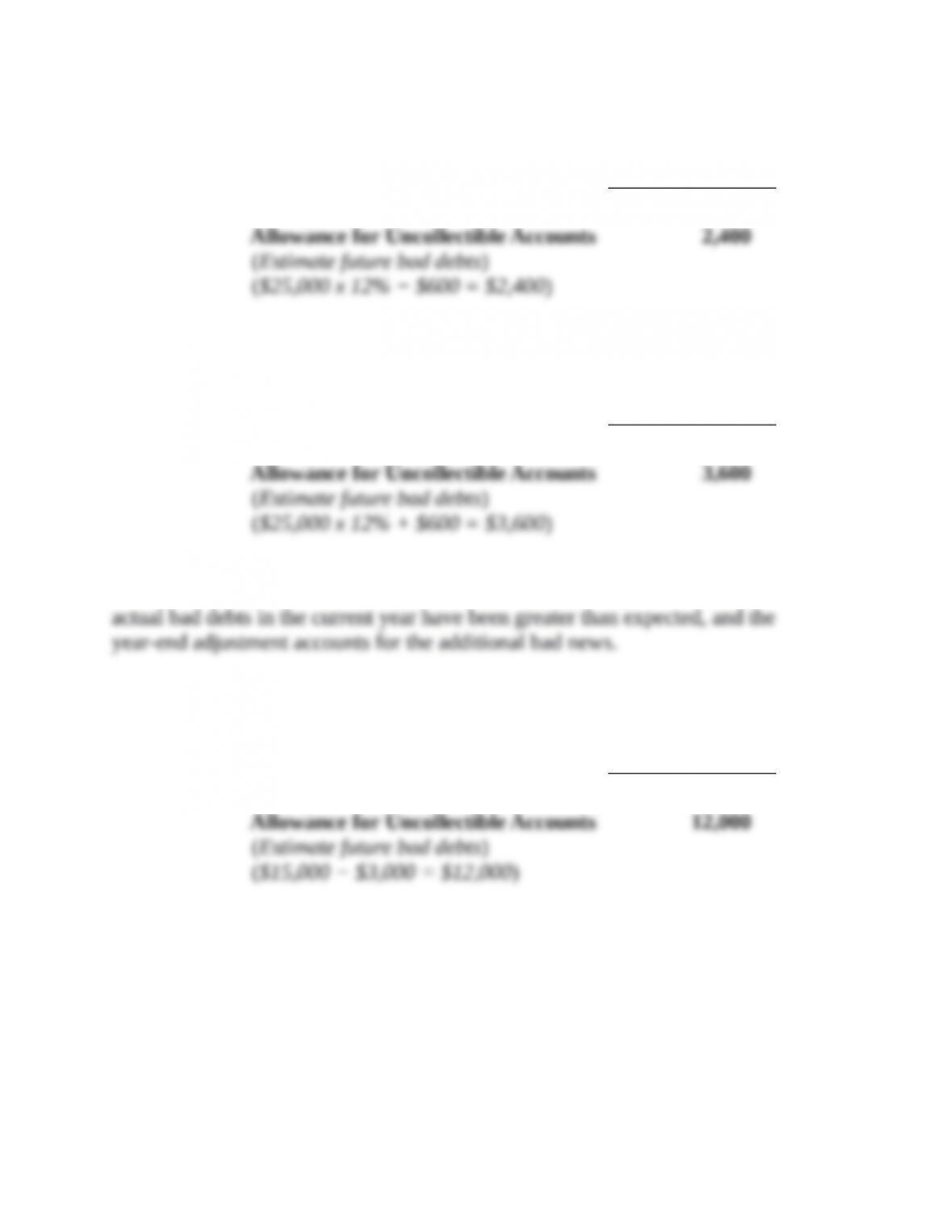
Debit Credit
Bad Debt Expense 2,000
Brief Exercise 5-4 (LO 5-3)
Debit Credit
Bad Debt Expense 2,400
Brief Exercise 5-5 (LO 5-3)
Debit Credit
Bad Debt Expense 3,600
The amount in BE5-5 is greater because the balance of Allowance for
Uncollectible Accounts before adjustment is a debit (or negative). This means that
Brief Exercise 5-6 (LO 5-3)
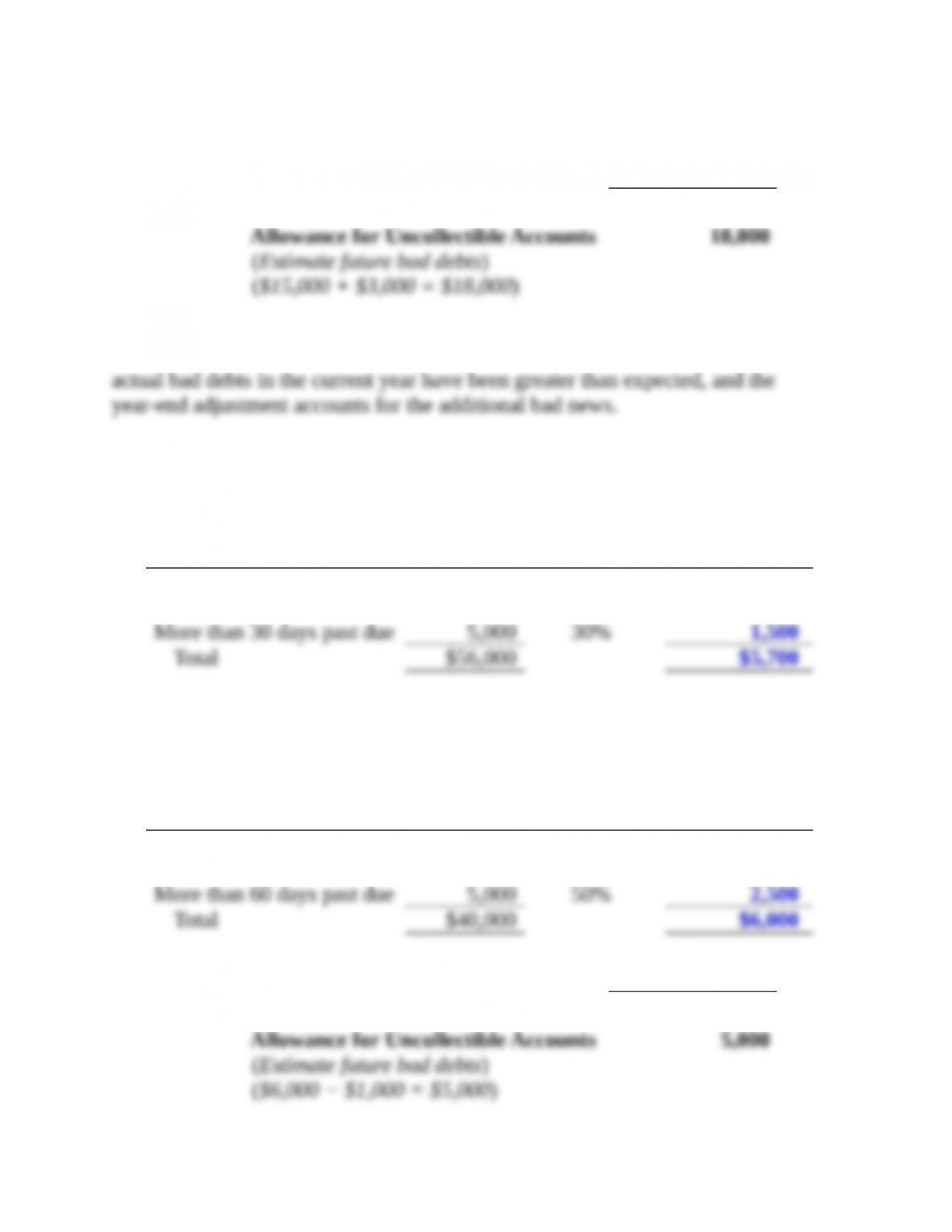
Debit Credit
Bad Debt Expense 12,000
Brief Exercise 5-7 (LO 5-3)
Debit Credit
Bad Debt Expense 18,000
The amount in BE5-7 is greater because the balance of Allowance for
Uncollectible Accounts before adjustment is a debit (or negative). This means that
Brief Exercise 5-8 (LO 5-4)
Age Group
Amount
Receivable
Estimated
Percent
Uncollectible
Estimated
Amount
Uncollectible
Not yet due $40,000 5% $2,000
1-30 days past due 11,000 20% 2,200
Brief Exercise 5-9 (LO 5-4)
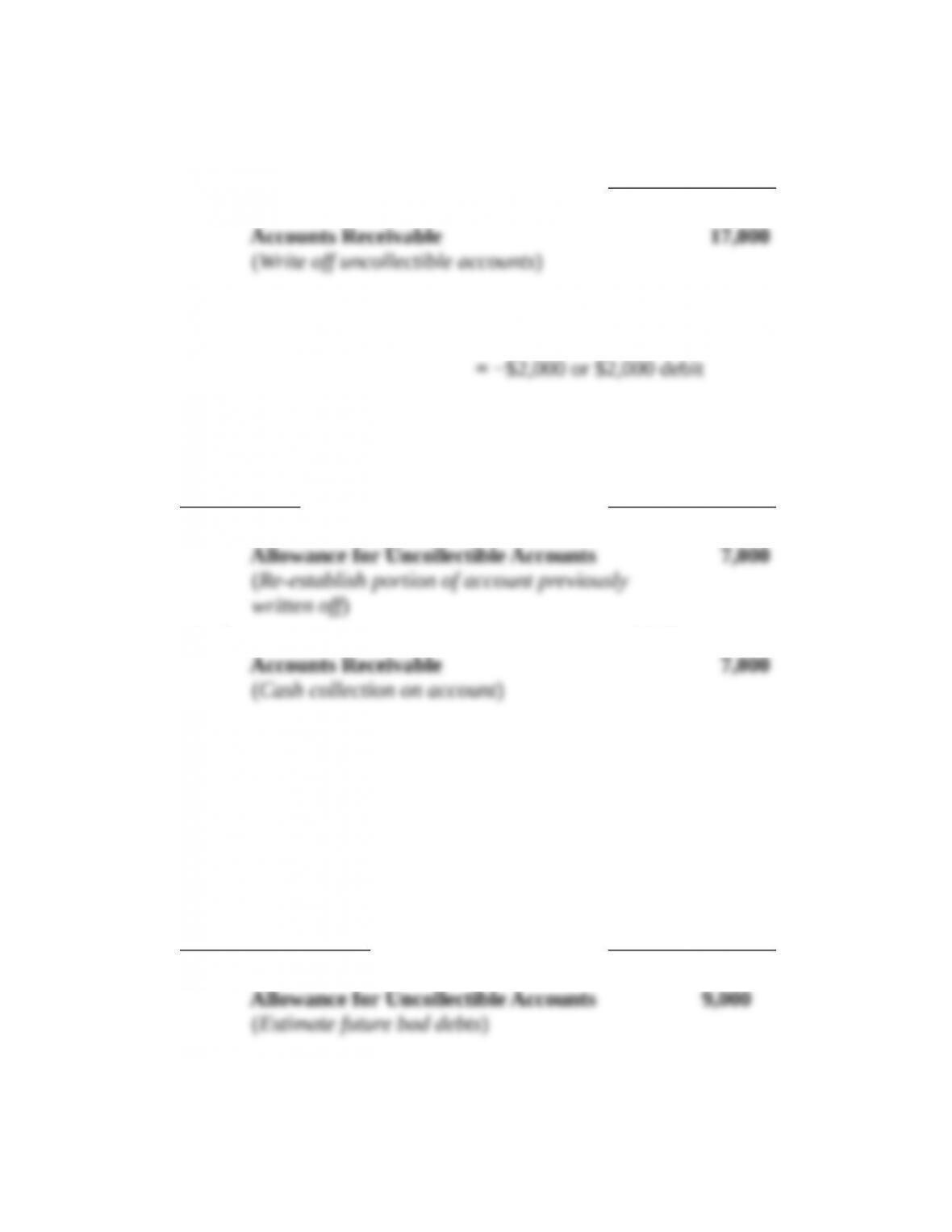
Age Group
Amount
Receivable
Estimated
Percent
Uncollectible
Estimated
Amount
Uncollectible
Not yet due $25,000 4% $1,000
1-60 days past due 10,000 25% 2,500
Debit Credit
Bad Debt Expense 5,000
Brief Exercise 5-10 (LO 5-5)
Debit Credit
Allowance for Uncollectible Accounts 17,000
Allowance for uncollectible accounts = $15,000 (beginning) − $17,000
(write-off)
Brief Exercise 5-11 (LO 5-5)
September 9 Debit Credit
Accounts Receivable 7,000
Cash 7,000
Brief Exercise 5-12 (LO 5-6)
If Brady uses the direct write-off method, then no adjustment is recorded at the end
of 2015 to estimate future bad debts. Instead, if Brady uses the allowance method,
the following adjustment would be recorded at the end of 2015:
December 31, 2015 Debit Credit
Bad Debt Expense 9,000
Brief Exercise 5-13 (LO 5-7)
Face
Value
Annual
interest rate
Fraction of
the year Interest
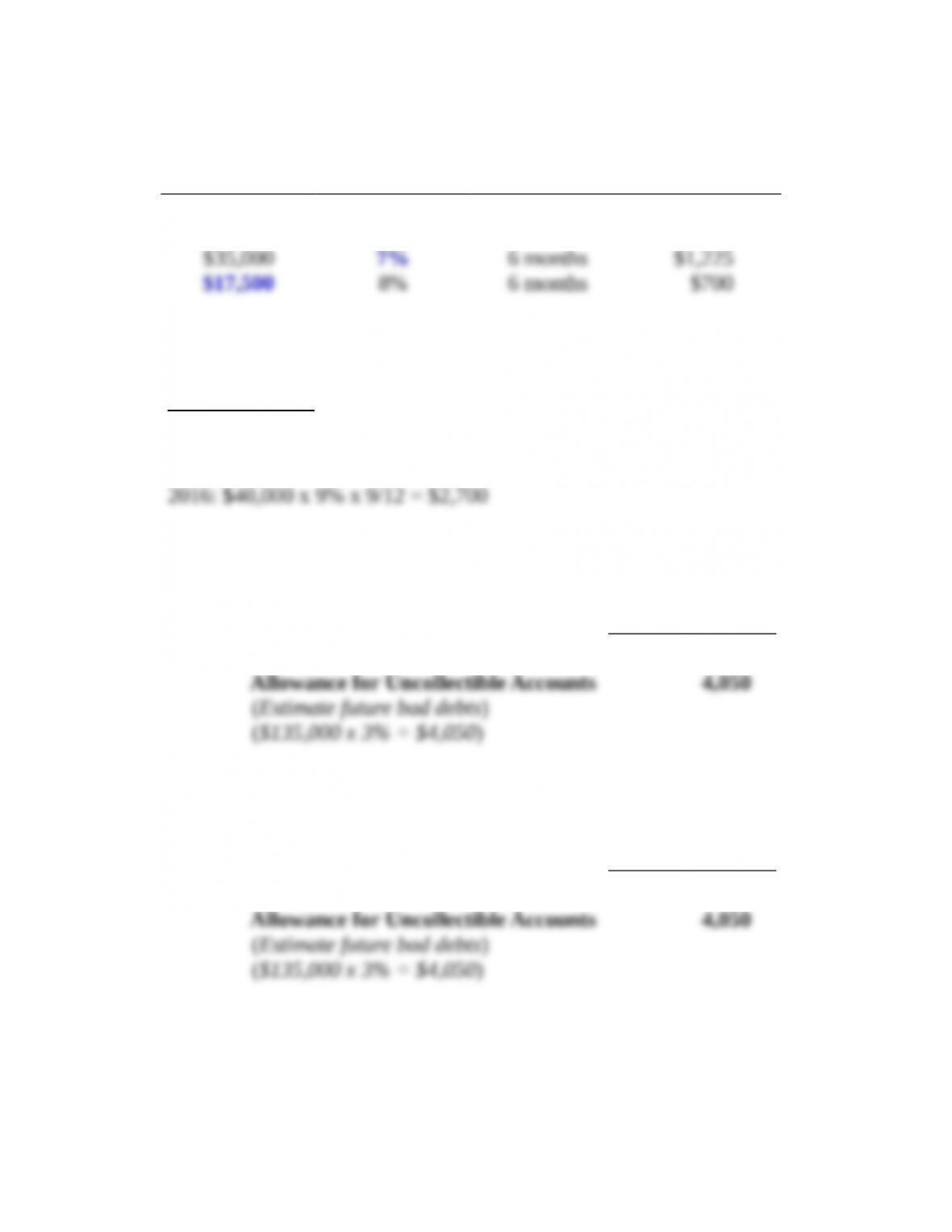
$11,000 6% 4 months $220
$30,000 5% 12 months $1,500
Brief Exercise 5-14 (LO 5-7)
Interest Revenue
2015: $40,000 x 9% x 3/12 = $900
Brief Exercise 5-15 (LO 5-9)
Debit Credit
Bad Debt Expense 4,050
Brief Exercise 5-16 (LO 5-9)
Debit Credit
Bad Debt Expense 4,050
Exercise 5-1 (LO 5-1)
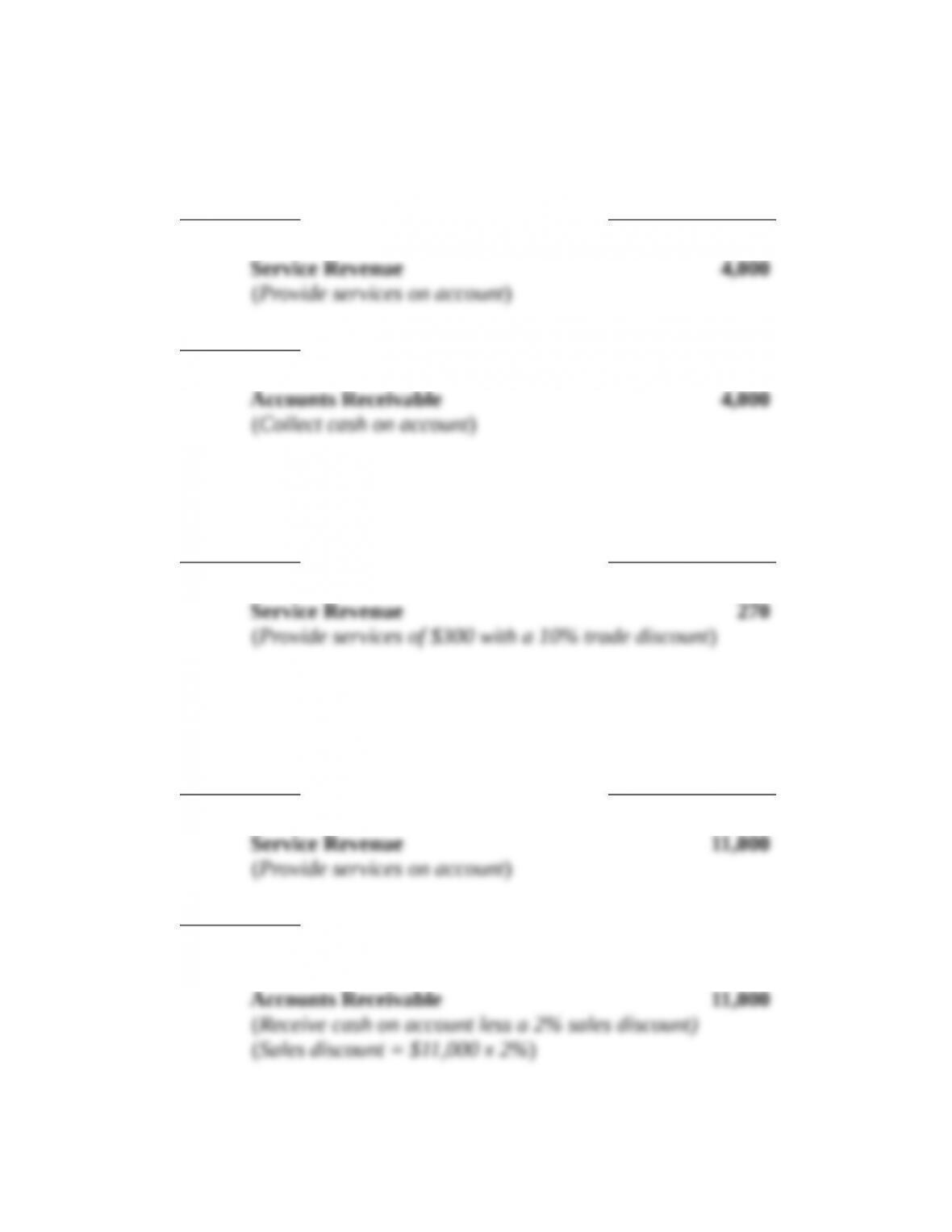
May 7 Debit Credit
Accounts Receivable 4,000
May 13
Cash 4,000
Exercise 5-2 (LO 5-2)
May 1 Debit Credit
Cash 270
Exercise 5-3 (LO 5-1, 5-2)
March 12 Debit Credit
Accounts Receivable 11,000
March 20
Cash 10,780
Sales Discounts 220
EXERCISES