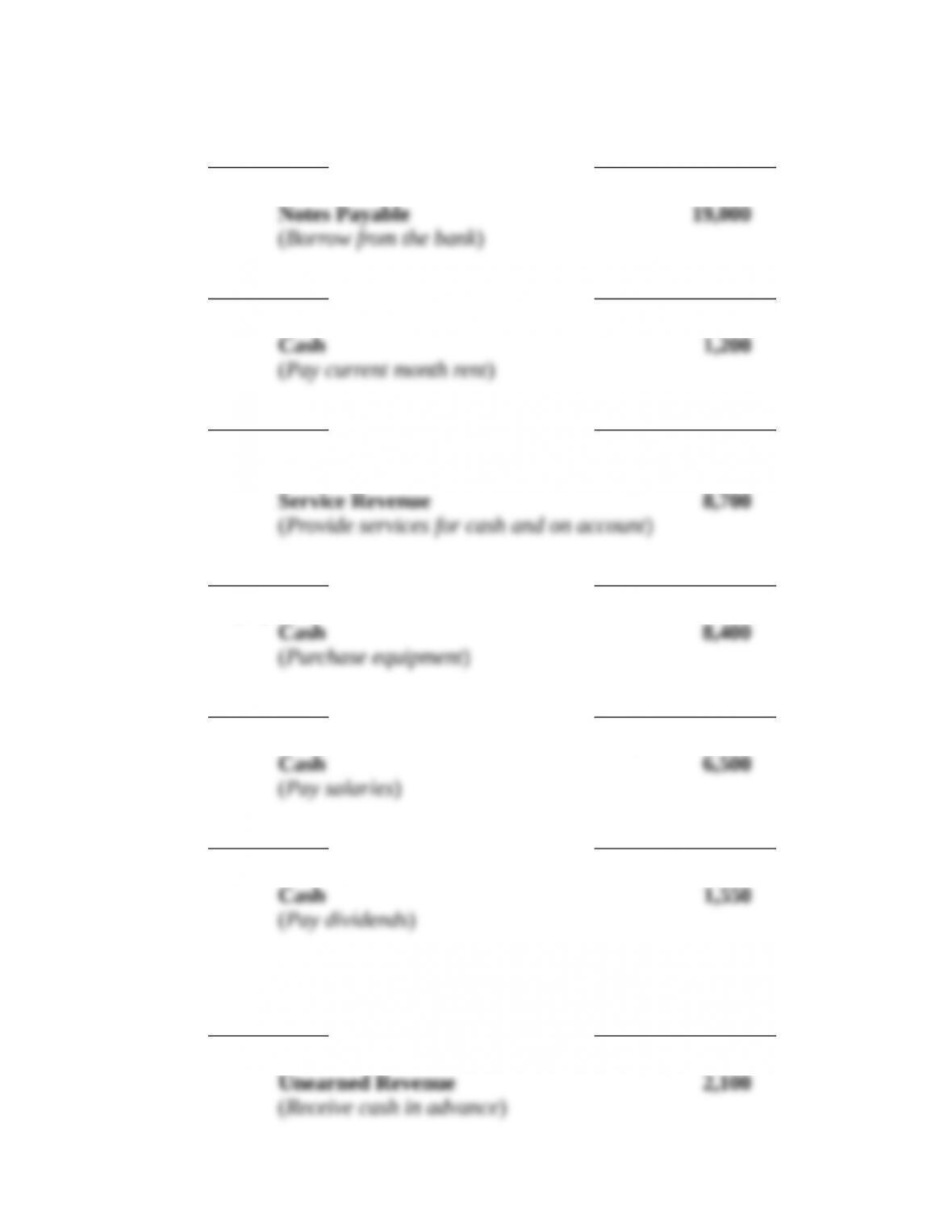
June 2 Debit Credit
Cash 19,000
June 3 Debit Credit
Rent Expense 1,200
June 7 Debit Credit
Cash 5,200
Accounts Receivable 3,500
June 11 Debit Credit
Equipment 8,400
June 17 Debit Credit
Salaries Expense 6,500
June 22 Debit Credit
Dividends 1,550
June 25 Debit Credit
Cash 2,100
Problem 4-5B (LO 4-7)
Requirement 1
Problem 4-5B (continued)
Requirement 1 (concluded)
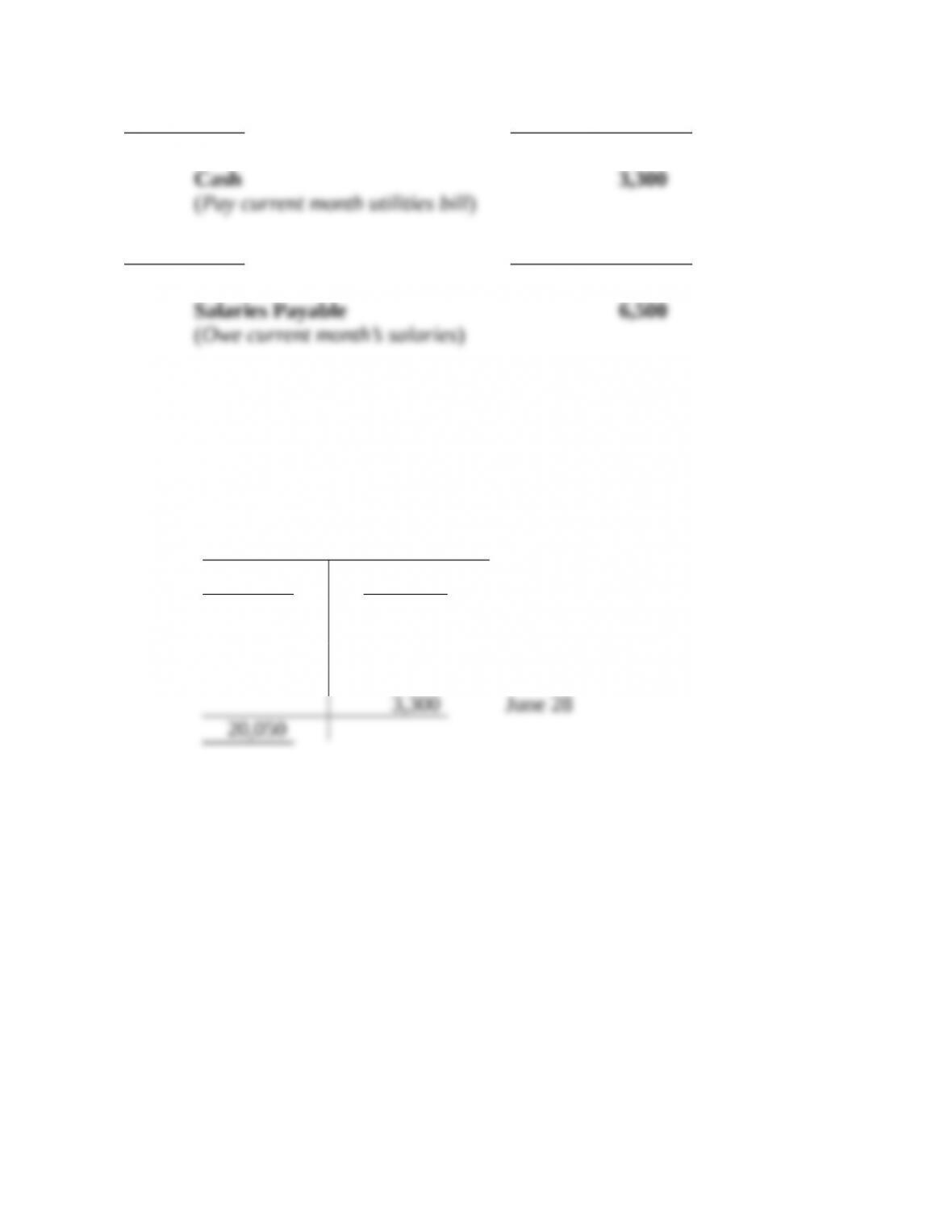
June 28 Debit Credit
Utilities Expense 3,300
June 30 Debit Credit
Salaries Expense 6,500
All transactions involve cash except for the salaries payable
transaction on June 30.
Cash
Debits Credits
June 1 14,700 1,200 June 3
June 2 19,000 8,400 June 11
June 7 5,200 6,500 June 17
June 25 2,100 1,550 June 22
Requirement 2
Requirement 3
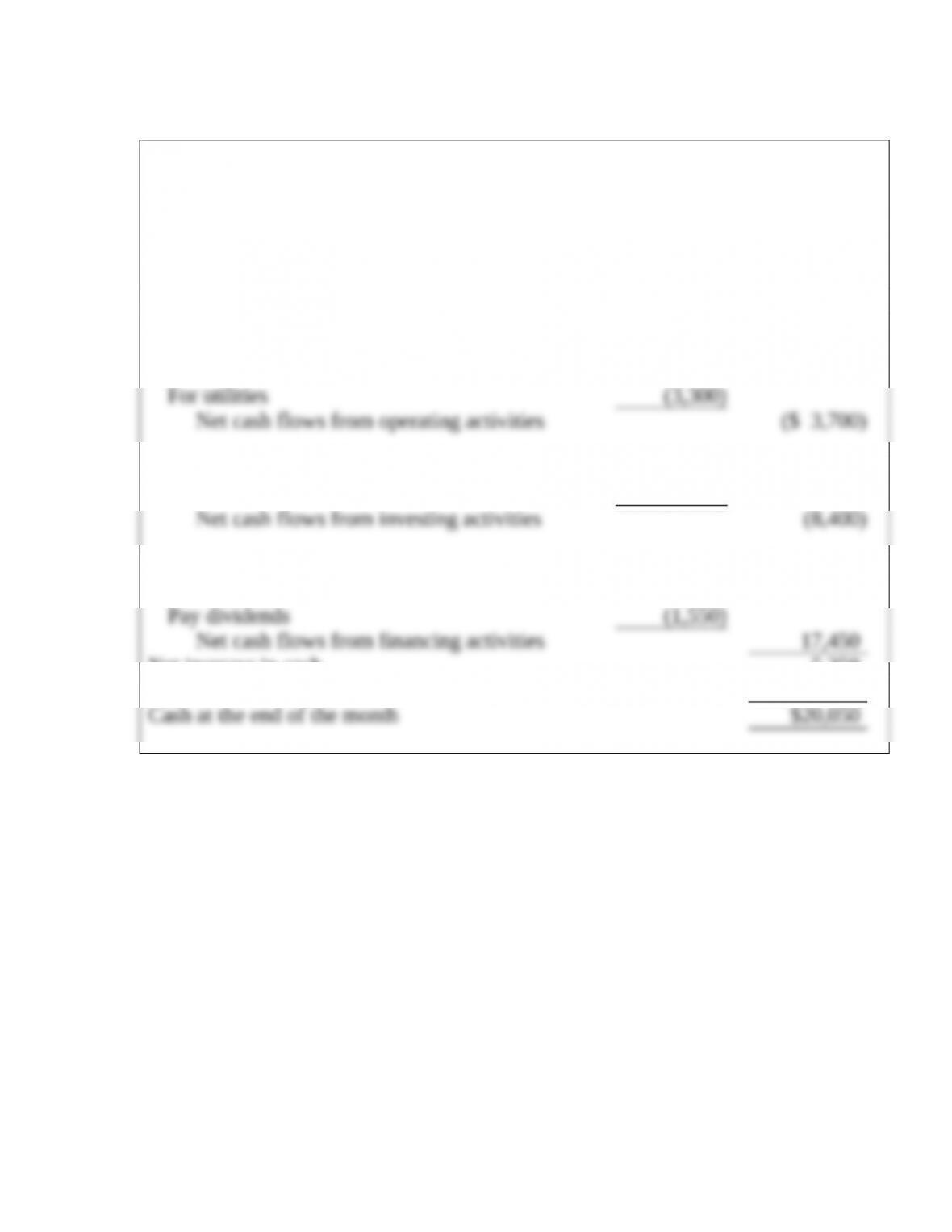
Homeward Bound
Statement of Cash Flows
For the month ended June 30
Cash Flows from Operating Activities
Cash inflows:
From customers $ 7,300
Cash outflows:
For rent (1,200)
For salaries (6,500)
Cash Flows from Investing Activities
Purchase equipment (8,400)
Cash Flows from Financing Activities
Borrow from bank 19,000
Net increase in cash 5,350
Cash at the beginning of the month 14,700
Net cash flows in statement of cash flows = $5,350
Change in cash balance for the month = $20,050 (ending) − $14,700 (beginning)
= $5,350
Problem 4-5B (continued)
Requirement 4
Requirement 5
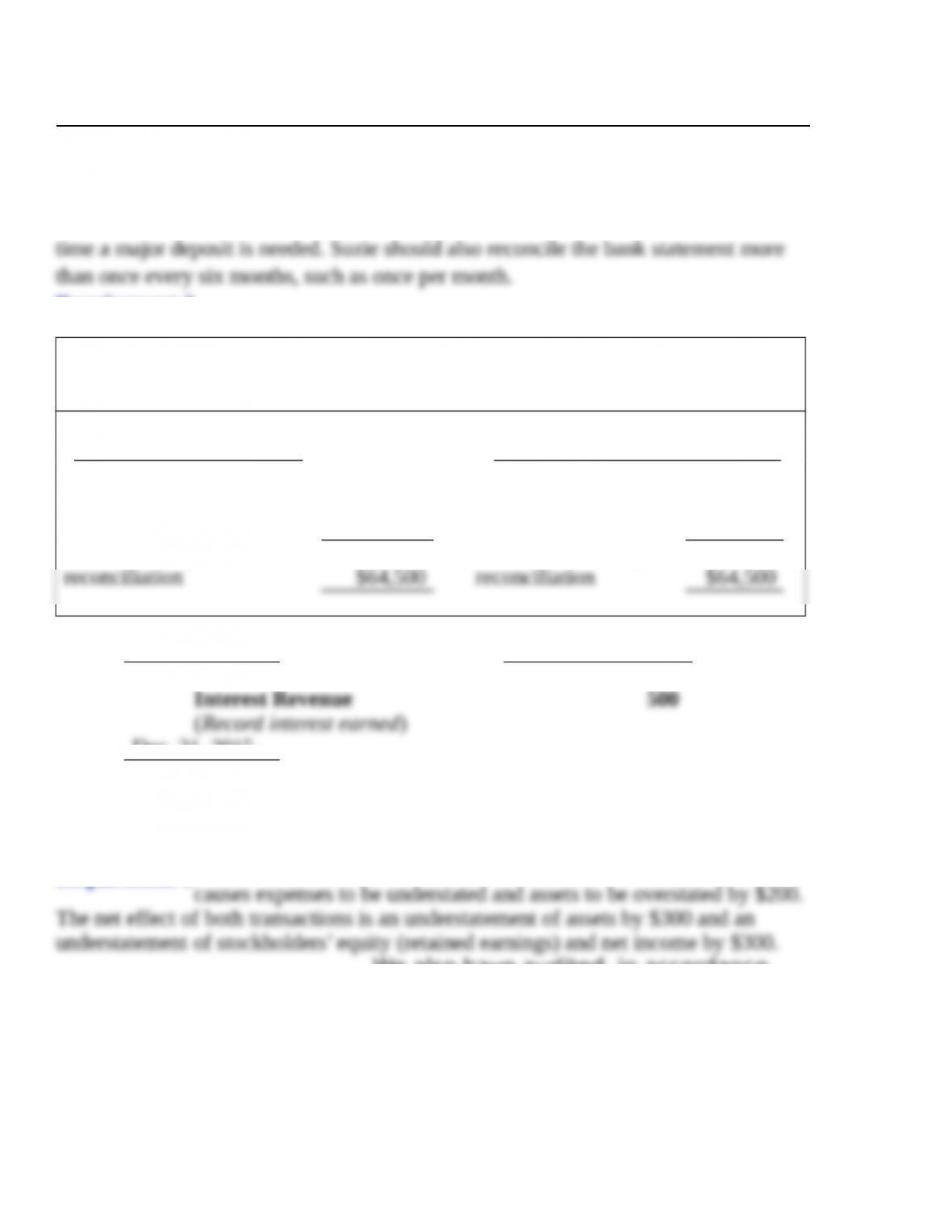
Great Adventures, Inc.
Bank Reconciliation
December 31, 2015
Bank’s Cash Balance Company’s Cash Balance
Per bank statement $50,500 Per general ledger $64,200
Deposits outstanding +20,000 Interest earned + 500
Checks outstanding − 6,000 Service fee − 200
Bank balance per
Company balance per
Dec. 31, 2015 Debit Credit
Cash 500
Dec. 31, 2015
Service Fee Expense 200
Cash 200
(Record bank service fee)
Failure to record the interest revenue would cause assets and revenues
to be understated by $500. Failure to record the service charge fee
We also have audited, in accordance
with the standards of the Public
Company Accounting Oversight Board
(United States), the e”ectiveness of the
Company’s internal control over
financial reporting as of February 2, 2013 based on criteria
ADDITIONAL PERSPECTIVES
Additional Perspective 4-1
Requirement 1
Suzie should make deposits more often than once per month, such as each day or each
Requirement 2
Requirement 3
Additional Perspective 4-2
Requirement 1
The Company considers all highly liquid investments purchased with a
The amount of cash reported in the current year is $509,119 thousand,
The amounts reported for operating, investing, and financing cash
The amounts in requirement 3 and requirement 4 are equal.
Net income for the past three years is $232,108, $151,705, and
$140,647 thousand. Free cash flows (operating cash flows plus
Additional Perspective 4-3
In our opinion, the Company maintained effective internal control over
financial reporting as of February 2, 2013, based on the criteria
The Company considers all highly liquid debt instruments with an
The amount of cash reported in the current year is $117,608 thousand,
The amounts reported for operating, investing, and financing cash
The amounts in requirement 3 and requirement 4 are equal.
Net income for the past three years is $164,305, $151,456, and
$134,682 thousand. Free cash flows (operating cash flows plus
Requirement 2
Requirement 3
Requirement 4
Requirement 5
Requirement 6
Requirement 1
Requirement 2
Requirement 4
Requirement 5
Requirement 6
Additional Perspective 4-4
American Eagle’s ratio of cash to total assets is 28.99% (= $509,119 /
$1,756,053). Buckle’s ratio of cash to total assets is 24.61% (=
$117,608 / $477,974). A higher ratio of cash to total assets for
American Eagle’s net income for the past three years is $232,108,
$151,705, and $140,647 thousand, while the company’s free cash
Buckle’s net income for the past three years is $164,305, $151,456, and $134,682
thousand, while the company’s free cash flows (operating cash flows plus investing
Based on this analysis alone, one might predict Buckle to have the greater percentage
change in net income in the following year. Keep in mind, though, that many factors
Additional Perspective 4-5
Requirement 1
Requirement 2
What is the issue?
The rules explicitly state that friends and family are not allowed to watch free movies,
and full price is to be paid for all concession items. By violating these rules, an
Who are the parties involved?
Jack could believe that because many workers, including upper management, are
violating policies in the employee handbook, it is less unethical to allow friends and
overall ethical tone by employees with respect to internal controls.
Requirement 1
To calculate free cash flows, add operating cash flows and investing cash flows ($ in
thousands).
Operating Investing Free Cash Flow
December 31, 2012 16,619,000 + (13,056,000) = (3,563,000)
Requirement 2
To calculate free cash flows, add operating cash flows and investing cash flows ($ in
thousands).
Operating Investing Free Cash Flow
December 31, 2012 19,586,000 + (9,004,000) = 10,582,000
What factors should Jack consider in making his decision?
Jack needs to remember that just because others are violating policies, it doesn’t make
it right for him. Upon employment, Jack agreed to the rules of employment. Even
By not engaging in these unethical actions, Jack also portrays a sense of ethical
responsibility and trustworthiness among his peers and management. In the long-term,
Additional Perspective 4-6
Requirement 3
Google’s trend is downward, unlike IBM’s. For the most part, companies like to see an
upward trend in free cash flows because it indicates increased profitability from
operating activities. However, for Google, the downward trend does not appear to be
Requirement 4
In general, the company that has the more positive trend in free cash flows will have
IBM increased from $146.76 to $193.99. Google increased for $593.97 to $737.97.
Some of the internal control weaknesses include:
1.
– The employee who authorizes payment should not also be the employee who
– The employee responsible for making cash disbursements should not also be the
– The fund balance should be verified by two or more employees.
2.
– The employee who authorizes payment should not also be the employee who
– The employee who authorizes the payment should not also be the employee who
– The employee who records the payment should not also be the employee who
3.
– The employee who opens the mail should not also be the employee that makes a list
– The employee who opens the mail should not also be the employee that makes the
– The employee who makes deposits at the bank should not also be the employee that
Additional Perspective 4-7