Question 4-1 (LO 4-1)
Occupational fraud is the use of one’s occupation for personal enrichment through the
deliberate misuse or misapplication of the employing organization’s resources. Occupational
Question 4-2 (LO 4-1)
Internal control is a company’s plan to (1) safeguard the company’s assets and (2) improve
the accuracy and reliability of accounting information. Effective internal control builds a wall to
Question 4-3 (LO 4-1)
Managers are entrusted with the resources of both the company’s lenders (liabilities) and
Question 4-4 (LO 4-1)
Managers are motivated to manipulate financial statements to maximize their compensation,
Question 4-5 (LO 4-1)
The fraud triangle represents the three elements of fraud: motive, rationalization, and
Question 4-6 (LO 4-1)
The major provisions of the Sarbanes-Oxley Act include the Public Company Accounting
Oversight Board, corporate executive accountability, limitation on nonaudit services, retention of
Answers to Review Questions (continued)
Question 4-7 (LO 4-2)
1. Control Environment – The overall ethical tone of the company with respect to internal
2. Risk Assessment – Identification and analysis of internal and external risk factors that could
Chapter 4
Cash and Internal ControlsREVIEW QUESTIONS
3. Control Activities – The policies and procedures that help ensure that management’s directives
4. Monitoring – Continuous observation of the internal control system.
5. Information and Communication – Systems designed to ensure accurate measurement of
Question 4-8 (LO 4-2)
Detective controls are designed to detect errors or fraud that have already occurred, while
preventive controls are designed to keep errors or fraud from occurring in the first place.
Preventive controls include separation of duties, physical controls, proper authorizations, and
employee management. Detective controls include reconciliations and performance reviews.
Question 4-9 (LO 4-2)
Authorizing transactions, recording transactions, and maintaining control of the related assets
Question 4-10 (LO 4-2)
Everyone in a company has an impact on the operation and effectiveness of internal controls,
but the top executives are the ones who must take final responsibility for their
establishment and success. The CEO and CFO sign a report each year assessing whether the
Question 4-11 (LO 4-2)
Internal controls cannot prevent financial misstatement in all cases, do not necessarily
Question 4-12 (LO 4-2)
Collusion occurs when two or more people act in coordination to circumvent internal
controls.
Question 4-13 (LO 4-2)
Fraud is more likely to occur when it is being committed by top-level employees who have
the ability to override internal control features. For example, managers may be required to obtain
Question 4-14 (LO 4-3)
Cash includes not only currency, coins, balances in checking accounts, and checks and
money orders received from customers, but also cash equivalents, defined as investments that
Question 4-15 (LO 4-3)
A purchase with a check is recorded as an immediate cash payment.
Question 4-16 (LO 4-4)
1. Record all cash receipts as soon as possible.
2. Open mail each day, and make a list of checks received, including the amount and
3. Designate an employee to deposit cash and checks into the company’s bank account each
4. Have another employee record cash receipts in the accounting records. Verify cash
Question 4-17 (LO 4-4)
Credit cards extend credit (or lend money) to the cardholder each time the cardholder uses
the credit card. The cardholder has a specified grace period before he or she has to pay the credit
Question 4-18 (LO 4-4)
Like credit cards, debit cards offer customers a way to purchase goods and services without a
physical exchange of cash. They differ, however, in that most debit cards (sometimes referred to
Question 4-19 (LO 4-4)
1. Make all disbursements, other than very small ones, by check, debit card, or credit card.
2. Authorize all expenditures before purchase and verify the accuracy of the purchase itself.
3. Make sure checks are serially numbered and signed only by authorized employees.
4. Periodically check amounts shown in the debit card and credit card statements against
5. Set maximum purchase limits on debit cards and credit cards. Give approval to purchase
6. Employees responsible for making cash disbursements should not also be in charge of
Answers to Review Questions (continued)
Question 4-20 (LO 4-4)
Credit card purchases are recorded as purchases on account.
Question 4-21 (LO 4-5)
A bank reconciliation matches the balance of cash in the bank account with the balance of
cash in the company’s own records by reconciling timing differences and errors. It is the
Question 4-22 (LO 4-5)
The two reasons are timing differences and errors. Timing differences arise when one party
Question 4-23 (LO 4-5)
Examples include deposits outstanding, checks outstanding, notes collected by the bank,
Question 4-24 (LO 4-5)
As a final step in the reconciliation process, the company must update the balance of cash for
Question 4-25 (LO 4-6)
The petty cash fund is cash kept on hand to pay for minor purchases.
Question 4-26 (LO 4-6)
Management establishes a petty cash fund by writing a check for cash against the company’s
checking account and giving the withdrawn cash to an employee who becomes responsible for it.
Question 4-27 (LO 4-7)
In addition to the change in total cash which can be calculated using two consecutive balance
Question 4-28 (LO 4-7)
Operating activities include cash transactions involving revenue and expense events during
Answers to Review Questions (continued)
Question 4-29 (LO 4-8)
When accrual-basis net income and free cash flows for the period move in the same direction
(that is, both increase or both decrease compared to last period), accrual-basis net income is
Question 4-30 (LO 4-8)
Between 1999 and 2004, Krispy Kreme had a negative relationship between cash flows and net
income, while Starbucks’ was positive. This should have been a sign to investors that Krispy
Kreme’s rising net income did not provide a good indication of the company’s long-term
BRIEF Exercises
Brief Exercise 4-1 (LO 4-1)
1. c.
2. a.
3. d.
4. b.
5. e.
Brief Exercise 4-2 (LO 4-2)
1. e.
2. d.
3. a.
4. c.
5. b.
Brief Exercise 4-3 (LO 4-2)
1. e.
2. a.
3. f.
4. c.
5. b.
6. d.
Brief Exercise 4-4 (LO 4-3)
1. Yes
2. No
3. Yes
4. Yes
5. No
6. Yes
Brief Exercise 4-5 (LO 4-4)
1. $ 500,000
2. 350,000
3. 582,000 (= $600,000 less 3% service fee)
Brief Exercise 4-6 (LO 4-4)
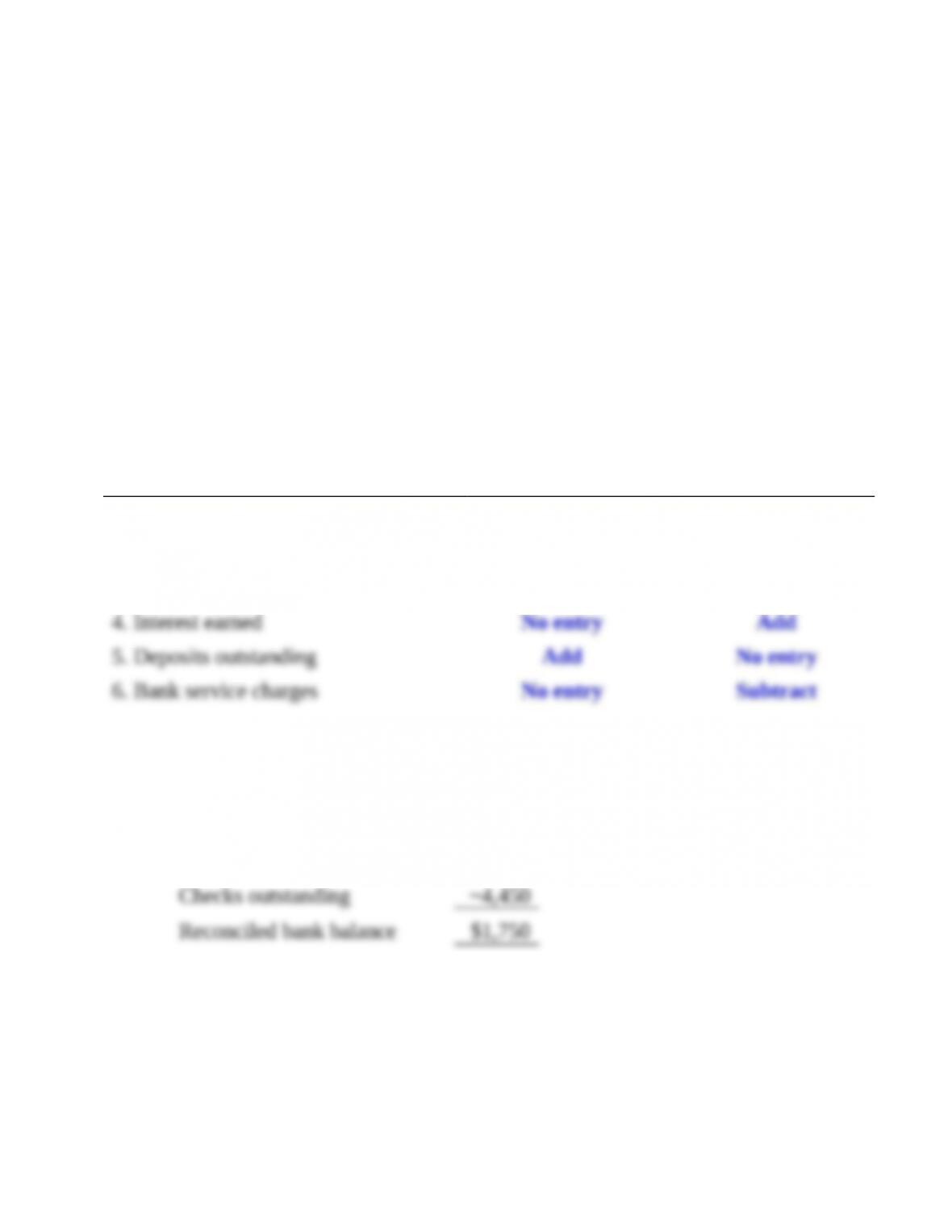
1. Debit Credit
Salaries Expense 500
2.
Equipment 1,000
3.
Repairs and Maintenance Expense 400
Brief Exercise 4-7 (LO 4-5)
1. d.
2. c.
3. f.
4. e.
5. a.
6. b.
Brief Exercise 4-8 (LO 4-5)
Reconciliation items Bank balance Company balance
1. Checks outstanding Subtract No entry
2. NSF checks No entry Subtract
3. Deposit recorded twice by company No entry Subtract
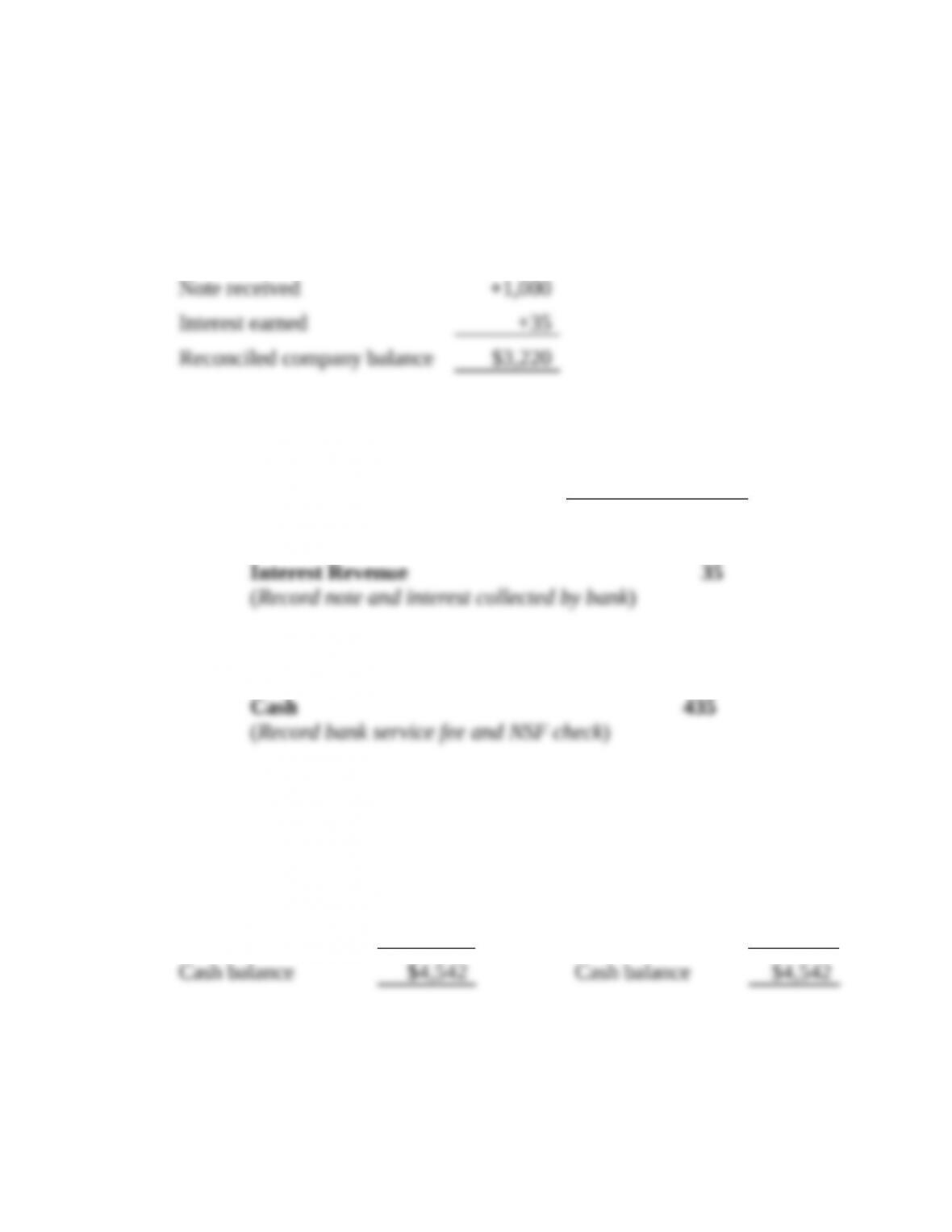
Brief Exercise 4-9 (LO 4-5)
Bank balance $2,000
Deposits outstanding +4,200
Brief Exercise 4-10 (LO 4-5)
Company balance $2,620
Service fees −85
NSF check −350
Brief Exercise 4-11 (LO 4-5)
Debit Credit
Cash 1,035
Notes Receivable 1,000
Service Fee Expense 85
Accounts Receivable 350
Brief Exercise 4-12 (LO 4-5)
Bank balance $7,345 Company balance $4,593
Checks outstanding −2,803 Service fees −85
Interest earned +34
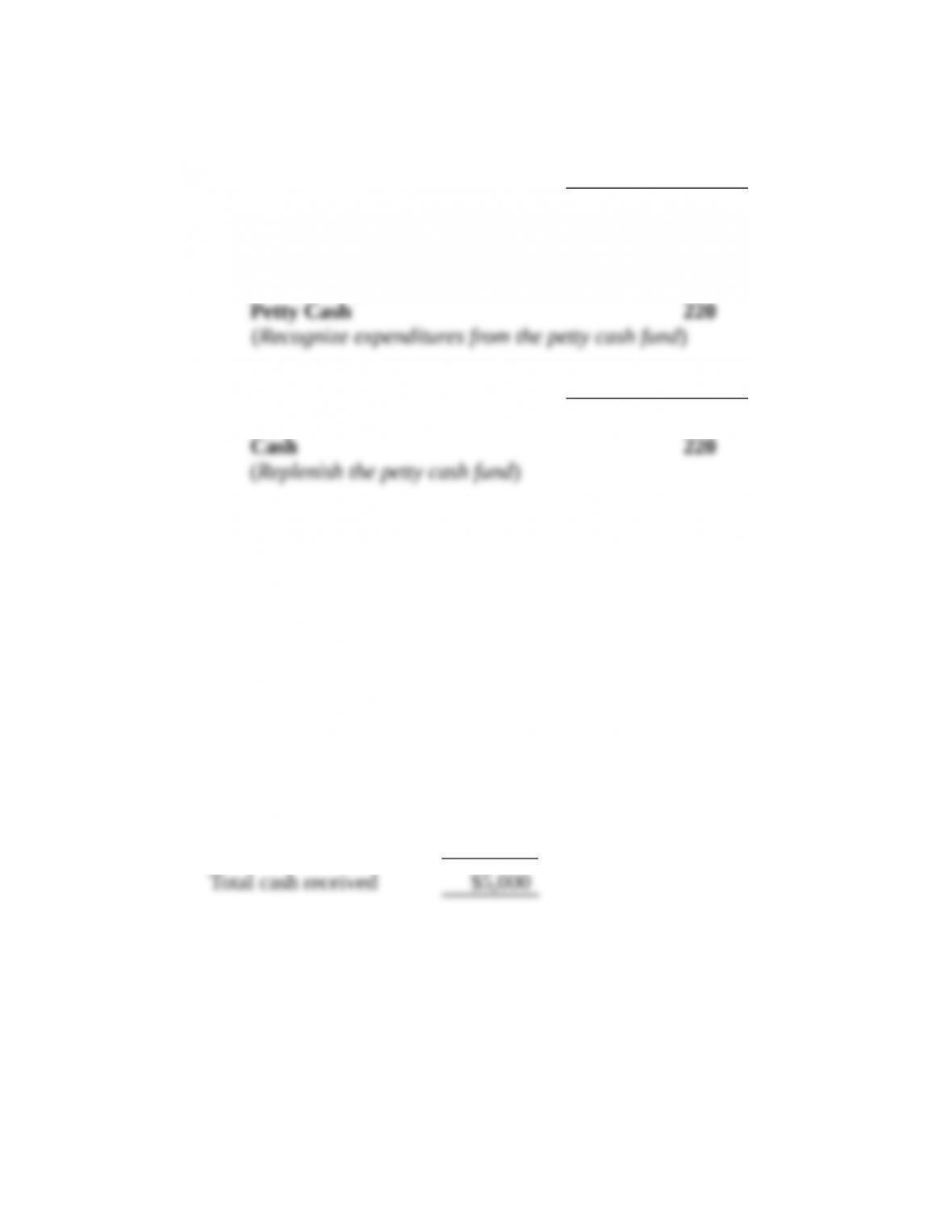
Brief Exercise 4-13 (LO 4-6)
Debit Credit
Postage Expense 60
Delivery Expense 85
Supplies Expense 50
Entertainment Expense 25
Debit Credit
Petty Cash 220
Brief Exercise 4-14 (LO 4-7)
1. c.
2. a.
3. b.
Brief Exercise 4-15 (LO 4-7)
Receipts for lessons in June $4,500
Receipts for lessons in May 500
Brief Exercise 4-16 (LO 4-7)
Total investing cash flows = $13,000

Brief Exercise 4-17 (LO 4-7)
Issuance of stock $11,000
Borrowing from bank 35,000
Brief Exercise 4-18 (LO 4-8)
Operating Cash Flows + Investing Cash Flows = Free Cash Flows
Tuohy Incorporated $19,200 $(4,800) $14,400
Oher Corporation 13,500 7,400 20,900