Question 3-1 (LO 3-1)
The revenue recognition principle states that we record revenue in the period in which we
earn it. If a company sells products or provides services to a customer in the current year, then
Question 3-2 (LO 3-1)
The matching principle states that we recognize expenses in the same period as the
revenues they help to generate. There is a cause-and-eect relationship between revenue and
Question 3-3 (LO 3-1)
Net income is an important profitability measure used by investors, creditors, and others in
assessing the performance of the company. Net income equals revenues minus expenses.
Question 3-4 (LO 3-2)
Under cash-basis accounting, revenues are recorded when cash is received and expenses are
recorded when cash is paid. In contrast, under accrual-basis accounting, revenues are recorded
Question 3-5 (LO 3-2)
(1) April 10th.
(2) April 10th.
(3) April 10th.
Question 3-6 (LO 3-2)
(1) March 28th.
(2) April 10th.
(3) May 2nd.
Chapter 3
The Accounting Cycle: End of the Periodreview Questions
Answers to Review Questions (continued)
Question 3-7 (LO 3-2)
(1) April 10th.
(2) April 10th.
(3) April 10th.
Question 3-8 (LO 3-2)
(1) March 28th.
(2) April 10th.
(3) May 2nd.
Question 3-9 (LO 3-3)
One of the primary purposes of adjusting entries is to allow for proper application of the
Question 3-10 (LO 3-3)
Prepayments are cases where cash is received before revenue is recognized or where cash is
Question 3-11 (LO 3-3)
A prepaid expense includes the purchase of supplies, prepaid insurance, and prepaid rent. The
Question 3-12 (LO 3-3)
An unearned revenue includes a customer paying cash before receiving the related product or
Question 3-13 (LO 3-3)
An accrued expense includes incurring an expense before the related cash outflow, such as
when the cost of employees’ salaries, utilities, taxes, and interest are incurred but not paid until a
Question 3-14 (LO 3-3)
An accrued revenue includes earning a revenue before the related cash inflow, such as
Answers to Review Questions (continued)
Question 3-15 (LO 3-3)
October 31 Debit Credit
Question 3-16 (LO 3-3)
Yes. Utilities expense and utilities payable will be understated at the end of September.
Utilities expense should be recorded during the period incurred (that is, in the period it helps to
Question 3-17 (LO 3-3)
November 30 Debit Credit
Unearned Revenues 20,000
Question 3-18 (LO 3-3)
Yes. Accounts receivable and service revenue will be understated at the end of May.
Accounts receivable should be recorded in the period the right to receive cash arises. Service
Question 3-19 (LO 3-3)
(a) Prepaid expense: Debit Supplies Expense; credit Supplies.
(b) Unearned revenue: Debit Unearned Revenue; credit Service Revenue.
Question 3-20 (LO 3-4)
The purpose of the adjusted trial balance is to list all accounts and their balances after
updating account balances for adjusting entries and check the equality of total debits and total

Question 3-21 (LO 3-5)
Classified indicates that assets are separated into those that provide a benefit over the next
year (current assets) and those that provide a benefit for more than one year (long-term assets).
Answers to Review Questions (continued)
Question 3-22 (LO 3-5)
Assets = Liabilities +
Stockholders’
equity
$12,000 = $8,000 + $X
Question 3-23 (LO 3-6)
The two purposes of closing entries are (1) to transfer the balances of temporary accounts
(revenues, expenses, and dividends) to the retained earnings account and (2) to reduce the
Question 3-24 (LO 3-6)
To “close” temporary accounts indicates that temporary account balances should be reduced to
zero at the end of the accounting period. The reason is that temporary accounts measure activity
Question 3-25 (LO 3-6)
The first closing entry transfers revenue transactions to retained earnings by debiting all
revenue accounts (reducing their balances to zero) and crediting retained earnings. The second
Question 3-26 (LO 3-6)
Net Income Dividends Retained Earnings*
Year 1 $ 300 $200 $ 100
Year 2 900 200 800
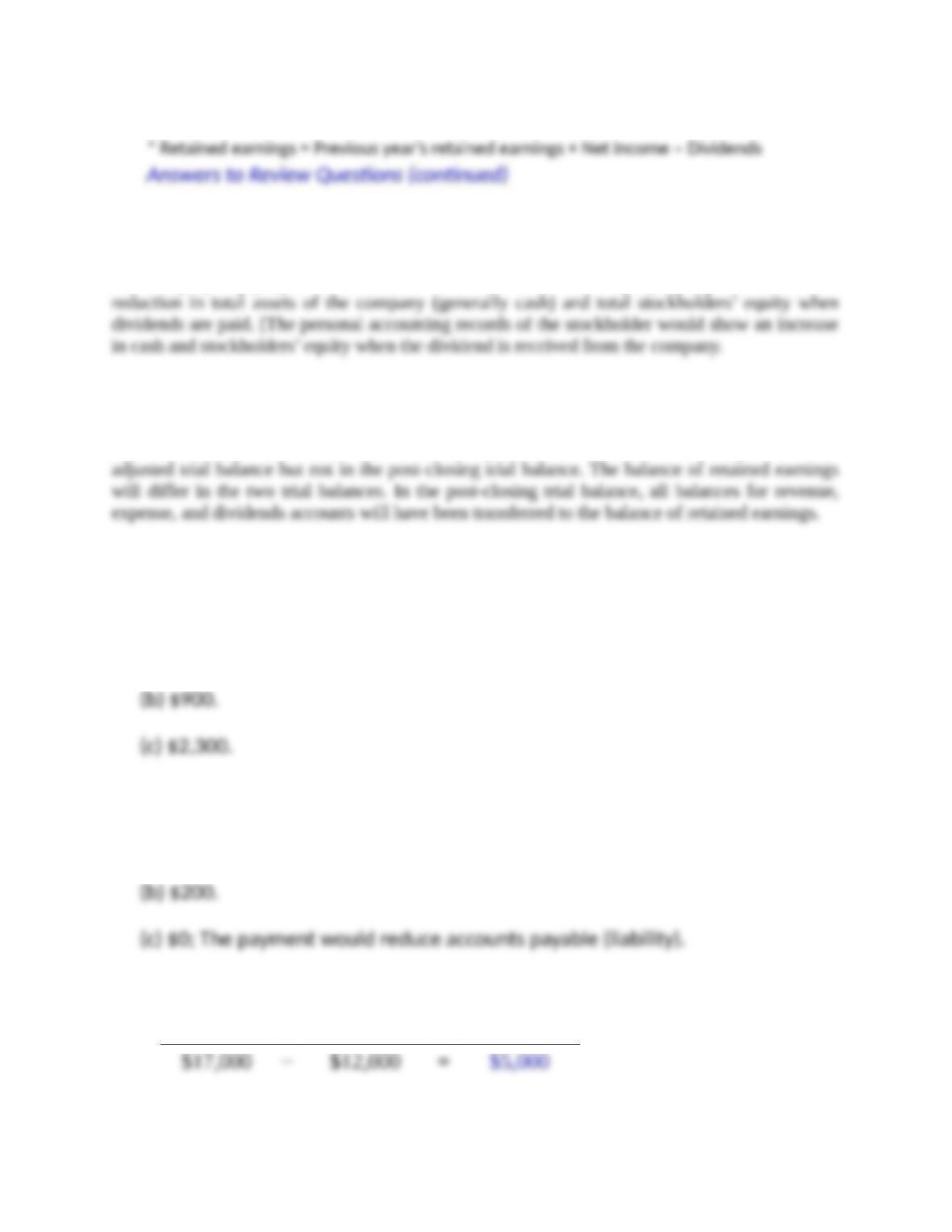
Question 3-27 (LO 3-6)
It is important to understand that transactions are recorded from the company’s perspective.
The company is paying dividends to its stockholders. From the company’s perspective, there is a
Question 3-28 (LO 3-7)
The adjusted trial balance does not include the effect of closing entries while the post-closing
trial balance does. This means that revenues, expenses, and dividends will be reported in the
BRIEF Exercises
Brief Exercise 3-1 (LO 3-1)
(a) $0; Cash received in advance is recorded as unearned revenue (liability).
Brief Exercise 3-2 (LO 3-1)
(a) $600.
Brief Exercise 3-3 (LO 3-1)
Revenues − Expenses = Net Income
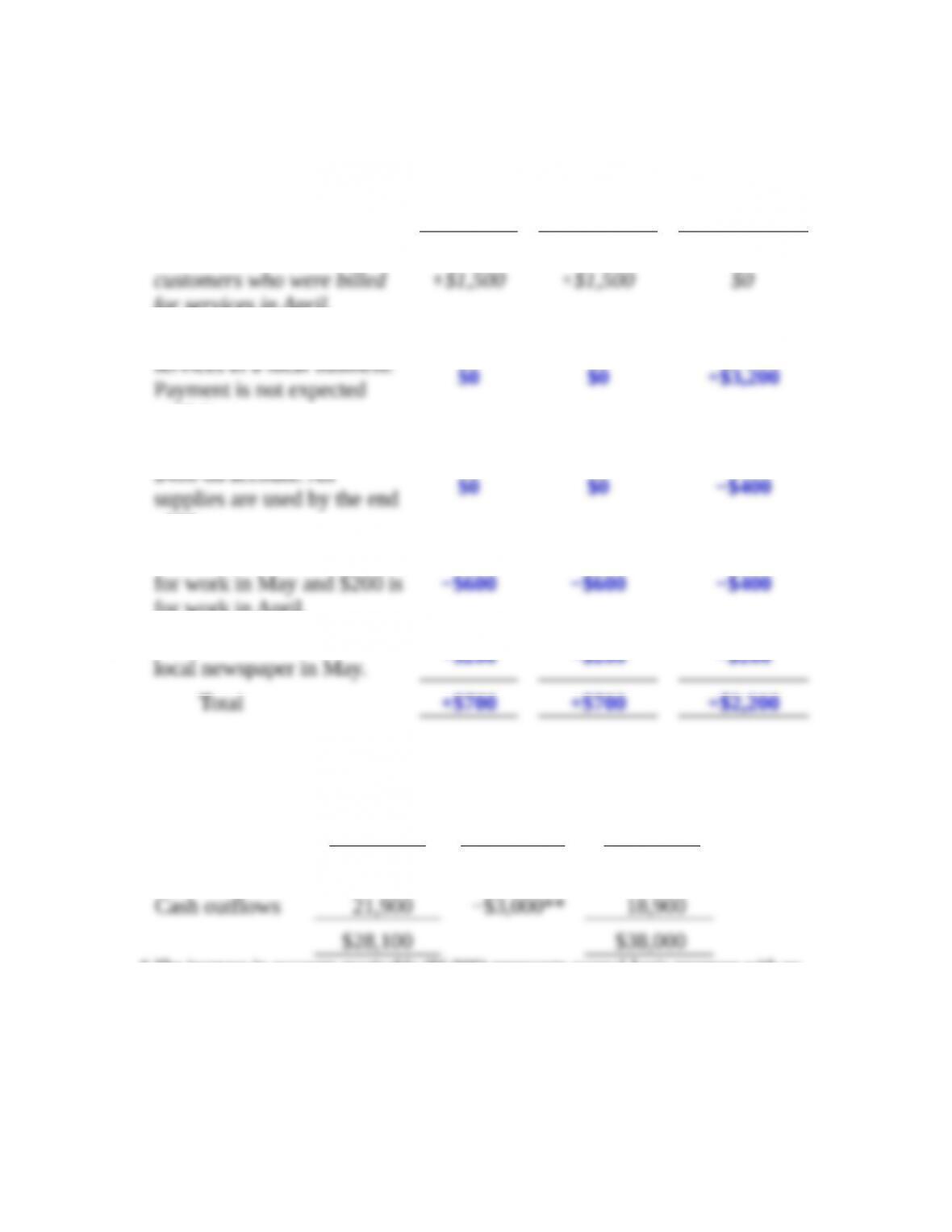
Brief Exercise 3-4 (LO 3-1, 3-2)
Impact on:
Cash
Balance
Cash-basis
Net
Income
Accrual-basis
Net Income
(a) Receive $1,500 from
for services in April.
(b) Provide $3,200 of consulting
services to a local business.
Payment is not expected
until June.
(c) Purchase office supplies for
$400 on account. All
supplies are used by the end
of May.
(d) Pay $600 to workers. $400 is
for work in April.
(e) Pay $200 to advertise in a
Brief Exercise 3-5 (LO 3-1, 3-2)
Cash-basis
net income
Accrual
adjustments
Accrual-basis
net income
Cash inflows $50,000 +$6,900* $56,900
* The increase in accounts receivable ($6,900) represents accrual-basis revenues with no
corresponding cash inflows.
** The decrease in salaries owed ($3,000) represents cash outflows for salaries of the prior
year and would not be expensed in the current year.
Brief Exercise 3-6 (LO 3-3)
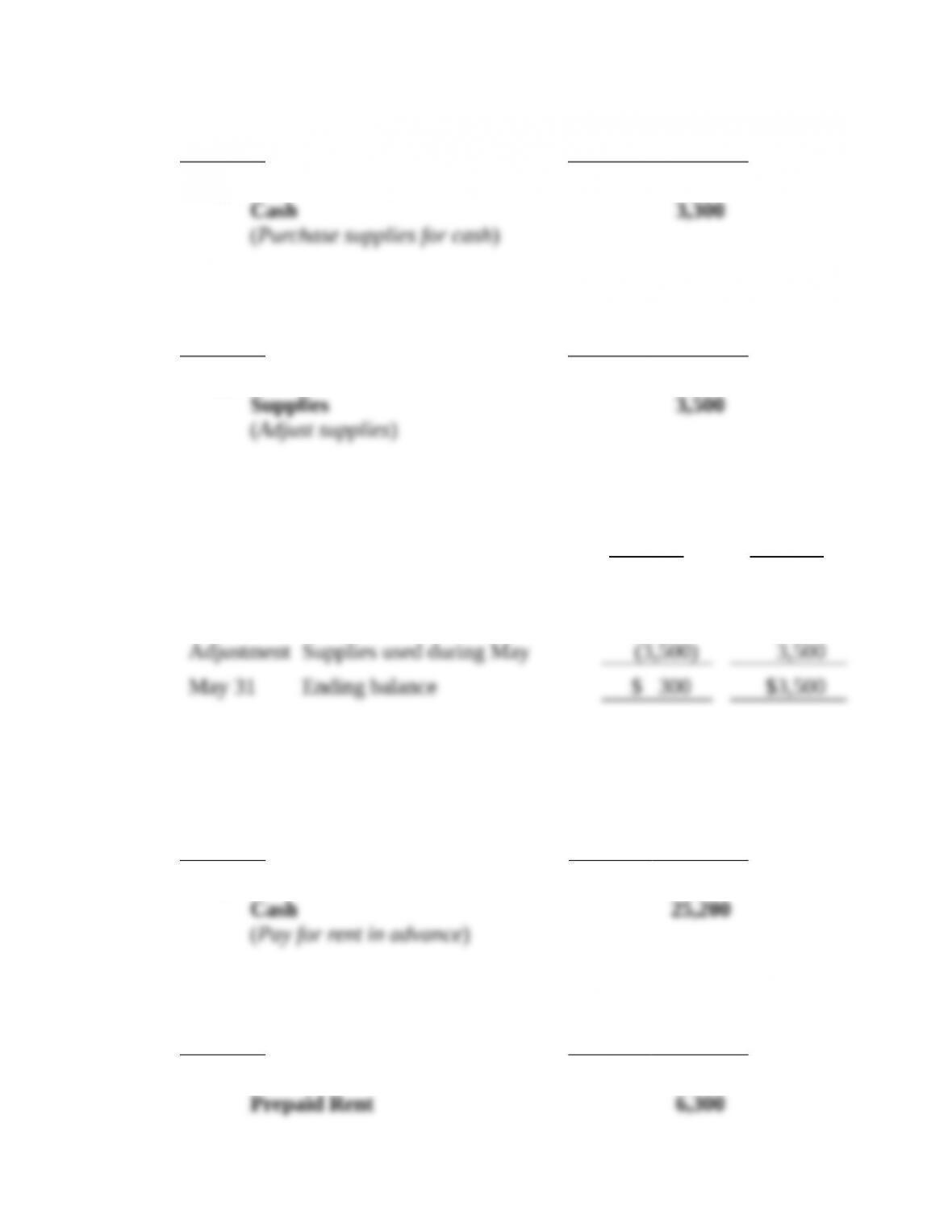
(1)
May 15 Debit Credit
Supplies 3,300
(2)
May 31 Debit Credit
Supplies Expense 3,500
(3)
Supplies
Supplies
Expense
May 1 Beginning balance $ 500 $ 0
May 15 Purchase 3,300
Brief Exercise 3-7 (LO 3-3)
(1)
Oct. 1 Debit Credit
Prepaid Rent 25,200
(2)
Dec. 31 Debit Credit
Rent Expense 6,300
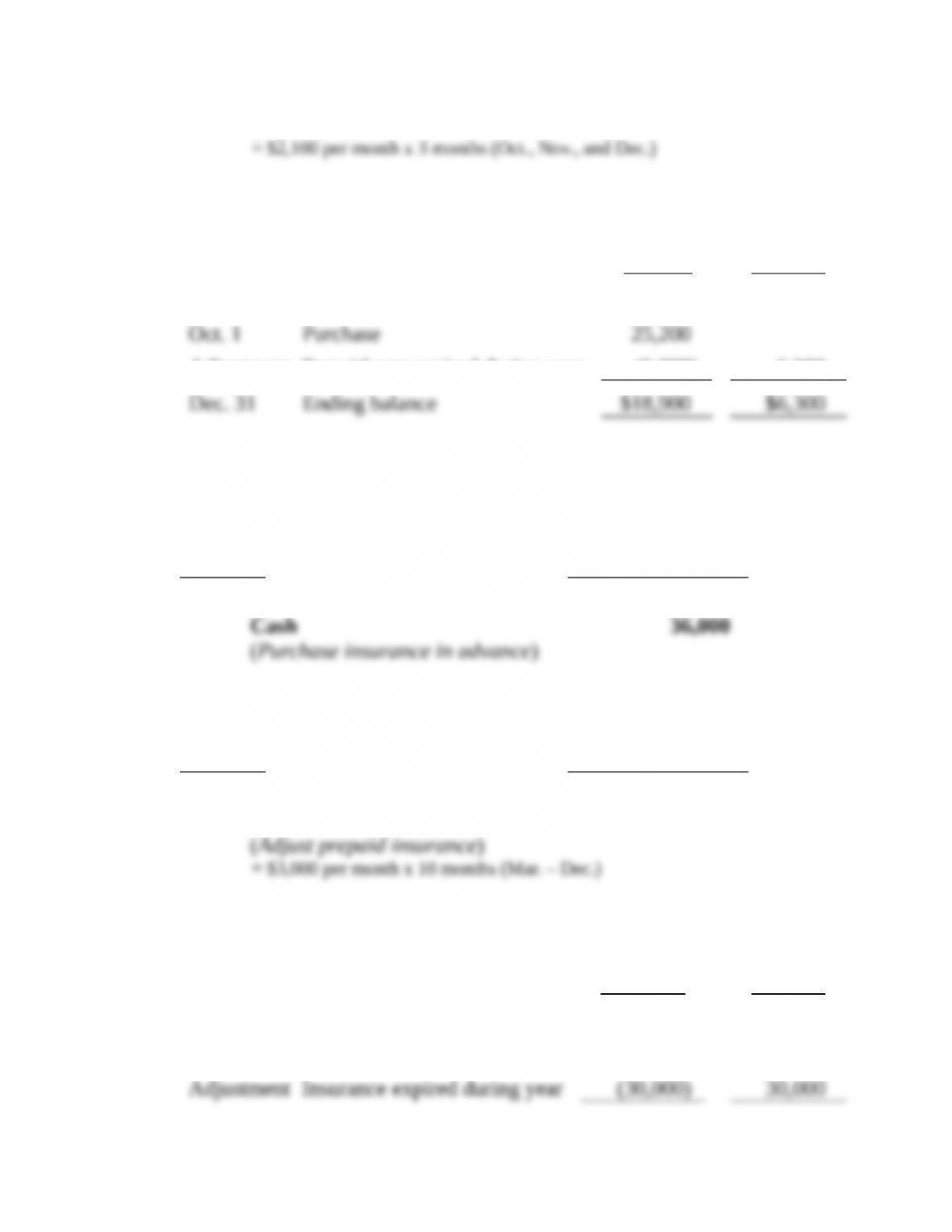
(Adjust prepaid rent)
(3) Prepaid
Rent
Rent
Expense
Jan. 1 Beginning balance $ 0 $ 0
Adjustment Prepaid rent expired during year (6,300) 6,300
Brief Exercise 3-8 (LO 3-3)
(1)
Mar. 1 Debit Credit
Prepaid Insurance 36,000
(2)
Dec. 31 Debit Credit
Insurance Expense 30,000
Prepaid Insurance 30,000
(3) Prepaid
Insurance
Insurance
Expense
Jan. 1 Beginning balance $ 0 $ 0
Mar. 1 Purchase 36,000
Brief Exercise 3-9 (LO 3-3)
(1)
Apr. 1 Debit Credit
Equipment 50,400
(2)
Dec. 31 Debit Credit
Depreciation Expense 5,400
(3) Accumulated
Depreciation
Depreciation
Expense
Jan. 1 Beginning balance $ 0 $ 0
Adjustment Depreciation during year 5,400 5,400
Brief Exercise 3-10 (LO 3-3)
(1)
Nov. 1 Debit Credit
Cash 6,000
(2)
Dec. 31 Debit Credit
Unearned Revenue 4,000
(3) Unearned
Revenue
Service
Revenue
Jan. 1 Beginning balance $ 0 $ 0
Nov. 1 Receipt 6,000
Brief Exercise 3-11 (LO 3-3)
(1)
Dec. 31, 2015 Debit Credit
Salaries Expense 1,200
(2)
Jan. 11, 2016 Debit Credit
Salaries Payable 1,200
Salaries Expense 4,400
(3) Salaries
Payable
Jan. 1, 2015 Beginning balance $ 0
Brief Exercise 3-12 (LO 3-3)
(1)
Jul. 1, 2015 Debit Credit
Cash 15,000
(2)
Dec. 31, 2015 Debit Credit