Problem 10-1C
Terms
__h__ 1. 100% stock dividend
__a__ 2. Statement of stockholders’ equity
__e__ 3. Treasury stock
__b__ 4. Value stocks
__j__ 5. PE ratio
__d__ 6. Stockholders’ equity section of the balance sheet
__c__ 7. Return on equity
__i__ 8. Retained earnings
__f__ 9. Accumulated deficit
__g__ 10. Growth stocks
Definitions
a. Summarizes the changes in the balance in each stockholders’ equity account
b. Priced low in relation to current earnings.
c. Measures the ability of company management to generate earnings from the
d. Shows the balance in each equity account at a point in time.
e. The corporation’s own stock that it reacquired.
f. A debit balance in retained earnings.
h. Effectively the same as a 2-for-1 stock split.
i. The earnings not paid out in dividends.
March 1, 2015 Debit Credit
Cash (3,000 x $22) 66,000
Common Stock (3,000 x $1.00) 3,000
April 1, 2015
Cash (5,000 shares x $110) 550,000
Problem 10-2C
Requirement 1
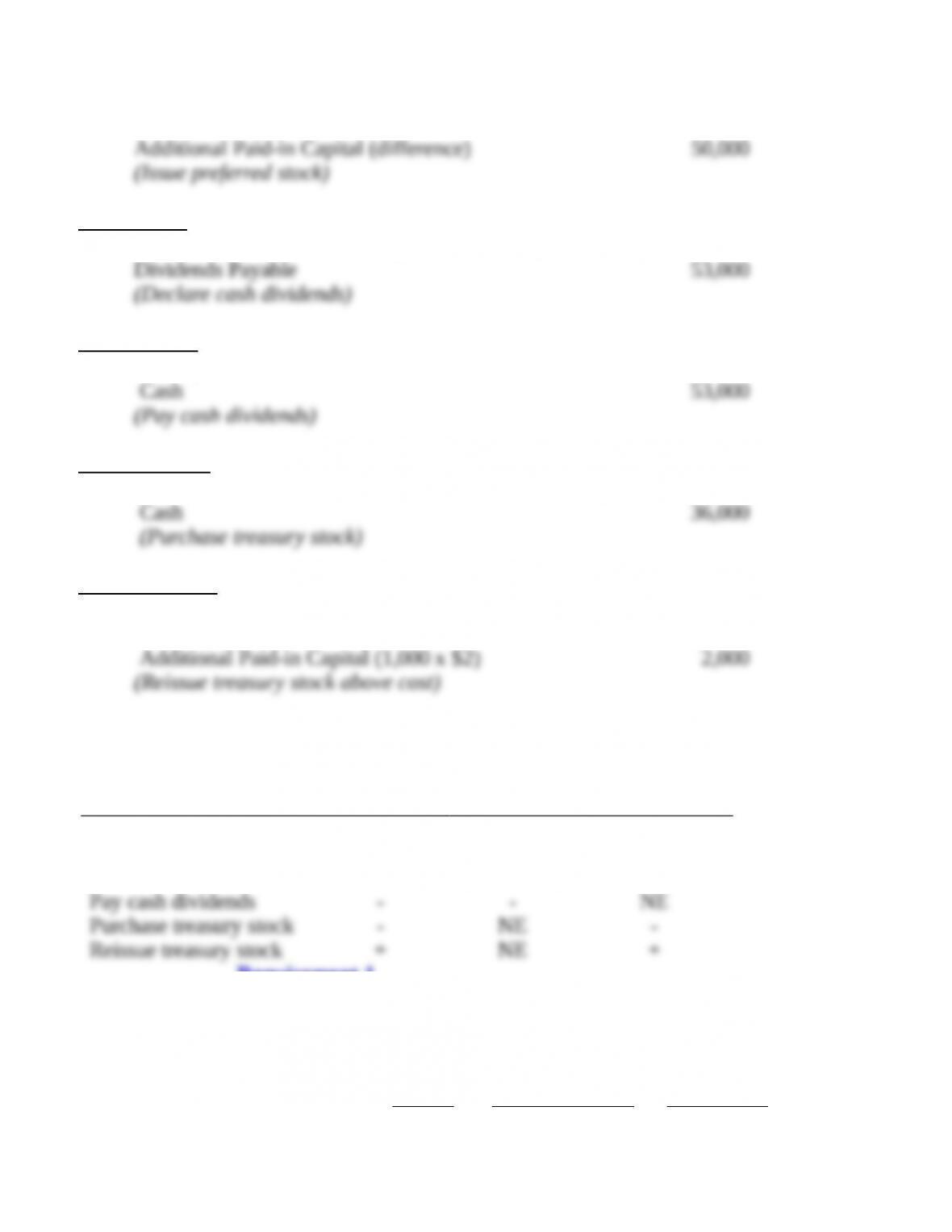
Preferred Stock (5,000 shares x $100) 500,000
June 1, 2015
Dividends (23,000 x $1 + 6,000 x $5) 53,000
June 30, 2015
Dividends Payable (23,000 x $1 + 6,000 x $5) 53,000
August 1, 2015
Treasury Stock (2,000 shares x $18) 36,000
October 1, 2015
Cash (1,000 shares x $20) 20,000
Treasury Stock (1,000 shares x $18) 18,000
Requirement 2
Transaction
Total
Assets
Total
Liabilities
Total
Stockholders’
Equity
Issue common stock + NE +
Issue preferred stock + NE +
Declare cash dividends NE + –
Requirement 1
Before
After 100%
Stock Dividend
After 2-for-1
Stock Split
Problem 10-3C
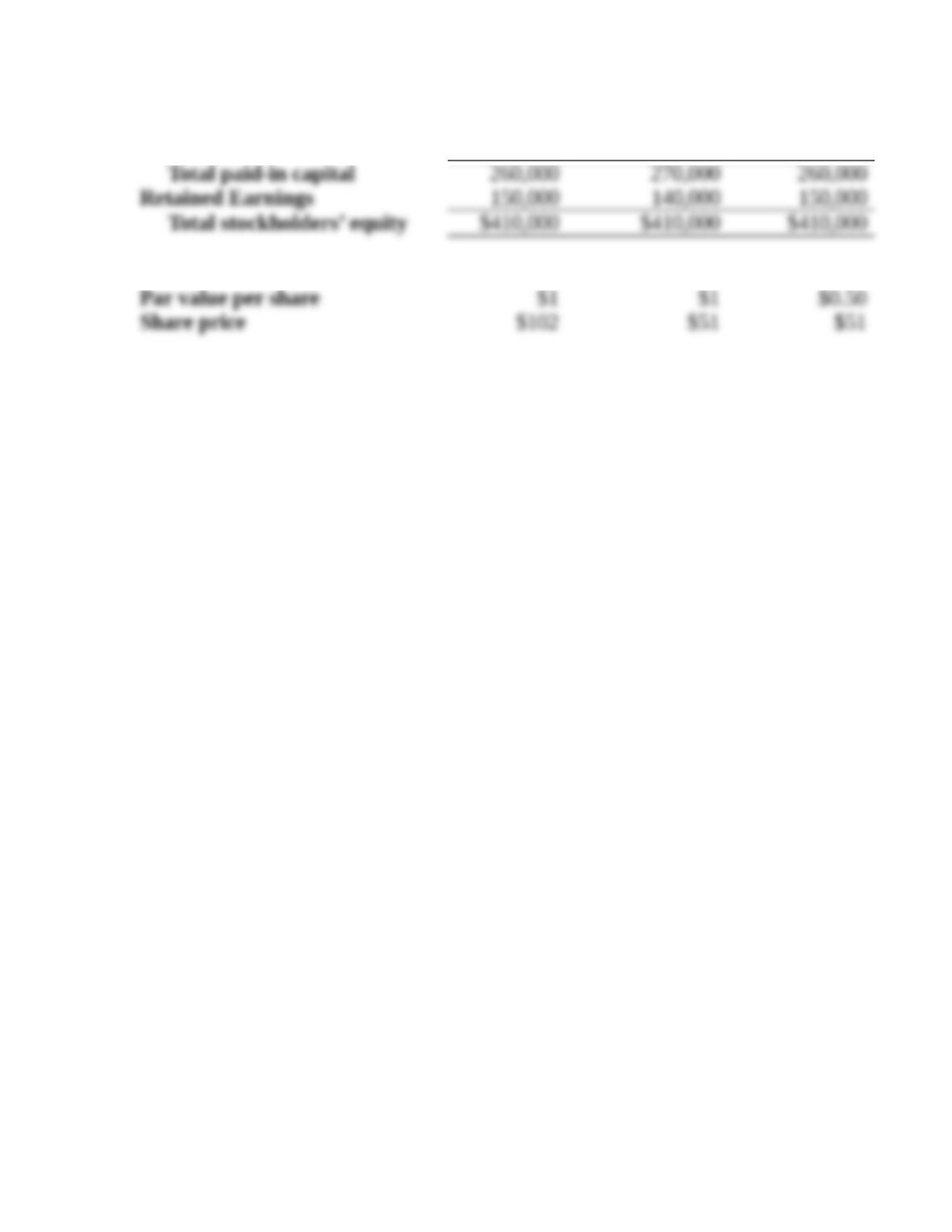
Common stock, $1 par value $ 10,000 $ 20,000 $ 10,000
Additional paid-in capital 250,000 250,000 250,000
Shares outstanding 10,000 20,000 20,000
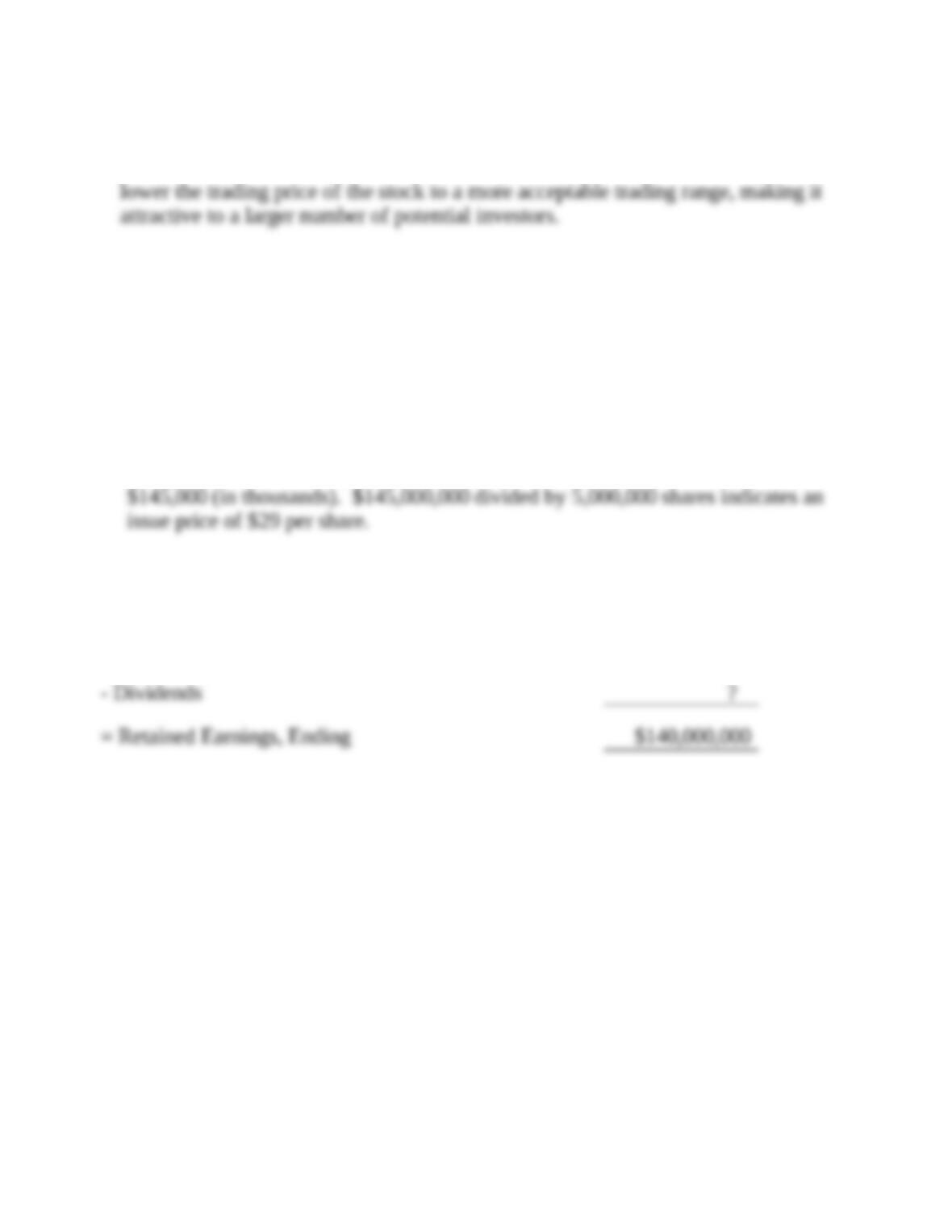
Requirement 1
Requirement 2
The primary reason companies declare a large stock dividend or a stock split is to
Problem 10-4C
Requirement 1
1,000,000 shares = ($50,000 / $50 par value per share) in thousands (x 1,000).
Requirement 2
5,000,000 shares = ($25,000 / $5 par value per share) in thousands (x 1,000).
Requirement 3
$29 per share. The total paid-in capital for common stock is $25,000 + $120,000 =
Requirement 4
Retained Earnings, Beginning $120,000,000
+ Net Income 30,000,000
Dividends paid for the year were $10,000,000.
Requirement 5
1,045,000 shares = ($20,900 / $20 per share) in thousands (x 1,000).
Problem 10-5C
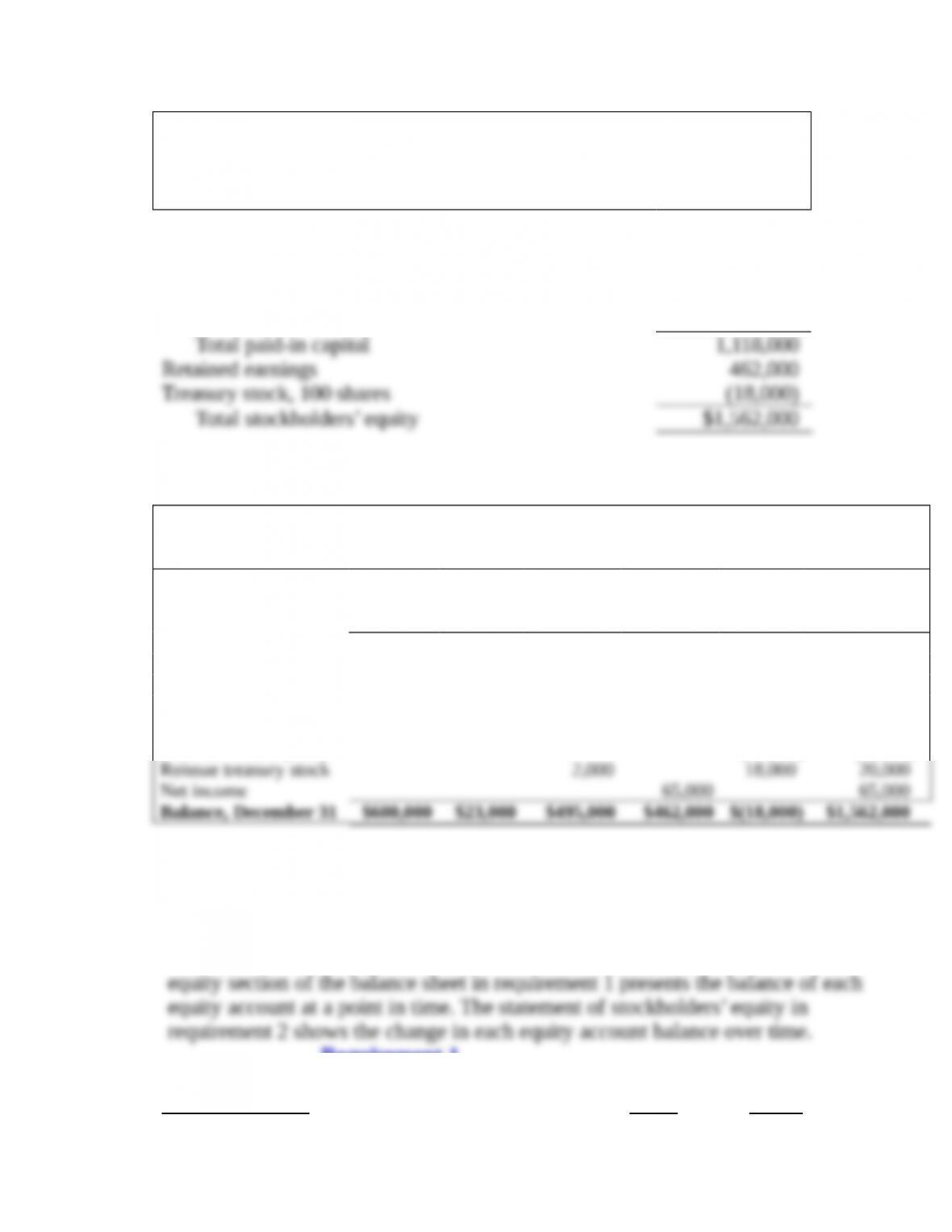
Sweet Sixteen
Balance Sheet
(Stockholders’ Equity Section)
December 31, 2015
Stockholders’ equity:
Preferred stock, $100 par value $ 600,000
Common stock, $1 par value 23,000
Additional paid-in capital 495,000
Requirement 2
Sweet Sixteen
Statement of Stockholders’ Equity
For the Year Ended December 31, 2015
Preferred
Stock
Common
Stock
Additional
Paid-in
Capital
Retained
Earnings
Treasury
Stock
Total
Stockholders’
Equity
Balance, January 1 $100,000 $20,000 $380,000 $450,000 $ -0- $950,000
Issued common stock 3,000 63,000 66,000
Issued preferred stock 500,000 50,000 550,000
Cash dividends (53,000) (53,000)
Purchase treasury stock (36,000) (36,000)
Requirement 3
Requirements 1 and 2 are similar in that requirement 1 shows the equity balances in
a column format and requirement 2 shows these same balances across the bottom
row. However, requirements 1 and 2 serve different purposes. The stockholders’
Requirement 1
February 2, 2015 Debit Credit
Problem 10-6C
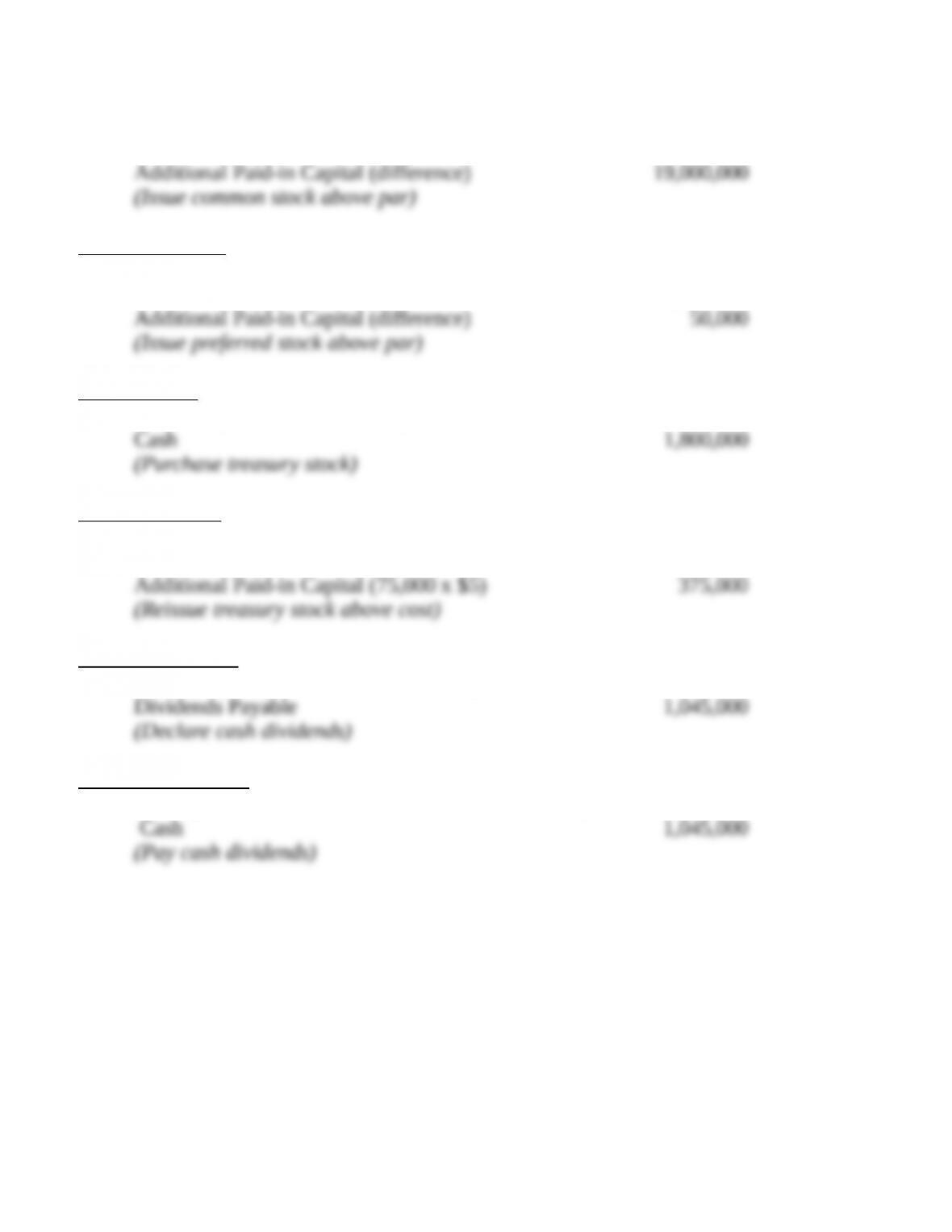
Cash (1,000,000 x $20) 20,000,000
Common Stock (1,000,000 x $1) 1,000,000
February 4, 2015
Cash (50,000 x $21) 1,050,000
Preferred Stock (50,000 x $20) 1,000,000
June 15, 2015
Treasury Stock (100,000 shares x $18) 1,800,000
August 15, 2015
Cash (75,000 shares x $23) 1,725,000
Treasury Stock (75,000 shares x $18) 1,350,000
November 1, 2015
Dividends (975,000 shares x $1.00 + $70,000) 1,045,000
November 30, 2015
Dividends Payable 1,045,000
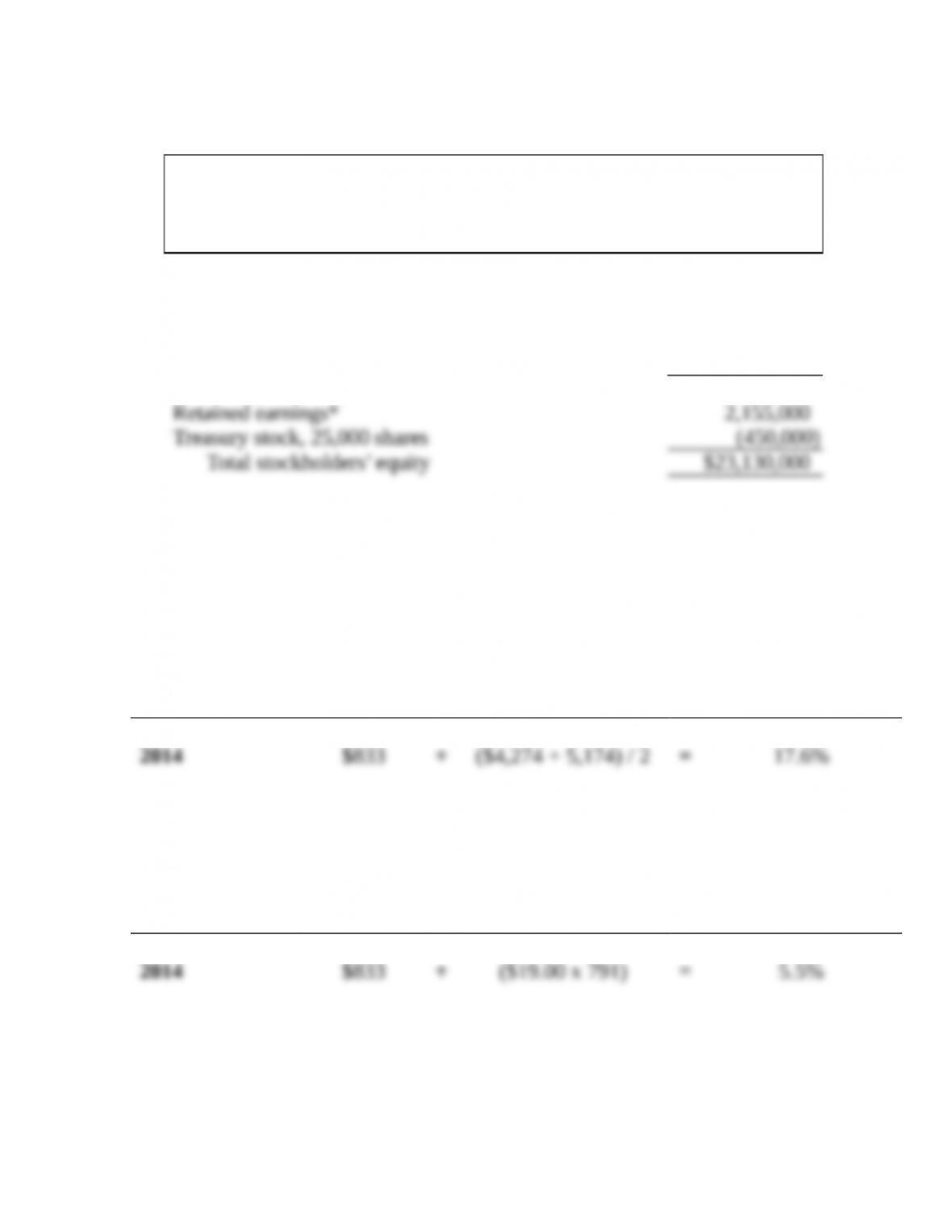
Requirement 2
Hoop It Up
Balance Sheet
(Stockholders’ Equity Section)
December 31, 2015
Stockholders’ equity:
Preferred stock, $20 par value $1,000,000
Common stock, $1 par value 1,000,000
Additional paid-in capital 19,425,000
Total paid-in capital 21,425,000
* $3,200,000 net income minus $1,045,000 in dividends.
($ in millions) Net Income ÷
Average
Stockholders’ Equity =
Return on
Equity
2015 $967 ÷($4,387+ 4,274) / 2 = 22.3%
($ in millions) Net Income ÷Market Value
of Equity =
Return on the
Market Value
of Equity
2015 $967 ÷($16.00 x 694) = 8.7%
Problem 10-6B (Continued)
Problem 10-7C
Requirement 1
The return on equity is higher in 2009 than in 2008.
Requirement 2
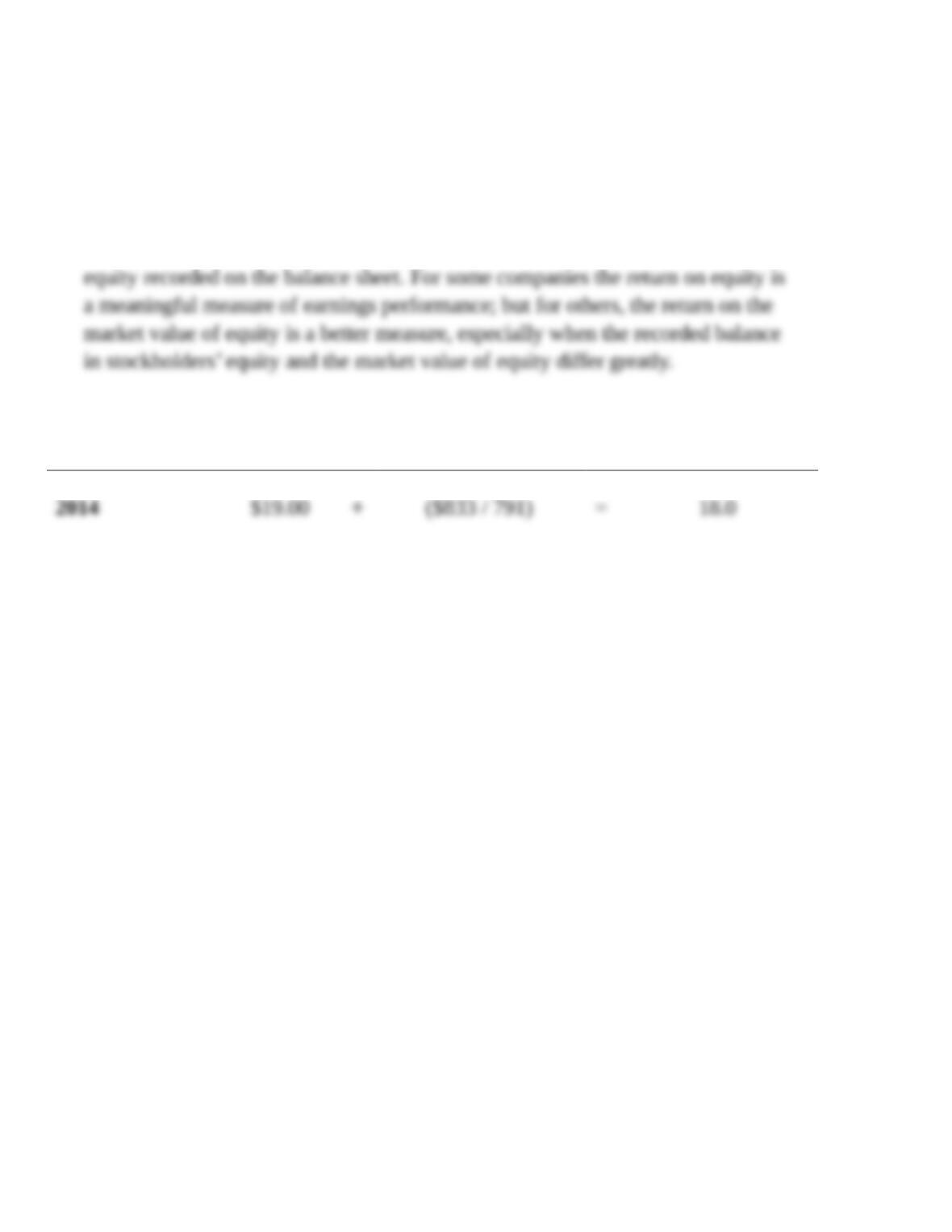
($ in millions) Stock Price ÷ Earnings Per Share =
Price-Earnings
Ratio
2015 $16.00 ÷($967 / 694) = 11.5
The return on the market value of equity is also higher in 2009 than in 2008.
Requirement 3
The return on the market value of equity is much lower than the return on equity
because the market value of equity is much higher than average stockholders’
Requirement 4
The price-earnings ratio in 2015 is much lower than in 2014. The company is trading
at a lower price per dollar of earnings in 2015.