* $140,000 beginning balance in retained earnings + $150,000 net income –
$115,000 in dividends

Financial Analysis: American Eagle
AP10-2
Requirement 1
$0.01 par value per share. The par value per share is listed in the stockholders’
Requirement 2
249,566,000 shares. The number of shares issued (in thousands) is listed in the
Requirement 3
Yes, 56,962,000 shares. The number of shares of treasury stock (in thousands) is
Requirement 4
$405,087,000. The cash dividends paid (in thousands) is listed near the bottom of
Financial Analysis: Buckle
AP10-3
Requirement 1
$0.01 par value per share. The par value per share is listed in the stockholders’
Requirement 2
48,059,269 shares. The number of shares issued is listed in the stockholders’ equity
Requirement 3
No. There is no treasury stock reported in the stockholders’ equity section of the
Requirement 4
$254,633,000. The cash dividends paid is listed in the retained earnings column of
Comparative Analysis: American Eagle vs. Buckle
AP10-4
Requirement 1
($ in thousands)
Net
Income
÷
Average
Stockholders’
Equity
= Return on
Equity
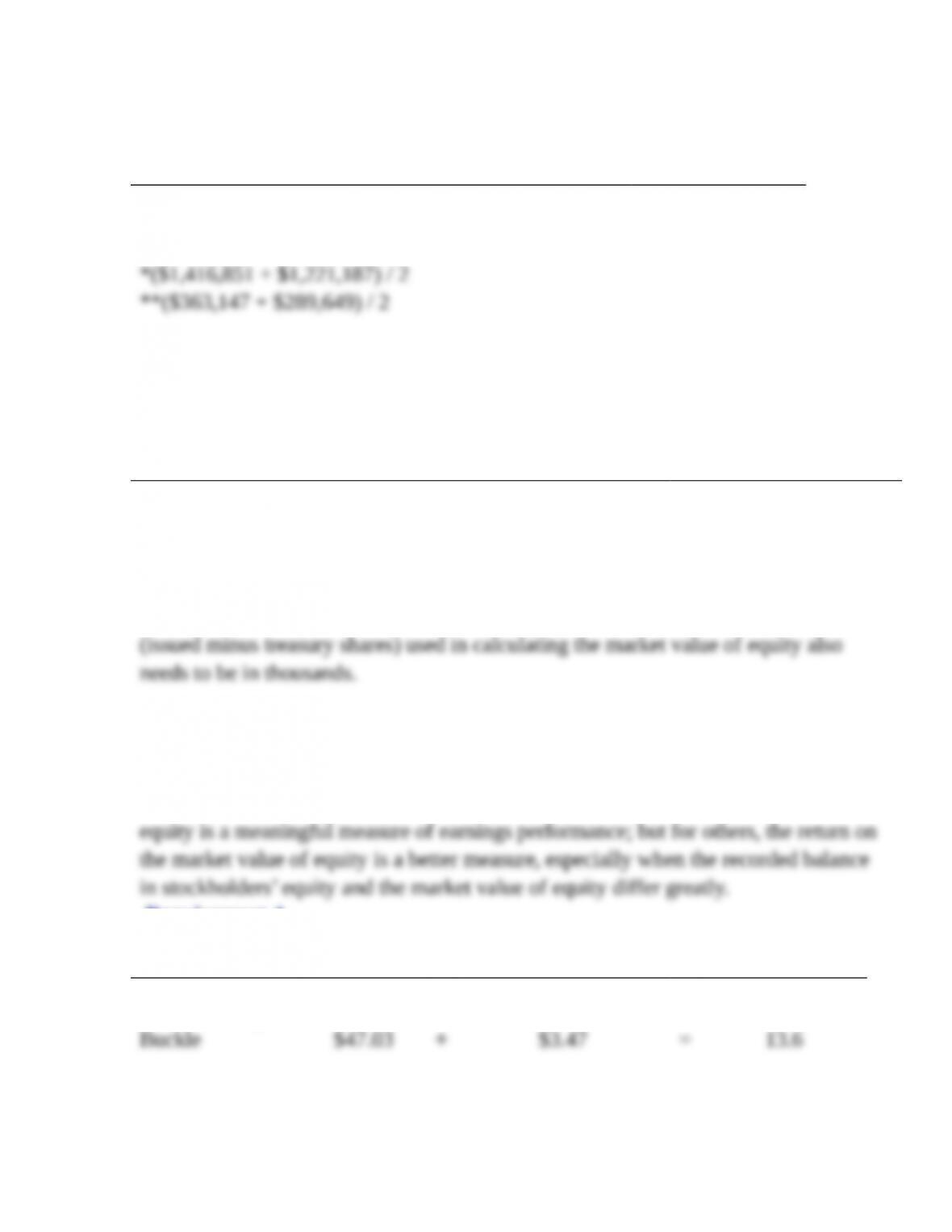
American Eagle $232,108 ÷$1,319,019* = 17.6%
Buckle $164,305 ÷$326,398** = 50.3%
($ in thousands) Net Income ÷Market Value
of Equity =
Return on the
Market Value
of Equity
American Eagle $232,108 ÷($20.19 x 192,604) = 6.0%
Buckle $164,305 ÷($47.03 x 48,059) = 7.3%
($ in thousands) Stock Price ÷ Earnings Per Share =
Price-Earnings
Ratio
American Eagle $20.19 ÷$1.19 = 17.0
Buckle $47.03 ÷$3.47 = 13.6
*($1,416,851 + $1,221,187) / 2
**($363,147 + $289,649) / 2
Buckle has a much higher return on equity than American Eagle.
Requirement 2
Buckle also has a higher return on market value of equity than American Eagle. Note
that since net income amounts are in thousands, the number of shares outstanding
Requirement 3
The return on the market value of equity is much lower than the return on equity for
both companies because the market value of equity is much higher than average
stockholders’ equity recorded on the balance sheet. For some companies the return on
Requirement 4
Requirement 1
Liabilities are the creditors’ claims to resources. Stockholders’ equity are the owners’
claim to resources.
Requirement 2
The balance sheet has always distinguished between liabilities and stockholders’
equity. Financial accounting information is designed to provide information useful to
Buckle is trading at a lower price per dollar of earnings than American Eagle. Ethics
AP10-5
Answers regarding the allocation of the additional $5 million in operating cash flows
will vary. Other areas to spend the money, not specifically mentioned in the case,
include increasing employee benefits such as retirement and healthcare, investing in
It is common for executives to be compensated based on the company’s performance
each year. This in itself is not unethical and often is a good business practice.
Internet Research
AP10-6
This case provides an opportunity for students to learn more about Form 10-K,
containing the annual report for publicly traded companies. It also introduces students
to EDGAR, one of the largest sources of accounting information available on the
Written Communication
AP10-7
Requirement 3
Arguments in support of eliminating the distinction relate to the difficulty, in certain
cases, in distinguishing between liabilities and stockholders’ equity. For instance,
preferred stock can be structured so that it is nearly identical to common stock by
giving preferred stock voting rights and making it convertible to common stock at the
option of the investor. On the other hand, preferred stock can also be structured so that
Requirement 4
While answers to this question will vary, students should be able to defend their
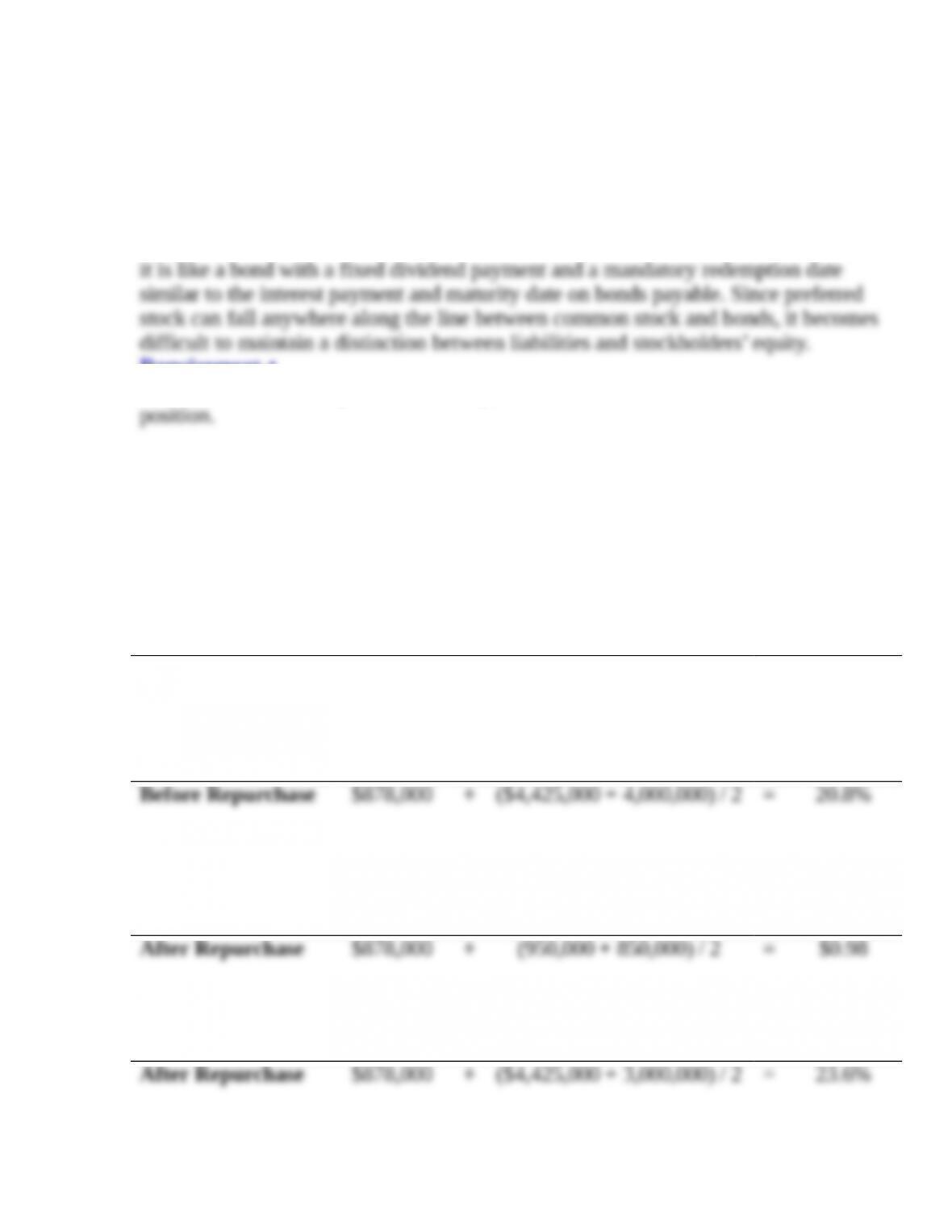
Net Income ÷Shares outstanding =Earnings
Per Share
Before Repurchase $878,000 ÷950,000 = $0.92
Net Income ÷Average
Stockholders’ Equity =Return on
Equity
Net Income ÷Shares outstanding =Earnings
Per Share
Net Income ÷Average
Stockholders’ Equity =Return on
Equity
Earnings Management
AP10-8
Requirement 1
Requirement 2

Requirement 3The repurchase of stock near year-end improves earnings per share by
reducing the number of outstanding shares used to calculate earnings per share. It also
improves the return on equity by reducing the ending balance in stockholders’ equity.