Question 1-1 (LO 1-1)
Accounting is the language of business. Whereas a basic math class might involve adding,
subtracting, and solving for unknown variables, accounting involves learning to measure
Question 1-2 (LO 1-1)
Those interested in making decisions about a company include investors, creditors,
Question 1-3 (LO 1-1)
Financial accounting seeks to measure business activities of a company and to communicate
those measurements to external parties for decision-making purposes. The two primary external,
or outside the firm, users of financial accounting information are investors and creditors.
Question 1-4 (LO 1-1)
The two primary functions of financial accounting are to measure business activities of a
Question 1-5 (LO 1-2)
The three basic business activities are financing, investing, and operating activities.
Financing activities are transactions that raise cash needed to operate the business. Investing
activities typically include the purchase or disposal of long-term resources such as land,
Question 1-6 (LO 1-2)
Typical financing activities would include selling stock and paying dividends to investors, as
Question 1-7 (LO 1-2)
Typical investing activities would include the purchase or disposal of land, casino buildings,
Chapter 1
A Framework for Financial Accounting REVIEW QUESTIONS
Answers to Review Questions (continued)
Question 1-8 (LO 1-2)
Typical operating activities would include the sale of software and consulting services, as
Question 1-9 (LO 1-2)
The three major legal forms of business organizations include sole proprietorship,
Question 1-10 (LO 1-2)
Assets: Resources owned.
Liabilities: Amounts owed.
Stockholders’ equity: Owners’ claims to resources.
Question 1-11 (LO 1-2)
The major advantage of a corporation is limited liability. Stockholders of a corporation are
not held personally responsible for the financial obligations of the corporation. Owners of sole
proprietorships or partnerships remain personally liable for activities of the business.
Question 1-12 (LO 1-3)
1. Income statement: Reports the company’s revenues and expenses during an interval of
2. Statement of stockholders’ equity: Summarizes the changes in stockholders’ equity from
3. Balance sheet: Presents the financial position of the company on a particular date. It
4. Statement of cash flows: Cash activities related to operating, investing, and financing
Question 1-13 (LO 1-3)
Balances of accounts reported in the income statement, statement of stockholders’ equity, and
statement of cash flows reflect activity from the beginning of the period through the end of the
Answers to Review Questions (continued)
Question 1-14 (LO 1-3)
Basic revenues would include sale of products (such as toys, dolls, and games) and services
Question 1-15 (LO 1-3)
The accounting equation is: Assets = Liabilities + Stockholders’ Equity. The format of the
Question 1-16 (LO 1-3)
Assets would include items such as merchandise inventory, office supplies, buildings, land,
Question 1-17 (LO 1-3)
Retained earnings represent the cumulative amount of net income earned over the life of the
company that has not been distributed to stockholders as dividends. Net income is shown in the
Question 1-18 (LO 1-3)
The statement of cash flows reports operating, investing, and financing cash flows. Examples
of each include:
Operating – selling merchandise, paying employee salaries, and paying for advertisement.
Question 1-19 (LO 1-3)
Two other important sources of information are the (1) management discussion and analysis
Question 1-20 (LO 1-4)
Successful companies use their resources efficiently to sell products and services for a profit.
Unsuccessful companies either offer lower-quality products and services or do not efficiently
keep their costs low. When a company is unprofitable, investors will neither invest in nor lend to
Answers to Review Questions (continued)
Question 1-21 (LO 1-5)
GAAP refers to Generally Accepted Accounting Principles, or the rules of financial
accounting. The fact that all companies use the same rules is critical to financial statement users,
Question 1-22 (LO 1-5)
The Financial Accounting Standards Board (FASB) is primarily responsible for the
Question 1-23 (LO 1-5)
U.S. GAAP refers to the set of accounting standards being developed in the United States by
the Financial Accounting Standards Board (FASB). IFRS (International Financial Reporting
Question 1-24 (LO 1-5)
The 1933 Securities Act and the 1934 Securities Exchange Act were designed to restore
investor confidence in financial accounting following the stock market crash in 1929 and the
Question 1-26 (LO 1-5)
The three objectives of financial reporting are providing information that:
1. is useful to investors and creditors in making decisions.
2. helps to predict cash flows.
3. tells about economic resources, claims to resources, and changes in resources and
claims.
Answers to Review Questions (continued)
Question 1-27 (LO 1-6)
The benefits to obtaining a degree in accounting include a wide variety of job opportunities,
high demand, and high salaries. Public accounting firms are professional service firms that
traditionally have focused on three areas: auditing, tax preparation/planning, and business
Question 1-28 (LO 1-7)
Relevance and faithful representation are the two fundamental qualitative characteristics.
Question 1-29 (LO 1-7)
The three components/aspects of relevance include:
1. Predictive value – Information is useful in helping to forecast future outcomes.
The three components/aspects of faithful representation include:
1. Completeness – All information necessary to describe an item is reported.
Question 1-30 (LO 1-7)
Cost effectiveness and materiality refer to practical boundaries (constraints) to achieving
desired
qualitative characteristics. Cost effectiveness suggests that financial accounting information is
provided only when the benefits of doing so exceed the costs. Materiality reflects the impact of
Question 1-31 (LO 1-7)
The four basic assumptions underlying GAAP include:
1. Economic entity assumption – All economic events can be identified with a particular
2. Monetary unit assumption – A common denominator is needed to measure all elements.
3. Periodicity assumption – The economic life of an enterprise (presumed to be
4. Going concern assumption – In the absence of information to the contrary, it is
Brief Exercise 1-1 (LO 1-1)
1. True
2. True
3. False
Brief Exercise 1-2 (LO 1-2)
1. b.
2. c.
3. a.
Brief Exercise 1-3 (LO 1-2)
1. c.
2. a.
3. b.
Brief Exercise 1-4 (LO 1-2)
1. e.
2. f.
3. b.
4. c.
BRIEF EXERCISES
5. a.
6. d.
Brief Exercise 1-5 (LO 1-2)
1. e.
2. d.
3. f.
4. a.
5. b.
Brief Exercise 1-6 (LO 1-2)
1. b.
2. a.
3. e.
4. c.
5. d.
Brief Exercise 1-7 (LO 1-3)
1. b.
2. a.
3. d.
4. c.
Brief Exercise 1-8 (LO 1-3)
1. c.
2. a.
3. d.
4. b.
Brief Exercise 1-9 (LO 1-5)
1. b.
2. d.
3. a.
4. c.
Brief Exercise 1-10 (LO 1-5)
1. Yes.
2. No.
3. Yes.
4. No.
5. Yes.
6. No.
Brief Exercise 1-11 (LO 1-6)
1. True
2. True
3. True
4. True
5. True
6. True
7. True
8. True
9. True
10. True
11. True
12. True
Brief Exercise 1-12 (LO 1-7)
1. b.
2. a.
3. c.
Brief Exercise 1-13 (LO 1-7)
1. c.
2. b.
3. a.
Exercise 1-1 (LO 1-2)
1. a.
EXERCISES
2. c.
3. a.
4. b.
5. c.
6. a.
7. b.
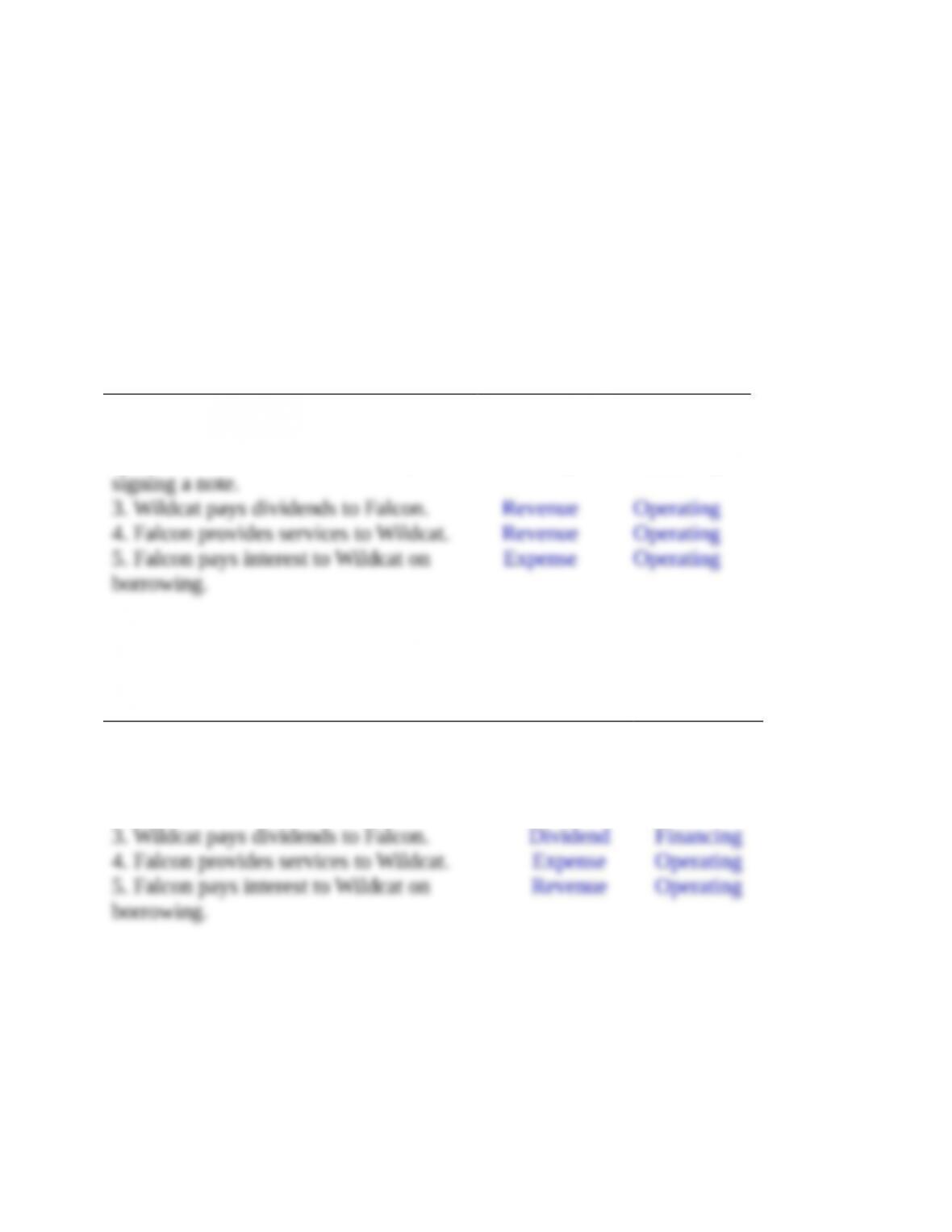
Exercise 1-2 (LO 1-2)
Transaction Account Activity
1. Falcon purchases common stock of
Wildcat.
Asset Investing
2. Falcon borrows from Wildcat by
Liability Financing
Exercise 1-3 (LO 1-2)
Transaction Account Activity
1. Falcon purchases common stock of
Wildcat.
Equity Financing
2. Falcon borrows from Wildcat by signing
a note.
Asset Investing