
Learning Objectives
LO1-1 Describe the two primary functions of financial accounting.
LO1-2 Understand the business activities that financial accounting measures.
LO1-3 Determine how financial accounting information is communicated through
financial statements.
LO1-4 Describe the role that financial accounting plays in the decision-making process.
LO1-5 Explain the term generally accepted accounting principles (GAAP) and
describe the role of GAAP in financial accounting.
LO1-6 Identify career opportunities in accounting.
Appendix
LO1-7 Explain the nature of the conceptual framework used to develop generally accepted
accounting principles.
Teaching Suggestions
This chapter introduces students to the concept that accounting is not a math course; it’s the
language of business. For Part A, emphasis should be placed on the two functions of accounting:
measurement and communication of business activities. These concepts are reinforced by
describing the business activities of a start-up company, and then discussing the measurements
that various decision makers need. Financial statements are presented for a fictitious company
that will be used in Chapters 1 to 4. The importance of accounting to decision makers, and its
importance to our society, is discussed. This emphasis is used to help students better understand
the role of accounting and motivate their interest in the course.
In Part B, the background of accounting standards and the historical perspective is provided.
The role of the auditor in adding credibility to financial information naturally leads to a
discussion of the ethical issues surrounding financial reporting.
Part C ends the main text with a discussion of careers in accounting. Again, this is used to be
both informative and motivational. This section emphasizes the broad range of job opportunities
available to those earning a degree in accounting, perhaps dispelling the traditional view of
accountants. It also discusses the strong demand for accounting majors.
For those interested, the conceptual framework is discussed in the appendix. The instructor
can cover the conceptual framework in this chapter and then refer back to it as topics in
subsequent chapters are covered. Alternatively, the instructor may wish to cover the conceptual
framework in conjunction with another chapter, such as Chapter 12, Financial Statement
Analysis.
Assignment Charts
Assignment Charts
Questions Learning
Objective(s) Topic
Time
(Min.)
1 LO1-1 Define accounting 5
2 LO1-1 Identify decision makers 5
3 LO1-1 Define financial accounting 5
4 LO1-1 Determine the functions of accounting 5
5 LO1-2 Classify business activities 5
6 LO1-2 Determine financing activities 5
7 LO1-2 Determine investing activities 5
8 LO1-2 Determine operating activities 5
9 LO1-2 Distinguish legal forms of business 5
10 LO1-2 Define account types 5
11 LO1-2 Name advantages and disadvantages of the legal
forms of business
5
12 LO1-3 Describe basic financial statements 5
13 LO1-3 Understand financial reporting period 5
14 LO1-3 Identify revenues and expenses 5
15 LO1-3 Understand the accounting equation 5
16 LO1-3 Identify assets and liabilities 5
17 LO1-3 Understand the link between the income statement
and balance sheet
5
18 LO1-3 Identify cash flows 5
19 LO1-3 Explain other forms of financial accounting
information
5
20 LO1-4 Explain the role of accounting in society 5
21 LO1-5 Define GAAP 5
22 LO1-5 Describe the role of the FASB 5
23 LO1-5 Compare U.S. GAAP and IFRS 5
24 LO1-5 Under the historical role of the securities acts 5
25 LO1-5 Describe the role of the auditor 5
26 LO1-5 List the three objectives of financial reporting 5
27 LO1-6 Understand benefits of an accounting degree 5
28 LO1-7 Discuss relevance and faithful representation 5
29 LO1-7 Identify the components of relevance and faithful
representation
5
30 LO1-7 Describe cost effectiveness 5
31 LO1-7 Define the four basic assumption underlying GAAP 5
Brief
Exercises Learning
Objective(s) Topic
Time
(Min.)
BE1-1 LO1-1 Define accounting 5
BE1-2 LO1-2 Identify the different types of business activities 5
BE1-3 LO1-2 Identify the different forms of business
organizations
5
BE1-4 LO1-2 Recognize the different account classifications 5
BE1-5 LO1-2 Assign account classifications 5
BE1-6 LO1-2 Assign account classifications 5
BE1-7 LO1-3 Describe each financial statement 5
BE1-8 LO1-3 Determine the location of items in financial
statements
5
BE1-9 LO1-5 Identify different groups engaged in providing
high-quality financial reporting
5
BE1-10 LO1-5 Identify the objectives of financial accounting 5
BE1-11 LO1-6 Identify careers for accounting majors 5
BE1-12 LO1-7 Identify the components/aspects of relevance 5
BE1-13 LO1-7 Identify the components/aspects of faithful
representation
5
Exercises Learning
Objective(s) Topic
Time
(Min.)
E1-1 LO1-2 Identify the different types of business activities 5
E1-2 LO1-2 Identify account classifications and business
activities
5
E1-3 LO1-2 Identify account classifications and business
activities
5
E1-4 LO1-2 Calculate net income and stockholders’ equity 10
E1-5 LO1-2 Calculate net loss and stockholders’ equity 10
E1-6 LO1-3 Prepare an income statement 5
E1-7 LO1-3 Prepare a statement of stockholders’ equity 10
E1-8 LO1-3 Prepare a balance sheet 5
E1-9 LO1-3 Prepare a statement of cash flows 10
E1-10 LO1-3 Link the income statement to the statement of
stockholders’ equity
15
E1-11 LO1-3 Link the statement of stockholders’ equity to the
balance sheet
15
E1-12 LO1-3 Link the balance sheet to the statement of cash
flows
15
E1-13 LO1-3 Compute missing amounts from financial statements 10
E1-14 LO1-3 Calculate the balance of retained earnings 5
E1-15 LO1-3 Calculate amounts related to the balance of retained
earnings.
10
E1-16 LO1-3 Use the accounting equation to calculate amounts
related to the balance sheet
10
E1-17 LO1-3 Calculate missing amounts related to the statement
of cash flows
10
E1-18 LO1-5 Understand the role of the auditor
E1-19 LO1-7 Identify the purpose of qualitative characteristics 10
E1-20 LO1-7 Identify business assumptions underlying GAAP 5
Problems Learning
Objective(s) Topic
Time
(Min.)
P1-1A LO1-2 Classify business activities 10
P1-2A LO1-2 Assign account classifications 10
P1-3A LO1-3 Prepare financial statements 20
P1-4A LO1-3 Understand the format of financial statements and
the link among them
25
P1-5A LO1-3 Prepare financial statements 20
P1-6A LO1-7 Identify underlying assumptions of GAAP 15
P1-7A LO1-7 Understand the components of the FASB’s
conceptual framework
10
P1-1B LO1-2 Classify accounts 10
P1-2B LO1-2 Assign business transactions to account
classifications
10
P1-3B LO1-3 Prepare financial statements 20
P1-4B LO1-3 Understand the format of financial statements and
the link among them
25
P1-5B LO1-3 Prepare financial statements 20
P1-6B LO1-7 Identify underlying assumptions of GAAP 15
P1-7B LO1-7 Understand the components of the FASB’s
conceptual framework
10
Additional
Perspectives Topic
Time
(Min.)
AP1-1 Continuing Problem: Great Adventures 20
AP1-2 Financial Analysis: American Eagle Outfitters, Inc. 15
AP1-3 Financial Analysis: The Buckle, Inc. 15
AP1-4 Comparative Analysis: American Eagle Outfitters, Inc., vs. The
Buckle, Inc.
20
AP1-5 Ethics 20
AP1-6 Internet Research 30
AP1-7 Written Communication 25
Chapter Quiz Questions
The following multiple-choice questions are 10 unique quiz questions that correspond to the 10
questions at the end of each chapter. Each question covers the same learning objective but with a
little different twist. The correct answer is highlighted in bold for each item.
LO1-1
1. Which of the following best describes financial accounting?
a. Artistic presentation.
b. Information measurement/communication process.
c. Mathematical procedure.
d. Behavioral psychology.
LO1-2
2. Which definition best describes financial accounting?
a. Process of measuring income taxes owed to the government.
b. System of maintaining communication with a company’s customers and suppliers.
c. Procedures designed to enhance the company’s image to potential investors.
d. Measuring a company’s business activities and communicating those measurements to
external parties.
LO1-2
3. Which of the following is a financing activity?
a. Paying utilities for the month.
b. Issuing common stock to investors.
c. Selling equipment for cash.
d. Purchasing office supplies.
LO1-2
4. Which of the following is an investing activity?
a. Purchasing land.
b. Paying dividends to stockholders.
c. Repaying amounts borrowed from the bank.
d. Purchasing advertising on a local radio station.
LO1-3
5. Which financial statement reports a company’s assets and liabilities?
a. Income statement.
b. Statement of cash flows.
c. Balance sheet.
d. Statement of stockholders’ equity.
LO1-3
6. Which financial statement shows a company’s revenues and expenses?
a. Income statement.
b. Statement of stockholders’ equity.
c. Balance sheet.
d. Statement of cash flows.
LO1-4
7. Which of the following best describes an important function of financial accounting?
a. To increase the number of customers for a company.
b. To support the efficient distribution of society’s resources.
c. To provide managers with useful information related to human resources.
d. To support government initiatives through taxation of company profits.
LO1-5
8. Which body has the primary responsibility for the establishment of Generally Accepted
Accounting Principles?
a. American Institute of Certified Public Accountants (AICPA).
b. International Accounting Standards Board (IASB).
c. Securities and Exchange Commission (SEC).
d. Financial Accounting Standards Board (FASB).
LO1-5
9. Traditional careers in public accounting include:
a. Auditors.
b. Tax preparers/planners.
c. Business consultants.
d. All of the above.
LO1-7
10. A component/aspect of relevant accounting information includes:
a. Faithful representation.
b. Comparability.
c. Predictive value.
d. Consistency.
Alternate Let’s Review
On December 31, Wortham Services reports the following year-end amounts.
Assets: Cash $11,000 Revenues: Service $85,000
Accts. rec. 19,000
Buildings 32,000
Expenses: Advertising 12,000
Liabilities: Salaries payable 5,000 Insurance 18,000
Notes payable 20,000 Salaries 44,000
Additional information:
a. The balance of retained earnings at the beginning of the year is $6,000.
b. The company pays dividends of $5,000 on December 31.
c. Common stock is $20,000 at the beginning of the year, and $5,000 of additional shares are
issued during the year.
Required:
Prepare the (1) income statement, (2) statement of stockholders’ equity, and (3) balance sheet.
Solution:
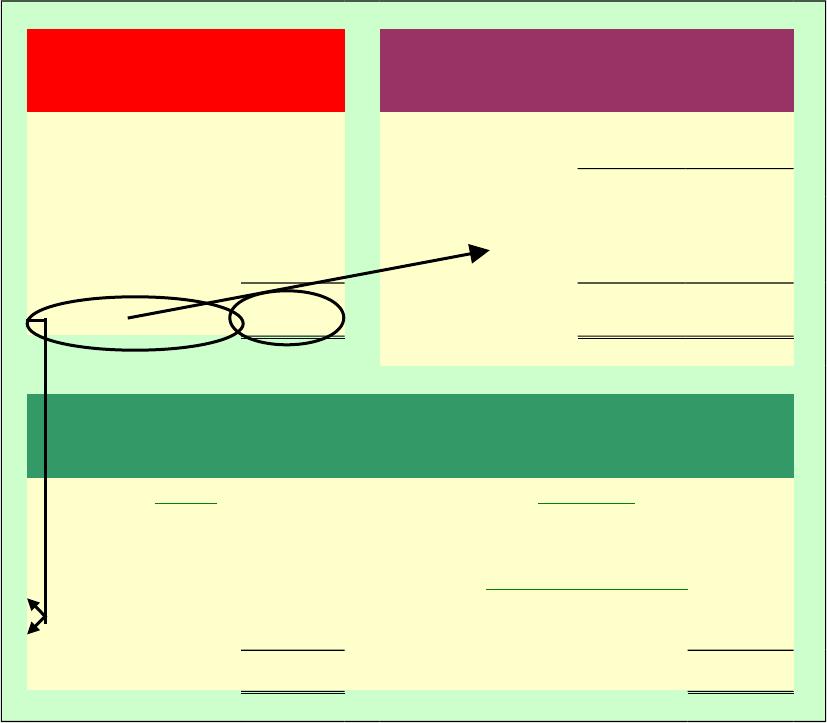
Wortham Services
Income Statement
Year ended Dec. 31
Wortham Services
Statement of Stockholders’ Equity
Year ended Dec. 31
Service revenue $85,000
Common
Stock
Retained
Earnings
Less: Beginning $20,000 $ 6,000
Adv. expense (12,000) New issuances 5,000
Ins. expense (18,000) Net income 11,000
Salaries expense (44,000) Less: Dividends (5,000)
Net Income $ 11,000 Ending $25,000 $12,000
Wortham Services
Balance Sheet
December 31
Assets Liabilities
Cash $11,000 Salaries payable $ 5,000
Accts. rec. 19,000 Notes payable 20,000
Buildings 32,000 Stockholders’ Equity
Common stock 25,000
Retained earnings 12,000
Total assets $62,000 Total liabilities and equity $62,000
Key Points by Learning Objective
LO1-1 Describe the two primary functions of financial accounting.
The functions of financial accounting are to measure business activities of a company and to
communicate information about those activities to investors and creditors and other outside users
for decision-making purposes.
LO1-2 Understand the business activities that financial accounting measures.
The measurement role of accounting is to create a record of the activities of a company. To make
this possible, a company must maintain an accurate record of its assets, liabilities, stockholders’
equity, revenues, expenses, and dividends.
LO1-3 Determine how financial accounting information is communicated through financial
statements.
The income statement compares revenues and expenses for the current period to assess the
company’s ability to earn a profit from running its operations.
The statement of stockholders’ equity reports information related to changes in common stock
and retained earnings each period. The change in retained earnings equals net income less
dividends for the period.
The balance sheet demonstrates that the company’s resources (assets) equal creditors’ claims
(liabilities) plus owners’ claims (stockholders’ equity) to those resources on a particular date.
The statement of cash flows reports cash transactions from operating, investing, and financing
activities for the period.
All transactions that affect revenues or expenses reported in the income statement ultimately
affect the balance sheet through the balance in retained earnings.
LO1-4 Describe the role that financial accounting plays in the decision-making process.
Financial accounting serves an important role by providing information useful in investment and
lending decisions.
No single piece of company information better explains a company’s stock price performance
than financial accounting net income. A company’s debt level is an important indicator of
management’s ability to respond to business situations and the possibility of bankruptcy.
LO1-5 Explain the term generally accepted accounting principles (GAAP) and describe the
role of GAAP in financial accounting.
The rules of financial accounting are called generally accepted accounting principles (GAAP).
The Financial Accounting Standards Board (FASB) is an independent, private body that has
primary responsibility for the establishment of GAAP in the United States.
The primary objective of financial accounting is to provide useful information to investors and
creditors in making decisions.
LO1-6 Identify career opportunities in accounting.
Because of the high demand for accounting graduates, the wide range of job opportunities, and
increasing salaries, this is a great time to obtain a degree in accounting.

Appendix
LO1-7 Explain the nature of the conceptual framework used to develop generally accepted
accounting principles.
The conceptual framework provides an underlying foundation for the development of accounting
standards and interpretation of accounting information.
To be useful for decision making, accounting information should have relevance and faithful
representation.
Common Mistakes
Common Mistake
Dividends represent the payment of cash but are not considered an expense in
running the business. Students sometimes mistakenly include the amount of
dividends as an expense in the income statement, rather than as a distribution
of net income in the statement of stockholders’ equity.
Decision Points
Question Accounting
Information
Analysis & Decision
How can I tell if a
company is
profitable?
Income statement If revenues exceed expenses, a
company has net income and is
profitable.
Career Corner
Career Corner
Over 20,000 employees join public accounting firms in entry-level jobs each
year, and thousands more go into other areas of accounting. While financial
accountants learn how to measure business transactions and prepare financial
reports, they also learn a great deal about the business itself. Because of this
widespread business knowledge, accountants often play a key role on the
management team. In fact, it should come as no surprise to learn that most
chief financial officers (CFOs) started their careers as accountants.
Accounting, because of its dynamic and professional nature, offers an
attractive career option. You can learn more about a career in accounting
by visiting the website of the American Institute of Certified Public
Accountants (www.aicpa.org). There, you can look under the Career
Development and Workplace Issues link to find current information about job
opportunities, salaries, work life for women, how to write a resume, how to
interview, and other general career advice. For salary and other job-related
information, consult the website of the U.S. Bureau of Labor Statistics

(www.bls.gov/oco/ocos001.htm) or go to careers-in-accounting.com. In
2010, entry-level jobs ranged between $50,000 and $70,000, with $55,000 as
the norm for Big-4 firms. Is an accounting degree right for you?
Ethical Dilemma
Ethical Dilemma
You have been the manager of a local restaurant for the past five years. Because
of increased competition, you notice you’re getting fewer customers. Despite all
your attempts to attract new customers and cut costs, the restaurant’s
profitability continues to decline. The restaurant owner tells you that if this
year’s profit is lower than last year’s, you’ll lose your job.
When preparing financial statements at the end of the year, you notice that this
year’s profit is lower. You know that by purposely understating certain
expenses, you can falsely report higher profits to the owner for this year. That
will allow you to keep your job for at least one more year and look for a new
job in the meantime.
What should you do? What if you really believe the lower profitability is caused
by factors outside your control? Would this make the false reporting acceptable?
Key Issues
Reporting higher profit makes the restaurant’s operations seem more profitable, signaling
better managerial performance.
Self-preservation (keeping your job) vs. honesty (accurate reporting).
Managing expectations—justifying why performance is truly declining.
Option 1: Do not understate expenses
The actions we take depict the type of person we are, not whom we hope to be. You may
believe other causes besides your performance drive the decline in performance, but that
should not be an excuse to lie and manipulate your boss.
A strong likelihood exists that the understatement of expenses will eventually be detected
(by auditors, owner, employees, etc.).
If caught, the ability to maintain employment with this restaurant or anywhere else will be
a challenge.
The best defense of your job is to prepare the financial statements accurately, and present
a thorough analysis to the restaurant owner regarding what you see as the true cause of
the decline in performance. A proactive approach with possible solutions to the problem
would be well received by a competent owner.
Option 2: Understate expenses
As the decline in performance is not your fault, you may decide that falsifying the
financial statements will allow you time to either explain to the owner why performance
has declined, or to look for another job.
It does not seem fair to be punished for things outside your control. You shouldn’t have to
lose your job just because the restaurant is not doing as well as it used to.
For those interested, the conceptual framework is discussed in the appendix. The instructor
can cover the conceptual framework in this chapter and then refer back to it as topics in
subsequent chapters are covered. Alternatively, the instructor may wish to cover the conceptual
framework in conjunction with another chapter, such as Chapter 12, Financial Statement
Analysis.
Assignment Charts
Assignment Charts
Questions Learning
Objective(s) Topic
Time
(Min.)
1 LO1-1 Define accounting 5
2 LO1-1 Identify decision makers 5
3 LO1-1 Define financial accounting 5
4 LO1-1 Determine the functions of accounting 5
5 LO1-2 Classify business activities 5
6 LO1-2 Determine financing activities 5
7 LO1-2 Determine investing activities 5
8 LO1-2 Determine operating activities 5
9 LO1-2 Distinguish legal forms of business 5
10 LO1-2 Define account types 5
11 LO1-2 Name advantages and disadvantages of the legal
forms of business
5
12 LO1-3 Describe basic financial statements 5
13 LO1-3 Understand financial reporting period 5
14 LO1-3 Identify revenues and expenses 5
15 LO1-3 Understand the accounting equation 5
16 LO1-3 Identify assets and liabilities 5
17 LO1-3 Understand the link between the income statement
and balance sheet
5
18 LO1-3 Identify cash flows 5
19 LO1-3 Explain other forms of financial accounting
information
5
20 LO1-4 Explain the role of accounting in society 5
21 LO1-5 Define GAAP 5
22 LO1-5 Describe the role of the FASB 5
23 LO1-5 Compare U.S. GAAP and IFRS 5
24 LO1-5 Under the historical role of the securities acts 5
25 LO1-5 Describe the role of the auditor 5
26 LO1-5 List the three objectives of financial reporting 5
27 LO1-6 Understand benefits of an accounting degree 5
28 LO1-7 Discuss relevance and faithful representation 5
29 LO1-7 Identify the components of relevance and faithful
representation
5
30 LO1-7 Describe cost effectiveness 5
31 LO1-7 Define the four basic assumption underlying GAAP 5
Brief
Exercises Learning
Objective(s) Topic
Time
(Min.)
BE1-1 LO1-1 Define accounting 5
BE1-2 LO1-2 Identify the different types of business activities 5
BE1-3 LO1-2 Identify the different forms of business
organizations
5
BE1-4 LO1-2 Recognize the different account classifications 5
BE1-5 LO1-2 Assign account classifications 5
BE1-6 LO1-2 Assign account classifications 5
BE1-7 LO1-3 Describe each financial statement 5
BE1-8 LO1-3 Determine the location of items in financial
statements
5
BE1-9 LO1-5 Identify different groups engaged in providing
high-quality financial reporting
5
BE1-10 LO1-5 Identify the objectives of financial accounting 5
BE1-11 LO1-6 Identify careers for accounting majors 5
BE1-12 LO1-7 Identify the components/aspects of relevance 5
BE1-13 LO1-7 Identify the components/aspects of faithful
representation
5
Exercises Learning
Objective(s) Topic
Time
(Min.)
E1-1 LO1-2 Identify the different types of business activities 5
E1-2 LO1-2 Identify account classifications and business
activities
5
E1-3 LO1-2 Identify account classifications and business
activities
5
E1-4 LO1-2 Calculate net income and stockholders’ equity 10
E1-5 LO1-2 Calculate net loss and stockholders’ equity 10
E1-6 LO1-3 Prepare an income statement 5
E1-7 LO1-3 Prepare a statement of stockholders’ equity 10
E1-8 LO1-3 Prepare a balance sheet 5
E1-9 LO1-3 Prepare a statement of cash flows 10
E1-10 LO1-3 Link the income statement to the statement of
stockholders’ equity
15
E1-11 LO1-3 Link the statement of stockholders’ equity to the
balance sheet
15
E1-12 LO1-3 Link the balance sheet to the statement of cash
flows
15
E1-13 LO1-3 Compute missing amounts from financial statements 10
E1-14 LO1-3 Calculate the balance of retained earnings 5
E1-15 LO1-3 Calculate amounts related to the balance of retained
earnings.
10
E1-16 LO1-3 Use the accounting equation to calculate amounts
related to the balance sheet
10
E1-17 LO1-3 Calculate missing amounts related to the statement
of cash flows
10
E1-18 LO1-5 Understand the role of the auditor
E1-19 LO1-7 Identify the purpose of qualitative characteristics 10
E1-20 LO1-7 Identify business assumptions underlying GAAP 5
Problems Learning
Objective(s) Topic
Time
(Min.)
P1-1A LO1-2 Classify business activities 10
P1-2A LO1-2 Assign account classifications 10
P1-3A LO1-3 Prepare financial statements 20
P1-4A LO1-3 Understand the format of financial statements and
the link among them
25
P1-5A LO1-3 Prepare financial statements 20
P1-6A LO1-7 Identify underlying assumptions of GAAP 15
P1-7A LO1-7 Understand the components of the FASB’s
conceptual framework
10
P1-1B LO1-2 Classify accounts 10
P1-2B LO1-2 Assign business transactions to account
classifications
10
P1-3B LO1-3 Prepare financial statements 20
P1-4B LO1-3 Understand the format of financial statements and
the link among them
25
P1-5B LO1-3 Prepare financial statements 20
P1-6B LO1-7 Identify underlying assumptions of GAAP 15
P1-7B LO1-7 Understand the components of the FASB’s
conceptual framework
10
Additional
Perspectives Topic
Time
(Min.)
AP1-1 Continuing Problem: Great Adventures 20
AP1-2 Financial Analysis: American Eagle Outfitters, Inc. 15
AP1-3 Financial Analysis: The Buckle, Inc. 15
AP1-4 Comparative Analysis: American Eagle Outfitters, Inc., vs. The
Buckle, Inc.
20
AP1-5 Ethics 20
AP1-6 Internet Research 30
AP1-7 Written Communication 25
Chapter Quiz Questions
The following multiple-choice questions are 10 unique quiz questions that correspond to the 10
questions at the end of each chapter. Each question covers the same learning objective but with a
little different twist. The correct answer is highlighted in bold for each item.
LO1-1
1. Which of the following best describes financial accounting?
a. Artistic presentation.
b. Information measurement/communication process.
c. Mathematical procedure.
d. Behavioral psychology.
LO1-2
2. Which definition best describes financial accounting?
a. Process of measuring income taxes owed to the government.
b. System of maintaining communication with a company’s customers and suppliers.
c. Procedures designed to enhance the company’s image to potential investors.
d. Measuring a company’s business activities and communicating those measurements to
external parties.
LO1-2
3. Which of the following is a financing activity?
a. Paying utilities for the month.
b. Issuing common stock to investors.
c. Selling equipment for cash.
d. Purchasing office supplies.
LO1-2
4. Which of the following is an investing activity?
a. Purchasing land.
b. Paying dividends to stockholders.
c. Repaying amounts borrowed from the bank.
d. Purchasing advertising on a local radio station.
LO1-3
5. Which financial statement reports a company’s assets and liabilities?
a. Income statement.
b. Statement of cash flows.
c. Balance sheet.
d. Statement of stockholders’ equity.
LO1-3
6. Which financial statement shows a company’s revenues and expenses?
a. Income statement.
b. Statement of stockholders’ equity.
c. Balance sheet.
d. Statement of cash flows.
LO1-4
7. Which of the following best describes an important function of financial accounting?
a. To increase the number of customers for a company.
b. To support the efficient distribution of society’s resources.
c. To provide managers with useful information related to human resources.
d. To support government initiatives through taxation of company profits.
LO1-5
8. Which body has the primary responsibility for the establishment of Generally Accepted
Accounting Principles?
a. American Institute of Certified Public Accountants (AICPA).
b. International Accounting Standards Board (IASB).
c. Securities and Exchange Commission (SEC).
d. Financial Accounting Standards Board (FASB).
LO1-5
9. Traditional careers in public accounting include:
a. Auditors.
b. Tax preparers/planners.
c. Business consultants.
d. All of the above.
LO1-7
10. A component/aspect of relevant accounting information includes:
a. Faithful representation.
b. Comparability.
c. Predictive value.
d. Consistency.
Alternate Let’s Review
On December 31, Wortham Services reports the following year-end amounts.
Assets: Cash $11,000 Revenues: Service $85,000
Accts. rec. 19,000
Buildings 32,000
Expenses: Advertising 12,000
Liabilities: Salaries payable 5,000 Insurance 18,000
Notes payable 20,000 Salaries 44,000
Additional information:
a. The balance of retained earnings at the beginning of the year is $6,000.
b. The company pays dividends of $5,000 on December 31.
c. Common stock is $20,000 at the beginning of the year, and $5,000 of additional shares are
issued during the year.
Required:
Prepare the (1) income statement, (2) statement of stockholders’ equity, and (3) balance sheet.
Solution:
Wortham Services
Income Statement
Year ended Dec. 31
Wortham Services
Statement of Stockholders’ Equity
Year ended Dec. 31
Service revenue $85,000
Common
Stock
Retained
Earnings
Less: Beginning $20,000 $ 6,000
Adv. expense (12,000) New issuances 5,000
Ins. expense (18,000) Net income 11,000
Salaries expense (44,000) Less: Dividends (5,000)
Net Income $ 11,000 Ending $25,000 $12,000
Wortham Services
Balance Sheet
December 31
Assets Liabilities
Cash $11,000 Salaries payable $ 5,000
Accts. rec. 19,000 Notes payable 20,000
Buildings 32,000 Stockholders’ Equity
Common stock 25,000
Retained earnings 12,000
Total assets $62,000 Total liabilities and equity $62,000
Key Points by Learning Objective
LO1-1 Describe the two primary functions of financial accounting.
The functions of financial accounting are to measure business activities of a company and to
communicate information about those activities to investors and creditors and other outside users
for decision-making purposes.
LO1-2 Understand the business activities that financial accounting measures.
The measurement role of accounting is to create a record of the activities of a company. To make
this possible, a company must maintain an accurate record of its assets, liabilities, stockholders’
equity, revenues, expenses, and dividends.
LO1-3 Determine how financial accounting information is communicated through financial
statements.
The income statement compares revenues and expenses for the current period to assess the
company’s ability to earn a profit from running its operations.
The statement of stockholders’ equity reports information related to changes in common stock
and retained earnings each period. The change in retained earnings equals net income less
dividends for the period.
The balance sheet demonstrates that the company’s resources (assets) equal creditors’ claims
(liabilities) plus owners’ claims (stockholders’ equity) to those resources on a particular date.
The statement of cash flows reports cash transactions from operating, investing, and financing
activities for the period.
All transactions that affect revenues or expenses reported in the income statement ultimately
affect the balance sheet through the balance in retained earnings.
LO1-4 Describe the role that financial accounting plays in the decision-making process.
Financial accounting serves an important role by providing information useful in investment and
lending decisions.
No single piece of company information better explains a company’s stock price performance
than financial accounting net income. A company’s debt level is an important indicator of
management’s ability to respond to business situations and the possibility of bankruptcy.
LO1-5 Explain the term generally accepted accounting principles (GAAP) and describe the
role of GAAP in financial accounting.
The rules of financial accounting are called generally accepted accounting principles (GAAP).
The Financial Accounting Standards Board (FASB) is an independent, private body that has
primary responsibility for the establishment of GAAP in the United States.
The primary objective of financial accounting is to provide useful information to investors and
creditors in making decisions.
LO1-6 Identify career opportunities in accounting.
Because of the high demand for accounting graduates, the wide range of job opportunities, and
increasing salaries, this is a great time to obtain a degree in accounting.
Appendix
LO1-7 Explain the nature of the conceptual framework used to develop generally accepted
accounting principles.
The conceptual framework provides an underlying foundation for the development of accounting
standards and interpretation of accounting information.
To be useful for decision making, accounting information should have relevance and faithful
representation.
Common Mistakes
Common Mistake
Dividends represent the payment of cash but are not considered an expense in
running the business. Students sometimes mistakenly include the amount of
dividends as an expense in the income statement, rather than as a distribution
of net income in the statement of stockholders’ equity.
Decision Points
Question Accounting
Information
Analysis & Decision
How can I tell if a
company is
profitable?
Income statement If revenues exceed expenses, a
company has net income and is
profitable.
Career Corner
Career Corner
Over 20,000 employees join public accounting firms in entry-level jobs each
year, and thousands more go into other areas of accounting. While financial
accountants learn how to measure business transactions and prepare financial
reports, they also learn a great deal about the business itself. Because of this
widespread business knowledge, accountants often play a key role on the
management team. In fact, it should come as no surprise to learn that most
chief financial officers (CFOs) started their careers as accountants.
Accounting, because of its dynamic and professional nature, offers an
attractive career option. You can learn more about a career in accounting
by visiting the website of the American Institute of Certified Public
Accountants (www.aicpa.org). There, you can look under the Career
Development and Workplace Issues link to find current information about job
opportunities, salaries, work life for women, how to write a resume, how to
interview, and other general career advice. For salary and other job-related
information, consult the website of the U.S. Bureau of Labor Statistics
(www.bls.gov/oco/ocos001.htm) or go to careers-in-accounting.com. In
2010, entry-level jobs ranged between $50,000 and $70,000, with $55,000 as
the norm for Big-4 firms. Is an accounting degree right for you?
Ethical Dilemma
Ethical Dilemma
You have been the manager of a local restaurant for the past five years. Because
of increased competition, you notice you’re getting fewer customers. Despite all
your attempts to attract new customers and cut costs, the restaurant’s
profitability continues to decline. The restaurant owner tells you that if this
year’s profit is lower than last year’s, you’ll lose your job.
When preparing financial statements at the end of the year, you notice that this
year’s profit is lower. You know that by purposely understating certain
expenses, you can falsely report higher profits to the owner for this year. That
will allow you to keep your job for at least one more year and look for a new
job in the meantime.
What should you do? What if you really believe the lower profitability is caused
by factors outside your control? Would this make the false reporting acceptable?
Key Issues
Reporting higher profit makes the restaurant’s operations seem more profitable, signaling
better managerial performance.
Self-preservation (keeping your job) vs. honesty (accurate reporting).
Managing expectations—justifying why performance is truly declining.
Option 1: Do not understate expenses
The actions we take depict the type of person we are, not whom we hope to be. You may
believe other causes besides your performance drive the decline in performance, but that
should not be an excuse to lie and manipulate your boss.
A strong likelihood exists that the understatement of expenses will eventually be detected
(by auditors, owner, employees, etc.).
If caught, the ability to maintain employment with this restaurant or anywhere else will be
a challenge.
The best defense of your job is to prepare the financial statements accurately, and present
a thorough analysis to the restaurant owner regarding what you see as the true cause of
the decline in performance. A proactive approach with possible solutions to the problem
would be well received by a competent owner.
Option 2: Understate expenses
As the decline in performance is not your fault, you may decide that falsifying the
financial statements will allow you time to either explain to the owner why performance
has declined, or to look for another job.
It does not seem fair to be punished for things outside your control. You shouldn’t have to
lose your job just because the restaurant is not doing as well as it used to.