Differences in accounting standards cause problems for investors in comparing companies whose
financial statements are prepared under different accounting rules. Investors unfamiliar with the accounting
multinational corporations to comply with multiple sets of accounting rules.
understandable, and enforceable global accounting standards to help participants in
GAAP is needed to meet the specific legal and regulatory requirements of the U.S.
business environment. A one size fits all approach taken by the IFRS may not work. Another argument for
GAAP and IFRS. Under this agreement, the two boards pledged to remove existing
differences between their standards and to coordinate their future standard-setting agendas so that major
accounting standards. It is important that the FASB and the IASB work together in
Revenues and expenses that relate to a company’s primary operating activities
such as sales revenue, cost of goods sold, and operating expenses would be
included in operating activities. Revenues and expenses from investing such as interest revenue or a loss on
sale of an investment would be included as investing activities. Revenues and expenses from financing
Appendix E
International Financial Reporting Standards
REVIEW QUESTIONS
Question E-1 (LOE-1)
Convergence refers to the process by which U.S. GAAP and IFRS will eventually merge to become a
single set of accounting standards.
Question E-2 (LOE-1)
Financial accounting standards and practices differ from country to country for many reasons,
including different legal systems, the influence of tax laws, sources of financing, inflation, culture,
Question E-3 (LOE-1)
Legal system (common law vs. code law) is often used as a way to describe overall differences in
accounting practices between countries. Common law countries such as the U.S., U.K., Australia, and
Canada have separate rules for financial accounting and tax accounting, rely more on equity financing,
Question E-4 (LOE-1)
Question E-5 (LOE-1)
Question E-6 (LOE-2)
Question E-7 (LOE-2)
Question E-8 (LOE-2)
Question E-9 (LOE-3)
Question E-10 (LOE-3)
such as interest expense incurred on borrowing or a gain on repurchase of long-term debt would be
LIFO is allowed under U.S. GAAP, but not under IFRS. U.S. companies
currently using LIFO will lobby to keep this method because a switch from LIFO
In the U.S., market value is defined as replacement cost, which is the cost to
replace the item in its identical form. However, the designated market value
An inventory write down causes total assets and net income to decrease. The
reversal of an inventory write down causes just the opposite: total assets and net
Under U.S. GAAP, companies are not allowed to revalue long-term assets to fair
A company would be more likely to report a contingent liability under IFRS. We accrue a contingent
IFRS is more conservative in the reporting of contingent liabilities. Companies are more likely under
Under U.S. GAAP, preferred stock is usually recorded as stockholders’ equity
with dividends reported as a reduction of retained earnings. Under IFRS, most
preferred stock is reported as debt with the dividends reported in the income statement as interest expense.
As we learned in Chapter 10, preferred stock has characteristics of both liabilities and stockholders’
U.S. GAAP provides for the separate reporting, as an extraordinary item, of a
material gain or loss that is both unusual in nature and infrequent in occurrence.
Exercises
Reason Description
1. _c__ Legal system a. More developed economies have more complex
2. _e__ Tax laws b. The extent of public disclosure depends on the
3. _g__ Sources of financing c. Common law countries rely more heavily on
4. _f__ Inflation d. Countries share business activities and have
Question E-11 (LOE-3)
Question E-12 (LOE-3)
Question E-13 (LOE-3)
Question E-14 (LOE-3)
Question E-15 (LOE-3)
U.S. GAAP requires all research and development expenditures to be expensed in the period incurred.
IFRS draws a distinction between research activities and development activities. Research expenditures
Question E-16 (LOE-3)
Question E-17 (LOE-3)
Question E-18 (LOE-3)
Exercise E-1 (LOE-1)
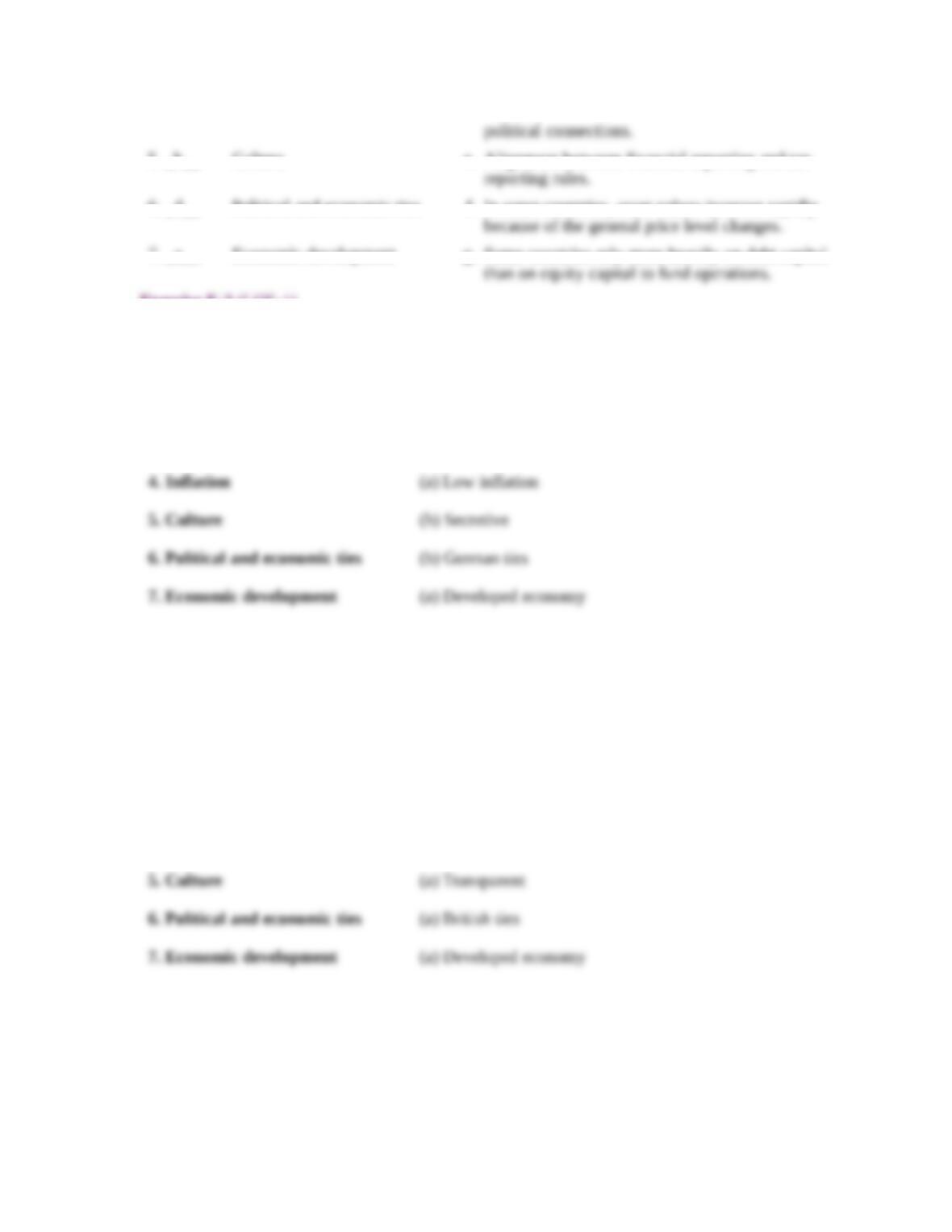
5. _b__ Culture e. Alignment between financial reporting and tax
6. _d__ Political and economic ties f. In some countries, asset values increase rapidly
7. _a__ Economic development g. Some countries rely more heavily on debt capital
Austria’s accounting is very similar to that of Germany.
1. Legal system (b) Code law
2. Tax laws (b) Similar tax and financial accounting rules
3. Sources of financing (b) More debt financing
Australia’s accounting is very similar to that of the United Kingdom.
1. Legal system (a) Common law
2. Tax laws (a) Different tax and financial accounting rules
3. Sources of financing (a) More equity financing
4. Inflation (a) Low inflation
Exercise E-2 (LOE-1)
Requirement 1
Requirement 2
Exercise E-3 (LOE-2)
For the idea
There are several reasons to allow U.S. companies the choice of reporting under either U.S. GAAP or
IFRS. It is important to allow U.S. companies the opportunity to report under IFRS because the rest of the
Against the idea
There are also several reasons to not allow U.S. companies the choice of reporting under either U.S. GAAP
or IFRS. U.S. GAAP is customized to fit the stringent legal and regulatory requirements of the U.S.
business environment. U.S. GAAP provides a better fit and should therefore be required for U.S.
Exercise E-4 (LOE-3)
Requirement 1
Principles-based accounting standards emphasize broad principles of accounting with relatively less
Requirement 2
Principles-based standards are more concise, allowing preparers and users of accounting information to
Requirement 3
Rules-based standards are more precise, providing additional guidance to preparers and users on an issue.
Requirement 4
Most people agree that, in order to reduce the volume of accounting rules internationally, future
Exercise E-5 (LOE-3)
Requirement 1
Operating activities include transactions relating to the primary operating activities of the business.
Requirement 2
(a) Sales, cost of goods sold, and operating expenses would be classified as an operating activity.
(b) Interest revenue, dividend income, and a gain or loss on sale of an investment would be classified as an
(c) Interest expense, bond issue costs, stock issue costs, and the gain or loss on the repurchase of long-term

Date Transaction
Number
of units
Unit
cost
Ending
Inventory
Jan. 1 Beginning Inventory 70 $83 $5,810
Apr. 7 Purchase 10 85 850
70 $6,660
Date Transaction
Number
of units
Unit
cost
Cost of Goods
Sold
Apr. 7 Purchase 180 $85 $15,300
Oct. 9 Purchase 90 87 7,830
270a$23,130
Date Transaction
Number
of units
Unit
cost
Ending
Inventory
Oct. 9 Purchase 80 $87 $6,960
Date Transaction
Number
of units
Unit
cost
Cost of Goods
Sold
Jan. 1 Beginning inventory 70 $83 $ 5,810
Apr. 7 Purchase 190 85 16,150
Oct. 9 Purchase 10 87 870
270a$22,830
Requirement 2
Requirement 3
FIFO will result in a higher income of $300 (gross profit of $4,170 vs. $3,870) reported on the income
Exercise E-7 (LOE-3)
Requirement 1
U.S. GAAP requires all research and development expenditures to be expensed in the period incurred.
Requirement 2
IFRS draws a distinction between research activities and development activities. Research expenditures
are expensed in the period incurred. However, development expenditures that meet specified criteria are
Requirement 3
Income under IFRS would be $500,000 higher than under U.S. GAAP. Total assets and stockholders’ equity
Exercise E-8 (LOE-3)
Requirement 1
A liability is an amount owed to a creditor. Stockholders’ equity is the owners’ claims to company
resources.
Requirement 2
Under the IFRS position, preferred stock is a liability. The true owners of the business are the common
shareholders as they control the company through voting rights. Preferred shareholders usually do not have
Requirement 3
Under the U.S. GAAP position, preferred stock is usually part of stockholders’ equity. Unlike long-term
Requirement 4The classification of preferred stock depends on the characteristics of the preferred stock
issue. Non-voting, mandatorily redeemable preferred stock with a fixed annual dividend is similar to bonds