Question D-1 (LO D-1)
A company might invest in another company to (1) receive dividends, earn interest, and gain
from the increase in the value of their investment, (2) temporarily invest excess cash created by
Question D-2 (LO D-1)
Companies can gain from the increase in the value of their investment. Even without
receiving dividends, investors still benefit when companies reinvest earnings, leading to even
Question D-3 (LO D-1)
Companies in seasonal industries often invest excess funds generated during the busy season
Question D-4 (LO D-1)
PepsiCo purchased Tropicana in order to diversify beyond soft drinks.
Question D-5 (LO D-1)
The flip side of an investment in equity securities is the issuance of stock.
Question D-6 (LO D-1)
The method depends on the level of influence. An insignificant level of influence results in
the use of the fair value method. A significant, but not controlling, level of influence results in
Question D-7 (LO D-2)
The two categories are trading securities and available-for-sale securities.
Question D-8 (LO D-2)
Dividends received are accounted for as dividend revenue under the fair value method.
Question D-9 (LO D-2)
An unrealized holding gain is the gain in value while holding the investment, while a realized
Appendix D
Investments REVIEW QUESTIONS
Answers to Review Questions (continued)
Question D-10 (LO D-2)
The way unrealized holding gains and losses are reported in the financial statements depends
on whether the investments are classified as “trading” or “available-for-sale.” Trading securities
Question D-11 (LO D-2)
The way unrealized holding gains and losses are reported in the financial statements depends
on whether the investments are classified as “trading” or “available-for-sale.” Available-for-sale
Question D-12 (LO D-3)
The equity method is used when an investor can’t control but can “significantly influence”
the investee. For example, if effective control is absent, the investor still might be able to
exercise significant influence over the operating and financial policies of the investee if the
Question D-13 (LO D-3)
The investor should account for dividends from the investee as a reduction in the investment
Question D-14 (LO D-4)
These statements combine the parent’s and subsidiary’s operating activities as if the two
Question D-15 (LO D-4)
It is appropriate to consolidate financial statements of two companies when the parent
Question D-16 (LO D-5)
The flip side of an investment in debt securities is the issuance of debt, such as bonds.
Question D-17 (LO D-5)
If bonds are purchased at a discount, the carrying value of the investment in bonds and the
amount recorded for interest revenue will increase over time. Recall that interest revenue is

Answers to Review Questions (continued)
Question D-18 (LO D-5)
If bonds are purchased at a premium, the carrying value of the investment in bonds and the
amount recorded for interest revenue will decrease over time. Recall that interest revenue is
Question D-19 (LO D-5)
When interest rates go down, the value of a bond with fixed interest payments goes up
Question D-20 (LO D-5)
Investments in debt securities are classified as “held-to-maturity,” “trading,” or
“available-for-sale” securities. Held-to-maturity securities are debt securities that the company
expects to hold until they mature, which means until they become payable. Trading securities are
Brief Exercise D-1 (LO D-1)
X 1. To invest excess cash created by operating in seasonal industries.
2. To increase employees’ morale.
X 3. To build strategic alliances.
4. To reduce government regulation.
X 5. To receive interest and dividends.
Brief Exercise D-2 (LO D-2)
September 1 Debit Credit
Investments (150 shares × $13) 1,950
Cash 1,950
BRIEF EXERCISES

November 1
Cash (150 shares × $17) 2,550
Investments (150 shares × $13) 1,950
Brief Exercise D-3 (LO D-2)
December 28 Debit Credit
Investments 485,000
(Purchase common stock)
December 31
Unrealized Holding Loss—Net Income 2,000
(Adjust investments to fair value)
Brief Exercise D-4 (LO D-2)
December 28 Debit Credit
Investments 485,000
(Purchase common stock)
December 31
Unrealized Holding Loss—Other Comprehensive Income 2,000
(Adjust investments to fair value)
Brief Exercise D-5 (LO D-2)
These are trading securities and are reported at their fair value, $20,000. We
know this because actively traded investments in debt or equity securities acquired
principally for the purpose of selling them in the near term are classified as
Brief Exercise D-6 (LO D-2)
These are available-for-sale securities and are reported at their fair value,
$20,000. Actively traded investments in debt or equity securities acquired
principally for the purpose of selling them in the near term are classified as
“trading securities.” The GE shares have been held for over a year. They are
Brief Exercise D-7 (LO D-3)
An investor should account for net income from an equity method investee as
an increase in its investments account and an increase in equity income. Therefore,
Brief Exercise D-8 (LO D-3)
An investor should account for dividends from an equity method investee as a
reduction in its investment account. Since investment revenue is recognized as the
investee earns it, it would be inappropriate to recognize revenue again when
Brief Exercise D-9 (LO D-4)
Wendy Day would report total inventory of $22,000 in the consolidated
financial statements. Since Wendy Day owns all of the outstanding stock in Strong
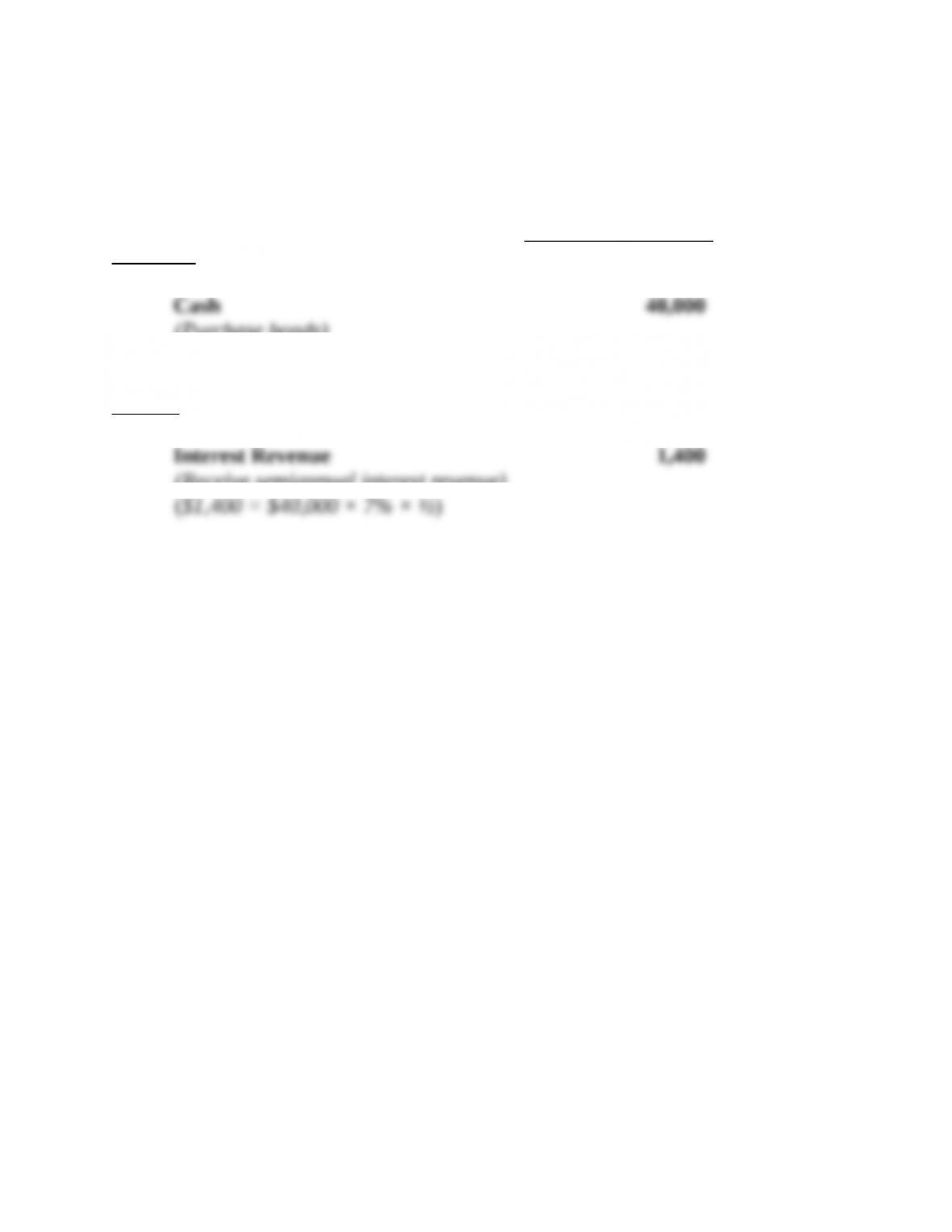
Brief Exercise D-10 (LO D-5)
1. Debit Credit
January 1
Investments 40,000
(Purchase bonds)
2.
June 30
Cash 1,400
(Receive semiannual interest revenue)
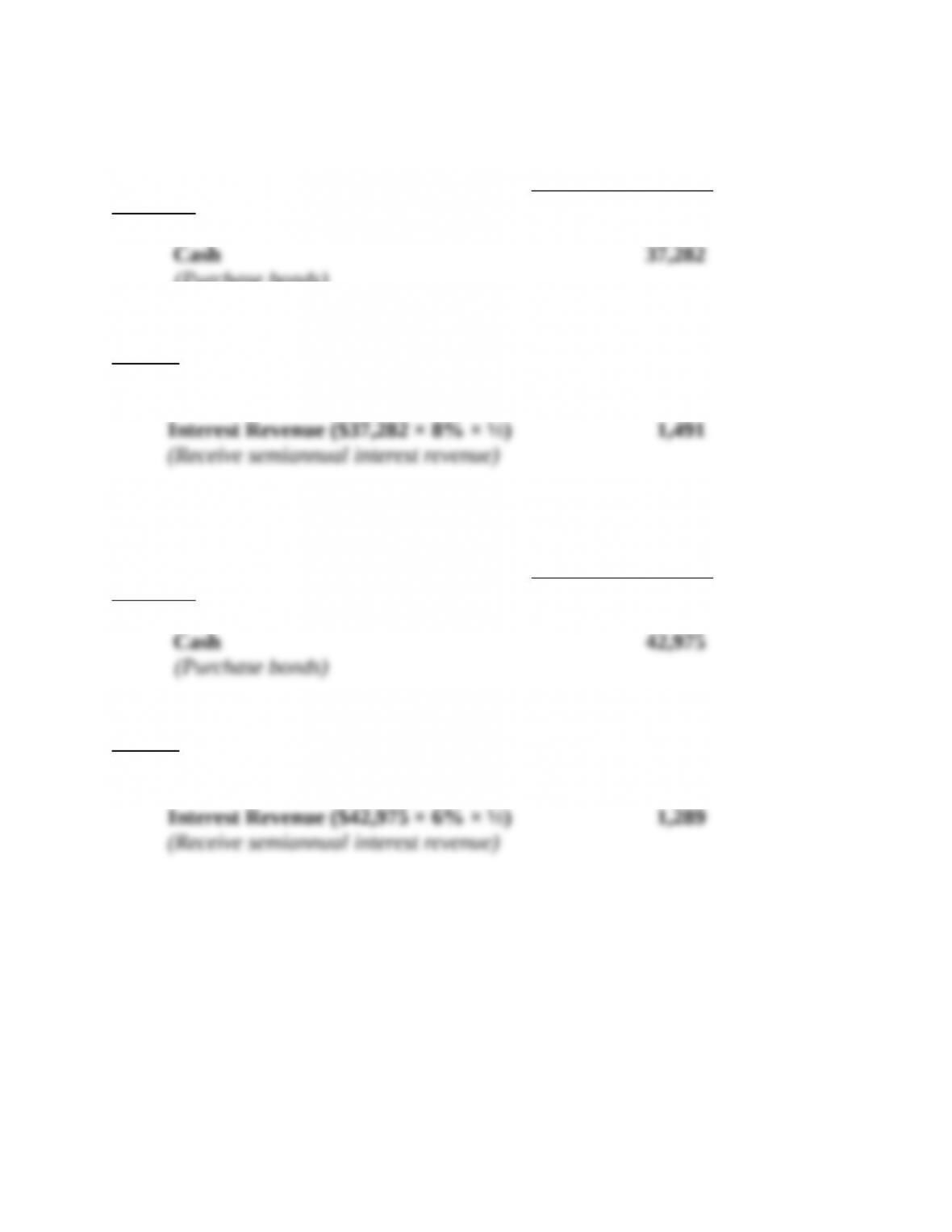
Brief Exercise D-11(LO D-5)
1. Debit Credit
January 1
Investments 37,282
(Purchase bonds)
2.
June 30
Cash ($40,000 × 7% × ½) 1,400
Investments (difference) 91
Brief Exercise D-12 (LO D-5)
1. Debit Credit
January 1
Investments 42,975
2.
June 30
Cash ($40,000 × 7% × ½) 1,400
Investments (difference) 111
Exercise D-1 (LO D-1)
__T__ 1. A reason companies invest in other companies is to build strategic
alliances.
EXERCISES

__F__ 2. All companies are required to pay dividends to their investors.
__F__ 3. When market interest rates increase, the market value of a bonds
__T__ 4. One way for a company to expand operations into a new industry is to
__T__ 5. Stocks typically have greater upside potential, providing a higher average
__F__ 6. Companies purchase debt securities primarily for the dividend revenue
Exercise D-2 (LO D-2)
Requirement 1
December 20 Debit Credit
Investments 1,500,000
Cash 1,500,000
(Purchase common stock)
December 28
Cash 6,000
Dividend Revenue 6,000
(Receive cash dividends)
December 31
Unrealized Holding Loss—Net Income 60,000
Investments (300,000 shares × $0.20 per share) 60,000
(Adjust investments to fair value)

Note: The investments decreased in value $0.20 per share from $5.00 per
share ($1,500,000/300,000 shares) to $4.80 per share. Unlike for securities
Requirement 2
Balance of the investments account on December 31: $1,500,000 − 60,000
= $1,440,000.
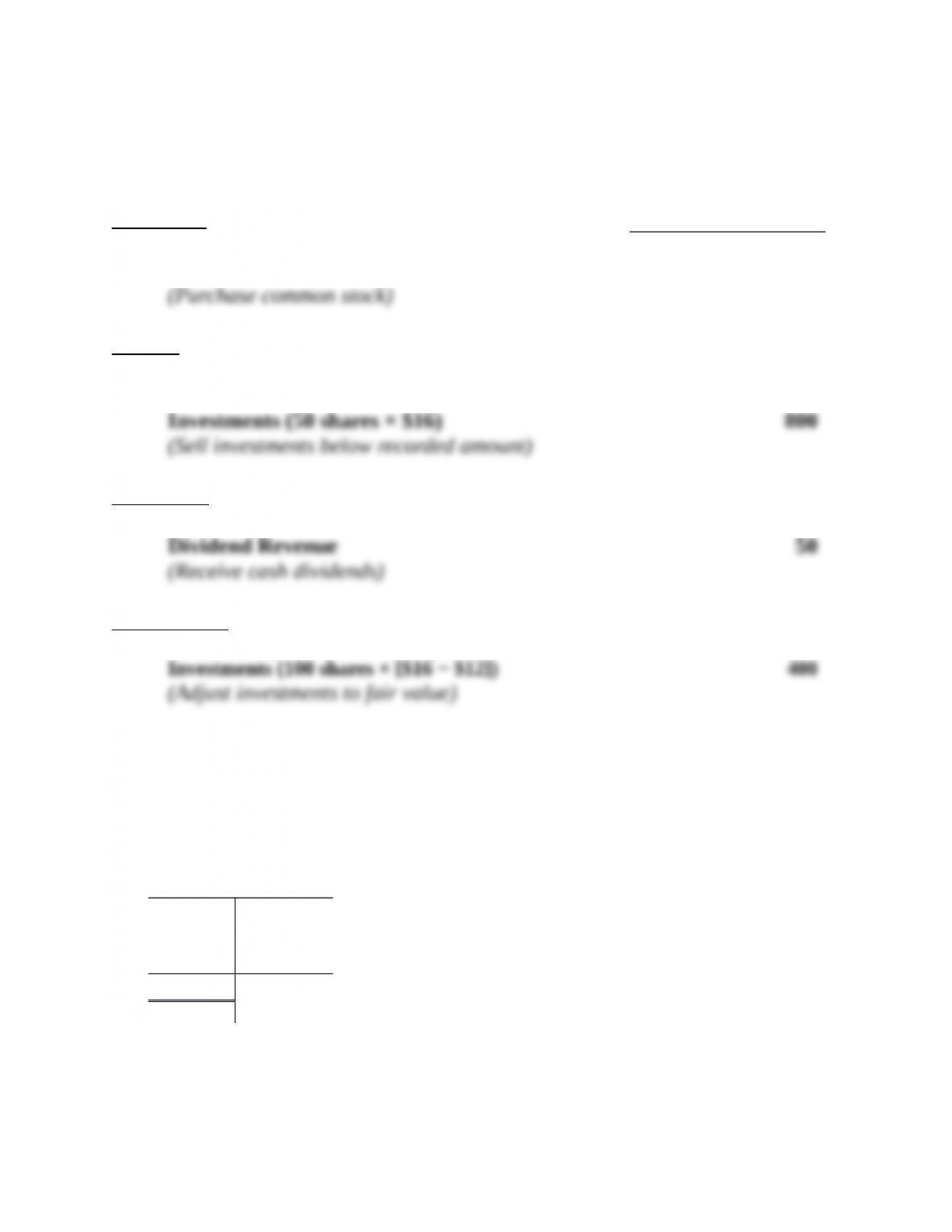
Exercise D-3 (LO D-2)
Requirement 1
February 1 Debit Credit
Investments 2,400
Cash 2,400
June 15
Cash (50 shares × $14) 700
Loss (difference) 100
October 31
Cash (100 shares × $0.50 per share) 50
December 31
Unrealized Holding Loss–Other Comprehensive Income 400
Requirement 2
The balance of the investment account on December 31 is $1,200, equal to the
100 remaining shares times $12 per share fair value. The balance of the
investment account can be verified by posting all journal entries to a t-account.
Investments
2,400
800
400
1,200