Chapter 20 – Management Compensation, Business Analysis, and Business Valuation
20-1
CHAPTER 20: MANAGEMENT COMPENSATION, BUSINESS
ANALYSIS, AND BUSINESS VALUATION
QUESTIONS
20-1 The key objective of the firm is to develop management compensation plans that
support the firm’s strategic objectives:
1. To motivate managers to exert a high level of effort to achieve the firm’s goal.
and for the effectiveness of their decision making.
20-2 Management compensation includes one or more of the following: salary, bonus,
and benefits or perquisites (“perks”).
Salary is a fixed payment, while a bonus is based upon the achievement
of performance goals for the period. Perks include special services and benefits
20-3 Risk aversion is the tendency to prefer decisions with assured outcomes over
those with uncertain outcomes. It is a relatively common decision-making
characteristic of managers. A risk-averse manager is biased against decisions
that have an uncertain outcome, even if the expected outcome is favorable. The
risk-averse manager prefers choices with certain outcomes to choices with more
favorable outcomes which are not certain. The effect is that certain decisions that
earnings per share).
Chapter 20 – Management Compensation, Business Analysis, and Business Valuation
20-2
20-4 Management compensation plans designed to motivate managers can have
undesired unethical effects. The presence of very strong motivation due to a
compensation plan, without compensating accounting controls designed to detect
20-5 From a financial reporting standpoint, the most desirable form of compensation is
deferred payment plans, which delay the expense on the income statement.
20-6 From the standpoint of taxes paid by the individual manager, the least desirable
forms of compensation are ones which have immediate tax consequences.
These include salary increases and cash bonuses. The most desirable form of
purposes.
20-7 The three bases for incentive bonus plans are stock price, a strategic
performance measurement systems (cost, revenue, profit, or investment center),
and the balanced scorecard. See Exhibit below:

Chapter 20 – Management Compensation, Business Analysis, and Business Valuation
20-3
Advantages and Disadvantages of Bonus Compensation Bases
Bonus Base
Motivation
Right Decision
Fairness
Stock Price
(+/-) depends on
whether stock and
stock options are
included in base pay
and/or bonus
(+) aligns
management
compensation with
short-term
shareholder interests
(+) consistent with
shareholder’s
interests
(-) lack of
controllability
Strategic
Performance
Measures (cost,
revenue, profit,
and investment
center)
(+) strongly motivating
if non-controllable
factors are excluded
(+) generally a good
measure of
economic
performance
(-) typically has only
a short term focus
(-) if bonus is very
high, can cause
inaccurate reporting
(+) intuitive, clear,
and easily
understood
(-) measurement
issues: differences
in accounting
conventions, cost
allocation methods,
financing methods,
etc.
Balanced
Scorecard:
Critical Success
Factors
(+) strongly
motivating if non-
controllable factors
are excluded
(+) aligns
management interest
with long-term
shareholder interests
(+) consistent with
management’s
strategy
(-) may be subject to
inaccurate reporting,
as for responsibility
accounting
measures
(+) if carefully
defined and
measured, CSFs
are likely to be
perceived as fair
(-) potential
measurement
issues, as for
responsibility
accounting

Chapter 20 – Management Compensation, Business Analysis, and Business Valuation
20-8 The six financial ratios used in the evaluation of liquidity are:
The first and second ratios are the accounts receivable and inventory
turnover ratios which measure the firm’s ability to manage two important
elements of current assets – accounts receivable and inventory. The lower the
balance in these accounts relative to sales, the less cash will be tied up in these
liabilities)
The sixth measure, free cash flow ratio (net free cash flow divided by
current liabilities) measures the effect of the firm’s free cash flow on liquidity.
20-9 The two types of bonus pools are unit-based and firm-wide. The unit-based is
determined from earnings in the unit only, while the firm-wide pool is determined
from the earnings of the aggregate firm. See below:
Advantages and Disadvantages of Different Bonus Pools
Motivation
Right Decision
Fairness
Unit-Based
(+) strong
motivation for an
effective
manager⎯ the
upside potential
(-) unmotivating for
manager of
economically
weaker units
(-) provides the
incentive for
individual managers
not to cooperate
with and support
other units, when
needed for the
good of the firm
(-) does not
separate the
performance of the
unit from the
manager’s
performance
Firm-Wide
(+) to attract
and retain good
managers
throughout the firm,
even in
economically
weaker units
(+) effort for the
good of the overall
firm is rewarded –
motivates teamwork
and sharing of
assets, etc, among
units
(+) separates the
performance of the
manager from that
of the unit
(+) can ap pear to
be more fair to
shareholders and

Chapter 20 – Management Compensation, Business Analysis, and Business Valuation
Key: (+) means the pool has a positive effect on the objective;
(-) means the pool has a negative effect on the objective.
20–10 The four types of bonus payment options are current cash bonus, deferred
bonus, stock options, and performance shares. See Exhibit below:
Advantages and Disadvantages of Different Bonus Payment Options
Motivation
Right Decision
Fairness
Current Bonus
(+) strong motivation for
current performance;
stronger motivation
than for deferred plans
(-) short term focus
(-) risk averse manager
avoids risky but potentially
beneficial projects
(+/-)depends on the
clarity of the bonus
arrangement and the
consistency with which
it is applied
(-) difficult to measure
economic performance
in one or a few
financial measures
(-) simple measures
are easily manipulated
by managers
Deferred Bonus
(+) strong motivation for
current performance,
but not as strong as for
the current bonus plan,
since the reward is
delayed
(+) tax advantages of
deferred compensation
(-) same as for current
bonus`
(+/-) as for current
bonus
(-) difficult to measure
economic performance
in one or a few
financial measures
(-) simple measures
are easily manipulated
by managers
Stock Options
(+) unlimited upside
potential is highly
motivating
(-) delay in reward
reduces motivation
somewhat
(+) incentive to consider
longer term issues
(+) provides better risk
incentives than for current or
deferred bonus plans
(+) consistent with
shareholder interests
(+/-) as above, plus
(-) uncontrollable
factors affect stock
price
Performance
Shares
(+/-) same as for stock
options
(+) incentive to consider
long-term issues
(+) consistent with the firm’s
strategy, when critical
success factors are used
(+) consistent with
shareholder interests, when
earnings per share is used
(+/-) depends on the
clarity of the bonus
arrangement and the
consistency with which
it is applied
(-) difficult to measure
economic performance
in one or a few
financial measures
(-) simple measures
are easily manipulated
by managers
Key: (+) means the payment option has a positive effect on the objective;
Chapter 20 – Management Compensation, Business Analysis, and Business Valuation
20-6
20–11 This question is intended for class discussion. There are a number of possible
views on this question. The goal of the discussion should not be to determine
the equity of a certain level of executive pay, but rather to show the ethical issue
20–12 The five methods discussed in the chapter for directly measuring the value of a
firm: book value of equity, market value of equity (market capitalization), the
discounted cash flow method, multiples-based valuation, and enterprise value.
The book value method takes the amount of equity from the balance
sheet.
The market value method is the most simple and direct. The value of the
firm is determined from the number of outstanding shares multiplied by the
current market price of the shares.
The discounted cash flow (DCF) method develops the value of the firm as
the discounted present value of the firm’s net free cash flows. It has the
earnings ratios of the stocks of comparable publicly-held firms, and then adjusted
for discounting. The earnings multiplier has important limitations. It is based on
accounting earnings, and is therefore subject to the limitations of accounting
earnings. The advantage is that the earnings multiplier is easy to apply.
two or more of the valuation techniques and to evaluate the assumption in each
in order to arrive at an overall valuation assessment.
20–13 Bonuses are the fastest growing part of total compensation. The growth of
interest in bonus plans is likely the result of firms’ increasing competition for the
very best executive talent. Also, shareholders prefer bonus plans to other forms
20-7
20–14 The goal of strategic cost management is the success of the firm in maintaining
competitive advantage, so it is important to evaluate the overall performance of
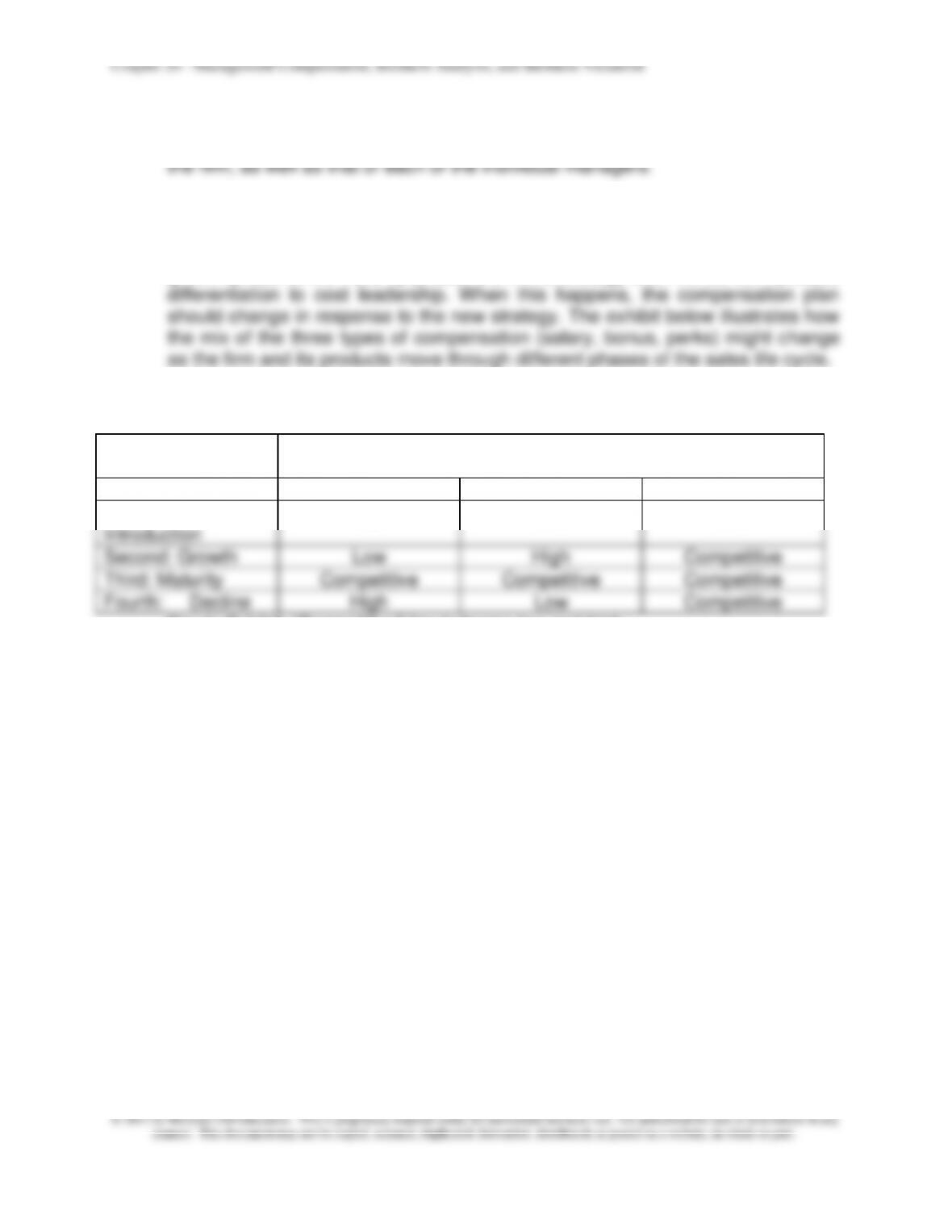
20–15 The firm’s strategy changes as its product(s) move through the different phases
of the sales life cycle – product introduction, growth, maturity, and decline (the
sales life cycle is covered in Chapter 13). As a firm’s product moves from the
growth phase to the maturity phase, the firm’s strategy also moves from product
Compensation Plans Tailored for Different Strategic Conditions
Product Sales Life
Cycle Phase
Compensation Plan
Salary
Bonus
Benefits
First: Product
Introduction
High
Low
Low
Second: Growth
Low
High
Competitive
Third: Maturity
Competitive
Competitive
Competitive
Fourth: Decline
High
Low
Competitive
Key to Exhibit: “Competitive” lies between low and high.

Chapter 20 – Management Compensation, Business Analysis, and Business Valuation
20-8
BRIEF EXERCISES
20–16
Inventory Turnover = _Cost of Good Sold_
Average Inventory
= ______$400,000______
= 111%
20–17
Market Value of Equity = Stock Price x # Shares Outstanding
20–18
Economic Value Added = EVA-based Net Income –
Cost of Capital x EVA-based Invested Capital
= $125,000
20–19
DCF Value = PV of cash flows + marketable securities – market value of debt
20–20
Multiples-Based Valuation = Earnings Multiplier x Earnings
20–21
Gross Profit Margin = _Gross Profit_
Net Sales

Chapter 20 – Management Compensation, Business Analysis, and Business Valuation
20-9
EXERCISES
20-22 Compensation, Strategy, and Market Value (20 min)
Jackson Supply is experiencing the anomaly of achieving its strategic
goals (customer service) while the stock price is falling relative to
competitors. Two questions arise:
1. Is the firm properly measuring customer service? Perhaps
more direct and effective measures are needed.
2. It may be that investors do not value the firm’s customer
service goals. The investors may be looking for cost reduction, for
production diversification and innovation, supply-chain management
innovation, or other strategic initiatives. What are competitors doing?
The firm might benefit from consulting with industry experts or
financial analysts that specialize in medical supply. In the end,
Jackson Supply must realize that its ultimate strategy must be to
satisfy shareholders, and the specific goals that are chosen, such as
customer service, must be linked to that strategy. Success is judged
by investors and not by top management.
Chapter 20 – Management Compensation, Business Analysis, and Business Valuation
20–10
20-23 Evaluating an Incentive Pay Plan; Strategy (15 min)
Unless Fox is rewarded significantly by the boat manufacturers for
volume of sales, the current incentive plan is likely to reduce profits
by increasing sales at the expense of profit margins. Sales
representatives’ incentives are to sell as many boats as possible, and
since reducing the price will help them to achieve this goal, they are
likely to sell many boats at low prices. A better approach would be to
Chapter 20 – Management Compensation, Business Analysis, and Business Valuation
20–11
20-24 Alternative Compensation Plans (20 min)
1. On the negative side, stock option incentives tied to share
prices are influenced by the broad economic factors affecting the
stock market, many of which are uncontrollable by the managers.
On the plus, the use of stock options can effectively align the
managers’ incentives and efforts with those of the shareholders,
who value the increase in stock price. Whatever efforts the manger
can make to increase stock price will be rewarded.
EPS, ROI, and return on equity can be influenced by executives’
efforts and are therefore useful as motivational tools. The use of a
stock option plan often indicates that the firm’s strategy includes
plans for growth; executives expect that the firm’s growth will make
the options valuable in the coming years.
2. Plans based on EPS:
a. have a short-term focus, so that managers tend to
maximize short term earnings and not take actions which will in
the long-term benefit the company.
b. if the bonus incentive is very high, a focus on EPS can
Chapter 20 – Management Compensation, Business Analysis, and Business Valuation
20–12
20-25 Performance Evaluation and Risk Aversion (20 min)
1. A flat salary with a bonus based on number of processed
applications would be best. The flat salary reduces Lewis’ risk level
because it insulates her from the uncertainty of a fluctuating
2. Emphasis will be placed on volume with less attention given to the
quality of the processing. Jill should be giving attention to both the
3. Some possible measures include:
1. A measure based on the number of complaints or due to
Chapter 20 – Management Compensation, Business Analysis, and Business Valuation
20–13
20-26 Performance Evaluation and Risk Aversion (20 min)
1. Compensation for Amy should be the ROI-based bonus since she
is risk neutral. Amy would accept some risk to increase profit for
2. ROI is not a good evaluation standard for Amy because she has no
role in investing decisions. Return on sales would perhaps be a
better measure. This would emphasize sales margins as opposed to
3. a. Yes, this is a fair performance evaluation method. Since
Stiles Furniture is in a similar environment with the same capabilities
as NightTime, then Stiles will be affected by the same business and
capabilities. If Stiles is more successful with an alternative strategy,
then Amy should be held responsible for not altering her strategy as
well.
b. The advantage to residual income is that it will motivate Amy
to invest in all projects which earn over a threshold return. If Amy’s
division is earning a high ROI, and management is concerned that
Chapter 20 – Management Compensation, Business Analysis, and Business Valuation
20–14
20-27 Bonus Compensation Base and Pool (20 min)
This question is intended primarily for class discussion, and there are a
variety of possible responses. A suggested approach follows.
1. Alternative bonus compensation bases include the SBU responsibility
center measures (cost center, profit center, revenue center, and
investment center) as well as a potential wide variety of nonfinancial
measures.
2. The use of revenues will probably have an upward bias on bonuses,
at least at financial service companies in recent years. The reason is
that revenue has grown faster than profits for these firms in recent
years. The Wall Street Journal estimates that bonuses in 2013
be multi-dimensioned, including profits, sales growth, and other
measures of financial and operating performance.
3. The use of a firm-wide bonus pool likely makes sense in the financial
services industry, since the firms have highly integrated operations.
Firms in other industries, such as consumer products, might find a
Chapter 20 – Management Compensation, Business Analysis, and Business Valuation
20–15
20–27 (continued –1)
4. The revenue-based method is not fair if you are considering the
shareholder point of view. The reason is noted in part 2 above;
shareholders are likely to place a higher value on earnings and cash
flow as opposed to revenue growth only. Considering the fairness of
Source: Liz Rappaport, Aaron Lucchetti, and Stephen Grocer, “Wall Street
Pay: A Record $144 Billion,” The Wall Street Journal, October 12, 2010,
p. C1; Joe Nocera, “Corzine Crashes Like It’s 2008,” The New York Times,
November 1, 2011, p. A21.