Chapter 18 – Performance Measurement to Support Business Strategy
18-1
© 2014 by McGraw-Hill Education. This is proprietary material solely for authorized instructor use. Not authorized for sale or distribution in any
manner. This document may not be copied, scanned, duplicated, forwarded, distributed, or posted on a website, in whole or part.
Chapter 18
Performance Measurement to Support Business
Strategy
Solutions to Review Questions
18–1.
Good performance requires both a successful strategy and an organization that can enact
the strategy. That is, we need alignment between the strategy and organizational
18–2.
No. The balanced scorecard is a set of performance targets and results that show an
18–3.
18–4.
Financial measures of performance attract attention and identify areas where
improvements need to be made. Nonfinancial performance measures direct employees’
18–5.
Critical success factors are the factors that are important to the organization’s success.
Chapter 18 – Performance Measurement to Support Business Strategy
18-2
18–6.
People at different levels in the organization have different responsibilities. Performance
measures are most effective when they relate to what people at different levels control.
18–7.
Benchmarking identifies an activity that needs to be improved, finds an organization that is
the most efficient at the activity, studies its process, and then utilizes that process.
18–8.
18–9.
An organization’s mission includes the organization’s values, its responsibilities to
stakeholders, and its goals. The strategy is the means to accomplish the mission.
18–10.
Customer satisfaction measures reflect the performance of the organization on several
factors, including quality control and delivery performance, that a customer values.
18–11.
18–12.
18–13.
Worker involvement is important for three reasons:
1) Increased worker involvement often translates to an increased commitment to the
organization.
2) Workers are able to be responsive at all levels if empowered with decision-making
responsibilities.
Chapter 18 – Performance Measurement to Support Business Strategy
18-3
3) Workers are able to use their skills and knowledge to further develop and to improve
the organization’s performance.
18–14.
See Exhibit 18.7 for examples.
Solutions to Critical Analysis and Discussion Questions
18–15.
Answers will vary, but should include discussions of the value proposition and the
demands that this places on the organization. Examples follow:
Local coffee shop:
Porter Framework: probably best considered a focused competitor — focusing on regional
18–16.
Answers will vary, but should include:
Stakeholders—students, professors, employees, publishers, authors, and regents.
Chapter 18 – Performance Measurement to Support Business Strategy
18-4
18–17.
Answers will vary.
Quality control:
1) Defects, e.g., scratches in the case
2) Number of customer complaints
3) Number of returns
Delivery performance:
1) Percentage of on-time deliveries
2) Percentage of deliveries damaged
3) Delivery service surveys
18–18.
Answers will vary. The purpose of multiple measures of performance serves two purposes
in an educational setting. First, it allows for differing strengths and weaknesses among
18–19.
Ultimately, the goal is to increase profits. In many, maybe most, settings, customer
satisfaction is a critical success factor in achieving that goal. By measuring customer
18–20.
Chapter 18 – Performance Measurement to Support Business Strategy
18-5
18–21.
The point of using multiple measures of performance is that each provides information to
18–22. (15 min.) Strategy and Management Accounting Systems.
a. Answers should consider the following:
Joe’s initial business model required providing a low cost pizza configured as the
customer ordered it and delivered to the correct location quickly. In this setting
Chapter 18 – Performance Measurement to Support Business Strategy
18-6
18–23. (15 min.) Business Strategy Classification
Organization
Dominant Porter Strategy
Apple
Product differentiation for mass-appeal consumer
electronic products
Greens Restaurant
Focused competitor, or “niche strategy” aimed at
customers who are vegetarian, or who like
vegetarian dishes, and are willing to pay high prices
for premier quality meals.
The University of
Phoenix
Cost leadership — perhaps qualified as occurring in
a niche or focused market of adult higher education
Wal-mart Stores
Cost leadership for a wide variety of basic consumer
products
Sysco
Cost leadership for a wide variety of bulk restaurant
food supplies — perhaps qualified as occurring in a
niche or focused market of restaurants
18–24. (20 min.) Different Performance Measures Across the Organization.
This question is based on the authors’ experience.
Answers will vary, but should include the following:
18–25. (20 min.) Balanced Scorecards and Strategy Maps: Crane Company.
Answers will vary. Crane Company has a strategy to be a low-cost leader in the industry,
Chapter 18 – Performance Measurement to Support Business Strategy
18-7
18–26. (20 min.) Balanced Scorecards and Strategy Maps: TechMasters, Inc.
Answers will vary. TechMasters wants to lead in innovation, but there are no measures
18–27. (20 min.) Benchmarks.
a. Number of product recalls. 2. Product performance.
18–28. (20 min.) Benchmarks.
a. Material quality. 3. Supplier performance.
Chapter 18 – Performance Measurement to Support Business Strategy
18-8
18–30. (10 min.) Manufacturing Cycle Time and Efficiency: Lancaster Metals.
Manufacturing
cycle efficiency
=
Processing time
Processing time + Moving time + Storing time + Inspection time
=
1.00 hrs.
1.50 hrs. + 0.25 hr. + 3.00 hrs. + 0.25 hrs.
=
1.00
hrs.
5.00
hrs.
=
20%
18–31. (20 min.) Functional measures.
Answers will vary. Some possible examples are:
Chapter 18 – Performance Measurement to Support Business Strategy
18-9
18–32. (30 min.) Partial Productivity Measures: North Central University.
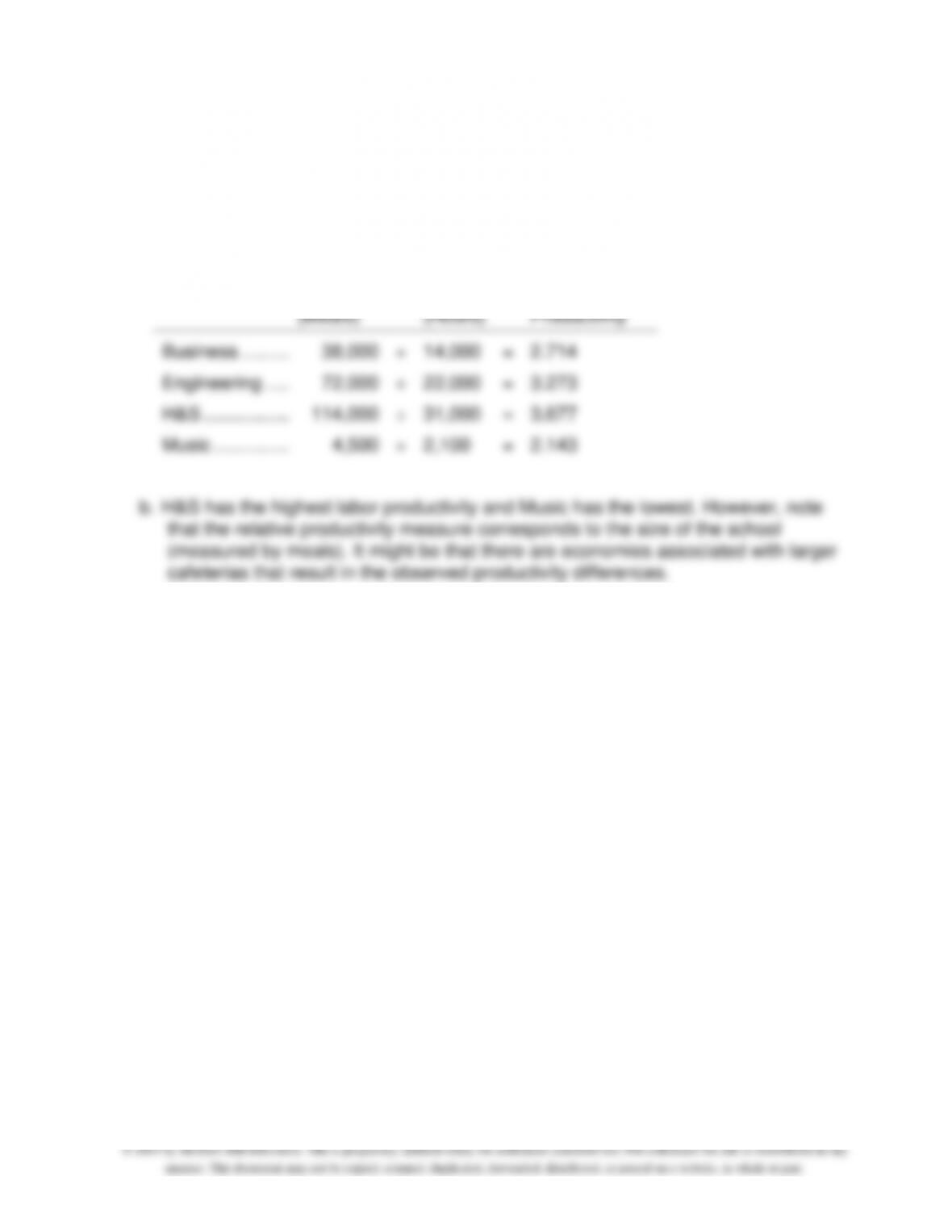
a. Partial labor productivity = Output (meals) ÷ Input (hours)
School
Output
(Meals)
÷
Input
(Hours)
=
Partial Labor
Productivity
Business ……….…..
38,000
÷
14,000
=
2.714
Engineering …..…..
72,000
÷
22,000
=
3.273
H&S ……………..…..
114,000
÷
31,000
=
3.677
Music ………………..
4,500
÷
2,100
=
2.143
b. H&S has the highest labor productivity and Music has the lowest. However, note
that the relative productivity measure corresponds to the size of the school
(measured by meals). It might be that there are economies associated with larger
cafeterias that result in the observed productivity differences.
Chapter 18 – Performance Measurement to Support Business Strategy
18–10
18–33. (30 min.) Partial Productivity Measures: McKinley Industries.
a. Partial labor productivity = Output (gallons) ÷ Input (hours)
Year
Output
(Gallons)
÷
Input
(Hours)
=
Partial Labor
Productivity
Year 1 …………..…..
22,000
÷
38,000
=
0.579
Year 2 …………..…..
27,000
÷
50,000
=
0.540
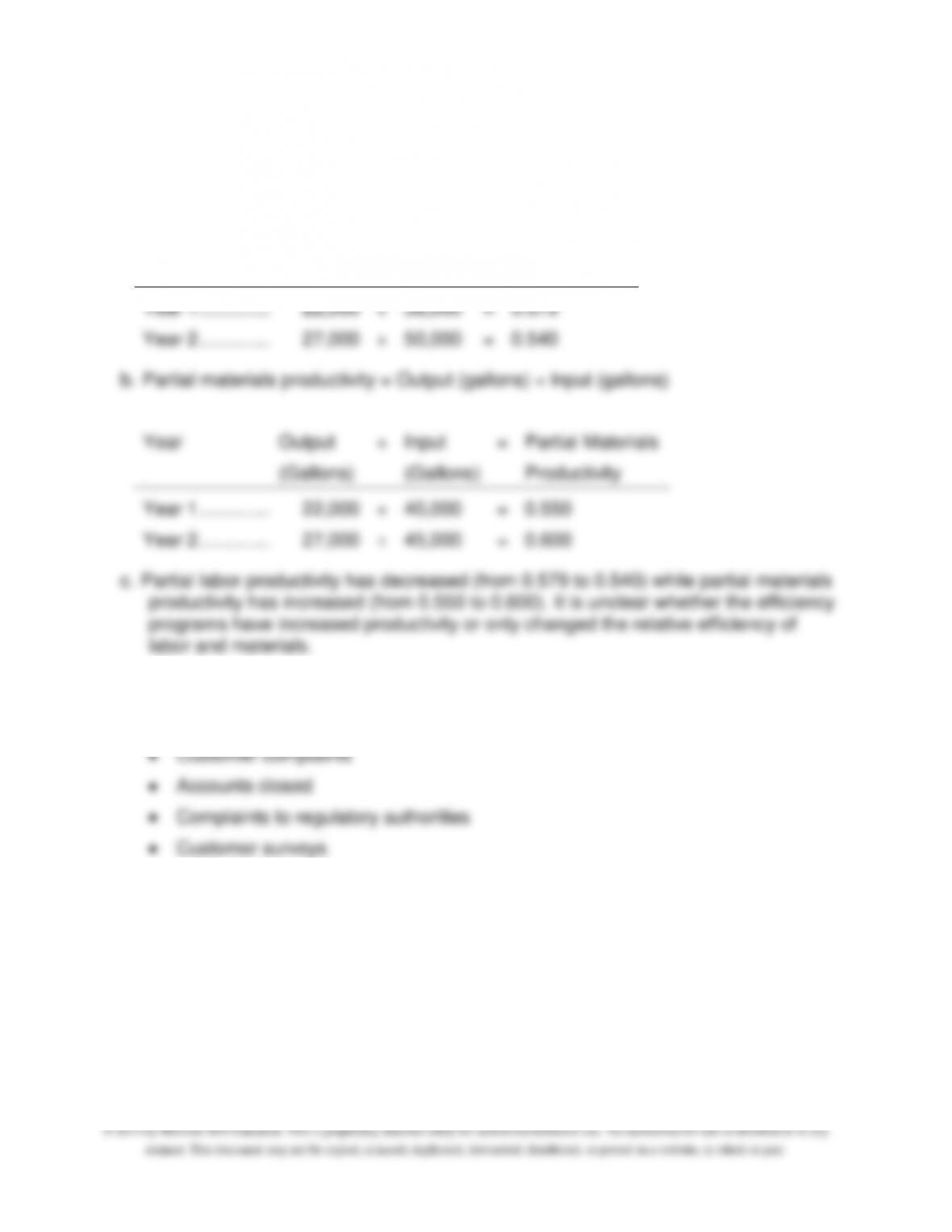
b. Partial materials productivity = Output (gallons) ÷ Input (gallons)
Year
Output
(Gallons)
÷
Input
(Gallons)
=
Partial Materials
Productivity
Year 1 …………..…..
22,000
÷
40,000
=
0.550
Year 2 …………..…..
27,000
÷
45,000
=
0.600
c. Partial labor productivity has decreased (from 0.579 to 0.540) while partial materials
productivity has increased (from 0.550 to 0.600). It is unclear whether the efficiency
programs have increased productivity or only changed the relative efficiency of
labor and materials.
18–34. (20 min.) Specifying Nonfinancial Measures.
Answers will vary. Measures of customer satisfaction for JYC include: