Chapter 16 – Fundamentals of Variance Analysis
16-1
16–1.
For performance evaluation purposes, the costing format should identify the actual costs
for comparison with expected costs during the relevant period. Under absorption costing,
the manufacturing fixed costs are allocated on a per unit basis. An increase in production
16–2.
False. Only variable costs and revenues “flex” with changes in activity. Fixed costs are
expected to remain the same when operations are in the relevant range.
16–3.
(d) Appropriate for any level of activity.
16–4.
(b) A master budget is based on a predicted level of activity, while a flexible budget is
based on the actual level of activity.
16–5.
False. A standard is related to a cost per unit. Budgets focus on totals.
Chapter 16 – Fundamentals of Variance Analysis
16-2
16–6.
The three primary sources of variances are:
a. price variances, which arise because actual material prices differ from standards;
16–7.
The fixed cost variances differ from variable cost variances because fixed costs do not
vary with the level of production activity. Therefore, the fixed costs in the flexible budget
Chapter 16 – Fundamentals of Variance Analysis
16-3
Solutions to Critical Analysis and Discussion Questions
16–8.
Preparation of the ex-post budget allows management to compare actual results with the
budget that would have been instituted if certain ex-ante factors were known. The most
16–9.
A flexible budget indicates budgeted revenues, costs and profits for virtually all feasible
levels of activity. Managers can use the flexible budget to determine what costs should be
16–10.
Selling more units of a product or service (assuming the price is not changed) might be
16–11.
The action that management can take in response to price variances is probably quite
different than the action that can be taken in response to efficiency variances. The latter is
16–12.
This problem arises more frequently than one would hope. Because costs are
accumulated in responsibility centers usually according to where the cost is incurred, it is
Chapter 16 – Fundamentals of Variance Analysis
16-4
16–13.
Typically, the labor price variances are relatively small since the rates are usually
determined in advance through the union negotiation process. However, if a line manager
16–14.
False. The production volume variance arises because fixed overhead is applied over a
16–15.
It is necessary to investigate the reasons why volume fell short of expectations. If
marketing was unable to sell the production then the marketing manager might be held
16–16.
There are two reasons why this view is not a good one. First, the fact that the division is
routinely delivering profits greater than expected suggests the budgeting process should
be reviewed to ensure the budget is reasonable. If the budgeting process seems to be
Chapter 16 – Fundamentals of Variance Analysis
16-5
Solutions to Exercises
16–17. (20 min.) Flexible Budgeting: Windsor, Inc.
Calculations: Master budget dollar amount
Sales revenue …………………………..
90,000 units x $12 per unit =
$1,080,000
Variable costs …………………………..
90,000 units x $5 per unit =
$450,000
Fixed costs ………………..…………
$ 300,000
Windsor, Inc.
Flexible Budget
Sales revenue ……………………………..……………..
$1,104,000
(= $12 x 92,000)
Less:
Variable manufacturing costs ……..……………..
460,000
(= $5 x 92,000)
Contribution margin …………………………..
$644,000
Less:
Fixed manufacturing costs ………….……………..
300,000
Operating profits …………………………..
$344,000
16–18. (30 min.) Sales Activity Variance: Windsor, Inc.
Flexible Budget
(based on actual
of 92,000 units)
Sales
Activity
Variance
Master Budget
(based on
budgeted
90,000 units)
Sales revenue ………………………………..…………..
$1,104,000
$24,000 F
$1,080,000
Less:
Variable manufacturing costs ………..…………..
460,000
10,000 U
450,000
Contribution margin …………………………..
$644,000
$14,000 F
$630,000
Less:
Fixed costs ……………………………………………..
300,000
______
300,000
Operating profits ……………………………..…………..
$344,000
$14,000 F
$ 330,000
Chapter 16 – Fundamentals of Variance Analysis
16-6
16–19. (30 min.) Profit Variance Analysis: Windsor, Inc.
Actual
(92,000
Units)
Manufacturing
Variances
Sales Price
Variance
Flexible Budget
(92,000 Units)
Activity
Variance
Master Budget
(90,000 Units)
Sales revenue ……………………….….
$1,117,800a
$13,800 F
$1,104,000b
$24,000 F
$1,080,000c
Less:
Variable manufacturing costs .……………………
542,800d
$82,800 U
_______
460,000e
10,000 U
450,000f
Contribution margin ……………….………….
575,000
82,800 U
$13,800 F
$644,000
14,000 F
630,000
Less:
Fixed manufacturing costs …..……………………
300,000
________
_______
300,000
_______
300,000
Operating profits …………………………..
$ 275,000
$82,800 U
$13,800 F
$344,000
$14,000 F
$ 330,000
Total Variance from Flexible Budget
$69,000 U (= $275,000 – $344,000)
Total Variance from Master Budget
$55,000 U (= $275,000 – $330,000)
a 92,000 units x $12.15
b 92,000 units x $12
c 90,000 units x $12
d 92,000 units x $5.90
e 92,000 units x $5
f 90,000 units x $5
Chapter 16 – Fundamentals of Variance Analysis
16-7
16–20. (20 min.) Flexible Budget.
a.
$40,000
b.
$8
per unit
VC
=
(TC – FC) ÷ X
=
($120,000 – $40,000) ÷ 10,000 units
c.
$104,000
TC
=
F + VX
=
$40,000 + ($8 x 8,000 units)
d.
$168,000
TC
=
F + VX
=
$40,000 + ($8 x 16,000 units)
Chapter 16 – Fundamentals of Variance Analysis
16-8
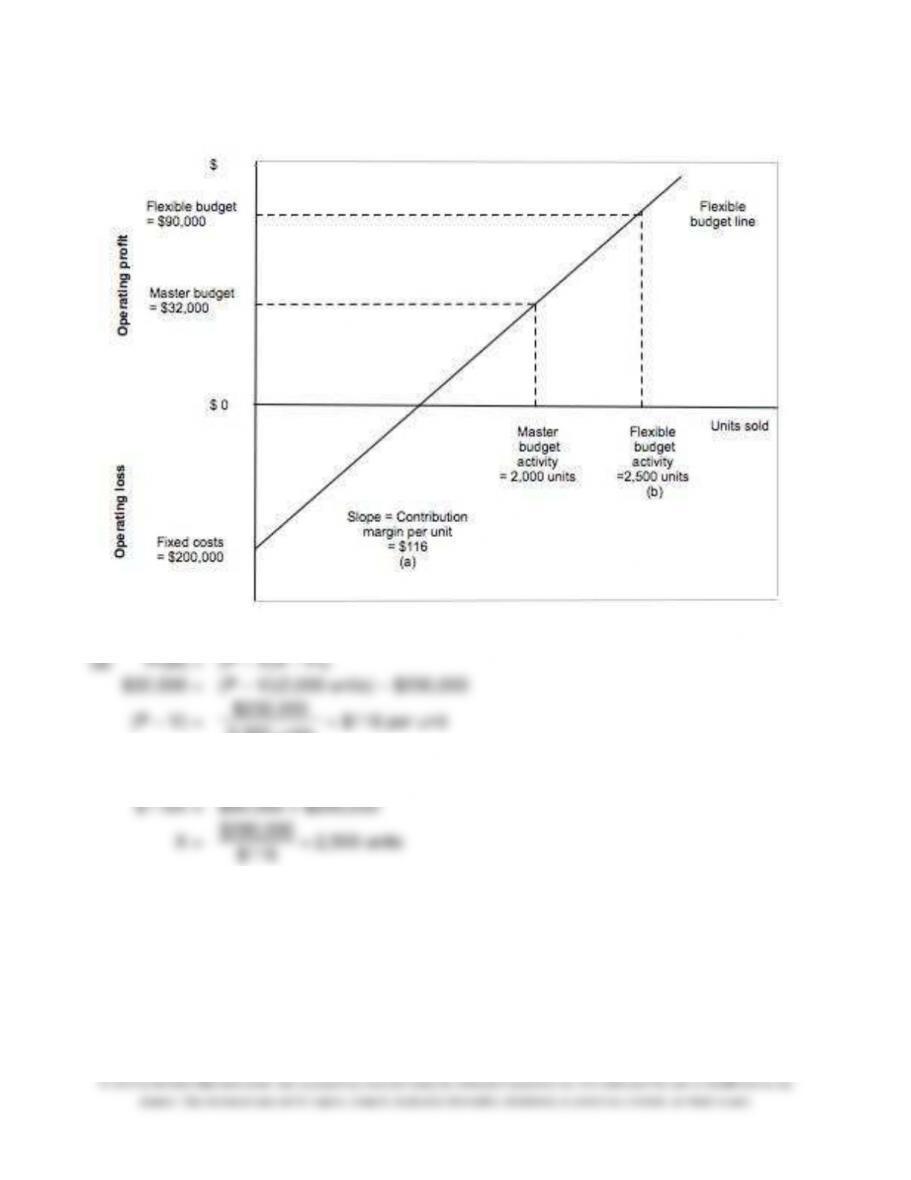
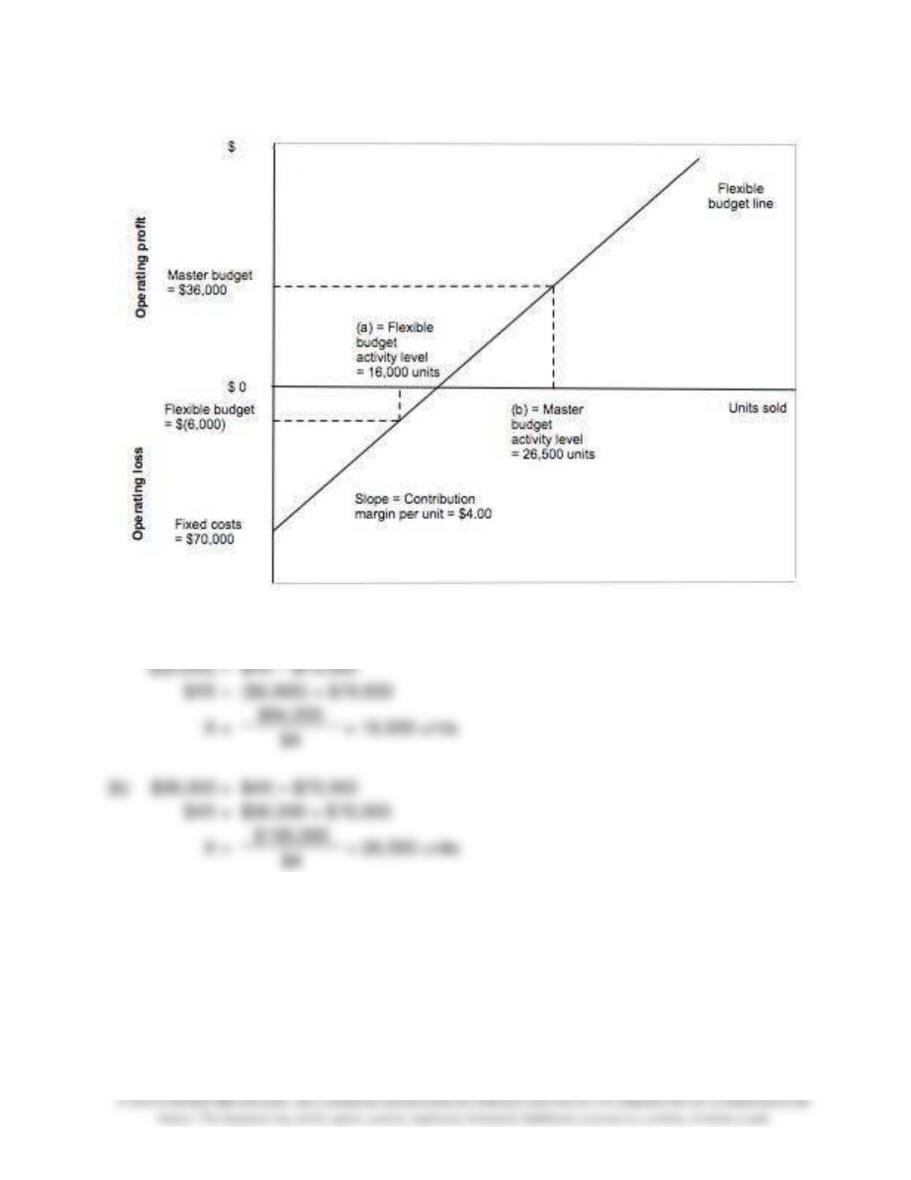
16–21. (25 min.) Fill In Amounts On Flexible Budget Graph.
Computations:
(a)
Profit
=
(P – V)X – FC
$32,000
=
(P – V)(2,000 units) – $200,000
(P – V)
=
$232,000
= $116 per unit
2,000 units
(b)
$90,000
=
$116 X – $200,000
$116X
=
$90,000 + $200,000
X
=
$290,000
= 2,500 units
$116
Chapter 16 – Fundamentals of Variance Analysis
16-9
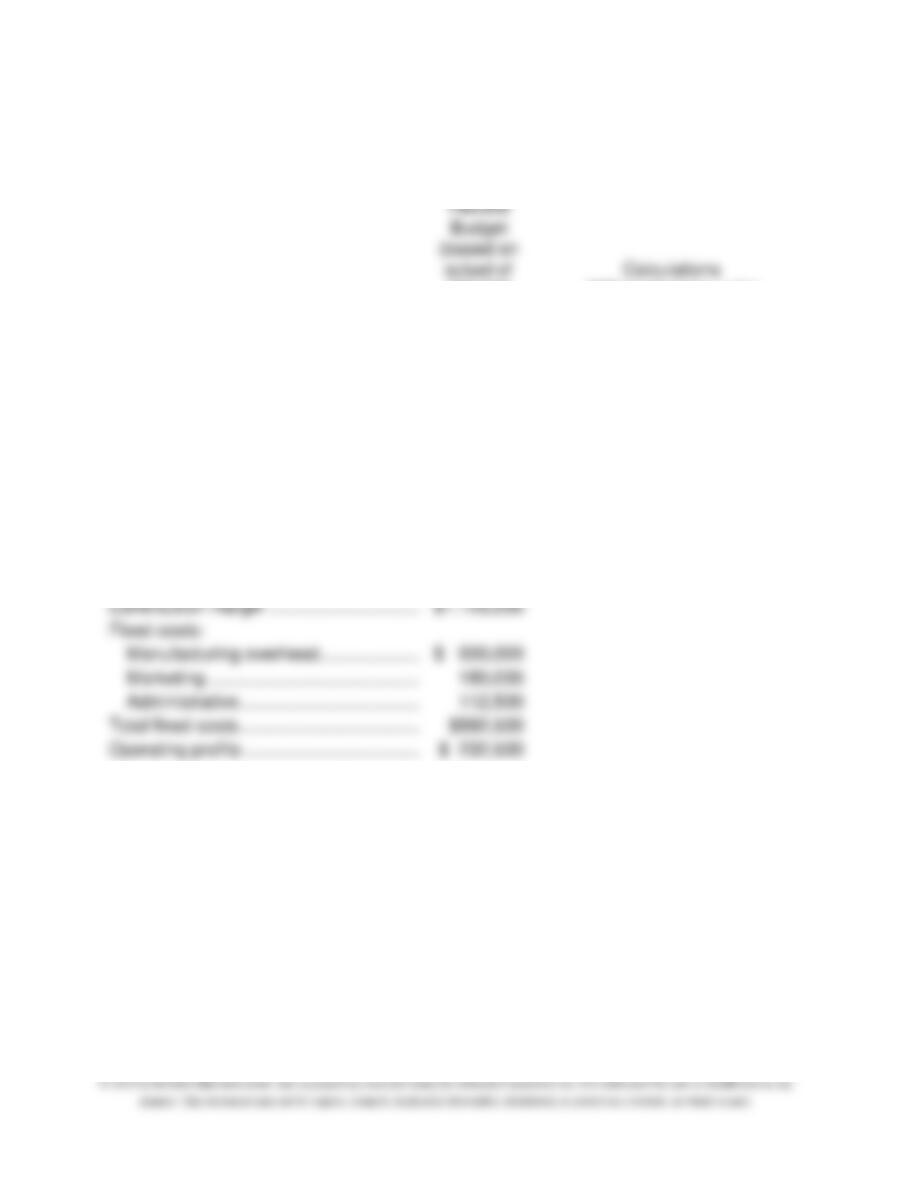
16–22. (25 min.) Flexible Budget.
Computations:
(a)
Profit
=
(P – V)X – FC
$(6,000)
=
$4X – $70,000
$4X
=
($6,000) + $70,000
X
=
$64,000
= 16,000 units
$4
(b)
$36,000
=
$4X – $70,000
$4X
=
$36,000 + $70,000
X
=
$106,000
= 26,500 units
$4
Chapter 16 – Fundamentals of Variance Analysis
16–23. (35 min.) Prepare Flexible Budget: Data-2-Go.
Flexible
Budget
(based on
actual of
750,000
units)
Calculations
(000 omitted for units)
Sales revenue ………………………………….…………
$2,812,500
$3,000,0
00
x
(750 ÷
800)
Variable costs:
Blank drives ………………………………….…………
843,750
900,000
x
(750 ÷
800)
Direct labor …………………………………..…………
196,875
210,000
x
(750 ÷
800)
Variable overhead …………………………..
365,625
390,000
x
(750 ÷
800)
Variable marketing and
administrative …………………………………..…………
281,250
300,000
x
(750 ÷
800)
Total variable costs …………………………..
$1,687,500
Contribution margin …………………………..
$1,125,000
Fixed costs:
Manufacturing overhead…………………………..
$ 600,000
Marketing …………………………………….…………
180,000
Administrative ……………………………….…………
112,500
Total fixed costs ……………………………….…………
$892,500
Operating profits …………………………………………
$ 232,500