Chapter 15 – Transfer Pricing
15–11
Solutions to Problems
15–29. (30 min.) Transfer Pricing With Imperfect Markets—ROI Evaluation, Normal
Costing: Athena Company.
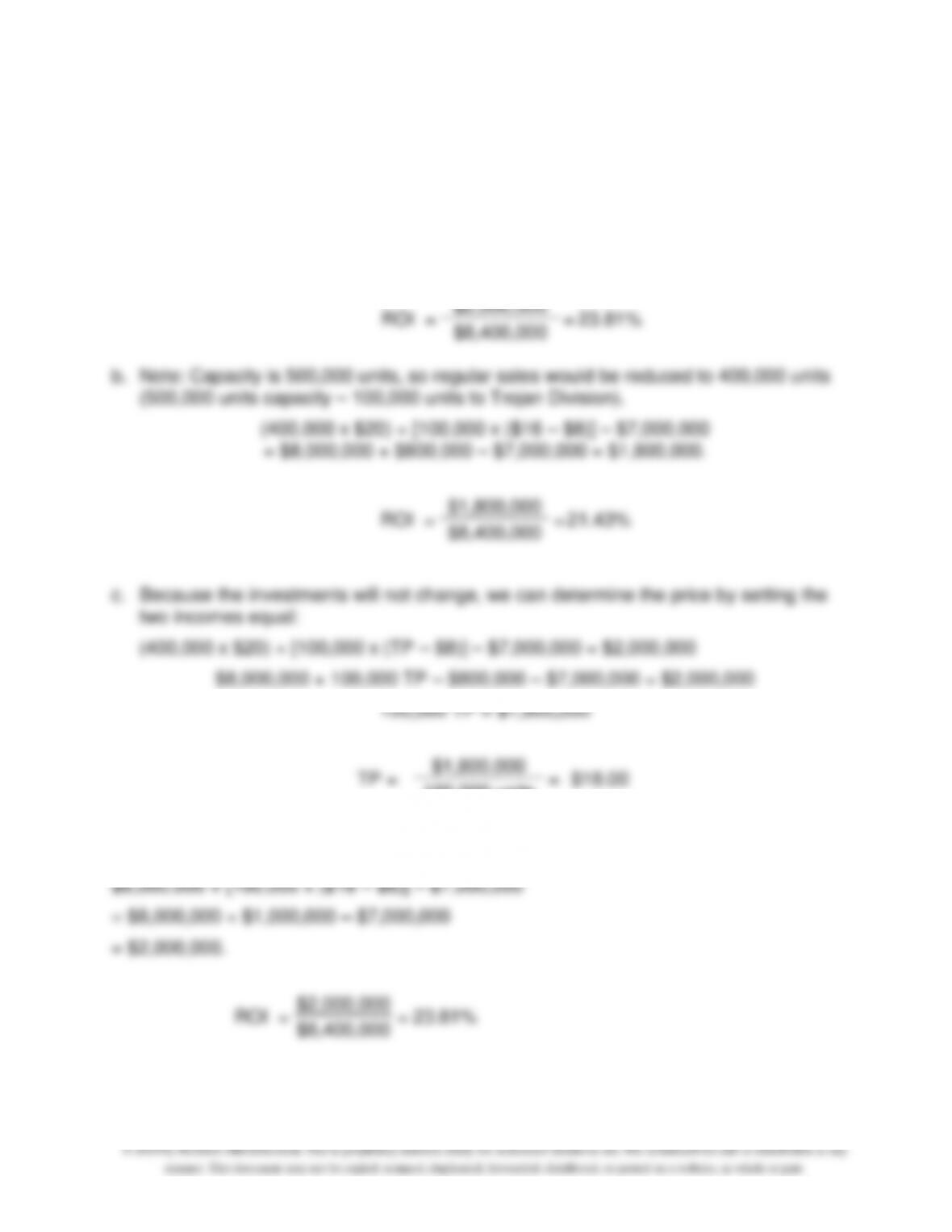
a. ROI for Spartan Division.
Income: [450,000 x ($28 – $8)] – [$14 x 500,000] = $2,000,000
ROI
=
$2,000,000
=
23.81%
$8,400,000
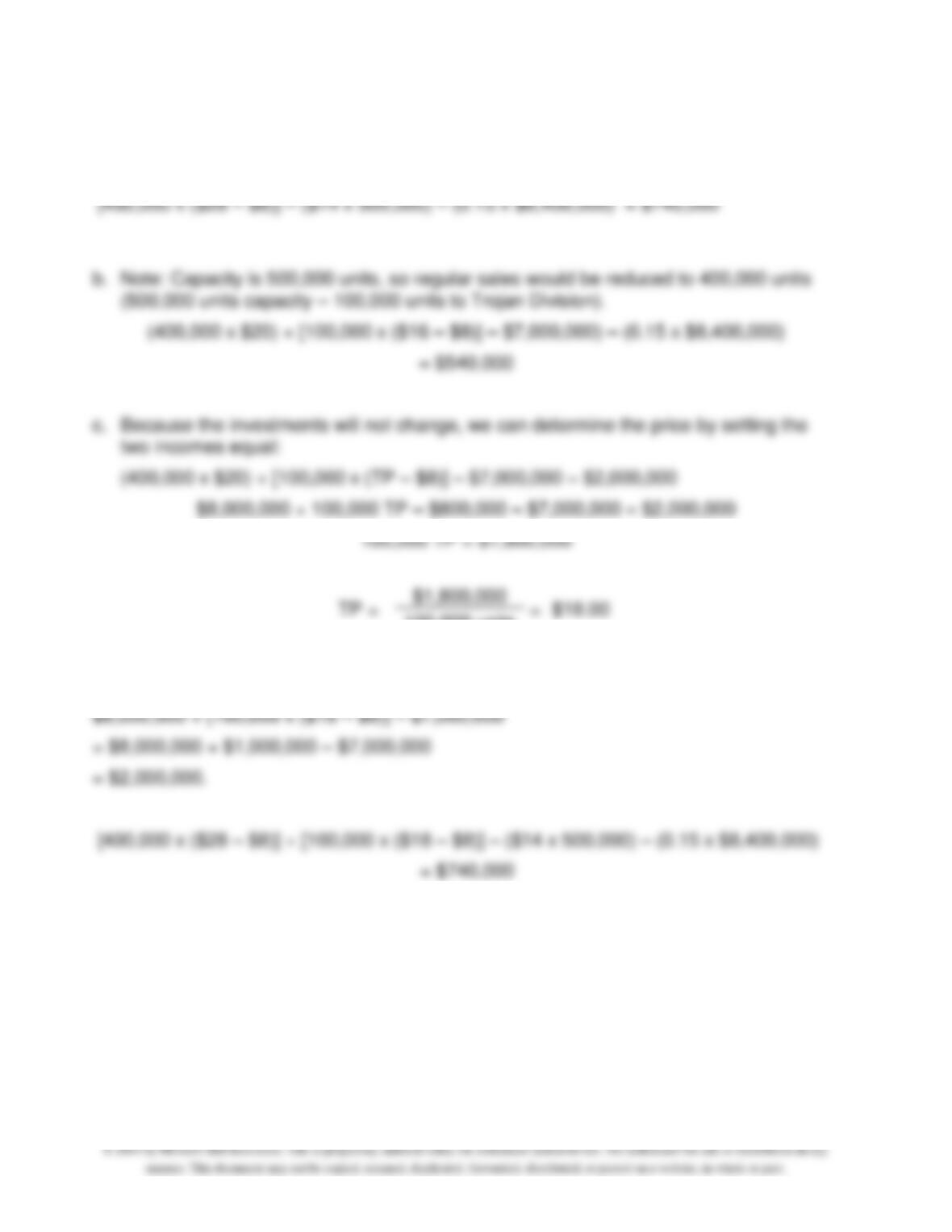
b. Note: Capacity is 500,000 units, so regular sales would be reduced to 400,000 units
(500,000 units capacity – 100,000 units to Trojan Division).
(400,000 x $20) + [100,000 x ($16 – $8)] – $7,000,000
= $8,000,000 + $800,000 – $7,000,000 = $1,800,000.
ROI
=
$1,800,000
=
21.43%
$8,400,000
c. Because the investments will not change, we can determine the price by setting the
two incomes equal:
(400,000 x $20) + [100,000 x (TP – $8)] – $7,000,000 = $2,000,000
$8,000,000 + 100,000 TP – $800,000 – $7,000,000 = $2,000,000
100,000 TP = $1,800,000
TP
=
$1,800,000
=
$18.00
100,000 units
where TP = transfer price per unit.
Proof
Chapter 15 – Transfer Pricing
15–30. (30 min.) Transfer Pricing With Imperfect Markets—RI Evaluation, Normal
Costing: Athena Company.
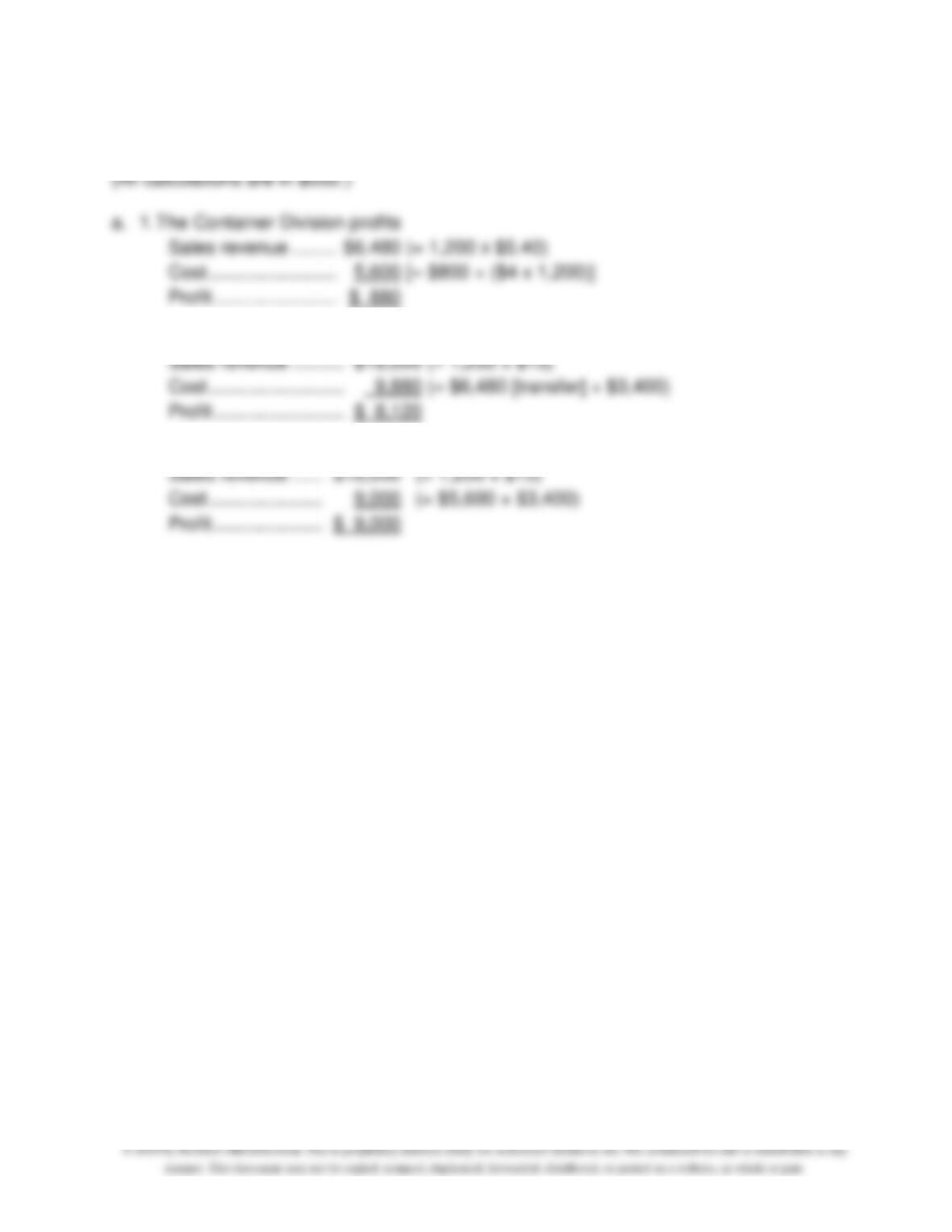
a. RI for Spartan Division.
Chapter 15 – Transfer Pricing
15–31. (50 min.) Evaluate Profit Impact of Alternative Transfer Decisions: Amazon
Beverages.
Chapter 15 – Transfer Pricing
15–14
15–31. (continued)
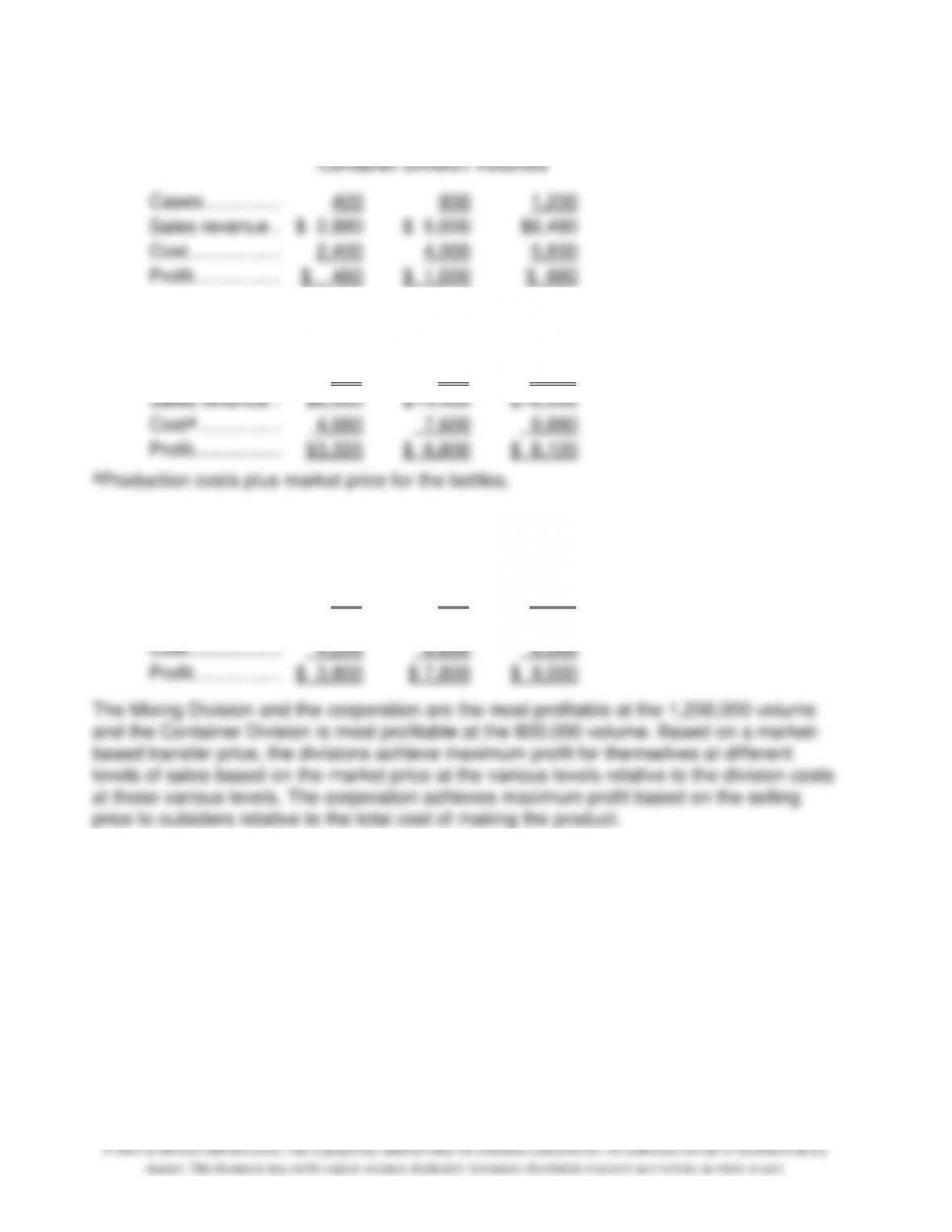
b. 1. No
Container Division Volumes
Cases …………………………..
400
800
1,200
Sales revenue ..…………………………
$ 2,880
$ 5,000
$6,480
Cost…………………………..
2,400
4,000
5,600
Profit ……………..……………
$ 480
$ 1,000
$ 880
2. Yes
Mixing Division Volumes
Cases …………………………..
400
800
1,200
Sales revenue ..…………………………
$8,000
$14,400
$18,000
Costa …………….…………….
4,680
7,600
9,880
Profit ……………..……………
$3,320
$ 6,800
$ 8,120
aProduction costs plus market price for the bottles.
3. Yes
Corporation Volumes
Cases …………………………..
400
800
1,200
Sales revenue ..…………………………
$8,000
$14,400
$18,000
Cost…………………………..
4,200
6,600
9,000
Profit ……………..……………
$ 3,800
$ 7,800
$ 9,000
The Mixing Division and the corporation are the most profitable at the 1,200,000 volume
and the Container Division is most profitable at the 800,000 volume. Based on a market–
based transfer price, the divisions achieve maximum profit for themselves at different
levels of sales based on the market price at the various levels relative to the division costs
at these various levels. The corporation achieves maximum profit based on the selling
price to outsiders relative to the total cost of making the product.
Chapter 15 – Transfer Pricing
15–15
15–32. (40 min.) International Transfer Prices: Skane Shipping, Ltd.
All revenues and costs are in millions of dollars.
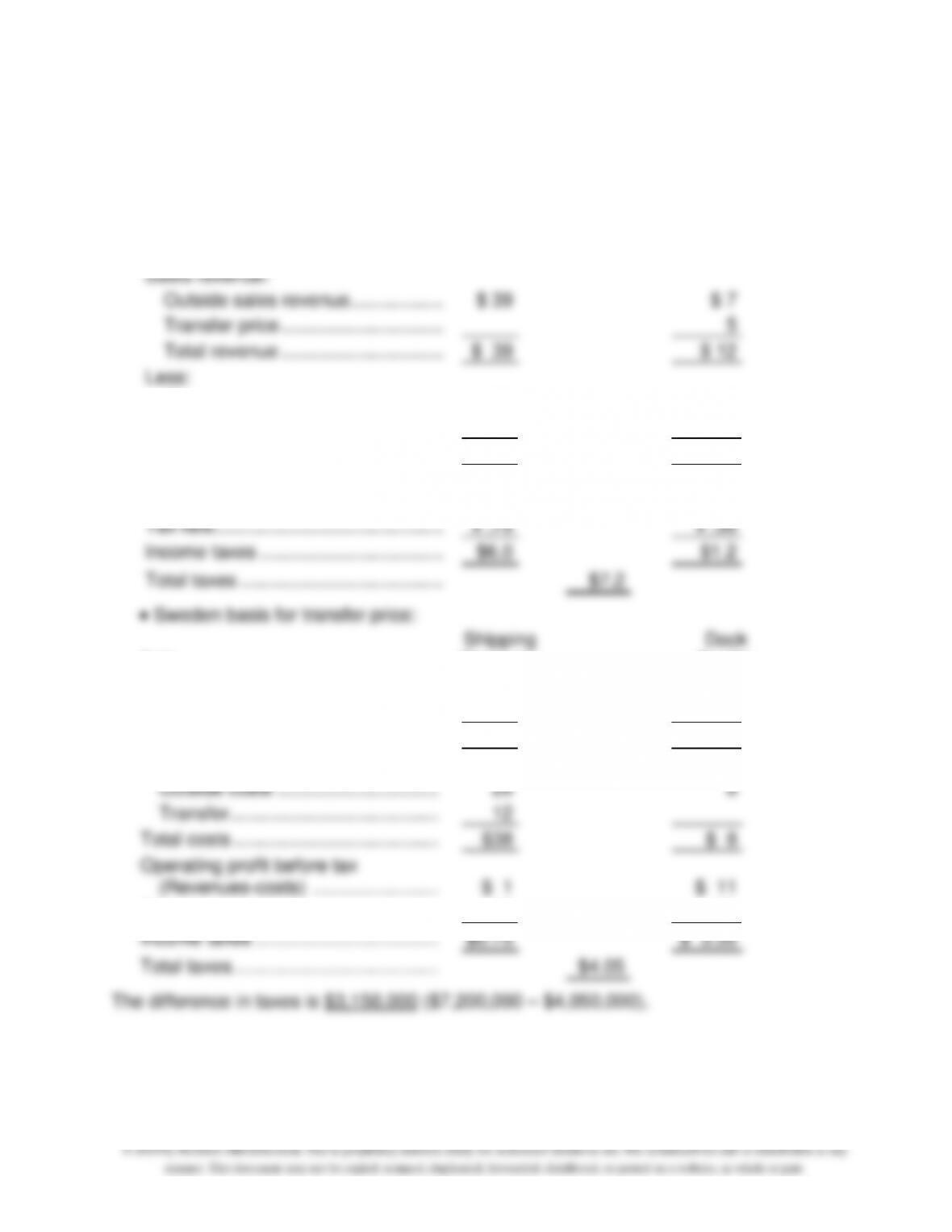
Malaysian basis for transfer price:
Item
Shipping
Company
Dock
Facility
Sales revenue:
Outside sales revenue …………………………..
$ 39
$ 7
Transfer price …………………………..
5
Total revenue …………………………..
$ 39
$ 12
Less:
Outside costs …………………………..
26
8
Transfer ………………………………….………………
5
Total costs ………………………………………………
$ 31
$ 8
Operating profit before tax
(Revenue – costs) …………………..………
$ 8
$4
Tax rate ……………………………………..………………
x .75
x .30
Income taxes ……………………………..………………
$6.0
$1.2
Total taxes …………………………………………………
$7.2
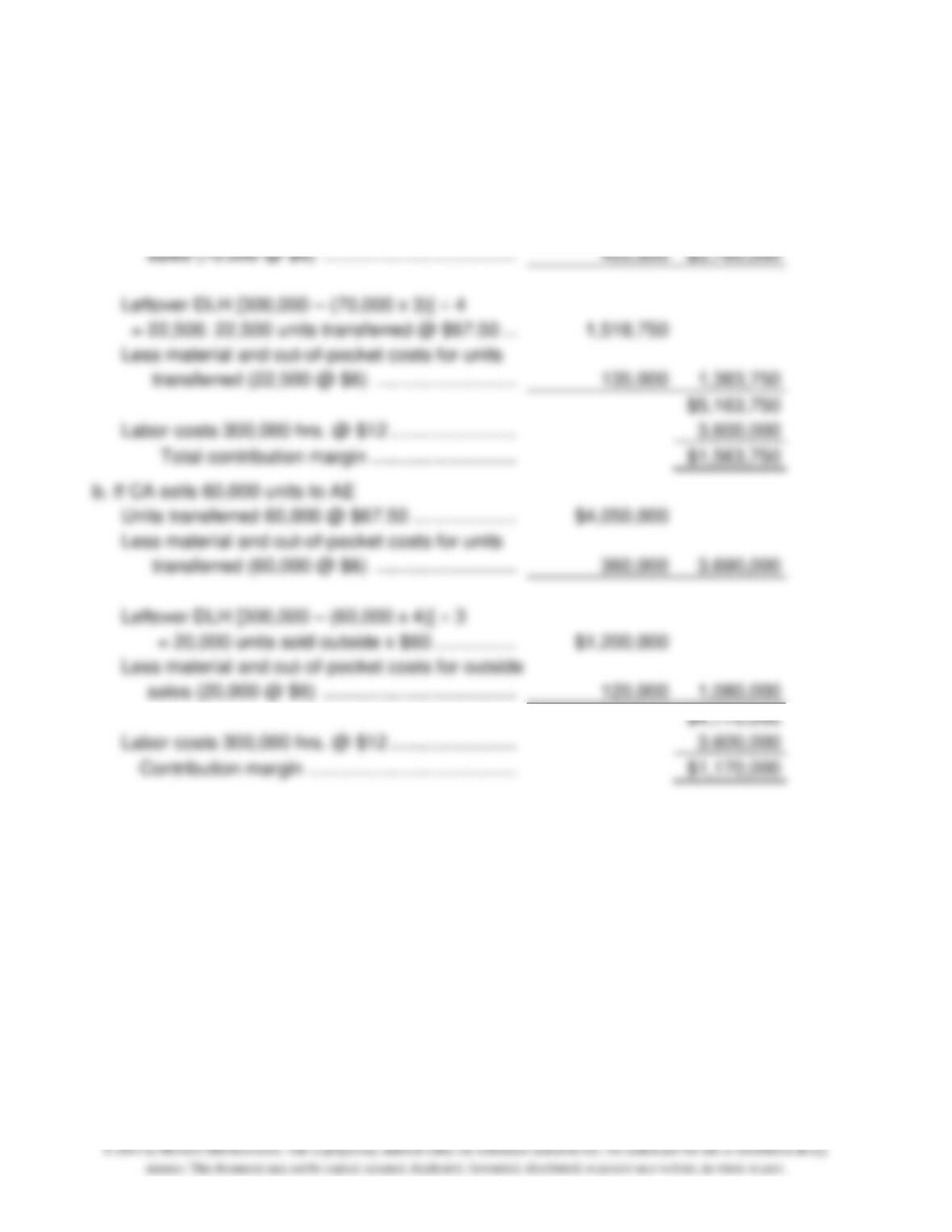
Item
Shipping
Company
Dock
Facility
Outside sales revenue ………………….……….
$ 39
$ 7
Transfer price……………………………………………..
12
Total revenue ……………………………………………..
$ 39
$ 19
Less:
Outside costs …………………………..
26
8
Transfer …………………………………..……………..
12
Total costs …………………………..……..……………..
$38
$ 8
Operating profit before tax
(Revenues-costs) …………………….…….
$ 1
$ 11
Tax rate ……………………………………..……………..
x .75
x .30
Income taxes ……………………………………………..
$0.75
$ 3.30
Total taxes ………………………………….……………..
$4.05
Chapter 15 – Transfer Pricing
15–16
15–33.
(60 min.) Analyze Transfer Pricing Data: Valencia Products.
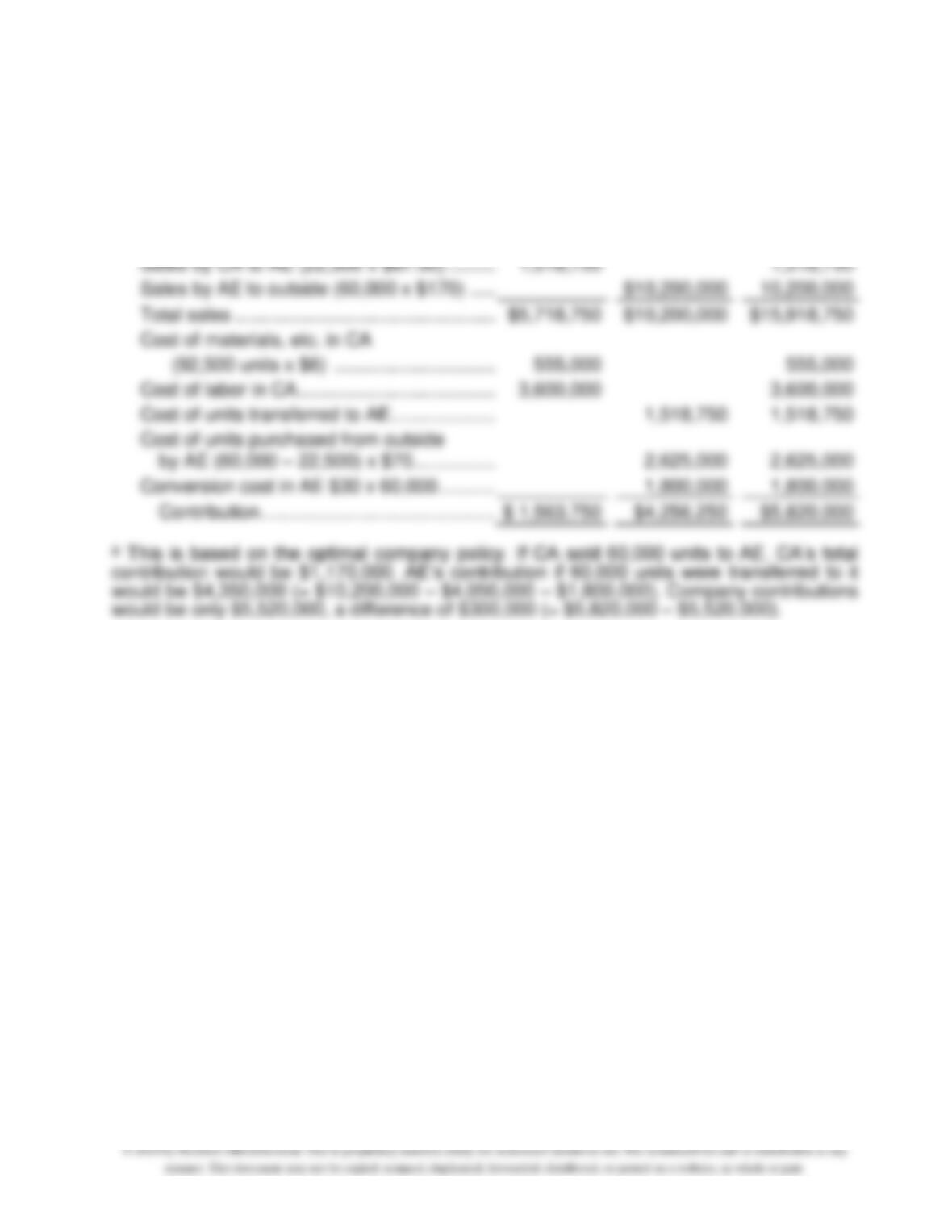
a. If CA sells 70,000 units to outside
Outside sales revenue 70,000 @ $60.00 ………..
$4,200,000
Less material and out-of-pocket costs for outside
sales (70,000 @ $6) ……………………………….
420,000
$3,780,000
Leftover DLH [300,000 – (70,000 x 3)] 4
= 22,500. 22,500 units transferred @ $67.50 …
1,518,750
Less material and out-of-pocket costs for units
transferred (22,500 @ $6) ………………………
135,000
1,383,750
$5,163,750
Labor costs 300,000 hrs. @ $12 ……………………
3,600,000
Total contribution margin ……………………….
$1,563,750
b. If CA sells 60,000 units to AE
Units transferred 60,000 @ $67.50 ………………..
$4,050,000
Less material and out-of-pocket costs for units
transferred (60,000 @ $6) ………………………
360,000
3,690,000
Leftover DLH [300,000 – (60,000 x 4)] 3
= 20,000 units sold outside x $60 …………….
$1,200,000
Less material and out-of-pocket costs for outside
sales (20,000 @ $6) ……………………………….
120,000
1,080,000
$4,770,000
Labor costs 300,000 hrs. @ $12 ……………………
3,600,000
Contribution margin ………………………………….
$1,170,000
Chapter 15 – Transfer Pricing
15–17
15–33. (continued)
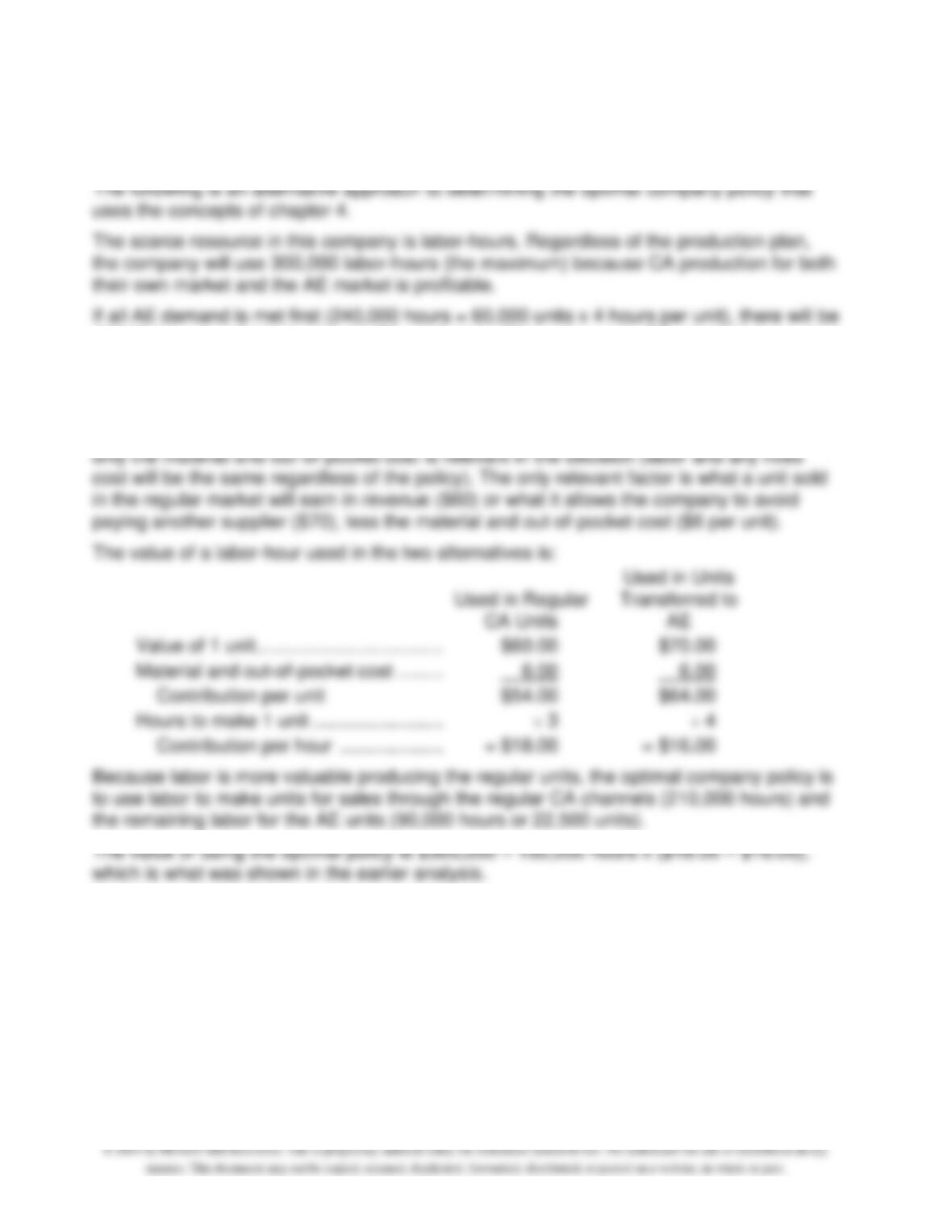
c. and d.a
CA Division
AE Division
Company
Sales by CA to outside (70,000 x $60) ……..……
$4,200,000
$4,200,000
Sales by CA to AE (22,500 x $67.50) ……….……
1,518,750
1,518,750
Sales by AE to outside (60,000 x $170) …………
$10,200,000
10,200,000
Total sales …………………………………………………
$5,718,750
$10,200,000
$15,918,750
Cost of materials, etc. in CA
(92,500 units x $6) …………………………..
555,000
555,000
Cost of labor in CA ………………………………………
3,600,000
3,600,000
Cost of units transferred to AE ………………………
1,518,750
1,518,750
Cost of units purchased from outside
by AE (60,000 – 22,500) x $70 ……………..……
2,625,000
2,625,000
Conversion cost in AE $30 x 60,000 ………………
1,800,000
1,800,000
Contribution ……………………………………….……
$ 1,563,750
$4,256,250
$5,820,000
a This is based on the optimal company policy. If CA sold 60,000 units to AE, CA’s total
contribution would be $1,170,000. AE’s contribution if 60,000 units were transferred to it
would be $4,350,000 (= $10,200,000 – $4,050,000 – $1,800,000). Company contributions
would be only $5,520,000, a difference of $300,000 (= $5,820,000 – $5,520,000).
Chapter 15 – Transfer Pricing
15–18
15–33. (continued)
Alternative approach.
60,000 hours available for regular CA production. Because regular CA production requires
210,000 labor-hours (= 70,000 units x 3 hours per unit), regular CA production will have to
be curtailed by 150,000 hours (= 50,000 units).
As discussed in chapter 4, we can look at the contribution margin per unit of constraining
resource (labor-hours here) to determine the optimal policy. Because all labor will be used,
Chapter 15 – Transfer Pricing
15–19
15–34. (40 min.) Transfer Pricing—Performance Evaluation Issues: Cochise
Corporation.
a. Southern would not supply Northern with the thermal switch for the $40 per unit price.
Southern is operating at capacity and would lose $20 ($60 – $40) for each switch sold
to Northern. The management performance of Southern is measured by return on
Northern incurs regardless of the appliance order, Cochise would lose $20 in cash flow
for each switch sold to Northern but gain $64 (the fixed overhead that will be charged
as part of the price, although it is not an incremental cost) plus markup from each
switch sold by Northern. This assumes there is no other source for the switch.
c. In the short run there is an advantage to Cochise of transferring the switch at the $40
inappropriate for the situation.
On the other hand, if this is an occurrence of relative infrequency, the intervention of
corporate management will not indicate inadequate organization structure. It might,
however, create problems with division managements. In the case at hand, if Cochise
management requires that the switch be transferred at $40, the result will be to
not; no mention is made of any other interdivisional business. Therefore, the Cochise
controller should recommend that each division should be free to act in accordance
with its best interests. The company is better served in the long run if Southern is
permitted to continue dealing with its regular customers at the market price. If Northern
is having difficulties, the solution does not lie with temporary help at the expense of
Chapter 15 – Transfer Pricing
15–20
© 2014 by McGraw-Hill Education. This is proprietary material solely for authorized instructor use. Not authorized for sale or distribution in any
manner. This document may not be copied, scanned, duplicated, forwarded, distributed, or posted on a website, in whole or part.
the part and still arrive at a total cost of $396. Because it is not operating at capacity, it
should be willing to try this.
CMA adapted.
15–35. (30 min.) Evaluate Transfer Price System: Oriole, Inc.
The purpose of this problem is to illustrate possible problems that can arise when
applying static rules, such as determining the optimal transfer price in a series of
decisions over time.