Chapter 15 – Transfer Pricing
15-1
© 2014 by McGraw-Hill Education. This is proprietary material solely for authorized instructor use. Not authorized for sale or distribution in any
manner. This document may not be copied, scanned, duplicated, forwarded, distributed, or posted on a website, in whole or part.
Chapter 15
Transfer Pricing
Solutions to Review Questions
15–1.
A transfer price is used to record the revenue or the cost from a sale between units (e.g.,
divisions) of a firm. It allows the completion of separate financial statements within the
firm.
15–2.
15–3.
Market-based transfer pricing is considered optimal under many circumstances because it
15–4.
The key limitation is that market prices are often not readily available. The limitations of
market-based transfer prices exist when the market price does not reflect the opportunity
15–5.
Direct intervention might be preferable when transfers between units are rare or where the
decision resulting from decentralized decision-making is considered too harmful to allow.
Chapter 15 – Transfer Pricing
15-2
15–6.
Reasons not to use market prices include situations where: (1) market prices are not
15–7.
When actual costs are used as a basis for the transfer, any variances or inefficiencies in
the selling division are passed along to the buying division. To promote responsibility in
15–8.
The advantage of negotiated transfer prices is that they can be used when market prices
are not easily available (for example, with unique products) or when relevant costs are
15–9.
The general transfer pricing rule is:
Transfer Price = Outlay Cost + Opportunity Cost of the Resource at the Point of Transfer
Chapter 15 – Transfer Pricing
15-3
Solutions to Critical Analysis and Discussion Questions
15–10.
15–11.
A cost-based or negotiated cost-based transfer pricing method would be necessary. We
15–12.
15–13.
Most likely Weyerhaeuser uses a market price, because the products are commodity
products (wood, pulp, and so on) with well-established markets.
15–14.
The transfer price becomes revenue for the selling segment and a cost to the buying
segment. An increase (decrease) in the transfer price increases (decreases) the selling
15–15.
Because transfer prices can affect the assignment of income from one jurisdiction to
another, there is a tendency to set a cross-jurisdictional transfer price in such a manner
Chapter 15 – Transfer Pricing
15-4
15–16.
Transfer prices are similar to cost allocations in that they assign costs (and profit) to two or
more cost objects. In fact, if we think about the service department cost allocations in
15–17. (20 min.) Apply Transfer Pricing Rules: Best Practices, Inc.
a. The minimum transfer price that the Corporate Division should obtain is $600 per hour,
15–18. (15 min.) Evaluate Transfer Pricing System: Mississippi Company
If Illinois Division buys from outsiders because the transfer price is greater than $60, this
15–19. (15 min.) Evaluate Transfer Pricing System
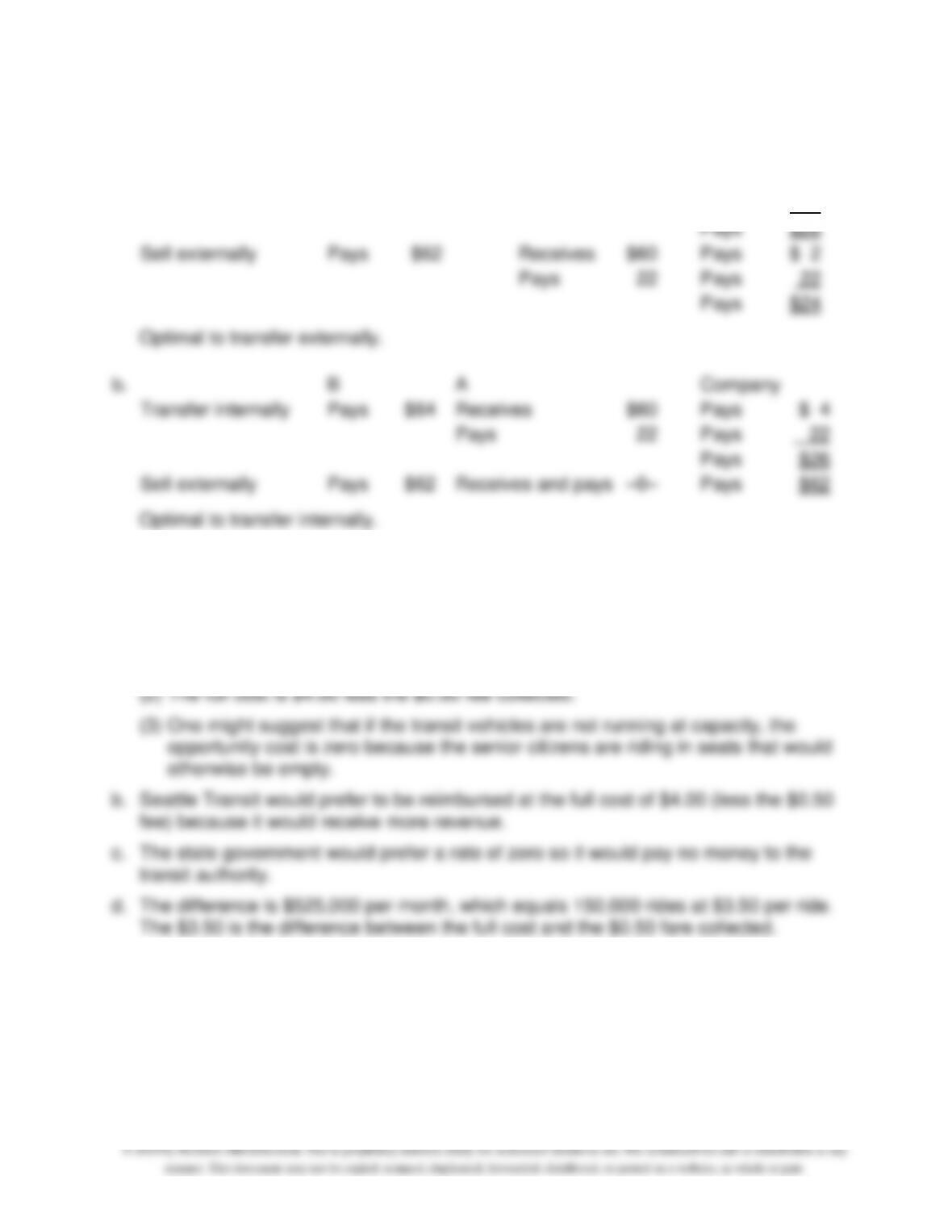
With the possibility of increased production, Uptown Division has an opportunity cost of
Chapter 15 – Transfer Pricing
15-5
15–20. (20 min.) Evaluate Transfer Pricing System.
a.
B
A
Company
Transfer internally
Pays
$64
Receives
$60
Pays
$ 4
Pays
$22
Pays
22
Pays
$26
Sell externally
Pays
$62
Receives
$60
Pays
$ 2
Pays
22
Pays
22
Pays
$24
Optimal to transfer externally.
b.
B
A
Company
Transfer internally
Pays
$64
Receives
$60
Pays
$ 4
Pays
22
Pays
22
Pays
$26
Sell externally
Pays
$62
Receives and pays
–0–
Pays
$62
Optimal to transfer internally.
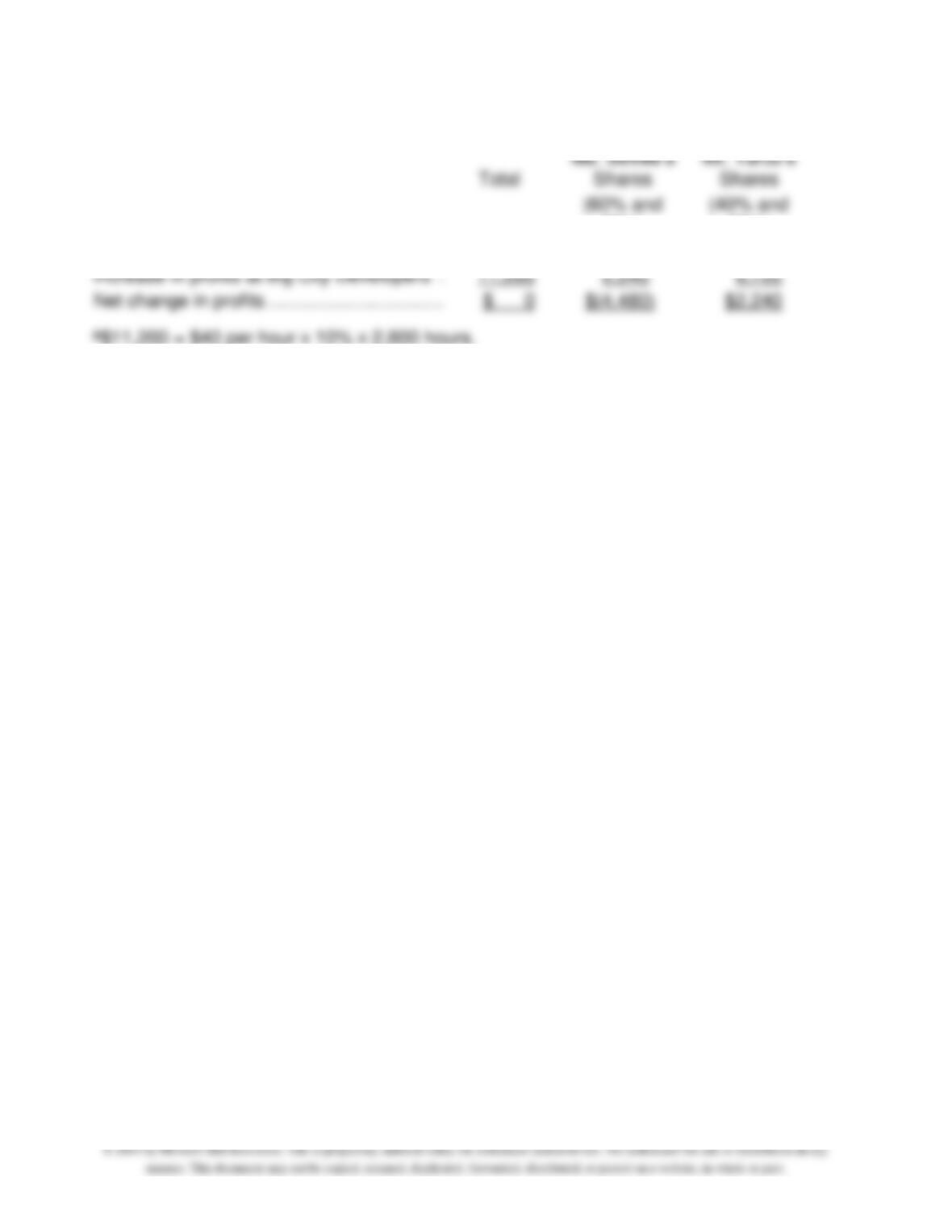
15–21. (25 min.) Evaluate Transfer Pricing System: Seattle Transit Ltd.
a. Different prices:
(1) The opportunity cost might be considered the regular fare of $2.00 less the $0.50
fee collected.
Chapter 15 – Transfer Pricing
15-6
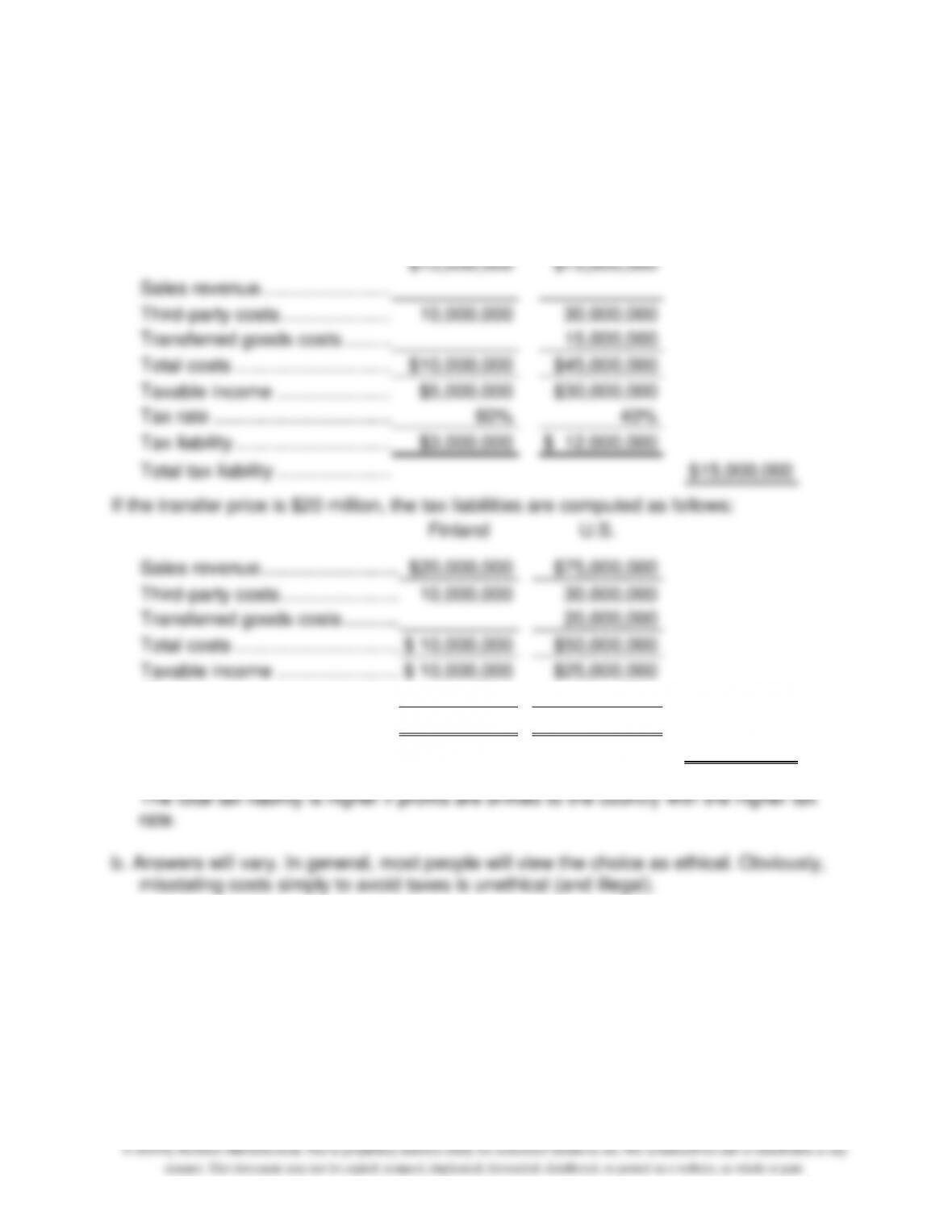
15–22. (25 min.) Evaluate Transfer Pricing System: BGTS.
Total
Ms. Seville’s
Shares
(60% and
20%)
Mr. Turco’s
Shares
(40% and
60%)
Decrease in profits at BGTS ………………….……..
$(11,200)a
$(6,720)
$(4,480)
Increase in profits at Big City Developers .……..
11,200
2,240
6,720
Net change in profits …………………………….……..
$ 0
$(4,480)
$2,240
a$11,200 = $40 per hour x 10% x 2,800 hours.
Chapter 15 – Transfer Pricing
15-7
15–23. (25 min.) International Transfer Prices–Ethical Issues: Trans Atlantic
Metals.
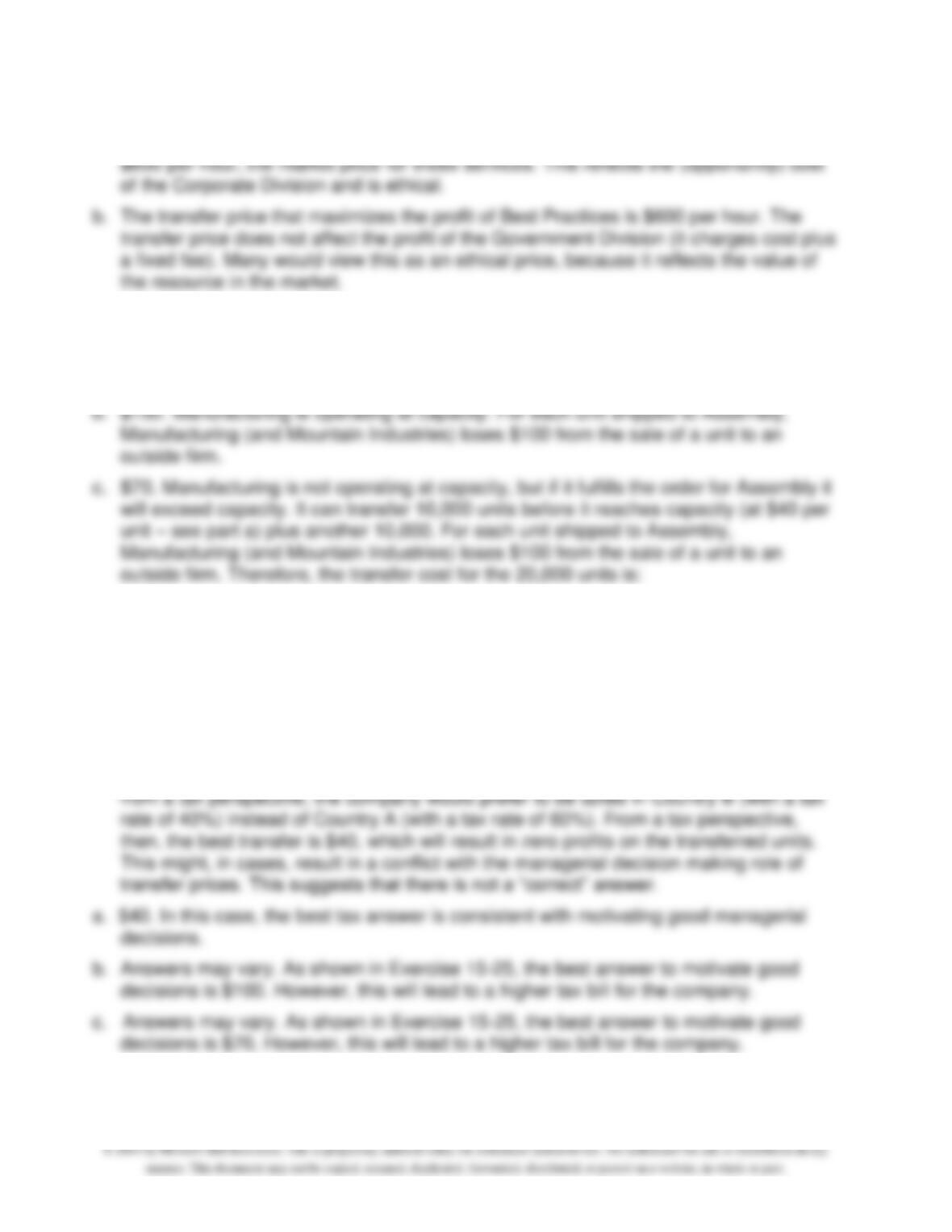
a. Analyze the tax liabilities in each jurisdiction using the alternative transfer prices. If the
transfer price is $15 million, the tax liabilities are:
Finland
U.S.
Sales revenue ……………………..……
$15,000,000
$75,000,000
Third-party costs ………………….……….
10,000,000
30,000,000
Transferred goods costs ……….………………….
15,000,000
Total costs …………………………..
$10,000,000
$45,000,000
Taxable income …………………..………
$5,000,000
$30,000,000
Tax rate ……………………………..……………………..
60%
40%
Tax liability …………………………..
$3,000,000
$ 12,000,000
Total tax liability …………………..………
$15,000,000
If the transfer price is $20 million, the tax liabilities are computed as follows:
Finland
U.S.
Sales revenue …………………………..
$20,000,000
$75,000,000
Third-party costs …………………..………
10,000,000
30,000,000
Transferred goods costs ………..…………………
20,000,000
Total costs …………………………..…………………….
$ 10,000,000
$50,000,000
Taxable income …………………………..
$ 10,000,000
$25,000,000
Tax rate …………………………………………………….
60%
40%
Tax liability …………………………..…………………….
$6,000,000
$ 10,000,000
Total tax liability …………………………..
$16,000,000
Chapter 15 – Transfer Pricing
15-8
15–24. (20 min.) Transfer Pricing Policies – Ethical Issues: Best Practices, Inc.
a. As in 15-17, the minimum transfer price that the Corporate Division should obtain is
15–25. (20 min.) Evaluate Transfer Pricing System: Mountain Industries.
a. $40. Manufacturing is operating below capacity, so the optimal transfer price is the
variable cost. The Assembly order will not exceed the current capacity.
10,000 x $40 + 10,000 x $100 = $1,400,000
or, $70 (= $1,400,000 ÷ 20,000 cases) per case.
15–26. (20 min.) International Transfer Prices: Mountain Industries.
This exercise is designed to illustrate the conflict between the use of a transfer price to
motivate managerial decision making and the desire to minimize corporate taxes.
Ignoring the tax issues, leads to the same answers as in Exercise 15-25. However,
Chapter 15 – Transfer Pricing
15-9
15–27. (30 min.) Segment Reporting: Leapin’ Larry’s Pre-Owned Cars
($ in millions)
a. Using an $6 million transfer price:
Item
Operation
Division
Financing
Division
Outside sales revenue …………………………..
$51
$12
Transfer price …………………………..…………………
6
Total revenue …………………………..…………………
$51
$18
Less:
Outside costs ……………………….….
39
10
Transfer …………………………………………………
6
Total costs …………………………………………………
$45
$ 10
Operating profit before tax …………………………..
$ 6
$8
b. Using a $3 million transfer price:
Item
Operation
Division
Financing
Division
Outside sales revenue …………………………..
$51
$12
Transfer price …………………………..…………………
3
Total revenue …………………………..…………………
$51
$15
Less:
Outside costs ……………………….….
39
10
Transfer ……………………………….…………………
3
Total costs …………………………………………………
$42
$ 10
Operating profit before tax …………………………..
$9
$ 5
Chapter 15 – Transfer Pricing
15–10
15–28. (30 min.) Segment Reporting: Perth Corporation.
($000)
Item
Casino
Hotel
Revenue:
Outside revenue …………………..………
$16,000
$11,000
Transfer price ……………………….….
2,400
1,000
Total revenue ……………………….….
$18,400
$12,000
Less:
Outside costs ……………………….….
$9,000
$8,000
Transfer ………………………………………………….
1,000
2,400
Total costs …………………………..………………….
$10,000
$10,400
Operating profit before tax …………………………..
$8,400
$1,600