Chapter 14 – Business Unit Performance Measurement
14–30
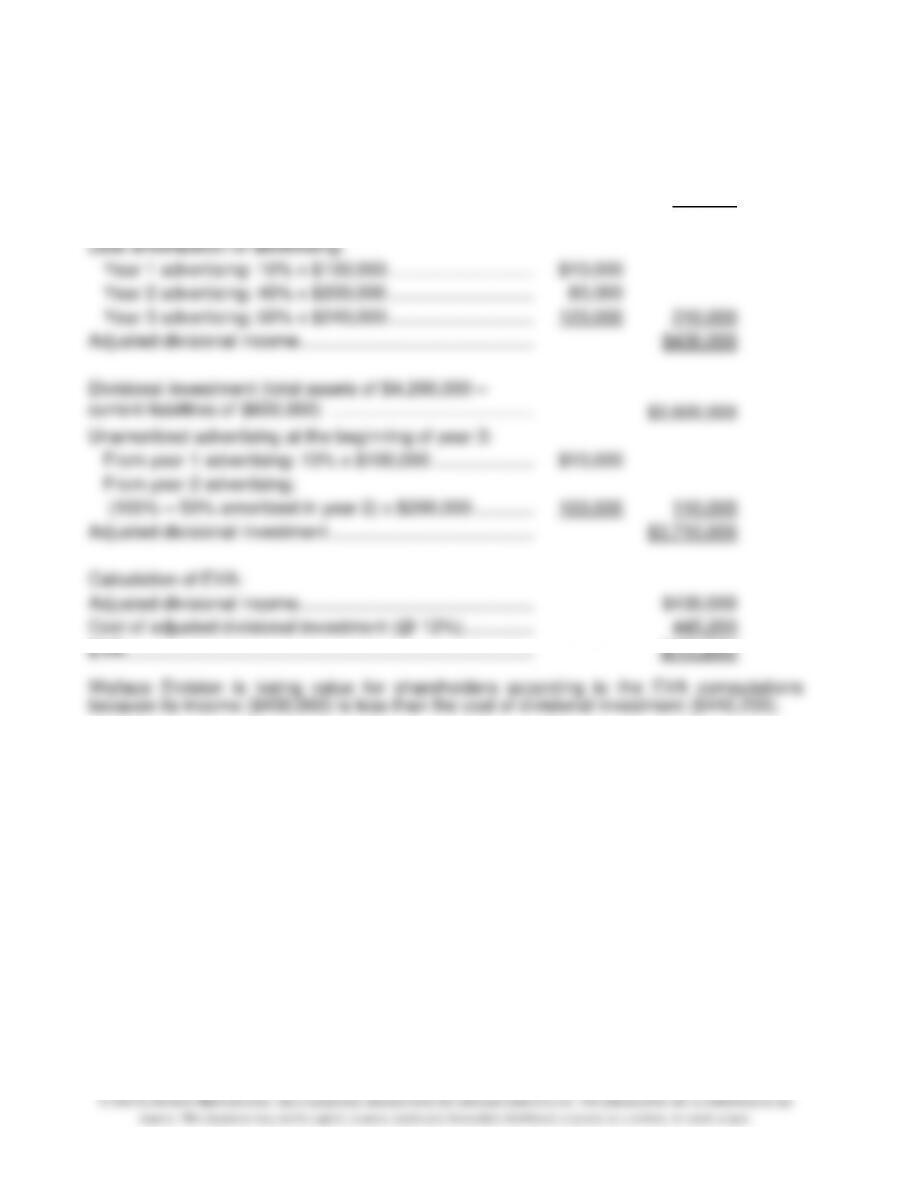
14–46. (35 min.) Economic Value Added: Biddle Company.
After-tax income ………………………………………………………
$400,000
Add back advertising expense for year 3 …………………….
240,000
$640,000
Less amortization of advertising:
Year 1 advertising: 10% x $100,000 ………………………..
$10,000
Year 2 advertising: 40% x $200,000 ………………………..
80,000
Year 3 advertising; 50% x $240,000 ………………………..
120,000
210,000
Adjusted divisional income ………………………………………..
$430,000
Divisional investment (total assets of $4,200,000 –
current liabilities of $600,000) …………………………………..
$3,600,000
Unamortized advertising at the beginning of year 3:
From year 1 advertising: 10% x $100,000 ………………..
$10,000
From year 2 advertising:
(100% – 50% amortized in year 2) x $200,000 …………
100,000
110,000
Adjusted divisional investment …………………………………..
$3,710,000
Calculation of EVA:
Adjusted divisional income ………………………………………..
$430,000
Cost of adjusted divisional investment (@ 12%) …………..
445,200
EVA ……………………………………………………………………….
$(15,200)
Wallace Division is losing value for shareholders according to the EVA computations
because its income ($430,000) is less than the cost of divisional investment ($445,200).
Chapter 14 – Business Unit Performance Measurement
14–31
14–47. (60 – 90 min.) Barrows Consumer Products (A).
a.
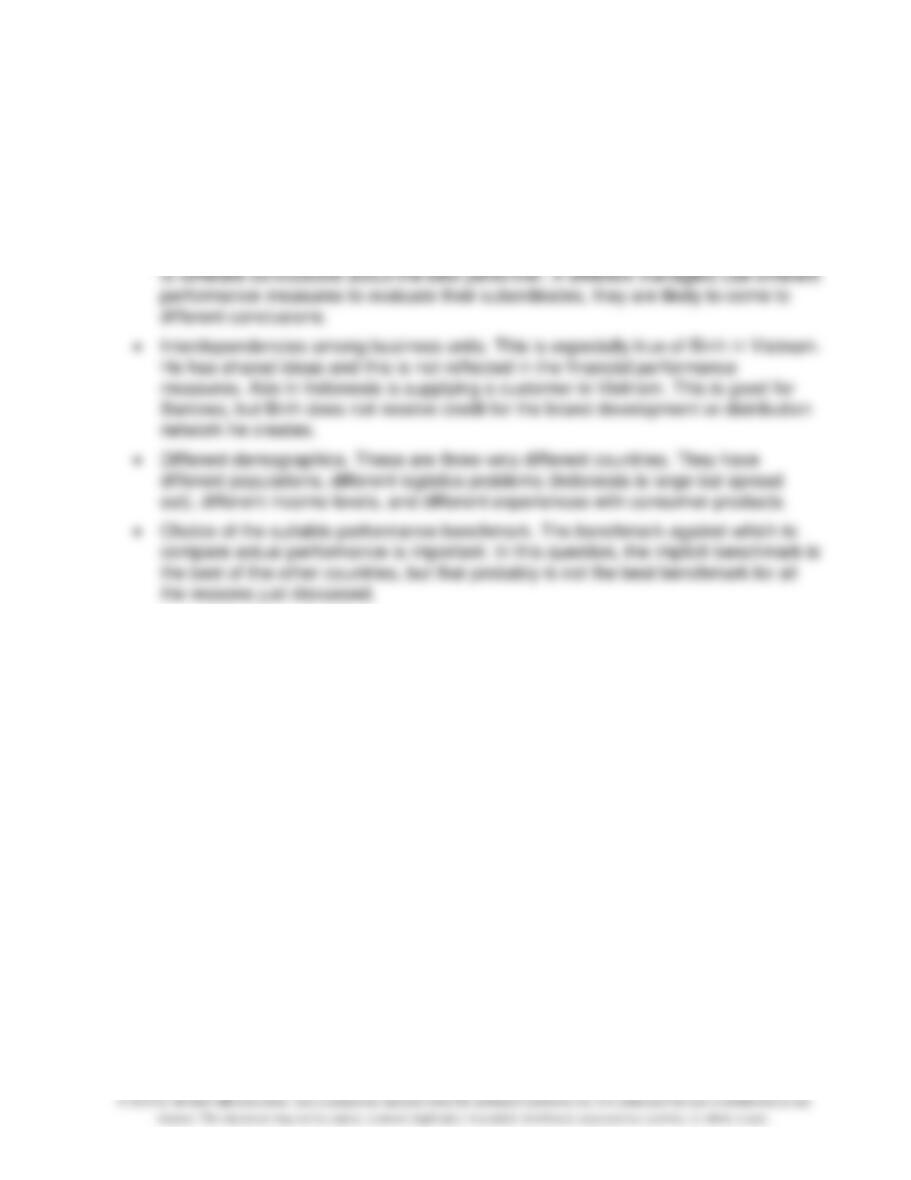
There are many possible problems in identifying the “best” performer, but some of the
most commonly cited by students are:
Different measures can be used in the sector. Different performance measures lead
Chapter 14 – Business Unit Performance Measurement
14–32
14–47. (continued)
b.
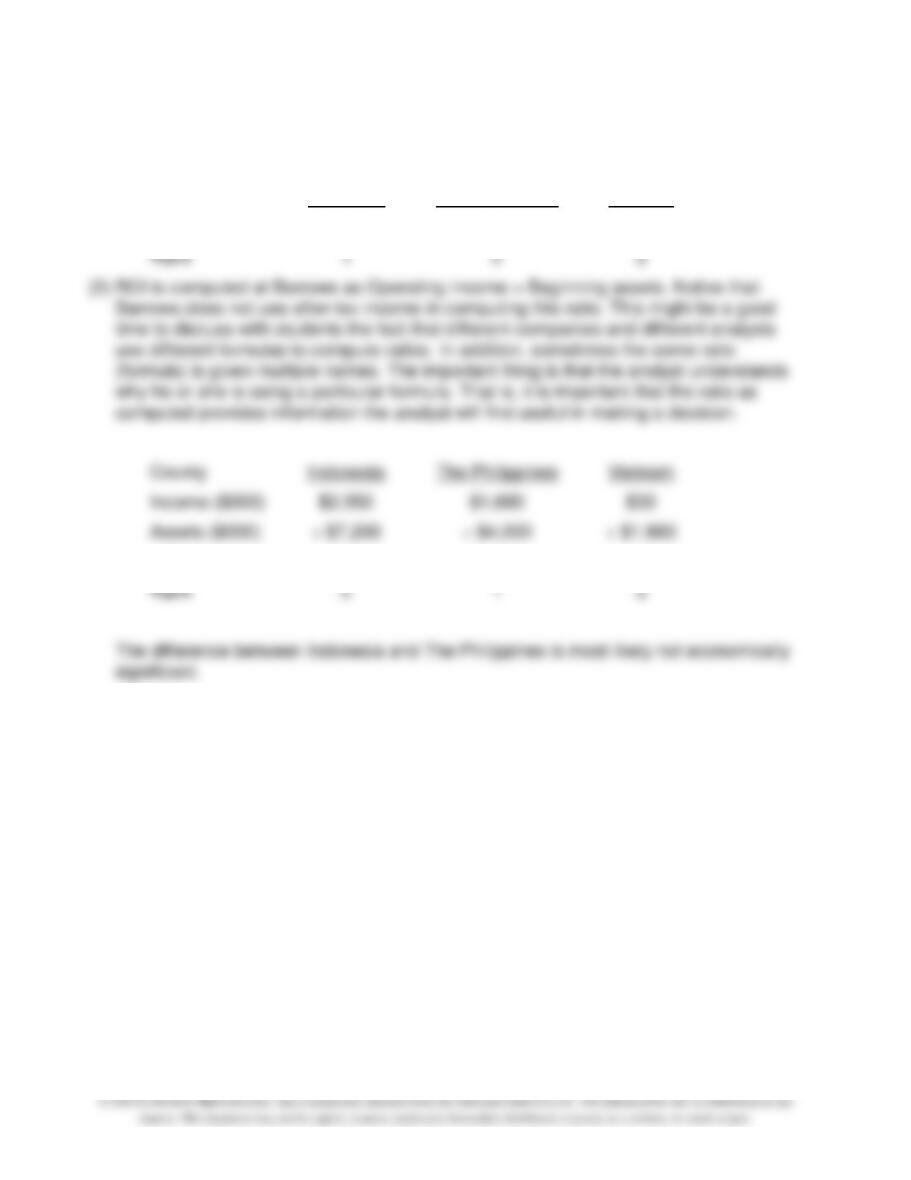
(1) Income is given in the case:
County
Indonesia
The Philippines
Vietnam
Income ($000)
$2,065
$1,176
$21
Rank
1
2
3
(2) ROI is computed at Barrows as Operating income ÷ Beginning assets. Notice that
Barrows does not use after-tax income in computing this ratio. This might be a good
time to discuss with students the fact that different companies and different analysts
use different formulas to compute ratios. In addition, sometimes the same ratio
(formula) is given multiple names. The important thing is that the analyst understands
why he or she is using a particular formula. That is, it is important that the ratio as
computed provides information the analyst will find useful in making a decision.
County
Indonesia
The Philippines
Vietnam
Income ($000)
$2,950
$1,680
$30
Assets ($000)
÷ $7,200
÷ $4,000
÷ $1,880
ROI
41.0%
42.0%
1.6%
Rank
2
1
3
The difference between Indonesia and The Philippines is most likely not economically
significant.
Chapter 14 – Business Unit Performance Measurement
14–33
14–47. (continued)
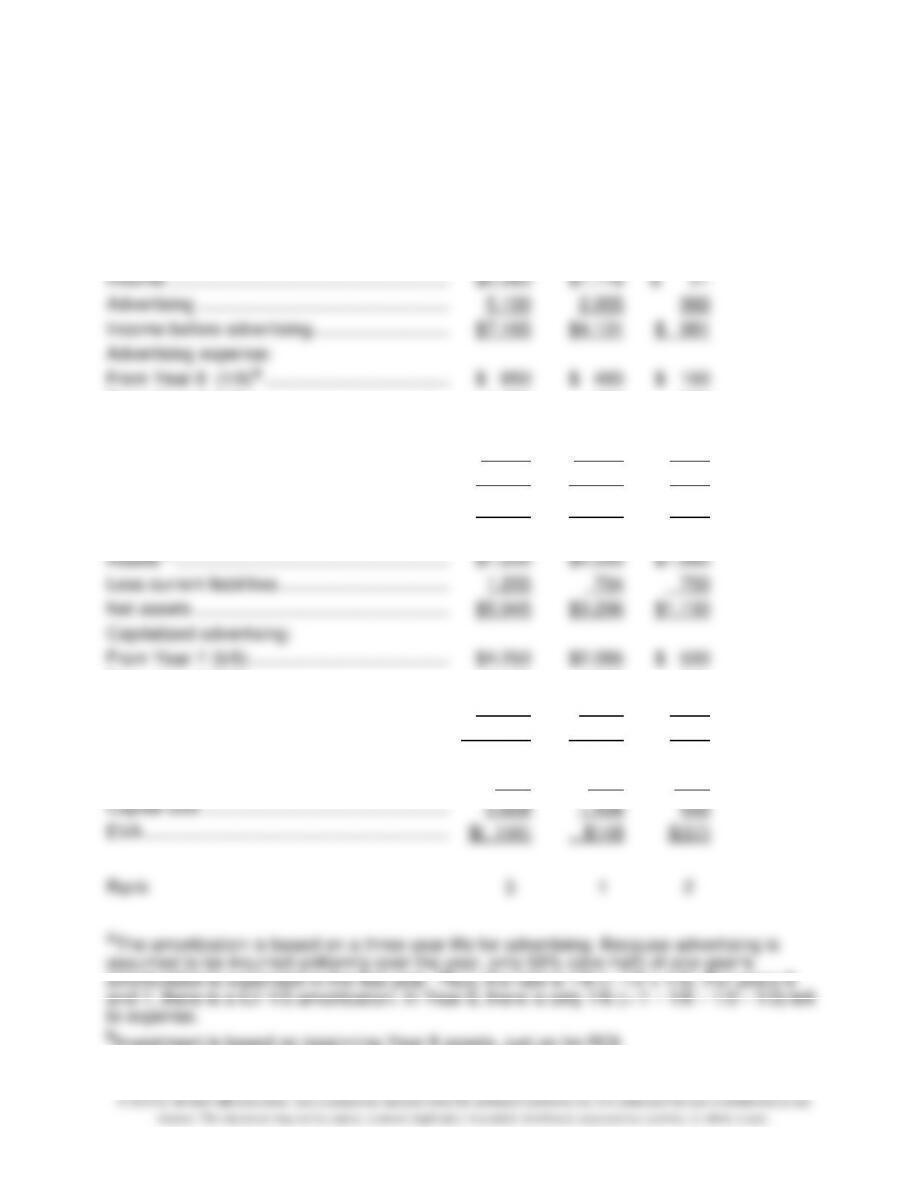
(3) EVA can be computed in many ways. This is one, in which advertising is amortized
over three years and advertising expenditures are assumed to be incurred uniformly
over the year.
($000)
Indonesia
Philippines
Vietnam
Income ………………………………………………………
$2,065
$1,176
$ 21
Advertising …………………………………………………
5,100
2,955
960
Income before advertising ……………………….….
$7,165
$4,131
$ 981
Advertising expense:
From Year 8 (1/6)a ………………………………..……
$ 850
$ 493
$ 160
From Year 7 (1/3) …………………………………..……
1,700
834
200
From Year 6 (1/3) …………………………………..……
1,400
800
183
From Year 5 (1/6) …………………………………..……
750
450
95
Total advertising expense ……………………….….
$4,700
$2,577
$638
Modified income …………………………………….……
$2,465
$1,554
$343
Assets b ………………………………………………..……
$7,200
$4,000
$1,880
Less current liabilities ……………………………..……
1,255
704
750
Net assets …………………………………………….……
$5,945
$3,296
$1,130
Capitalized advertising:
From Year 7 (5/6) …………………………………..……
$4,250
$2,085
$ 500
From Year 6 (3/6) …………………………………..……
2,100
1,200
275
From Year 5 (1/6) …………………………………..……
750
450
95
Capitalized advertising …………………………………
$ 7,100
$3,735
$870
Modified investment ……………………………….……
$13,045
$7,031
$2,000
Cost of capital ……………………………………….……
20%
20%
20%
Capital cost …………………………………………..……
2,609
1,406
400
EVA ……………………………………………………....
$( 144)
$148
$(57)
Rank
3
1
2
aThe amortization is based on a three-year life for advertising. Because advertising is
assumed to be incurred uniformly over the year, only 50% (one-half) of one–year’s
amortization is expensed in the first year. Thus, the rate is 1/6 (= 1/2 x 1/3). For years 6
and 7, there is a full 1/3 amortization. In Year 8, there is only 1/6 (= 1 – 1/6 – 1/3 – 1/3) left
to expense.
bInvestment is based on beginning Year 8 assets, just as for ROI.
Chapter 14 – Business Unit Performance Measurement
14–34
14–47. (continued)
c.
Answers will vary. Some common suggestions include dividing by population or by
income. Others suggest a subjective assessment.
d.
The following items should be included:
14–48. (60 – 90 min.) Capital Investment Analysis and Decentralized Performance
Measurement: Diversified Electronics.
a. David Parker’s new product proposal was rejected because its ROI was less than 15
percent after tax.
Project ROI
=
Profit [1.0 – Tax rate]
Investment
=
$230,000 [1.0 – .40]
$1,000,000
=
13.8%
The decision was not correct because it is inappropriate to use a short-term measure
like ROI to evaluate a long-term decision, ignoring completely the project’s cash flows.
Also, a performance measure that is suitable for measuring past performance should
not be used for an investment decision. (This is why accrual accounting might be
appropriate for evaluating past performance while cash flows are used for decision
Chapter 14 – Business Unit Performance Measurement
14–35
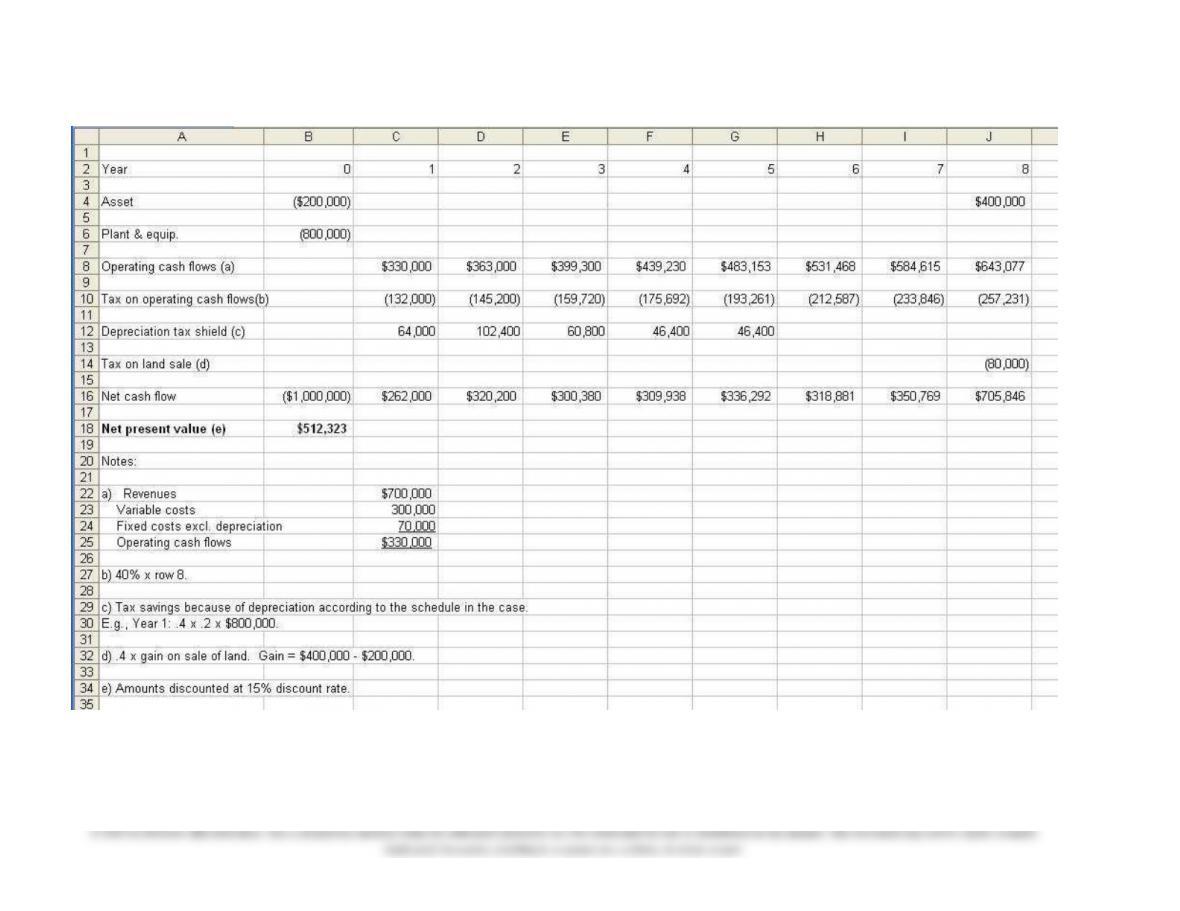
making. If the company had used DCF (Discounted Cash Flows) analysis, the results
would have been as shown in the spreadsheet on the following page.
b. It appears that Diversified Electronics’ management wanted the focus of division
1. It may not be appropriate to use one ROI performance standard for all divisions,
Chapter 14 – Business Unit Performance Measurement
14–36
14–48. (continued)
Chapter 14 – Business Unit Performance Measurement
14–37
14–48. (continued)
Possible Modification to the Present System
3. Use of gross book values and/or current values in the investment base would
standardize performance measures.
4. Corporate management could consider using EVA, if division managers have
incentives to reject projects having a return that is greater than the cost of capital
but less than currently earned ROI.