Chapter 14 – Business Unit Performance Measurement
14–21
14–39. (30 min.) Economic Value Added: Pitt, Inc.
(In thousands of dollars)
a.
Residual Income
$3,750 – 0.12 x ($4,000 + $5,000 – $1,500 – $1,250)
= $3,000
b.
($3,750 – $3,500a) – 0.12 x ($4,000 – $1,250 + $6,500)
= $(860)
a Loss on old equipment equal to its $5 million cost less $1,500,000 depreciation.
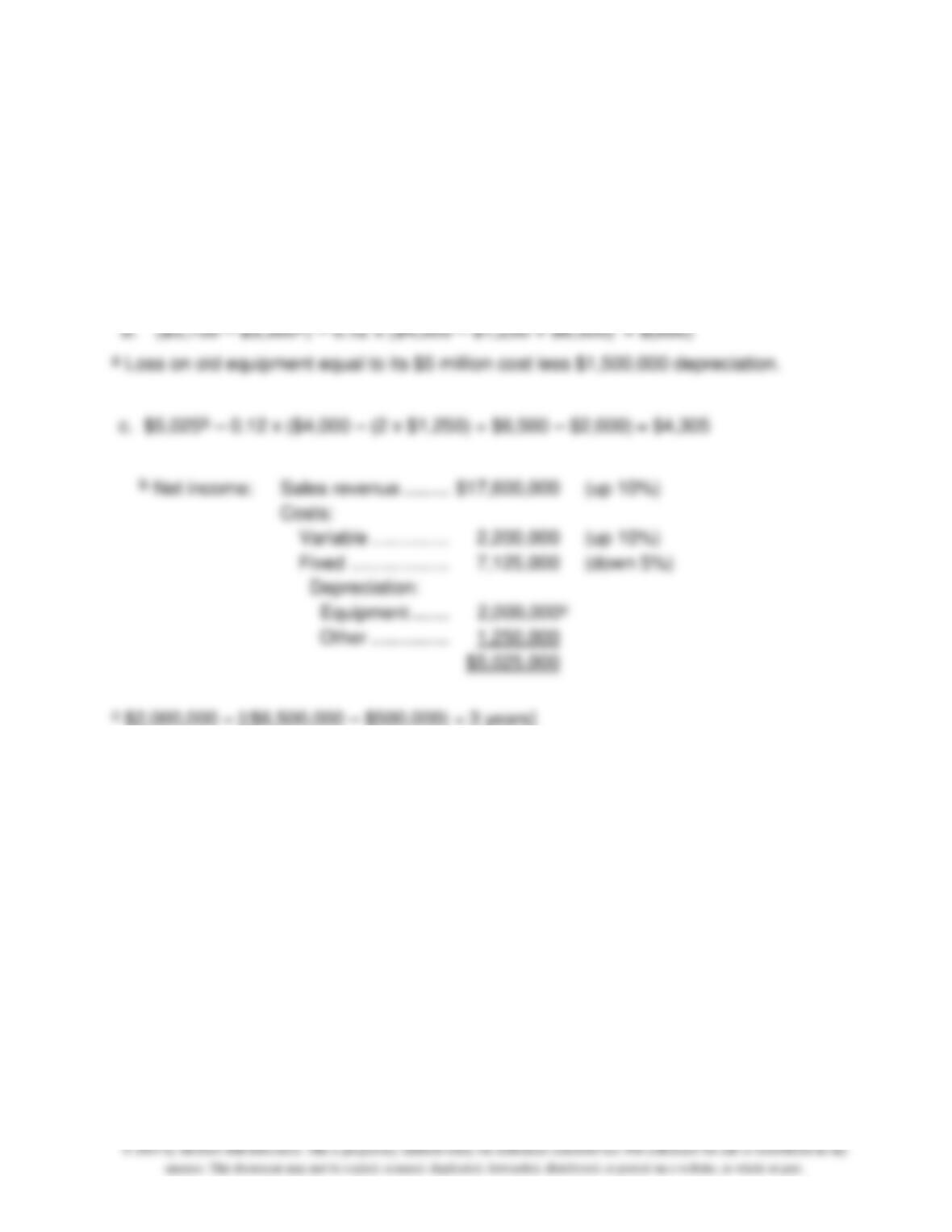
c.
$5,025b – 0.12 x ($4,000 – (2 x $1,250) + $6,500 – $2,000)
= $4,305
b Net income:
Sales revenue …………………………..
$17,600,000
(up 10%)
Costs:
Variable …………………………..
2,200,000
(up 10%)
Fixed ……………….………….
7,125,000
(down 5%)
Depreciation:
Equipment …….…………………….
2,000,000c
Other …………………………..
1,250,000
$5,025,000
c $2,000,000 = [($6,500,000 – $500,000) ÷ 3 years]
Chapter 14 – Business Unit Performance Measurement
14–40. (20 min.) Evaluate Trade-Offs In Performance Measurement and Decisions:
Pitt, Inc.
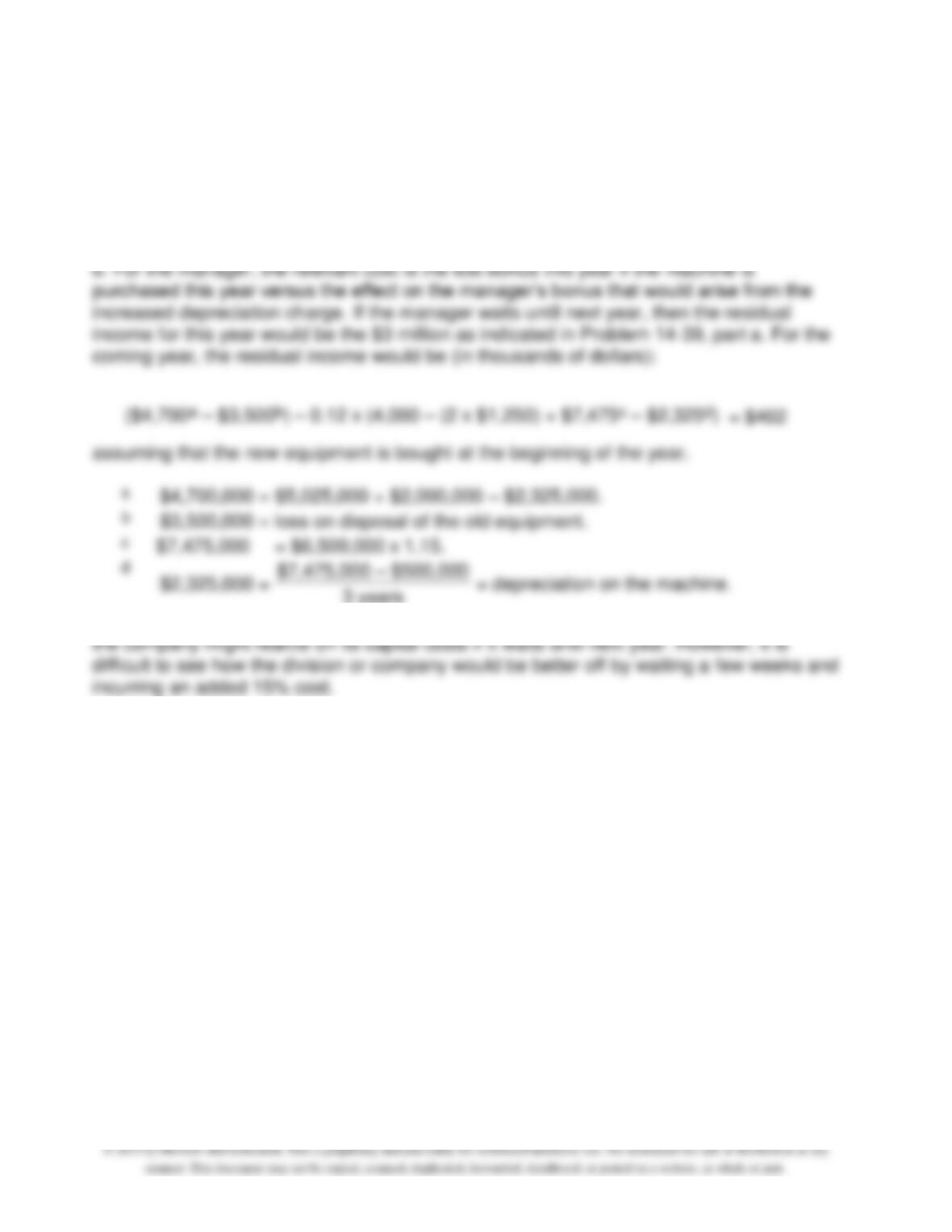
a. The machine is going to result in a positive net benefit, so he would want to acquire it
as early in the year as possible so he could obtain a full year’s benefits.
Chapter 14 – Business Unit Performance Measurement
14–23
14–41. (40 min.) ROI and Management Behavior—Ethical Issues: Asher Company.
a. Most of the specific actions that division managers can take that would result in
increasing division ROI and decreasing corporate ROI relate to investment proposals.
The division managers have the responsibility to recommend investment opportunities
for their divisions. The facts in the problem would suggest that they have been
but would depress it in the short run (start-up periods).
b. Asher’s corporate goals and goals for its divisions are not congruent. Improving the
division ROI does not automatically lead to improved corporate ROI. Certain actions
could be taken by a division that would improve its ROI, such as rejecting an
investment below its ROI but above the corporation ROI, but would not necessarily
corporation is not indifferent to cash flow because it has to invest the cash.
c. The changes should be two-fold in character. The emphasis on a single measure for
performance evaluation should be eliminated. Additional factors important to division
and corporate goals should be included.
One approach would be to establish a target ROI, which would include allowances for
the company requires attention to such items as:
new products and/or new markets.

Chapter 14 – Business Unit Performance Measurement
14–24
14–41. (continued)
d. Answers will vary. Clearly, manipulating numbers at the division level is unethical (and
probably illegal). Taking actions, for example refusing to engage in interdivisional
Chapter 14 – Business Unit Performance Measurement
14–25
14–42. (30 min.) Impact of Decisions to Capitalize or Expense on Performance
Measurement—Ethical Issues: Pharm-It.
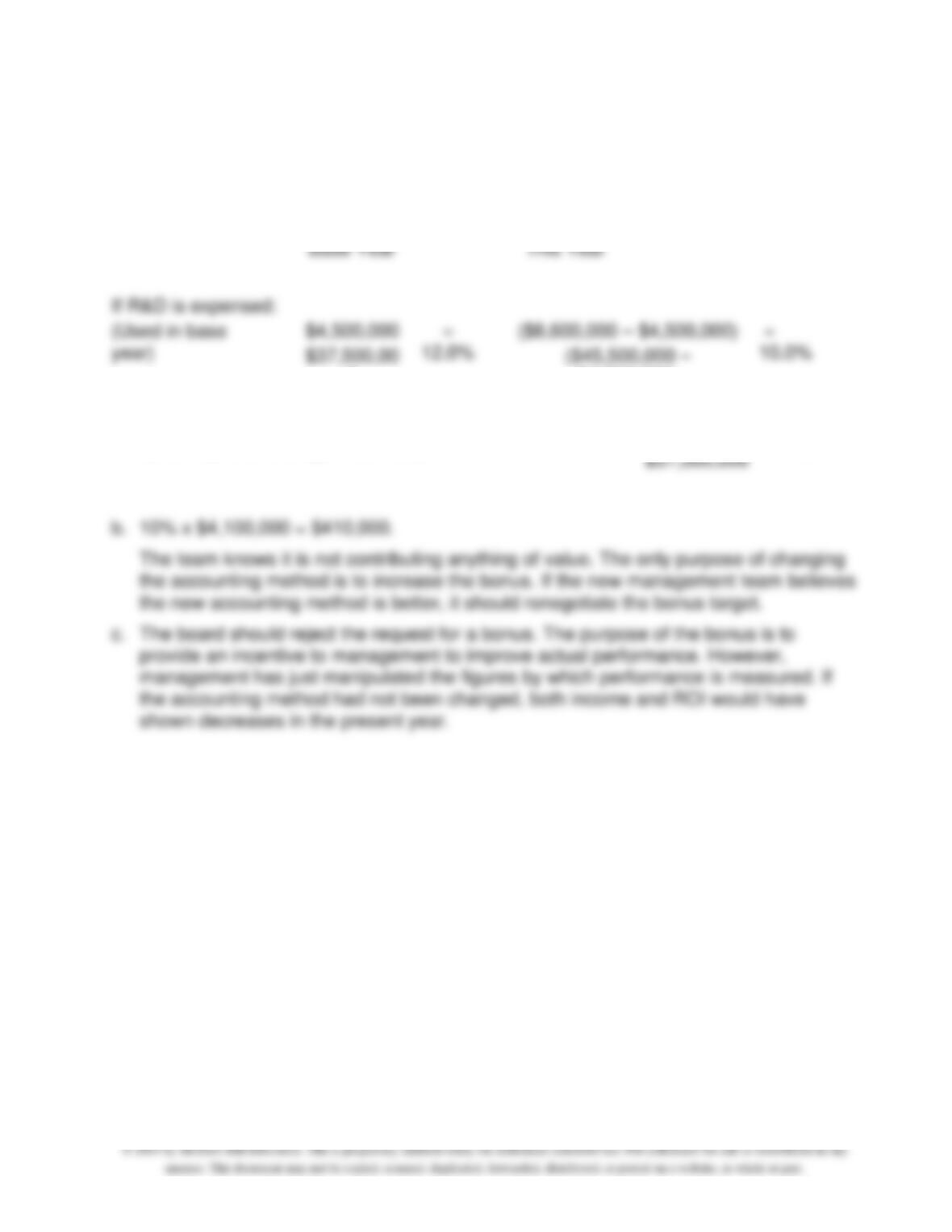
a.
ROI
Base Year
This Year
If R&D is expensed:
(Used in base
year)
$4,500,000
=
12.0%
($8,600,000 – $4,500,000)
=
10.0%
$37,500,00
0
($45,500,000 –
$4,500,000)
If R&D is capitalized:
(Used by new management team)
$8,600,000
= 22.9%
$37,500,000
b. 10% x $4,100,000 = $410,000.
The team knows it is not contributing anything of value. The only purpose of changing
the accounting method is to increase the bonus. If the new management team believes
the new accounting method is better, it should renegotiate the bonus target.
c. The board should reject the request for a bonus. The purpose of the bonus is to
provide an incentive to management to improve actual performance. However,
management has just manipulated the figures by which performance is measured. If
the accounting method had not been changed, both income and ROI would have
shown decreases in the present year.
Chapter 14 – Business Unit Performance Measurement
14–26
14–43. (30 min.) Evaluate Performance Evaluation System—Behavioral issues:
Seville Products.
a. An answer that assumed that managers should only be held responsible for what they
control would make the following arguments:
The financial reporting and performance evaluation program of Seville Products is
performance report because these costs are not under the control of the division
management. Moreover, the allocation basis is artificial in that corporate management
determines Salvador Division sales volume.
Salvador’s managers currently share some of the organization-wide risk because they
are held responsible for things they do not control. Presumably, they must be
b. Following the notion that managers should be held responsible only for what they
control, the answer to requirement b would be:
The following revisions should be made to Seville Products’s financial reporting and
performance evaluation system.
Evaluate Salvador Division as a cost center and include in the analysis only those
identified separately and treated as the final addition to division costs.
Corporate computer costs should be included on the report. The amount charged
should be based upon actual usage and a predetermined standard rate.
Provided a flexible budget is used for the actual level of production activity, a
variance analysis can be included in the evaluation. The variances should be
Chapter 14 – Business Unit Performance Measurement
14–27
CMA adapted.
14–44. (35 min.) ROI, EVA, Different Asset Bases: House Station, Inc.
a. and b.
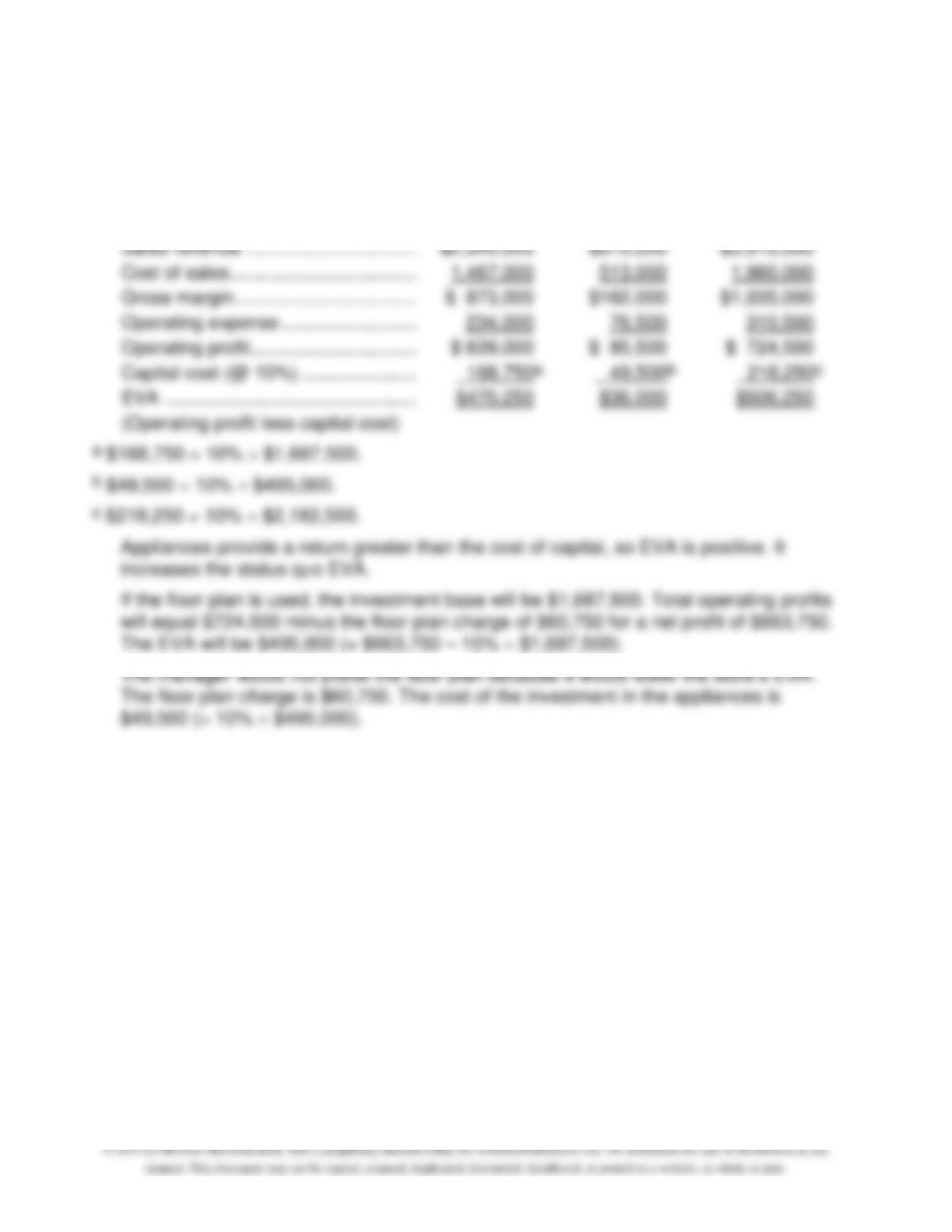
Income statements to summarize the alternatives are as follows:
Regular
Merchandise
Appliances
Total
Sales revenue ………….……………….
$2,340,000
$675,000
$3,015,000
Cost of sales …………………………..
1,467,000
513,000
1,980,000
Gross margin …………..………………
$ 873,000
$162,000
$1,035,000
Operating expense …..………………………
234,000
76,500
310,500
Operating profit ………..…………………
$ 639,000
$ 85,500
$ 724,500
Investment …………………………..
÷ $1,687,500
÷ $495,000
÷ $2,182,500
ROI ………………………..…
(a.) 37.87%
17.27%
(b.) 33.20%
Although the appliances provide a return greater than the cost of capital, it lowers the
status quo ROI.
c. If the floor plan is used, the investment base will be $1,687,500. Total operating profits
will equal $724,500 minus the floor plan charge of $60,750 for a net profit of $663,750.
The ROI will be 39.33% which is $663,750 $1,687,500.
d. The manager would prefer the floor plan because it would raise the store’s ROI above
the current ROI of 37.87%.
Chapter 14 – Business Unit Performance Measurement
14–28
14–44. (continued)
e.
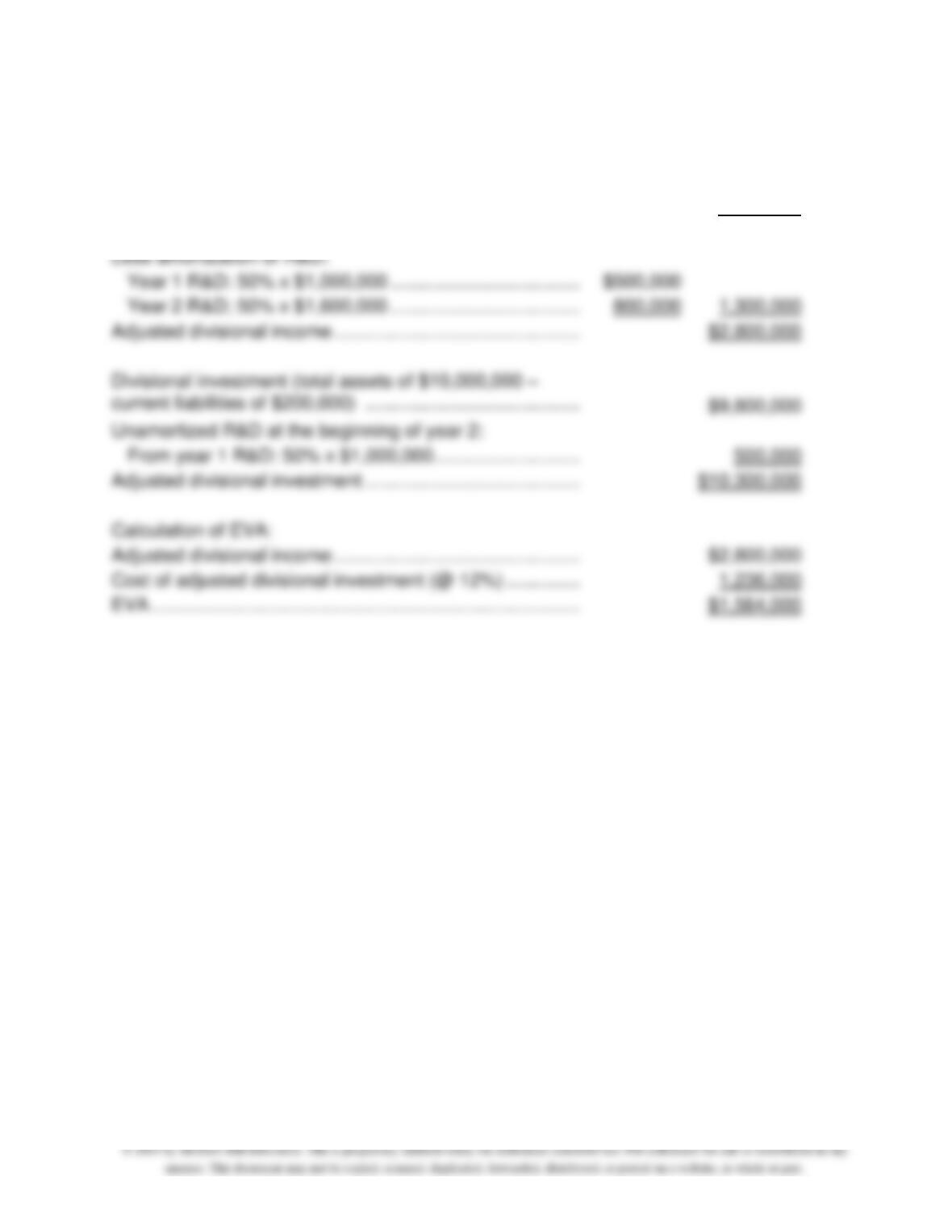
Income statements to summarize the alternatives are as follows: ($ in thousands)
Regular
Merchandise
Appliances
Total
Sales revenue …………………………………………….
$2,340,000
$675,000
$3,015,000
Cost of sales ……………………………………………….
1,467,000
513,000
1,980,000
Gross margin ……………………………..……………….
$ 873,000
$162,000
$1,035,000
Operating expense ……………………..……
234,000
76,500
310,500
Operating profit …………………………..……………….
$ 639,000
$ 85,500
$ 724,500
Capital cost (@ 10%) ………………….……….
168,750a
49,500b
218,250c
EVA ……………………………………………………….
(Operating profit less capital cost)
$470,250
$36,000
$506,250
a $168,750 = 10% $1,687,500.
b $49,500 = 10% $495,000.
c $218,250 = 10% $2,182,500.
Appliances provide a return greater than the cost of capital, so EVA is positive. It
increases the status quo EVA.
If the floor plan is used, the investment base will be $1,687,500. Total operating profits
will equal $724,500 minus the floor plan charge of $60,750 for a net profit of $663,750.
The EVA will be $495,000 (= $663,750 – 10% $1,687,500).
The manager would not prefer the floor plan because it would lower the store’s EVA.
The floor plan charge is $60,750. The cost of the investment in the appliances is
$49,500 (= 10% $495,000).
Chapter 14 – Business Unit Performance Measurement
14–29
14–45. (35 min.) Economic Value Added: Suwon Pharmaceuticals.
After-tax income ………………………………………………………
$2,500,000
Add back R&D expense for year 2 …………………………..…
1,600,000
$4,100,000
Less amortization of R&D:
Year 1 R&D: 50% x $1,000,000 ………………………………
$500,000
Year 2 R&D; 50% x $1,600,000 ………………………………
800,000
1,300,000
Adjusted divisional income …………………………..……………
$2,800,000
Divisional investment (total assets of $10,000,000 –
current liabilities of $200,000) …………………………………..
$9,800,000
Unamortized R&D at the beginning of year 2:
From year 1 R&D: 50% x $1,000,000……………………….
500,000
Adjusted divisional investment …………………………………..
$10,300,000
Calculation of EVA:
Adjusted divisional income …………………………..……………
$2,800,000
Cost of adjusted divisional investment (@ 12%) …………..
1,236,000
EVA ……………………………………………………………………….
$1,564,000