Chapter 14 – Business Unit Performance Measurement
14-1
© 2014 by McGraw-Hill Education. This is proprietary material solely for authorized instructor use. Not authorized for sale or distribution in any
manner. This document may not be copied, scanned, duplicated, forwarded, distributed, or posted on a website, in whole or part.
Chapter 14
Business Unit Performance Measurement
Solutions to Review Questions
14–1.
Divisional income is relatively easy to compute because the data exist for financial
reporting purposes. It is related to firm profit, which is of interest to the shareholders. It
14–2.
The basic computations are the same. Because divisional income is not reported, the
14–3.
ROI-type measures adjust for size. In addition, ROI measures adjust for asset usage.
14–4.
There are two common situations. First, managers might choose not to invest in
worthwhile projects because the ROI is less than the target, even though the net
14–5.
ROI is income divided by assets; residual income is income less a capital charge equal

Chapter 14 – Business Unit Performance Measurement
14-2
14–6.
EVA® makes adjustments to income and investment to correct accounting calculations
14–7.
14–8.
Chapter 14 – Business Unit Performance Measurement
14-3
Solutions to Critical Analysis and Discussion Questions
14–9.
14–10.
14–11.
Two problems usually arise here:
(a) The division might be encouraged to produce in volumes in excess of sales. In this
14–12.
Residual income measures depend upon the rate chosen for charging a division for its
investments. Different rates can yield different residual income rankings. In addition,
14–13.
The reason the division manager has been delegated the authority to make investment
decisions is that he or she has better local knowledge of the investment opportunities.
Chapter 14 – Business Unit Performance Measurement
14-4
14–14.
Residual Income (RI) is defined as follows:
Investment center operating profits—(Capital charge × Investment center assets)
The capital charge is the minimum acceptable rate of return, which will likely be
greater than the company’s cost of capital.
14–15.
The problem with using the same measure of performance for managers at all levels in
an organization is that managers’ responsibilities and decision rights differ. For
14–16.
If the division can rent and the rent does not have to be capitalized for inclusion in the
investment base, the residual income will increase so long as the income from the asset
Chapter 14 – Business Unit Performance Measurement
14-5
14–17.
ROI does not take the time value of money into account; it is computed based on
annual results. The cost of capital is a measure that does consider the time value of
14–18.
Residual income divided by divisional assets is just ROI minus the cost of capital (see
below). Therefore, while the measure allows a comparison among divisions, it suffers
14–19.
Chapter 14 – Business Unit Performance Measurement
14-6
Solutions to Exercises
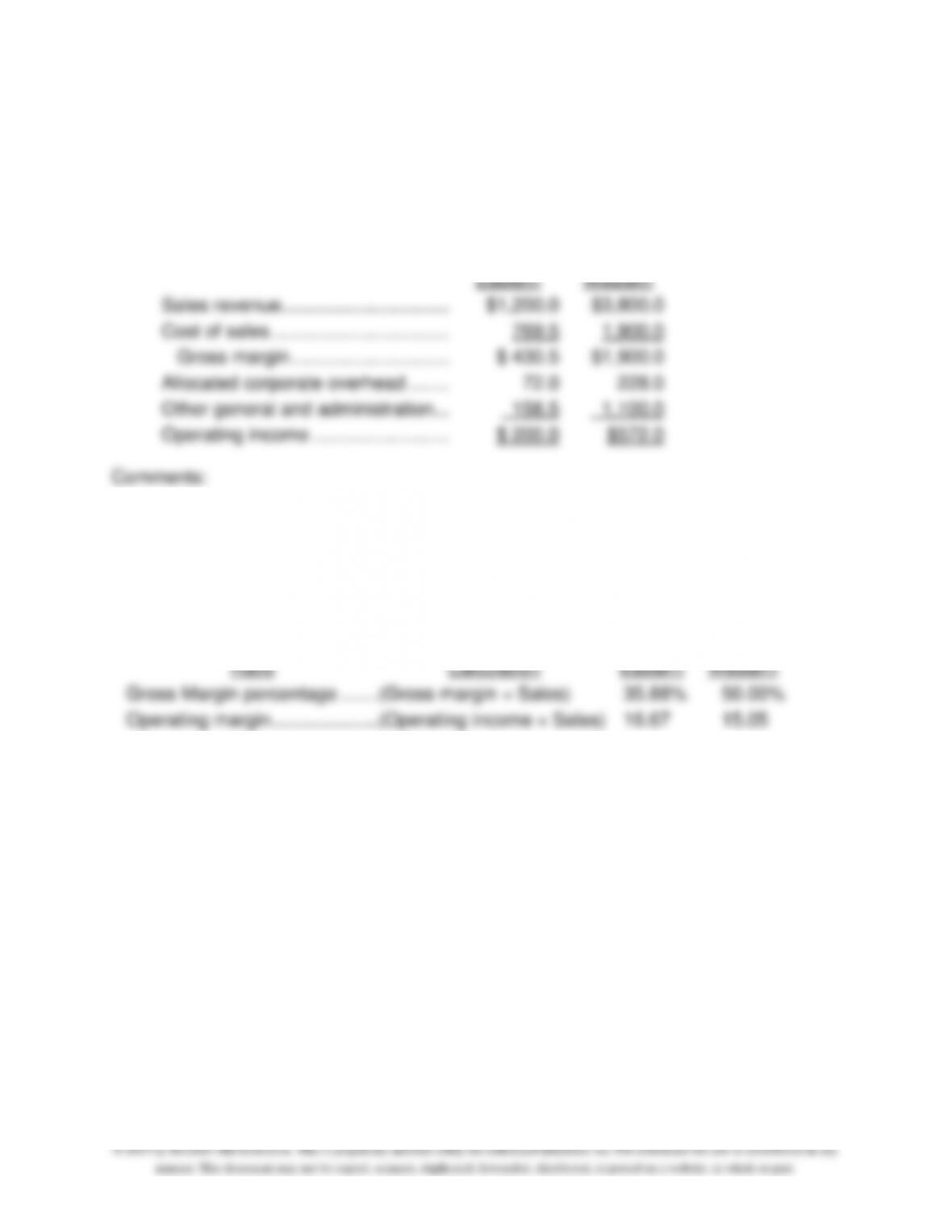
14–20. (10 min.) Compute Divisional Income: Eastern Merchants.
Operating Income
(thousands)
Eastern
Western
Sales revenue …………………………………………….
$1,200.0
$3,800.0
Cost of sales ……………………………..……………….
769.5
1,900.0
Gross margin …………………………..
$ 430.5
$1,900.0
Allocated corporate overhead ……………………….
72.0
228.0
Other general and administration….……………….
158.5
1,100.0
Operating income …………………………..
$ 200.0
$572.0
Comments:
1. Divisional income is greater in Western.
2. The gross margin percentage is higher in Western.
3. The operating margin is greater in Eastern.
4. Corporate overhead appears to be allocated on the basis of revenues (6% in both
divisions).
Ratio
Calculation
Eastern
Western
Gross Margin percentage ……..……………………
(Gross margin ÷ Sales)
35.88%
50.00%
Operating margin …………………………..
(Operating income ÷ Sales)
16.67
15.05
Chapter 14 – Business Unit Performance Measurement
14-7
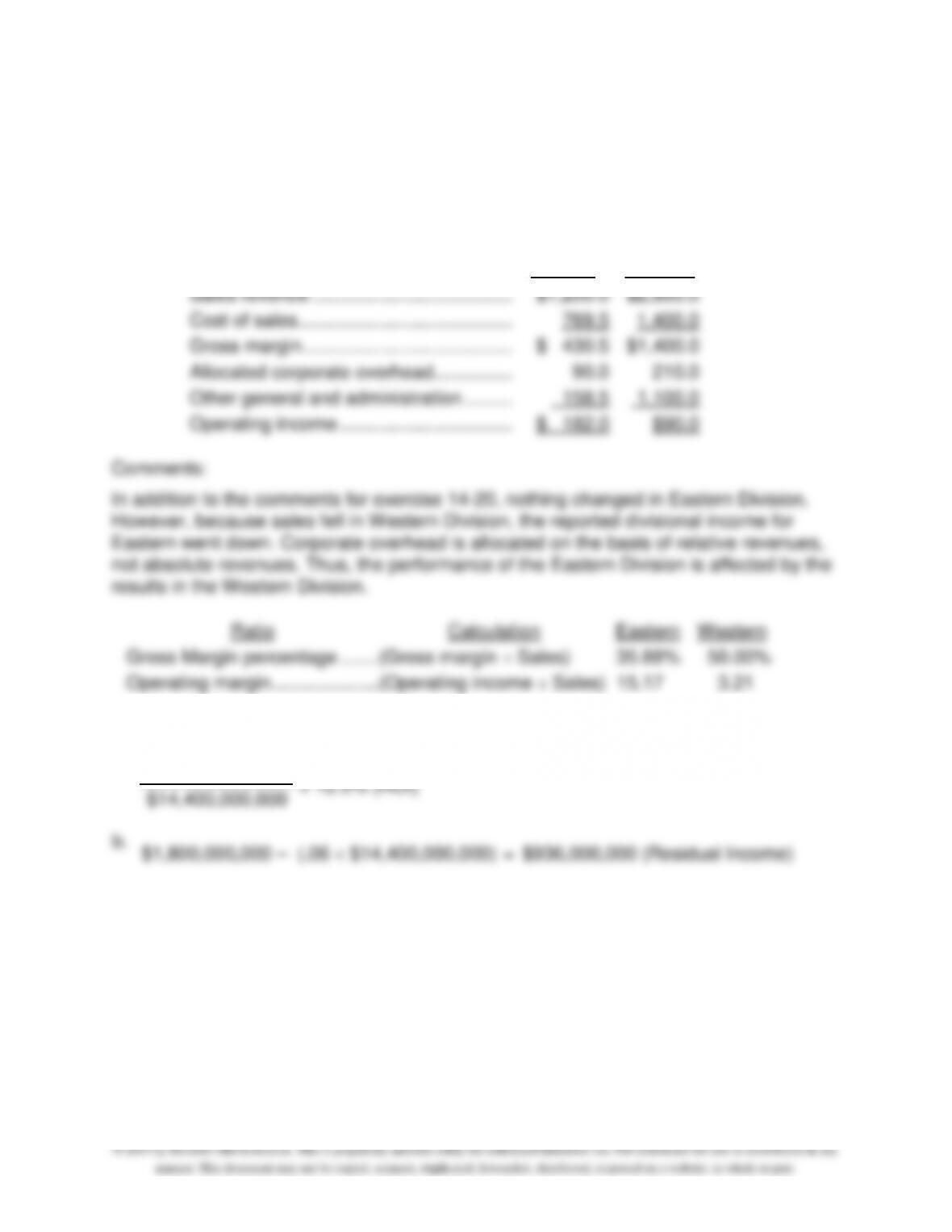
14–21. (10 min.) Compute Divisional Income: Eastern Merchants.
Operating Income
(thousands)
Eastern
Western
Sales revenue …………………………………………….
$1,200.0
$2,800.0
Cost of sales……………………………………………….
769.5
1,400.0
Gross margin …………………………………..………….
$ 430.5
$1,400.0
Allocated corporate overhead…………….………….
90.0
210.0
Other general and administration ……….………….
158.5
1,100.0
Operating income …………………………….………….
$ 182.0
$90.0
Comments:
In addition to the comments for exercise 14-20, nothing changed in Eastern Division.
However, because sales fell in Western Division, the reported divisional income for
Eastern went down. Corporate overhead is allocated on the basis of relative revenues,
not absolute revenues. Thus, the performance of the Eastern Division is affected by the
results in the Western Division.
Ratio
Calculation
Eastern
Western
Gross Margin percentage ……..……………………
(Gross margin ÷ Sales)
35.88%
50.00%
Operating margin …………………………..
(Operating income ÷ Sales)
15.17
3.21
14–22. (10 min.) Compute RI and ROI: TL Division.
a.
$1,800,000,000
= 12.5% (ROI)
$14,400,000,000
b.
$1,800,000,000 – (.06 $14,400,000,000)
=
$936,000,000 (Residual Income)
Chapter 14 – Business Unit Performance Measurement
14-8
14–23. (25 min.) ROI Versus RI.
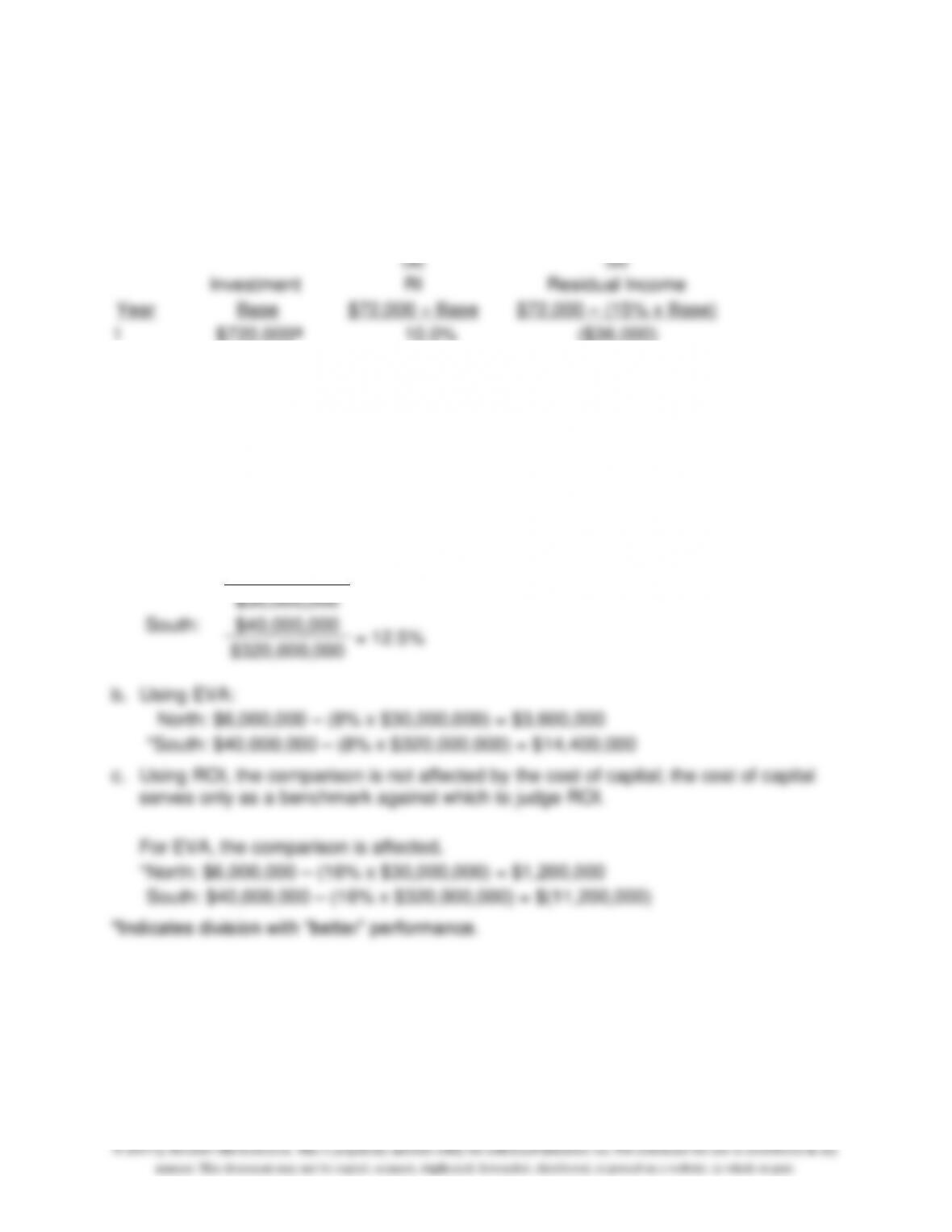
Annual income = $252,000 – ($720,000 ÷ 4 years) = $72,000
Year
Investment
Base
(a)
RI
$72,000 ÷ Base
(b)
Residual Income
$72,000 – (15% x Base)
1
$720,000a
10.0%
($36,000)
2
540,000
13.3
(9,000)
3
360,000
20.0
18,000
4
180,000
40.0
45,000
a Base decreases by annual depreciation of $180,000.
14–24. (10 min.) Compare Alternative Measures of Division Performance:
Solomons Company.
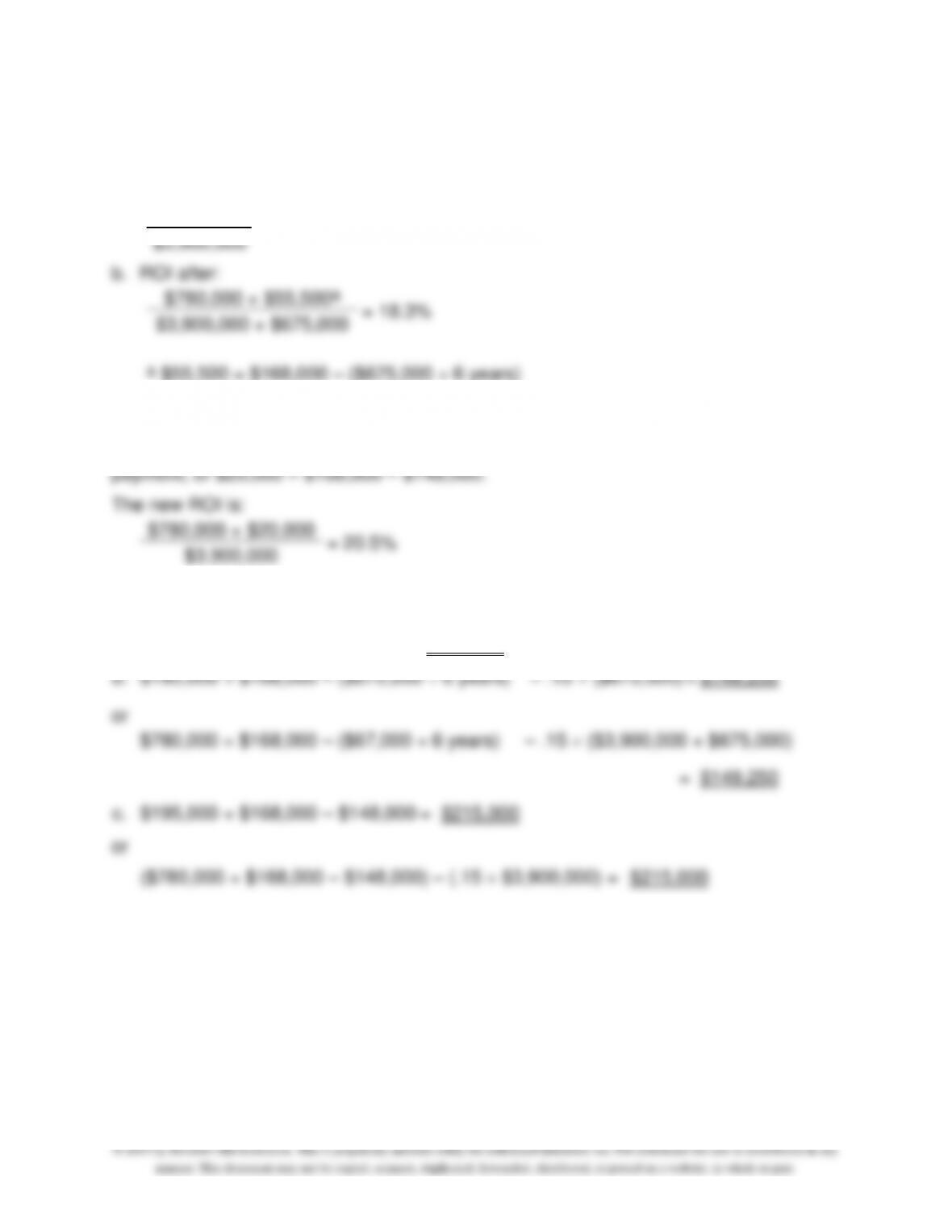
a. Using return on investment measures:
*North:
$6,000,000
= 20%
$30,000,000
South:
$40,000,000
= 12.5%
$320,000,000
b. Using EVA:
North: $6,000,000 – (8% x $30,000,000) = $3,600,000
*South: $40,000,000 – (8% x $320,000,000) = $14,400,000
c. Using ROI, the comparison is not affected by the cost of capital; the cost of capital
serves only as a benchmark against which to judge ROI.
For EVA, the comparison is affected.
*North: $6,000,000 – (16% x $30,000,000) = $1,200,000
South: $40,000,000 – (16% x $320,000,000) = $(11,200,000)
*Indicates division with “better” performance.
Chapter 14 – Business Unit Performance Measurement
14–25. (10 min.) Impact of New Asset on Performance Measures: Ocean Division.
a. ROI before:
$780,000
= 20%
$3,900,000
b. ROI after:
$780,000 + $55,500a
= 18.3%
$3,900,000 + $675,000
a $55,500 = $168,000 – ($675,000 ÷ 6 years)
14–26. (10 min.) Impact Of Leasing On Performance Measures.
With the lease, the incremental income is the operating cash flow minus the lease
= 20.5%
Chapter 14 – Business Unit Performance Measurement
14–10
14–28. (20 min.) Impact of an Asset Disposal on Performance Measures: Noonan
Division.
a. ROI before disposal:
$495,000
= 15%
$3,300,000
b. ROI after disposal:
$495,000 – $42,000
= 15.1%
$3,300,000 – $300,000
c. Residual income before disposal:
$495,000 – 0.12 x $3,300,000
= $99,000
d. Residual income after disposal:
($495,000 – $42,000) – 0.12 x ($3,300,000 – $300,000)
= $93,000
14–29. (20 min.) Impact of an Asset Disposal on Performance Measures: Noonan
Division.
a. ROI before disposal:
$495,000
= 16.5%
$3,000,000
b. ROI after disposal:
$495,000 – $42,000
= 15.1%
$3,000,000
c. Residual income before disposal:
$495,000 – 0.12 x $3,000,000
= $135,000
d. Residual income after disposal:
($495,000 – $42,000) – 0.12 x ($3,000,000)
= $93,000