Chapter 12 – Fundamentals of Management Control Systems
12-1
© 2014 by McGraw-Hill Education. This is proprietary material solely for authorized instructor use. Not authorized for sale or distribution in any
manner. This document may not be copied, scanned, duplicated, forwarded, distributed, or posted on a website, in whole or part.
Chapter 12
Fundamentals of Management Control Systems
Solutions to Review Questions
12–1.
Accounting assigns costs and revenues to “responsibility centers” that correspond to the
decision authority of managers. This allows the firm to measure performance based on the
12–2.
Although there are well-developed standards for many accounting transactions,
accounting decisions still depend on the judgment of managers. There are also many
12–3.
Top managers are viewed as agents of the Board of Directors. The Board of Directors can
be considered the agent of the shareholders.
12–4.
The division president would be the principal relative to subordinate managers.
12–5.
In many cases managers are content to take a stated salary and perform optimally.
However, in other organizations managers appear to perform better when given profit
Chapter 12 – Fundamentals of Management Control Systems
12-2
12–6.
Separation of duties helps prevent financial fraud because it limits the opportunity to
commit the fraud. When a separation of duties exists, two or more individuals must
12–7.
Local managers often have better information about local conditions. This information is
12–8.
Sales people can often influence costs by offering expedited delivery or other “extras” that
do not reduce the revenue used to determine commissions but can increase costs.
12–9.
There is a strong incentive to “find” $100,000 in income. The manager might defer
12–10.
Frequently managers will wait until near the end of the budget period to make
discretionary expenditures. Sometimes managers will use “excess” funds from one period
Chapter 12 – Fundamentals of Management Control Systems
12-3
12–11.
The service costs are being allocated on the basis of use when, in fact, some of the costs
were incurred to provide capacity. Dual rates might be established so that the capacity
12–12.
The allocation method affects the costs (and profits in a profit center) of the different units.
If a manager’s compensation depends on costs or profits, he or she will have an interest in
12–13.
Large divisions are, all other things being equal, more likely to rank in the upper half.
Hence, a large division manager would tend to receive a bonus with performance that is
12–14.
Although there is no explicit bonus, better performance is likely to lead to greater chances
for promotion (and higher salary).
12–15.
Answers will vary. There are many reasons for pay not to reflect performance. In some
Chapter 12 – Fundamentals of Management Control Systems
12-4
It is important when discussing performance measurement that the performance of the
manager(s) be separated from the performance of the company (or business unit). Often,
12–16.
The Treadway Commission listed the pressures to achieve unrealistically high, short-term
financial results and incentive systems that focus on short-term financial results as
12–17.
Two explanations for the existence of unrealistic profit objectives for division managers are
that upper management might be uninformed about the division, and that they might be
12–18.
Committing financial fraud in the current period might seem to outweigh future problems
that the fraud might cause. The perpetrator of the fraud might be promoted before the
Chapter 12 – Fundamentals of Management Control Systems
12-5
Solutions to Exercises
12–19. (15 min.) Evaluating Management Control Systems: Chama Car Detailing.
a. Based on the company’s method for measuring performance, Deana has done well.
The actual wage was $2.01 (= $15.13 – $13.12) below the target wage. Mike has not
performed well. Actual profits are $108,000 (= $745,000 – $637,000) below target
profits.
12–20. (20 min.) Evaluating Management Control Systems – Ethical Considerations:
Magnolia Manufacturing.
a. Income with the new technique will be $7.2 million (= $6 million x 1.20) or 20% above
target. Without the new technique, there will be no bonus. With the new technique,
Chapter 12 – Fundamentals of Management Control Systems
12-6
e. Kevin is responsible for manufacturing and has little direct control over sales. One
recommendation would be to evaluate Kevin based on costs relative to a budget based
12–21. (15 min.) Management Control Systems and Incentives: DC.
This problem represents part of the incentive plan of a U.S.-based international
conglomerate. This part of the incentive system was designed to focus managers on
maximizing short-term earnings.
the company wants.
As a footnote, the company also makes outright grants of stock to division managers on a
discretionary basis. This award rewards managers that top management considers to be
high performers even if their division earnings do not beat the target. Managers who get
Chapter 12 – Fundamentals of Management Control Systems
12-7
12–22. (15 min.) Management Control Systems and Incentives: Heavy.
This problem represents the change in an incentive plan at a company that
manufactures machinery and engines. In negotiating a wage contract with the
employees’ union, the company offered and the union agreed to a profit-sharing
480,000
x $30,000,000 = $18,000,000
480,000 + 320,000
Ground Service
320,000
x $30,000,000 = $12,000,000
480,000 + 320,000
400,000
x $30,000,000 = $6,000,000
400,000 + 1,600,000
Ground Service
1,600,000
x $30,000,000 = $24,000,000
400,000 + 1,600,000
Check: $30,000,000 = $6,000,000 + $24,000,000
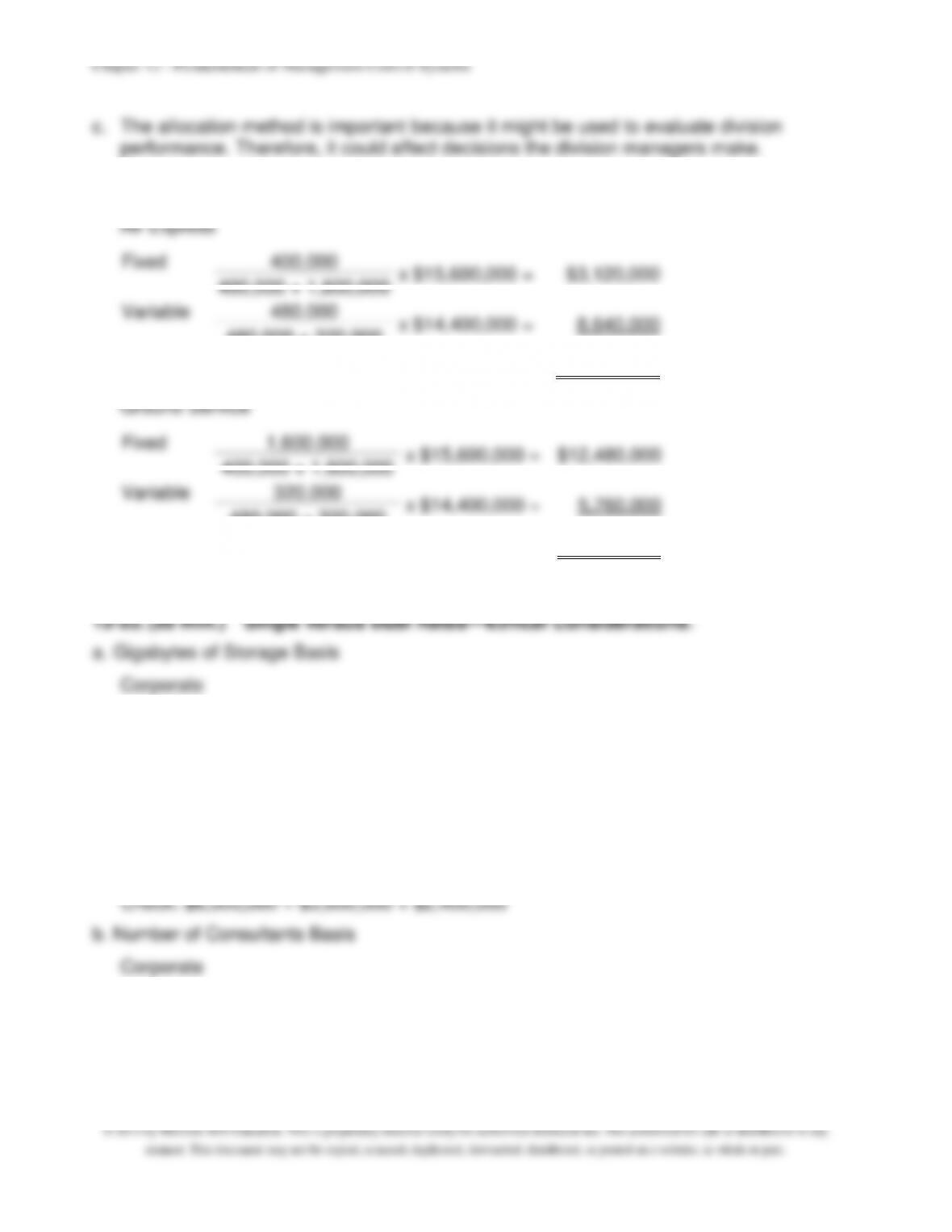
c. The allocation method is important because it might be used to evaluate division
performance. Therefore, it could affect decisions the division managers make.
12–24. (10 min.) Single versus Dual Rates: Packages-2-Go.
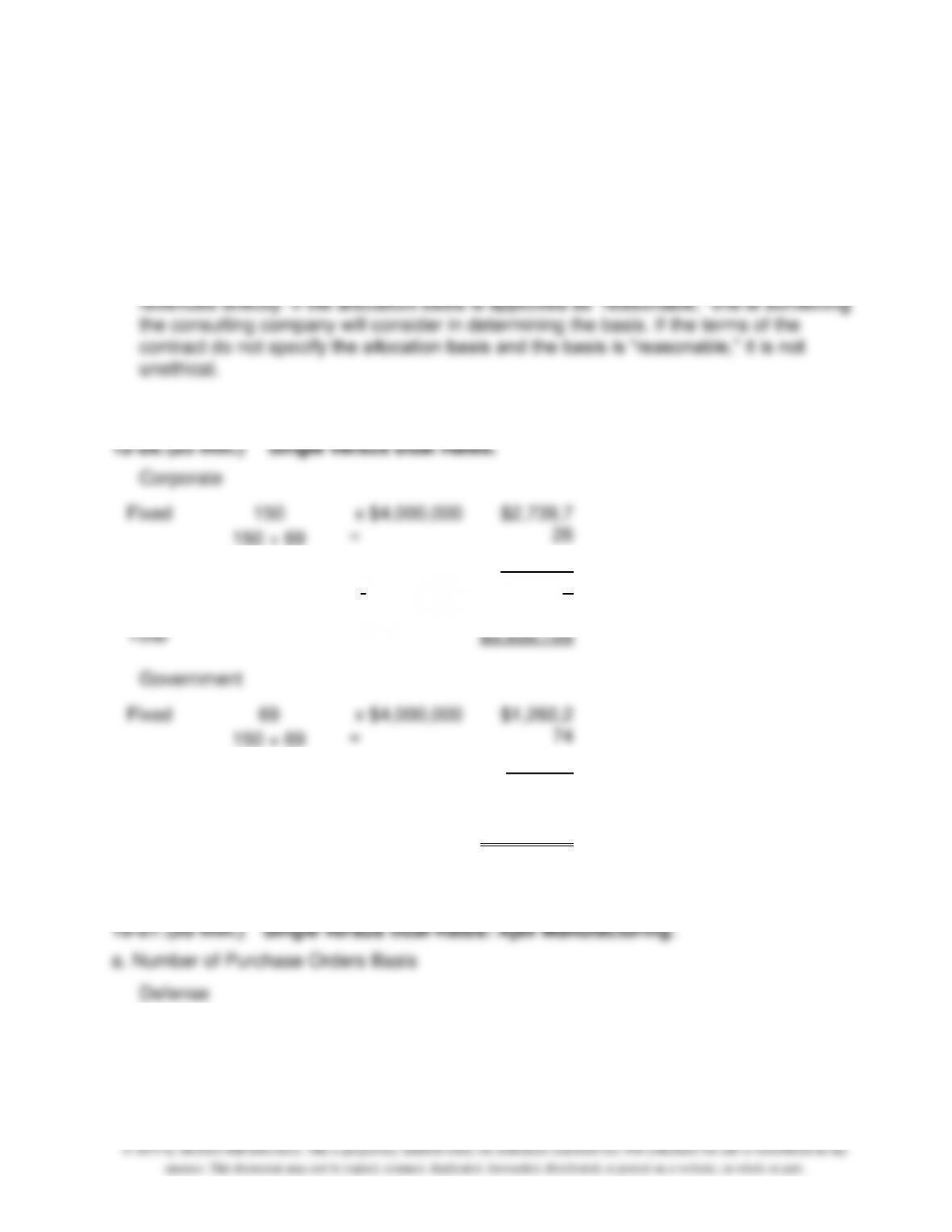
Chapter 12 – Fundamentals of Management Control Systems
Government
69
x $6,000,000 =
$1,890,41
1
150
+ 69
Check: $6,000,000 = $4,109,589 + $1,890,411
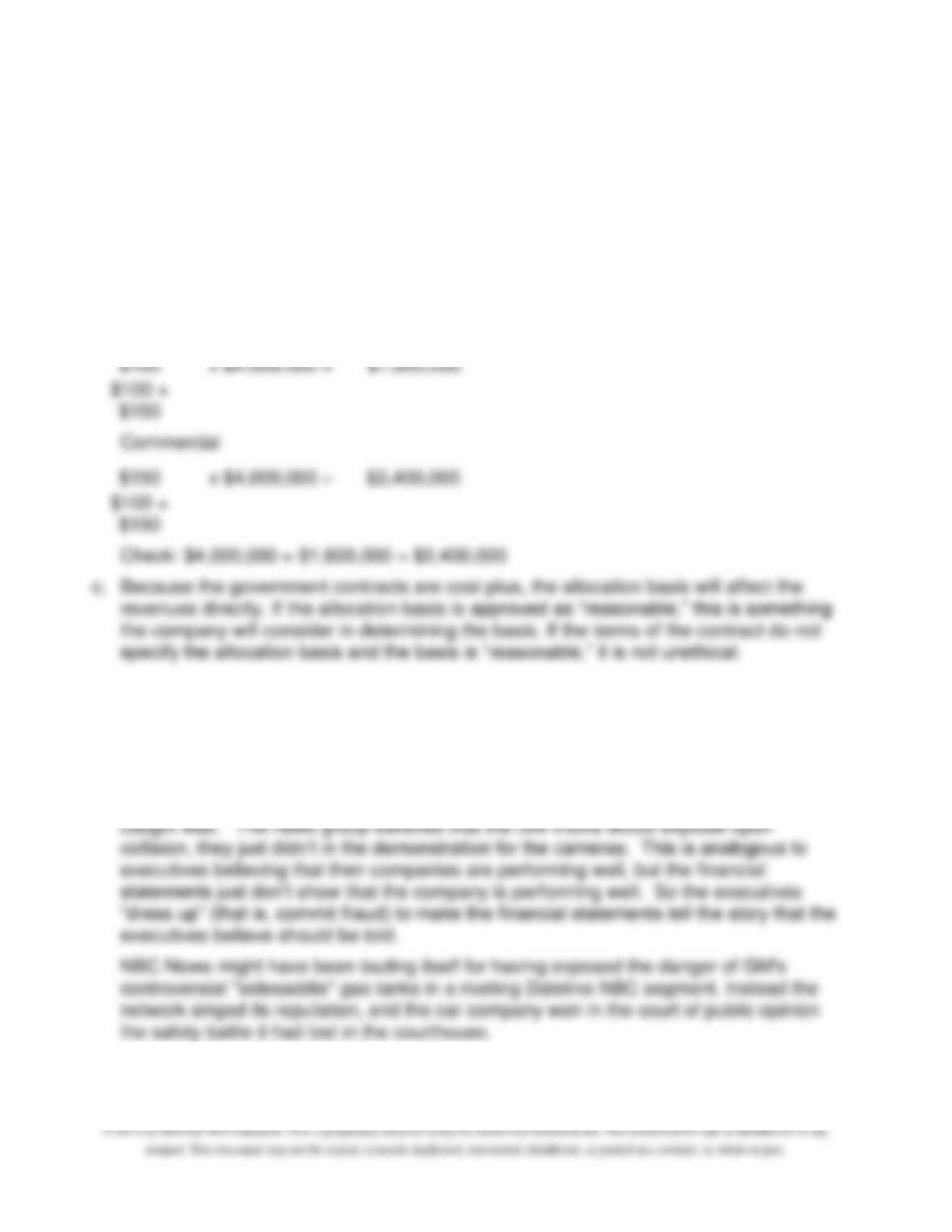
c. Because the government contracts are cost-plus, the allocation basis will affect the
x $2,000,000
x $2,000,000
Chapter 12 – Fundamentals of Management Control Systems
12–10
Commercial
20,000
x $4,000,000
=
$3,200,0
00
5,000 +
20,000
Check: $4,000,000 = $800,000 + $3,200,000
b. Dollar Amount of Purchases Basis
Defense
$100
x $4,000,000 =
$1,600,000
$100 +
$150
Commercial
$150
x $4,000,000 =
$2,400,000
$100 +
$150
Check: $4,000,000 = $1,600,000 + $2,400,000
c. Because the government contracts are cost-plus, the allocation basis will affect the
revenues directly. If the allocation basis is approved as “reasonable,” this is something
the company will consider in determining the basis. If the terms of the contract do not
specify the allocation basis and the basis is “reasonable,” it is not unethical.
12–28. (20 min.) Tone at the Top – Ethics.
This case refers to an incident reported by NBC’s Dateline. The news group
committed fraud (not financial fraud) when it rigged the GM trucks to blow up. The
executive in this case set a tone that the behavior was not the problem, but getting