Chapter 11 – Service Department and Joint Cost Allocation
11-51
© 2014 by McGraw-Hill Education. This is proprietary material solely for authorized instructor use. Not authorized for sale or
distribution in any manner. This document may not be copied, scanned, duplicated, forwarded, distributed, or posted on a website, in
whole or part.
11–62. (50 min.) Joint Costing In A Process Costing Context—Estimated Net
Realizable Value Method: West Coast Designs.
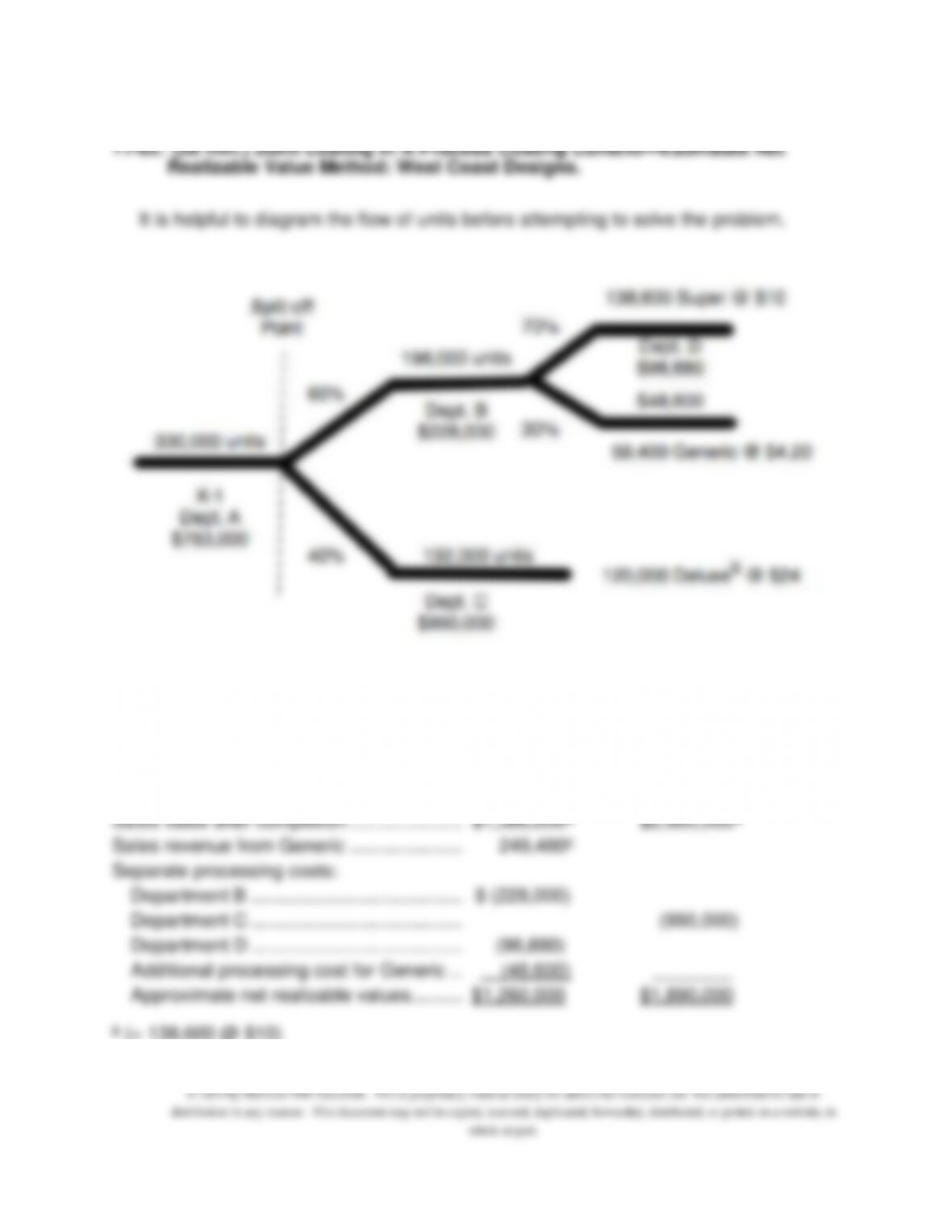
It is helpful to diagram the flow of units before attempting to solve the problem.
a120,000 good output = 132,000 ÷ 110%
The next step is to determine the net realizable values of Super and Deluxe at the first
split-off.
Super
Deluxe
Sales value after completion ………………….……..
$1,386,000a
$2,880,000b
Sales revenue from Generic ………………….……..
249,480c
Separate processing costs:
Department B …………………………………..……..
$ (228,000)
Department C …………………………………..……..
(990,000)
Department D …………………………………..……..
(98,880)
Additional processing cost for Generic ………..
(48,600)
________
Approximate net realizable values ……….……..
$1,260,000
$1,890,000
a (= 138,600 @ $10)
11-52
© 2014 by McGraw-Hill Education. This is proprietary material solely for authorized instructor use. Not authorized for sale or
distribution in any manner. This document may not be copied, scanned, duplicated, forwarded, distributed, or posted on a website, in
whole or part.
b (= 120,000 @ $24)
c (= 59,400 @ $4.20)
Chapter 11 – Service Department and Joint Cost Allocation
11-53
11–62. (continued)
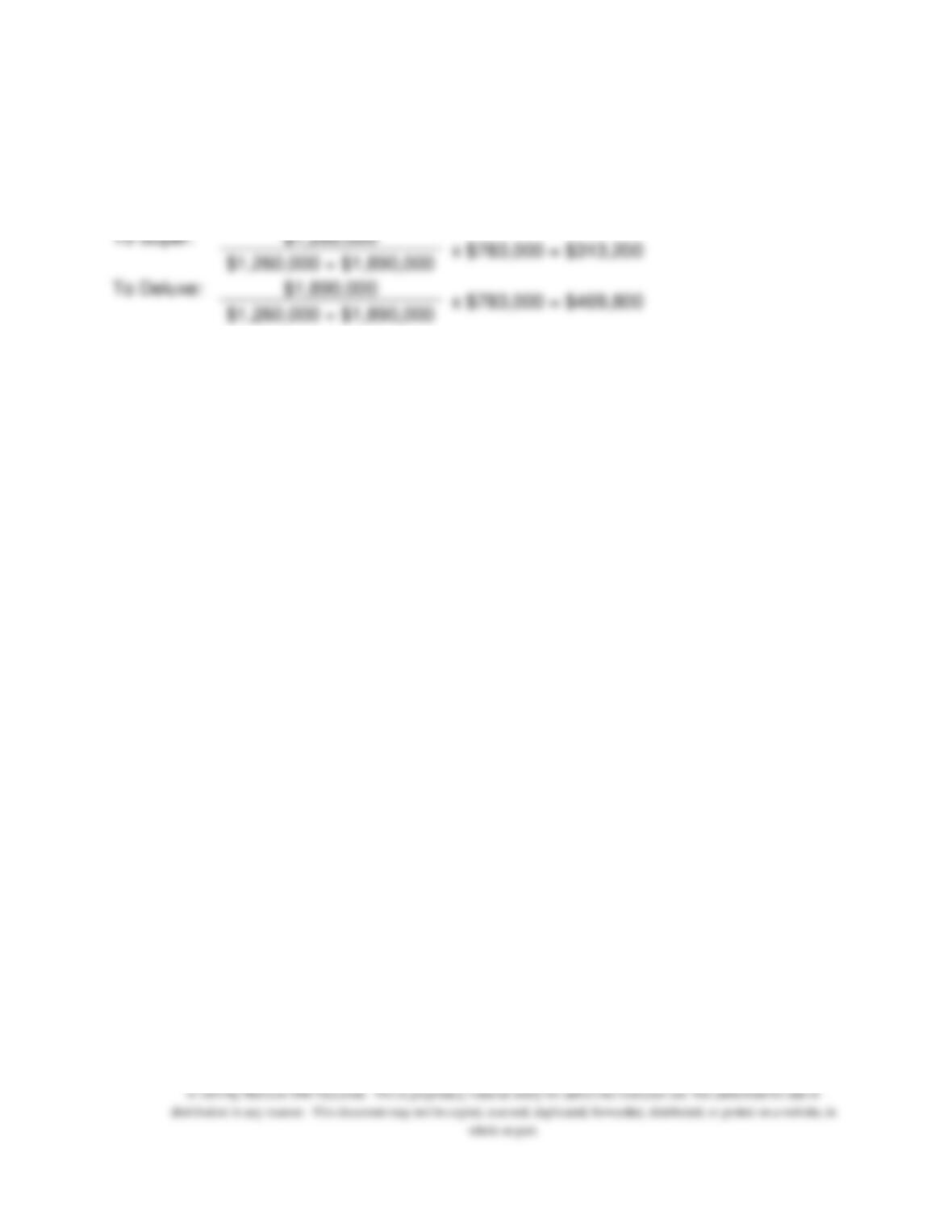
Cost allocation:
To Super:
$1,260,000
x $783,000 = $313,200
$1,260,000 + $1,890,000
To Deluxe:
$1,890,000
x $783,000 = $469,800
$1,260,000 + $1,890,000
Chapter 11 – Service Department and Joint Cost Allocation
11-54
11–63. (35 min.) Find Maximum Input Price—Estimated Net Realizable Value
Method: Ticon Corporation.
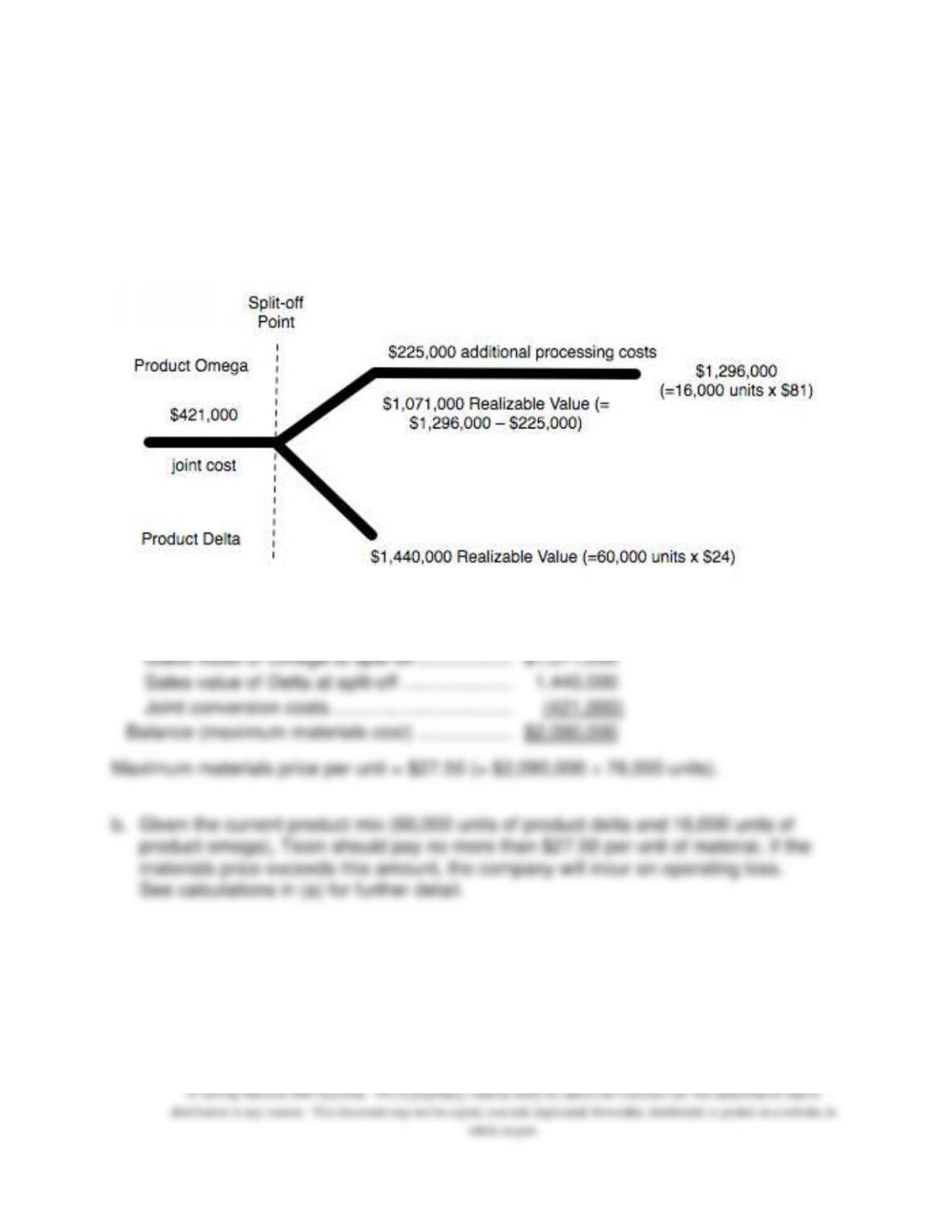
a. A diagram of the operation appears as follows:
The total allowable materials costs would then be:
Sales value of Omega at split-off ………………..
$1,071,000
Sales value of Delta at split-off …………………..
1,440,000
Joint conversion costs ……………………………....
(421,000)
Balance (maximum materials cost) ………………..
$2,090,000
Maximum materials price per unit = $27.50 (= $2,090,000 ÷ 76,000 units).
b. Given the current product mix (60,000 units of product delta and 16,000 units of
product omega), Ticon should pay no more than $27.50 per unit of material. If the
materials price exceeds this amount, the company will incur an operating loss.
See calculations in (a) for further detail.
Chapter 11 – Service Department and Joint Cost Allocation
11-55
11–64. (30 min.) Effect Of By-Product versus Joint Cost Accounting: Black
Corporation.
a. (1) Accounted for as a joint product.
Allocation:
Xy–1:
60%
x
$731,000
=
$438,600
Xy–2:
30%
x
$731,000
=
$219,300
Xy–3:
10%
x
$731,000
=
$ 73,100
(2) Allocated for as a by-product.
Allocation:
Xy–1:
60% ÷ (60% + 30%)
x
$655,800a
=
$437,200
Xy–2:
30% ÷ (60% + 30%)
x
$655,800a
=
$218,600
Xy–3:
$75,200, the value of Xy-3 is assigned to Xy-3.
a $655,800 = $731,000 – $75,200 net realizable value of Xy-3.
b. The net realizable value of the by-product (Xy-3) reduces the joint costs of the other
two products. Thus, an amount of joint cost equal to the net realizable value of Xy–3
is essentially allocated to the by-product; there is no need to allocate additional joint
costs to it.
Chapter 11 – Service Department and Joint Cost Allocation
11-56
11–65. (30 min.) Joint Cost Allocation and Product Profitability: Western Woods,
Inc.
Grade A:
4,000
x $17,120 =
$4,280
4,000 + 12,000
Grade B:
12,000
x $17,120 =
12,840
4,000 + 12,000
$17,120
b. Allocation on the basis of market value
Grade A:
$28,000
x $17,120 =
$14,980
$28,000 + $4,000
Grade B:
$4,000
x $17,120 =
2,140
$28,000 + $4,000
$17,120
c. It is not possible to determine which product is more profitable. One cannot be
produced without the other—hence only the profitability of the total output is
relevant. Use of the physical quantities measured in Part (a) would suggest that
there is a loss on Grade-B lumber. This loss would be calculated as:
Revenue from Grade-B Lumber …..
$ 4,000
Allocated cost of logs ………………….
(12,840)
Loss on Grade-B lumber …………….
$(8,840)
However, if Grade-B lumber were not sold, the $4,000 revenue would be lost but
total costs would be unchanged. Hence, net income would fall if this “losing” product
were discontinued. This illustrates the potentially misleading effects of cost
allocations.
Chapter 11 – Service Department and Joint Cost Allocation
Solution to Integrative Case
11–66. (60 min.) Effect of Cost Allocation on Pricing and Make versus Buy
Decisions: Ag-Coop
Chapter 11 – Service Department and Joint Cost Allocation
11-58
11-66. (continued)
b. Total joint cost incurred in processing 25,000 lbs. of input =
Greenup …………………………..
25,000
x
.5
=
12,500
Maintane …………..………………
25,000
x
.3
=
7,500
Winterizer………….……………….
25,000
x
.2
=
5,000
25,000
Sales Price
per lb.
Selling Cost/lb.
(20% of Sales
Price)
Net
Realizable
Value per lb.
Number
of Lbs.
Total NRV
Greenup …..………………………
$10.50
$2.10
$8.40
12,500
$105,000
Maintane ….……………………….
9.00
1.80
7.20
7,500
54,000
Winterizer…………………………..
10.40
2.08
8.32
5,000
41,600
$200,600
Allocated cost per lb. of Greenup
=
$118,750
x
($105,000 ÷ $200,600)
12,500 lbs.
=
$4.97
Allocated cost per lb. of Maintane
=
$118,750
x
($54,000 ÷ $200,600)
7,500 lbs.
=
$4.26
Allocated cost pound lb. of Winterizer
=
$118,750
x
($41,600 ÷ $200,600)
5,000 lbs.
=
$4.93
Chapter 11 – Service Department and Joint Cost Allocation
11-59
11-66. (continued)
c. The profit under current production schedule A is:
Total net realizable value
=
$200,600
(from b above)
Less joint costs incurred
118,750
$ 81,850
Outputs under alternative production schedule B:
Product
Output Mix
Unit kwh Usage
Usage per 100 Lbs. of Input
Greenup
60
%
32
1,920
Maintane
10
20
200
Winterizer
30
40
1,200
3,320
Pounds of input processed =
750,000 kwh
= 22,590 pounds
3,320 kwh per hundred pounds
Amount of Greenup produced
=
22,590
x
.6
=
13,554
Amount of Maintane produced
=
22,590
x
.1
=
2,259
Amount of Winterizer produced
=
22,590
x
.3
=
6,777
22,590
The margin under alternate production schedule B is:
($8.40 x 13,554) + ($7.20 x 2,259) + ($8.32 x 6,777) – ($1.50 x 22,590) – $81,250