Chapter 11 – Service Department and Joint Cost Allocation
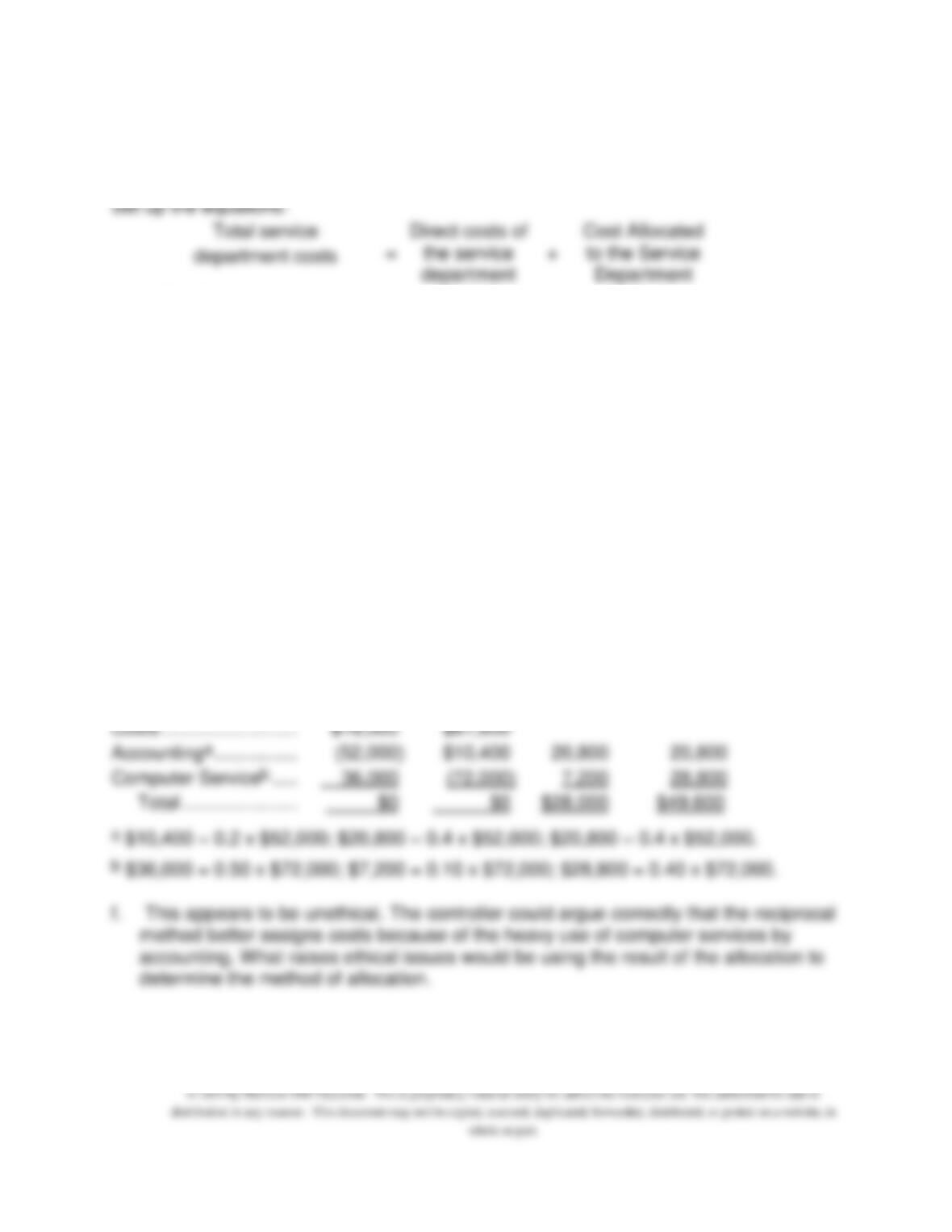
11–54. (continued)
e. Reciprocal Method:
Chapter 11 – Service Department and Joint Cost Allocation
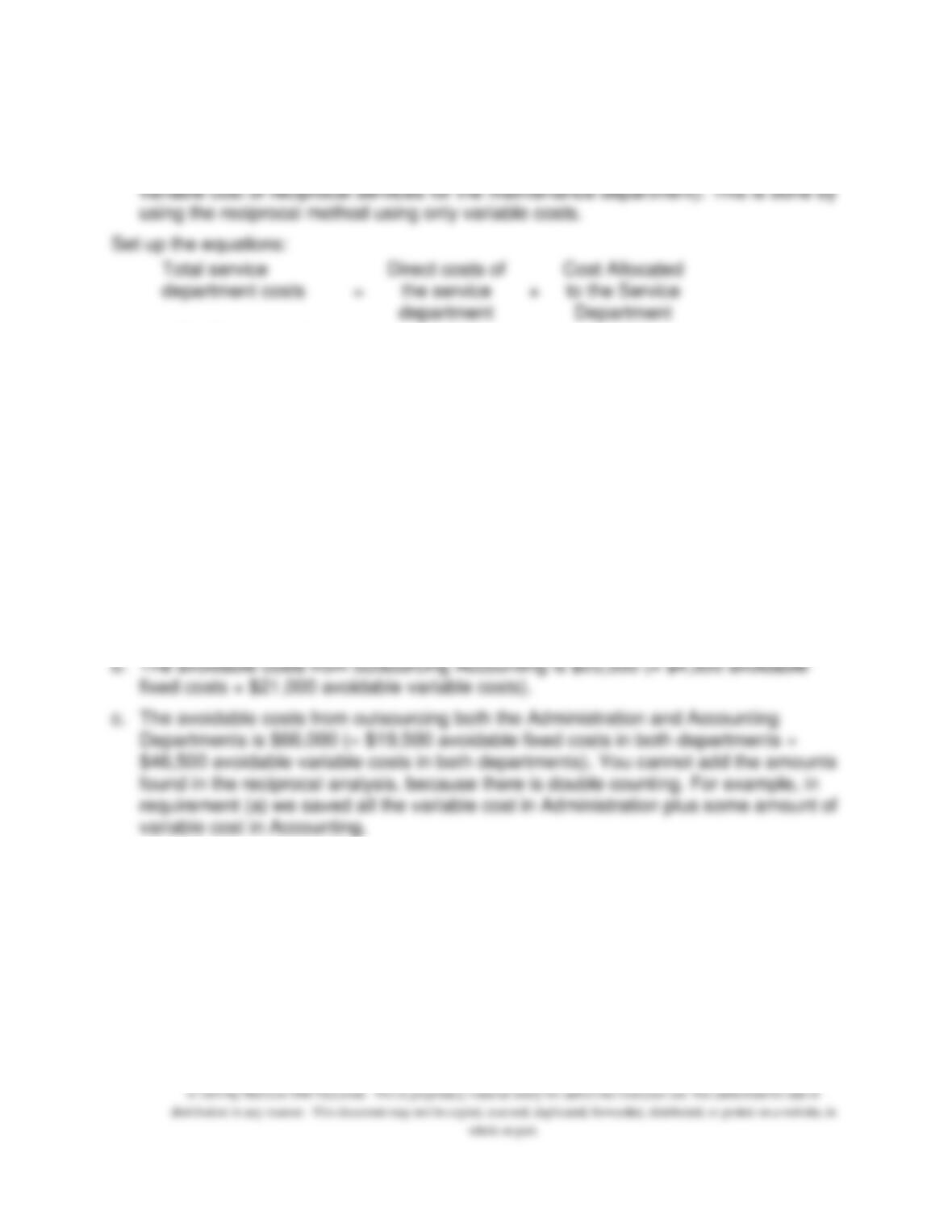
11–55. (45 min.) Reciprocal Cost Allocation – Outsourcing a Service Department:
GB Service Corp.
a. To determine the avoidable cost, first determine the variable cost (including the
Chapter 11 – Service Department and Joint Cost Allocation
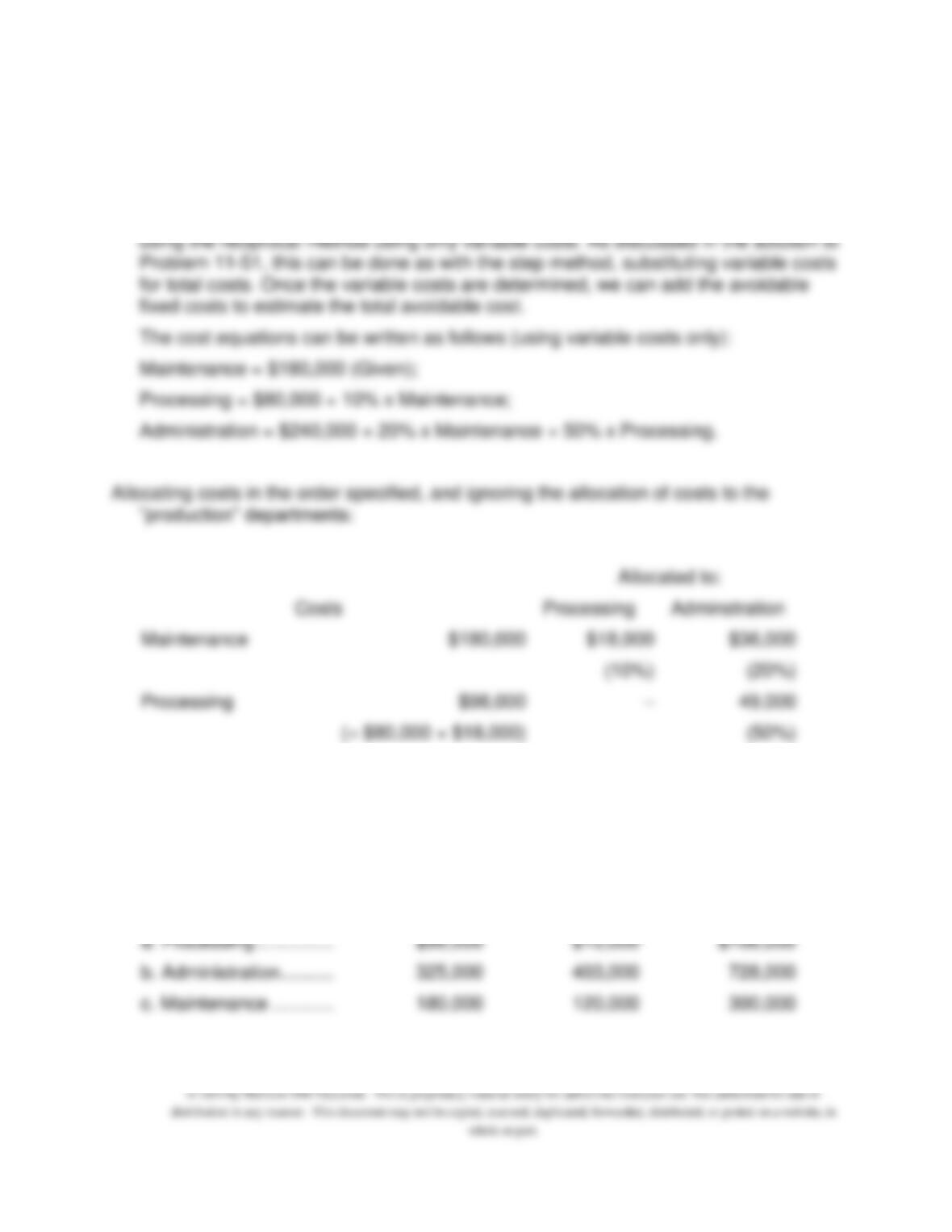
11–56. (45 min.) Reciprocal Cost Allocation – Outsourcing a Service Department:
Manzano Bank.
To determine the avoidable cost, first determine the variable cost (including the
variable cost of reciprocal services for the maintenance department). This is done by
Chapter 11 – Service Department and Joint Cost Allocation
11-44
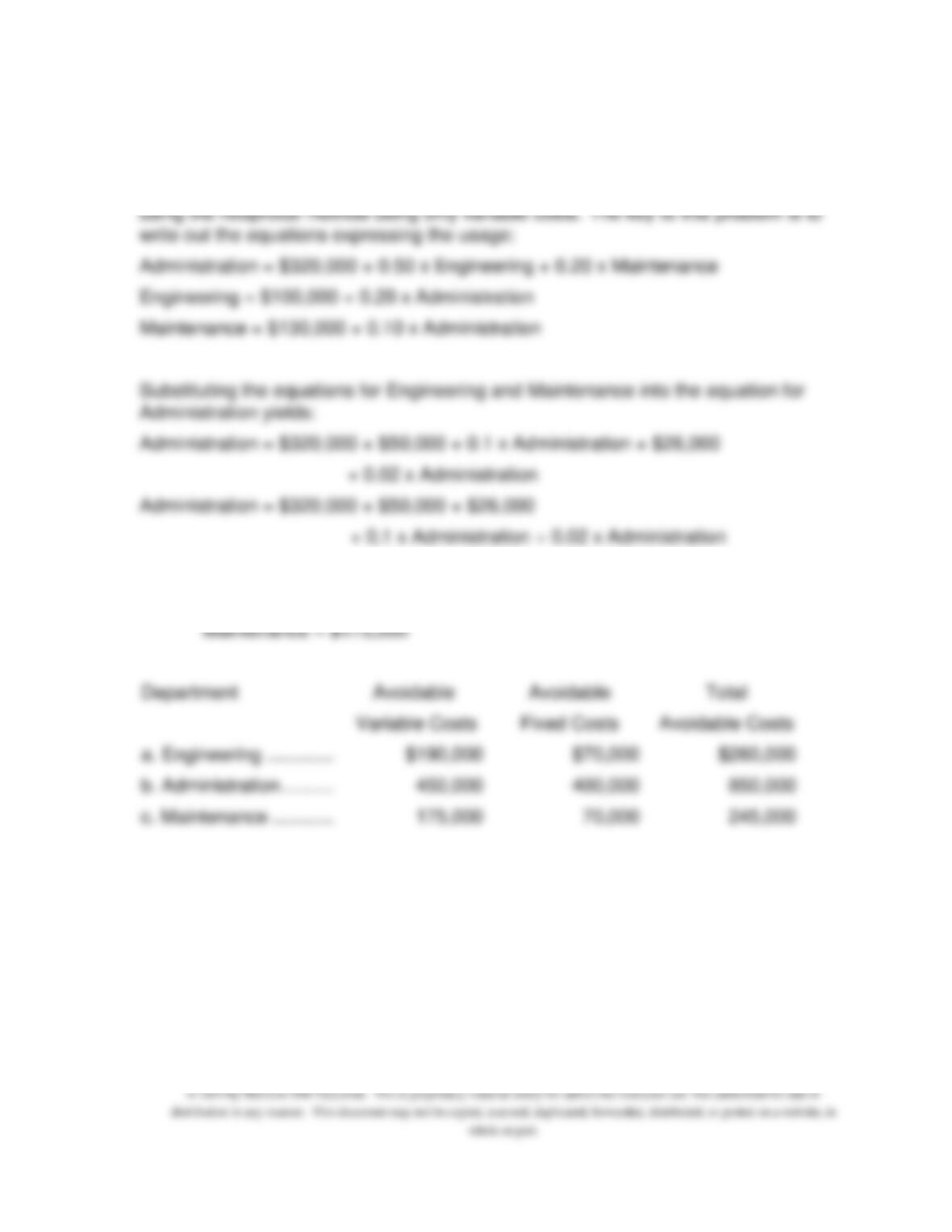
11–57. (45 min.) Reciprocal Cost Allocation – Outsourcing a Service Department:
Farmington Components.
To determine the avoidable cost, first determine the variable cost (including the
variable cost of reciprocal services for the maintenance department). This is done by
0.88 x Administration = $396,000
Solving, Administration = $450,000; Engineering = $190,000; and
Chapter 11 – Service Department and Joint Cost Allocation
11–58. (45 min.) Net Realizable Value of Joint Products: Toledo Chemical
Company.
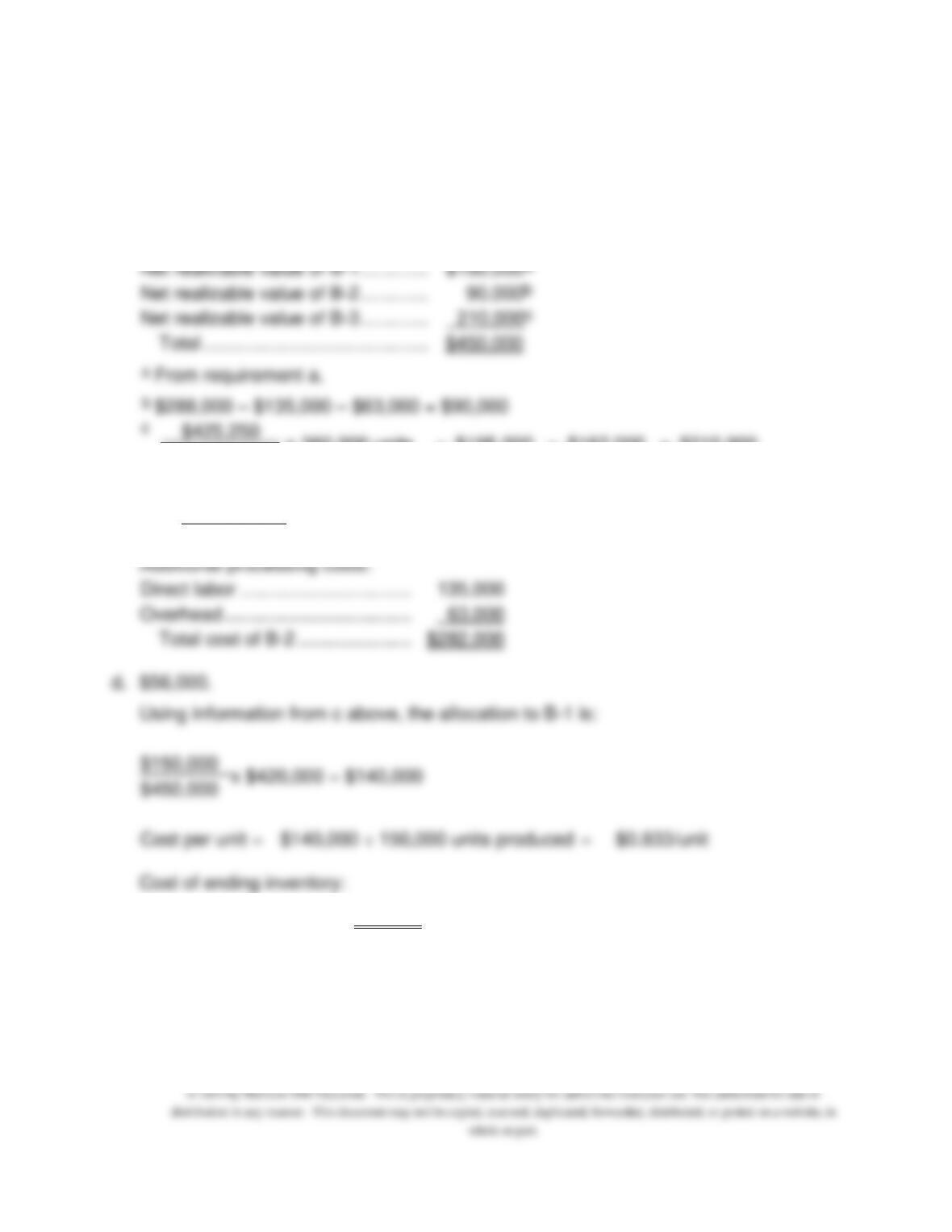
a. $150,000
Chapter 11 – Service Department and Joint Cost Allocation
11-46
11-58. (continued)
c. $282,000.
Net realizable value of B-1 ………….……………….
$150,000a
Net realizable value of B-2 ………….……………….
90,000b
Net realizable value of B-3 ………….……………….
210,000c
Total …………………………………….………………..
$450,000
a From requirement a.
b $288,000 – $135,000 – $63,000 = $90,000
c
$425,250
x
360,000 units
–
$195,000
–
$162,000
=
$210,000
270,000 units
Allocation of joint costs to B-2:
$90,000
x $420,000 =
$ 84,000
$450,000
Additional processing costs:
Direct labor …………………………….………………….
135,000
Overhead ……………………………….………………….
63,000
Total cost of B-2 …………………..………
$282,000
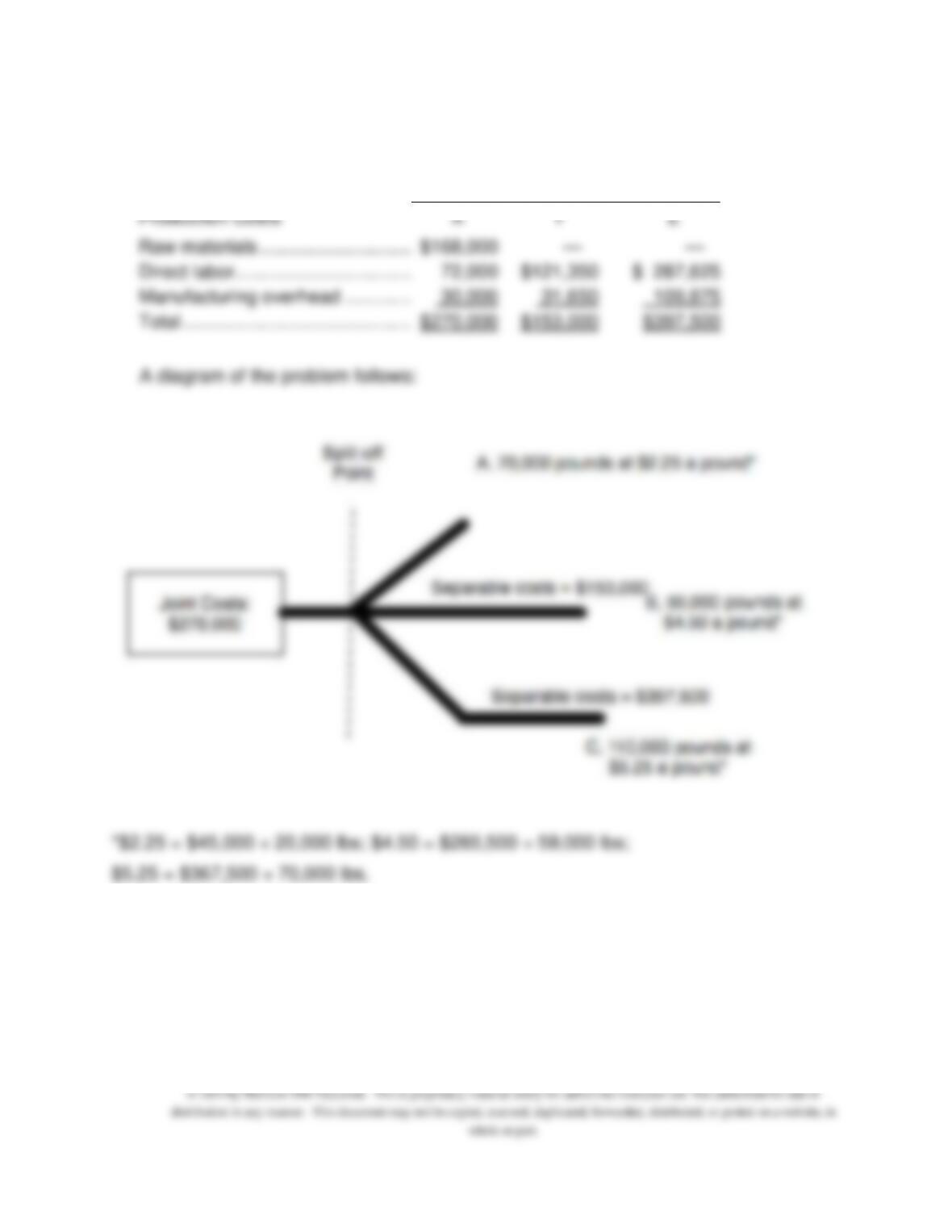
d. $56,000.
Using information from c above, the allocation to B-1 is:
$150,000
x $420,000 = $140,000
$450,000
Cost per unit
=
$140,000 ÷ 150,000 units produced
=
$0.933/unit
Cost of ending inventory:
60,000 units x $0.933
=
$56,000 (adjusted for rounding)
Chapter 11 – Service Department and Joint Cost Allocation
11-47
11–59. (40 min.) Estimated Net Realizable Value and Effects Of Processing
Further: Fletcher Fabrication, Inc.
a.
Departments
Production Costs
X
Y
Z
Raw materials ………………………..…
$168,000
—
—
Direct labor …………………………….…………………..
72,000
$121,350
$ 287,625
Manufacturing overhead ………….……………….
30,000
31,650
109,875
Total ……………………………………..………………..
$270,000
$153,000
$397,500
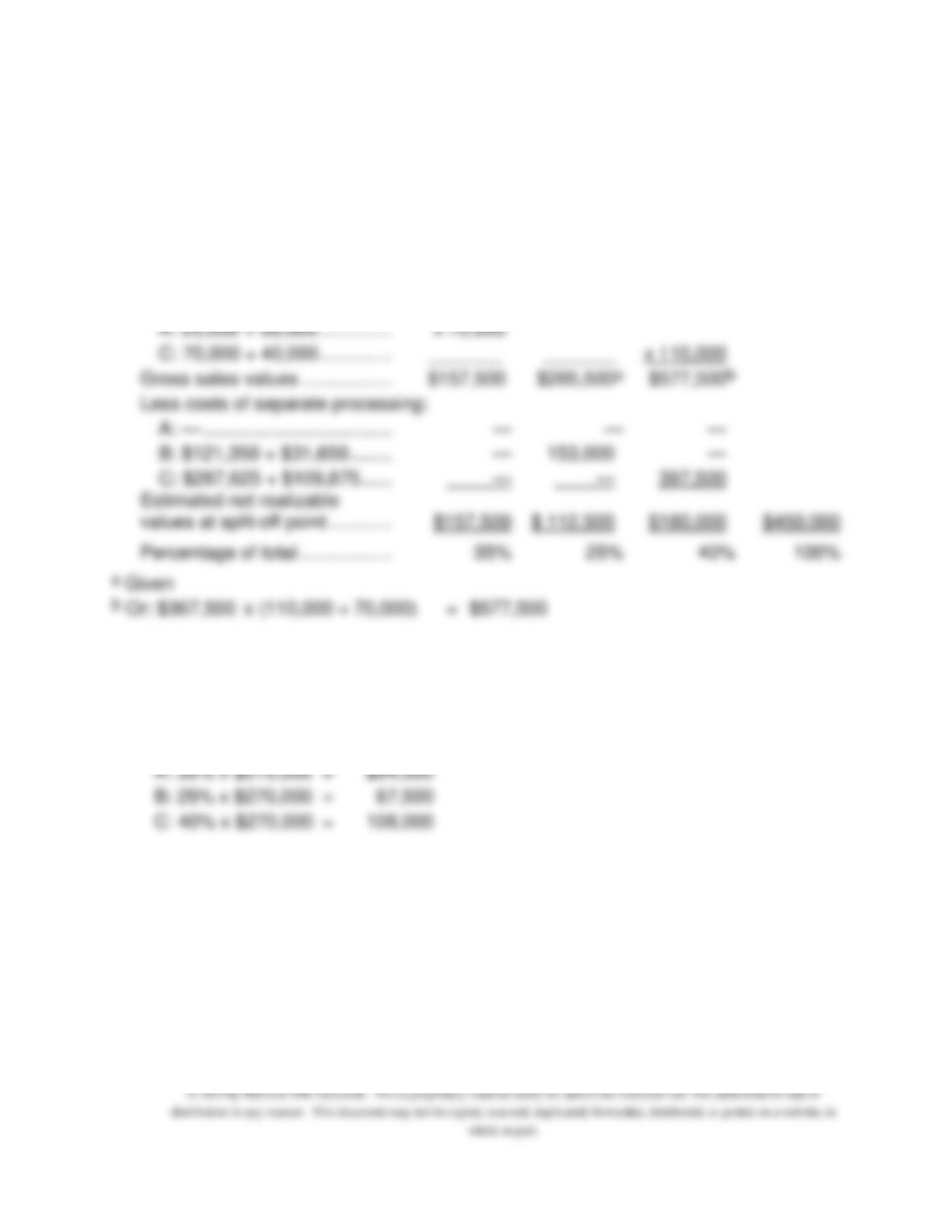
A diagram of the problem follows:
*$2.25 = $45,000 ÷ 20,000 lbs; $4.50 = $265,500 ÷ 59,000 lbs;
$5.25 = $367,500 ÷ 70,000 lbs.
Chapter 11 – Service Department and Joint Cost Allocation
11-48
11-59. (continued)
Product A
Product B
Product C
Total
1.
Selling price per pound:
X: $45,000 20,000 ………….……………….
$2.25
Z: $367,500 70,000 ………..…………………
$5.25
Multiply by pounds produced:
A: 20,000 + 50,000 …………………………..
x 70,000
C: 70,000 + 40,000…………………………..
_______
_______
x 110,000
Gross sales values …………………………..
$157,500
$265,500a
$577,500b
Less costs of separate processing:
A: — ……………………………….……………………..
—
—
—
B: $121,350 + $31,650 …………………………..
—
153,000
—
C: $287,625 + $109,875 …….…………………….
—
—
397,500
Estimated net realizable
values at split-off point ………….……………….
$157,500
$ 112,500
$180,000
$450,000
Percentage of total ……………….………….
35%
25%
40%
100%
a Given
b Or: $367,500
x
(110,000 ÷ 70,000)
=
$577,500
2. Total joint costs: $168,000 + $72,000 + $30,000 = $270,000
Allocation:
A: 35% x $270,000
=
$94,500
B: 25% x $270,000
=
67,500
C: 40% x $270,000
=
108,000
Chapter 11 – Service Department and Joint Cost Allocation
11-59. (continued)
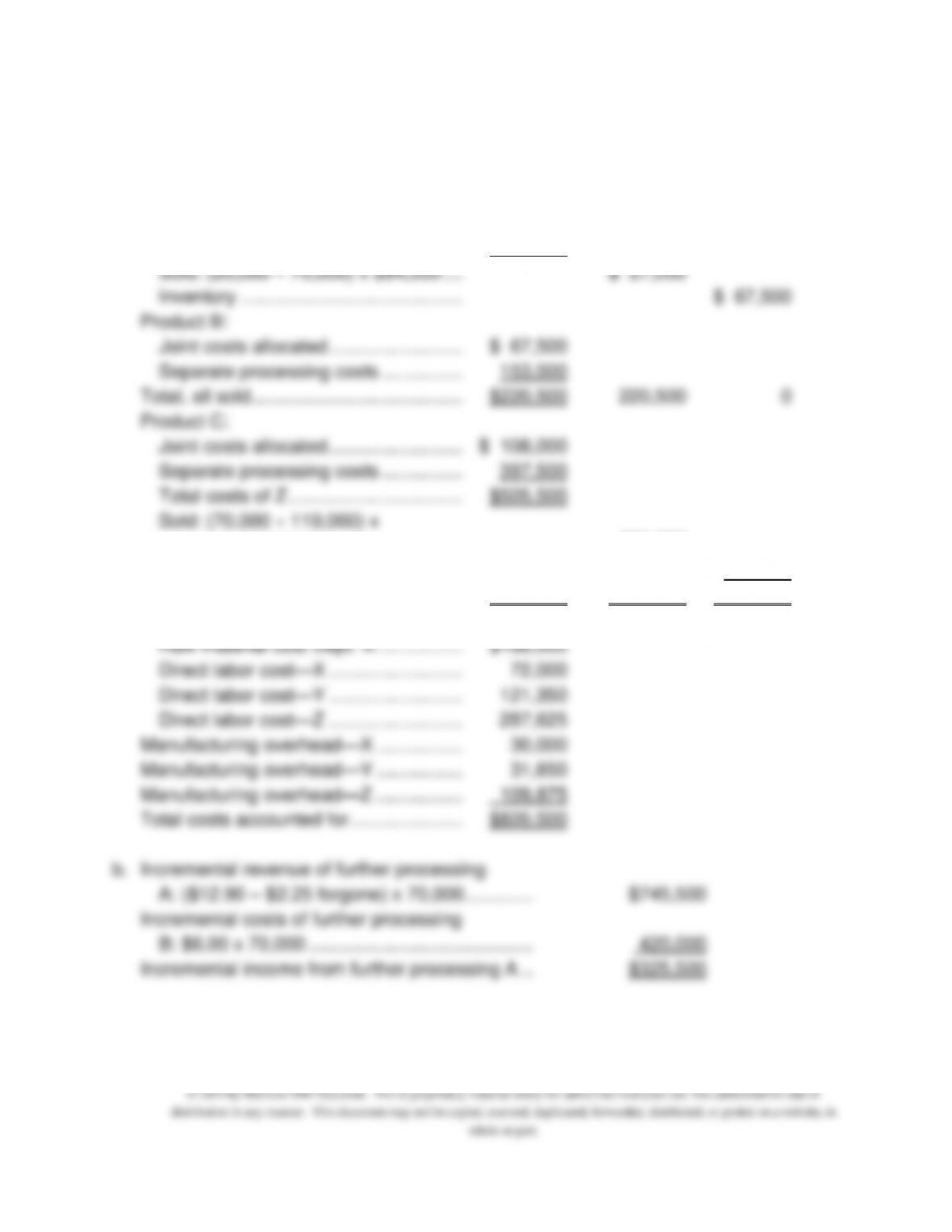
3. and 4.
Total Costs
Cost of
Goods Sold
Ending
Inventory
Product A:
Joint costs allocated ……………………..……
$ 94,500
Sold: (20,000 70,000) x $94,500 ….………….
$ 27,000
Inventory …………………………………….………….
$ 67,500
Product B:
Joint costs allocated ……………………..……
$ 67,500
Separate processing costs …………….………….
153,000
Total, all sold …………………………………..………….
$220,500
220,500
0
Product C:
Joint costs allocated ……………………..……
$ 108,000
Separate processing costs …………….………….
397,500
Total costs of Z …………………………….………….
$505,500
Sold: (70,000 110,000) x
$505,500 ……………………….….
321,682
Inventory …………………………………….………….
________
________
183,818
Totals …………………………………………….…………
$820,500
$569,182
$251,318
Proof of total:
Raw material cost Dept. X ……………..………….
$168,000
Direct labor cost—X ……………………..……
72,000
Direct labor cost—Y ……………………..……
121,350
Direct labor cost—Z ……………………..……
287,625
Manufacturing overhead—X ……………..………….
30,000
Manufacturing overhead—Y ……………..………….
31,650
Manufacturing overhead—Z ……………..………….
109,875
Total costs accounted for ………………….……….
$820,500
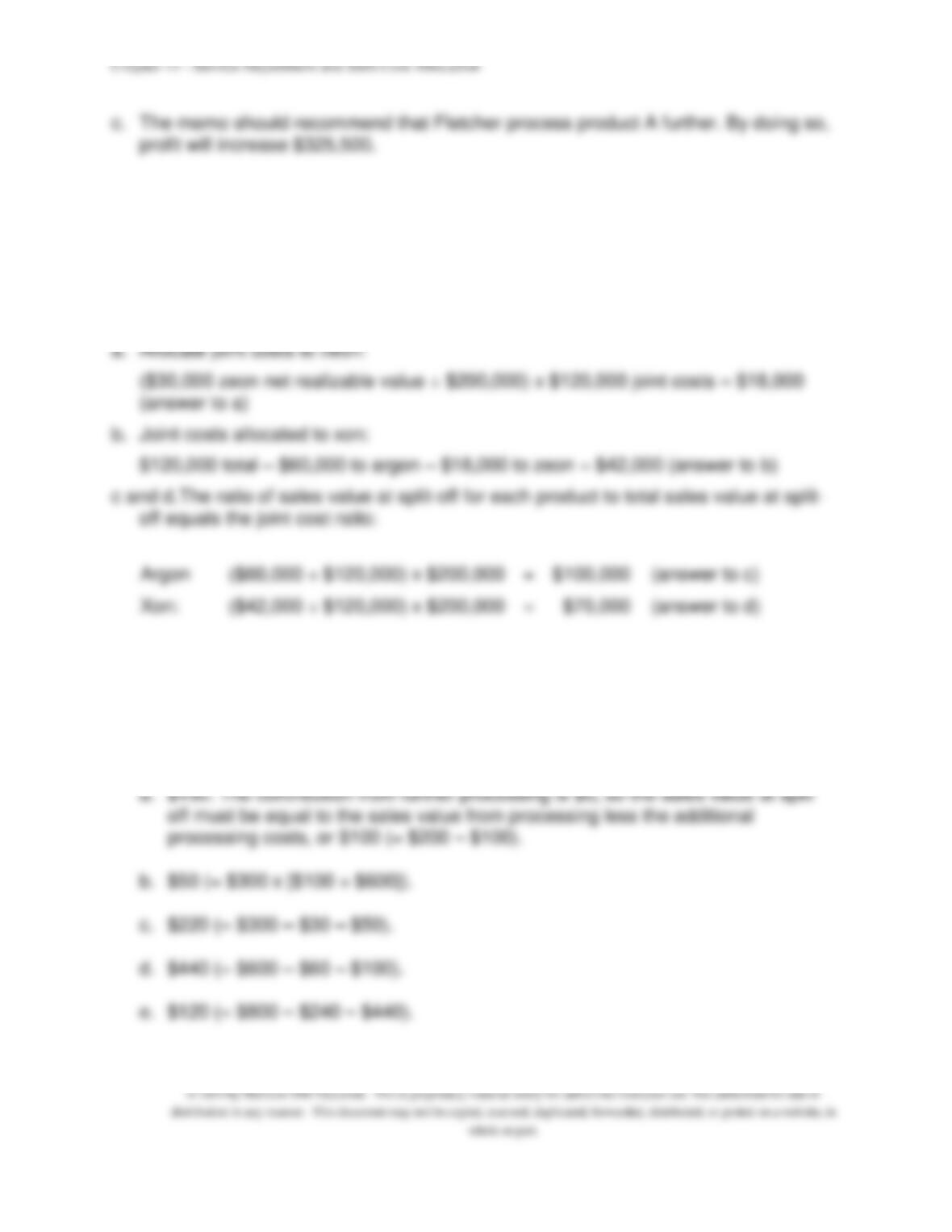
Incremental revenue of further processing
B: $6.00 x 70,000 …………………………………….
11-50
© 2014 by McGraw-Hill Education. This is proprietary material solely for authorized instructor use. Not authorized for sale or
distribution in any manner. This document may not be copied, scanned, duplicated, forwarded, distributed, or posted on a website, in
whole or part.
c. The memo should recommend that Fletcher process product A further. By doing so,
profit will increase $325,500.
11–60.
(35 min.) Find Missing Data—Net Realizable Value: Athens, Inc.
Athens must be using the net realizable value method because the ratio of argon’s joint
costs to the total does not equal the ratio of argon’s physical units to the total.
11–61.
(35 min.) Find Missing Data—Net Realizable Value: MS Enterprises
MS must be using the net realizable value method because the ratio of X1’s joint costs
to the total does not equal the ratio of X1’s physical units to the total.