Chapter 11 – Service Department and Joint Cost Allocation
11-1
© 2014 by McGraw-Hill Education. This is proprietary material solely for authorized instructor use. Not authorized for sale or distribution in any
manner. This document may not be copied, scanned, duplicated, forwarded, distributed, or posted on a website, in whole or part.
Chapter 11
Service Department and Joint Cost Allocation
Solutions to Review Questions
11–1.
Companies allocate costs to estimate or assess the costs of their activities (products,
processes, etc.). It is an estimate and subject to the problem that cost allocation
contains an arbitrary element. Not allocating costs, however, is also an estimate—an
estimate of zero. This may be appropriate for some decisions, but not for others.
11–2.
The essential difference is the allocation of costs among service departments. The
direct method makes no inter-service-department allocation, the step method makes a
Chapter 11 – Service Department and Joint Cost Allocation
11-2
11–3.
Allocations usually begin from the service department that has provided the greatest
proportion of its services to other service departments, or that services the greatest
number of other service departments. This criterion is used to minimize the
11–4.
Joint cost allocations are usually made to assign a cost to a product after the split-off
point. This is usually done for external reporting, tax, or rate-making purposes or to
11–5.
Because net realizable values of the output provide a measure of the economic benefit
11–6.
It could be preferable to use a physical quantities measure if it reflects the economic
benefit ultimately obtainable from the production process, particularly if there is no
11–7.
For joint products, costs of the inputs up to the split-off point are allocated to each of the
products. Costs prior to split-off are not allocated to by-products in the same way as to
Chapter 11 – Service Department and Joint Cost Allocation
11-3
11–8.
Chapter 11 – Service Department and Joint Cost Allocation
11-4
Solutions to Critical Analysis and Discussion Questions
11–9.
Management might believe there are benefits to the use of allocated costs. An
awareness of total costs may influence managerial behavior and decision making. For
example, management might want to make division managers aware of common costs
11–10.
Allocating zero costs is another allocation method. It, too, is an arbitrary method.
However, an advantage of not allocating costs is that the time saved reduces the
11–11.
As with all cost allocation methods, there is a cost-benefit trade-off to be made. If the
allocations using the reciprocal method are similar to the allocations using the direct or
11–12.
The concepts of direct and indirect are related to a specific cost object within the
organization. Costs that can be attributed to a cost object and can, in both a physical
and practical sense, be related to the cost object with no intermediate allocations are
11–13.
Chapter 11 – Service Department and Joint Cost Allocation
11-5
11–14.
11–15.
The addition of an employee in one department will increase the allocation base and,
therefore, reduce the allocation to the department that does not add the employee. The
P1
2 employees x ($24,000 3 employees) = $16,000
P2
1 employee x ($24,000 3 employees) = $8,000
and the manager in P2 has a $4,000 cost reduction even though the manager of P2
11–16.
Answers will vary. Before deciding to outsource a service department, a company would
want to consider some of the following. (1) Will the quality of service be the same?
11–17.
Answers will vary. First, it is useful to consider whether there are any reciprocal
services. Both the Library and Career Development make use of Computer Support, but
Chapter 11 – Service Department and Joint Cost Allocation
11-6
Development. Records of Library use are often difficult to collect, but again, students in
11–18.
Some managers use fully allocated cost numbers for long-run pricing and other long-run
decisions. Allocated joint costs are used to compute the costs of department and
11–19.
The two situations are similar in that the conceptual treatment of the allocation problem
is the same: the costs cannot be separately identified for each department or product;
11–20.
Examples include timber, livestock, petroleum, real estate development (produces lots),
railroad (many cars on the same train), and many other processing industries.
11–21.
The allocation of joint cost is similar to that of fixed costs in the sense that if I sell less of
one of the products, the cost to be allocated does not change (assuming free disposal).
11–22. (15 min.) Why Costs Are Allocated—Ethical Issues: Giga-Corp.
a. The president of Stable Division would probably prefer to allocate Personnel costs
Chapter 11 – Service Department and Joint Cost Allocation
11-7
c. Notice that the view of the “correct” allocation method depends on where you sit.
11–23. (20 min.) Cost Allocation—Direct Method: Warren, Ltd.
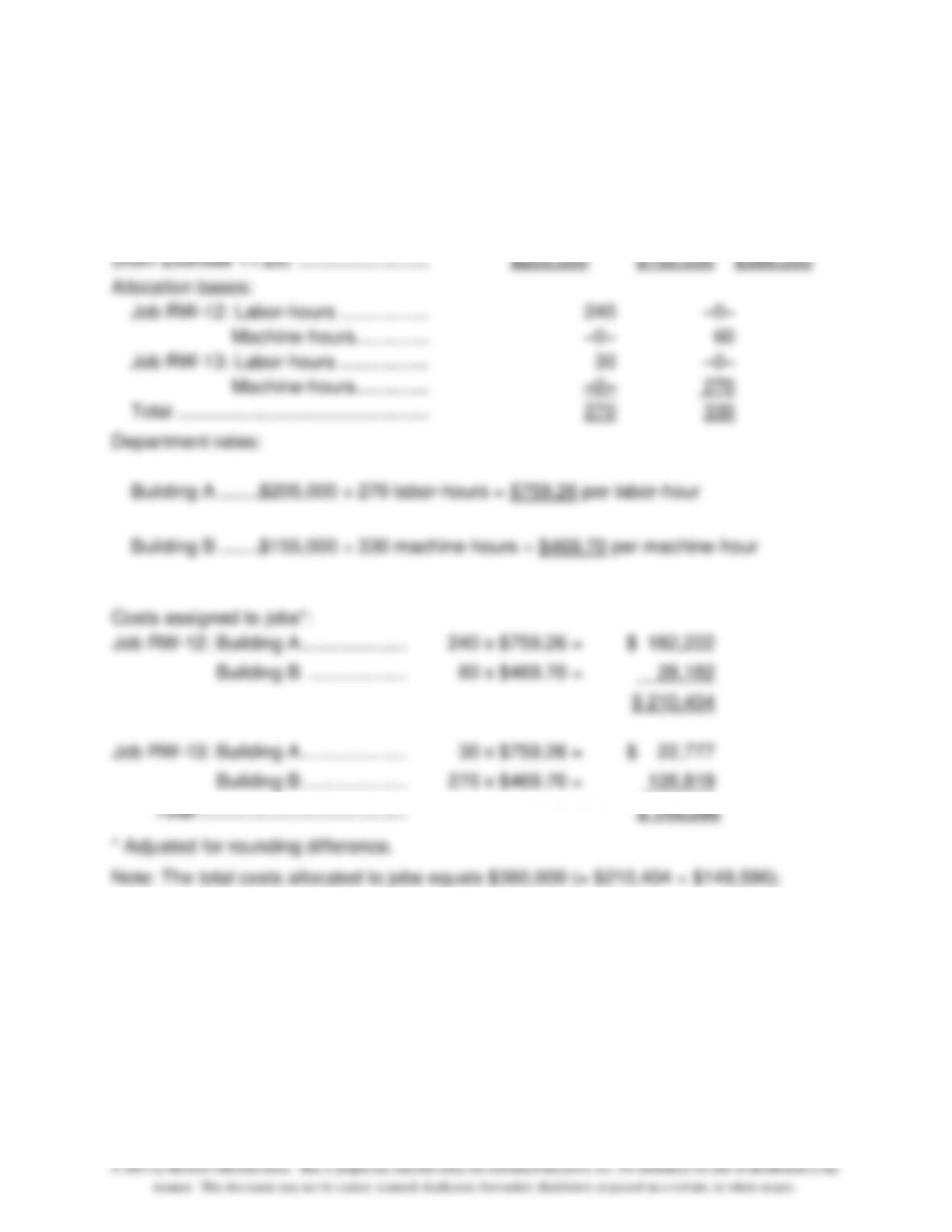
Direct Method:
To
Building A
Building B
Maintenance …………………………..
$125,000a
$75,000
Cafeteria ………………………………..….
80,000b
80,000
Total Costs ……………………………..….
$205,000
$155,000
a $125,000
=
0.5
x $200,000
0.5 + 0.3
b $80,000
=
0.1
x $160,000
0.1 + 0.1
(Note that the use of Maintenance’s costs by Cafeteria and the use of Cafeteria
costs by Maintenance are ignored.)
Chapter 11 – Service Department and Joint Cost Allocation
11-8
11–24. (30 min.) Allocating Service Department Costs First to Production
Departments and Then to Jobs: Warren Ltd.
Building A
Building B
Total
Costs allocated to each department
(from Exercise 11.23) ……………………..……
$205,000
$155,000
$360,000
Allocation bases:
Job RW-12: Labor-hours …………………………..
240
–0–
Machine-hours………………………..
–0–
60
Job RW-13: Labor-hours …………………………..
30
–0–
Machine-hours………………………..
–0–
270
Total ………………………………………….…………..
270
330
Department rates:
Building A ……..……………………
$205,000 ÷ 270 labor-hours = $759.26 per labor-hour
Building B ……..……………………
$155,000 ÷ 330 machine-hours = $469.70 per machine-hour
Costs assigned to jobs*:
Job RW-12: Building A ………………..…………
240 x $759.26
=
$ 182,222
Building B ……………….………….
60 x $469.70
=
28,182
$ 210,404
Job RW-13: Building A ………………..…………
30 x $759.26
=
$ 22,777
Building B ………………..…………
270 x $469.70
=
126,819
Total ………………………………….……………….
$ 149,596
* Adjusted for rounding difference.
Note: The total costs allocated to jobs equals $360,000 (= $210,404 + $149,596).
Chapter 11 – Service Department and Joint Cost Allocation
11-9
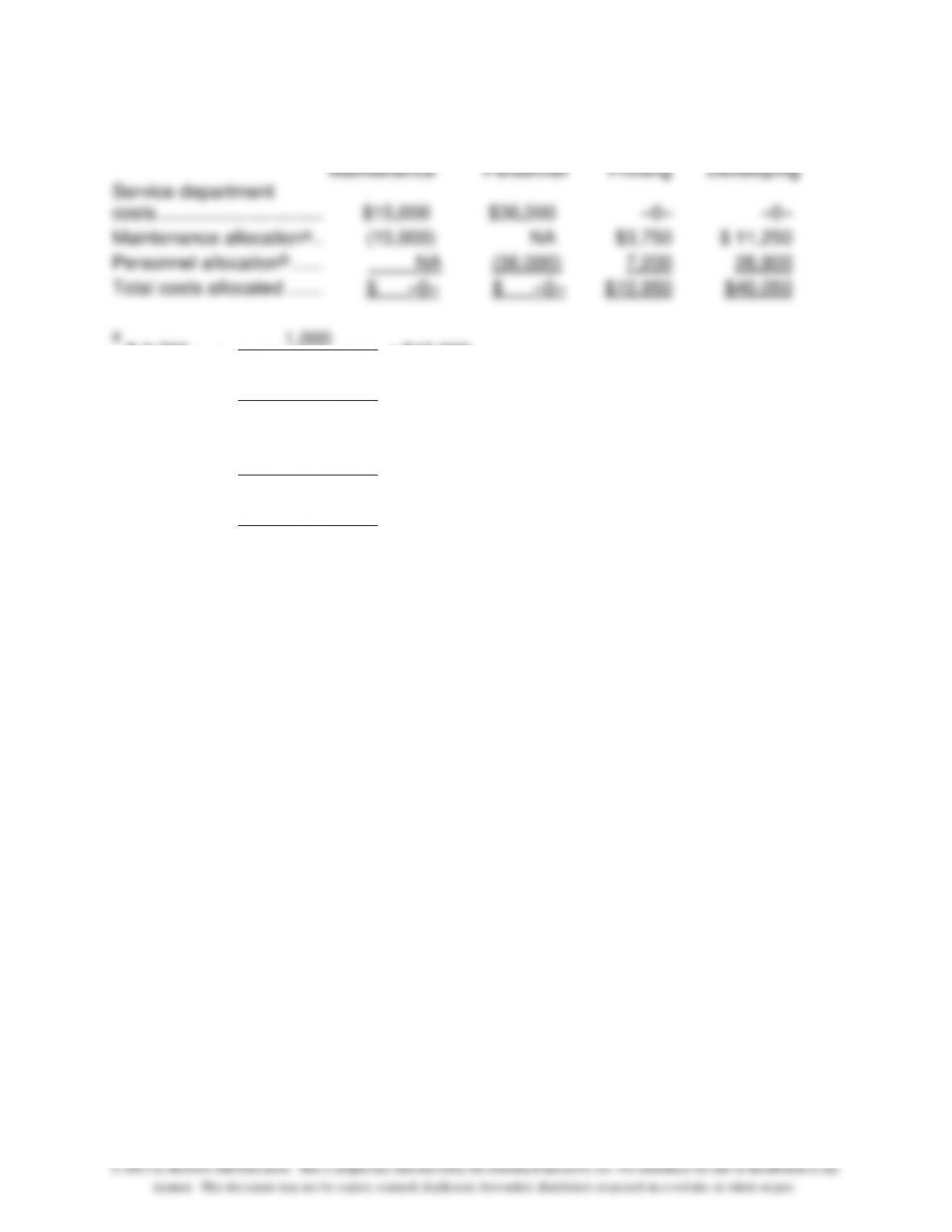
11–25. (15 min.) Cost Allocation–Direct Method: University Printers
Maintenance
Personnel
Printing
Developing
Service department
costs …………………………..…………………………..
$15,000
$36,000
–0–
–0–
Maintenance allocationa ..…………………………
(15,000)
NA
$3,750
$ 11,250
Personnel allocationb …………………………..
NA
(36,000)
7,200
28,800
Total costs allocated …….…………………….
$ –0–
$ –0–
$10,950
$40,050
a
$ 3,750
=
1,000
x $15,000
(1,000 + 3,000)
$ 11,250
=
3,000
x $15,000
(1,000 + 3,000)
b
$ 7,200
=
500
x $36,000
(500 + 2,000)
$28,800
=
2,000
x $36,000
(500 + 2,000)
Chapter 11 – Service Department and Joint Cost Allocation
11-10
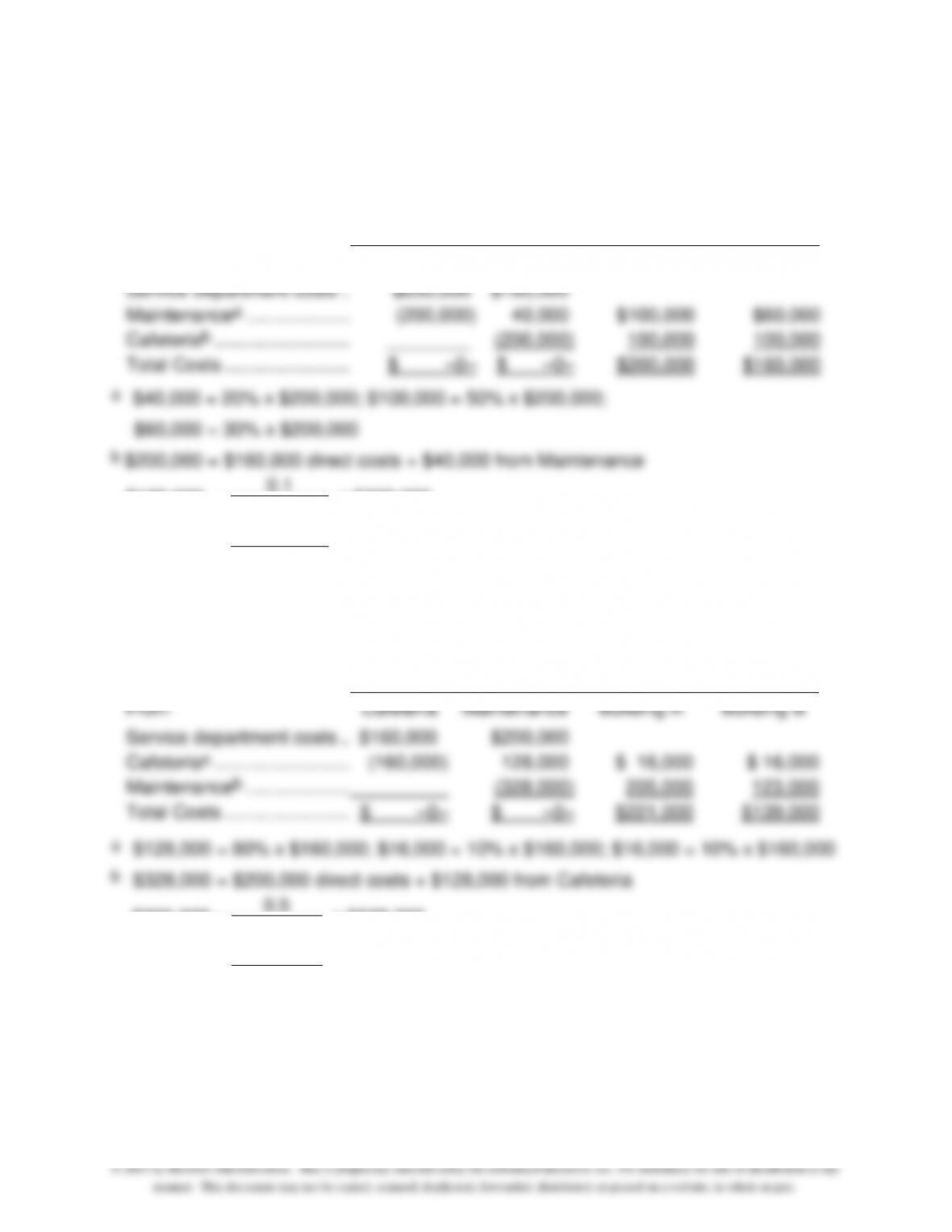
11–26. (25 min.) Cost Allocation—Step Method: Warren, Ltd.
a. Step Method—Maintenance First:
To
From
Maintenance
Cafeteria
Building A
Building B
Service department costs ..…………………………
$200,000
$160,000
Maintenancea ………………..…………
(200,000)
40,000
$100,000
$60,000
Cafeteriab ……………………..……
________
(200,000)
100,000
100,000
Total Costs …………………………..
$ –0–
$ –0–
$200,000
$160,000
a $40,000 = 20% x $200,000; $100,000 = 50% x $200,000;
$60,000 = 30% x $200,000
b $200,000 = $160,000 direct costs + $40,000 from Maintenance
$100,000
=
0.1
x $200,000
(0.1 + 0.1)
$100,000
=
0.1
x $200,000
(0.1 + 0.1)
b. Step Method—reverse order:
To
From
Cafeteria
Maintenance
Building A
Building B
Service department costs ..…………………………
$160,000
$200,000
Cafeteriaa ……………………..……
(160,000)
128,000
$ 16,000
$ 16,000
Maintenanceb ………………..…………
________
(328,000)
205,000
123,000
Total Costs …………………………..
$ –0–
$ –0–
$221,000
$139,000
a $128,000 = 80% x $160,000; $16,000 = 10% x $160,000; $16,000 = 10% x $160,000
b $328,000 = $200,000 direct costs + $128,000 from Cafeteria
$205,000
=
0.5
x $328,000
(0.5 + 0.3)
$123,000
=
0.3
x $328,000
(0.5 + 0.3)