Chapter 10 – Fundamentals of Cost Management
10–27. (15 min.) Activity-Based Costing of Customers: Rock Solid Bank & Trust.
a. RSB&T can use this information to change the way banking services are priced.
Managers at the bank may want to consider ATM fees or require minimum
10–28. (15 min.) Activity-Based Costing of Customers—Ethical Issues: Red’s
Lumber.
a. Red could use the information to offer “discounts” for weekday orders, which is
equivalent to a premium for weekend orders. Before Red makes any changes, he
should try to understand the reason for the difference. Are the sales patterns
Chapter 10 – Fundamentals of Cost Management
10–29. (15 min.) Activity-Based Costing of Customers—Ethical Issues: Central
State College.
a. Possible allocation bases include number of students, student hours in the lab,
10–30. (15 min.) Activity-Based Costing of Suppliers: Davis Fabricators.
This can be answered using the format of Exhibit 10.9. First compute the cost of
a late delivery.
Number of tons delivered late
(10,000 x 25% + 6,000 x 5%)
2,800
Cost of late deliveries…………………….
(Given)
$22,400
Cost of late delivery per ton …………...
($22,400 ÷ 2,800)
$8
Now compute the “effective” price of a ton.
Alpha
First
Average purchase price per ton ……………....
$10.00
$12.00
Additional cost of late delivery per ton ……....
$8
$8
Probability of late delivery ……………………....
25%
5%
Expected cost of late delivery per ton ………..
$2.00
$0.40
Effective cost per ton ……………………………...
$12.00
$12.40
10–31. (10 min.) Activity-Based Costing of Suppliers: Davis Fabricators.
Chapter 10 – Fundamentals of Cost Management
10–32. (20 min.) Activity-Based Costing of Suppliers: Kinnear Plastics.
The approach to this problem is to determine how much it costs to purchase a
ton of “good” plastic. The effective price is the quoted price divided by the
10–33. (10 min.) Activity-Based Costing of Suppliers: Kinnear Plastics.
a. $760. This can be answered as a breakeven calculation, solving for B, the bid:
10–34. (15 min.) Resources Used versus Resources Supplied: Tri-State Mill.
Resources Used
Resources
Supplied
Unused Resource
Capacity
Energy ……………………..……
$5,400
$6,900
$1,500
($0.90 6,000 mh)
(given)
($6,900 – $5,400)
Repairs …………………….…….
$9,600
$12,000
$2,400
($16 600 jobs )
(given)
($12,000 – $9,600)
Chapter 10 – Fundamentals of Cost Management
10–35. (10 min.) Resources Used versus Resources Supplied: Tri-State Mill.
a.
Finishing sales …………………………..
$ 30,000
Energy costs …………………………..
$6,900
Repair costs ……………………………………………..
12,000
18,900
Operating profit …………………………..
$ 11,100
b.
Resources
Used
Unused
Resource
Capacity
Resources
Supplied
Finishing sales ……………….
$ 30,000
Costs
Volume related
Energy …………………….
$5,400
$1,500
$6,900
Batch related
Repairs ……………………
9,600
2,400
12,000
Total costs ……………………..
$15,000
$3,900
$18,900
18,900
Finishing operating profits ..
$ 11,100
10–36. (15 min.) Resources Used versus Resources Supplied: Gundy Press.
Resources Used
Resources
Supplied
Unused Resource
Capacity
Setups …………………………..
$21,875
$22,500
$625
($125 175 runs)
(given)
($22,500 – $21,875)
Clerical ………………..…………
$7,500
$10,000
$2,500
($15 500 pages)
(given)
($10,000 – $7,500)
Chapter 10 – Fundamentals of Cost Management
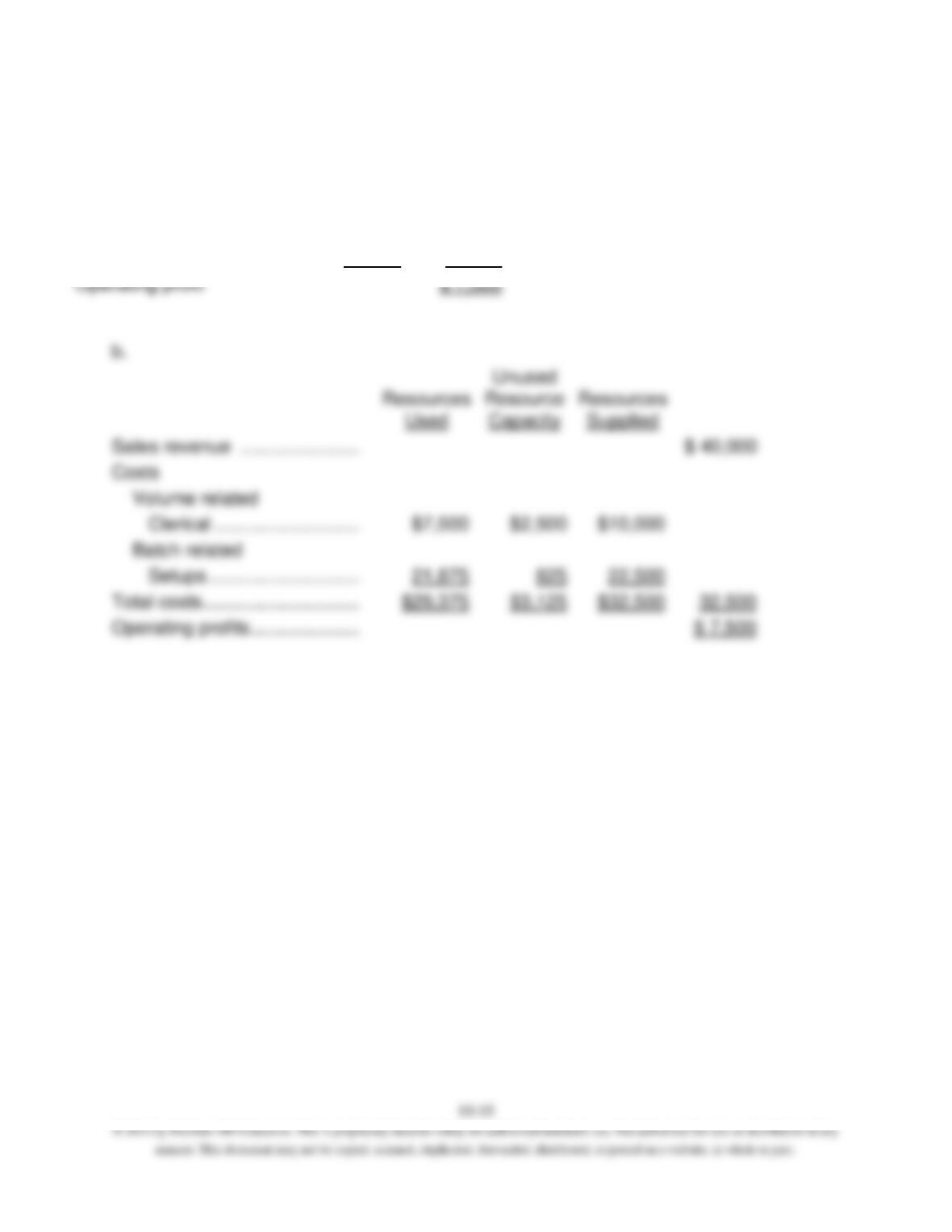
10–37. (10 min.) Resources Used versus Resources Supplied: Gundy Press.
a.
Sales revenue ……………………
$ 40,000
Setup costs …………………..
$22,500
Clerical costs …………………
10,000
32,500
Operating profit
$ 7,500
b.
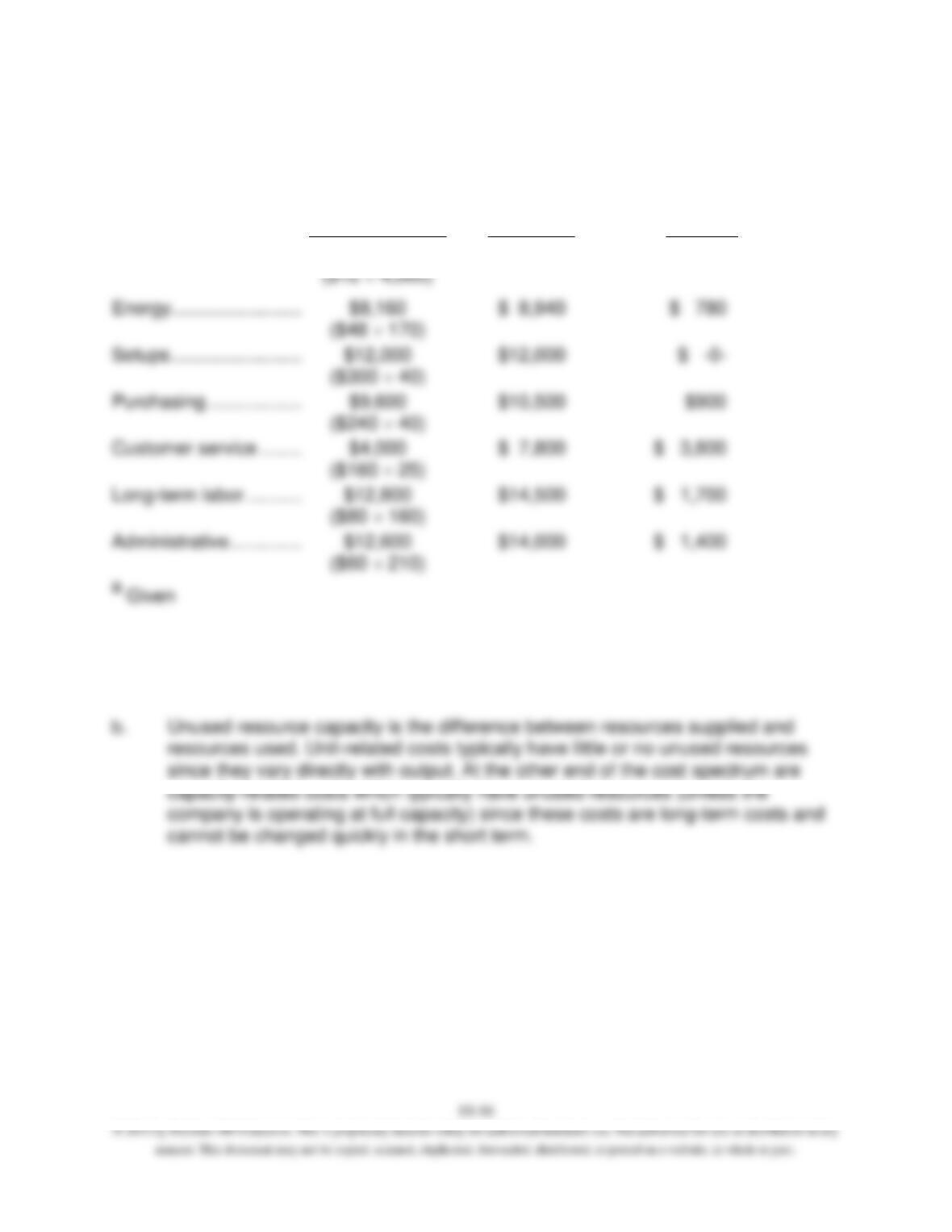
Resources
Used
Unused
Resource
Capacity
Resources
Supplied
Sales revenue …………………..
$ 40,000
Costs
Volume related
Clerical ……………………….
$7,500
$2,500
$10,000
Batch related
Setups ………………………..
21,875
625
22,500
Total costs …………………………
$29,375
$3,125
$32,500
32,500
Operating profits …………………
$ 7,500
Chapter 10 – Fundamentals of Cost Management
10–38. (40 min.) Resources Used versus Resources Supplied: Gunnison Supply.
a.
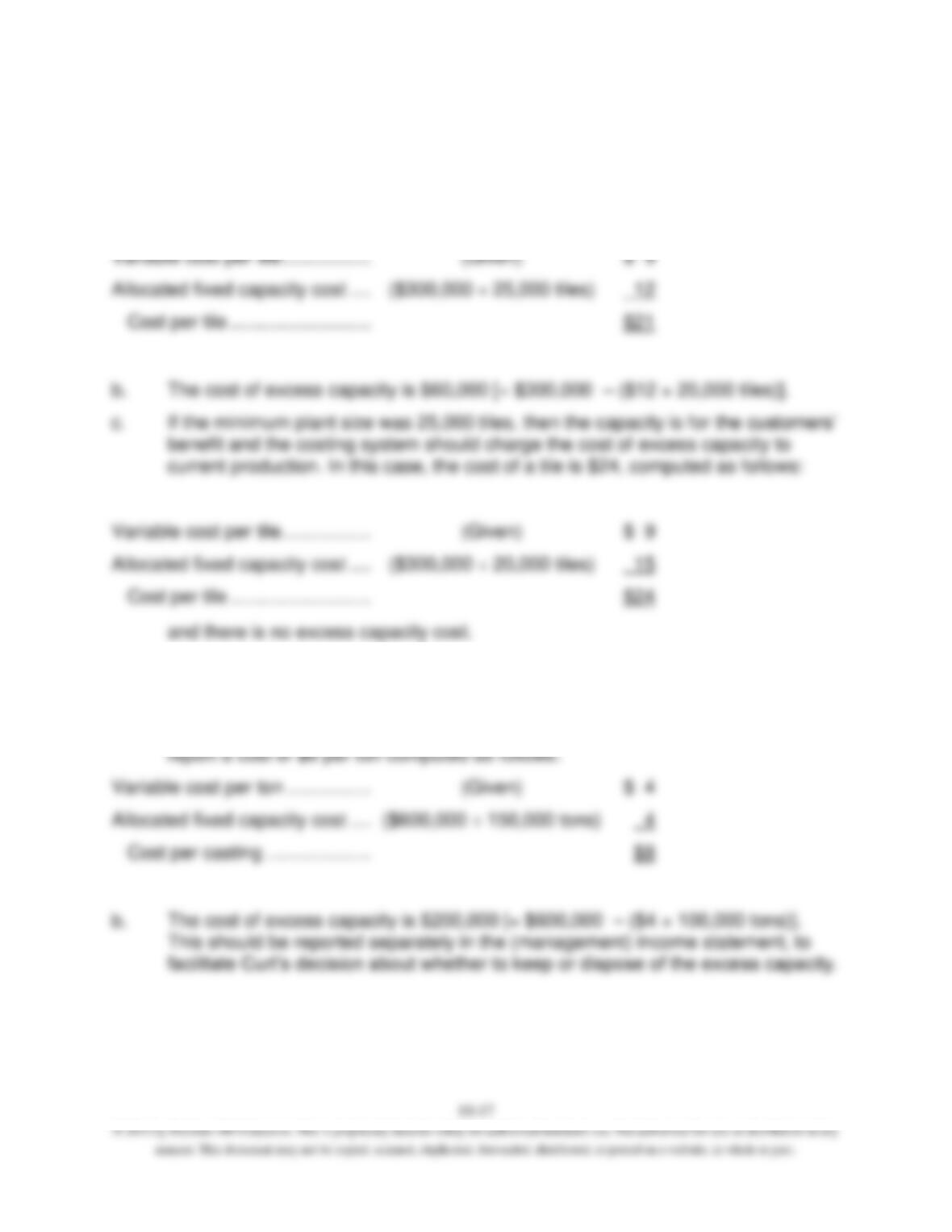
Resources Used
Resources
Supplieda
Unused Resource
Capacity
Materials ………………….……….
$48,000
($12 4,000)
$49,000
$ 1,000
Energy …………………….…….
$8,160
($48 170)
$ 8,940
$ 780
Setups …………………….…….
$12,000
($300 40)
$12,000
$ -0-
Purchasing …………………………..
$9,600
($240 40)
$10,500
$900
Customer service ……..……………………
$4,000
($160 25)
$ 7,800
$ 3,800
Long-term labor ………..…………………
$12,800
($80 160)
$14,500
$ 1,700
Administrative …………..………………
$12,600
($60 210)
$14,000
$ 1,400
a Given
b. Unused resource capacity is the difference between resources supplied and
resources used. Unit-related costs typically have little or no unused resources
since they vary directly with output. At the other end of the cost spectrum are
capacity-related costs which typically have unused resources (unless the
company is operating at full capacity) since these costs are long-term costs and
cannot be changed quickly in the short term.
Chapter 10 – Fundamentals of Cost Management
10–39. (20 min.) Assigning Cost of Capacity: Beth’s Supplies.
a. Because the plant was purchased with excess capacity for future growth, current
production should not be charged with excess capacity. Therefore, the cost
system should report a cost of $21 per tile computed as follows:
Variable cost per tile ……………..….
(Given)
$ 9
Allocated fixed capacity cost ….….
($300,000 ÷ 25,000 tiles)
12
Cost per tile ………………………….
$21
b. The cost of excess capacity is $60,000 [= $300,000 – ($12 × 20,000 tiles)].
c. If the minimum plant size was 25,000 tiles, then the capacity is for the customers’
benefit and the costing system should charge the cost of excess capacity to
current production. In this case, the cost of a tile is $24, computed as follows:
Variable cost per tile ……………..….
(Given)
$ 9
Allocated fixed capacity cost ….….
($300,000 ÷ 20,000 tiles)
15
Cost per tile ………………………….
$24
and there is no excess capacity cost.
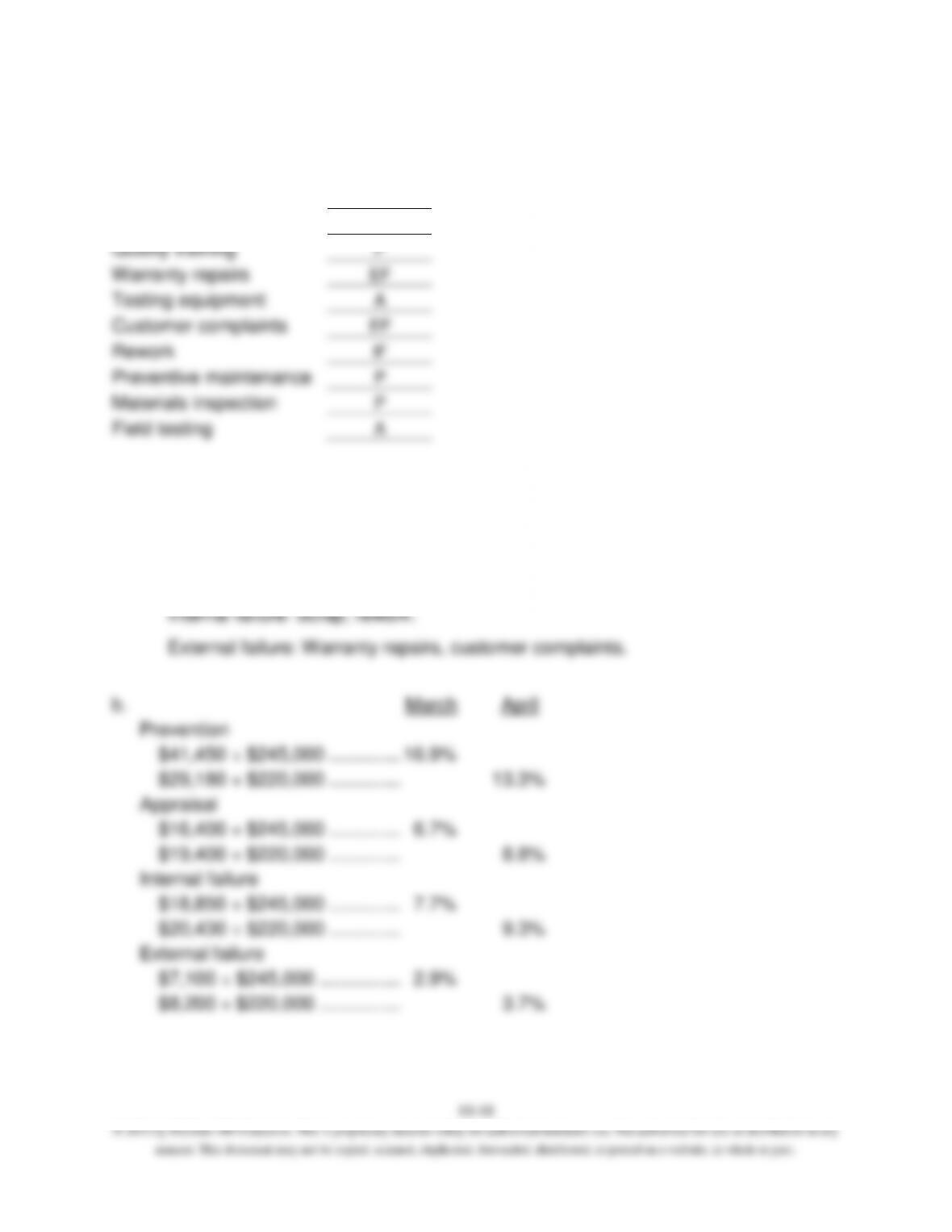
10–40. (20 min.) Assigning Cost of Capacity: Curt’s Castings.
a. Because the plant was purchased for the benefit of Curt, current production
should not be charged with excess capacity. Therefore, the cost system should
Variable cost per ton …………….….
(Given)
$ 4
Allocated fixed capacity cost ….….
Cost per casting ………………..….
Chapter 10 – Fundamentals of Cost Management
10–41. (15 min.) Costs of Quality: Hastings Corporation.
Process inspection
P
Scrap
IF
Quality training
P
Warranty repairs
EF
Testing equipment
A
Customer complaints
EF
Rework
IF
Preventive maintenance
P
Materials inspection
P
Field testing
A
10–42. (20 min.) Costs of Quality: Trovatore Corporation.
a. Prevention: Process inspection, quality training, preventive maintenance,
materials inspection.
Appraisal: Testing equipment, field testing.
Chapter 10 – Fundamentals of Cost Management
10–43. (30 min.) Trading-Off Costs of Quality: Trovatore Corporation.
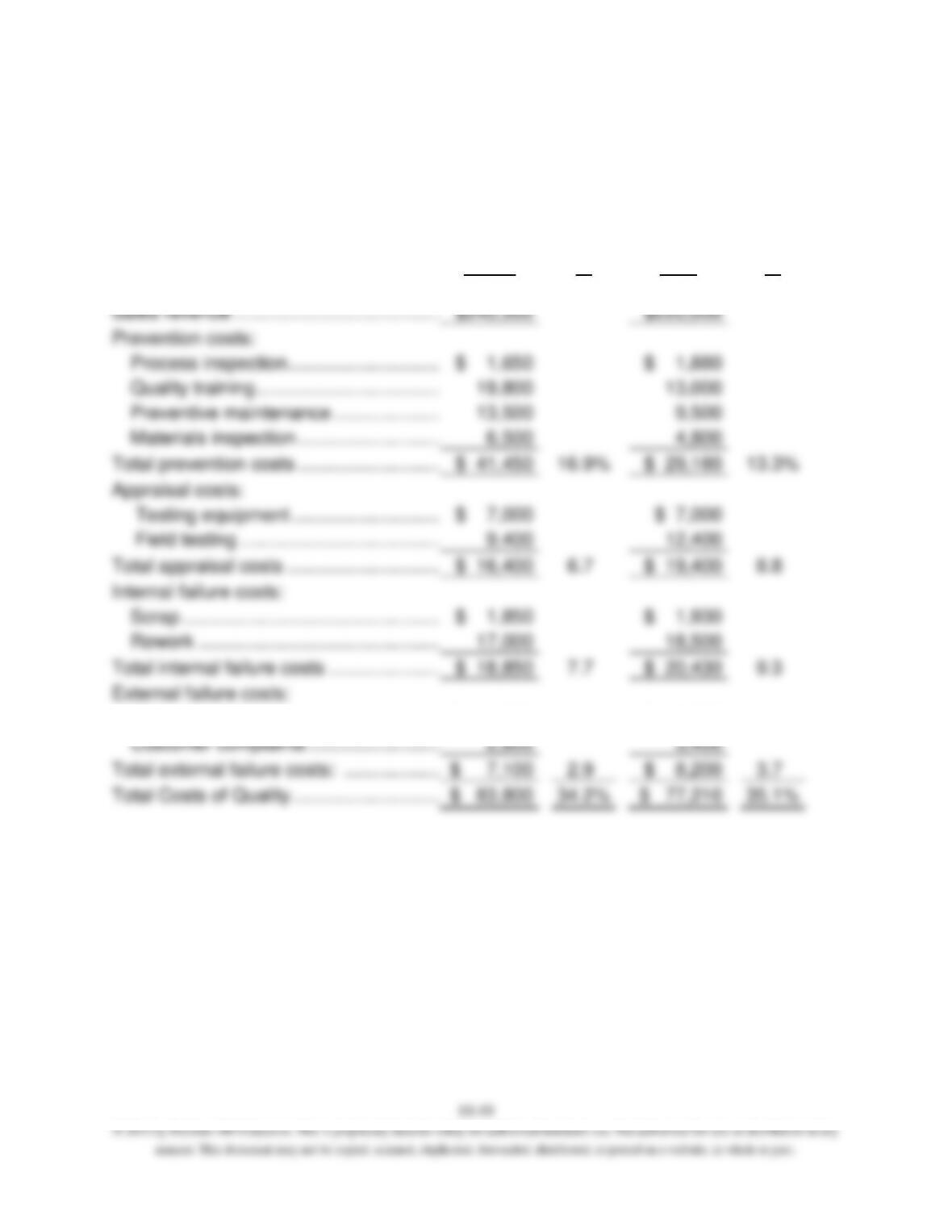
Trovatore Corporation
Cost of Quality Report
March
%
April
%
Sales revenue ………………………………….…………
$245,000
$220,000
Prevention costs:
Process inspection…………………………..
$ 1,650
$ 1,880
Quality training …………………………………………
19,800
13,000
Preventive maintenance …………………………..
13,500
9,500
Materials inspection ……………………….….
6,500
4,800
Total prevention costs ……………………….….
$ 41,450
16.9%
$ 29,180
13.3%
Appraisal costs:
Testing equipment ………………………..…
$ 7,000
$ 7,000
Field testing ……………………………………………
9,400
12,400
Total appraisal costs …………………………..
$ 16,400
6.7
$ 19,400
8.8
Internal failure costs:
Scrap …………………………………………..…………
$ 1,850
$ 1,930
Rework ………………………………………..…………
17,000
18,500
Total internal failure costs ………………….……….
$ 18,850
7.7
$ 20,430
9.3
External failure costs:
Warranty repairs ………………………………………
$ 4,300
$ 4,800
Customer complaints ……………………..……
2,800
3,400
Total external failure costs: ……………….…………
$ 7,100
2.9
$ 8,200
3.7
Total Costs of Quality ………………………..…
$ 83,800
34.2%
$ 77,210
35.1%
Chapter 10 – Fundamentals of Cost Management
10–44. (20 min.) Costs of Quality: Nuke-It-Now.
a. Prevention: Redesign process, training on equipment, preventative maintenance.
Appraisal: Final inspection.
Internal failure: Discard defective units, rework.