Chapter 10 – Fundamentals of Cost Management
© 2014 by McGraw-Hill Education. This is proprietary material solely for authorized instructor use. Not authorized for sale or distribution in any
manner. This document may not be copied, scanned, duplicated, forwarded, distributed, or posted on a website, in whole or part.
10-1
Chapter 10
Fundamentals of Cost Management
Solutions to Review Questions
10–1.
Activity-based costing provides management with detailed costing information about
10–2.
Activity-based management can be implemented without an activity-based costing
10–3.
Value-added activities add value to the product or service whereas nonvalue-added
activities do not add value. By identifying activities that do not add value, management
10–4.
Customers affect costs by the way they interact with the company and place demands
on company activities. Common examples are ordering behavior and sales support.
10–5.
Chapter 10 – Fundamentals of Cost Management
10-2
10–6.
Resources supplied represent the capacity of the organization. They are the resources
available for use. Resources consumed are those used in the manufacture of the
10–7.
Capacity costs, generally included in the fixed overhead allocation, affect reported
product costs. Managers use reported costs to make decisions such as what price to
10–8.
Quality affects cost in two major ways. Conformance costs are those that the firm incurs
in order to ensure the product or service meets required quality levels. Examples
10–9.
The four categories of a cost of quality system are:
1. Prevention: Costs to ensure good quality (product design, training).
2. Appraisal: Costs to ensure poor-quality items are not shipped (inspection).
3. Internal failure: Costs of producing below-quality items that are not shipped (scrap,
rework).
4. External failure: Costs of producing and shipping below-quality items (warranty
costs, lost sales).
Chapter 10 – Fundamentals of Cost Management
Solutions to Critical Analysis and Discussion Questions
10–10.
Answers will vary.
10–11.
10–12.
It was not value added to the customers (students and faculty) unless the new
placement made the books easier to find and use.
10–13.
Answers will vary.
a) Clothing retail store: Returning defective product to suppliers and processing
10–14.
10–15.
The problem with first computing product costs and then customer costs is that it
Chapter 10 – Fundamentals of Cost Management
10–16.
While customers are the source of revenue, they make demands on company
resources and affect costs through their buying behavior.
10–17.
Two important factors managers need to consider are what competitors will do and how
the competitive environment will change over time. Focusing on customer profitability
10–18.
There is an opportunity cost associated with idle capacity. Knowing that capacity is not
being used allows managers to decide what to do with it. They may decide to leave it in
10–19.
10–20.
Answers will vary but should include reasons why the elements are not important. For
instance, when purchasing a low-cost item, like paint to touch up minor scratches,
10–21.
Answers will vary. One example follows. The quality-based view would encourage
continuous improvement of the production process and might offer incentives (i.e. cash
Chapter 10 – Fundamentals of Cost Management
© 2014 by McGraw-Hill Education. This is proprietary material solely for authorized instructor use. Not authorized for sale or distribution in any
manner. This document may not be copied, scanned, duplicated, forwarded, distributed, or posted on a website, in whole or part.
10-5
products are a natural part of the production process and are very difficult to eliminate.
Thus, thorough inspections throughout the production process are necessary to ensure
minimal defects.
Chapter 10 – Fundamentals of Cost Management
Solutions to Exercises
10–22. (10 min.) Activity-Based Cost Management in a College.
1. b. Improves efficiency. Renewing books no longer requires an intermediate
person, the librarian, as part of the transaction.
2. a. Reduces frequency of activity. Reducing the number of hours the library is
open reduces all of the activities required to keep it open.
10–23. (10 min.) Cost Hierarchy for a Not-for-Profit.
a. Facility level (will not vary over range of activity).
b. Facility level (will not vary over range of activity).
Chapter 10 – Fundamentals of Cost Management
10–24. (20 min.) Driver Identification.
a. Number of calls to new commercial customers; records kept by sales reps.
b. Time spent on negotiation; time records kept.
c. Time spent on review; time records kept.
Chapter 10 – Fundamentals of Cost Management
10–25. (20 min.) Activity-Based Costing of Customers: Marvin’s Kitchen Supply.
a. Delivery cost based on order value:
Customer
Order
Value
Delivery Charge
(@10%)
City Diner ……………………………..………….
$75,000
$7,500
Le Chien Chaud …………………….…….
$90,000
9,000
b. Delivery cost based on activity-based costing:
Cost driver rates:
Activity
Cost Driver
Cost ÷
Driver Volume =
Rate
Processing order .
Number of orders
$75,000 ÷
5,000 orders =
$15 per order
Loading truck …….
Number of items
150,000 ÷
100,000 items =
$1.50 per item
Delivering
merchandise ……..
Number of orders
90,000 ÷
5,000 orders =
$18 per order
Processing
invoice ……………..
Number of invoices
72,000 ÷
4,000 invoices =
$18 per invoice
Processing order ……………….
Loading truck ……………………
Delivering merchandise ……..
Processing invoice …………….
Chapter 10 – Fundamentals of Cost Management
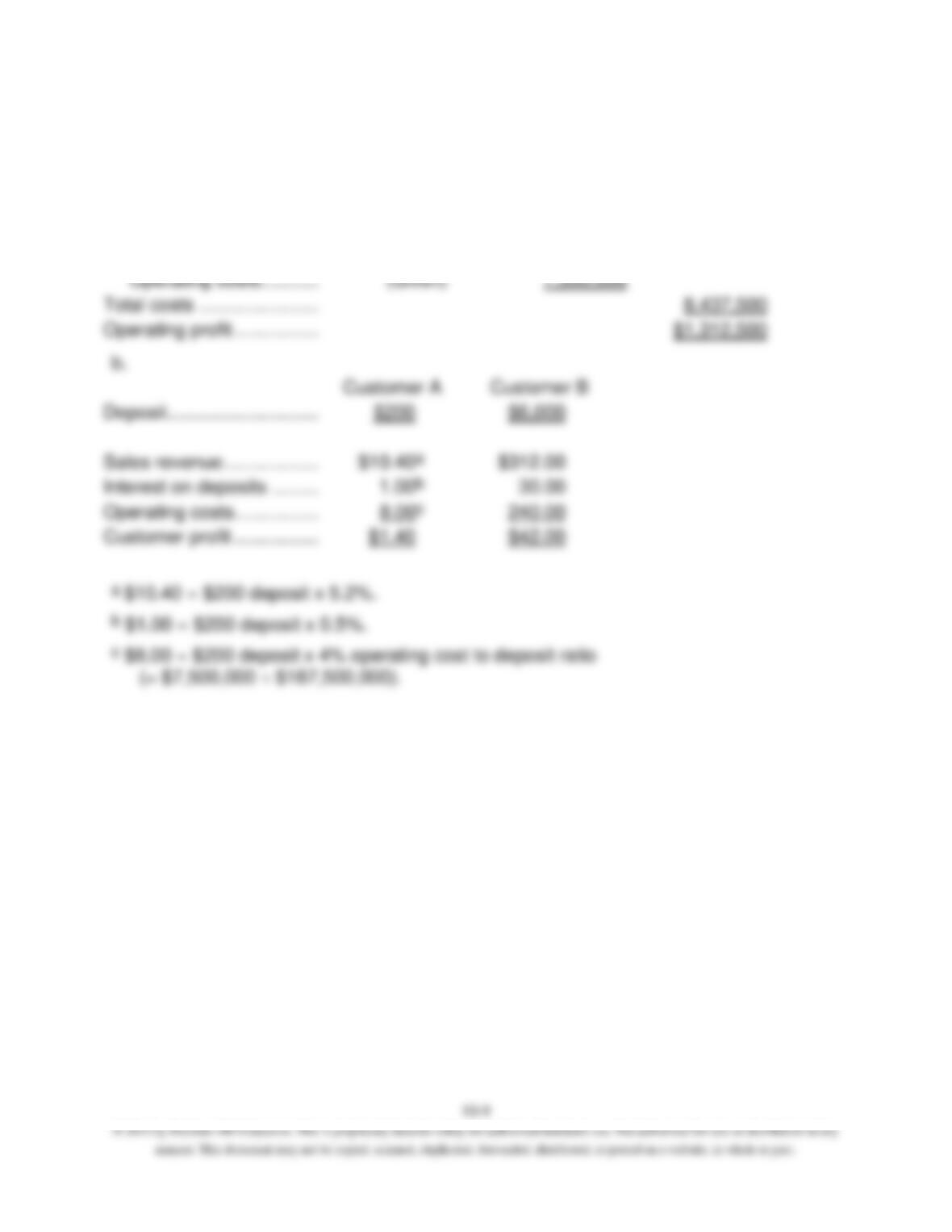
10–26. (30 min.) Activity-Based Costing of Customers: Rock Solid Bank & Trust.
a.
Sales revenue ……………….
$187,500,000 x 5.2%
$9,750,000
Costs:
Interest on deposits…….
$187,500,000 x 0.5%
937,500
Operating costs …………
(Given)
7,500,000
Total costs ……………………
8,437,500
Operating profit ……………..
$1,312,500
b.
Customer A
Customer B
Deposit …………………………..
$200
$6,000
Sales revenue ………………...
$10.40a
$312.00
Interest on deposits ………...
1.00b
30.00
Operating costs ……………....
8.00c
240.00
Customer profit ……………....
$1.40
$42.00
a $10.40 = $200 deposit x 5.2%.
b $1.00 = $200 deposit x 0.5%.
c $8.00 = $200 deposit x 4% operating cost to deposit ratio
(= $7,500,000 ÷ $187,500,000).
Chapter 10 – Fundamentals of Cost Management
10-26. (continued)
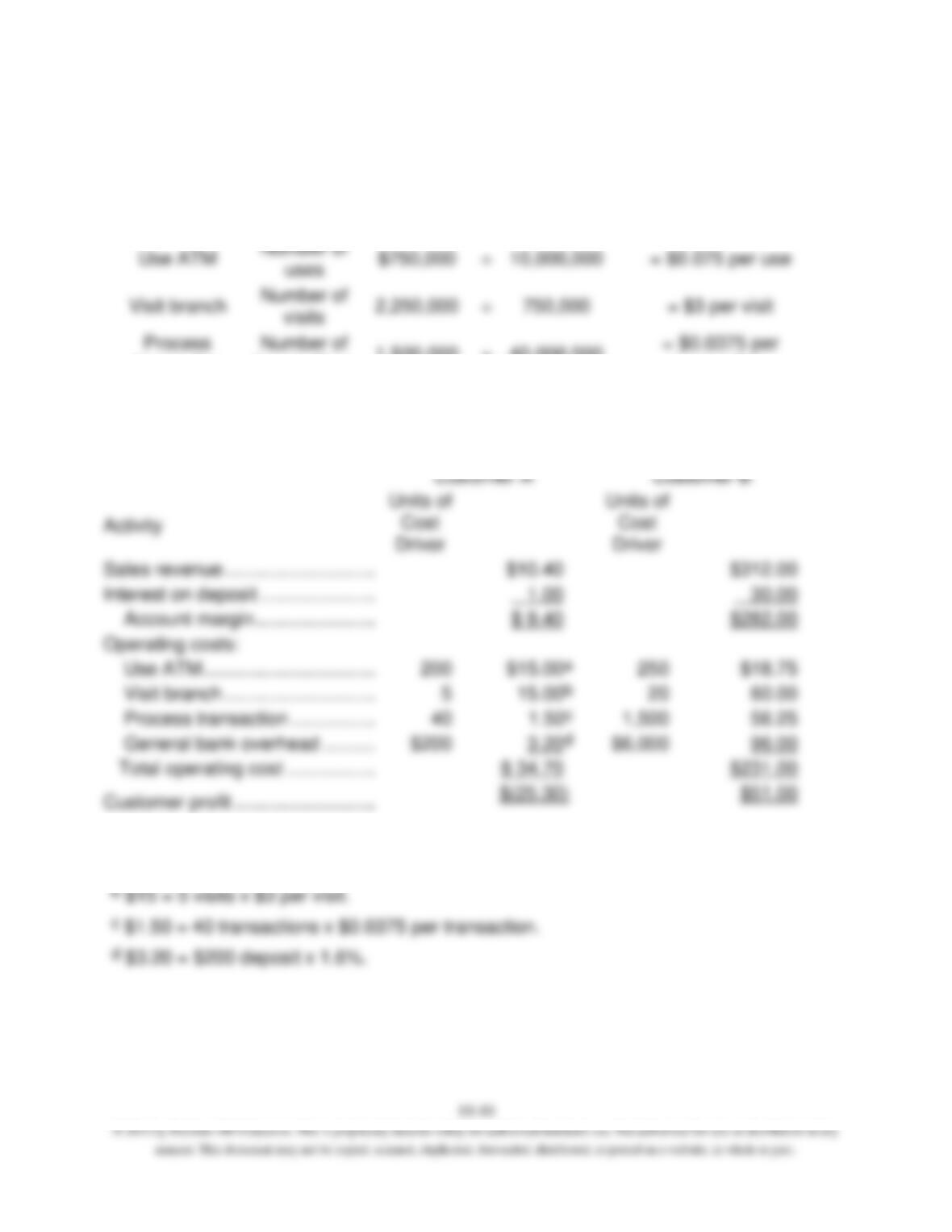
c.
Activity
Cost Driver
Cost
Driver Volume
Rate
Use ATM
Number of
uses
$750,000
÷
10,000,000
= $0.075 per use
Visit branch
Number of
visits
2,250,000
÷
750,000
= $3 per visit
Process
transaction
Number of
transactions
1,500,000
÷
40,000,000
= $0.0375 per
transaction
General bank
overhead
Total deposits
3,000,000
÷
$187,500,000
=1.6% of deposits
Customer A
Customer B
Activity
Units of
Cost
Driver
Units of
Cost
Driver
Sales revenue ………………………..…
$10.40
$312.00
Interest on deposit ………………….……….
1.00
30.00
Account margin …………………..………
$ 9.40
$282.00
Operating costs:
Use ATM ………………………………………………..
200
$15.00a
250
$18.75
Visit branch ………………………..…
5
15.00b
20
60.00
Process transaction …………….…………….
40
1.50c
1,500
56.25
General bank overhead ……….………………….
$200
3.20d
$6,000
96.00
Total operating cost ……………..……………
$ 34.70
$231.00
Customer profit …………………………..
$(25.30)
$51.00
a $15 = 200 uses x $0.075 per use.