Chapter 09 – Activity-Based Costing
9-50
9-51. (continued)
d.
Creamy
Crunch
Direct labor cost per hour …………………………..
$6.00
Direct labor hours per case ………………………..…
1
Total cases produced ……………………………….…
3,000
Labor hours per product ………………………………
3,000
Total labor hours: 3,000
Allocation rate per labor hour
=
Total overhead/Total labor hours
=
$69,500/3,000
=
$23.17
per labor hour
Allocated Production Costs:
Creamy
Crunch
Material cost per case ……………………………….…
$ 9.00
Direct labor cost per case …………………………..
6.00
Allocated overhead per case ……………………..…
23.17
Product cost …………………………………………….…
$38.17
Gross profit margins:
Selling price …………………………………………….…
$35.00
Product cost—direct labor allocation base ………
(38.17
)
$ (3.17
)
Profit margin percentage …………………………..
$(3.17) ÷ $35.00
=
(9.1)%
The recommendation to management is to drop Creamy Crunch and sell out!
e. The policies and allocation method employed by CBI encourage poor decision
Chapter 09 – Activity-Based Costing
9-51
9-52. (90 min.) Multiple Allocation Bases: Chocolate Bars, Inc.
a.
Almond
Dream
Krispy
Krackle
Creamy
Crunch
Total
Total direct
labor hoursa …….…………………….
7,000
(63.6%)
3,000
(27.3%)
1,000
(9.1%)
11,000
(100%)
Total machine
hoursa …………….…………….
2,000
(13.3%)
7,000
(46.7%)
6,000
(40%)
15,000
(100%)
Factory space
(sq. ft.) …………………………..
1,000
(10%)
4,000
(40%)
5,000
(50%)
10,000
(100%)
Total rent for factory space:
$15,000 per month
Total machine operating costs:
$30,000 per month
Total other overhead:
$24,500 per month (= $69,500 – $15,000 – $30,000)
Total cases produced/month:
3,000 cases
Fraction:
Labor (%)
Machine hours (%)
Factory space (%)
Almond Dream …………….…………….
63.6%
13.3%
10%
Krispy Krackle ……………..……………
27.3
46.7
40
Creamy Crunch …………………………..
9.1
40.0
50
Allocated Costs:
Total
Per Case
Almond Dream (63.6% x $24,500) + (13.3% x $30,000) +
(10% x $15,000) …………………………………………………..
=
$21,072
$21.07
Krispy Krackle (27.3% x $24,500) + (46.7% x $30,000) +
(40% x $15,000) …………………………………………………..
=
26,699
26.70
Creamy Crunch (9.1% x $24,500) + (40% x $30,000) +
(50% x $15,000) …………………………………………………..
=
21,730
21.73
Allocated production costs:
Almond
Dream
Krispy
Krackle
Creamy
Crunch
Material cost …………………………..
$ 8.00
$ 2.00
$ 9.00
Direct labor …………………………..……………………
42.00
18.00
6.00
Allocated OH …………………………..
21.07
26.70
21.73
Production cost per case ………..…………………
$71.07
$46.70
$36.73
Selling price …………………………..
$85.00
$55.00
$35.00
Product cost …………………………..
(71.07)
(46.70)
(36.73)
Profit (loss)…………………………………………………
$13.93
$ 8.30
$ (1.73)
Profit margin ratio ………………….……….
16.4%
15.1%
(4.9)%
Chapter 09 – Activity-Based Costing
9-52
9–52. (continued)
b. Based upon the table above and the gross profit margin rule, management would
50% of the factory space and, thus, is allocated half of the rent costs.
c.
Almond
Dream
Krispy
Krackle
Direct labor hours per case …………….…………….
7
3
Machine hours per case ………………..…………
2
7
Factory space (sq. ft.)a ………………….……….
2,000
(33.3%)
4,000
(66.7%)
Case of output per month …………………………..
2,000
1,000
Labor hours required …………………….…….
14,000
(82.4%)
3,000
(17.6%)
Machine hours required …………………………..
4,000
(36.4%)
7,000
(63.6%)
Total rent for factory space:
$15,000 per month
Total machine operating costs:
$30,000 per month
Total other overhead:
$24,500 per month
Total labor hours/month:
17,000
Total cases produced/month:
3,000 cases
Total machine hours
11,000 hours
Product allocation base:
Fraction:
Labor (%)
Machine hours (%)
Factory space (%)
Almond Dream …………………………..
82.4%
36.4%
33.3% (rounded)
Krispy Krackle ………….……………….
17.6
63.6
66.7 (rounded)
aThis product mix leaves 4,000 square feet of space available.
Chapter 09 – Activity-Based Costing
9-53
9-52. (continued)
Allocated Cost:
Total
Per Case
Almond Dream (82.4% x $24,500) +
(36.4% x $30,000) + (33.3% x $15,000) ……………
=
$36,108
$18.05
Krispy Krackle (17.6% x $24,500) +
(63.6% x $30,000) + (66.7% x $15,000) ……………
=
33,392
33.39
Allocated production costs:
Almond
Dream
Krispy
Krackle
Material cost ………………………………………………
$ 8.00
$ 2.00
Direct labor ………………………………………………..
42.00
18.00
Allocated OH ………………………………………………
18.05
33.39
Production cost per case ……………………………..
$68.05
$53.39
Selling price ……………………………………………….
$85.00
$55.00
Product cost ……………………………………………….
(68.05)
(53.39)
$16.95
$ 1.61
Profit margin ratio:
Ratio = Gross Margin/Price …………………………..
19.9%
2.9%
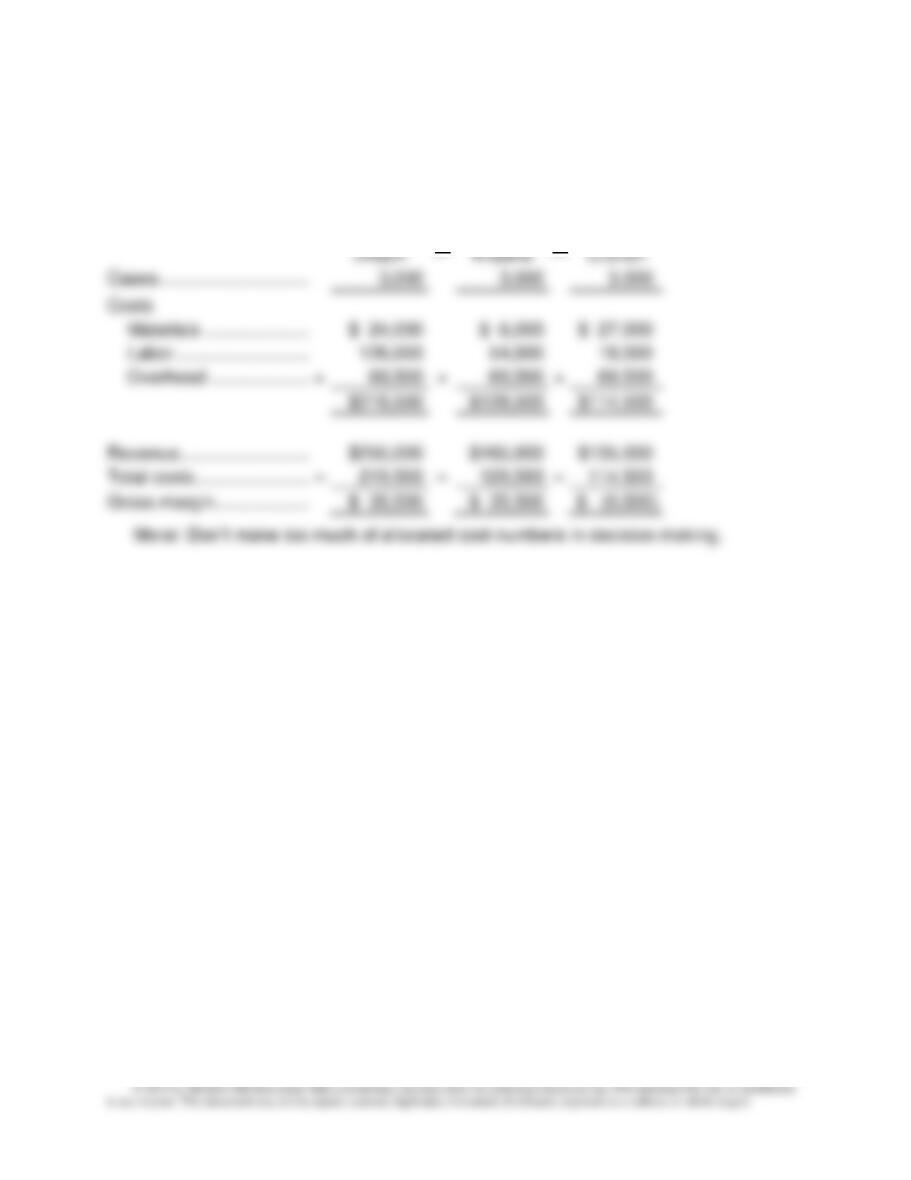
only 13.9%, computed as follows:
Cases Produced = 3,000
Overhead Allocation = $69,500 ÷ 3,000 = $23.17
Allocated production costs:
Almond
Dream
Material cost ………………………………………………
$ 8.00
Direct labor ………………………………………………..
42.00
Allocated OH ………………………………………………
23.17
Production cost per case ……………………………..
$73.17
Selling price ……………………………………………….
$85.00
Product cost ……………………………………………….
(73.17)
$11.83
Profit margin ratio:
Ratio = Gross Margin/Price …………………………..
13.9%
Chapter 09 – Activity-Based Costing
9-54
9-52. (continued)
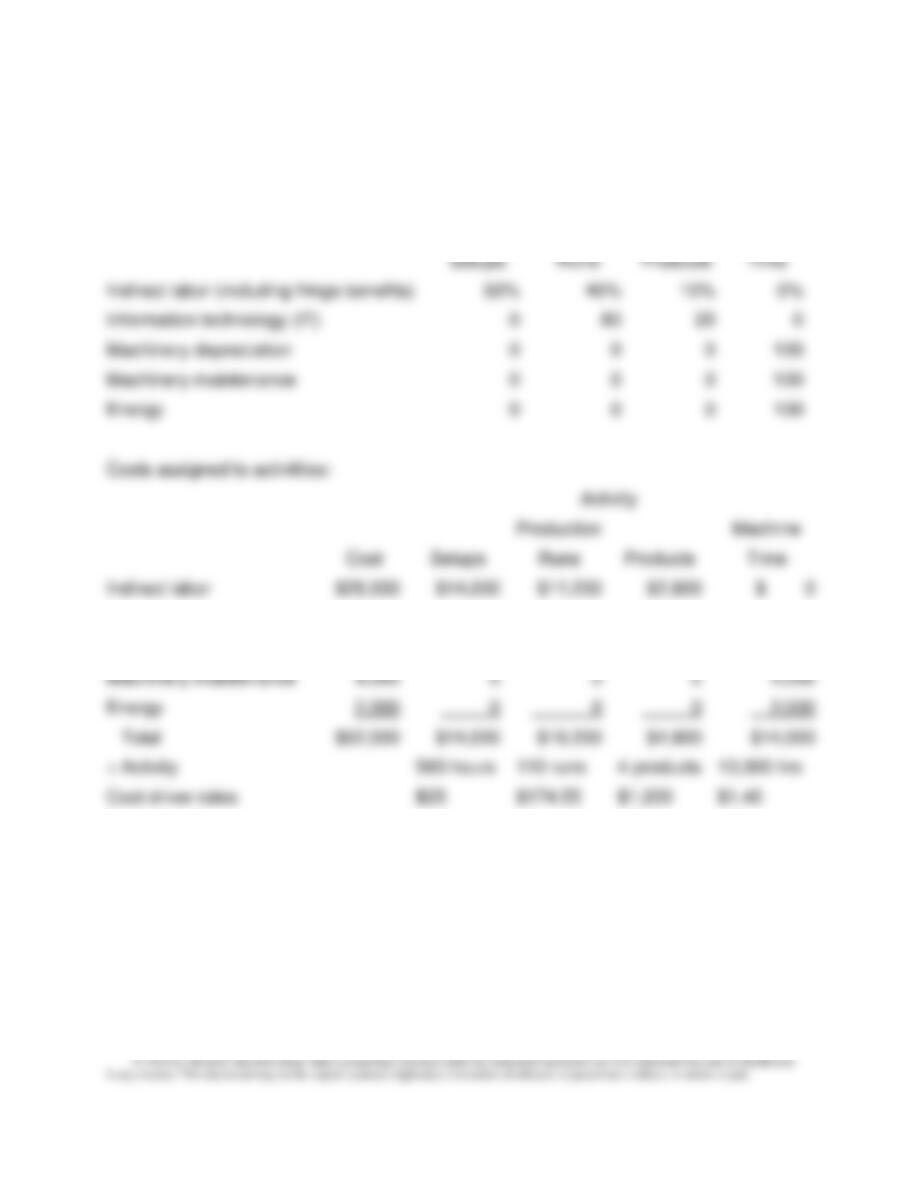
If we compute the gross margin for the three products at maximum production, we
find Almond Dream and Krispy Krackle to be equally profitable, computed as follows:
Almond
Dream
or
Krispy
Krackle
or
Creamy
Crunch
Cases …………………………..
3,000
3,000
3,000
Costs
Materials …………………………..
$ 24,000
$ 6,000
$ 27,000
Labor …………………………..
126,000
54,000
18,000
Overhead ………………..…………
+
69,500
+
69,500
+
69,500
$219,500
$129,500
$114,500
Revenue ……………………..……
$255,000
$165,000
$105,000
Total costs …………………..………
–
219,500
–
129,500
–
114,500
Gross margin……………….………….
$ 35,500
$ 35,500
$ (9,500)
Moral: Don’t make too much of allocated cost numbers in decision making.
Chapter 09 – Activity-Based Costing
9-55
9-53. (90 min.) Activity-Based Costing – The Grape Cola Caper.
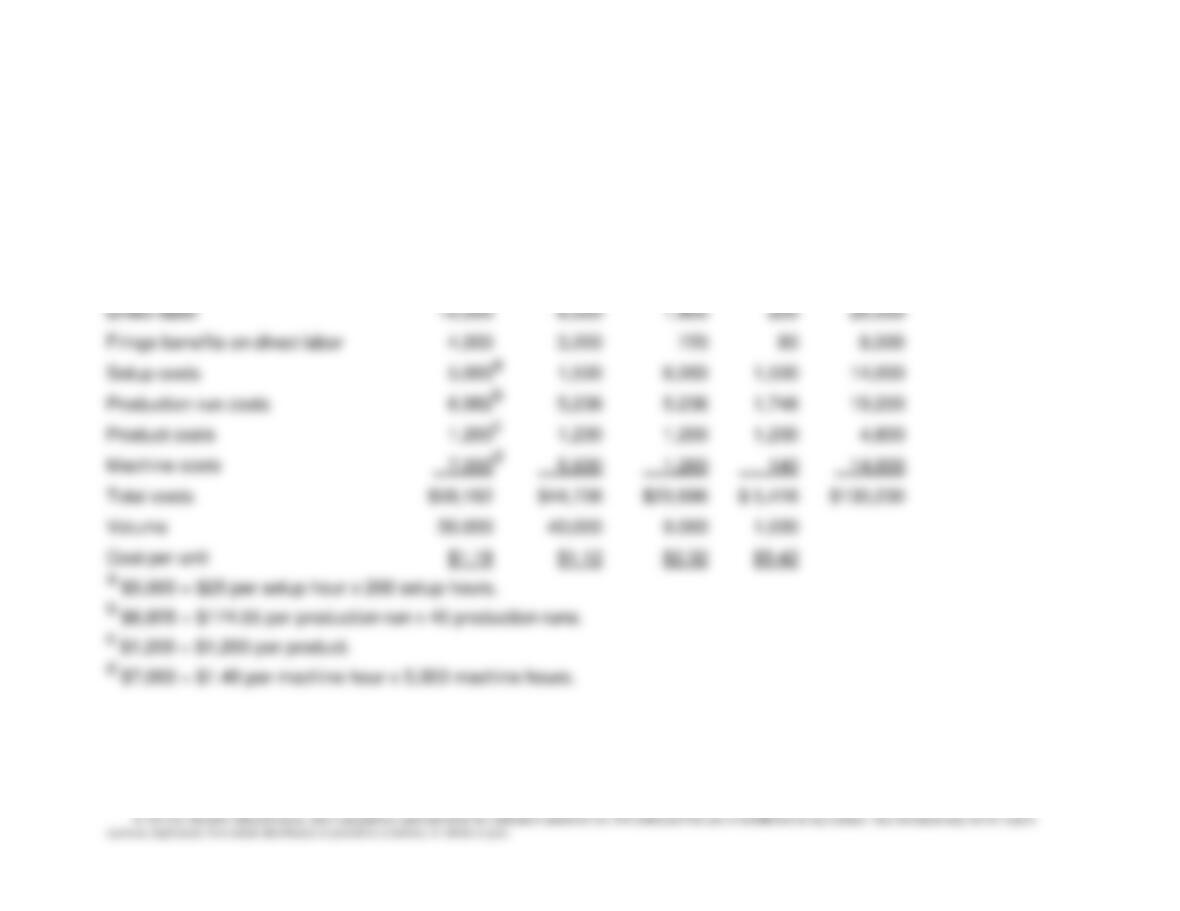
a. Percentage utilization of resource by activities:
Activity
Setups
Production
Runs
Products
Machine
Time
Indirect labor (including fringe benefits)
50%
40%
10%
0%
Information technology (IT)
0
80
20
0
Machinery depreciation
0
0
0
100
Machinery maintenance
0
0
0
100
Energy
0
0
0
100
Costs assigned to activiities:
Activity
Cost
Setups
Production
Runs
Products
Machine
Time
Indirect labor
$28,000
$14,000
$11,200
$2,800
$ 0
IT
10,000
0
8,000
2,000
0
Machinery depreciation
8,000
0
0
0
8,000
Machinery maintenance
4,000
0
0
0
4,000
Energy
2,000
0
0
0
2,000
Total
$52,000
$14,000
$19,200
$4,800
$14,000
÷ Activity
560 hours
110 runs
4 products
10,000 hrs
Cost driver rates
$25
$174.55
$1,200
$1.40
Chapter 09 – Activity-Based Costing
9-56
9-53. (continued)
b.
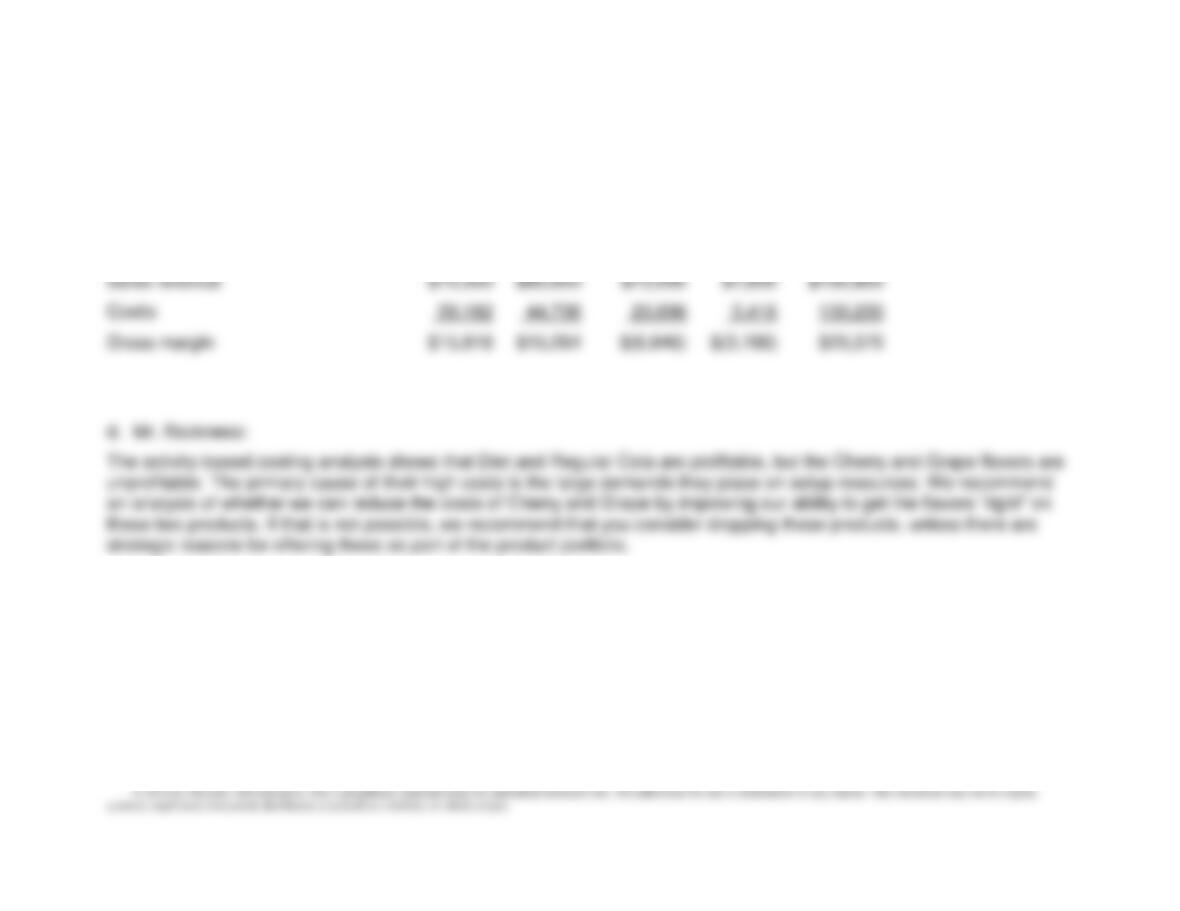
Unit Costs on Cola Bottling Line
Diet
Regular
Cherry
Grape
Total
Materials
$ 25,000
$ 20,000
$ 4,680
$ 550
$ 50,230
Direct labor
10,000
8,000
1,800
200
20,000
Fringe benefits on direct labor
4,000
3,200
720
80
8,000
Setup costs
5,000
a
1,500
6,000
1,500
14,000
Production run costs
6,982
b
5,236
5,236
1,746
19,200
Product costs
1,200
c
1,200
1,200
1,200
4,800
Machine costs
7,000
d
5,600
1,260
140
14,000
Total costs
$59,182
$44,736
$20,896
$ 5,416
$130,230
Volume
50,000
40,000
9,000
1,000
Cost per unit
$1.18
$1.12
$2.32
$5.42
a $5,000 = $25 per setup hour x 200 setup hours.
b $6,928 = $174.55 per production run x 40 production runs.
c $1,200 = $1,200 per product.
d $7,000 = $1.40 per machine hour x 5,000 machine hours.
Chapter 09 – Activity-Based Costing
9-57
9-53. (continued)
c.
Monthly Report on Cola Bottling Line
Diet
Regular
Cherry
Grape
Total
Sales revenue
$75,000
$60,000
$13,950
$1,650
$150,600
Costs
59,182
44,736
20,896
5,416
130,230
Gross margin
$15,818
$15,264
$(6,946)
$(3,766)
$20,370
d. Mr. Rockness:
The activity-based costing analysis shows that Diet and Regular Cola are profitable, but the Cherry and Grape flavors are
unprofitable. The primary cause of their high costs is the large demands they place on setup resources. We recommend
an analysis of whether we can reduce the costs of Cherry and Grape by improving our ability to get the flavors “right” on
these two products. If that is not possible, we recommend that you consider dropping these products, unless there are
strategic reasons for offering these as part of the product portfolio.