Chapter 09 – Activity-Based Costing
9-41
9-48. (40 min.) Choosing an Activity-Based Costing System: MTI.
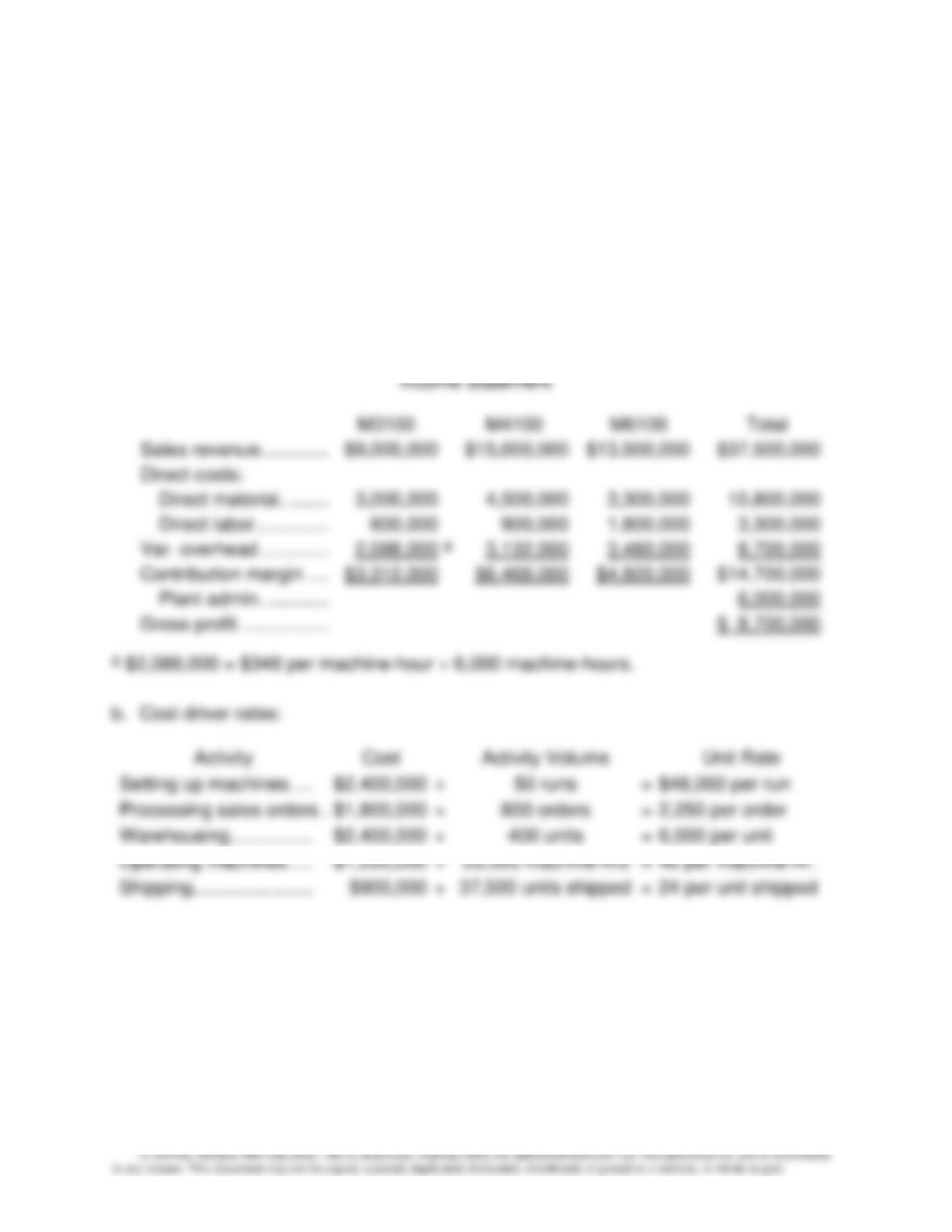
a. Total overhead to allocate is $8,700,000 (= $2,400,000 + $1,800,000 + $2,400,000 +
$1,200,000 + $900,000).
The overhead rate is $348 per machine-hour (= $8,700,000 ÷ 25,000 machine-hours).
MTI
Chapter 09 – Activity-Based Costing
9-42
9-48. (continued)
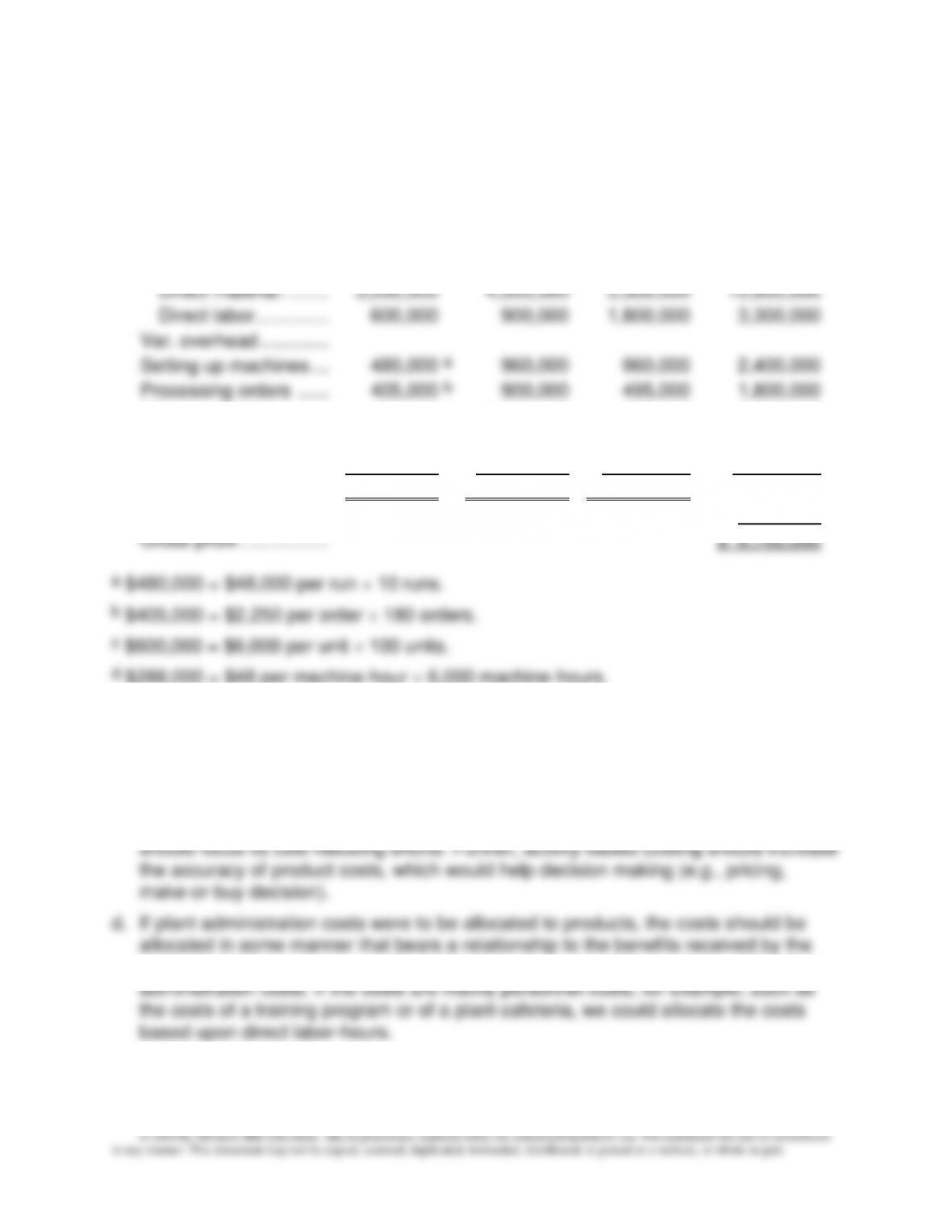
Income Statement
M3100
M4100
M6100
Total
Sales revenue ………….……………….
$9,000,000
$15,000,000
$13,500,000
$37,500,000
Direct costs:
Direct material. ……..……………………
3,000,000
4,500,000
3,300,000
10,800,000
Direct labor …………..………………
600,000
900,000
1,800,000
3,300,000
Var. overhead ………….……………….
Setting up machines …………………………..
480,000
a
960,000
960,000
2,400,000
Processing orders …………………………..
405,000
b
900,000
495,000
1,800,000
Warehousing …………………………..
600,000
c
1,200,000
600,000
2,400,000
Operating machines ….……………………….
288,000
d
432,000
480,000
1,200,000
Shipping ………………….……….
240,000
e
420,000
240,000
900,000
Cont. margin …………………………..
$3,387,000
$ 5,688,000
$ 5,625,000
$14,700,000
Plant admin. …………………………..
6,000,000
Gross profit ……………..……………
$ 8,700,000
a $480,000 = $48,000 per run 10 runs.
b $405,000 = $2,250 per order 180 orders.
c $600,000 = $6,000 per unit 100 units.
d $288,000 = $48 per machine-hour 6,000 machine-hours.
e $240,000 = $24 per unit shipped 10,000 units shipped.
c. Although both methods yield similar product costs, the activity-based costing method
provides a more detailed breakdown of the costs. This additional information should
enable MTI management to make better decisions. For example, if MTI wants to
reduce costs, then activity-based costing will list the activities on which management
products. In this case, we would want to know more about the contents of the plant
Chapter 09 – Activity-Based Costing
9-43
Solutions to Integrative Cases
9-49. Decision Making and Distorted Costs: ACE Industries.
This problem is a simple illustration of the death spiral.
a.
A
C
E
Total
Sales revenue ……………….…..
$270,000
$165,000
$305,000
$740,000
Material costs ……………….…..
70,000
65,000
145,000
280,000
Labor costs …………………..…..
20,000
12,000
28,000
60,000
Manufacturing overhead ……..
240,000
Operating profit ……………..…..
$160,000
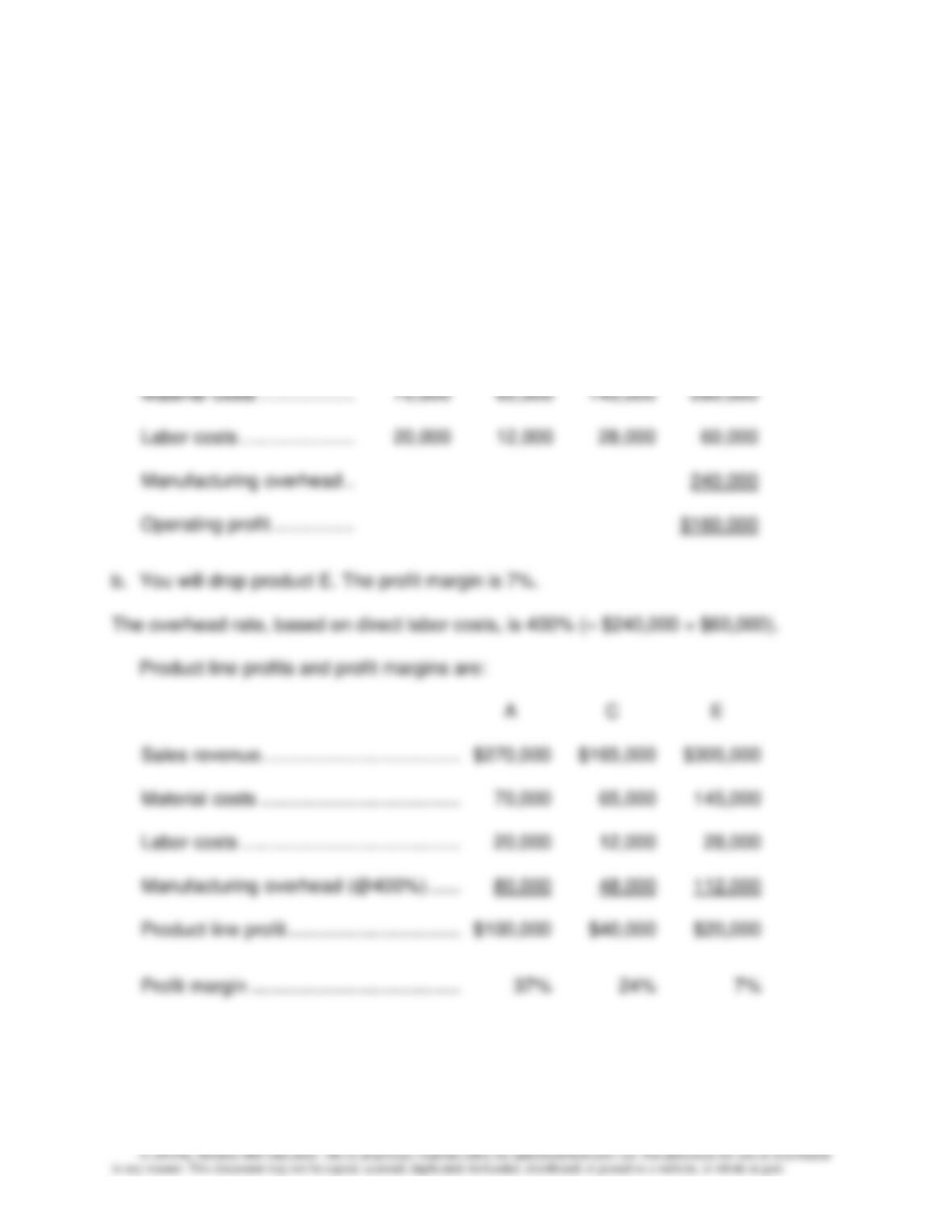
b. You will drop product E. The profit margin is 7%.
The overhead rate, based on direct labor costs, is 400% (= $240,000 ÷ $60,000).
Product line profits and profit margins are:
A
C
E
Sales revenue …………………………………..
$270,000
$165,000
$305,000
Material costs …………………………………..
70,000
65,000
145,000
Labor costs ……………………………………...
20,000
12,000
28,000
Manufacturing overhead (@400%) ……...
80,000
48,000
112,000
Product line profit ……………………………...
$100,000
$40,000
$20,000
Profit margin …………………………………....
37%
24%
7%
Chapter 09 – Activity-Based Costing
9-44
9-49. (continued)
c.
A
C
Total
Sales revenue ……………….…..
$270,000
$165,000
$435,000
Material costs ……………….…..
70,000
65,000
135,000
Labor costs …………………..…..
20,000
12,000
32,000
Manufacturing overhead ……..
208,000
Operating profit ……………..…..
$60,000
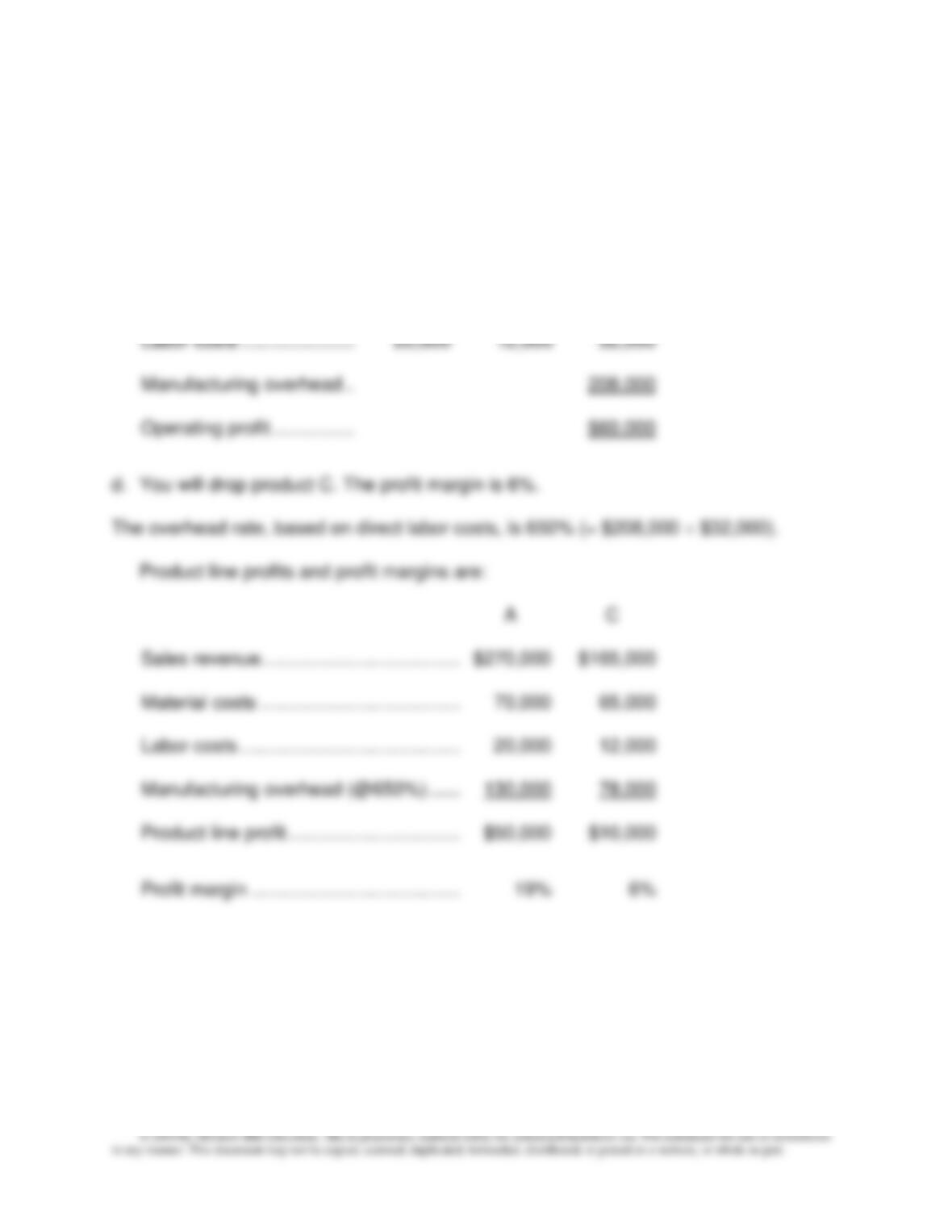
d. You will drop product C. The profit margin is 6%.
The overhead rate, based on direct labor costs, is 650% (= $208,000 ÷ $32,000).
Product line profits and profit margins are:
A
C
Sales revenue …………………………………..
$270,000
$165,000
Material costs …………………………………..
70,000
65,000
Labor costs ……………………………………...
20,000
12,000
Manufacturing overhead (@650%) ……...
130,000
78,000
Product line profit ……………………………...
$50,000
$10,000
Profit margin …………………………………....
19%
6%
Chapter 09 – Activity-Based Costing
9-45
9-49. (continued)
e.
A
Total
Sales revenue ……………….…..
$270,000
$270,000
Material costs ……………….…..
70,000
70,000
Labor costs …………………..…..
20,000
20,000
Manufacturing overhead ……..
190,000
Operating profit ……………..…..
$(10,000)
f. The problem is that some part of the overhead is unavoidable, so that when
products are dropped, the overhead does not decline proportionately. The reported
profit margin, computed by using an overhead rate that includes both fixed and
variable overhead costs is not useful for decision making.
9-50. (50 Min) Cost Allocation and Environmental Processes—Ethical Issues:
California Circuits Company.
a.
XL-D
XL-C
Raw material …………………………….
$12.00
$14.00
Direct labor – Production …………….
$2.00
$2.00
Direct labor – Assembly ……………..
8.00
10.00
8.00
10.00
Overhead @ 120%a …………………..
12.00
12.00
Total ………………………………………..
$34.00
$36.00
a Overhead rate = Total overhead ÷ Total direct labor cost
= ($1,000,000 + $500,000) ÷ [(100,000 $10) + (25,000 $10)]
= 120% of direct labor costs
Chapter 09 – Activity-Based Costing
9-46
b.
XL-D
XL-C
Raw material ……………………………..
$12.00
$14.00
Direct labor – Production ……………..
$2.00
$2.00
Direct labor – Assembly ………………
8.00
10.00
8.00
10.00
Overhead – Production @ $5 per MHa ….……….
$8.00
$8.00
Overhead – Assembly @ $10 per DLHb ………….
4.00
12.00
4.00
12.00
Total …………………………………………
$34.00
$36.00
a Overhead rate—Production Department = Production overhead ÷ Total machine–
hours
= $1,000,000 ÷ [(100,000 1.6) + (25,000 1.6)]
= $5 per machine-hour
b Overhead Rate—Assembly Department = Assembly overhead ÷ Total direct labor-hrs
= $500,000 ÷ [(100,000 0.4) + (25,000 0.4)]
= $10 per direct labor-hour
c. Since both products use machine time and direct labor time in the same proportion
(in fact, in equal amounts), it is irrelevant whether machine-hours or direct labor-
hours are used to allocate overhead costs to the final products or whether it is done
by manufacturing department or using a plantwide rate.
9-50. (continued)
d.
XL-D
XL-C
Raw material …………………………………..
$12.00
$14.00
Direct labor – Production …………………..
$2.00
$2.00
Direct labor – Assembly ……………………
8.00
10.00
8.00
10.00
Overhead – Productiona
Supervision @ $8/direct labor-hour ….
$0.80
$0.80
Material handling @ 6% mat’l. cost ….
0.72
0.84
Testing @ $0.40/ test hour ……………..
1.20
1.20
Waste treatment @ $0.25/gallon ……..
2.50
0.00
Depreciation @ $2/mach. hr ……………
3.20
3.20
Shipping @ $0.05/pound ………………..
0.05
0.08
Chapter 09 – Activity-Based Costing
Total production overhead …………………
8.47
6.12
Overhead – Assembly @ $10/DLHb ……
4.00
4.00
Total ………………………………………………
$34.47
$34.12
Chapter 09 – Activity-Based Costing
9-48
9-50. (continued)
e. This question raises the issue of costs that are missing in the typical accounting
records of the firm. In this case, the ABC system suggests that XL-C, the model that
9-51. (60 min.) Distortions Caused By Inappropriate Overhead Allocation Base:
Chocolate Bars, Inc.
a.
Almond
Dream
Krispy
Krackle
Creamy
Crunch
Product costs:
Labor-hours per case …………………….…….
7
3
1
Total cases produced …………………….…….
1,000
1,000
1,000
Material cost per case …………………………..
$8.00
$2.00
$9.00
Direct labor cost per case……………….…………
$42.00
$18.00
$6.00
Labor-hours per product …………………………..
7,000
3,000
1,000
Total overhead = $69,500
Total labor-hours = 11,000
Direct labor costs per hour = $6.00
Allocation rate per labor-hour = $6.32 per labor-hour (rounded)
Costs of products:
Material cost per case …………………………..
$ 8.00
$ 2.00
$ 9.00
Direct labor cost per case……………….…………
42.00
18.00
6.00
Allocated overhead per case …………..…………
44.24
18.96
6.32
Product cost ……………………………………………
$94.24
$38.96
$21.32
Selling price …………………………………….…………
$85.00
$55.00
$35.00
Gross profit margin …………………………..…………
(10.87
)%
29.16
%
39.09
%
Drop product? ………………………………….…………
Yes
No
No
Chapter 09 – Activity-Based Costing
9-49
© 2014 by McGraw-Hill Education. This is proprietary material solely for authorized instructor use. Not authorized for sale or distribution
in any manner. This document may not be copied, scanned, duplicated, forwarded, distributed, or posted on a website, in whole or part.
b. Almond Dream has a much higher proportion of direct labor-hours than Krispy
Krackle or Creamy Crunch, so Almond Dream is allocated a greater share of the
overhead costs.
9-51. (continued)
c.
Krispy
Krackle
Creamy
Crunch
Direct labor cost per hour …………………………….
$6.00
$6.00
Direct labor-hours per case…………………………..
3
1
Total cases produced ………………………………….
1,000
2,000
Labor-hours per product ………………………………
3,000
2,000
Total labor-hours: 5,000
Allocation rate per labor-hour
=
Total overhead ÷ Total labor-hours
=
$69,500/5,000
=
$13.90
per labor-hour
Allocated production costs:
Krispy
Krackle
Creamy
Crunch
Material cost per case ………………………………….
$ 2.00
$ 9.00
Direct labor cost per case ……………………….….
18.00
6.00
Allocated overhead per case
($13.90 per labor-hour) ……………………….….
41.70
13.90
Product cost ……………………………………………….
$61.70
$28.90
Gross profit margins:
Selling price ………………………………………….…….
$55.00
$35.00
Product cost—direct labor allocation base ..…….
(61.70
)
(28.90
)
$ (6.70
)
$ 6.10
Profit margin percentage ………………………..…
$(6.70) ÷ $55.00
$6.10 ÷ $35.00
=
(12.2)
%
=
17.4
%
The recommendation to management is to drop Krispy Krackle and increase
production of Creamy Crunch.