Chapter 09 – Activity-Based Costing
9-1
© 2014 by McGraw-Hill Education. This is proprietary material solely for authorized instructor use. Not authorized for sale or distribution
in any manner. This document may not be copied, scanned, duplicated, forwarded, distributed, or posted on a website, in whole or part.
Chapter 9
Activity-Based Costing
Solutions to Review Questions
9-1.
Common allocation bases are direct labor-hours, direct labor costs, and machine-hours.
Somewhat less common is direct material costs.
9-2.
False. Department allocation is a two-stage process, so the first-stage assignment of
9-3.
Most companies produce multiple products and simply adding them up does not
9-4.
The costs include the systems and the software, but the most important cost is
managers’ time. Managers need to make many decisions about the activities and the
9-5.
1. Identify activities that consume resources.
2. Identify the cost driver associated with each activity.
3. Compute a cost rate per activity unit (e.g., rate per setup, rate per part, rate per
machine-hour).
4. Allocate costs to products by multiplying the activity rate times the volume of activity
consumed by the product.
Chapter 09 – Activity-Based Costing
9-2
9-6.
False. While the total cost allocated is the same, the reported costs for individual
9-7.
Activity-based costing will benefit most companies with high overhead costs and diverse
products and processes. If there is little overhead or if there is a single product, the
9-8.
A personnel department provides its services by completing a set of activities using
resources. In this way, implementing activity-based costing in an administrative function
9-9.
9-10.
Activity-based costing does not change the process for direct costs, so the statement is
9-11.
9-3
© 2014 by McGraw-Hill Education. This is proprietary material solely for authorized instructor use. Not authorized for sale or distribution
in any manner. This document may not be copied, scanned, duplicated, forwarded, distributed, or posted on a website, in whole or part.
using appropriate cost drivers (e.g., number of students, number of classes, number of
faculty, etc.).
9-12.
False. Activity-based costing is most useful when the first-stage allocation is to
9-13.
There is no rule that the price charged for a product has to exceed its cost. There may
be important marketing or strategic reasons why a company wants to be in a particular
9-14.
Activity-based costing is like any other information system; it has its benefits and its
costs. It is not appropriate in all situations and the benefits may not justify its costs in
others.
9-15.
9-16.
9-17.
9-18.
Chapter 09 – Activity-Based Costing
9-4
© 2014 by McGraw-Hill Education. This is proprietary material solely for authorized instructor use. Not authorized for sale or distribution
in any manner. This document may not be copied, scanned, duplicated, forwarded, distributed, or posted on a website, in whole or part.
products that require more handling, perhaps because of toxicity, use more overhead
resources. Allocating no overhead costs to a product is as likely to distort decision
making as allocating costs based on an arbitrary allocation base.
9-19.
9-20.
Answers will vary. The function selected will determine the activities, but some
examples of activities are processing payments, processing job applications, checking
9-21.
Answers will vary. Elements of the system that suggest it is an ABC system include cost
pools that are activities, multiple cost pools, and multiple cost drivers. However, the two
9-22. (30 min.) Plantwide versus Department Allocation: Munoz Sporting
Equipment.
Baseball
Bats
Tennis
rackets
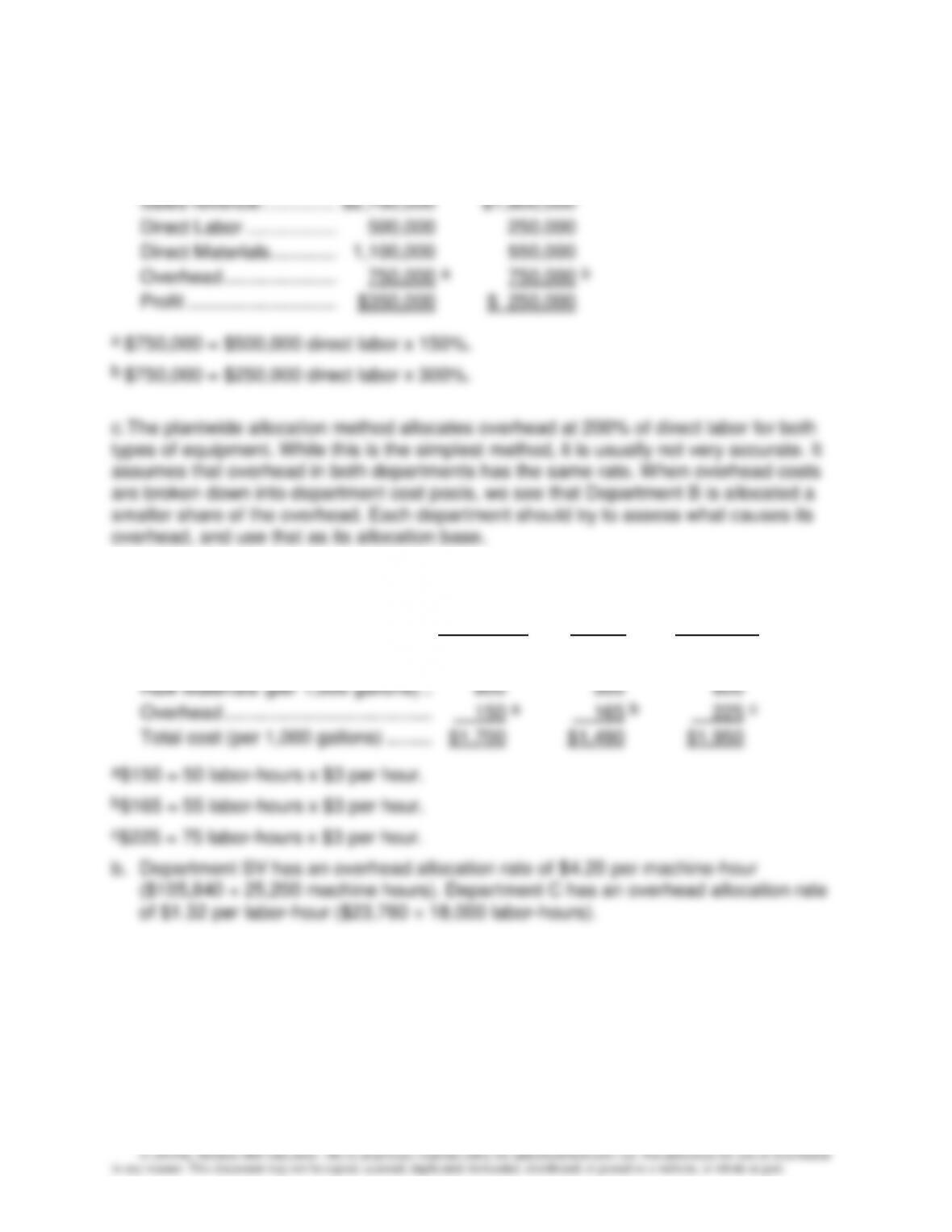
a.
Sales revenue …………………………..
$2,700,000
$1,800,000
Direct Labor …………………………..
500,000
250,000
Direct Materials ………….……………….
1,100,000
550,000
Overhead ………………….……….
1,000,000
a
500,000
b
Profit ………………………..…
$100,000
$ 500,000
a $1,000,000 = $500,000 direct labor x 200%.
b $500,000 = $250,000 direct labor x 200%.
Chapter 09 – Activity-Based Costing
9-5
b. Maria was wrong; Baseball bats were more profitable.
Baseball
Bats
Tennis
rackets
Sales revenue …………………………..
$2,700,000
$1,800,000
Direct Labor …………………………..
500,000
250,000
Direct Materials ………….……………….
1,100,000
550,000
Overhead ………………….……….
750,000
a
750,000
b
Profit ………………………..…
$350,000
$ 250,000
9-23. (35 min.) Plantwide versus Department Allocation: Main Street Ice Cream
Company.
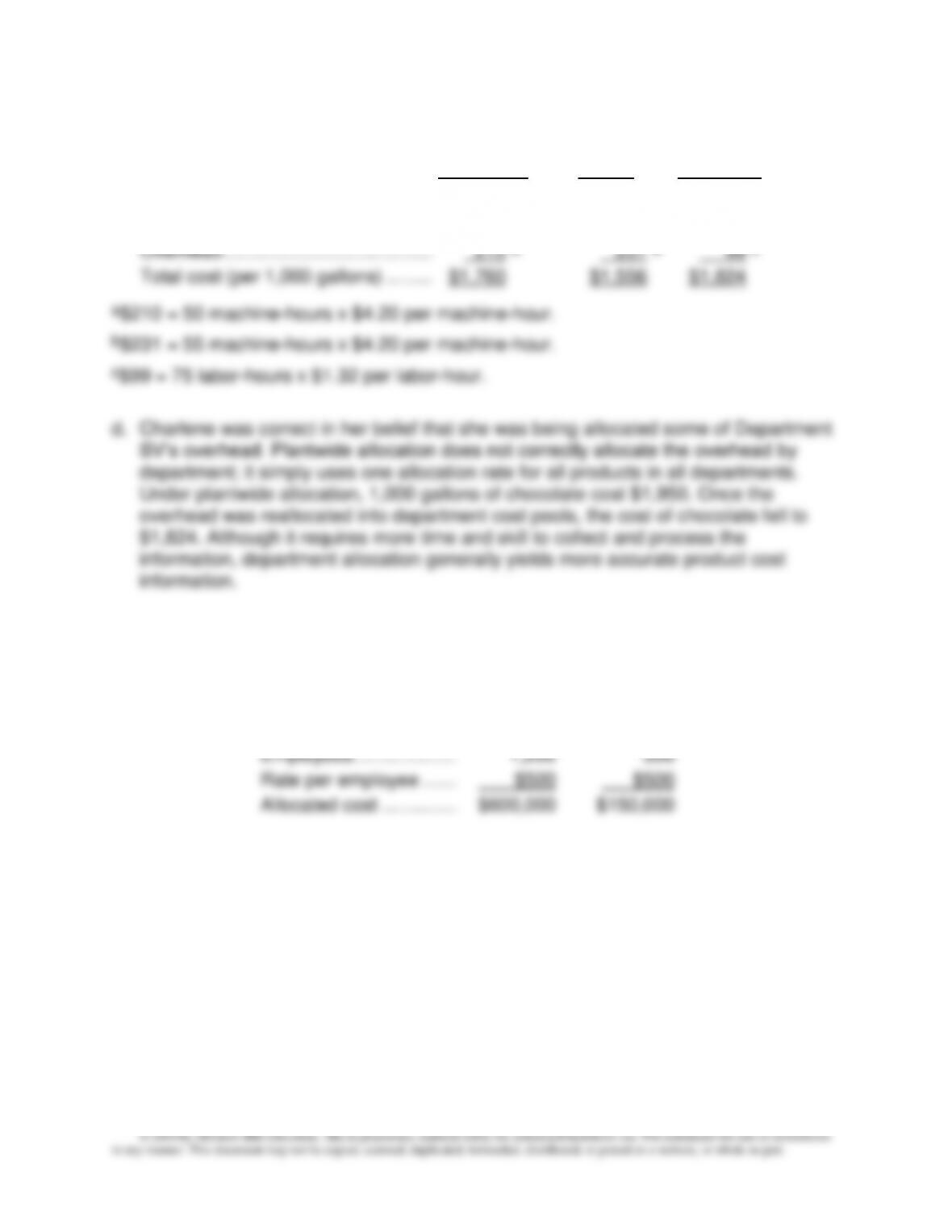
Strawberry
Vanilla
Chocolate
a.
Direct Labor (per 1,000 gallons) ……………………
$750
$825
$1,125
Raw Materials (per 1,000 gallons) …………………
800
500
600
Overhead …………………………………..………………
150
a
165
b
225
c
Total cost (per 1,000 gallons) ……….………………
$1,700
$1,490
$1,950
a$150 = 50 labor-hours x $3 per hour.
b$165 = 55 labor-hours x $3 per hour.
c$225 = 75 labor-hours x $3 per hour.
b. Department SV has an overhead allocation rate of $4.20 per machine-hour
($105,840 ÷ 25,200 machine hours). Department C has an overhead allocation rate
of $1.32 per labor-hour ($23,760 ÷ 18,000 labor-hours).
Chapter 09 – Activity-Based Costing
9-6
c.
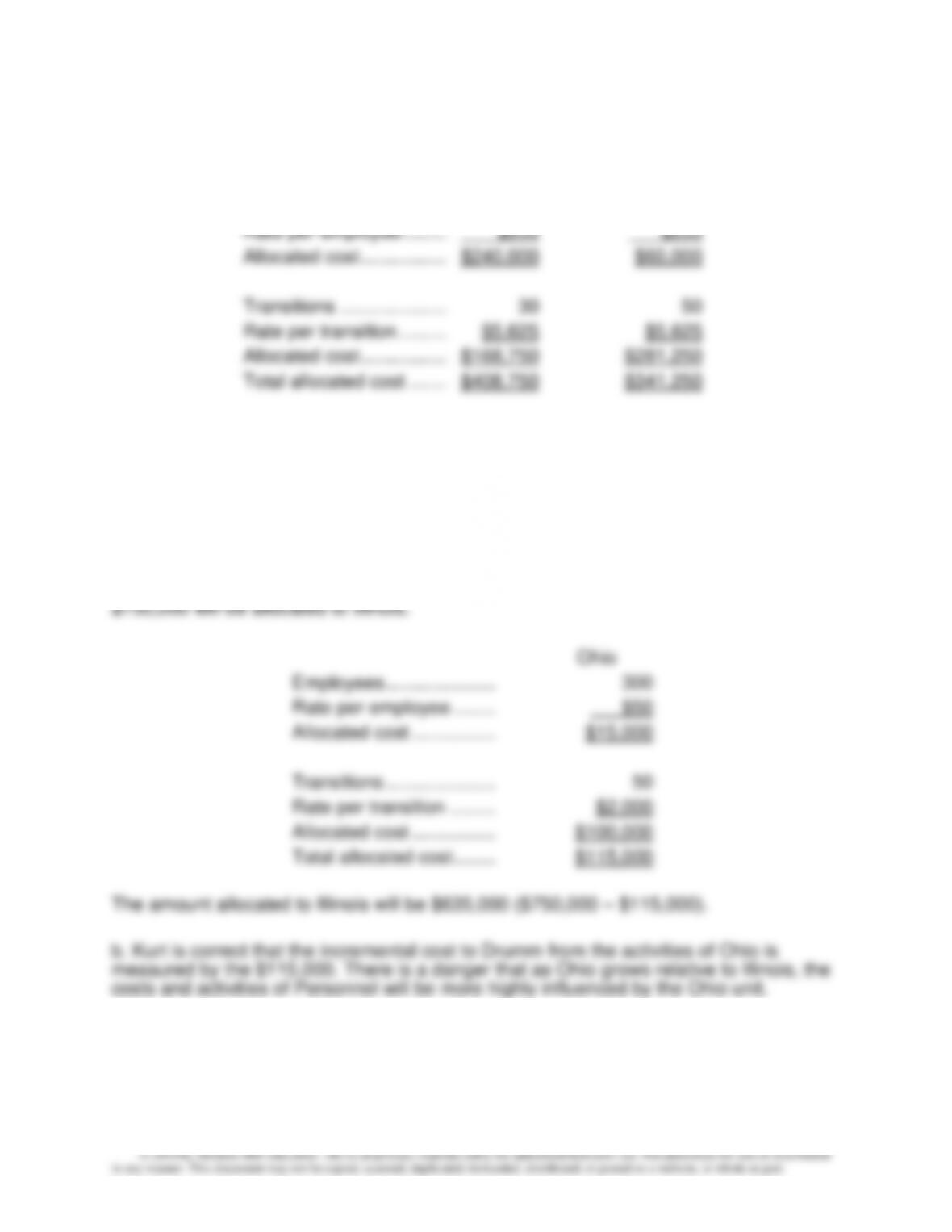
Strawberry
Vanilla
Chocolate
Direct Labor (per 1,000 gallons) ……………………
$750
$825
$1,125
Raw Materials (per 1,000 gallons) …………………
800
500
600
Overhead …………………………………..………………
210
a
231
b
99
c
Total cost (per 1,000 gallons) ……….………………
$1,760
$1,556
$1,824
a$210 = 50 machine-hours x $4.20 per machine-hour.
b$231 = 55 machine-hours x $4.20 per machine-hour.
c$99 = 75 labor-hours x $1.32 per labor-hour.
d. Charlene was correct in her belief that she was being allocated some of Department
SV’s overhead. Plantwide allocation does not correctly allocate the overhead by
department; it simply uses one allocation rate for all products in all departments.
Under plantwide allocation, 1,000 gallons of chocolate cost $1,950. Once the
overhead was reallocated into department cost pools, the cost of chocolate fell to
$1,824. Although it requires more time and skill to collect and process the
information, department allocation generally yields more accurate product cost
information.
9-24. (30 min.) Unitwide versus Department Allocation: Drumm Corporation.
a.
Illinois
Ohio
Employees ………………..…………
1,200
300
Rate per employee …….…………………….
$500
$500
Allocated cost …………………………..
$600,000
$150,000
Chapter 09 – Activity-Based Costing
b.
Illinois
Ohio
Employees …………………………..
1,200
300
Rate per employee …………………………..
$200
$200
Allocated cost ……………..……………
$240,000
$60,000
Transitions …………………………..
30
50
Rate per transition ……….………………….
$5,625
$5,625
Allocated cost ……………..……………
$168,750
$281,250
Total allocated cost ……..……………………
$408,750
$341,250
9-25. (30 min.) Unit wide versus Department Allocation: Drumm Corporation.
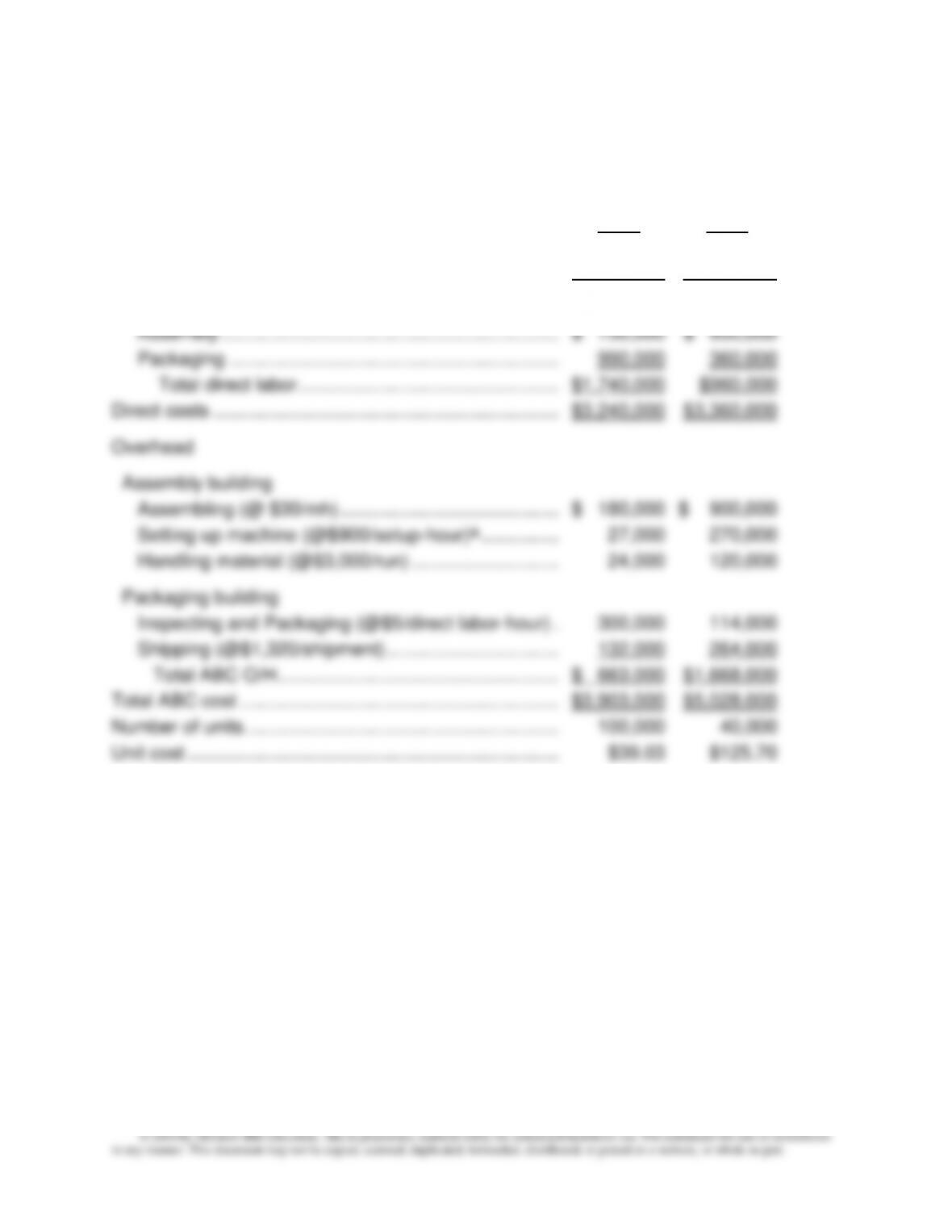
a. First, note that the total to be allocated is $750,000 (= $600,000 + $150,000 in the
current system or $408,750 + $341,250 in the revised system). Then we just need to
compute the variable cost to be allocated to Ohio; the difference between this and
Employees …………………………..
Rate per employee ……..……………………
Allocated cost …………….…………….
Transitions …………………………..
50
Rate per transition …………………………..
Allocated cost …………….…………….
$100,000
Total allocated cost ……..……………………
$115,000
Chapter 09 – Activity-Based Costing
9-8
9-26. (30 min.) Activity-Based Costing: Joplin Industries.
a.
J25P
J40X
Direct material ……………………………………………………..
$1,500,000
$2,400,000
Direct labor
Assembly ………………………………………………………..
$ 750,000
$ 600,000
Packaging …………………………..………………………….
990,000
360,000
Total direct labor …………………………………………..
$1,740,000
$960,000
Direct costs …………………………………………………………
$3,240,000
$3,360,000
Overhead
Assembly building
Assembling (@ $30/mh) ……………………………………
$ 180,000
$ 900,000
Setting up machine (@$900/setup-hour)a ……………
27,000
270,000
Handling material (@$3,000/run) ……………………….
24,000
120,000
Packaging building
Inspecting and Packaging (@$5/direct labor-hour) .
300,000
114,000
Shipping (@$1,320/shipment) …………………………...
132,000
264,000
Total ABC O/H………………………………………………
$ 663,000
$1,668,000
Total ABC cost …………………………………………………….
$3,903,000
$5,028,000
Number of units ……………………………………………………
100,000
40,000
Unit cost ……………………………………………………………..
$39.03
$125.70
a 75% of the amounts in Exhibit 9.16. ($27,000 = .75 $36,000; $270,000 = .75
$360,000).
Chapter 09 – Activity-Based Costing
9-9
9-26. (continued)
b. Kris could have made the reductions he planned, but the effect on the product costs
would have been different. The $99,000 reduction in setup costs (25% of $396,000),
would have been spread between the two products based on labor or machine–
hours.
Chapter 09 – Activity-Based Costing
9-10
9-27. (30 min.) Activity-Based Costing in a Nonmanufacturing Environment:
Cathy’s Catering.
a. & b.
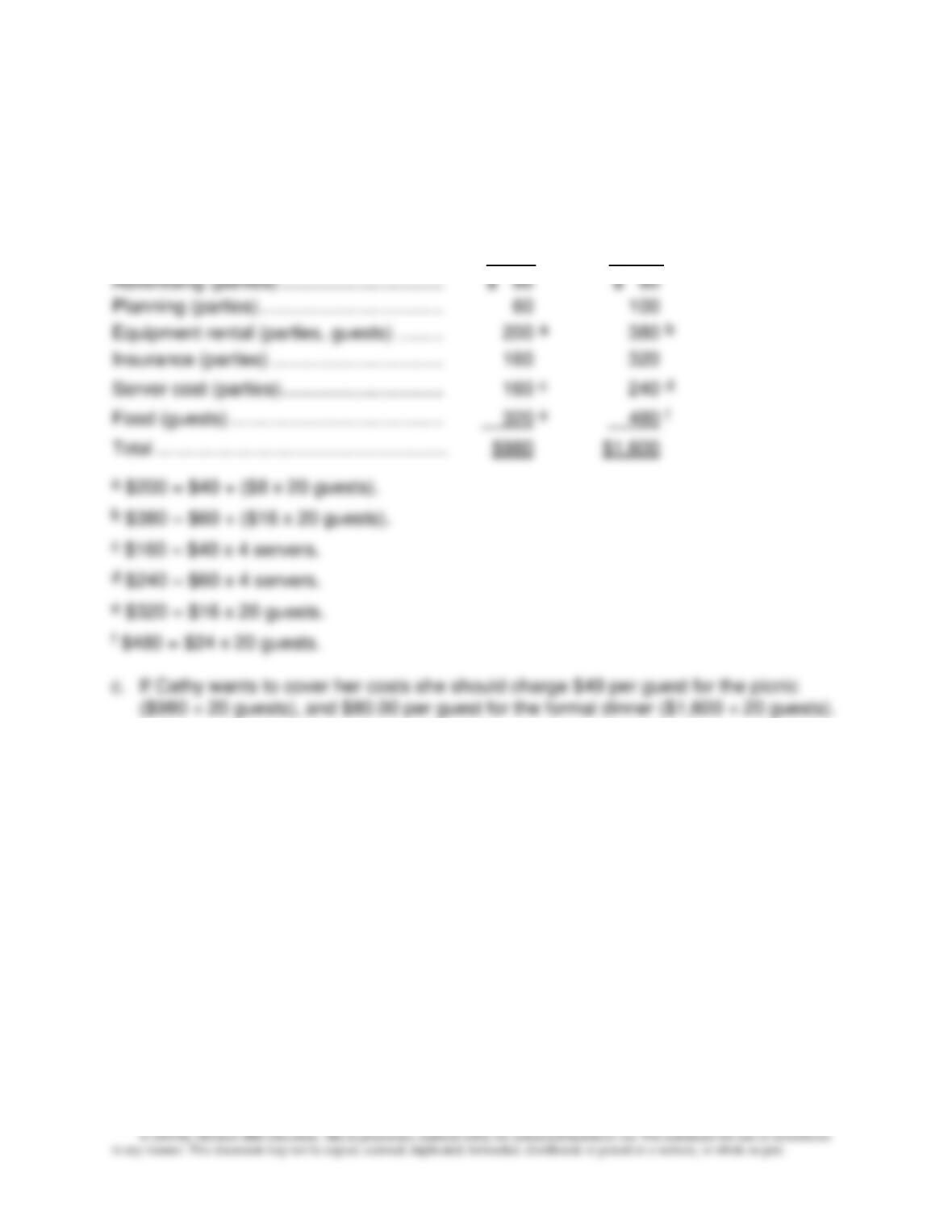
Activities
a.
Afternoon
Picnic
b.
Formal
Dinner
Advertising (parties) ………………………….
$ 80
$ 80
Planning (parties) ……………………………..
60
100
Equipment rental (parties, guests) ………
200
a
380
b
Insurance (parties) …………………………...
160
320
Server cost (parties) ………………………….
160
c
240
d
Food (guests) …………………………………..
320
e
480
f
Total ………………………………………………….
$980
$1,600
a $200 = $40 + ($8 x 20 guests).
b $380 = $60 + ($16 x 20 guests).
c $160 = $40 x 4 servers.
d $240 = $60 x 4 servers.
e $320 = $16 x 20 guests.
f $480 = $24 x 20 guests.
c. If Cathy wants to cover her costs she should charge $49 per guest for the picnic
($980 ÷ 20 guests), and $80.00 per guest for the formal dinner ($1,600 ÷ 20 guests).