Chapter 08 – Process Costing
8-51
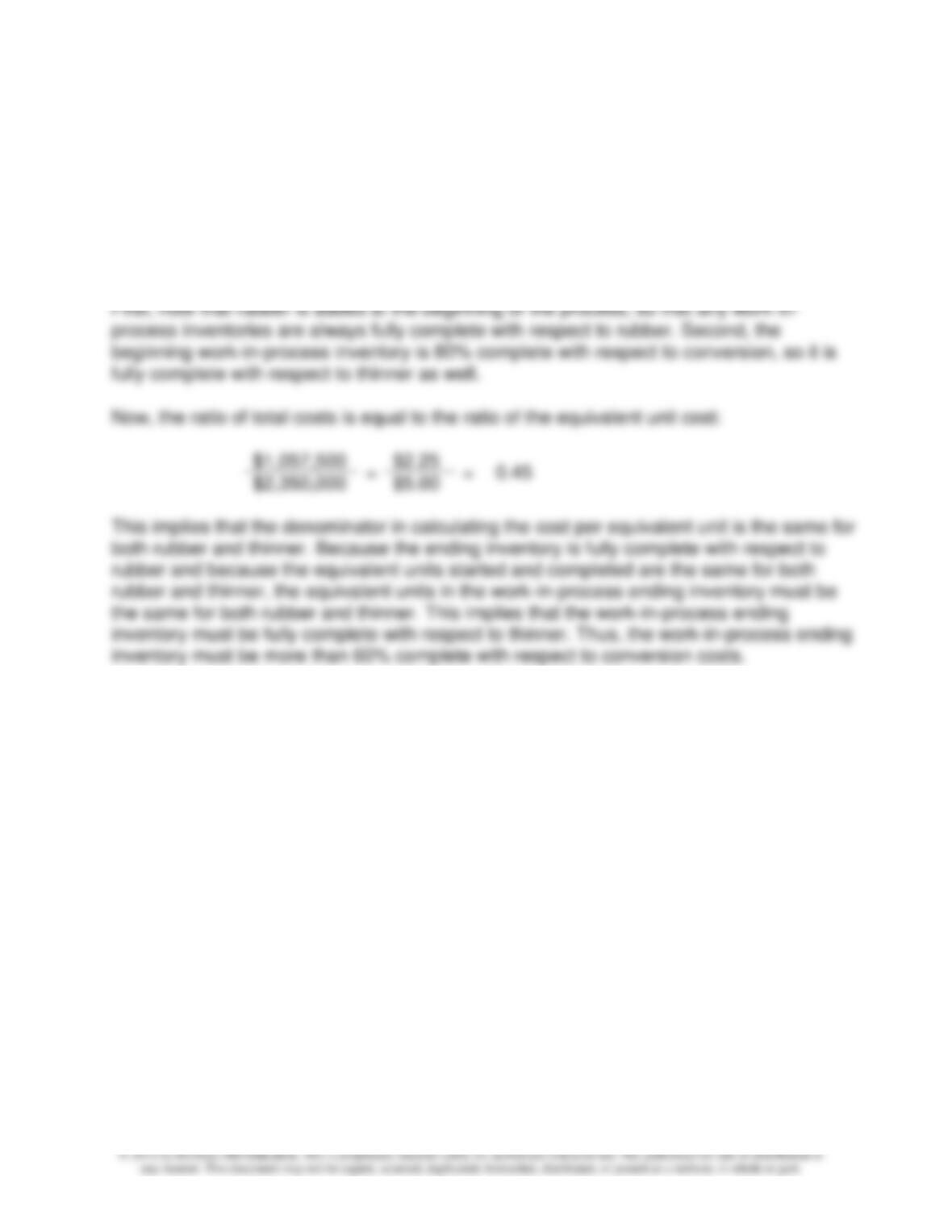
8-48. (30 min.) Determine Degree of Completion—FIFO method: Saline Solutions.
c. The ending work in process is at least 60% complete with respect to conversion costs.
This is a problem that requires relatively few computations, but a thorough understanding
of process costing. There are various ways to work through to an answer; the following is
one.
Chapter 08 – Process Costing
8-49. (40 min.) Solving For Unknowns—FIFO Method.
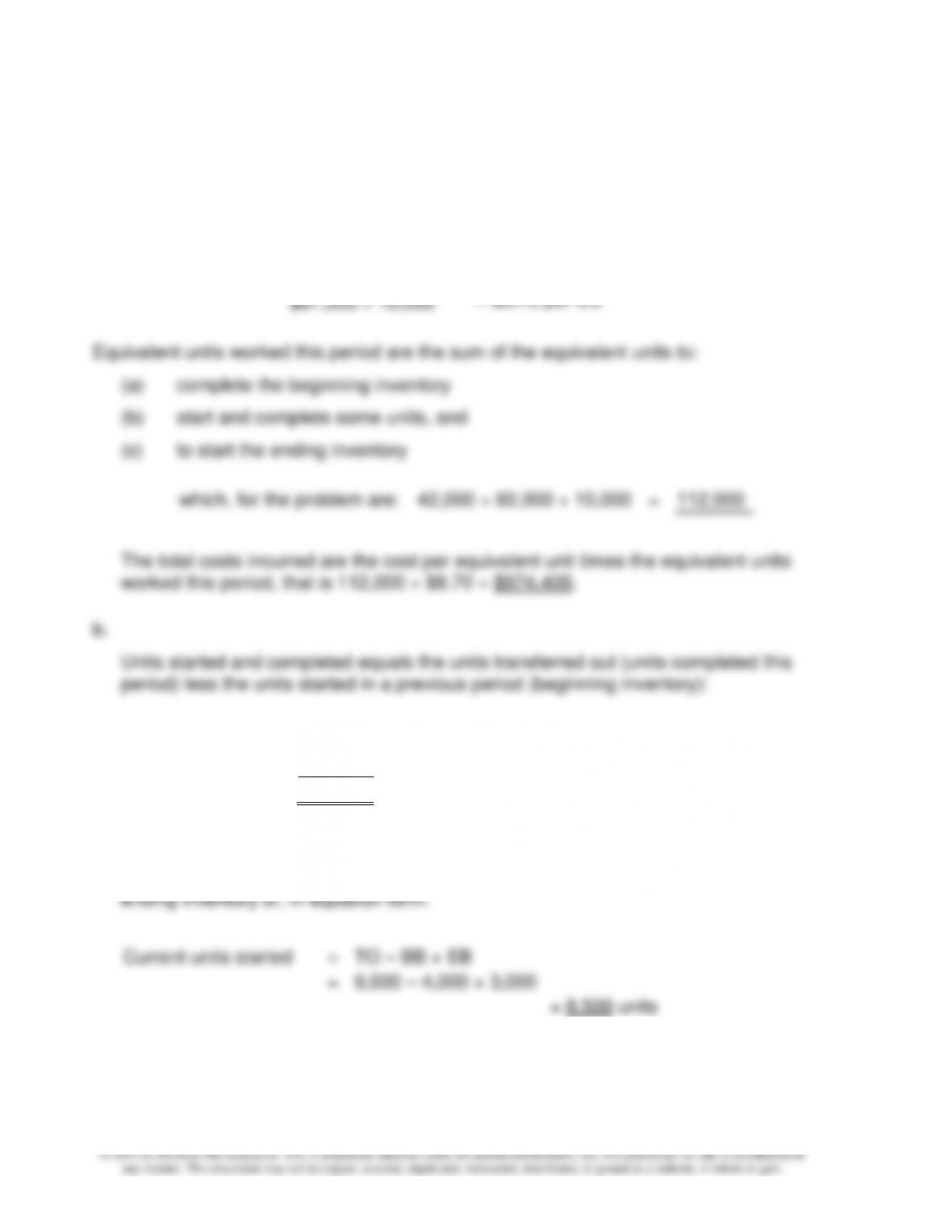
a. The cost per equivalent unit is obtained by dividing the ending inventory costs by the
equivalent units in ending inventory:
$87,000 ÷ 10,000
= $8.70 per EU
Equivalent units worked this period are the sum of the equivalent units to:
(a) complete the beginning inventory
(b) start and complete some units, and
(c) to start the ending inventory
which, for the problem are:
42,000 + 60,000 + 10,000
=
112,000
The total costs incurred are the cost per equivalent unit times the equivalent units
worked this period, that is 112,000 $8.70 = $974,400.
b.
Units started and completed equals the units transferred out (units completed this
period) less the units started in a previous period (beginning inventory):
40,000
units transferred out
–5,000
units in beginning inventory
35,000
units started and completed.
c.
Current units started equals units transferred out minus beginning inventory plus
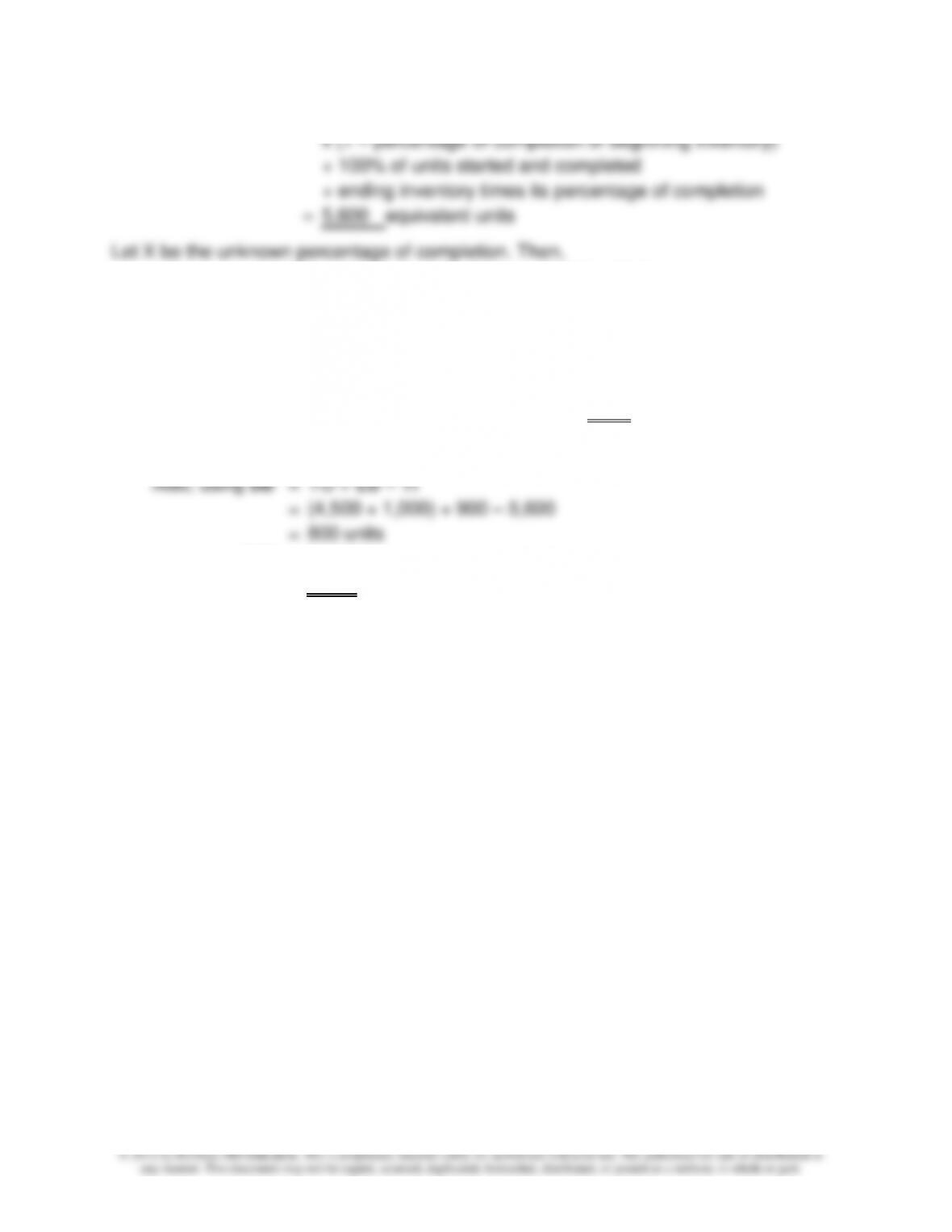
Chapter 08 – Process Costing
8-53
8-49. (continued)
d.
Equivalent units
=
Beginning inventory
x (1 – percentage of completion of beginning inventory)
+ 100% of units started and completed
+ ending inventory times its percentage of completion
=
5,600
equivalent units
5,600
=
1,000 (1 – X) + 4,500 + (3,000 x 30%)
5,600
=
1,000 – 1,000X + 5,400
collecting terms:
5,600 – 5,400 – 1,000
=
–1,000X
800
=
1,000X
X
=
80%
Also, using BB
=
TO + EB – TI
=
(4,500 + 1,000) + 900 – 5,600
=
800 units
800
=
1,000X
X
=
80%
Chapter 08 – Process Costing
8-54
8-50. (50 min.) Solving For Unknowns—Weighted-Average Method.
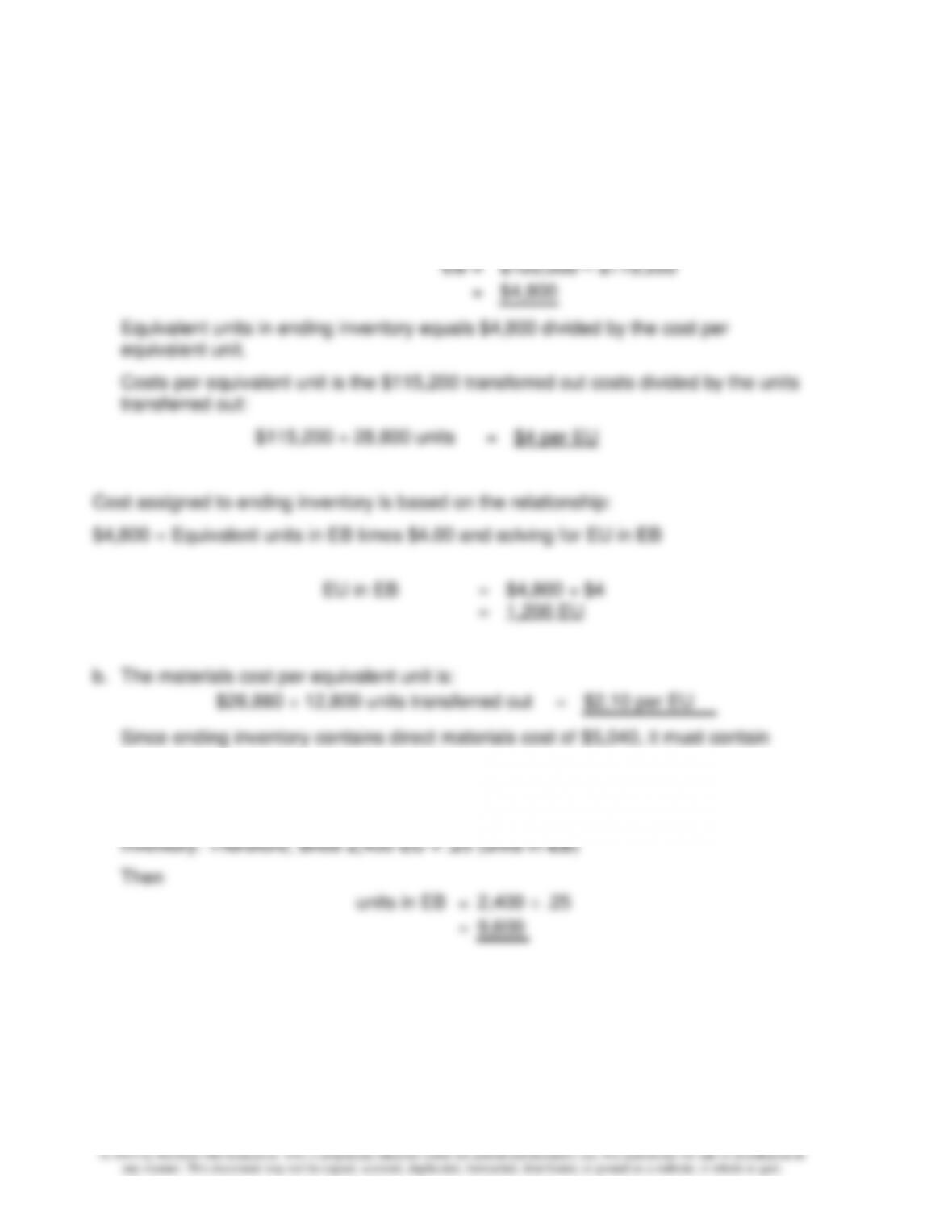
a. First, we compute the cost of ending inventory:
BB + TI (current work)
=
TO + EB
$11,400 + $108,600
=
$115,200 + EB
EB
=
$120,000 – $115,200
=
$4,800
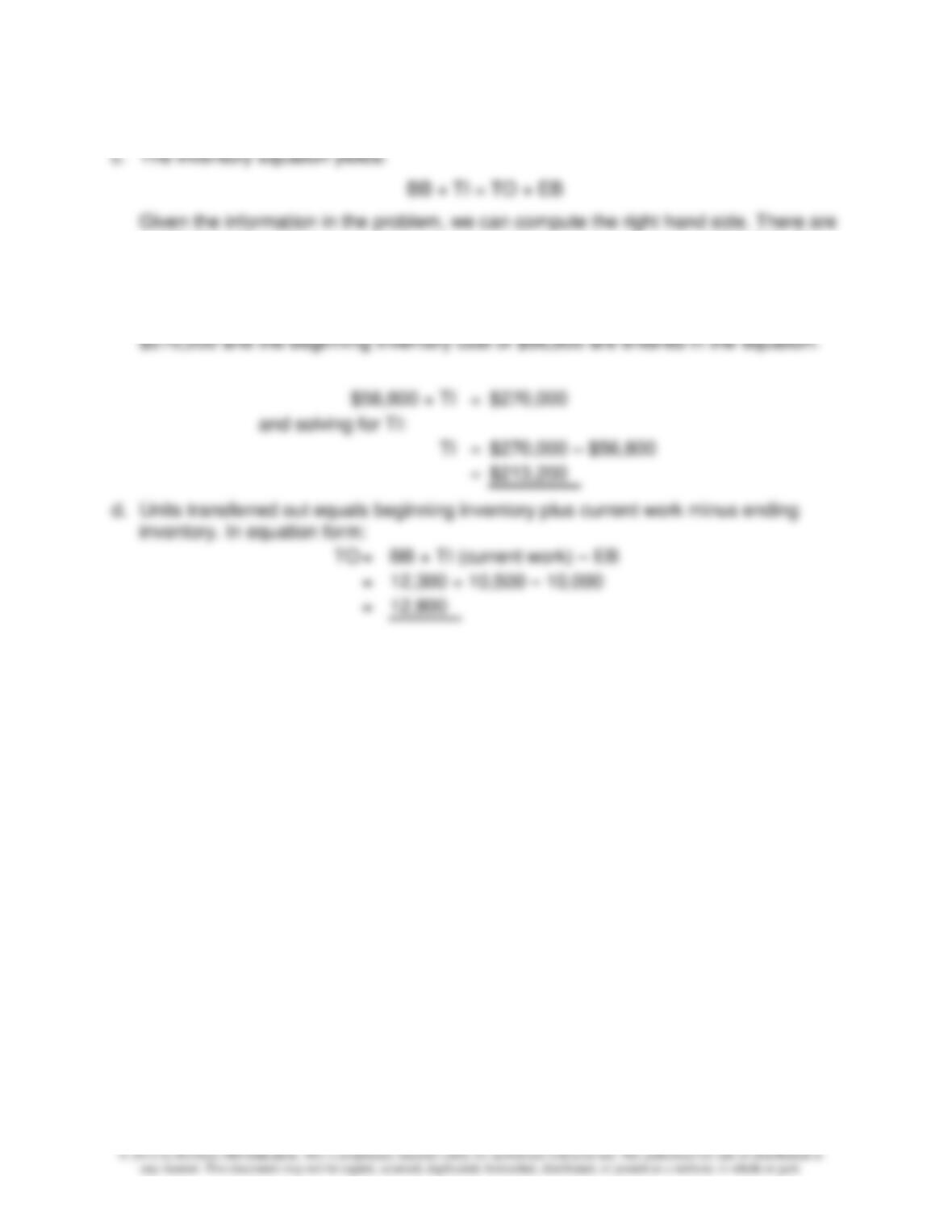
$26,880 ÷ 12,800 units transferred out
=
$2.10 per EU
2,400 ( = $5,040 ÷ $2.10) equivalent units.
If the inventory is 25% complete with respect to direct materials costs, then these
2,400 equivalent units represent 25% of the physical count of units in the ending
Chapter 08 – Process Costing
8-55
8-50. (continued)
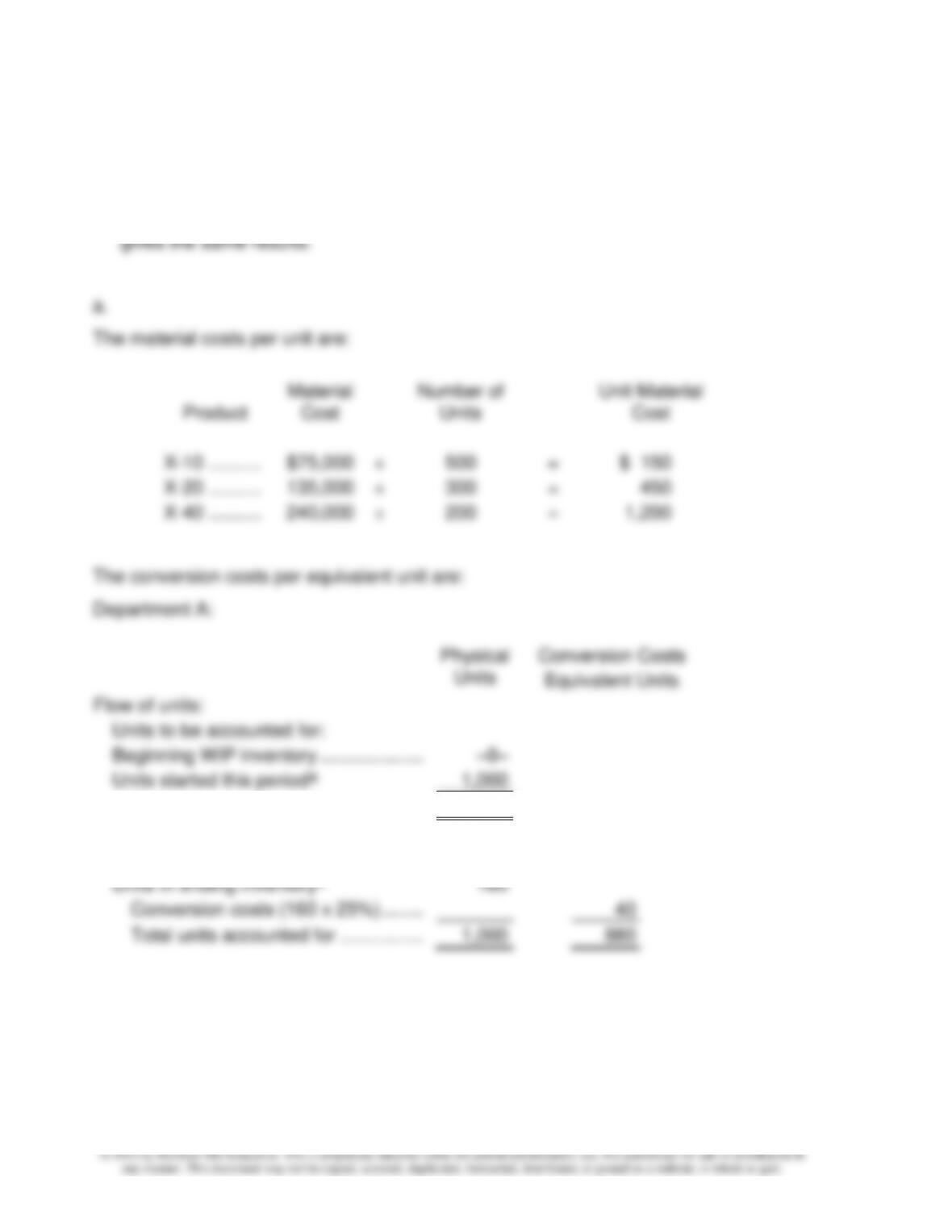
4,800 (24,000 x 20%) equivalent units in ending inventory at a cost of $18,000. The
cost per equivalent unit is $3.75 (or $18,000 4,800 EU).
The right hand side of the equation is the total equivalent units represented by all costs
in the account (72,000 EU) times the cost per equivalent unit ($3.75). The resulting
Chapter 08 – Process Costing
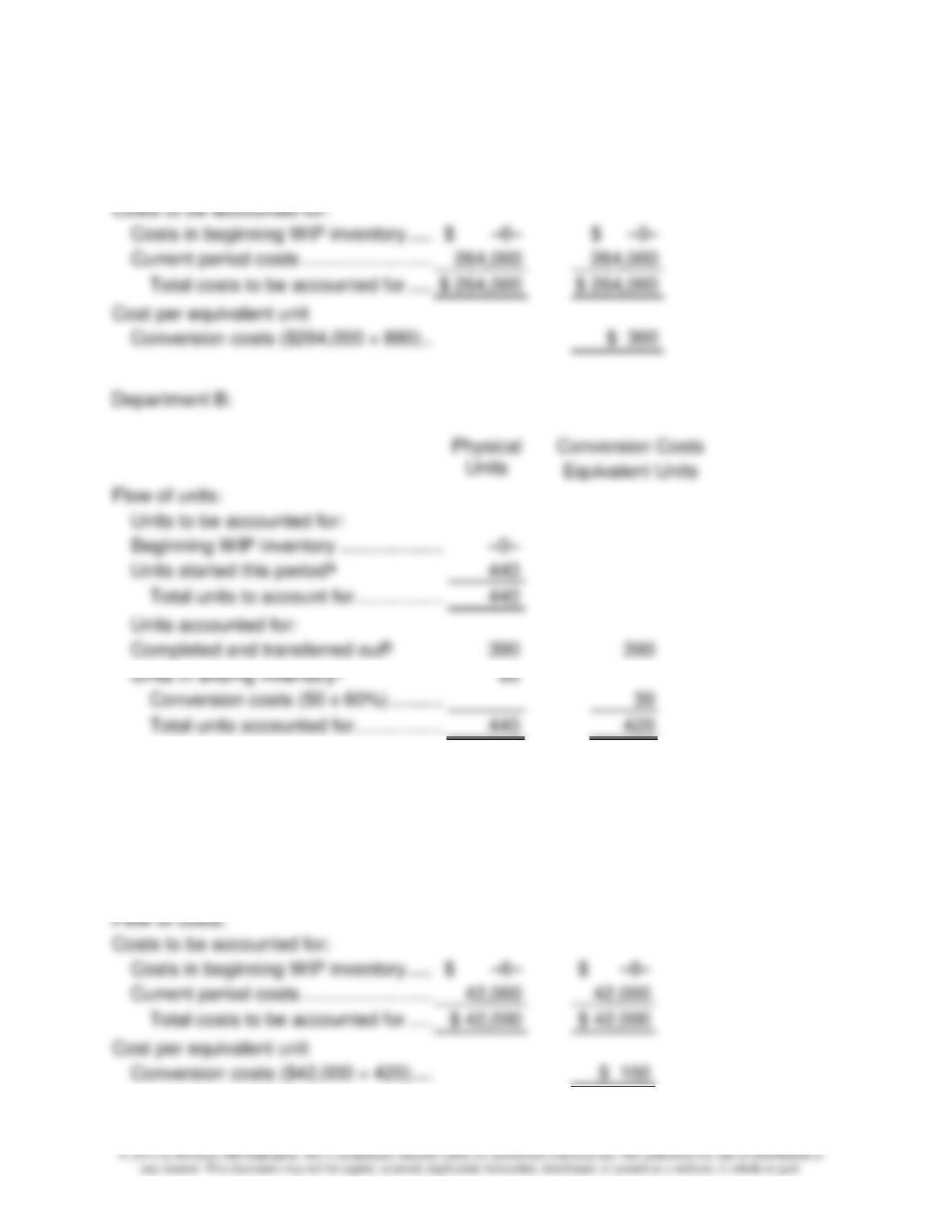
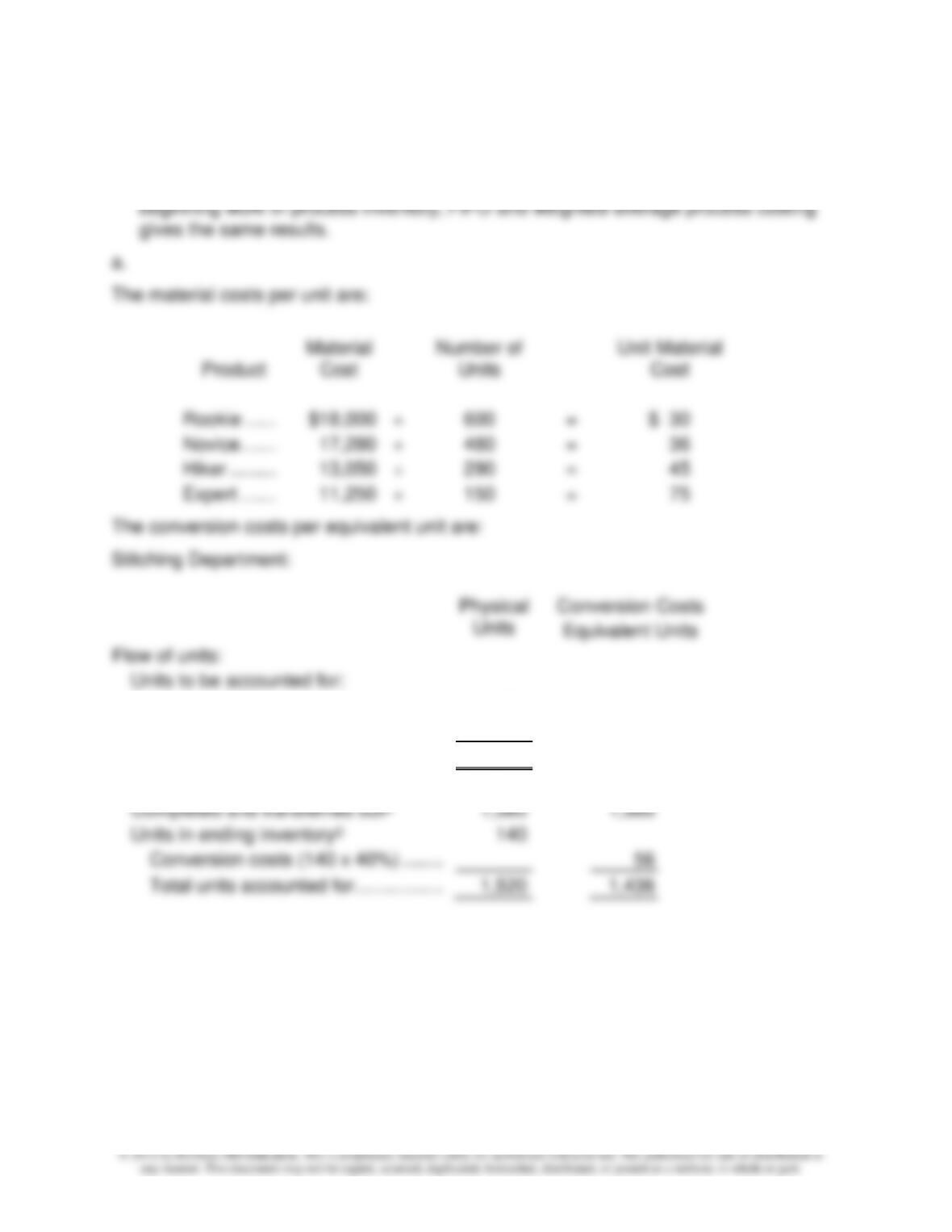
8-51. (50 min.) Operation Costing—Work-in-Process Inventory: Washington, Inc.
The solution to this problem is to apply process costing methods for the conversion
costs and then add the cost of materials for each product. Because there is no
beginning work-in-process inventory, FIFO and weighted-average process costing
Chapter 08 – Process Costing
8-51. (continued)
Total
Conversion
Costs
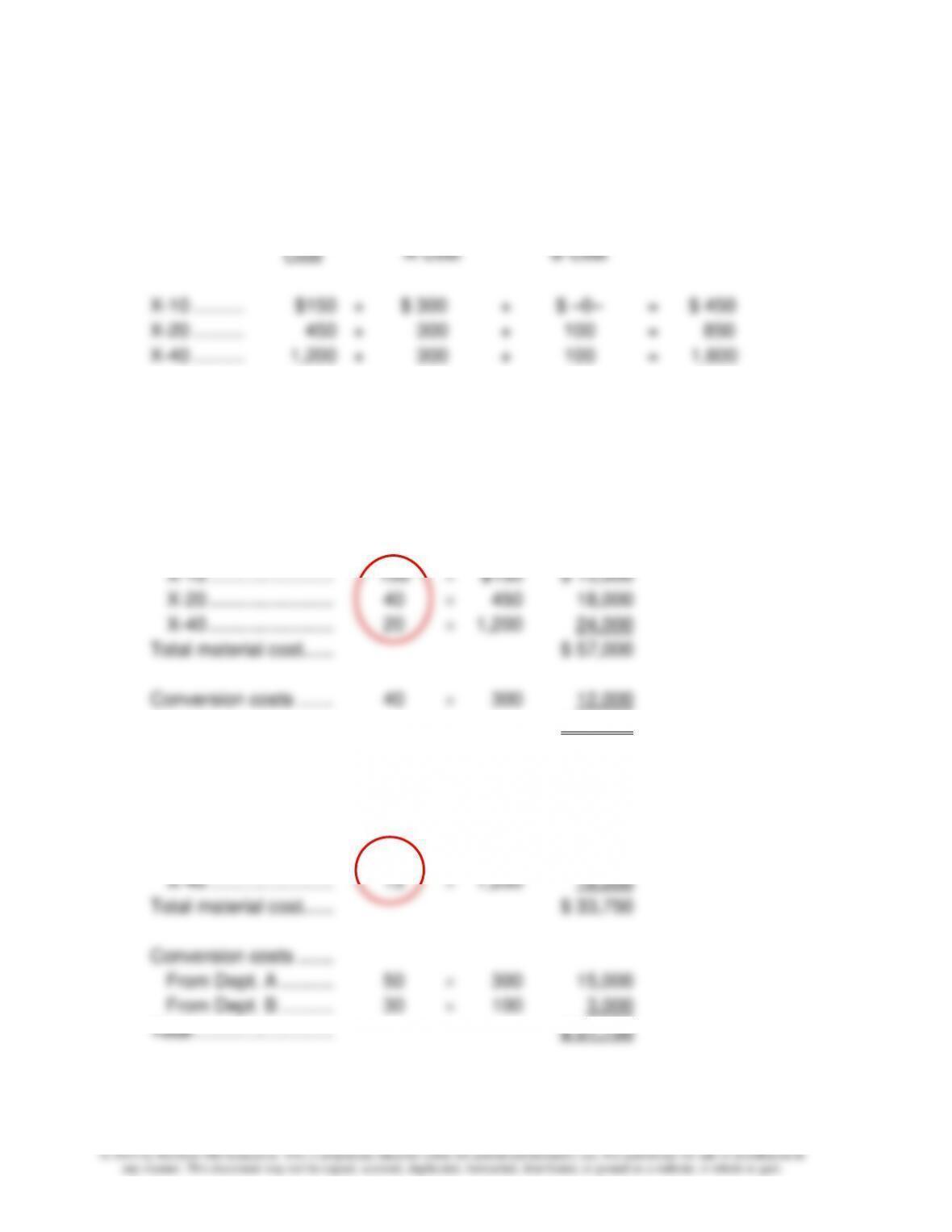
Flow of costs:
Costs to be accounted for:
Costs in beginning WIP inventory ……………….
$ –0–
$ –0–
Current period costs ……………………..……
264,000
264,000
Total costs to be accounted for ……………….
$ 264,000
$ 264,000
Cost per equivalent unit
Conversion costs ($264,000 ÷ 880) …………….
$ 300
Units to be accounted for:
Beginning WIP inventory ………………..…………
Total units to account for ……………..…………
Units accounted for:
Conversion costs (50 x 60%) ……….…………
Total units accounted for ……………..…………
Chapter 08 – Process Costing
8-58
8-51. (continued)
Cost of units transferred to finished goods:
Product
Unit
Material
Cost
Unit
Department
A Cost
Unit
Department
B Cost
Unit Cost
X-10 ……….
$150
+
$ 300
+
$ –0–
=
$ 450
X-20 ……….
450
+
300
+
100
=
850
X-40 ……….
1,200
+
300
+
100
=
1,600
b.
Work-in-Process Ending Inventory Balances are (note the number of units is equal to the
difference between the units started and units completed):
Department A:
Material cost
Number
of Units
Unit
Cost
Total Cost
X-10 ……………………
100
$150
$ 15,000
X-20 ……………………
40
450
18,000
X-40 ……………………
20
1,200
24,000
Total material cost……
$ 57,000
Conversion costs …….
40
300
12,000
Total ………………………
$ 69,000
Department B:
Material cost
Number
of Units
Unit
Cost
Total Cost
X-20 ……………………
35
$450
15,750
X-40 ……………………
15
1,200
18,000
Total material cost……
$ 33,750
Conversion costs …….
From Dept. A ……….
50
300
15,000
From Dept. B ……….
30
100
3,000
Total ………………………
$ 51,750
Chapter 08 – Process Costing
8-52. (50 min.) Operation Costing—Work-in-Process Inventory: Miller Outdoor
Equipment.
The solution to this problem is to apply process costing methods for the conversion
costs and then add the cost of materials for each product. Because there is no
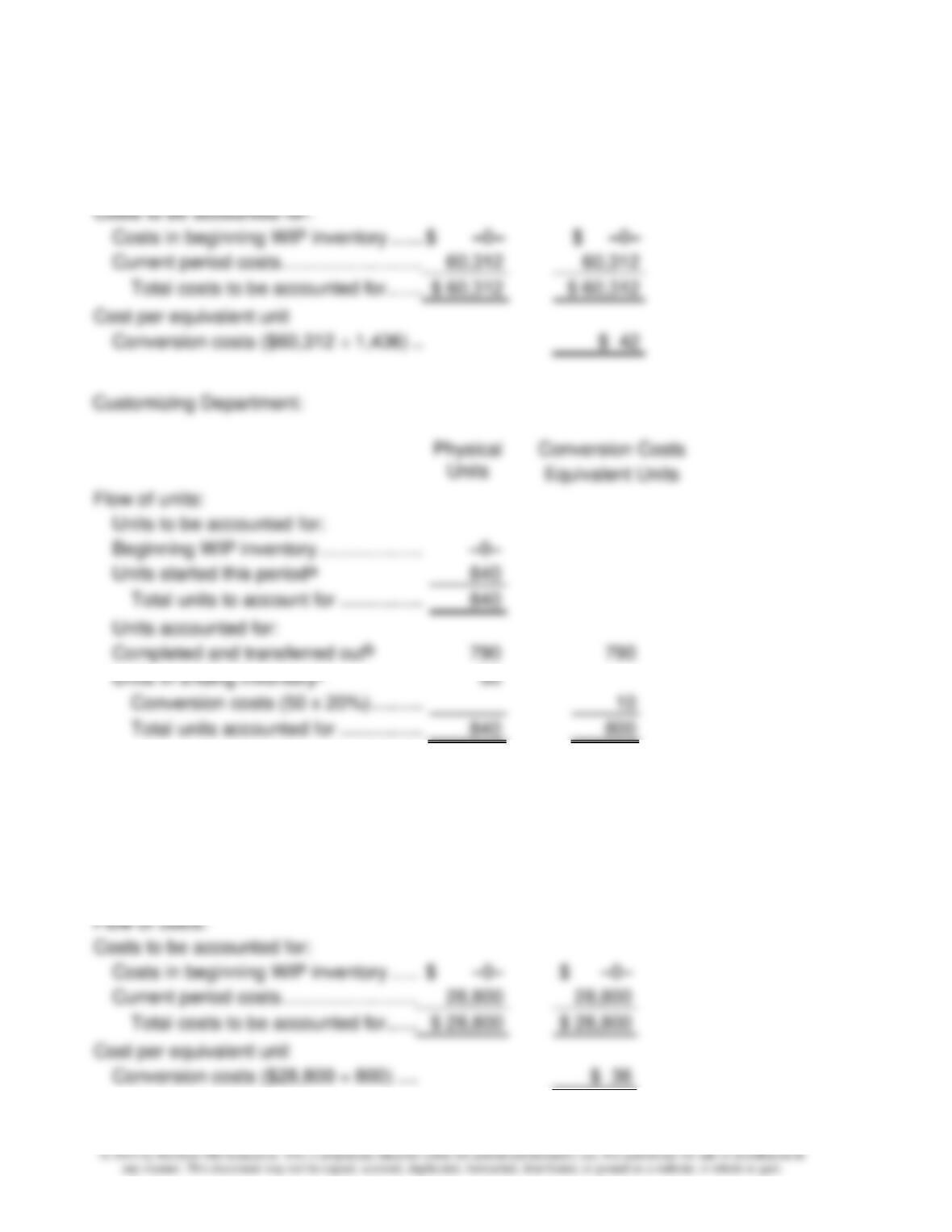
Chapter 08 – Process Costing
8-52. (continued)
Total
Conversion
Costs
Flow of costs:
Costs to be accounted for:
Costs in beginning WIP inventory ………………
$ –0–
$ –0–
Current period costs …………………………..
60,312
60,312
Total costs to be accounted for …….…………
$ 60,312
$ 60,312
Cost per equivalent unit
Conversion costs ($60,312 ÷ 1,436) ..…………
$ 42
Flow of units:
Beginning WIP inventory ………………..…………
Units accounted for:
Conversion costs (50 x 20%) ……….…………
Total units accounted for …………….…………