Chapter 08 – Process Costing
8-1
© 2014 by McGraw-Hill Education. This is proprietary material solely for authorized instructor use. Not authorized for sale or distribution in
any manner. This document may not be copied, scanned, duplicated, forwarded, distributed, or posted on a website, in whole or part.
Chapter 8
Process Costing
Solutions to Review Questions
8-1.
Process costing is most likely to be used in industries that produce relatively
homogeneous products using continuous processes.
8-2.
Using the basic cost flow equation, rearrange the terms to solve for the unknown
beginning inventory. From BB + TI – TO = EB, we have:
8-3.
With FIFO costing, the units in the beginning inventory are transferred out first. These
beginning inventory units carry with them the costs incurred in a previous period plus the
8-4.
Under FIFO costing, the equivalent units represent only the work done in the current
8-5.
Prior department costs behave the same as direct materials, which are typically added at
the start of production. They are treated separately because they represent the
8-2
© 2014 by McGraw-Hill Education. This is proprietary material solely for authorized instructor use. Not authorized for sale or distribution in
any manner. This document may not be copied, scanned, duplicated, forwarded, distributed, or posted on a website, in whole or part.
costs incurred in prior departments. Thus, the prior department costs are not useful for
evaluating the performance of the manager of the department receiving the units.
8-6.
8-7.
8-8.
To assign costs to specific barrels of liquid cleaning products or similarly mass–produced
items requires a considerable amount of record keeping. Assuming products are all the
8-9.
This is a fairly common problem. LIFO is usually beneficial for tax purposes when prices
are rising and inventory levels are steady or rising. However, maintaining internal records
on a LIFO basis is often quite burdensome. To avoid the problem, companies usually
8-10.
The results will be the same using either costing system. The important point is that job
Chapter 08 – Process Costing
8-3
8-11.
The correct answer is (b). The difference between the weighted-average and FIFO
methods of process costing is how they handle beginning WIP. When there is no
beginning WIP there is no difference between the two costing methods.
8-12.
If the percentage completion is overstated, (a) the total equivalent units for the period will
be overstated, because the work-in-process ending inventory will be assumed to have
8-13.
The correct answer is (b). The weighted-average method of process costing combines the
costs of work done in the previous period and the current period.
8-14.
(e). None of these answers are correct.
Answers (a) and (b) are incorrect because (a) ignores stages of completion and (b) double
8-15.
Chapter 08 – Process Costing
8-4
Solutions to Exercises
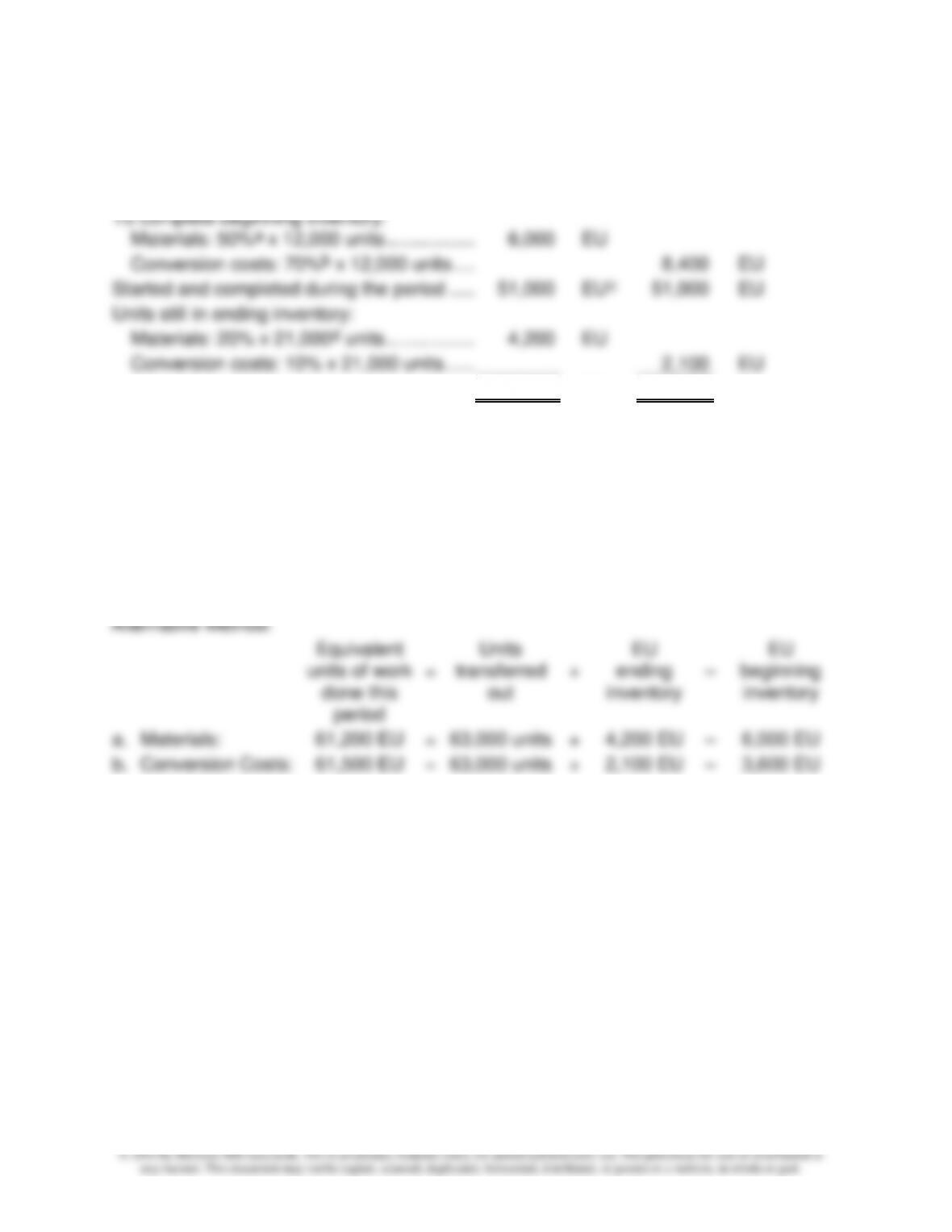
8-16. (20 min.) Compute Equivalent Units—Weighted-Average Method: Clean
Corporation.
a.
Materials
b.
Conversion Costs
Units transferred out ……………………………………
63,000
63,000
Equivalent units in ending inventory:
Materials: 20% x 21,000a units ………………….
4,200
EU
Conversion costs: 10% x 21,000 units ………..
2,100
EU
Total equivalent units for all work done to date ..
67,200
EU
65,100
EU
a21,000 units in ending inventory
= 12,000 units in beginning inventory + 72,000 units started this period
– 63,000 units transferred out.
Chapter 08 – Process Costing
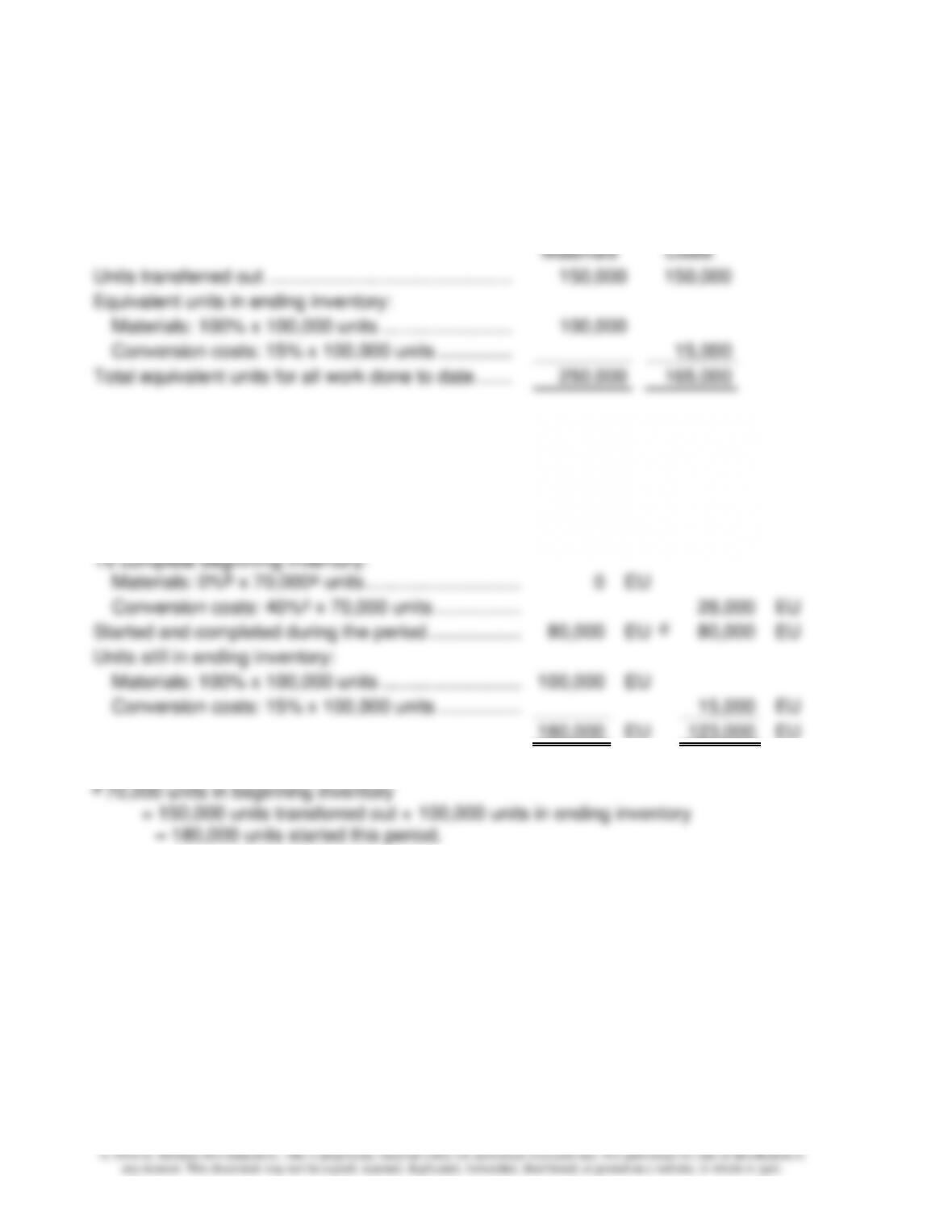
8-17. (20 min.) Compute Equivalent Units—FIFO method: Clean Corporation.
Compute Equivalent Units—FIFO
a.
Materials
b.
Conversion Costs
To complete beginning inventory:
Materials: 50%a x 12,000 units …………………..
6,000
EU
Conversion costs: 70%b x 12,000 units …..…..
8,400
EU
Started and completed during the period ………..
51,000
EU
c
51,000
EU
Units still in ending inventory:
Materials: 20% x 21,000d units …………………..
4,200
EU
Conversion costs: 10% x 21,000 units …….…..
2,100
EU
61,200
EU
61,500
EU
a50% = 100% – 50% already done at the beginning of the period.
b70% = 100% – 30% already done at the beginning of the period.
c51,000 units started and completed = 63,000 units transferred out less 12,000 units from
beginning inventory.
d 21,000 units in ending inventory = 12,000 units in beginning inventory + 72,000 units
started this period – 63,000 units transferred out.
Materials:
Conversion Costs:
Chapter 08 – Process Costing
8-6
8-18. (15 min.) Compute Equivalent Units—Weighted-Average Method: Missouri
Corporation.
a.
Materials
b.
Conversion
Costs
Units transferred out ………………………………………..
150,000
150,000
Equivalent units in ending inventory:
Materials: 100% x 100,000 units …………………….
100,000
Conversion costs: 15% x 100,000 units …………..
15,000
Total equivalent units for all work done to date …….
250,000
165,000
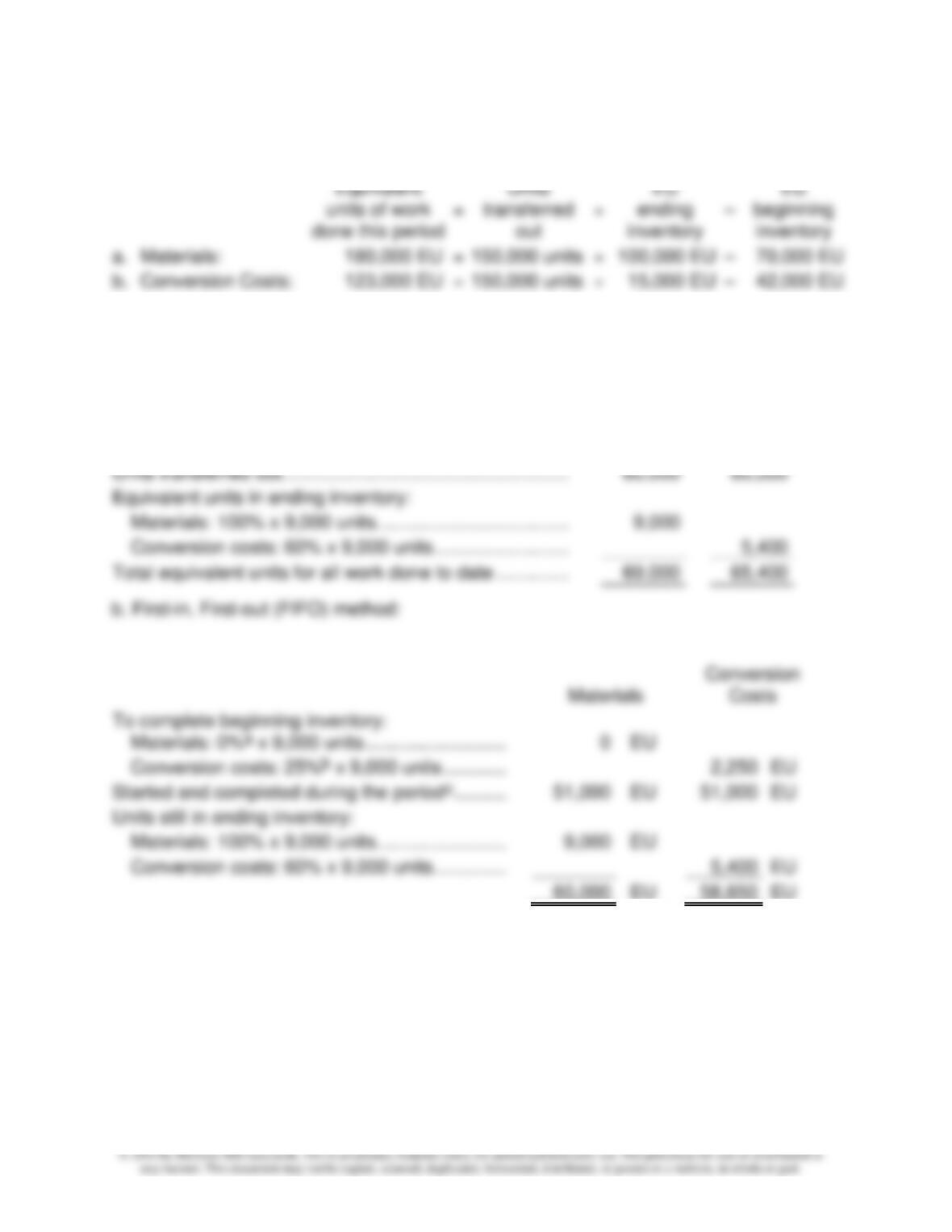
8-19. (20 min.) Compute Equivalent Units—FIFO method: Missouri Corporation.
a.
Materials
b.
Conversion
Costs
To complete beginning inventory:
Materials: 0%b x 70,000a units …………………………
0
EU
Conversion costs: 40%c x 70,000 units ……………..
28,000
EU
Started and completed during the period ………………
80,000
EU
d
80,000
EU
Units still in ending inventory:
Materials: 100% x 100,000 units ………………………
100,000
EU
Conversion costs: 15% x 100,000 units …………….
15,000
EU
180,000
EU
123,000
EU
b 0% = 100% – 100% already done at the beginning of the period.
c 40% = 100% – 60% already done at the beginning of the period.
d 80,000 units started and completed = 150,000 units transferred out less 70,000 units
from beginning inventory.
Chapter 08 – Process Costing
8-7
Alternative Method
Equivalent
units of work
done this period
=
Units
transferred
out
+
EU
ending
inventory
–
EU
beginning
inventory
a.
Materials:
180,000 EU
=
150,000 units
+
100,000 EU
–
70,000 EU
b.
Conversion Costs:
123,000 EU
=
150,000 units
+
15,000 EU
–
42,000 EU
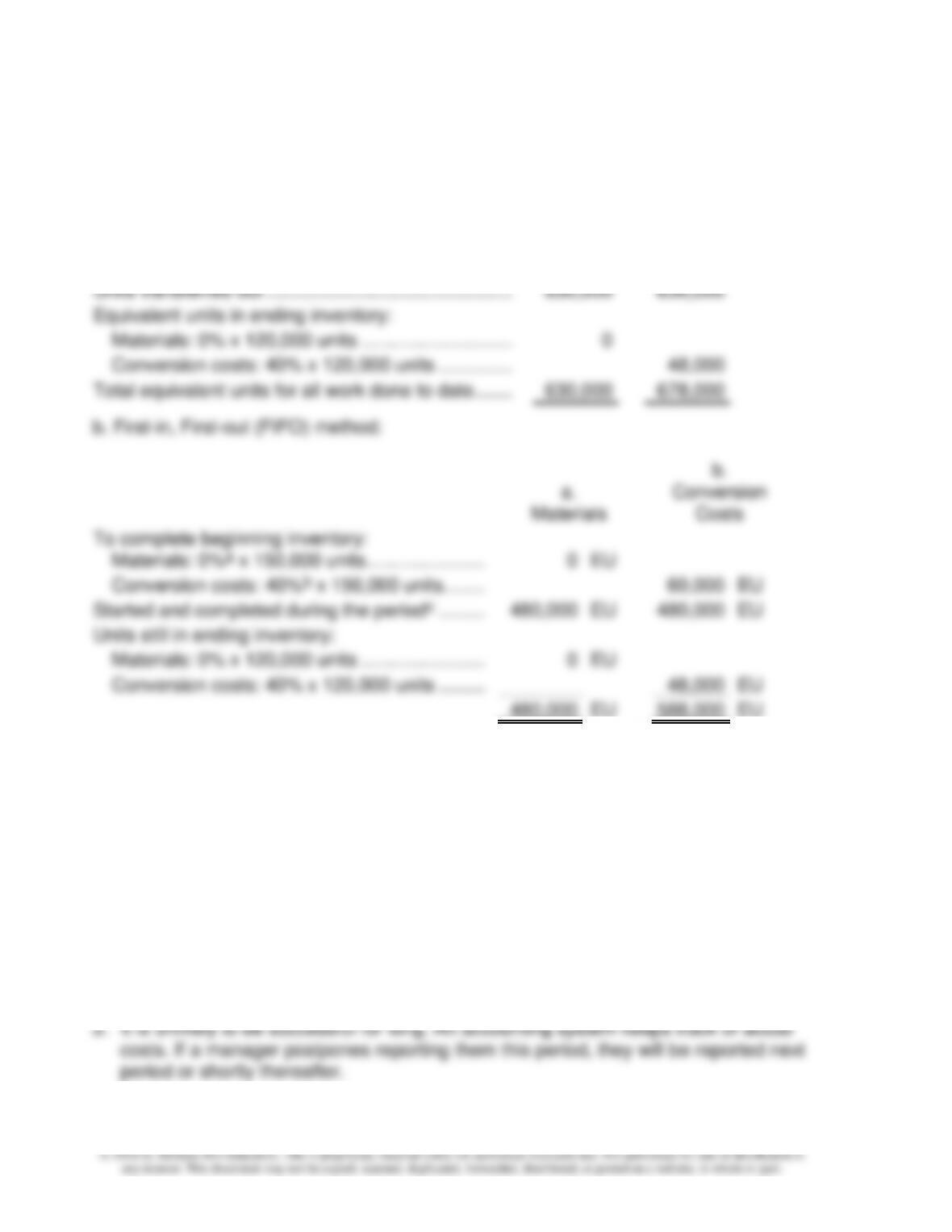
8-20. (30 min.) Compute Equivalent Units: Bears, Inc.
a. Weighted-average method:
Materials
Conversion
Costs
Units transferred out ……………………………………………….
60,000
60,000
Equivalent units in ending inventory:
Materials: 100% x 9,000 units……………………………….
9,000
Conversion costs: 60% x 9,000 units ……………………..
5,400
Total equivalent units for all work done to date …………..
69,000
65,400
b. First-in, First-out (FIFO) method:
Materials
Conversion
Costs
To complete beginning inventory:
Materials: 0%a x 9,000 units ………………………
0
EU
Conversion costs: 25%b x 9,000 units …………
2,250
EU
Started and completed during the periodc ……….
51,000
EU
51,000
EU
Units still in ending inventory:
Materials: 100% x 9,000 units…………………….
9,000
EU
Conversion costs: 60% x 9,000 units …………..
5,400
EU
60,000
EU
58,650
EU
a 0% = 100% – 100% already done at the beginning of the period.
b 25% = 100% – 75% already done at the beginning of the period.
c 51,000 units started and completed
= 60,000 units transferred out less 9,000 units from beginning inventory.
Chapter 08 – Process Costing
8-8
8-21. (30 min.) Compute Equivalent Units—Ethical Issues: Aaron Company.
a. Weighted-average method:
Materials
Conversion
Costs
Units transferred out ………………………………………..
630,000
630,000
Equivalent units in ending inventory:
Materials: 0% x 120,000 units ………………………..
0
Conversion costs: 40% x 120,000 units …………..
48,000
Total equivalent units for all work done to date …….
630,000
678,000
b. First-in, First-out (FIFO) method:
a.
Materials
b.
Conversion
Costs
To complete beginning inventory:
Materials: 0%a x 150,000 units…………………..
0
EU
Conversion costs: 40%b x 150,000 units ……..
60,000
EU
Started and completed during the periodc ………
480,000
EU
480,000
EU
Units still in ending inventory:
Materials: 0% x 120,000 units ……………………
0
EU
Conversion costs: 40% x 120,000 units ………
48,000
EU
480,000
EU
588,000
EU
a 0% = 100% – 100% already done at the beginning of the period (conversion was 60%
complete).
b 40% = 100% – 60% already done at the beginning of the period.
c 480,000 units started and completed
= 630,000 units transferred out less 150,000 units from beginning inventory.
c.
1. The change will reduce the unit cost for the units transferred to finished goods.
2. It is not ethical; there is no reason to believe the change reflects anything other than a
desire for reporting better results.
Chapter 08 – Process Costing
8-9
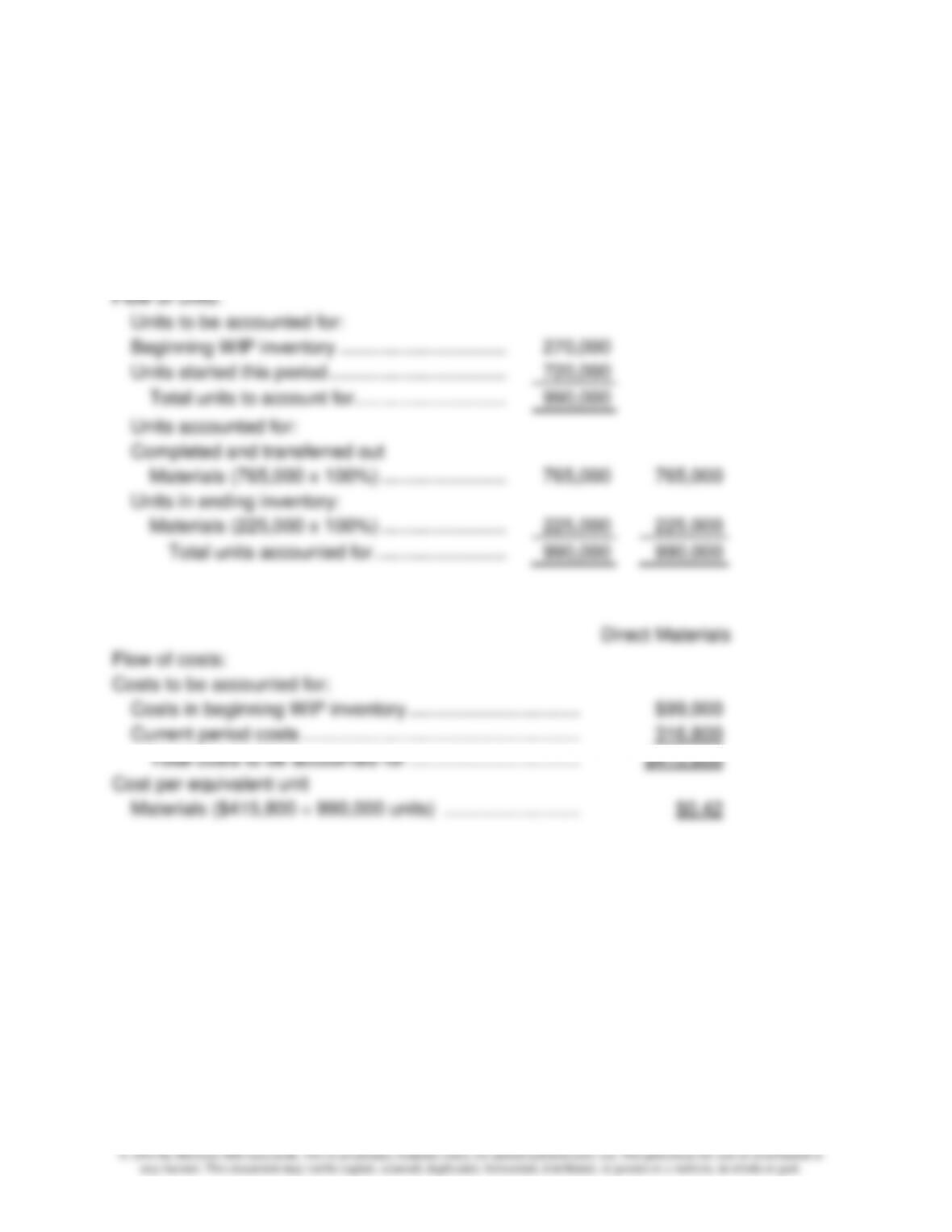
8-22. (20 min.) Compute Cost per Equivalent Unit—Weighted-Average Method:
Davenport Plant.
Physical
Units
Materials
Eq. Units
Flow of units:
Units to be accounted for:
Beginning WIP inventory …………………………..
270,000
Units started this period …………………………….
720,000
Total units to account for ………………………..
990,000
Units accounted for:
Completed and transferred out
Materials (765,000 x 100%) ……………………
765,000
765,000
Units in ending inventory:
Materials (225,000 x 100%) ……………………
225,000
225,000
Total units accounted for …………………….
990,000
990,000
Direct Materials
Flow of costs:
Costs to be accounted for:
Costs in beginning WIP inventory …………………………...
$99,000
Current period costs ……………………………………………..
316,800
Total costs to be accounted for …………………………...
$415,800
Cost per equivalent unit
Materials ($415,800 ÷ 990,000 units) ……………………..
$0.42
Chapter 08 – Process Costing
8-10
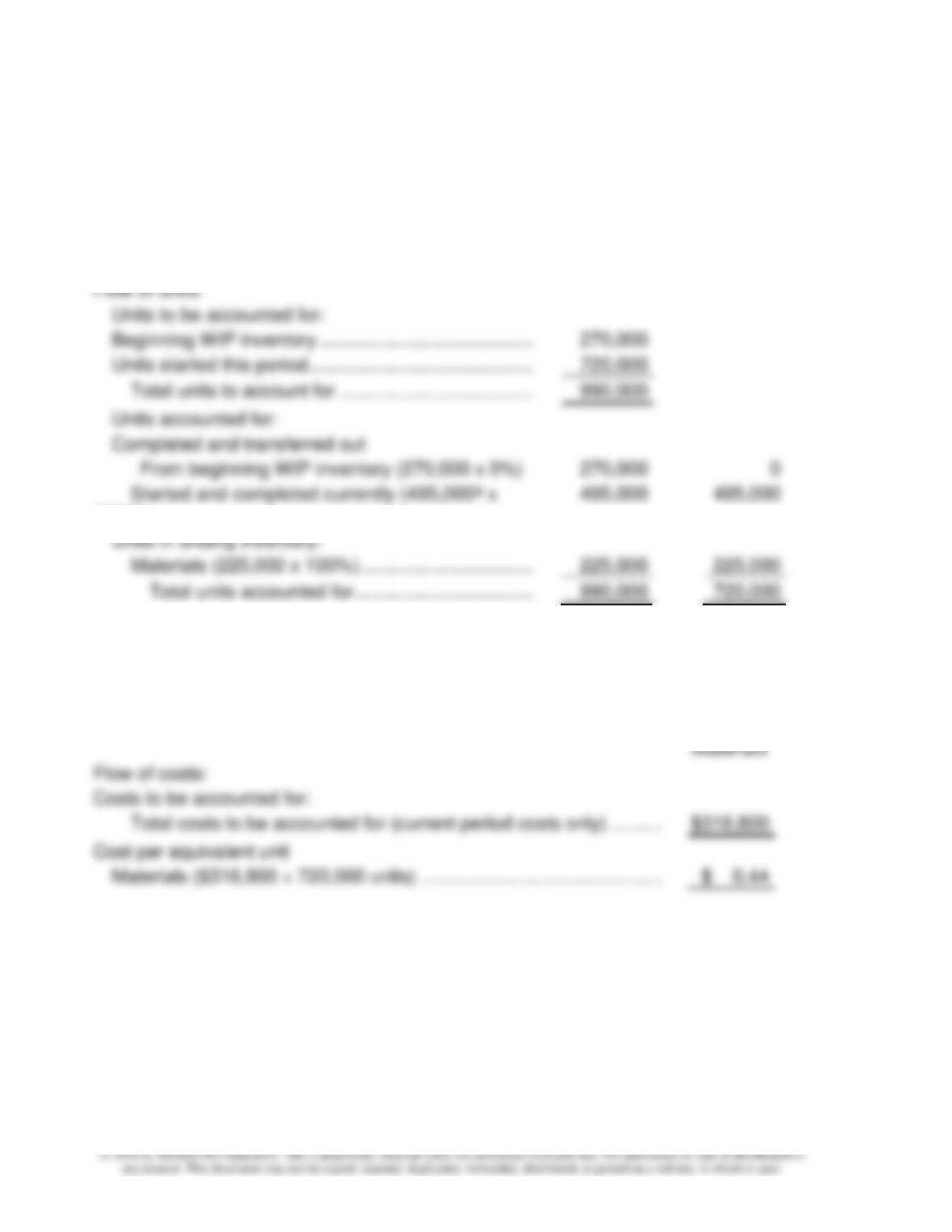
8-23. (20 min.) Compute Cost per Equivalent Unit—FIFO method: Davenport
Plant.
Physical
Units
Materials Eq.
Units
Flow of units:
Units to be accounted for:
Beginning WIP inventory …………………………………..
270,000
Units started this period…………………………………….
720,000
Total units to account for ……………………………….
990,000
Units accounted for:
Completed and transferred out
From beginning WIP inventory (270,000 x 0%)
270,000
0
Started and completed currently (495,000a x
100%) …………………………..…………………………………..
495,000
495,000
Units in ending inventory:
Materials (225,000 x 100%) …………………………...
225,000
225,000
Total units accounted for …………………………….
990,000
720,000
a 495,000 units started and completed = 765,000 units transferred out – 270,000
beginning WIP units.
Direct
Materials
Flow of costs:
Costs to be accounted for:
Total costs to be accounted for (current period costs only) ……….
$316,800
Cost per equivalent unit
Materials ($316,800 ÷ 720,000 units) ……………………………………….
$ 0.44