Chapter 07 – Job Costing
7-21
7-39. (50 min.) Assigning Costs—Missing Data.
Materials Inventory
Balance 11/1
45,400
(a)
86,200
Direct materials
Purchases
113,600
(a)
16,400
Indirect materials
Balance 11/30
56,400
Work-in-Process Inventory
Balance 11/1
32,600
(given)
Direct materials
86,200
(b)
Direct labor
176,000
374,400
(d)
(b)
Overhead applied
264,000
(d)
Balance 11/30
184,400
(h)
Proration
6,270
Balance 11/30
190,670
Finished Goods Inventory
Balance 11/1
129,600
(d)
374,400
(c)
403,000
Balance 11/30
101,000
(h)
Proration
3,762
Balance 11/30
104,762
Cost of Goods Sold
(c)
403,000
(h)
Proration
15,048
Manufacturing Overhead Control
(a)
16,400
(e)
26,000
(f)
48,200
(g)
198,480
289,080
(h)
Applied Manufacturing Overhead
(given)
264,000
(h)
264,000
Chapter 07 – Job Costing
7-22
7-39. (continued)
Wages Payable
(b)
176,000
(e)
26,000
Sales Revenue
(given)
725,400
$45,400 + $113,600 – $56,400 – $86,200 (debit to work in process)
=
$16,400
(b) Let X = Direct labor costs
Overhead applied
=
150% X
$264,000
=
150% X
X
=
$176,000
(c) Let X = Cost of goods sold
Sales
=
180% X
$725,400
=
180% X
X
=
$403,000
(d) Finished goods BB = Finished Goods EB + $28,600
BB
=
101,000 + 28,600
BB
=
$129,600
Cost of goods manufactured
=
Finished goods EB + Cost of goods sold –
Finished Goods BB
=
$101,000 + $403,000 – $129,600
=
$374,400
Work in process EB
=
$32,600 + $86,200 + $176,000 + $264,000 – $374,400
=
$184,400
(e)
Indirect labor
=
Total credits to Wages Payable – Direct labor
=
$202,000 – $176,000
Chapter 07 – Job Costing
7-23
=
$26,000
7-39. (continued)
(f) Charge factory depreciation to manufacturing overhead.
Work-in-process
(25% x $25,080)
$ 6,270
Finished goods
(15% x $25,080)
3,762
Cost of goods sold
(60% x $25,080)
15,048
$25,080
7-40. (40 min.) Analysis Of Overhead Using A Predetermined Rate: Kansas
Company.
a.
$10.60 per DLH.
$1,908,000
= $10.60 per DLH
180,000
b.
$475,500.
Beginning balance ………….……………….
$162,000
Direct materials ……………..……………
135,000
Direct labor …………………………..
84,000
*
Overhead applied …………..………………
94,500
**
$475,500
*The wage rate for direct labor is $8.00 per hour. $8.00 x 10,500 hours = $84,000.
**$9.00 x 10,500 direct labor-hours.
c. $54,000 (= $9.00 x 6,000 direct labor-hours)
d. $229,500 (= $9.00 x 25,500 direct labor-hours)
e.
$220,500.
Supplies …………………………………………………….
$ 18,000
Indirect labor wages …………..………………
51,000
Supervisory salaries …………..………………
108,000
Factory facilities …………………………..
19,500
Factory equipment costs……..……………………
24,000
$220,500
Chapter 07 – Job Costing
f. Credit it to cost of goods sold. The amount is clearly not material (0.1% of cost of
goods sold), so it is not worth the effort involved in prorating.
Overapplied Overhead ……………
$0
Cost of Goods Sold ………………..
2,937,000*
Work-in-Process Inventory ………
114,000
Finished Goods Inventory ……….
246,000
*$2,940,000 – $3,000
Direct materials ……………..……………
Direct labor …………………………..
*
$344,500.
Supplies …………………………..………………………..
Indirect labor wages …………..………………
Supervisory salaries …………..………………
Factory facilities ………………..…………
Factory equipment costs …….…………………….
Chapter 07 – Job Costing
7-25
20% (= $8 million ÷ $40 million for cost of goods sold) for Finished Goods
Inventory. This yields:
Underapplied Overhead …………..
$0
Cost of Goods Sold…………………
$30,100,000*
Work-in-Process Inventory ………
4,300,000**
Finished Goods Inventory ………..
8,600,000***
*$28,000,000 + (70% x $3,000,000)
**$4,000,000 + (10% x $3,000,000)
***$8,000,000 + (20% x $3,000,000)
7-42. (30 min.) Finding Missing Date: BackupsRntUs
a. February 29: Ending Work-in-process inventory:
—only one job is remaining in ending Work-in-process inventory.
Direct Materials ………………………..…
$15,600
Direct Labor …………………………….…………………
10,800
($36 per hour x 300 hours)
Manufacturing Overhead …………..………………
5,400
($18 per hour x 300 hours)
Total Cost of Ending Work in
Process Inventory ………………..…………
$31,800
b. Direct materials purchased during February:
Since the accounts payable account is used only for direct material purchases, the
month’s purchases can be determined from analyzing the accounts payable account:
Beginning Balance
+
Transfers In
–
Transfers Out
=
Ending Balance
$36,000
+
Transfers In
–
$252,000
=
$54,000
Transfers In
=
$270,000
c. Actual manufacturing overhead incurred during February:
$18 per hour x 5,200 total direct labor-hours =
$93,600
d. Cost of goods sold during February:
Beginning Finished
Goods Inventory
+
Cost of Goods
Manufactured
–
Cost of
Goods Sold
=
Ending Finished
Goods Inventory
$ 108,000
+
$564,000
–
Cost of
Goods Sold
=
$66,000
$672,000
–
$ 66,000
=
Cost of Goods Sold
$606,000
=
Cost of Goods Sold
Chapter 07 – Job Costing
7-26
7-43. (30 min.) Cost Accumulation—Service: Youth Athletic Services.
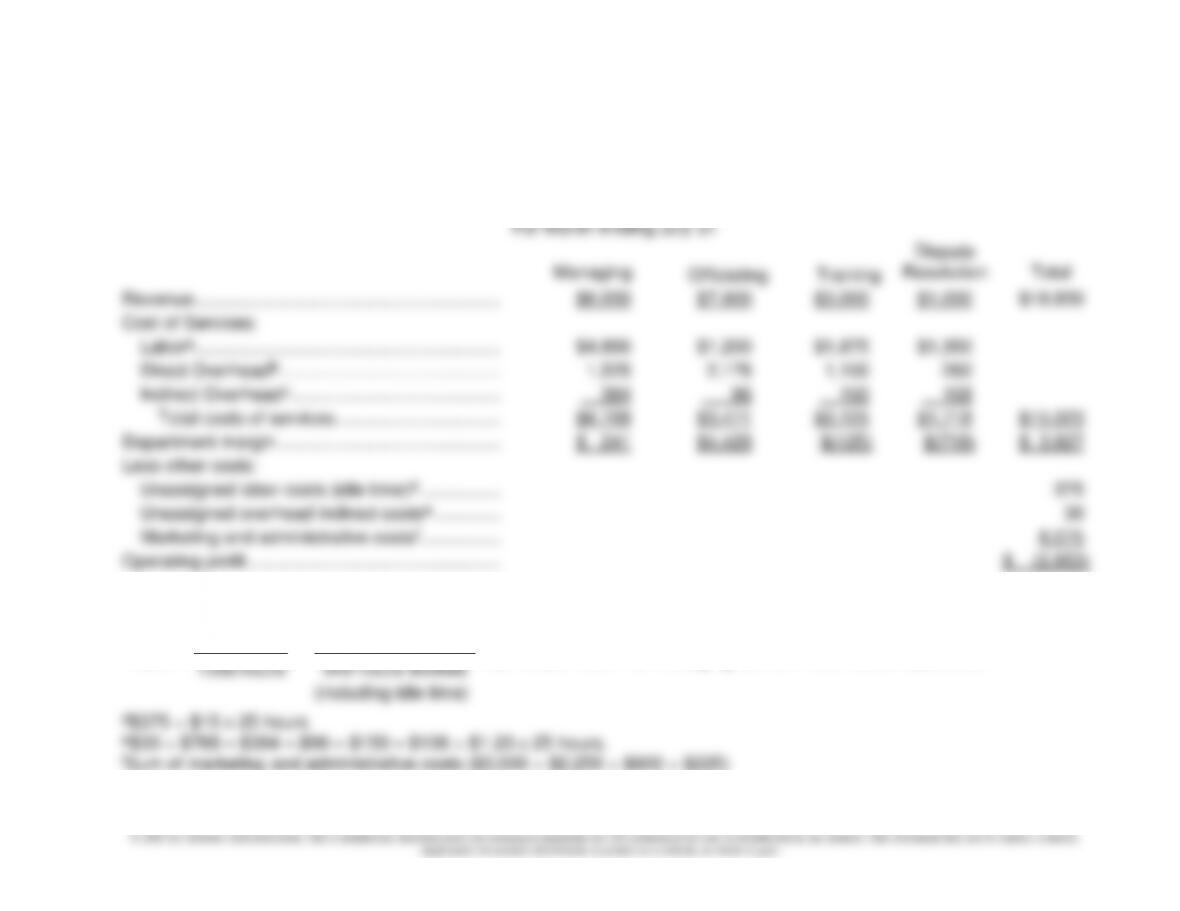
T-accounts (Not required—see next page for income statement)
Wages, Salaries,
and Accounts
Payable
Managing Direct
Labor Cost
Officiating
Direct Labor Cost
Training Direct
Labor Cost
Dispute
Resolution
Direct Labor Cost
Unassigned
Labor Cost
4,800
1,200
1,875
1,350
375
(= $15 x
320)
(= $15 x
80)
(= $15 x
125)
(= $15 x
90)
(= $15 x
25)
9,600
Managing
Direct Overhead
Cost
Officiating Direct
Overhead Cost
Training Direct
Overhead Cost
Dispute
Resolution Direct
Overhead Cost
5,060
950
200
375
875
300
1,000
700
250
150
10
200
50
Chapter 07 – Job Costing
7-43. (continued)
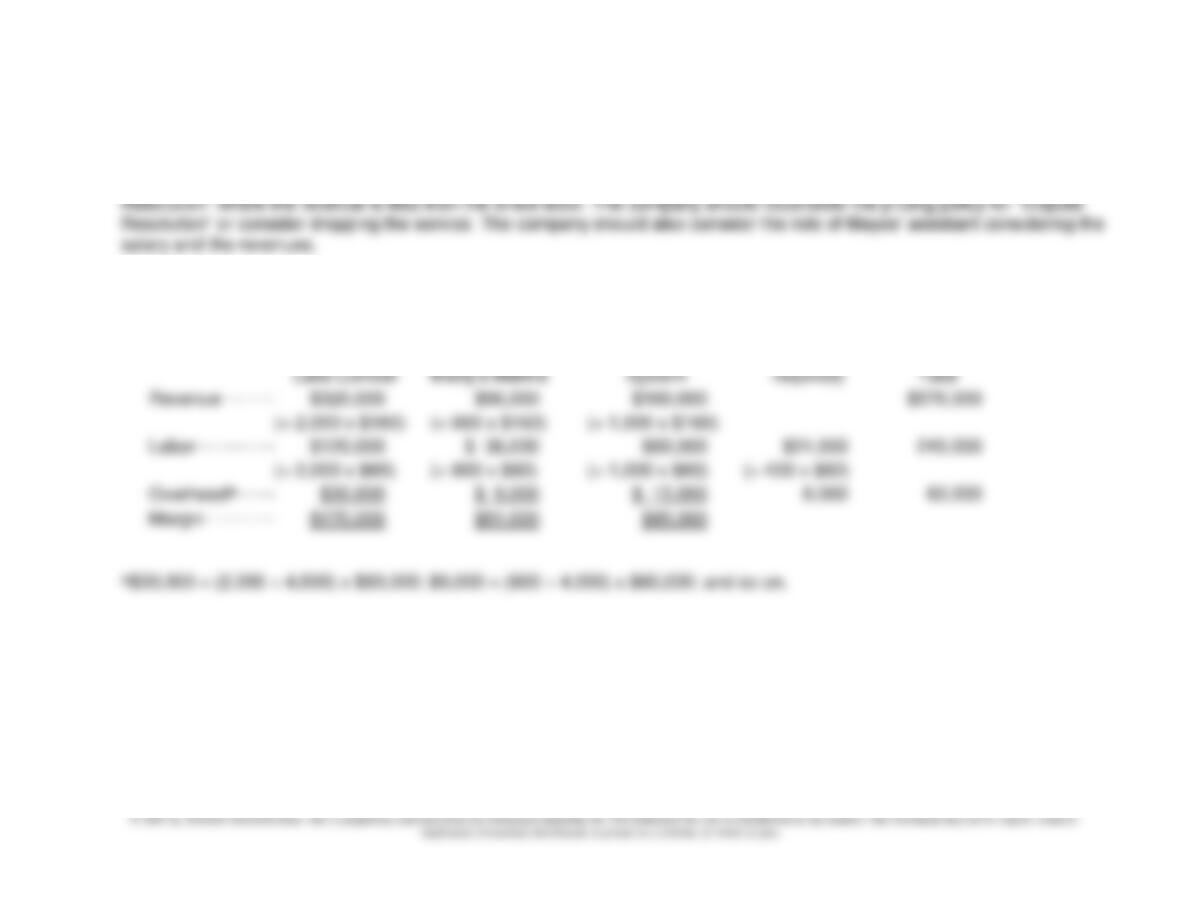
Income Statement
Youth Athletic Services
Income Statement
Chapter 07 – Job Costing
7-28
7-43. (continued)
Only Managing and Officiating are clearly profitable. Training is losing a small amount of money. The problem is in “Dispute
7-44. (25 min.) Job Costs—Service Company: Bay Accountants.
a.
Lake Lumber
Marty’s Marina
State Prison
System
Unassigned
Costs (not
required)
Total
Revenue ………….……………….
$320,000
$96,000
$160,000
$576,000
(= 2,000 x $160)
(= 600 x $160)
(= 1,000 x $160)
Labor ……………….………….
$120,000
$ 36,000
$60,000
$24,000
240,000
(= 2,000 x $60)
(= 600 x $60)
(= 1,000 x $60)
(= 400 x $60)
Overheada …………………………..
$30,000
$ 9,000
$ 15,000
6,000
60,000
Margin ……………..……………
$170,000
$51,000
$85,000
a$30,000 = (2,000 ÷ 4,000) x $60,000; $9,000 = (600 ÷ 4,000) x $60,000; and so on.
Chapter 07 – Job Costing
7-29
7-44. (continued)
b.
Bay Accountants
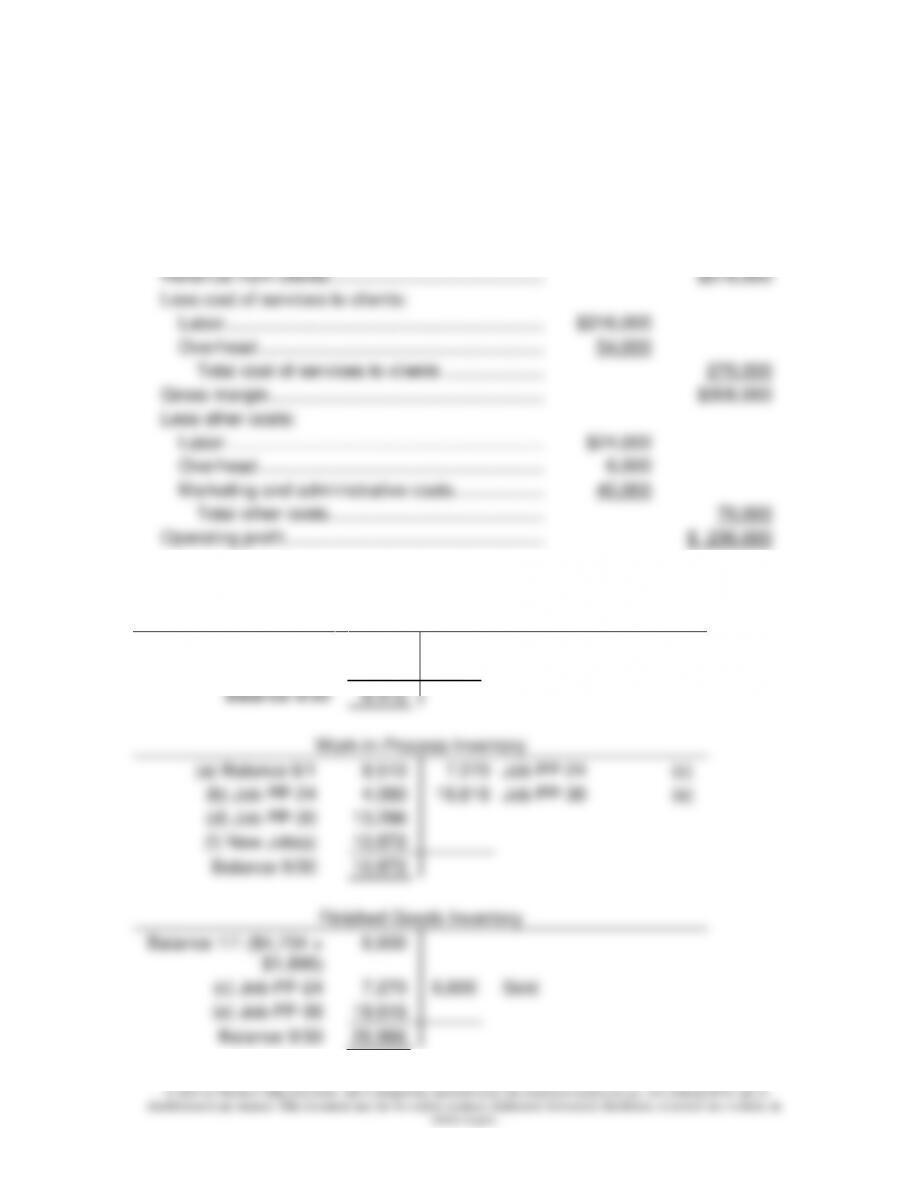
Income Statement
For Month Ending January 31
Revenue from clients …………………………………….
$576,000
Less cost of services to clients:
Labor……………………………………………………….
$216,000
Overhead …………………………………………………
54,000
Total cost of services to clients ………………..
270,000
Gross margin ……………………………………………….
$306,000
Less other costs:
Labor……………………………………………………….
$24,000
Overhead …………………………………………………
6,000
Marketing and administrative costs ………………
40,000
Total other costs …………………………………….
70,000
Operating profit …………………………………………….
$ 236,000
7-45. (50 min.) Job Costs In A Service Company: Pete’s Patios.
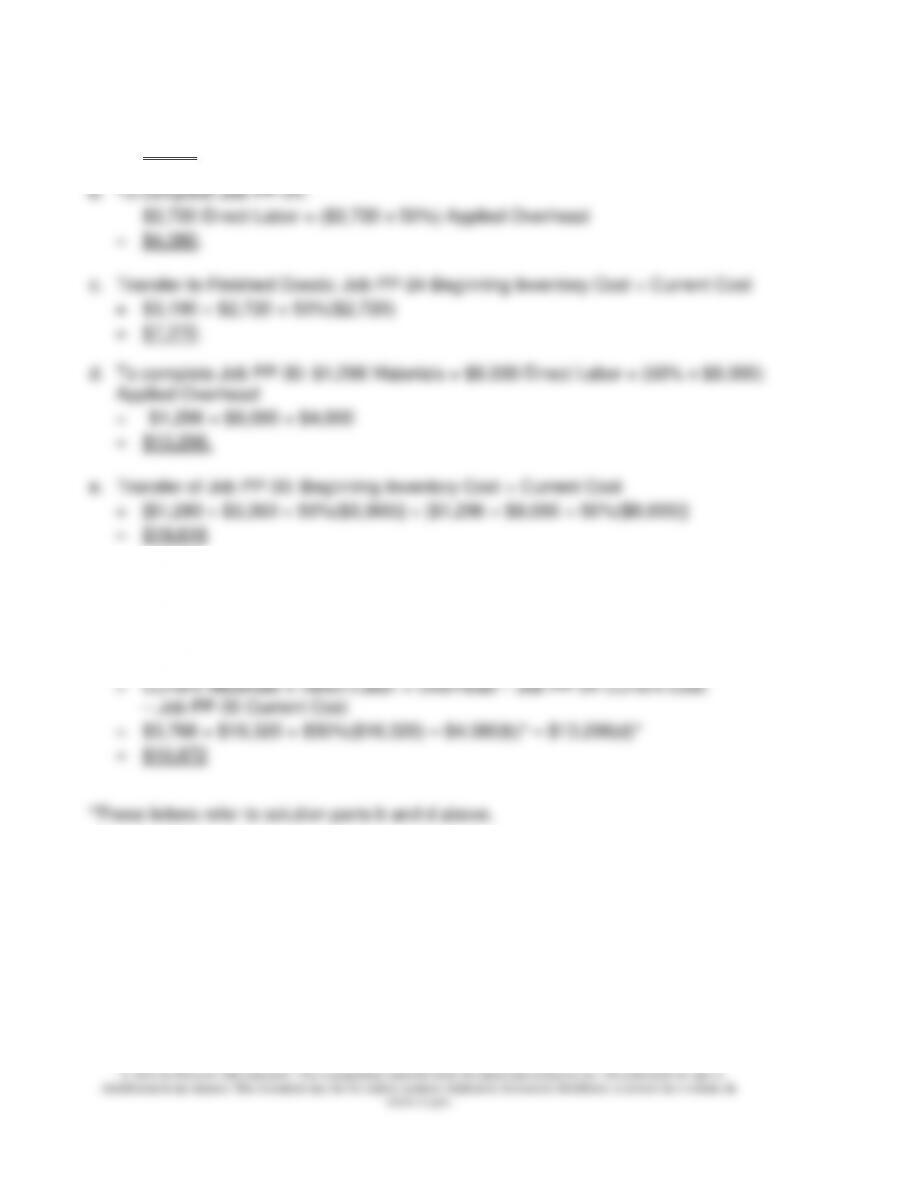
Materials Inventory
Balance 9/1 (given)
11,040
192
Indirect Materials
Purchases (given)
1,392
3,768
Requisition
Balance 9/30
8,472
Work-in-Process Inventory
(a) Balance 9/1
9,510
7,270
Job PP–24
(c)
(b) Job PP–24
4,080
19,616
Job PP–30
(e)
(d) Job PP–30
13,296
(f) New Job(s)
10,872
Balance 9/30
10,872
Finished Goods Inventory
Balance 1/1 ($4,704 +
$1,896)
6,600
(c) Job PP–24
7,270
6,600
Sold
(e) Job PP–30
19,616
Balance 9/30
26,886
Chapter 07 – Job Costing
7-30
a.
Direct Materials + Direct Labor + Applied Overhead
=
$2,038 + $1,280 + $768 + $3,360 + [50% ($768 + $3,360)]
=
$9,510.
b.
To complete Job PP-24:
$2,720 Direct Labor + ($2,720 x 50%) Applied Overhead
=
$4,080.
c.
Transfer to Finished Goods: Job PP-24 Beginning Inventory Cost + Current Cost
=
$3,190 + $2,720 + 50%($2,720)
=
$7,270.
d.
To complete Job PP-30: $1,296 Materials + $8,000 Direct Labor + (50% x $8,000)
Applied Overhead
=
$1,296 + $8,000 + $4,000
=
$13,296.
e.
Transfer of Job PP-30: Beginning Inventory Cost + Current Cost
=
[$1,280 + $3,360 + 50%($3,360)] + [$1,296 + $8,000 + 50%($8,000)]
=
$19,616
7-45. (continued)
f.
New Job Cost = Current Charges to WIP less Current Charges for Jobs PP-24 and
PP–30:
=
Current Materials + Direct Labor + Overhead – Job PP-24 Current Cost
– Job PP-30 Current Cost
=
$3,768 + $16,320 + $50%($16,320) – $4,080(b)* – $13,296(d)*
=
$10,872
*These letters refer to solution parts b and d above.