Chapter 06 – Fundamentals of Product and Service Costing
6-1
© 2014 by McGraw-Hill Education. This is proprietary material solely for authorized instructor use. Not authorized for sale or distribution
in any manner. This document may not be copied, scanned, duplicated, forwarded, distributed, or posted on a website, in whole or part.
Chapter 6
Fundamentals of Product and Service Costing
Solutions to Review Questions
6-1.
Cost allocation is the assignment of costs in cost pools to cost objects. The cost objects
6-2.
Cost management systems should satisfy the following criteria:
6-3.
Cost flow diagrams serve two purposes. First, they help describe how a cost
6-4.
A job costing accounting system traces costs to individual units or to specific jobs
(typically custom products). A process costing accounting system is used when identical
6-5.
Chapter 06 – Fundamentals of Product and Service Costing
6-2
6-6.
It would be ideal, but unlikely, that an allocation base would reflect direct causality
between the activity and the overhead cost.
6-7.
6-8.
The basic cost flow model appears as follows:
Beginning balance + Transfers in – Transfers out = Ending balance
Beginning balance is the balance of inventory at the beginning of the period. Transfers
6-9.
Although there may be no one correct way to allocate cost, cost allocation can provide
6-10.
There are three important points to consider:
1. The cost system should meet the needs of the users (the decision makers).
2. The cost system must provide the appropriate data for its intended purpose.
Different cost information is used for different purposes.
Chapter 06 – Fundamentals of Product and Service Costing
6-3
6-11.
The basic cost flow model is as follows:
Beginning balance + Transfers in – Transfers out = Ending balance
6-12.
It is sometimes difficult (and frustrating) for managers when the cost accountant says
6-13.
Reasons to agree with approach: If the products are not contributing to company profits,
then the products should be eliminated. This will increase overall company profits.
6-14.
The way the “products” are defined will depend, at least in part, on the decision the
dean is interested in making. They may be defined as degree programs vs. non-degree
programs. They may be the different degree programs. They might be the credit hour
Chapter 06 – Fundamentals of Product and Service Costing
6-4
6-15.
Answers will vary. Common answers include the number of students, the number of
credit hours, number of classes, number of class sessions, and so on.
6-16.
The two most important criteria in determining an allocation base are (1) causality and
6-17.
Although it would be ideal for the cost allocation base to have cause–and-effect relation
with overhead costs, it is unlikely to happen for several reasons. One reason is that
some of the overhead is fixed and therefore does not depend on volume (at least within
6-18.
6-19.
There are many reasons why two companies may have different cost systems. First,
firms may be pursuing different strategies (cost containment versus product
6-20.
Chapter 06 – Fundamentals of Product and Service Costing
6-5
Solutions to Exercises
6-21. (20 min.) Basic Cost Flow Model: Office Mart.
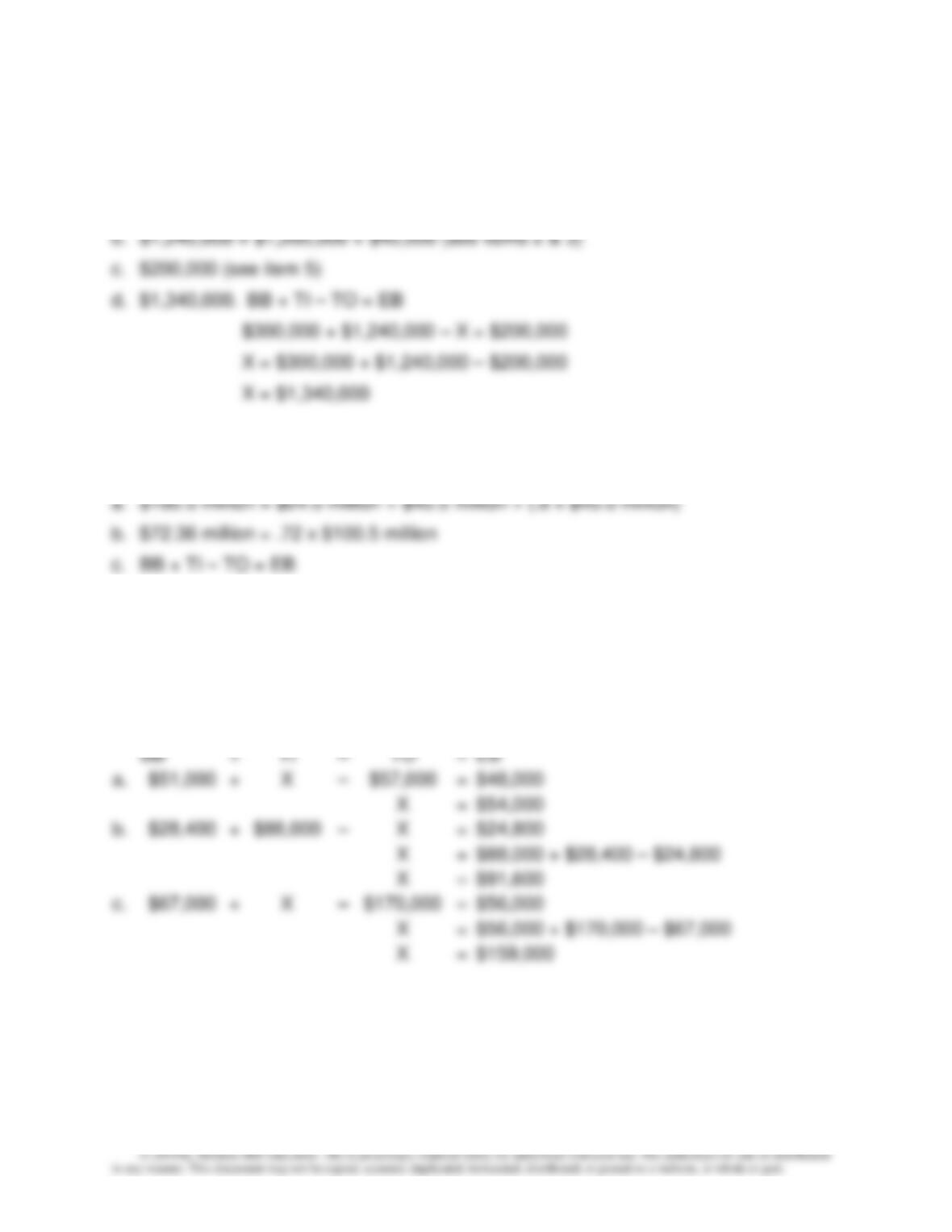
a. $300,000 (see item 5)
6-22. (20 min.) Basic Cost Flow Model: Generic Electric.
0 + $100.5 million – $72.36 million = EB
EB = $28.14 million
6-23. (20 min.) Basic Cost Flow Model.
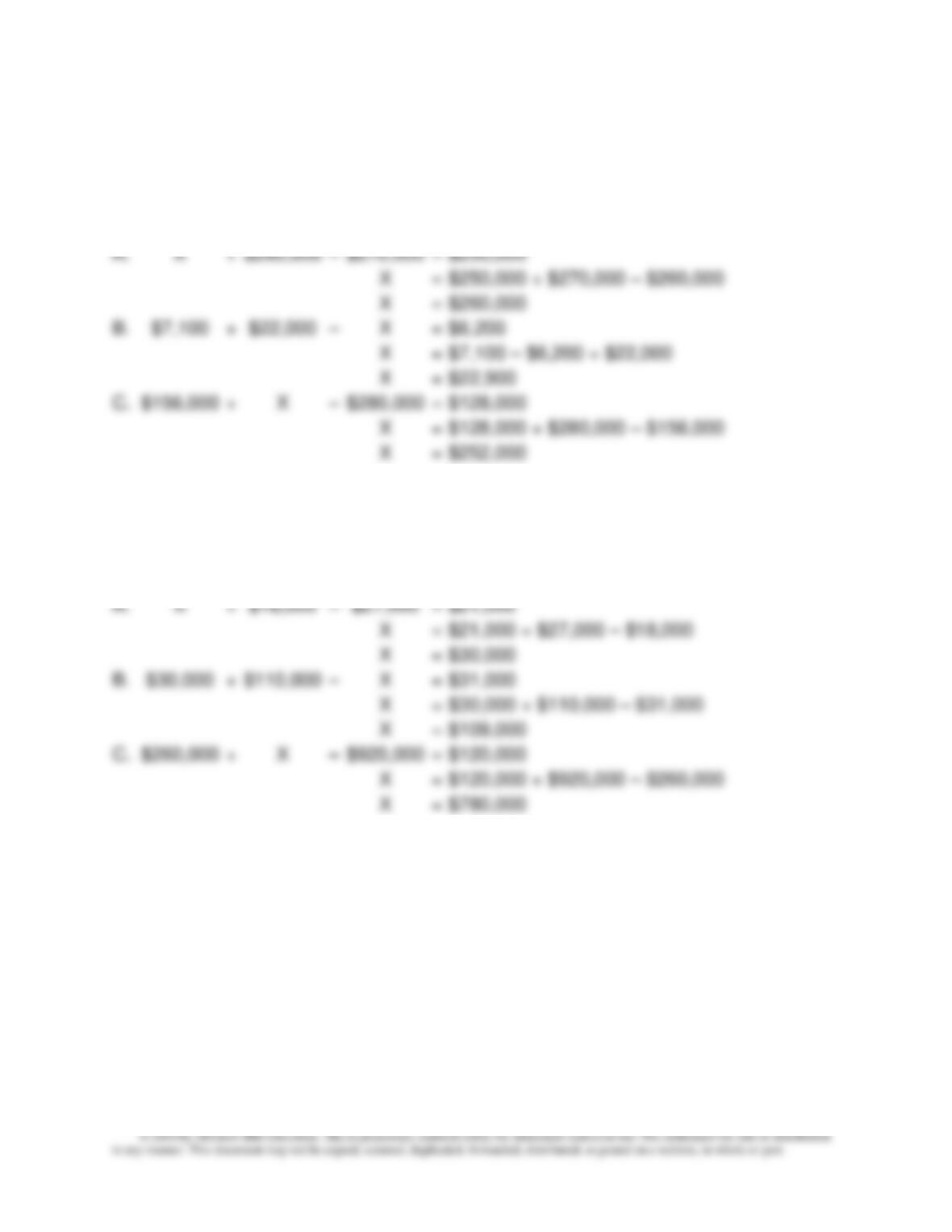
Based on the basic formula:
BB
+
TI
–
TO
=
EB
a.
$51,000
+
X
–
$57,000
=
$48,000
X
=
$54,000
b.
$28,400
+
$88,000
–
X
=
$24,800
X
=
$88,000 + $28,400 – $24,800
X
=
$91,600
c.
$67,000
+
X
–
$170,000
=
$56,000
X
=
$56,000 + $170,000 – $67,000
X
=
$159,000
Chapter 06 – Fundamentals of Product and Service Costing
6-6
6-24. (20 min.) Basic Cost Flow Model.
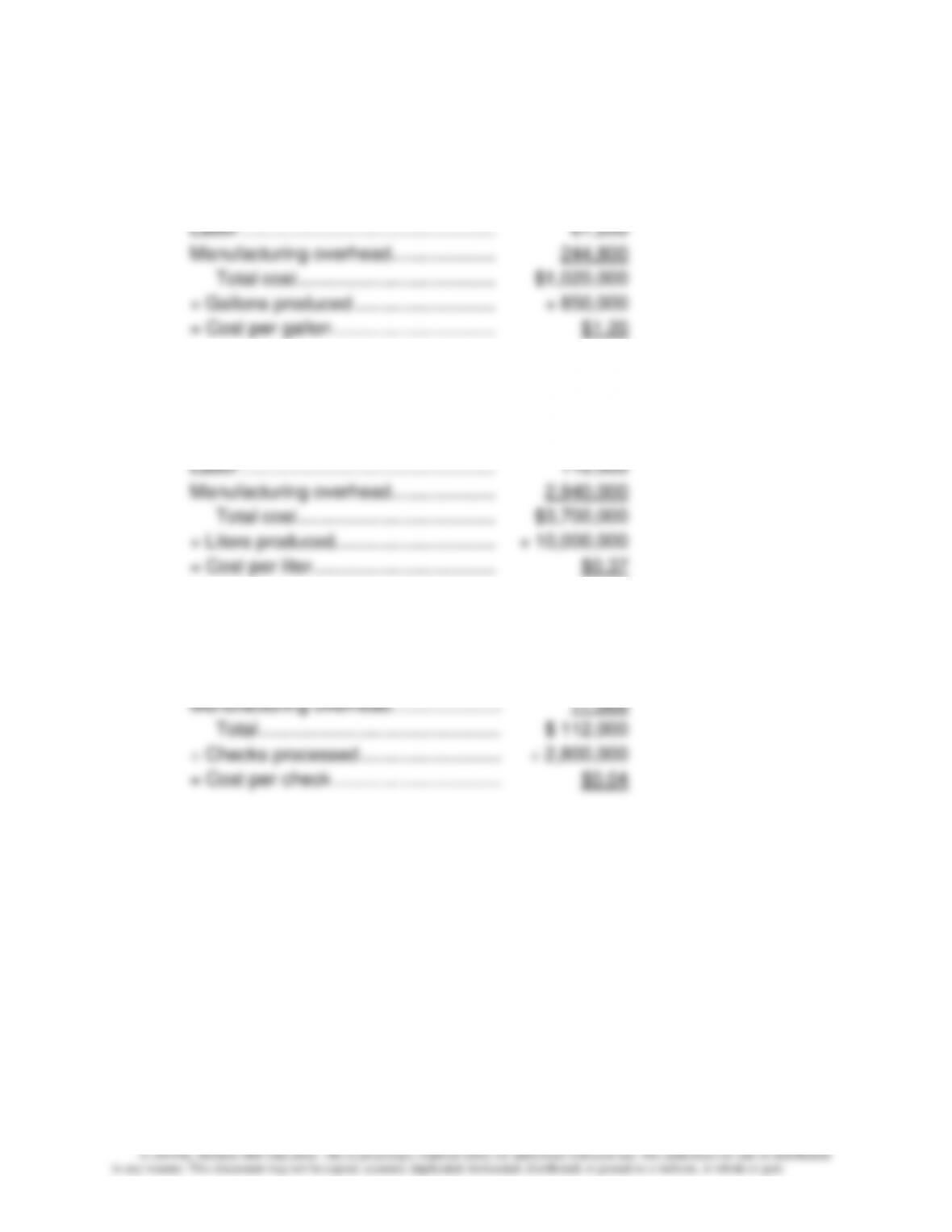
Based on the basic formula:
BB
+
TI
–
TO
=
EB
A.
X
+
$260,000
–
$270,000
=
$250,000
X
=
$250,000 + $270,000 – $260,000
X
=
$260,000
B.
$7,100
+
$22,000
–
X
=
$6,200
X
=
$7,100 – $6,200 + $22,000
X
=
$22,900
C.
$156,000
+
X
–
$280,000
=
$128,000
X
=
$128,000 + $280,000 – $156,000
X
=
$252,000
6-25. (20 min.) Basic Cost Flow Model.
Based on the basic formula:
BB
+
TI
–
TO
=
EB
A.
X
+
$18,000
–
$27,000
=
$21,000
X
=
$21,000 + $27,000 – $18,000
X
=
$30,000
B.
$30,000
+
$110,000
–
X
=
$31,000
X
=
$30,000 + $110,000 – $31,000
X
=
$109,000
C.
$260,000
+
X
–
$920,000
=
$120,000
X
=
$120,000 + $920,000 – $260,000
X
=
$780,000
Chapter 06 – Fundamentals of Product and Service Costing
6-7
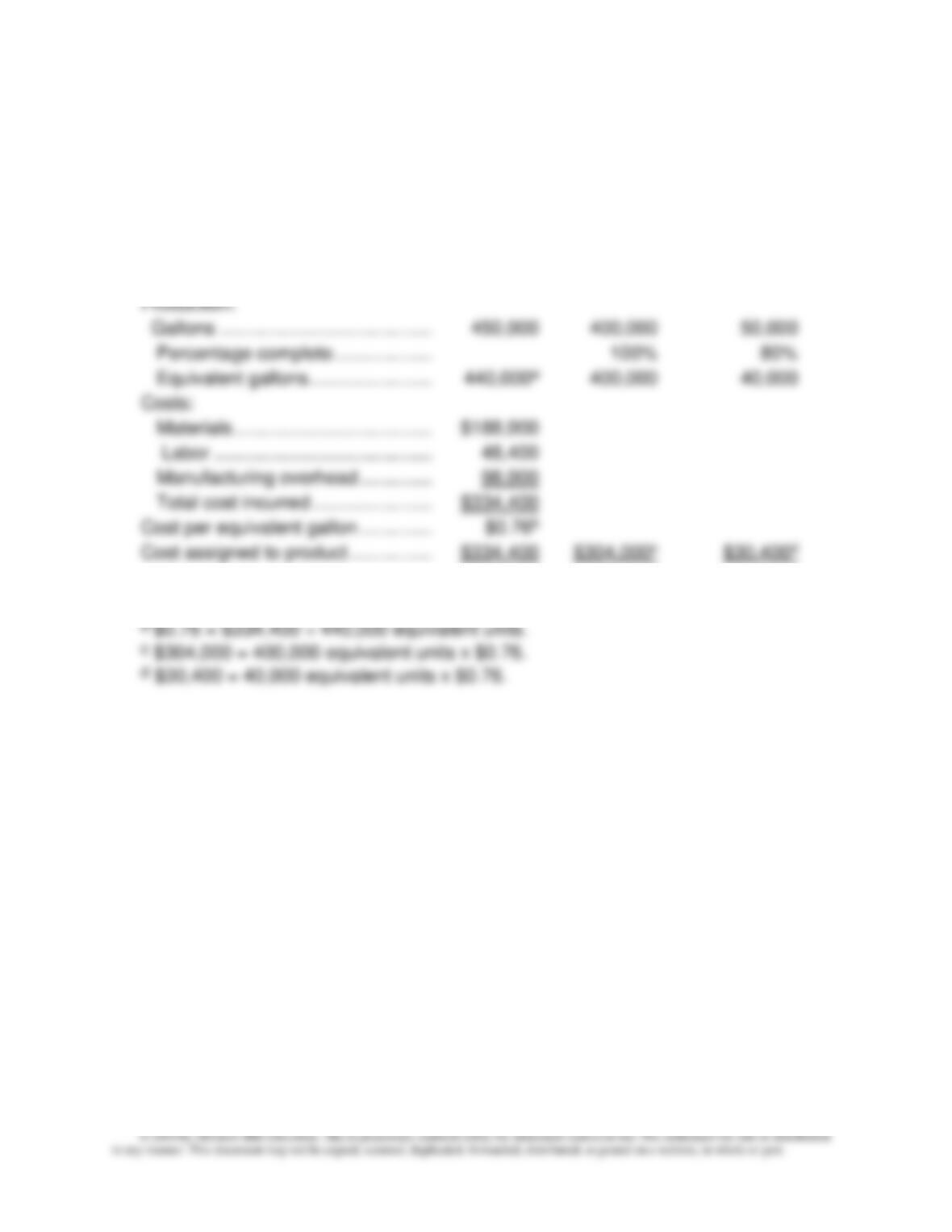
6-26. (10 min.) Basic Product Costing: Enviro Corporation.
Materials ……………………………………..
$714,000
Labor ………………………………………….
61,200
Manufacturing overhead ………………..
244,800
Total cost ………………………………..
$1,020,000
÷ Gallons produced ………………………
÷ 850,000
= Cost per gallon ………………………….
$1.20
6-27. (10 min.) Basic Product Costing: Pogues’s Pops.
Materials ……………………………………..
$650,000
Labor ………………………………………….
110,000
Manufacturing overhead ………………..
2,940,000
Total cost ………………………………..
$3,700,000
÷ Liters produced………………………….
÷ 10,000,000
= Cost per liter ……………………………..
$0.37
6-28. (10 min.) Basic Product Costing: Big City Bank.
Labor …………………………………………..
$ 35,000
Manufacturing overhead …………………
77,000
Total ……………………………………….
$ 112,000
÷ Checks processed ………………………
÷ 2,800,000
= Cost per check …………………………..
$0.04
Chapter 06 – Fundamentals of Product and Service Costing
6-8
6-29. (20 min.) Basic Product Costing: Kim and Smith Refiners.
Total
a.
Sold
b.
Work-in–
Process,
March 31
Production:
Gallons …………………………………..
450,000
400,000
50,000
Percentage complete ……………….
100%
80%
Equivalent gallons……………………
440,000a
400,000
40,000
Costs:
Materials ………………………………..
$188,000
Labor ……………………………………
48,400
Manufacturing overhead …………..
98,000
Total cost incurred …………………..
$334,400
Cost per equivalent gallon …………..
$0.76b
Cost assigned to product …………….
$334,400
$304,000c
$30,400d
a 440,000 equivalent units = 400,000 gallons completed + 80% x 50,000 gallons
in process.
b $0.76 = $334,400 ÷ 440,000 equivalent units.
c $304,000 = 400,000 equivalent units x $0.76.
d $30,400 = 40,000 equivalent units x $0.76.
Chapter 06 – Fundamentals of Product and Service Costing
6-9
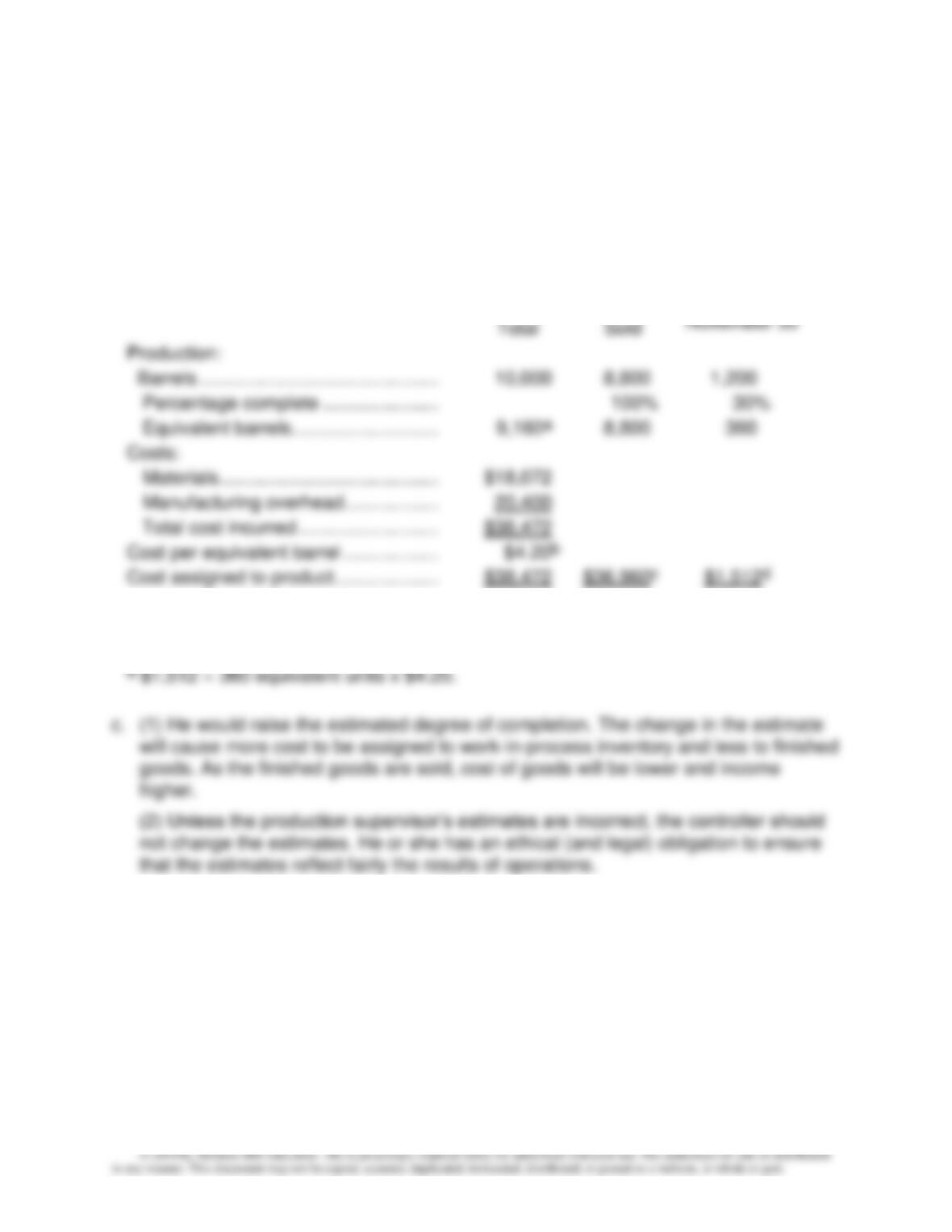
6-30. (20 min.) Basic Product Costing—Ethical Issues: Old Tyme Soda.
a. and b.
Total
a.
Sold
b.
Work-in–
Process,
November 30
Production:
Barrels …………………………..…………..
10,000
8,800
1,200
Percentage complete ………………….
100%
30%
Equivalent barrels ……………………….
9,160a
8,800
360
Costs:
Materials …………………………..……….
$18,072
Manufacturing overhead ………………
20,400
Total cost incurred ………………………
$38,472
Cost per equivalent barrel ………………
$4.20b
Cost assigned to product ………………..
$38,472
$36,960c
$1,512d
a 9,160 equivalent units = 8,800 barrels sold + 30% x 1,200 barrels in process.
b $4.20 = $38,472 ÷ 9,160 equivalent units.
c $36,960 = 8,800 equivalent units x $4.20.
d $1,512 = 360 equivalent units x $4.20.
c. (1) He would raise the estimated degree of completion. The change in the estimate
will cause more cost to be assigned to work-in-process inventory and less to finished
goods. As the finished goods are sold, cost of goods will be lower and income
higher.
(2) Unless the production supervisor’s estimates are incorrect, the controller should
not change the estimates. He or she has an ethical (and legal) obligation to ensure
that the estimates reflect fairly the results of operations.
Chapter 06 – Fundamentals of Product and Service Costing
6-10
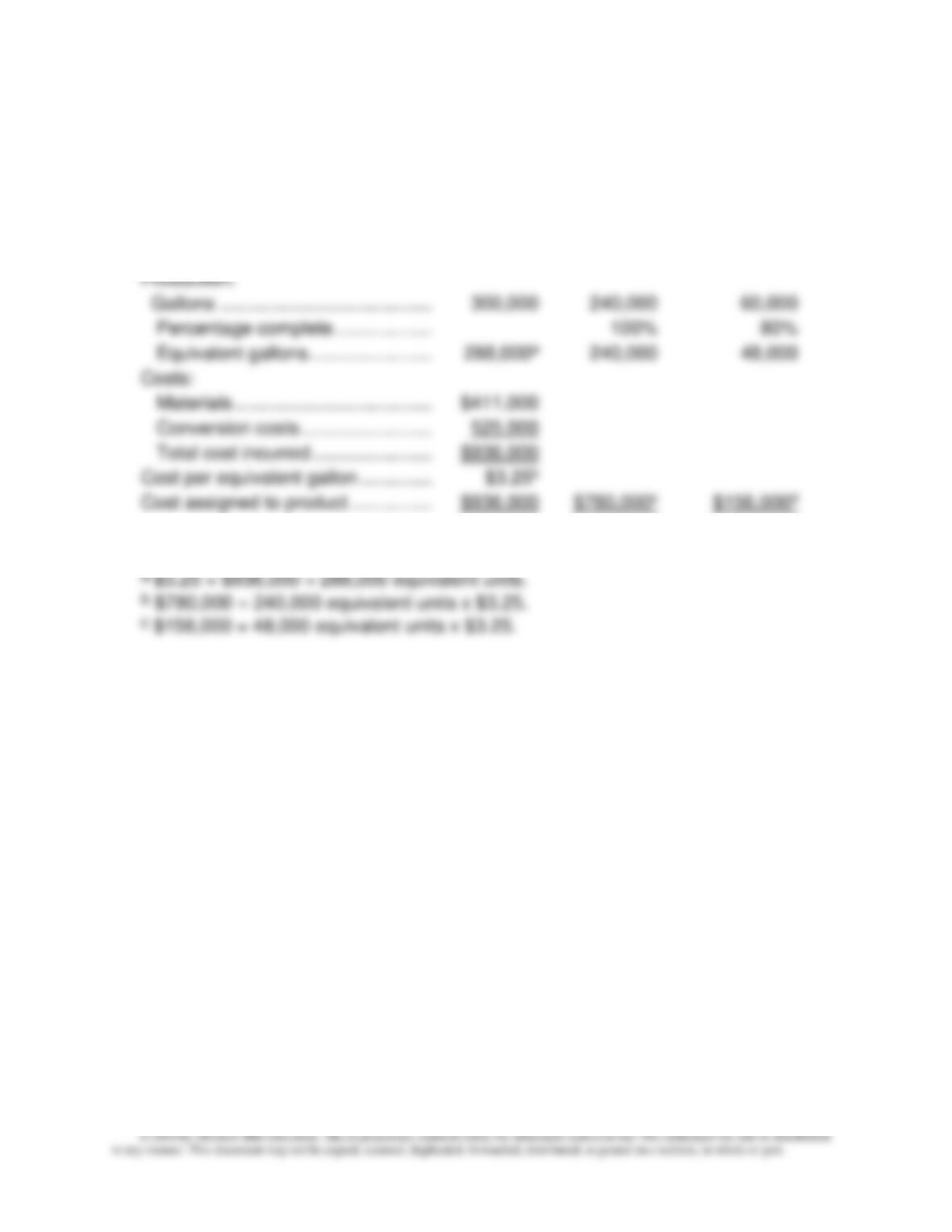
6-31. (15 min.) Process Costing: Van Goe.
Total
Transferred
to Finished
Goods
Work-in–
Process,
January 31
Production:
Gallons …………………………………..
300,000
240,000
60,000
Percentage complete ……………….
100%
80%
Equivalent gallons……………………
288,000a
240,000
48,000
Costs:
Materials ………………………………..
$411,000
Conversion costs …………………….
525,000
Total cost incurred …………………..
$936,000
Cost per equivalent gallon …………..
$3.25b
Cost assigned to product …………….
$936,000
$780,000c
$156,000d
a 288,000 equivalent units = 240,000 gallons completed + 80% x 60,000 gallons
in process.
a $3.25 = $936,000 ÷ 288,000 equivalent units.
b $780,000 = 240,000 equivalent units x $3.25.
c $156,000 = 48,000 equivalent units x $3.25.