5-55. (40 min.) Learning Curves (Appendix 5B).
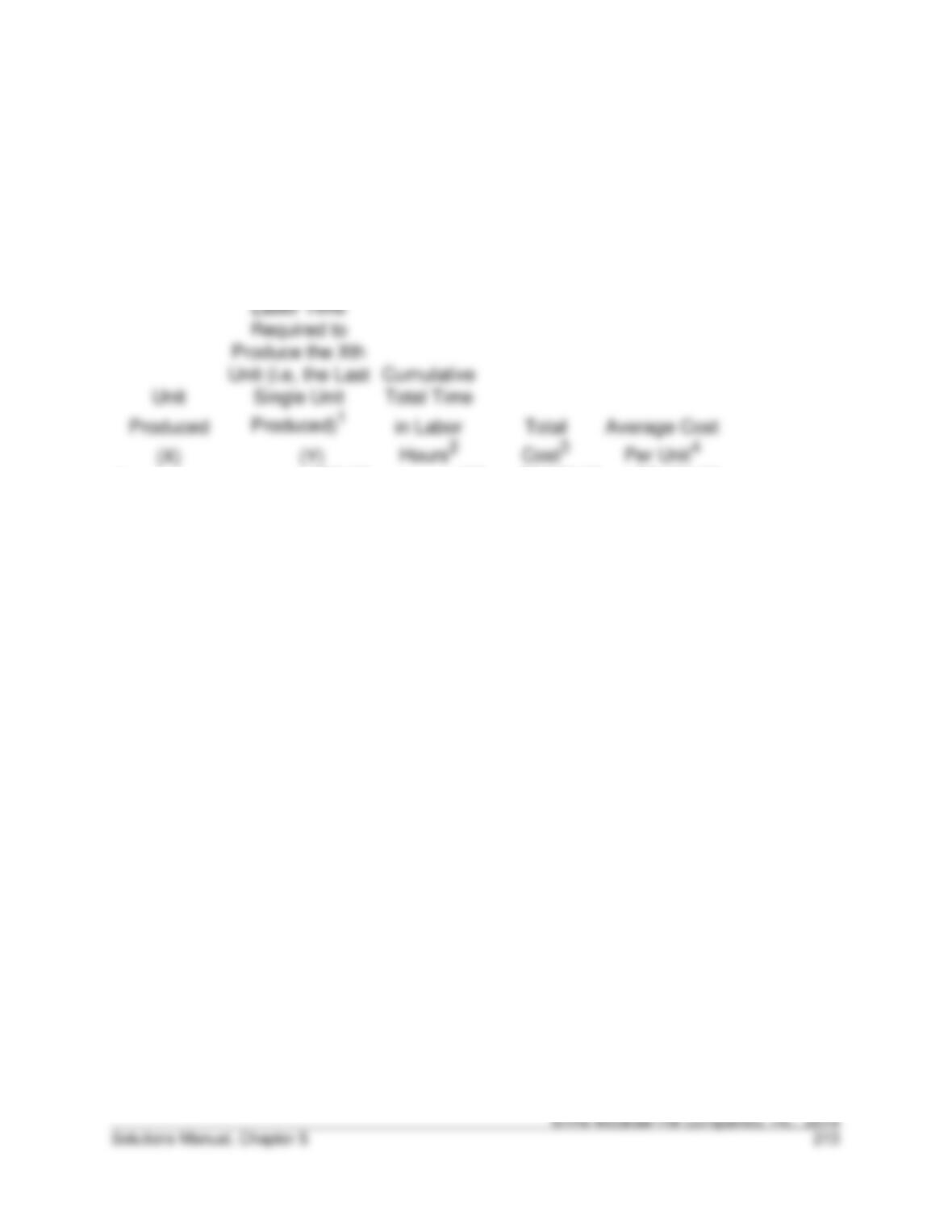
a. The learning rate coefficient is -0.152004, so the table in Exhibit 5-21 would be as
follows for a learning rate of 90%. (Note: rounding errors might lead to slight
differences from the results reported below.)
Labor Time
Required to
Produce the Xth
Unit (i.e, the Last
Cumulative
Unit
Single Unit
Total Time
Produced
Produced)1
in Labor
Total
Average Cost
(X)
(Y)
Hours2
Cost3
Per Unit4
1 ……………..
100.00
100
$5,000.00
$5,000.00
2 ……………..
90.00
190.00
9,500.00
4,750.00
3 ……………..
84.62
274.62
13,731.02
4,577.01
4 ……………..
81.00
355.62
17,781.02
4,445.25
5 ……………..
78.30
433.92
21,695.95
4,339.19
6 ……………..
76.16
510.08
25,503.87
4,250.64
7 ……………..
74.39
584.47
29,223.60
4,174.80
8 ……………..
72.90
657.37
32,868.59
4,108.57
1. Y = 100 (X-0.152004).
2. Cumulative time in labor hours for unit X is the sum of the time for each of the units
up to and including unit X.
3. Total cost is equal to the cumulative time multiplied by $50.
4. Average cost is equal to the total cost divided by the number of units produced.
©The McGraw-Hill Companies, Inc., 2014
214 Fundamentals of Cost Accounting
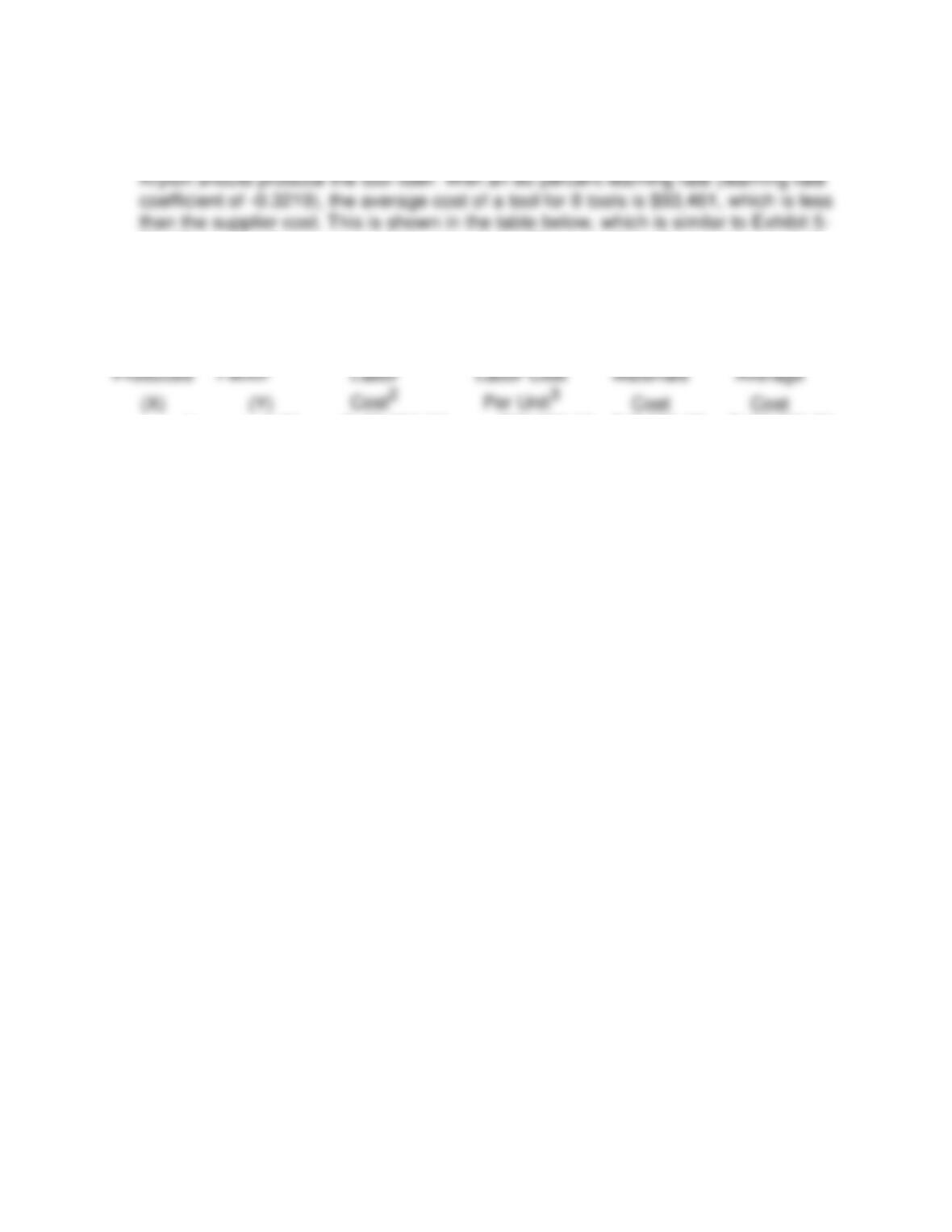
5-56. (40 min.) Learning Curves (Appendix 5B): Krylon Company.
21. (Note: rounding errors might lead to slight differences from the results reported
below.)
Unit
Learning
Total
Average
Total
Produced
Factor1
Labor
Labor Cost
Materials
Average
(X)
(Y)
Cost2
Per Unit3
Cost
Cost
1
1.00
$ 80,000.00
$80,000.00
$40,000.00
$120,000.00
2
0.80
144,001.25
72,000.62
40,000.00
112,000.62
3
0.70
200,171.28
66,723.76
40,000.00
106,723.76
4
0.64
251,373.27
62,843.32
40,000.00
102,843.32
5
0.60
299,026.41
59,805.28
40,000.00
99,805.28
6
0.56
343,963.31
57,327.22
40,000.00
97,327.22
7
0.53
386,724.81
55,246.40
40,000.00
95,246.40
8
0.51
427,687.20
53,460.90
40,000.00
93,460.90
1. This is the ratio of the labor time it takes to produce unit X relative to the first unit
and is equal to( X-0.3219).
2. The total labor cost is $80,000 (the labor cost to produce the first unit) multiplied by
the cumulative learning factor.
3. The average cost is the total cost divided by the number of units produced.
Solutions to Integrative Cases
5-57. (60 min.) Cost Estimation, CVP Analysis, and Decision Making: Luke
Corporation.
This problem is more subtle than it might appear, because the student must consider
©The McGraw-Hill Companies, Inc., 2014
216 Fundamentals of Cost Accounting
5-57. (continued)
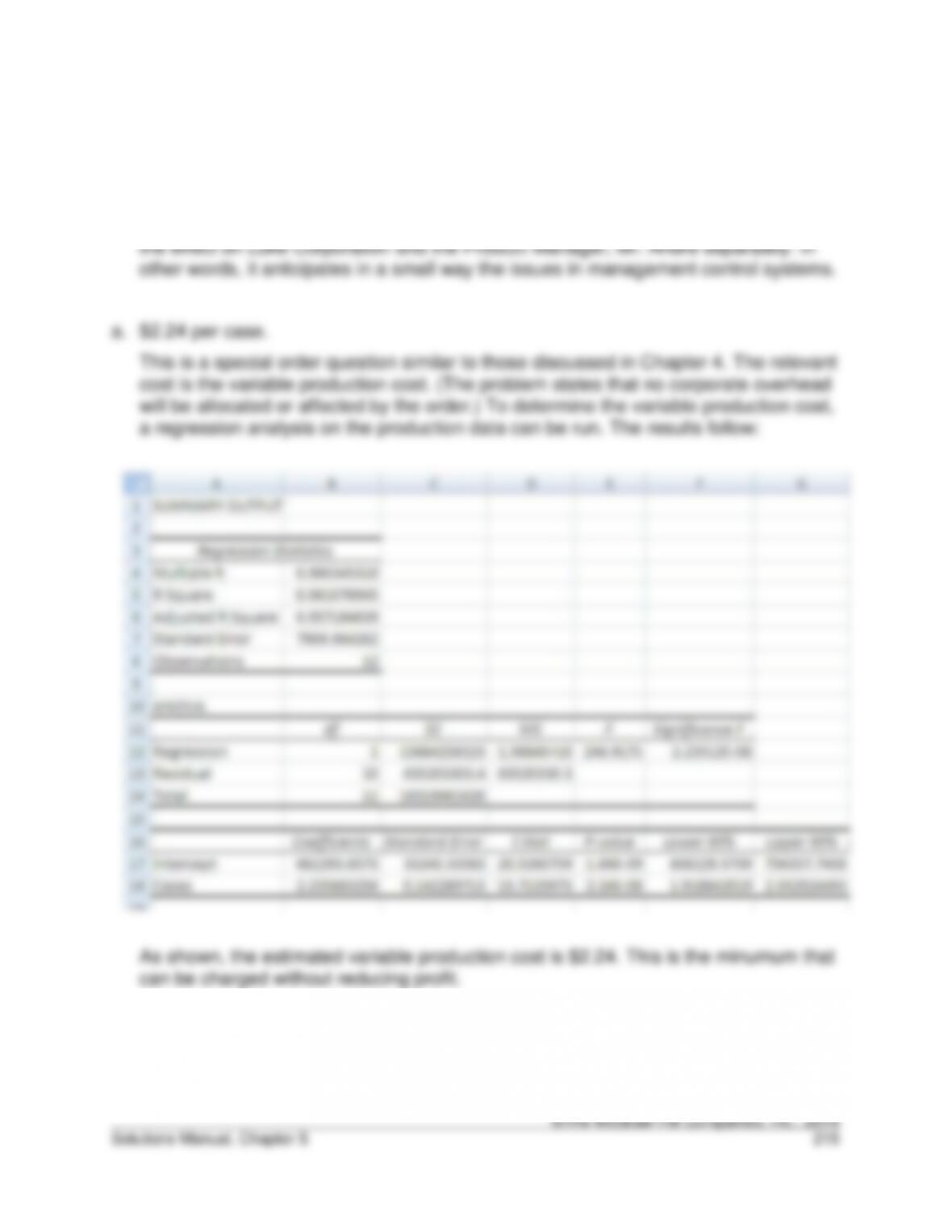
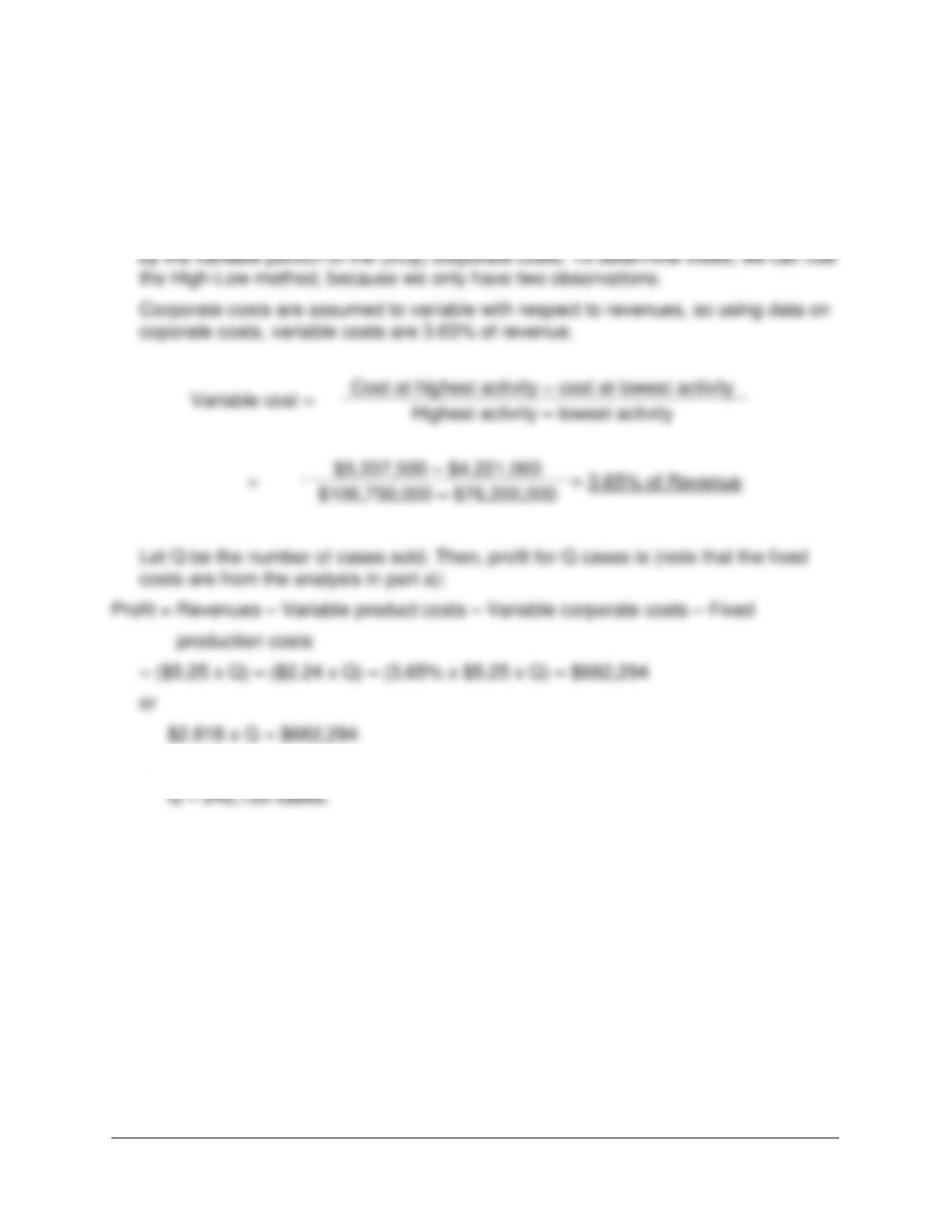
b. 242,120 cases.
To break even on the product, Luke has to sell a sufficient number of cases to cover
fixed production costs on the product. The contribution margin, however, is lowered
or
5-57. (continued)
c. 274,565 cases.
This problem differs from requirement (c), because the the requirement that the
revenue from the product covers the production costs and the full 5% corporate cost

©The McGraw-Hill Companies, Inc., 2014
218 Fundamentals of Cost Accounting