5
Cost Estimation
Solutions to Review Questions
5-1.
Common methods of cost estimation are engineering analysis, account analysis, and
statistical analysis of historical data.
5-2.
Engineering estimates are based on design specifications and industry and firm cost
standards.
5-3.
Engineering estimates are particularly helpful when:
Attempting to compare company operations with standards;
5-4.
The biggest problem likely to be encountered from the indiscriminate use of regression
methods is that the model may not have any logical foundation. This may result in a
©The McGraw-Hill Companies, Inc., 2014
178 Fundamentals of Cost Accounting
5-5.
The longer the data series used in the analysis, the easier it is to see a trend in the data
when using the scattergraph method. When using any method, the longer the data
5-6.
Simple regression assumes a single independent variable (e.g., cost driver) and
multiple regression assumes two or more independent variables.
5-7.
Adjusted R2 considers the number of independent variables used in the estimation and
“adjusts” the R2 to reflect the use of additional variables.
5-8.
Accurate cost estimates improve decision-making. Better decisions lead to higher
company value.
5-9.
It is important to incorporate learning into cost estimates, because doing so improves
the accuracy of the cost estimates, which leads to better decisions.
Solutions to Critical Analysis and Discussion Questions
5-10.
a. Direct labor would be fixed if a union contract limited the company‘s ability to lay off
unneeded personnel or if management were contemplating a change in facilities but
maintaining the same labor force.
5-11.
Account analysis incorporates the judgment of the executive where experience would
5-12.
Data in the historical accounting records should only be used insofar as they are likely
to continue in the future. In periods of price instability or technological innovation, use of
5-13.
One may:
Adjust the data to present all costs in some common dollar measure;
Use activity measures that are expressed in dollars that move with the price
©The McGraw-Hill Companies, Inc., 2014
5-14.
5-15.
It is possible for empirical data to show a negative intercept even though fixed costs
cannot be negative. It may be that the slope of the cost curve is particularly steep over
5-16.
How well defined is the model? That is, does the one independent variable explain
variation in the dependent variable? Are there any outliers? Is the relation linear?
5-17.
5-18.
5-19.
You should probably tell the executive about the error. If correcting the errors does not
5-20.
You should report your concerns. At a minimum, the manager responsible for recording
costs should be told.
5-21.
Answers will vary. (1) Income tax preparers become more proficient as they learn; (2)
graders on an exam can process an individual exam paper in less time as they
©The McGraw-Hill Companies, Inc., 2014
Solutions Manual, Chapter 5 181
complete more; and, (3) a travel agent will be able to book a flight in less time the more
reservation requests they handle.
5-22.
5-23.
By using standardized techniques, McDonalds is able to transmit information to its
employees effectively so they learn quickly.
5-24.
Data from previous products, which are likely to be similar, provide information about
how learning might affect the cost of the new product. The disadvantage is that the
©The McGraw-Hill Companies, Inc., 2014
182 Fundamentals of Cost Accounting
5-25. (15 min.) Methods of Estimating Costs―Engineering Estimates: Custom
Homebuilders.
Administrative costs …………………………………...
$20,000
Building costs – per square foot (moderate) ....
(3,000 x $150 =)
450,000
Appliances (moderate) ………………………………..
25,000
Utilities costs (if required) …………………………....
40,000
Estimated cost ……………………………………...
$535,000
5-26. (15 min.) Methods of Estimating Costs – Engineering Estimates: Cray-Z
Consultants.
Partner cost (per hour) …………………………………
(20 x $600 =)
$12,000
Senior cost (per hour) ………………………………….
(175 x $250 =)
43,750
Associate cost (per hour) ……………………………..
(500 x $75 =)
37,500
Miscellaneous cost ……………………………………..
20,000
Estimated consultant and miscellaneous cost …
$113,250
G&A costs ………………………………………………….
(150% x $113,250 =)
169,875
Estimated costs
$283,125
5-27. (15 min.) Methods of Estimating Costs—Account Analysis: Frankie’s
Fixtures.
a. Cost estimate with new costs and volume.
Cost Item
Last Year’s
Cost
(1)
Cost
Change
(1 + Cost
Increase)
(2)
This Year’s
Cost
(at last
year’s
volume)
(1) x (2) =
(3)
Growth in
Volume
(4)
This Year’s
Cost
(3) x (4) = (5)
Direct
materials
$420,000
120%
=
$504,000
220,000
= $528,000
210,000
Direct
labor ………..…….
350,000
104%
=
364,000
220,000
= 381,333
210,000
Variable
overhead ….…….
308,000
100%
=
308,000
220,000
= 322,667
210,000
Fixed
Overhead ……….
480,000
110%
=
528,000
(fixed)
= 528,000
Total
costs ………..…….
$1,558,000
$1,760,000
b. Costs per unit:
Last year:
$7.42
(= $1,558,000 ÷ 210,000)
This year:
$8.00
(= $1,760,000 ÷ 220,000)
5-28. (15 min.) Methods of Estimating Costs—Account Analysis.
a. Cost estimate with new costs and volume.
Cost Item
Year 1
Cost
(1)
Cost
Change
(1 + Cost
Increase)
(2)
Year 2 Cost
(at last
year’s
volume)
(1) x (2) =
(3)
Growth
in
Volume
(4)
Year 2 Cost
(3) x (4) = (5)
Direct
materials …
$540,000
110%
=
$594,000
195,000
= $772,200
150,000
Direct
labor ……….
3,870,000
115%
=
4,450,500
195,000
= 5,785,650
150,000
Variable
overhead …
810,000a
100%
=
810,000
195,000
= 1,053,000
150,000
Fixed
Overhead ..
900,000
105%
=
945,000
(fixed)
= 945,000
Total
costs ……….
$6,120,000
$8,555,850
a $810,000 = $1,710,000 total overhead – $900,000 fixed overhead.
b. Costs per unit:
Last year:
$40.80
(= $6,120,000 ÷ 150,000)
This year:
$43.88
(= $8,555,850 ÷ 195,000)
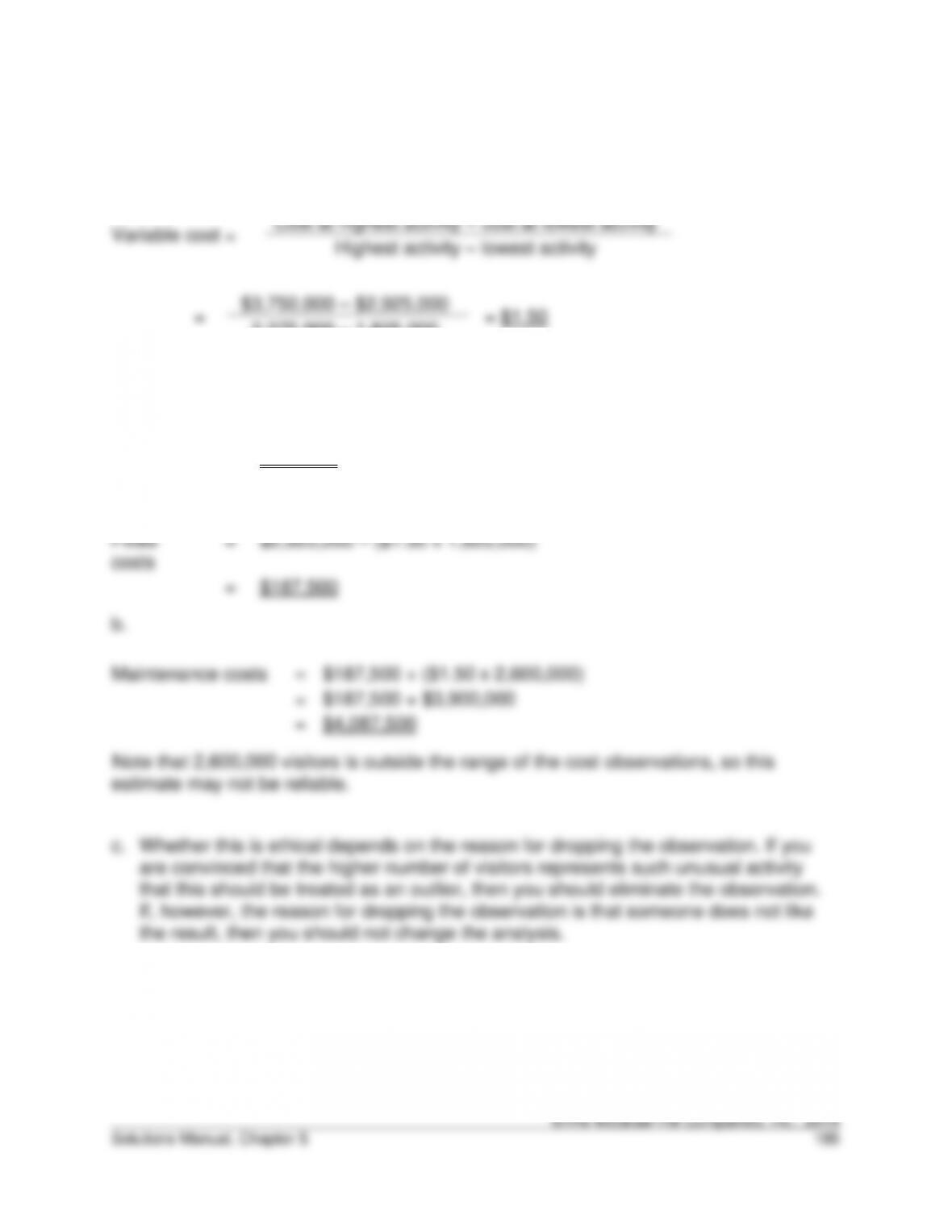
5-29. (10 min.) Methods of Estimating Costs—High-Low, Ethical Issues: Oak
Island Amusements Center.
a.
Variable cost =
Cost at highest activity – cost at lowest activity
Highest activity – lowest activity
=
$3,750,000 – ($1.50 x 2,375,000)
=
©The McGraw-Hill Companies, Inc., 2014
186 Fundamentals of Cost Accounting
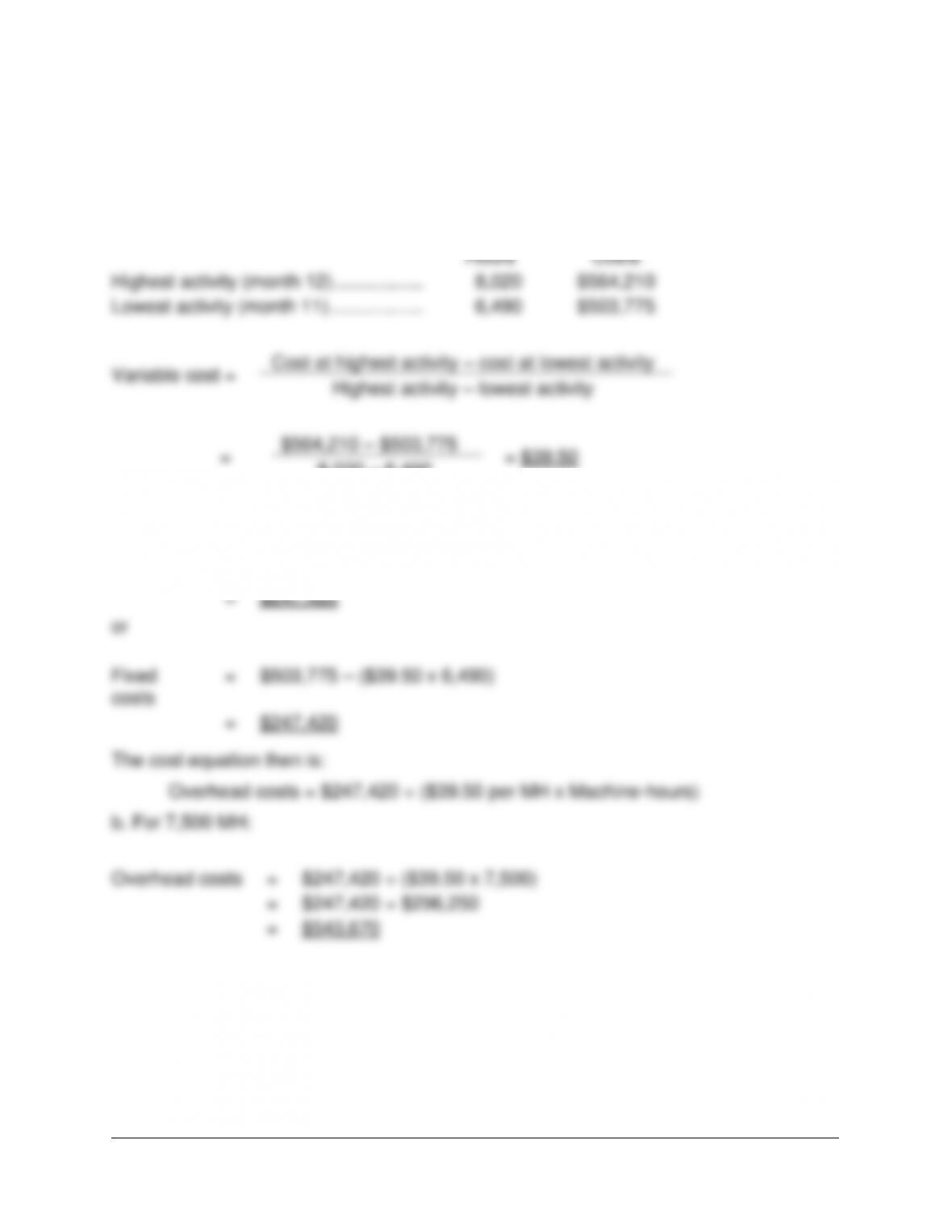
5-30. (25 min.) Methods of Estimating Costs—High-Low: Adriana Corporation.
a. High-low estimate
Machine-
Hours
Overhead
Costs
Highest activity (month 12) ……………..
8,020
$564,210
Lowest activity (month 11) ………………
6,490
$503,775
Variable cost =
Cost at highest activity – cost at lowest activity
Highest activity – lowest activity
=
$564,210 – $503,775
8,020 – 6,490
= $39.50
Fixed
costs
=
Total costs – variable costs
=
$564,210 – ($39.50 x 8,020)
=
$247,420
or
Fixed
costs
=
$503,775 – ($39.50 x 6,490)
=
$247,420
The cost equation then is:
Overhead costs = $247,420 + ($39.50 per MH x Machine-hours)
b. For 7,500 MH:
Overhead costs
=
$247,420 + ($39.50 x 7,500)
=
$247,420 + $296,250
=
$543,670