Chapter 04 -Fundamentals of Cost Analysis for Decision Making
4-31
4-52. (continued)
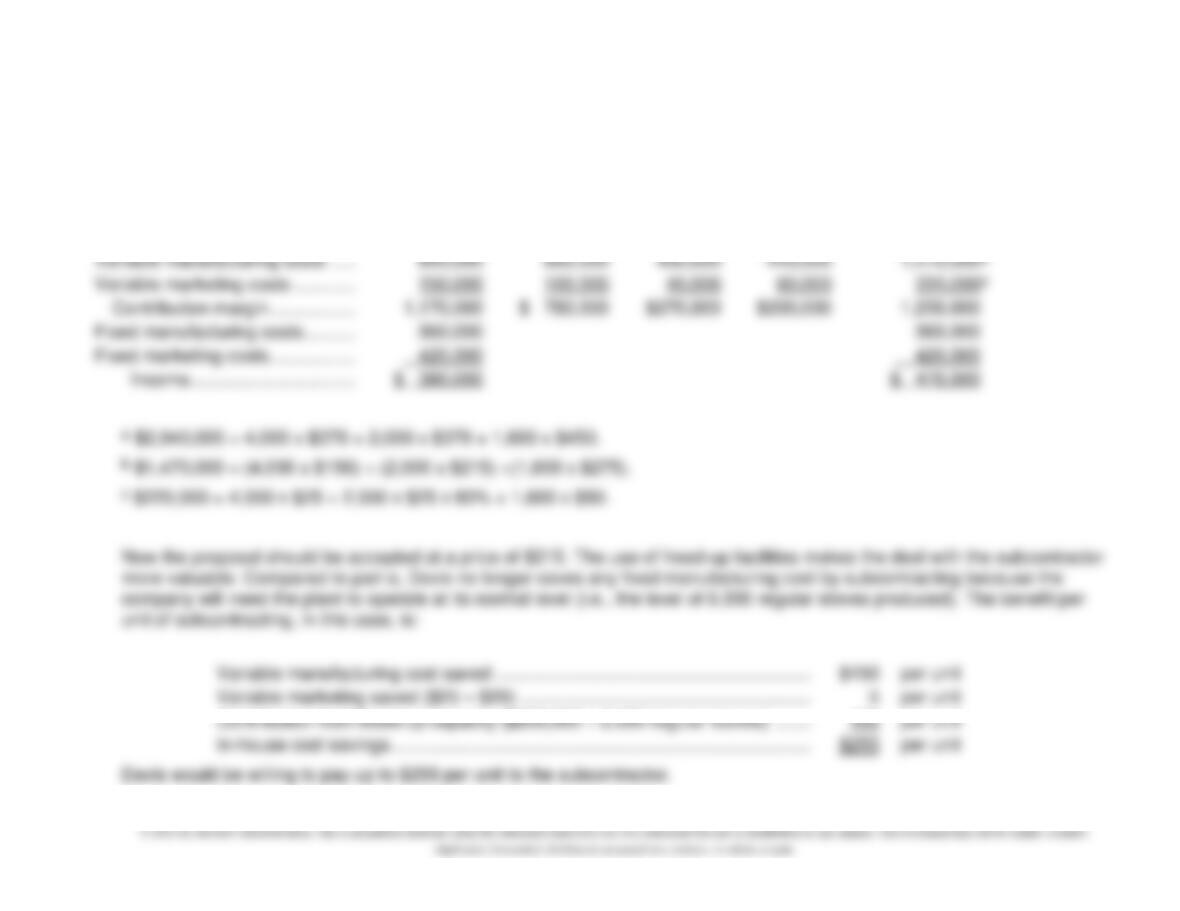
f.
6,000 Regular
Stoves Produced
Contract 2,000 Regular Stoves;
Produce 1,600 Modified Stoves and 4,000 Regular Stoves
In-house
Regular (In)
Regular (Out)
Modified
Total
Revenue ……………………………….
$2,220,000
$1,480,000
$740,000
$720,000
$2,940,000a
Variable manufacturing costs …..
900,000
600,000
430,000
440,000
1,470,000b
Variable marketing costs …………
150,000
100,000
40,000
80,000
220,000c
Contribution margin ……………..
1,170,000
$ 780,000
$270,000
$200,000
1,250,000
Fixed manufacturing costs ……….
360,000
360,000
Fixed marketing costs ……………..
420,000
420,000
Income …………………………...
$ 390,000
$ 470,000
a $2,940,000 = 4,000 x $370 + 2,000 x $370 + 1,600 x $450.
b $1,470,000 = (4,000 x $150) + (2,000 x $215) +(1,600 x $275).
c $220,000 = 4,000 x $25 + 2,000 x $25 x 80% + 1,600 x $50.
Now the proposal should be accepted at a price of $215. The use of freed-up facilities makes the deal with the subcontractor
more valuable. Compared to part e, Davis no longer saves any fixed manufacturing cost by subcontracting because the
company will need the plant to operate at its normal level (i.e., the level of 6,000 regular stoves produced). The benefit per
unit of subcontracting, in this case, is:
Variable manufacturing cost saved ……………………………………………………….
$150
per unit
Variable marketing saved ($25 – $20) …………………………………………………....
5
per unit
Contribution from freed-up capacity ($200,000 ÷ 2,000 regular stoves) ……....
100
per unit
In-house cost savings …………………………………………………………………………...
$255
per unit
Davis would be willing to pay up to $255 per unit to the subcontractor.
Chapter 04 -Fundamentals of Cost Analysis for Decision Making
4-32
4-53. (60 min.) Make or Buy: King City Specialty Bikes (KCSB).
a. The in-house unit cost that should be used to evaluate the quotation received from the
outside contractor is $192. Therefore the proposal for $140 from the outside contractor
should be accepted.
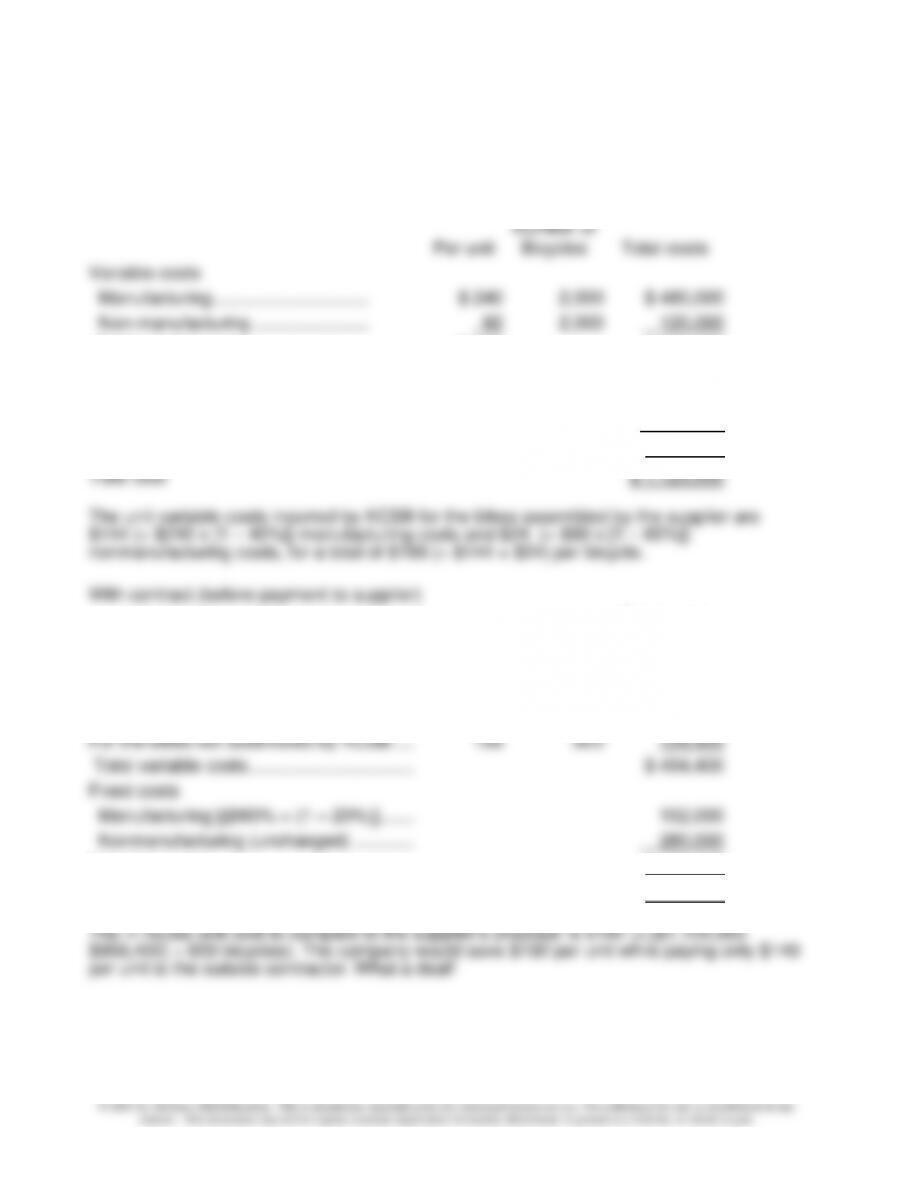
Without contract:
Per unit
Number of
Bicycles
Total costs
Variable costs
Manufacturing ………………………….
$ 240
2,000
$ 480,000
Non-manufacturing …………………..
60
2,000
120,000
Total variable costs ……………………
$ 300
$ 600,000
Fixed costs
Manufacturing ………………………….
120
2,000
240,000
Nonmanufacturing ……………………
140
2,000
280,000
Total fixed costs …………………………
$ 520,000
Total cost
$ 1,120,000
The unit variable costs incurred by KCSB for the bikes assembled by the supplier are
$144 (= $240 x [1 – 40%]) manufacturing costs and $24 (= $60 x [1 – 60%])
nonmanufacturing costs, for a total of $168 (= $144 + $24) per bicycle.
With contract (before payment to supplier)
Total costs
For the bikes assembled by KCSB:
Variable costs:
Per unit
Number of
Bicycles
For the bikes assembled by KCSB ……….
$ 300
1,200
$ 360,000
For the bikes not assembled by KCSB ….
168
800
134,400
Total variable costs …………………………...
$ 494,400
Fixed costs
Manufacturing [@80% = (1 – 20%)] …….
192,000
Nonmanufacturing (unchanged) …………
280,000
Total fixed costs …………………………………
$ 472,000
Total cost ………………………………………….
$ 966,400
Chapter 04 -Fundamentals of Cost Analysis for Decision Making
4-53. (continued)
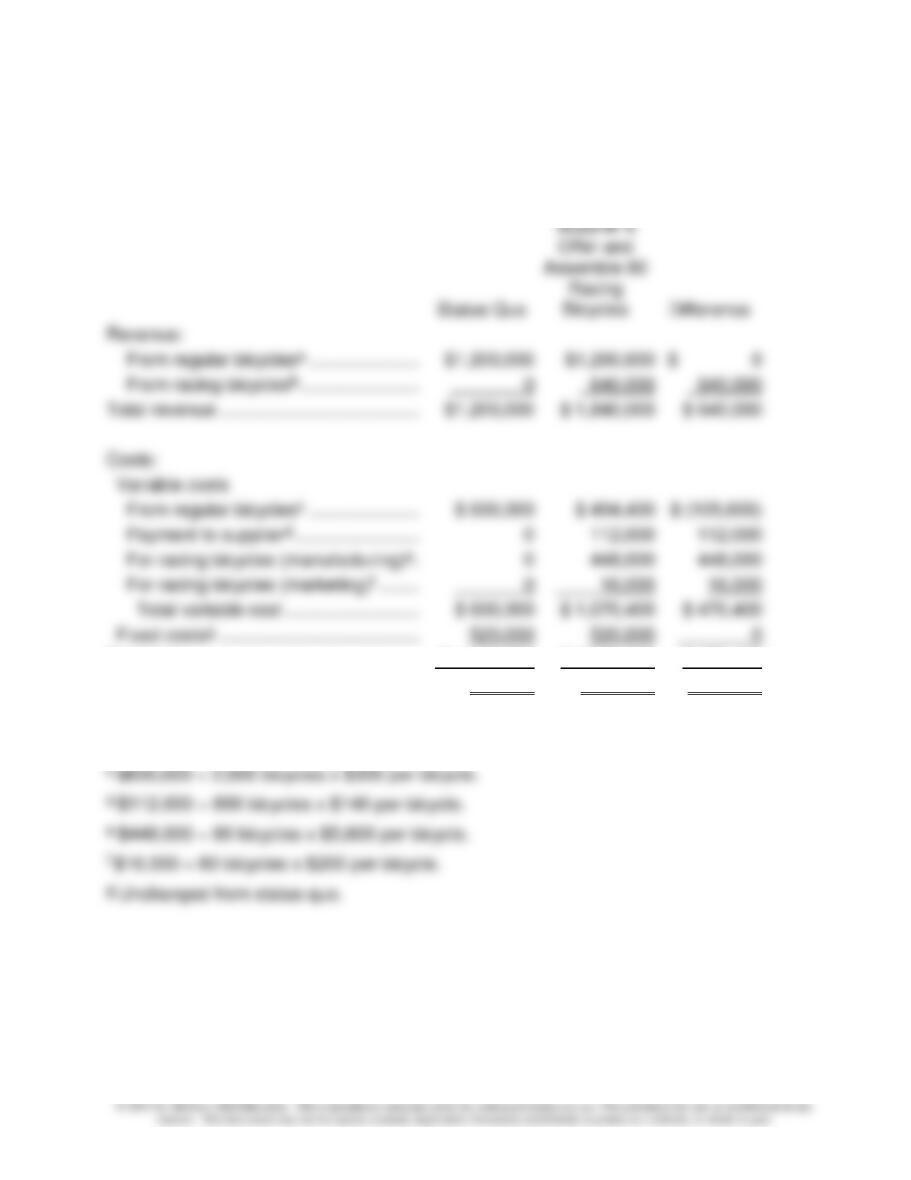
b. The additional revenue from the racing bicycles is greater than the additional costs
from using the supplier and assembling the racing bicycles. Therefore the supplier’s
offer should be accepted.
Status Quo
Accept
Supplier’s
Offer and
Assemble 80
Racing
Bicycles
Difference
Revenue:
From regular bicyclesa ………………….
$1,200,000
$1,200,000
$ 0
From racing bicyclesb ……………………
0
640,000
640,000
Total revenue ………………………………….
$1,200,000
$ 1,840,000
$ 640,000
Costs:
Variable costs
From regular bicyclesc ………………….
$ 600,000
$ 494,400
$ (105,600)
Payment to supplierd …………………….
0
112,000
112,000
For racing bicycles (manufacturing)e .
0
448,000
448,000
For racing bicycles (marketing)f ……..
0
16,000
16,000
Total variable cost ………………………
$ 600,000
$ 1,070,400
$ 470,400
Fixed costsg ………………………………….
520,000
520,000
0
Total cost ………………………………………..
$ 1,120,000
$ 1,590,400
$ 470,400
Profit ………………………………………………
$80,000
$249,600
$169,600
a $1,200,000 = 2,000 bicycles x $600 per bicycle.
b $640,000 = 80 bicycles x $8,000 per bicycle.
Chapter 04 -Fundamentals of Cost Analysis for Decision Making
4-34
4-54. Decision Whether to Add or Drop: Carson Corporation.
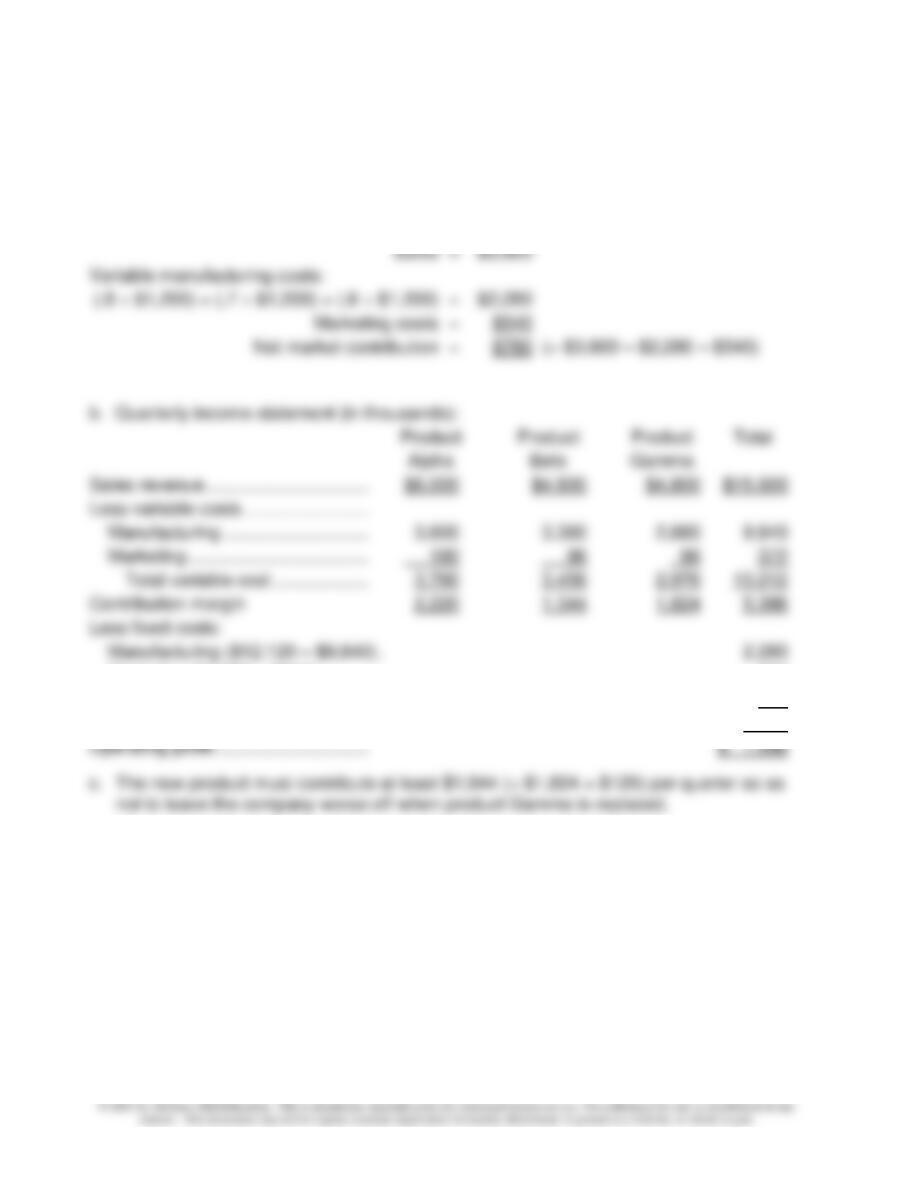
a. The regional market should not be dropped as this market not only covers all the
variable costs and separable fixed costs but also gives net market contribution of
$780,000 toward the common fixed costs.
Sales
=
$3,600
Variable manufacturing costs:
(.6 $1,200) + (.7 $1,200) + (.6 $1,200)
=
$2,280
Marketing costs
=
$540
Net market contribution
=
$780
(= $3,600 – $2,280 – $540)
b. Quarterly income statement (in thousands):
Product
Alpha
Product
Beta
Product
Gamma
Total
Sales revenue …………………………...
$6,000
$4,800
$4,800
$15,600
Less variable costs …………………….
Manufacturing ………………………..
3,600
3,360
2,880
9,840
Marketing ………………………………
180
96
96
372
Total variable cost ……………….
3,780
3,456
2,976
10,212
Contribution margin
2,220
1,344
1,824
5,388
Less fixed costs:
Manufacturing ($12,120 – $9,840) .…………….
2,280
Marketing ($1,260 – $372) ……….
888
Administrative…………………………
624
Total fixed costs …………………..
3,792
Operating profit ………………………….
$ 1,596
c. The new product must contribute at least $1,944 (= $1,824 + $120) per quarter so as
not to leave the company worse off when product Gamma is replaced.
Chapter 04 -Fundamentals of Cost Analysis for Decision Making
4-35
4-55. (30 min.) Decision Whether to Close a Store: Power Music.
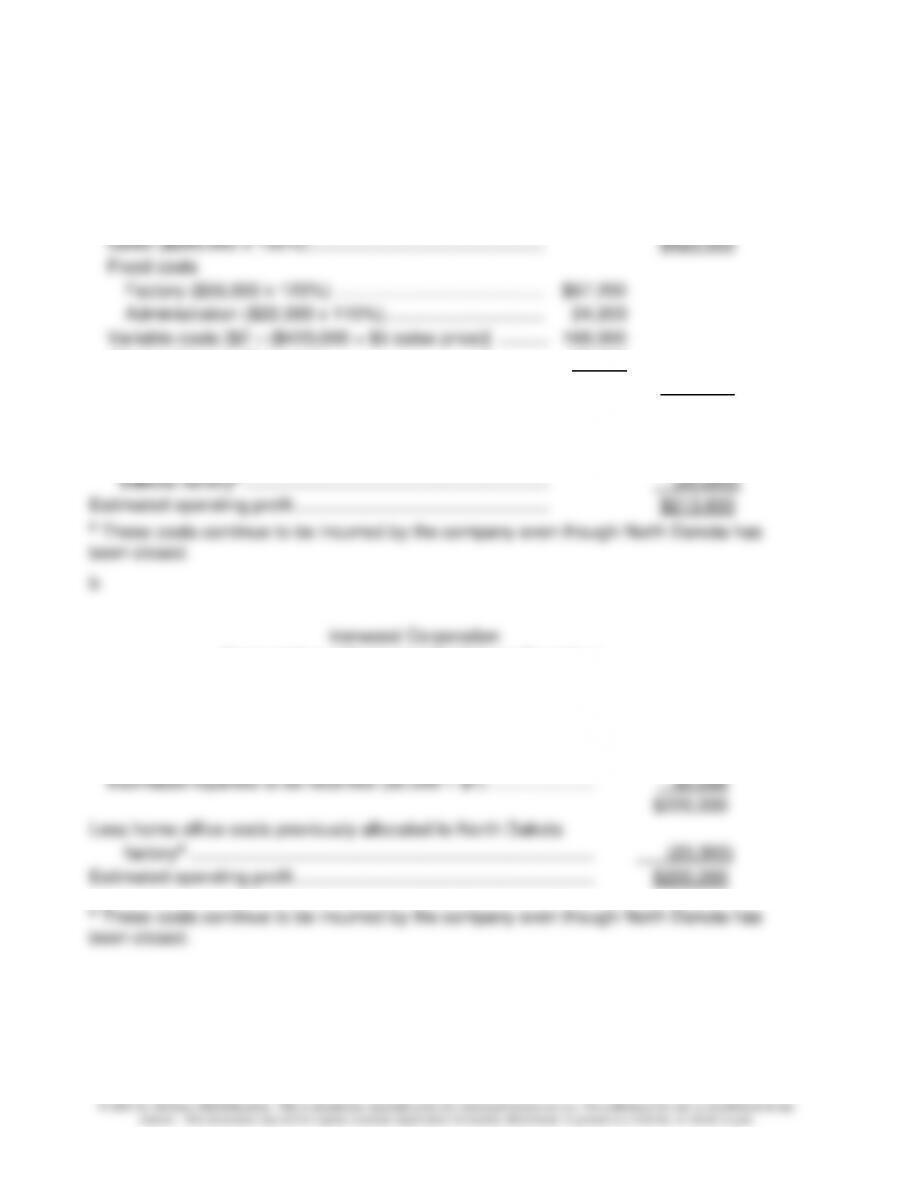
We recommend that Power Music close the store. The cost savings are greater than
the lost margin on the sales. The difference, however, is not large and if there are
other considerations, they might outweigh the estimated increase in profits.
d 10% of these costs could be saved if the store is closed.
Chapter 04 -Fundamentals of Cost Analysis for Decision Making
4-36
4-56. (45 min.) Closing a Plant: Ironwood Corporation.
a.
Ironwood Corporation
Computation of Estimated Profit from Operations
after Expansion of Minnesota Factory
Minnesota factory:
Sales ($280,000 x 150%) ………………………………………..
$420,000
Fixed costs
Factory ($56,000 x 120%) ……………………………………
$67,200
Administration ($22,000 x 110%) …………………………..
24,200
Variable costs [$2 ($420,000 ÷ $5 sales price)] ……….
168,000
Allocated home office costs ……………………………………..
35,000
Total ………………………………………………………………….
294,400
Estimated operating profit ………………………………………..
$125,600
Wisconsin factory—estimated operating profit ………………..
108,000
Less home office costs previously allocated to North
Dakota factorya …………………………………………………….
(20,000)
Estimated operating profit ……………………………………………
$213,600
a These costs continue to be incurred by the company even though North Dakota has
been closed.
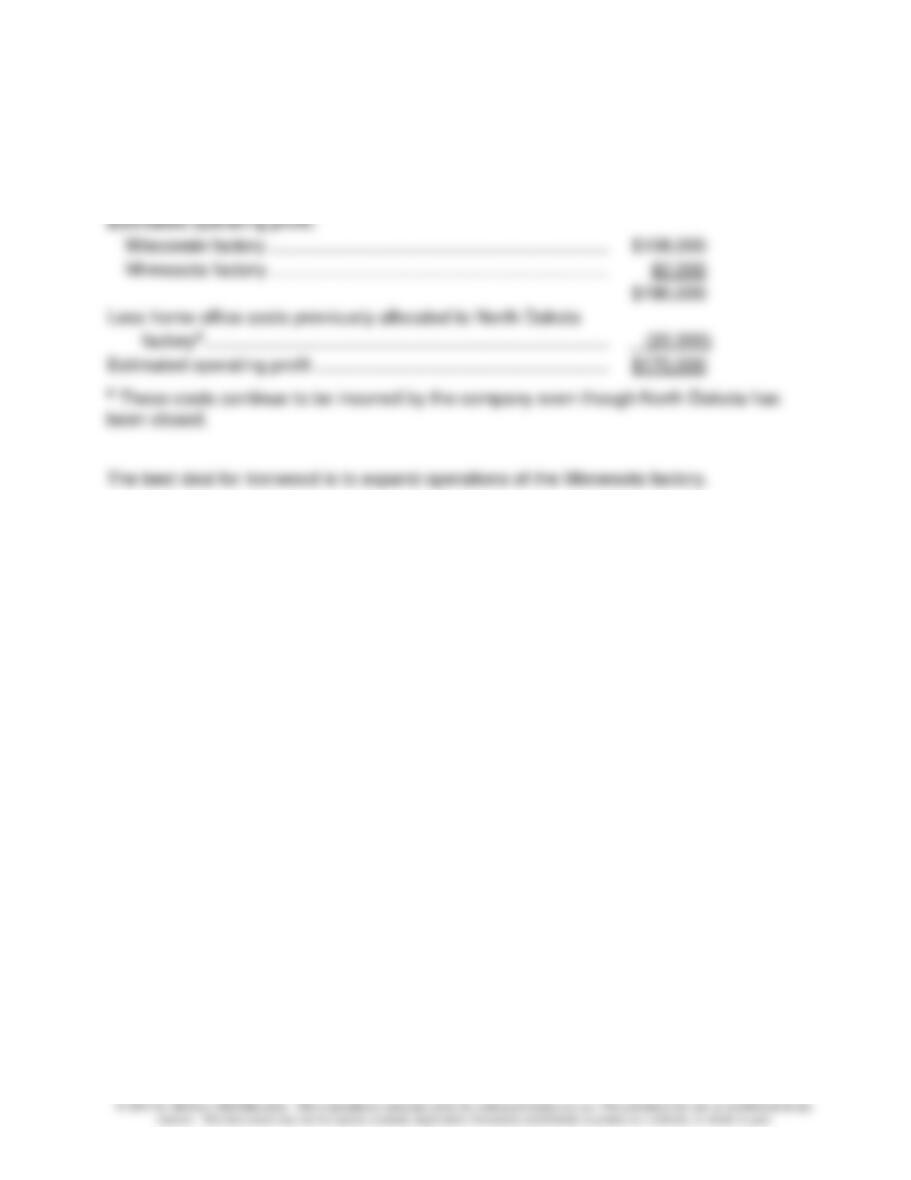
b.
Ironwood Corporation
Computation of Estimated Profit from Operations
after Negotiation of Royalty Contract
Estimated operating profit:
Wisconsin factory ……………………………………………………………
$108,000
Minnesota factory ……………………………………………………………
82,000
Estimated royalties to be received (30,000 $1) …………………
30,000
$220,000
Less home office costs previously allocated to North Dakota
factorya ………………………………………………………………………
(20,000)
Estimated operating profit ……………………………………………………
$200,000
a These costs continue to be incurred by the company even though North Dakota has
been closed.
Chapter 04 -Fundamentals of Cost Analysis for Decision Making
4-37
4-56. (continued)
c.
Ironwood Corporation
Computation of Estimated Profit from Operations
after Shutdown of North Dakota Factory
Estimated operating profit:
Wisconsin factory …………………………………………………………..
$108,000
Minnesota factory …………………………..………………………………
82,000
$190,000
Less home office costs previously allocated to North Dakota
factorya ………………………………………………………………………
(20,000)
Estimated operating profit …………………………………………………..
$170,000
a These costs continue to be incurred by the company even though North Dakota has
been closed.
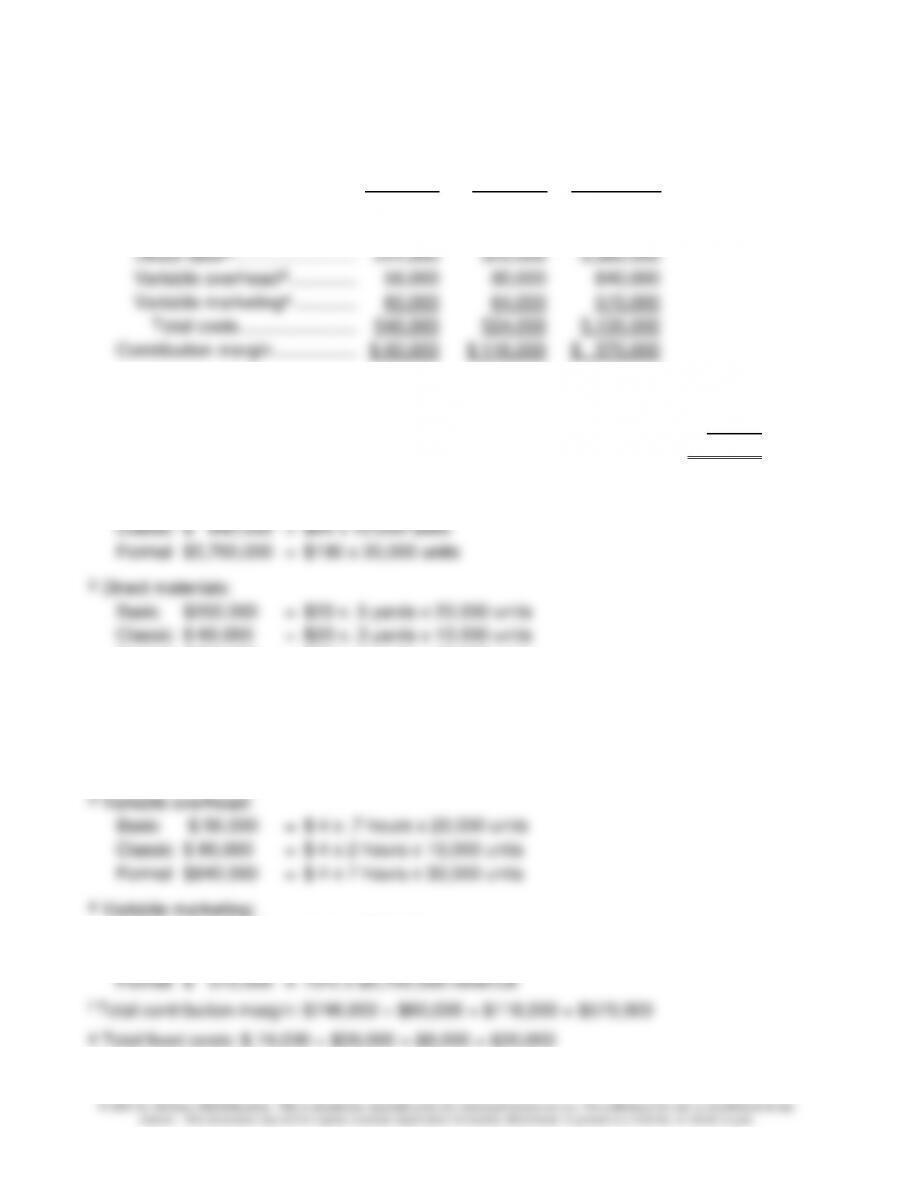
The best deal for Ironwood is to expand operations of the Minnesota factory.
Chapter 04 -Fundamentals of Cost Analysis for Decision Making
4-38
4-57. (60 min.) Optimum Product Mix: Austin Enterprises.
a.
Basic
Classic
Formal
Total revenuea ………………………..…
$600,000
$640,000
$5,700,000
Less variable manufacturing costs:
Direct materialsb ………………………..
200,000
60,000
360,000
Direct laborc …………………….…….
224,000
320,000
3,360,000
Variable overheadd …………..………..
56,000
80,000
840,000
Variable marketinge ………….………..
60,000
64,000
570,000
Total costs …………………………..
540,000
524,000
5,130,000
Contribution margin ……………..………..
$ 60,000
$ 116,000
$ 570,000
Total contribution marginf ……………………………..
$746,000
Total fixed costsg …………………………………………
74,000
Total operating profit ……………………………………
$672,000
a Revenue:
Basic
$ 600,000
=
$30 x 20,000 units
Classic
$ 640,000
=
$64 x 10,000 units
Formal
$5,700,000
=
$190 x 30,000 units
Basic
$200,000
=
$20 x .5 yards x 20,000 units
Classic
$ 60,000
=
$20 x .3 yards x 10,000 units
Formal
$360,000
=
$20 x .6 yards x 30,000 units
c Direct labor:
Basic
$ 224,000
=
$ 16 x .7 hours x 20,000 units
Classic
$ 320,000
=
$ 16 x 2 hours x 10,000 units
Formal
$3,360,000
=
$ 16 x 7 hours x 30,000 units
Basic
$ 56,000
=
$ 4 x .7 hours x 20,000 units
Classic
$ 80,000
=
$ 4 x 2 hours x 10,000 units
Formal
$840,000
=
$ 4 x 7 hours x 30,000 units
Basic
$ 60,000
=
10% x $600,000 revenue
Classic
$ 64,000
=
10% x $640,000 revenue
Formal
$ 570,000
=
10% x $5,700,000 revenue
Chapter 04 -Fundamentals of Cost Analysis for Decision Making
4-39
4-57. (continued)
b. Contribution margin per constrained resource, labor:
Basic
$4.286
=
($60,000 ÷ 20,000 units) ÷ .7 hours
Classic
$5.80
=
($116,000 ÷ 10,000 units) ÷ 2 hours
Formal
$2.714
=
($570,000 ÷ 30,000 units) ÷ 7 hours
The Classic would be the most profitable product line given the constrained resource,
direct labor.
c. The most profitable combination is to produce up to the demand of Classic with a
contribution of $5.80 per direct labor-hour, and the remaining hours spent on Basic
with a contribution of $4.286.
10,000 Classics x 2 hours per Classic = 20,000 hours
10,000 hoursa ÷ .7 hours per Basic = 14,285 Basics (rounded)
Therefore, Austin should produce 10,000 Classics and 14,285 Basics.
a10,000 hours = 30,000 hours – 20,000 hours.
Chapter 04 -Fundamentals of Cost Analysis for Decision Making
4-57. (continued)
d.
Basic
Classic
Total revenuea …………………………………..………
$428,550
$640,000
Less variable manufacturing costs:
Direct materialsb …………………………….………
142,850
60,000
Direct laborc …………………………………..………
159,992
320,000
Variable overheadd …………………………..
39,998
80,000
Variable marketinge ………………………..…
42,855
64,000
Total costs ………………………………….………
385,695
524,000
Contribution margin ……………………………………
$ 42,855
$116,000
Total contribution marginf …………………………….
$158,855
Total fixed costsg ………………………………………..
74,000
Total operating profit ……………………………………
$ 84,855
a Revenue:
Basic
$428,550
=
$30
x
14,285 units
Classic
$640,000
=
$64
x
10,000 units
Classic
=
$20
x
.3 yards
x
10,000 units
Basic
$ 159,992
=
$ 16
x
.7 hours
x
14,285 units
Classic
$320,000
=
$ 16
x
2 hours
x
10,000 units
Basic
=
$ 4
x
.7 hours
x
14,285 units
Classic
=
$ 4
x
2 hours
x
10,000 units