Chapter 04 – Fundamentals of Cost Analysis for Decision Making
4-21
4-48. (continued)
The difference in profit is $1,677,500 – $1,230,000 = $447,500.
The company is better off accepting the special order. (Of course, the company
would earn even more profit if it could first produce for the regular customers and
Chapter 04 – Fundamentals of Cost Analysis for Decision Making
4-49. (30 min.) Special Orders: Sherene Nili
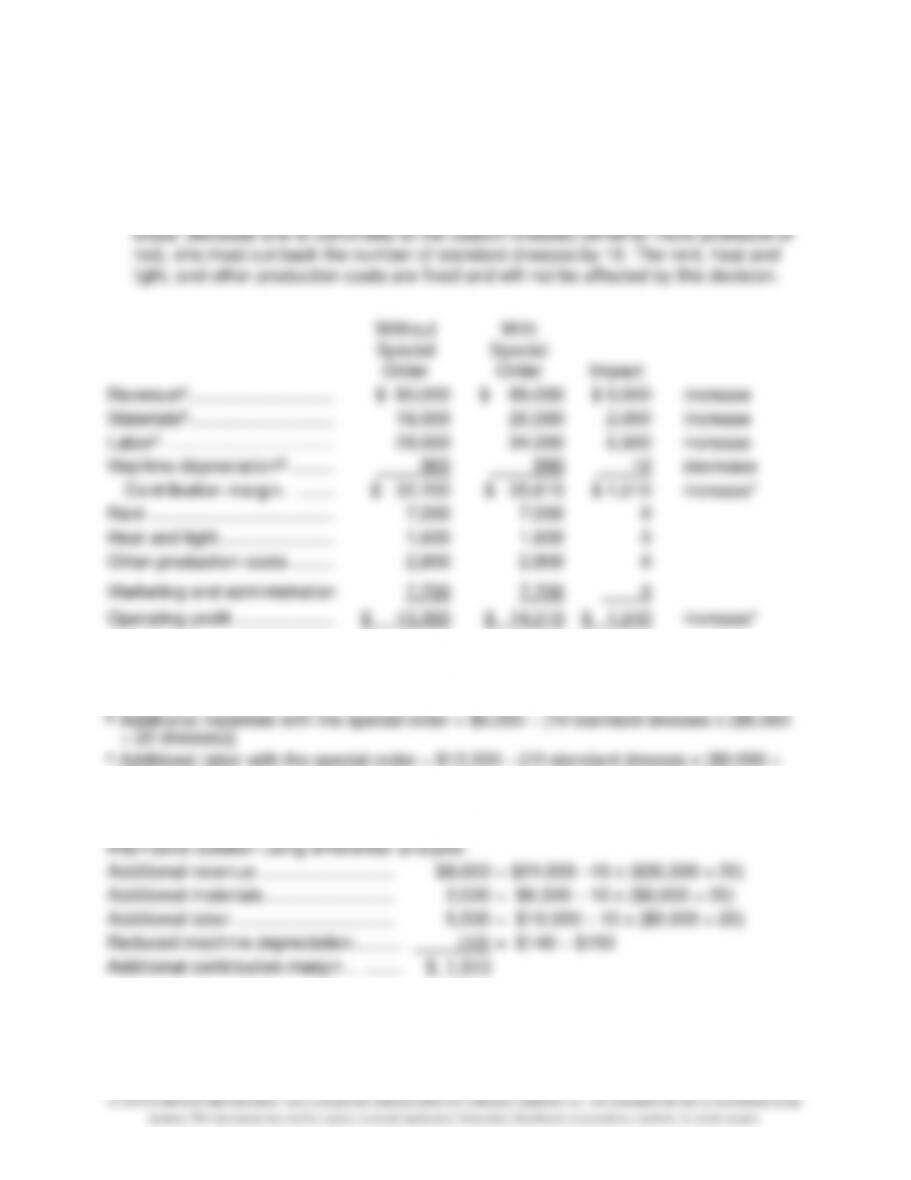
a. Based on profit, Ms. Nili should accept the special order. Accepting the special
order means Ms. Nili will only be able to produce 10 standard dresses. Each
standard dress requires 15 (= 300 hours ÷ 20 dresses) hours of machine time per
Chapter 04 – Fundamentals of Cost Analysis for Decision Making
4-23
4-49. (continued)
b. The minumum price that would still provide a (zero) incremental profit is $24,000 −
$1,510 = $22,490. The $1,510 is the additional contribution margin from the special
Chapter 04 – Fundamentals of Cost Analysis for Decision Making
4-24
4-50. (30 min.) Pricing Decisions: SMART
a.
One
Four
Eight
Seminar
Seminars
Seminars
Number of participants ………………………………..……….
20
80
140
Setup costs ……………………………………………….………
$ 600
$ 600
$ 600
Materials cost (@ $100 per participant) ………….……….
2,000
8,000
14,000
Differential labor costs ………………………………………….
1,200
5,200
8,800
Allocated fixed costs (@75% of direct labor
costs) ………………………………………………………..……….
900
3,900
6,600
Total costs ……………………………………………..……….
$ 4,700
$17,700
$30,000
Fee (@25% of total costs) …………………………………….
1,175
4,425
7,500
Bid (Total cost plus Fee) ……………………………………….
$ 5,875
$22,125
$37,500
b.
One
Four
Eight
Seminar
Seminars
Seminars
Differential costs:
Setup costs ……………………………………………….………
$ 600
$ 600
$ 600
Materials cost (@ $100 per participant) ………….……….
2,000
8,000
14,000
Differential labor costs ………………………………………….
1,200
5,200
8,800
Allocated fixed costs…………………………………….……….
0
0
0
Total differential costs ……………………………..……….
$ 3,800
$13,800
$23,400
Differential bid …………………………………………………….
5,875
22,125
37,500
Contribution to profit …………………………………….……….
$ 2,075
$8,325
$14,100
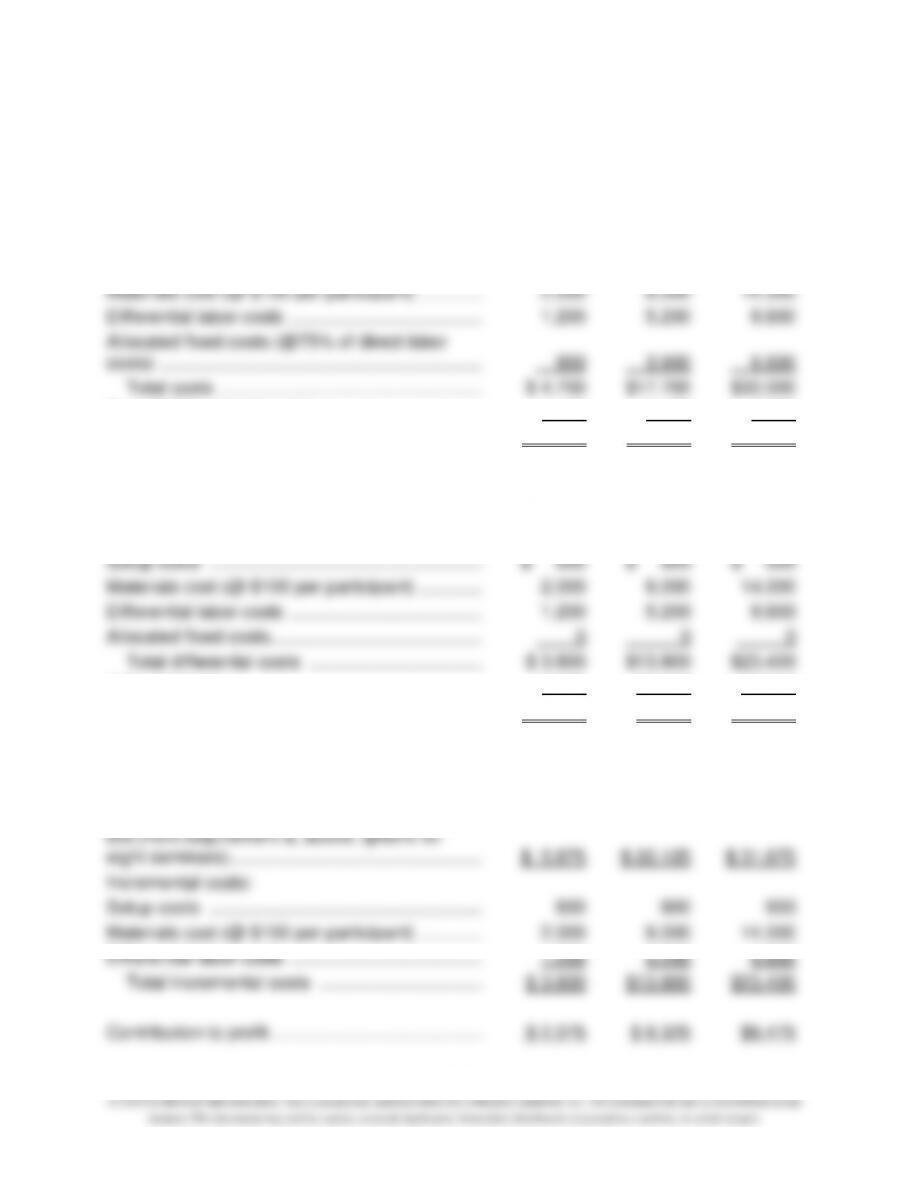
c. Disagree. The contribution to profit is greatest for eight seminars.
One
Four
Eight
Seminar
Seminars
Seminars
Bid (from requirement a, above, @85% for
eight seminars) …………………………………………………….
$ 5,875
$ 22,125
$ 31,875
Incremental costs:
Setup costs ……………………………………………….………
600
600
600
Materials cost (@ $100 per participant) ………….……….
2,000
8,000
14,000
Differential labor costs ………………………………………….
1,200
5,200
8,800
Total incremental costs …………………………………….
$ 3,800
$13,800
$23,400
Contribution to profit …………………………………….……….
$ 2,075
$ 8,325
$8,475
Chapter 04 – Fundamentals of Cost Analysis for Decision Making
4-25
4-51. Pricing Decisions: M. Anthony, LLP.
a. Total fixed costs = $2,760,000 [= 60 songs x ($21,000 fixed overhead + $25,000
fixed marketing and administrative)]
Variable cost per song = $20,000 (= $17,000 + $3,000)
Profit
=
(P – V)X – F
$0
=
($80,000 – $20,000)X – $2,760,000
$60,000X
=
$2,760,000
X =
$2,760,000
$60,000
X =
46
songs
b. Profit will be $40,000 higher if the price is $90,000 per song:
Price per song
$80,000
$90,000
Number of songs ……….
60
52
Revenue …………………..
$4,800,000
$4,680,000
Variable cost …………….
1,200,000
1,040,000
Contribution margin ……
$3,600,000
$3,640,000
Fixed cost …………………
2,760,000
2,760,000
Profit ………………………..
$840,000
$880,000
c. Profit will be $150,000 more if M. Anthony accepts the order. The contribution
margin per song for the school’s songs will be $25,000 (= $40,000 – $15,000):
Contribution without the special order = $3,600,000 (= $60,000 x 60 songs).
Contribution with the special order = $3,750,000 (= $60,000 x 50 songs
+ $25,000 x 30 songs).
Chapter 04 – Fundamentals of Cost Analysis for Decision Making
4-51 (continued)
10 songs, which is equal to $600,000 (= $60,000 per song x 10 songs). Thus the
price = variable cost + forgone contribution margin = $15,000 + ($600,000 ÷ 30) =
$38,000.
4-52. (120 min.) Comprehensive Differential Costing Problem: Davis Kitchen
Supply.
This problem gives students a good understanding of the fixed/variable cost
dichotomy. It is worthwhile to emphasize to students that fixed costs may be
“unitized” (i.e., allocated to individual units of product) for certain purposes, and that
Chapter 04 – Fundamentals of Cost Analysis for Decision Making
4-27
4-52. (continued)
b. Recommendation: Don’t accept contract.
Without
Government
Contract
With Government Contract
Impact
Regular
Government
Total
Revenue …………………………………………
$2,960,000
$2,590,000
$245,000a
$2,835,000
$125,000
decrease
Variable manufacturing costs ………….…
1,200,000
1,050,000
150,000
1,200,000
–0–
Variable marketing costs ………………..…
200,000
175,000
—
175,000
25,000
decrease
Contribution margin ……………………….…
1,560,000
$1,365,000
$95,000
1,460,000
100,000
decrease
Fixed manufacturing costs ……………..…
360,000
360,000
–0–
Fixed marketing costs ………………………
420,000
420,000
–0–
Income ………………………………………..…
$780,000
$680,000
$100,000
decrease
a
Government revenue is 1,000 x $150 + ($360,000 x 12.5%) + $50,000 = $245,000, assuming the government’s “share” of
March fixed manufacturing costs is 12.5% (= 1,000 units 8,000 units). Alternatives are for the company to get
reimbursement for 1/6 x $360,000 fixed manufacturing costs (1/6 = 1,000 units ÷ 6,000 units normal production), which
would increase revenue from $245,000 to $260,000; or get no reimbursement for fixed manufacturing costs, which would
reduce revenue to $200,000.
Chapter 04 -Fundamentals of Cost Analysis for Decision Making
4-28
4-52. (continued)
A shorter approach to Requirement b (but more difficult for some students to
understand) is this:
Forgone contribution (equals forgone income)
on regular sales if government contract is
accepted …………………………..……………………..…
1,000 x $195
=
$(195,000)
lost
Profit from government contract:
Fixed fee …………………………………………………
50,000
gained
Share of fixed mfg. costs ($360,000 ÷ 8) …..…
45,000
gained
Gain ………………………………………………………..…
95,000
gained
Differential profit if contract accepted …………..… ………………
$(100,000)
c. Minimum price = variable mfg. costs + shipping costs + order costs =
$150 + $40 + ($4,000 ÷ 2,000) = $192.
At this price per unit, the $384,000 of differential costs caused by the 2,000 unit order
will just be recovered.
Some students solve for this price using the break-even formula:
X = 2,000 units = F/(P – V)
2000 units = $4,000/(P – $190)
2,000 P – 2,000 x $190 = $4,000
2,000 P = $384,000
P = $384,000 ÷ 2,000 units
P = $192.
Chapter 04 -Fundamentals of Cost Analysis for Decision Making
4-29
4-52. (continued)
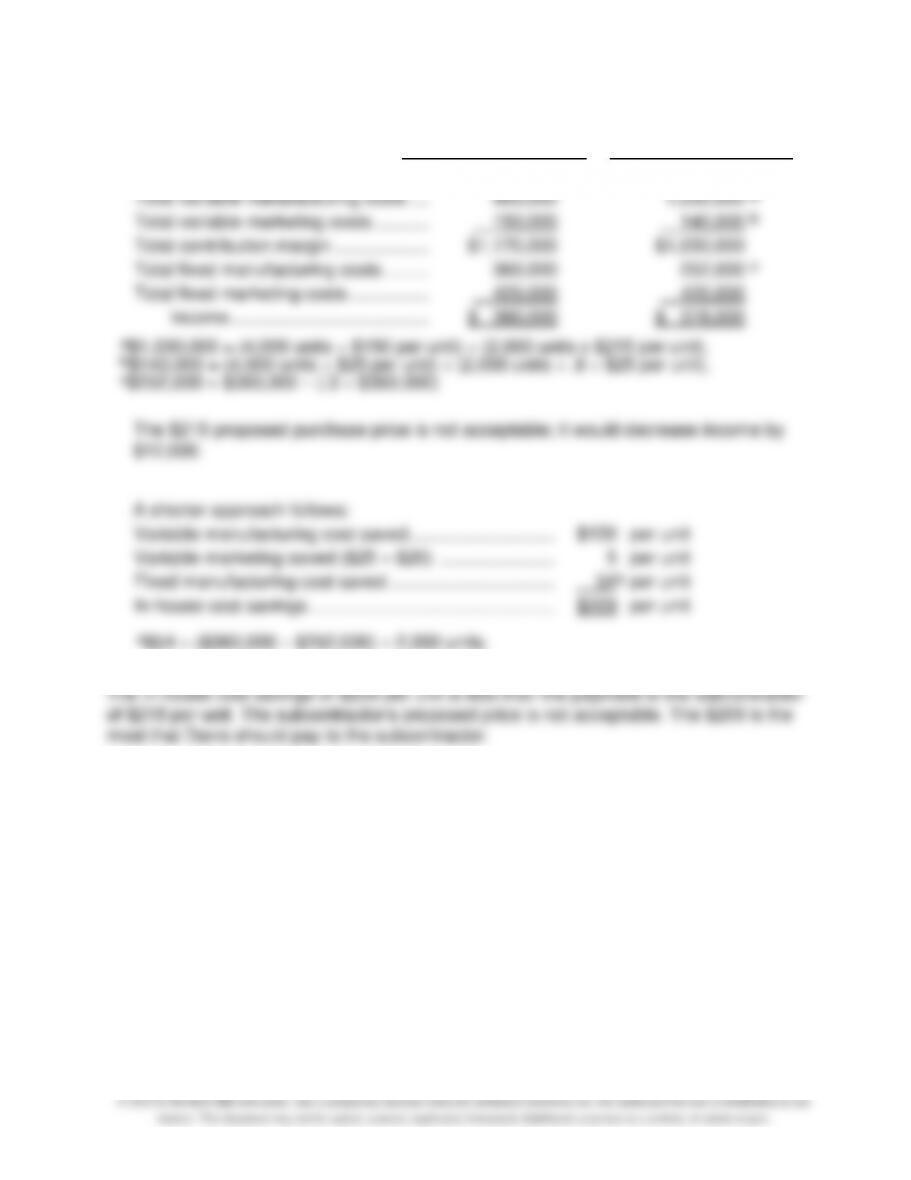
e. No, the $215 proposed purchase price is not acceptable.
All Production In-house
2,000 Units Contracted
Total revenue ……………………………….…………….
$2,220,000
$2,220,000
Total variable manufacturing costs ….……………. ……………
900,000
1,030,000
a
Total variable marketing costs ………..……………. ……………………
150,000
140,000
b
Total contribution margin ……………….…………. …………………………
$1,170,000
$1,050,000
Total fixed manufacturing costs ……………………. …………………
360,000
252,000
c
Total fixed marketing costs …………….……………. ………………………
420,000
420,000
Income ………………………………….…………….
$ 390,000
$ 378,000
a$1,030,000 = (4,000 units $150 per unit) + (2,000 units x $215 per unit).
b$140,000 = (4,000 units $25 per unit) + (2,000 units .8 $25 per unit).
c$252,000 = $360,000 – (.3 $360,000)
The $215 proposed purchase price is not acceptable; it would decrease income by
$12,000.
A shorter approach follows:
Variable manufacturing cost saved ………………………..
$150
per unit
Variable marketing saved ($25 – $20) …………………..
5
per unit
Fixed manufacturing cost saved …………………………...
54a
per unit
In-house cost savings ………………………………………….
$209
per unit
a$54 = ($360,000 – $252,000) 2,000 units.