Chapter 04 – Fundamentals of Cost Analysis for Decision Making
4-11
© 2014 by McGraw-Hill Education. This is proprietary material solely for authorized instructor use. Not authorized for sale or distribution in any
manner. This document may not be copied, scanned, duplicated, forwarded, distributed, or posted on a website, in whole or part.
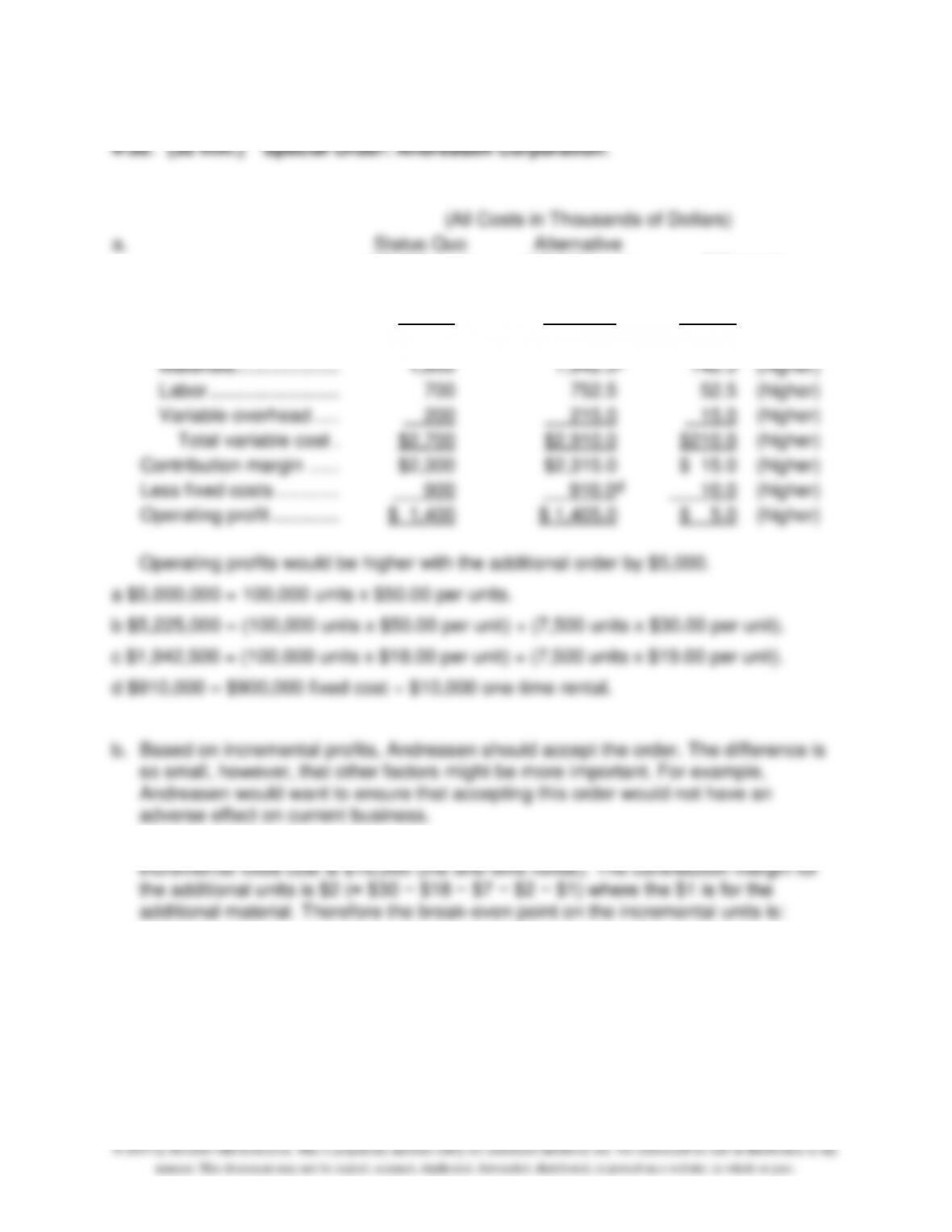
4-36. (30 min.) Special Order: Andreasen Corporation.
(All Costs in Thousands of Dollars)
a.
Status Quo
100,000 Units
Alternative
107,500 Units
Difference
Sales revenue ……………
$5,000a
$5,225.0b
$225.0
(higher)
Less variable costs:
Materials………………..
1,800
1,942.5c
142.5
(higher)
Labor …………………….
700
752.5
52.5
(higher)
Variable overhead …..
200
215.0
15.0
(higher)
Total variable cost .
$2,700
$2,910.0
$210.0
(higher)
Contribution margin ……
$2,300
$2,315.0
$ 15.0
(higher)
Less fixed costs …………
900
910.0d
10.0
(higher)
Operating profit ………….
$ 1,400
$ 1,405.0
$ 5.0
(higher)
Operating profits would be higher with the additional order by $5,000.
a $5,000,000 = 100,000 units x $50.00 per units.
b $5,225,000 = (100,000 units x $50.00 per unit) + (7,500 units x $30.00 per unit).
c $1,942,500 = (100,000 units x $18.00 per unit) + (7,500 units x $19.00 per unit).
d $910,000 = $900,000 fixed cost + $10,000 one-time rental.
b. Based on incremental profits, Andreasen should accept the order. The difference is
so small, however, that other factors might be more important. For example,
Andreasen would want to ensure that accepting this order would not have an
adverse effect on current business.
c. This question can be answered using the break-even analysis of Chapter 3. The
5,000 (= $10,000 ÷ $2).
Chapter 04 – Fundamentals of Cost Analysis for Decision Making
4-12
© 2014 by McGraw-Hill Education. This is proprietary material solely for authorized instructor use. Not authorized for sale or distribution in any
manner. This document may not be copied, scanned, duplicated, forwarded, distributed, or posted on a website, in whole or part.
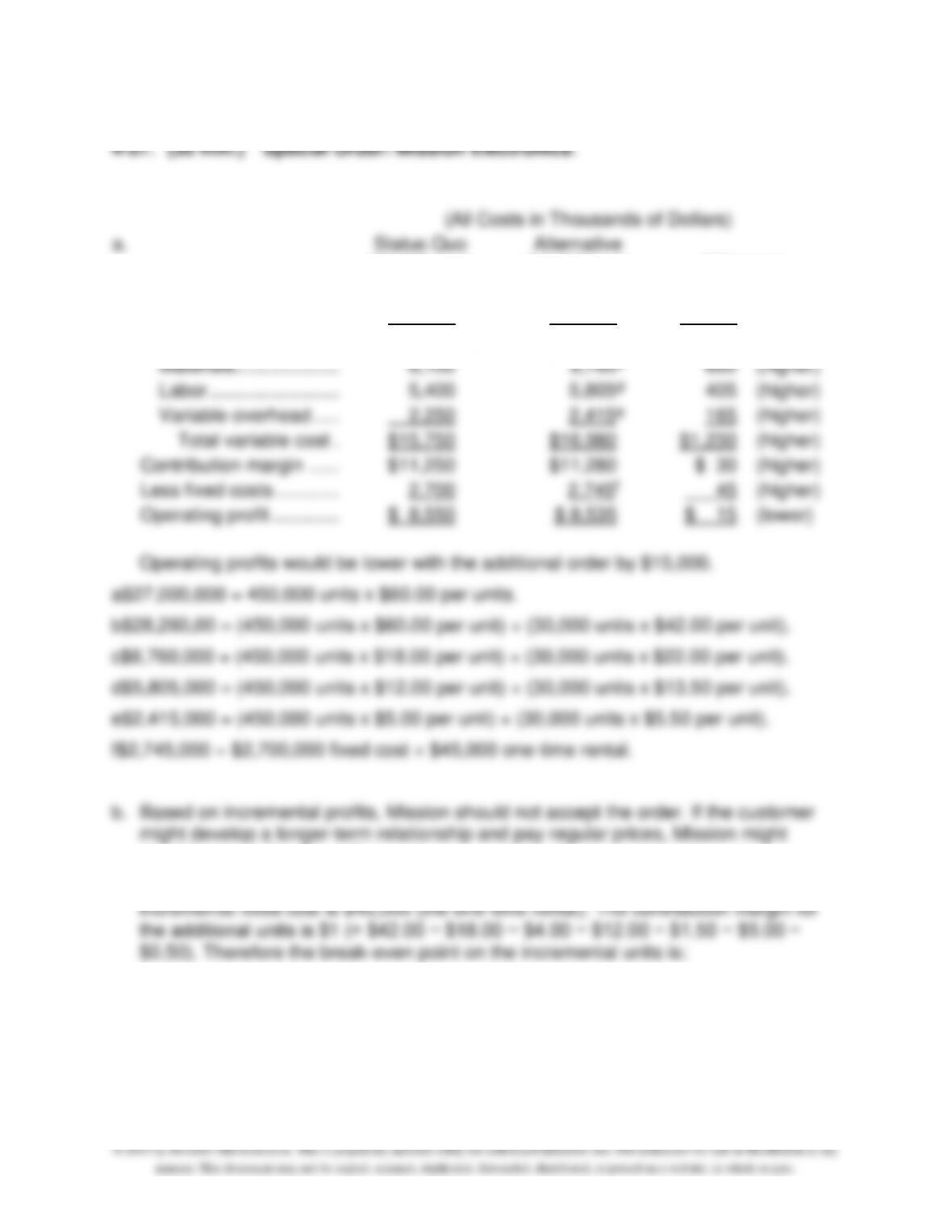
4-37. (30 min.) Special Order: Mission Electronics.
(All Costs in Thousands of Dollars)
a.
Status Quo
450,000 Units
Alternative
480,000 Units
Difference
Sales revenue ……………
$27,000a
$28,260b
$1,260
(higher)
Less variable costs:
Materials………………..
8,100
8,760c
660
(higher)
Labor …………………….
5,400
5,805d
405
(higher)
Variable overhead …..
2,250
2,415e
165
(higher)
Total variable cost .
$15,750
$16,980
$1,230
(higher)
Contribution margin ……
$11,250
$11,280
$ 30
(higher)
Less fixed costs …………
2,700
2,745f
45
(higher)
Operating profit ………….
$ 8,550
$ 8,535
$ 15
(lower)
Operating profits would be lower with the additional order by $15,000.
a$27,000,000 = 450,000 units x $60.00 per units.
b$28,260,00 = (450,000 units x $60.00 per unit) + (30,000 units x $42.00 per unit).
c$8,760,000 = (450,000 units x $18.00 per unit) + (30,000 units x $22.00 per unit).
d$5,805,000 = (450,000 units x $12.00 per unit) + (30,000 units x $13.50 per unit).
e$2,415,000 = (450,000 units x $5.00 per unit) + (30,000 units x $5.50 per unit).
f$2,745,000 = $2,700,000 fixed cost + $45,000 one-time rental.
b. Based on incremental profits, Mission should not accept the order. If the customer
might develop a longer-term relationship and pay regular prices, Mission might
consider accepting the order.
c. This question can be answered using the break-even analysis of Chapter 3. The
45,000 (= $45,000 ÷ $1).
Chapter 04 – Fundamentals of Cost Analysis for Decision Making
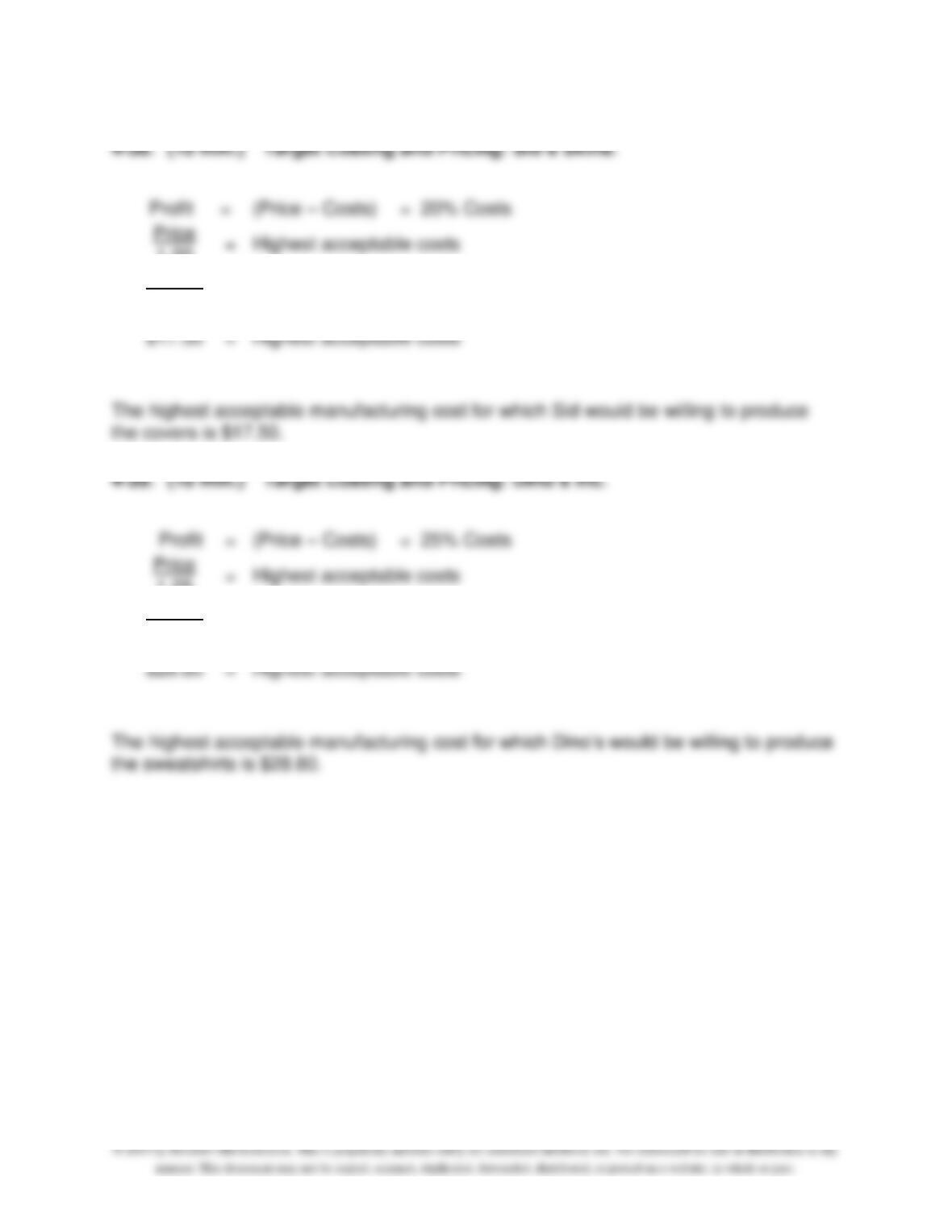
4-38. (10 min.) Target Costing and Pricing: Sid’s Skins.
Profit
=
(Price – Costs)
=
20% Costs
Price
=
Highest acceptable costs
1.20
$21.00
=
Highest acceptable costs
1.20
$17.50
=
Highest acceptable costs
=
(Price – Costs)
=
25% Costs
=
Highest acceptable costs
$28.80
=
Highest acceptable costs
Chapter 04 – Fundamentals of Cost Analysis for Decision Making
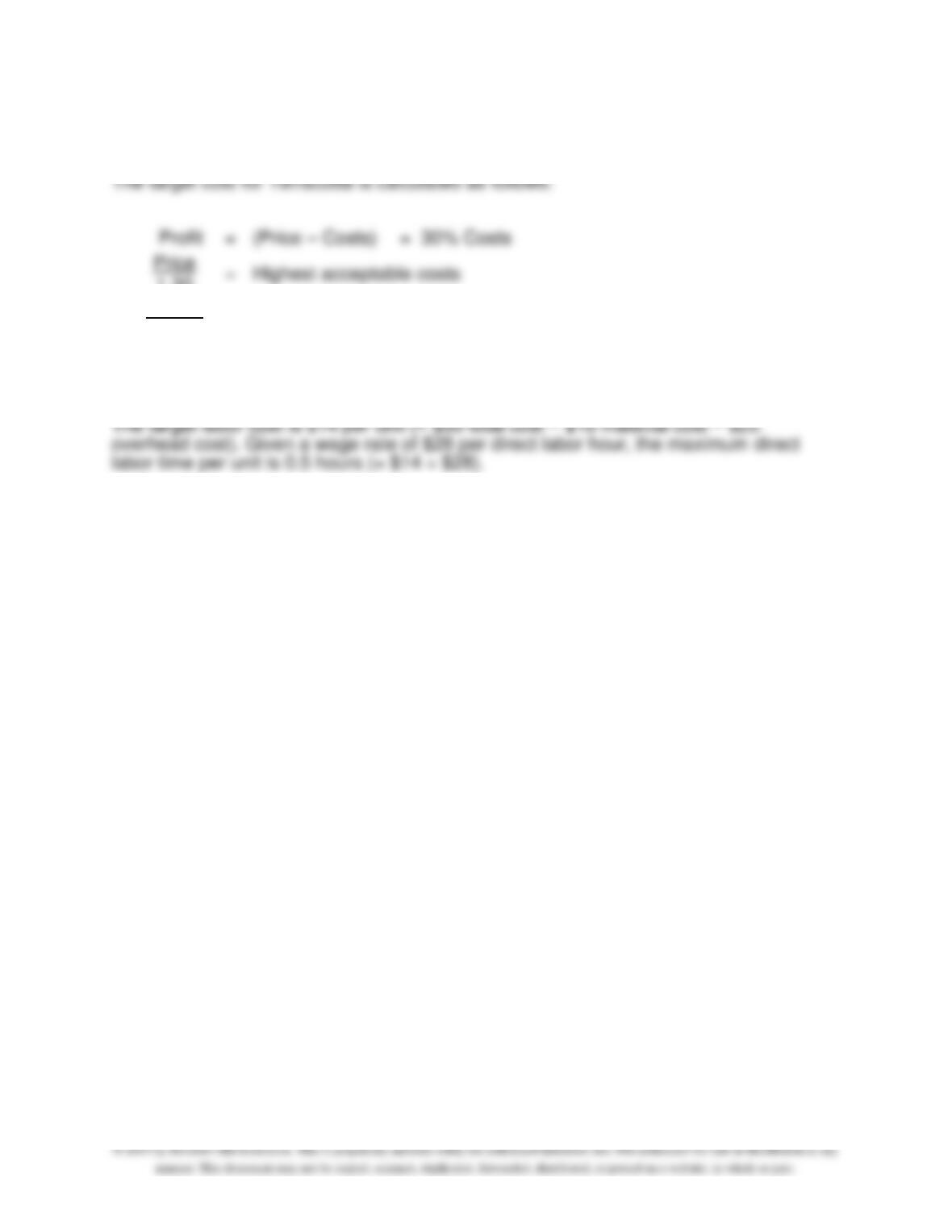
4-40. (20 min.) Target Costing: Terracotta, Inc.
0.5 hours.
Chapter 04 – Fundamentals of Cost Analysis for Decision Making
4-15
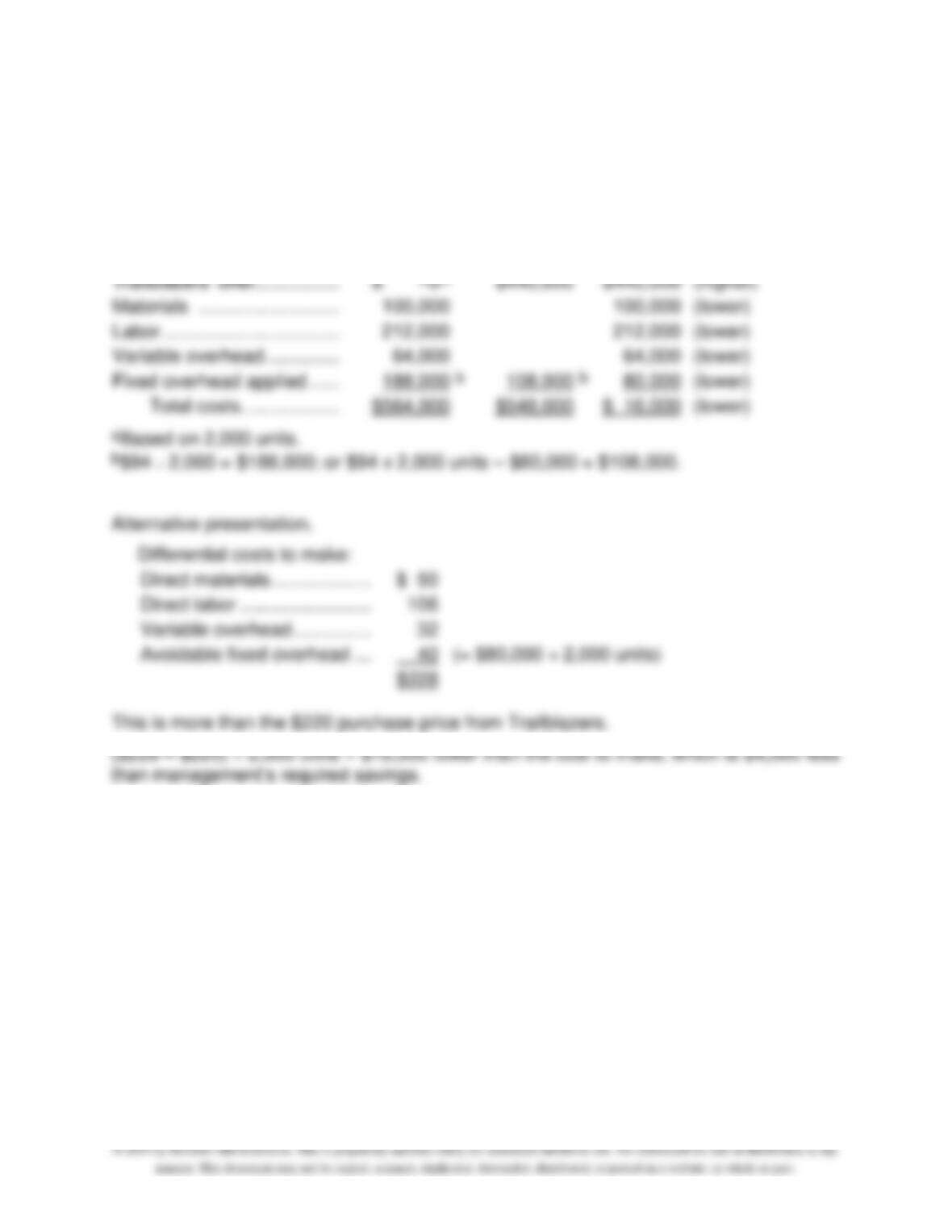
4-41. (20 min.) Make-or-Buy Decisions: Mobility Partners.
The $20,000 savings could not be achieved. The cost to make is only $16,000 more
than the cost to purchase from Trailblazers.
Status Quoa
Alternative
Difference
Trailblazers’ offer …………….
$ –0–
$440,000
$440,000
(higher)
Materials ………………………
100,000
100,000
(lower)
Labor …………………………….
212,000
212,000
(lower)
Variable overhead …………..
64,000
64,000
(lower)
Fixed overhead applied ……
188,000
b
108,000
b
80,000
(lower)
Total costs……………….
$564,000
$548,000
$ 16,000
(lower)
aBased on 2,000 units.
b$94 2,000 = $188,000; or $94 x 2,000 units – $80,000 = $108,000.
Alternative presentation.
Differential costs to make:
Direct materials ……………….
$ 50
Direct labor …………………….
106
Variable overhead ……………
32
Avoidable fixed overhead …
40
(= $80,000 ÷ 2,000 units)
$228
This is more than the $220 purchase price from Trailblazers.
($228 – $220) 2,000 units = $16,000 lower than the cost to make, which is $4,000 less
than management’s required savings.
Chapter 04 – Fundamentals of Cost Analysis for Decision Making
4-16
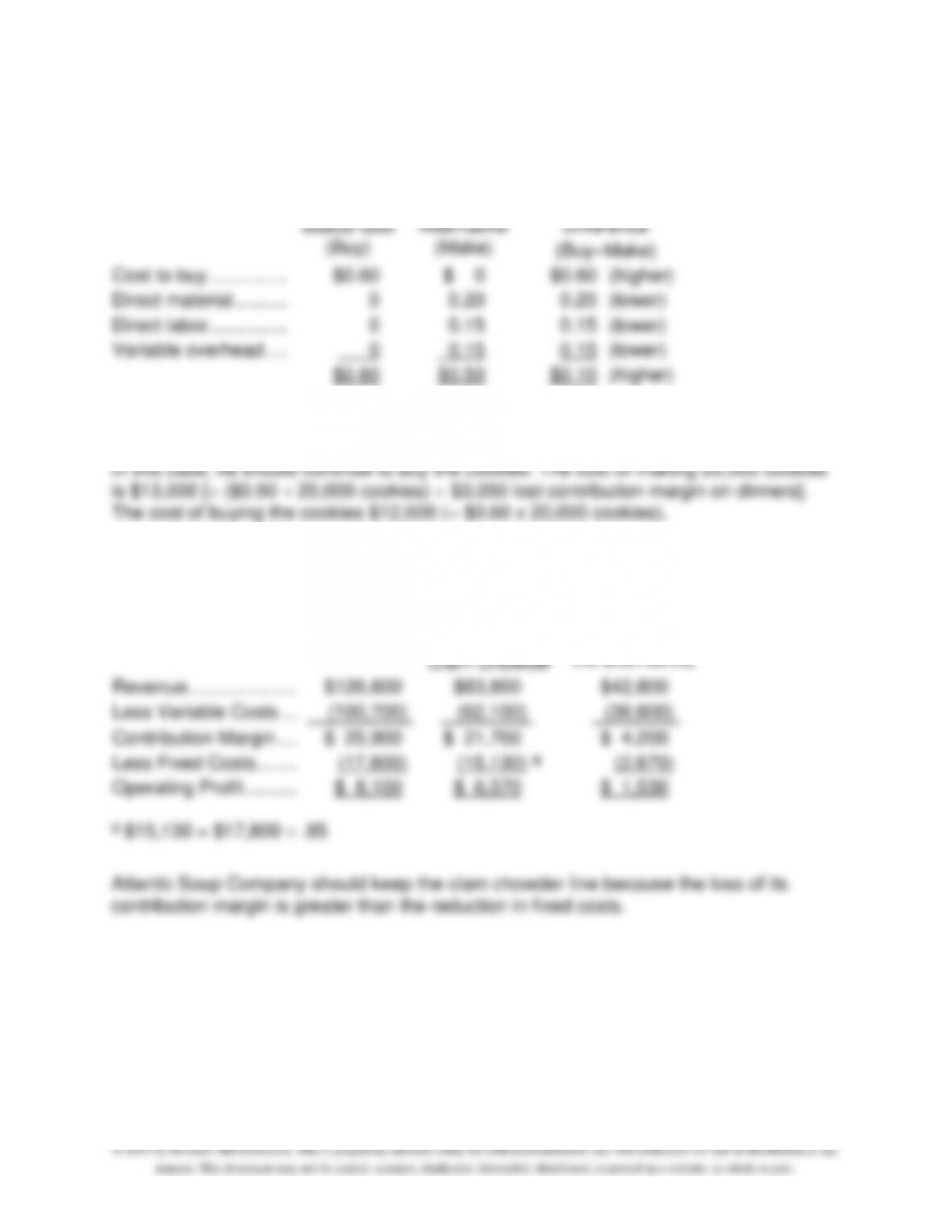
4-42. (15 min.) Make or Buy Decisions: Mel’s Meals 2 Go.
Mel could save $0.10 per cookie ($0.20 per lunch) by making the cookies rather than
buying them.
Status Quo
(Buy)
Alternative
(Make)
Difference
(Buy–Make)
Cost to buy ……………
$0.60
$ 0
$0.60
(higher)
Direct material ……….
0
0.20
0.20
(lower)
Direct labor ……………
0
0.15
0.15
(lower)
Variable overhead ….
0
0.15
0.15
(lower)
$0.60
$0.50
$0.10
(higher)
4-43. (10 min.) Make or Buy with Opportunity Costs: Mel’s Meals 2 Go.
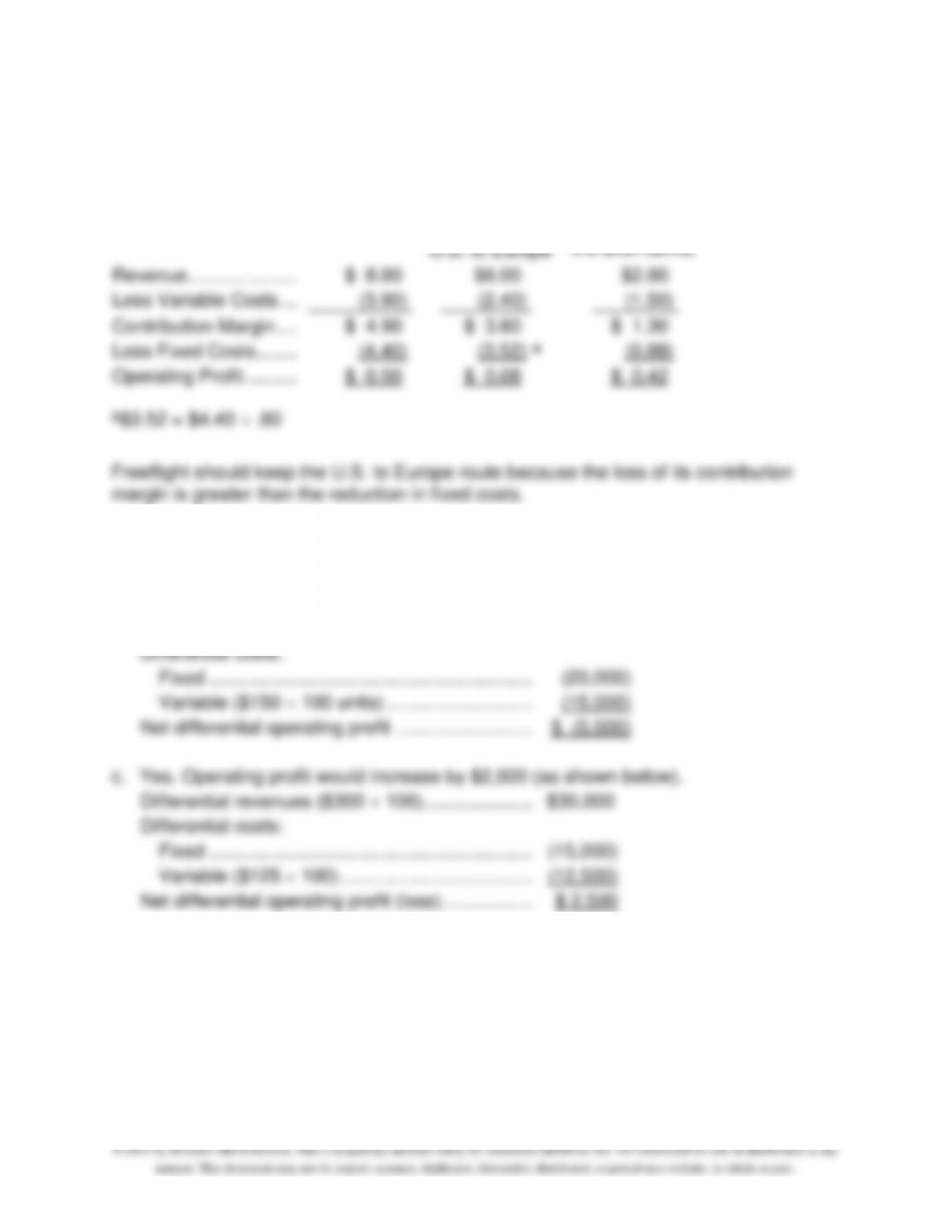
4-44. (30 min.) Dropping Product Lines: Atlantic Soup Company.
Status Quo
Alternative:
Drop
Clam Chowder
Difference
(all lower under
the alternative)
Revenue …………………
$126,600
$83,800
$42,800
Less Variable Costs …
(100,700)
(62,100)
(38,600)
Contribution Margin ….
$ 25,900
$ 21,700
$ 4,200
Less Fixed Costs ……..
(17,800)
(15,130)
a
(2,670)
Operating Profit ……….
$ 8,100
$ 6,570
$ 1,530
a $15,130 = $17,800 .85
Atlantic Soup Company should keep the clam chowder line because the loss of its
contribution margin is greater than the reduction in fixed costs.
Chapter 04 – Fundamentals of Cost Analysis for Decision Making
4-17
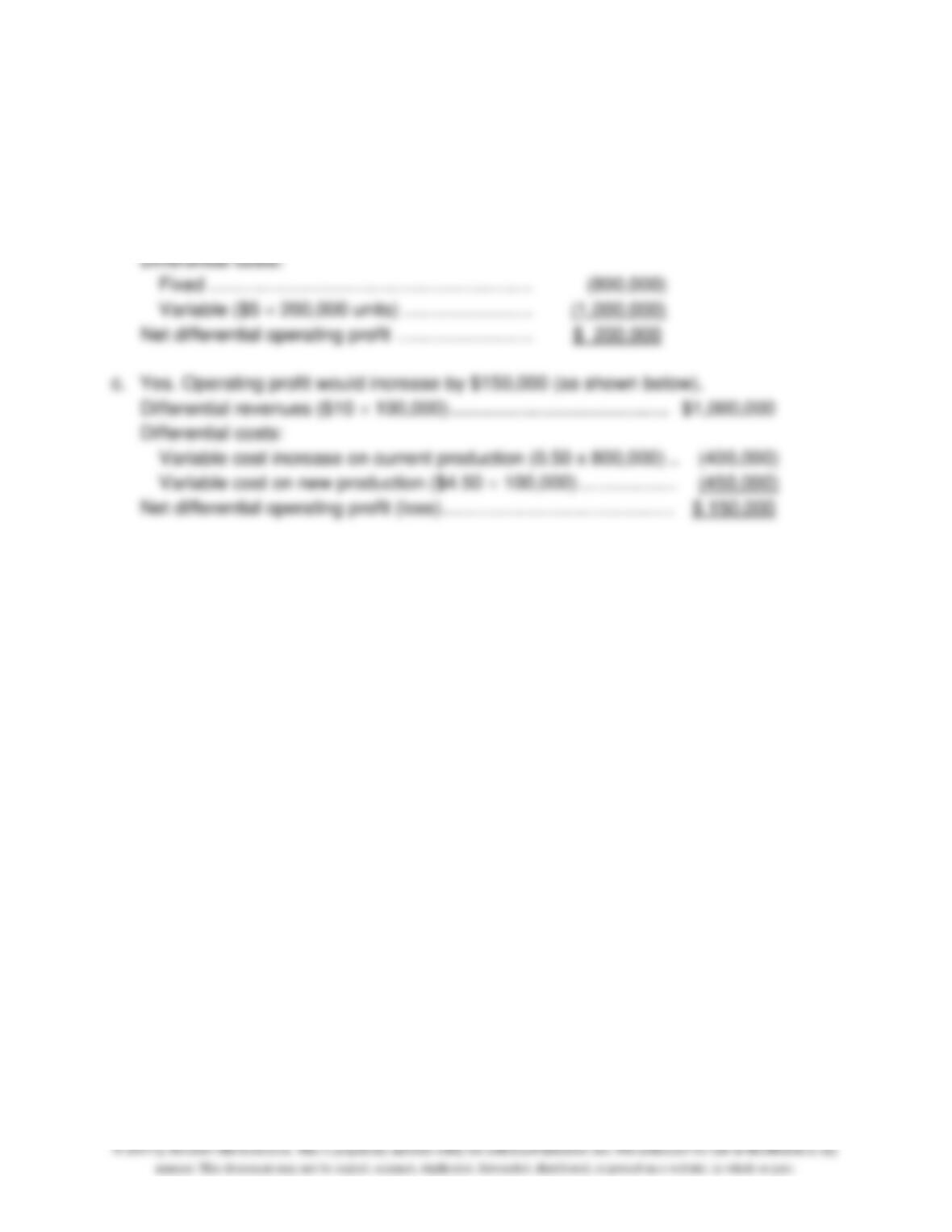
4-45. (30 min.) Dropping Product Lines: Freeflight Airlines.
Status Quo
Alternative:
Drop
U.S. to Europe
Difference
(all lower under
the alternative)
Revenue …………………
$ 8.80
$6.00
$2.80
Less Variable Costs …
(3.90)
(2.40)
(1.50)
Contribution Margin ….
$ 4.90
$ 3.60
$ 1.30
Less Fixed Costs ……..
(4.40)
(3.52)
a
(0.88)
Operating Profit ……….
$ 0.50
$ 0.08
$ 0.42
a$3.52 = $4.40 .80
Freeflight should keep the U.S. to Europe route because the loss of its contribution
margin is greater than the reduction in fixed costs.
4-46. (30 min.) Theory of Constraints: CompDesk, Inc.
a. Yes. The bottleneck is in Building 2, which can only produce 400 chairs.
b. No. Operating profit would decrease by $5,000 (as shown below).
Differential revenues ($300 100 units) …………
$30,000
Differential costs:
Fixed ……………………………………………………..
(20,000)
Variable ($150 100 units) ……………………….
(15,000)
Net differential operating profit ……………………..
$ (5,000)
c. Yes. Operating profit would increase by $2,500 (as shown below).
Differential revenues ($300 100) …………………
$30,000
Differential costs:
Fixed ……………………………………………………..
(15,000)
Variable ($125 100) ……………………………….
(12,500)
Net differential operating profit (loss) ……………..
$ 2,500
Chapter 04 – Fundamentals of Cost Analysis for Decision Making
4-18
4-47. (30 min.) Theory of Constraints: Playful Pens, Inc.
a. Yes. The bottleneck is Machine 2, which can only produce 800,000 holders.
b. Yes. Operating profit would increase by $200,000 (as shown below).
Differential revenues ($10 200,000 units) …….
$2,000,000
Differential costs:
Fixed ……………………………………………………..
(800,000)
Variable ($5 200,000 units) …………………….
(1,000,000)
Net differential operating profit ……………………..
$ 200,000
c. Yes. Operating profit would increase by $150,000 (as shown below).
Differential revenues ($10 100,000) ……………………………………
$1,000,000
Differential costs:
Variable cost increase on current production (0.50 x 800,000) ..
(400,000)
Variable cost on new production ($4.50 100,000) ……………….
(450,000)
Net differential operating profit (loss)………………………………………
$ 150,000
Chapter 04 – Fundamentals of Cost Analysis for Decision Making
4-19
Solutions to Problems
4-48. (60 min.) Special Order: Hi-Speed Electronics, Inc.
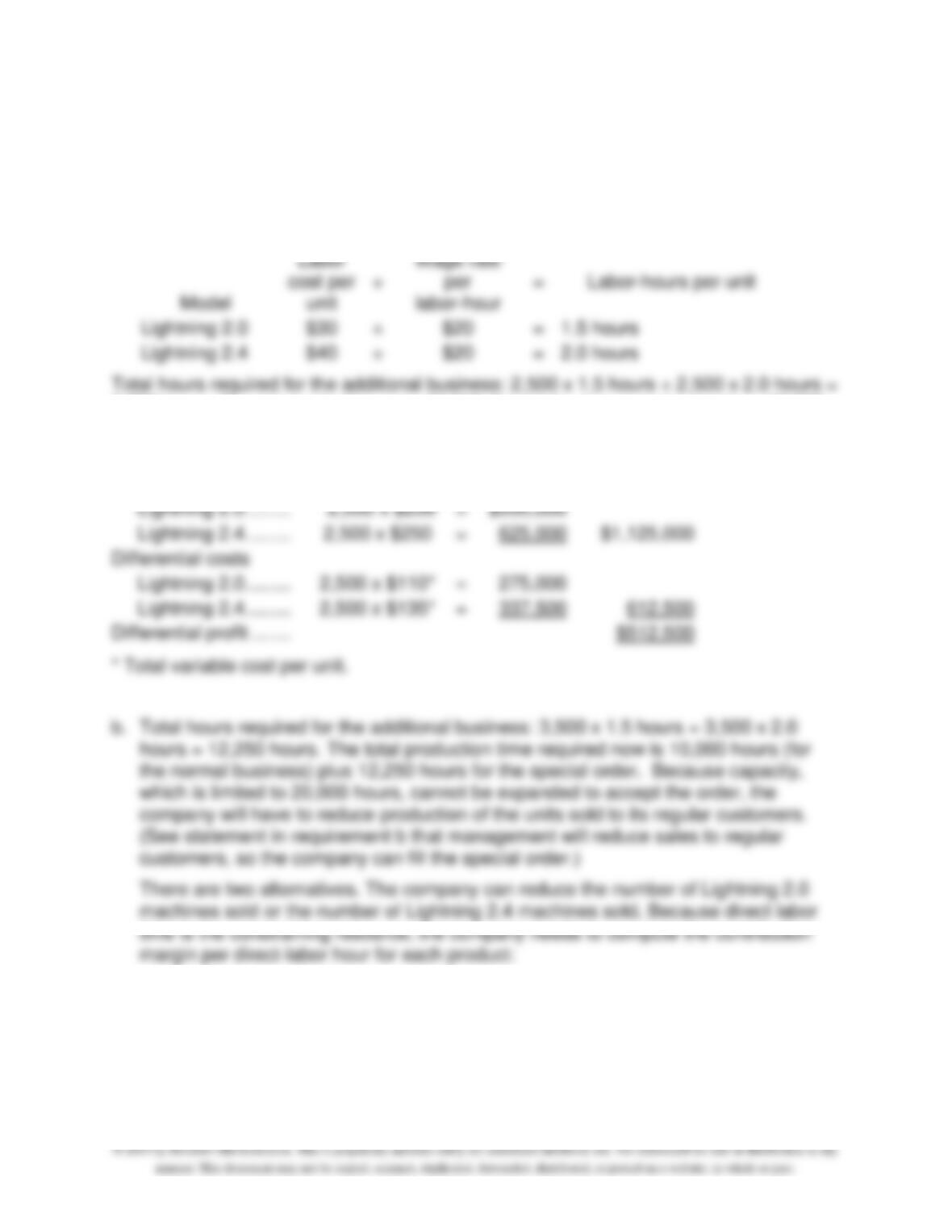
a.
Direct labor hours per unit:
Model
Labor
cost per
unit
÷
Wage rate
per
labor-hour
=
Labor-hours per unit
Lightning 2.0
$30
÷
$20
=
1.5 hours
Lightning 2.4
$40
÷
$20
=
2.0 hours
8,750 hours. Current production uses 10,000 direct-labor hours and capacity is 20,000
direct-labor hours, so capacity will not have to be expanded to accept the order.
Additional profit (contribution margin):
Differential revenues:
Lightning 2.0 ………
2,500 x $200
=
$500,000
Lightning 2.4 ………
2,500 x $250
=
625,000
$1,125,000
Differential costs
Lightning 2.0 ………
2,500 x $110*
=
275,000
Lightning 2.4 ………
2,500 x $135*
=
337,500
612,500
Differential profit ……..
$512,500
* Total variable cost per unit.
b. Total hours required for the additional business: 3,500 x 1.5 hours + 3,500 x 2.0
hours = 12,250 hours. The total production time required now is 10,000 hours (for
the normal business) plus 12,250 hours for the special order. Because capacity,
which is limited to 20,000 hours, cannot be expanded to accept the order, the
company will have to reduce production of the units sold to its regular customers.
(See statement in requirement b that management will reduce sales to regular
customers, so the company can fill the special order.)
There are two alternatives. The company can reduce the number of Lightning 2.0
machines sold or the number of Lightning 2.4 machines sold. Because direct labor
time is the constraining resource, the company needs to compute the contribution
margin per direct-labor hour for each product:
Chapter 04 – Fundamentals of Cost Analysis for Decision Making
4-20
4-48. (continued)
Lightning 2.0
Lightning 2.4
Revenue per unit …………………………....
$290
$390
Variable cost per unit ……………………….
110
135
Contribution margin per unit ……………..
$180
$255
Divide by Direct-labor hours per unit ..
1.5
2.0
Contribution margin per hour …………….
$120.00
$127.50
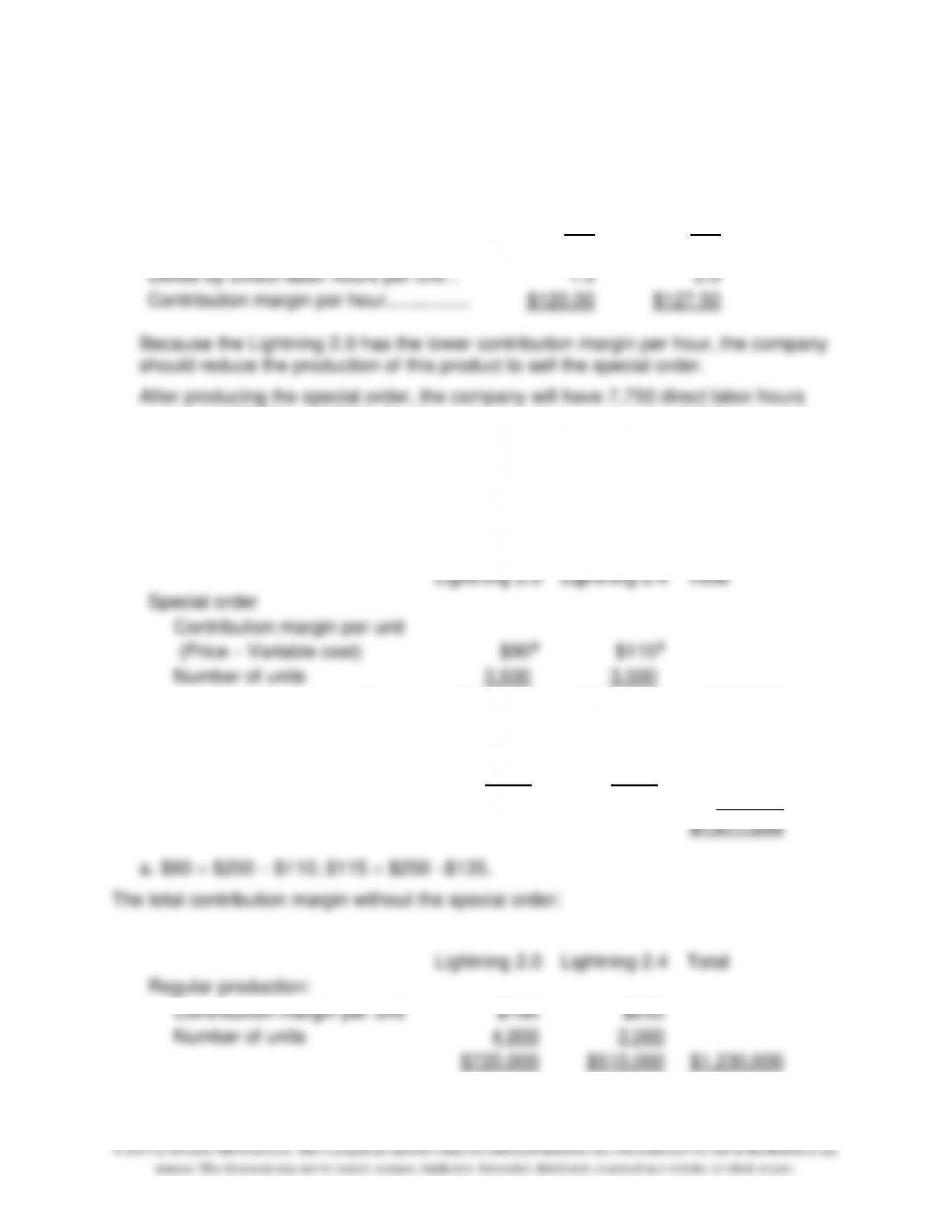
Because the Lightning 2.0 has the lower contribution margin per hour, the company
should reduce the production of this product to sell the special order.
After producing the special order, the company will have 7,750 direct labor hours
remaining (20,000 – 12,250). It will use these to first produce the 2,000 units of the
Lightning 2.4 (4,000 = 2,000 x 2.0 direct labor hours). The company will then use the
remaining 3,750 direct labor hours (7,750 – 4,000) to make 2,500 units of the
Lightning 2.0.
The total contribution margin with the special order:
Lightning 2.0
Lightning 2.4
Total
Special order
Contribution margin per unit
(Price – Variable cost)
$90a
$115a
Number of units
3,500
3,500
Total contribution margin
$315,000
$402,500
$717,500
Regular production:
Contribution margin per unit
$180
$255
Number of units
2,500
2,000
$450,000
$510,000
960,000
$1,677,500
a. $90 = $200 – $110; $115 = $250 –$135.
The total contribution margin without the special order:
Lightning 2.0
Lightning 2.4
Total
Regular production:
Contribution margin per unit
$180
$255
Number of units
4,000
2,000
$720,000
$510,000
$1,230,000