Chapter 04 – Fundamentals of Cost Analysis for Decision Making
4-1
© 2014 by McGraw-Hill Education. This is proprietary material solely for authorized instructor use. Not authorized for sale or distribution in any
manner. This document may not be copied, scanned, duplicated, forwarded, distributed, or posted on a website, in whole or part.
Chapter 4
Fundamentals of Cost Analysis for Decision
Making
Solutions to Review Questions
4-1.
Costs that are “fixed in the short run” are usually not fixed in the long run. In fact few, if
any, costs are fixed over a very long time horizon.
4-2.
A sunk cost has taken place in the past and cannot be changed. A differential cost is
one that will change with a given decision.
4-3.
Strictly speaking, sunk costs can never be differential costs. However, sunk costs can
determine the amounts of certain differential costs. For example, federal income taxes
4-4.
4-5.
The full cost of a product is the sum of all fixed and variable costs of manufacturing and
4-6.
4-2
© 2014 by McGraw-Hill Education. This is proprietary material solely for authorized instructor use. Not authorized for sale or distribution in any
manner. This document may not be copied, scanned, duplicated, forwarded, distributed, or posted on a website, in whole or part.
only the costs of development and production, but also the costs of maintenance and
disposal.
4-7.
Cost-plus pricing is most likely to be used for unique products where no market price
information exists—areas like construction jobs, defense contracts, and custom orders.
4-8.
1. Develop a product that satisfies the needs of potential customers.
2. Choose a target price based on consumers’ perceived value of the product and
competitor’s prices.
3. Derive a target cost by subtracting the desired profit margin from the target price.
4. Perform value engineering to achieve target costs.
4-9.
Predatory pricing is the practice of a setting a selling price at a low price with the intent
of driving competitors out of the market or of creating a barrier to entry for new
4-10.
4-11.
Price discrimination is the practice of selling identical goods or services to different
customers at different prices. A cost accountant would help determine the costs of
Chapter 04 – Fundamentals of Cost Analysis for Decision Making
4-3
4-12.
Unit gross margins are typically computed with an allocation of fixed costs. Total fixed
costs generally will not change with a change in volume within the relevant range.
4-13.
4-14.
Production constraints mean that managers have to consider the opportunity cost of
using production resources. Producing one unit of Product A means that less of Product
4-15.
Common nonfinancial considerations that are important in deciding to drop a product
4-16.
The theory of constraints focuses on these three factors:
1. Throughput contribution: Sales dollars minus direct materials and other variable
costs.
2. Investments: Inventories, equipment, buildings, and other assets used to generate
throughput contribution.
3. Operating costs: All operating costs other than direct materials and other variable
costs.
Chapter 04 – Fundamentals of Cost Analysis for Decision Making
4-4
Solutions to Critical Analysis and Discussion Questions
4-17.
The main differential costs are the rent and the additional commission. Staff salaries
and the other costs of providing mortgages would not be differential.
4-18.
The remaining lease costs are sunk (assuming the company cannot sublet the space),
so they are not relevant to the decision.
4-19.
4-20.
4-21.
This is price discrimination. The airlines are able to segment customers who are more
sensitive to the schedule or to knowing travel plans in advance.
4-22.
4-23.
Variable costs are usually relevant when talking about changes in production volumes.
However, if the change in production volume extends beyond the “relevant range,”
Chapter 04 – Fundamentals of Cost Analysis for Decision Making
4-5
4-24.
In the short run, sales revenues need only cover the differential costs of production and
sale. So, from a short-run perspective, so long as the sale does not affect other output
4-25.
This is a difficult and complex issue, so the purpose of this question is to stimulate
discussion and have students think about the complexities of using incremental costs as
a basis for decision making.
4-26.
The differential costs include:
Fuel
Chapter 04 – Fundamentals of Cost Analysis for Decision Making
4-6
4-27.
The differential costs include:
Cost of the car
Forgone interest income on funds paid for the car
Interest on debt on the car
4-28.
4-29.
Fixed costs are relevant anytime they change with the product-mix decision. For
example, if there are fixed costs that can be eliminated with the elimination of one or
4-30.
Performance can be improved at the bottleneck by increasing capacity or shifting
resources from non-bottleneck areas to the bottleneck.
4-31.
Chapter 04 – Fundamentals of Cost Analysis for Decision Making
4-7
Solutions to Exercises
4-32. (25 min.) Special Orders: Maria’s Food Service.
a.
Status Quo
3,000 Units
Alternative
3,300 Units
Difference
Sales revenue …….
$ 18,000
$19,050
$1,050
(higher)
Variable costs:
Mealsa ……………
9,000
9,900
900
(higher)
Administrativeb ..
1,500
1,500
0
Contribution margin
$ 7,500
$7,650
$ 150
(higher)
Fixed costs …………
5,100
5,100
0
Operating profit …..
$ 2,400
$ 2,550
$ 150
(higher)
a Variable costs per meal = ($13,500 – $4,500) ÷ 3,000 units
= $3.00 per unit.
Alternatively, variable costs per meal:
$4.50 [($13,500 – $4,500) ÷ $13,500] = $3.00 per unit.
$3.00 per unit x 300 = $900 additional cost.
b No additional administrative costs according to the exercise.
Alternative presentation.
Per Unit
300 Meals
Sales revenue ……………………………………………………..
$3.50
$1,050
Variable costs:
Meal costs:
$4.50 [($13,500 – $4,500) ÷ $13,500] =
3.00
900
Contribution to operating profit ……………………………….
$0.50
$150
Accepting this order would increase operating profits by $150.
Chapter 04 – Fundamentals of Cost Analysis for Decision Making
4-33. (25 min.) Special Orders: Carlsbad Enterprises.
Chapter 04 – Fundamentals of Cost Analysis for Decision Making
4-9
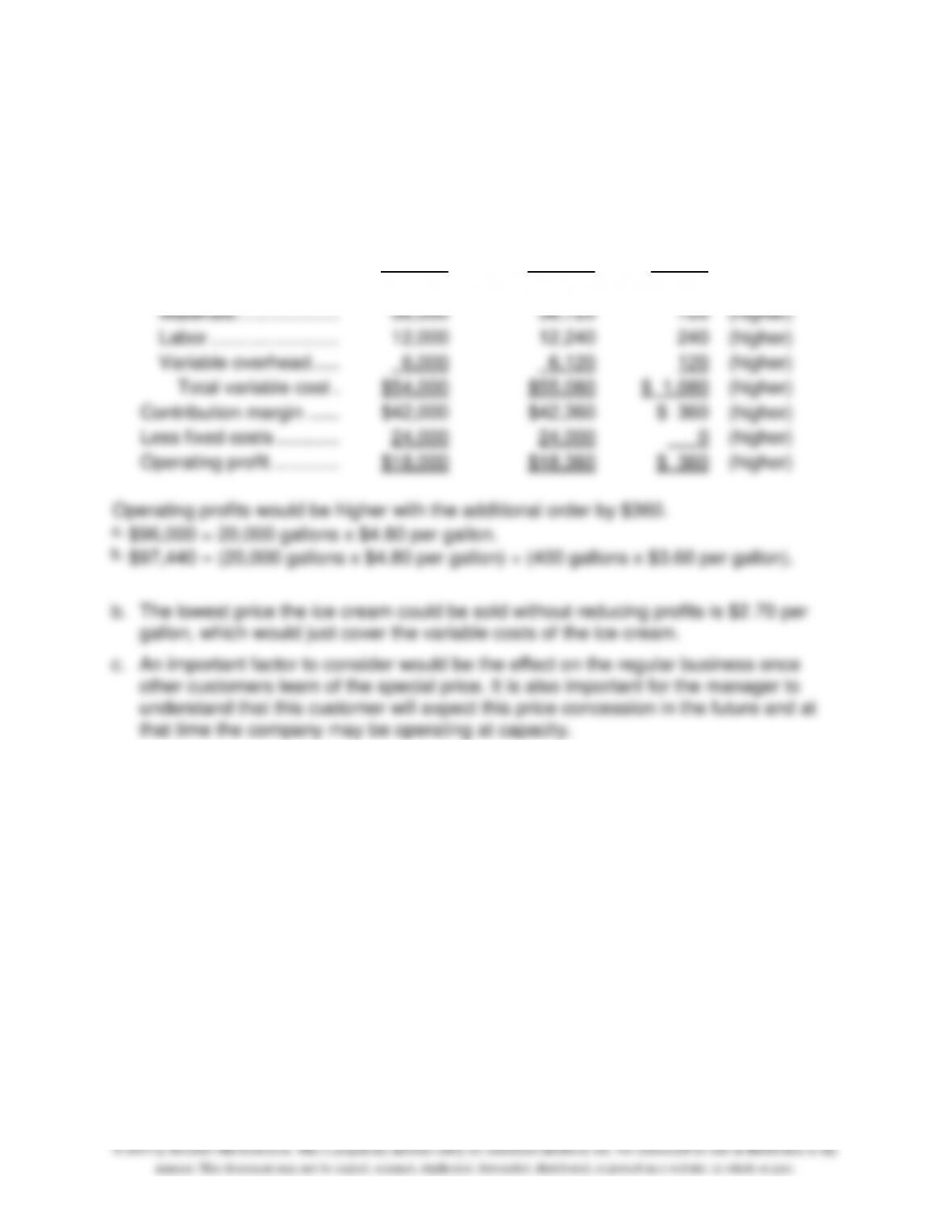
4-34. (30 min.) Pricing Decisions: Cold Rock.
a.
Status Quo
20,000 gallons
Alternative
20,400 gallons
Difference
Sales revenue ……………
$96,000a
$97,440b
$1,440
(higher)
Less variable costs:
Materials………………..
36,000
36,720
720
(higher)
Labor …………………….
12,000
12,240
240
(higher)
Variable overhead …..
6,000
6,120
120
(higher)
Total variable cost .
$54,000
$55,080
$ 1,080
(higher)
Contribution margin ……
$42,000
$42,360
$ 360
(higher)
Less fixed costs …………
24,000
24,000
0
(higher)
Operating profit ………….
$18,000
$18,360
$ 360
(higher)
Operating profits would be higher with the additional order by $360.
a. $96,000 = 20,000 gallons x $4.80 per gallon.
b. $97,440 = (20,000 gallons x $4.80 per gallon) + (400 gallons x $3.60 per gallon).
b. The lowest price the ice cream could be sold without reducing profits is $2.70 per
gallon, which would just cover the variable costs of the ice cream.
c. An important factor to consider would be the effect on the regular business once
other customers learn of the special price. It is also important for the manager to
understand that this customer will expect this price concession in the future and at
that time the company may be operating at capacity.
Chapter 04 – Fundamentals of Cost Analysis for Decision Making
4-10
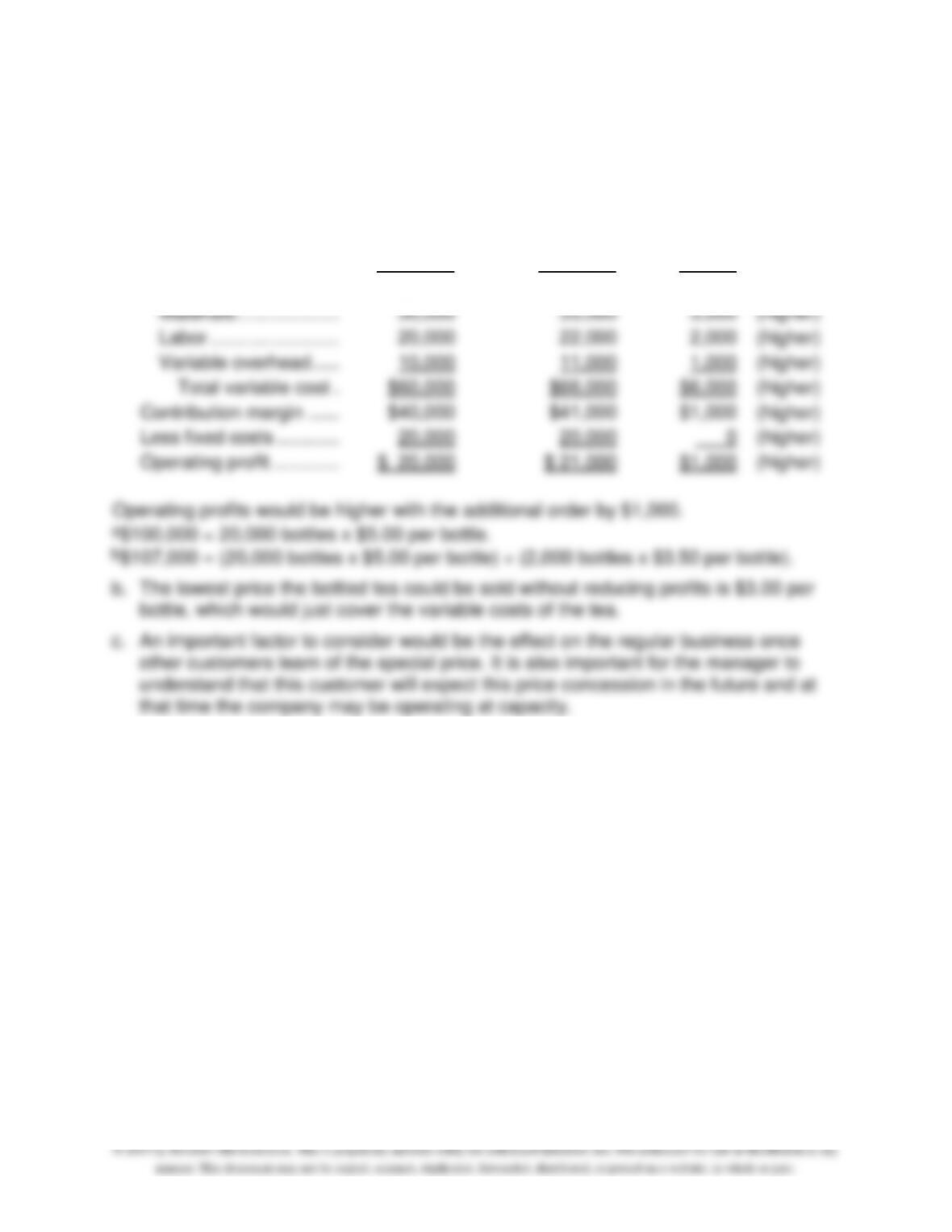
4-35. (30 min.) Pricing Decisions: Mother’s Bottlers.
a.
Status Quo
20,000 Bottles
Alternative
22,000 Bottles
Difference
Sales revenue ……………
$100,000a
$107,000b
$7,000
(higher)
Less variable costs:
Materials………………..
30,000
33,000
3,000
(higher)
Labor …………………….
20,000
22,000
2,000
(higher)
Variable overhead …..
10,000
11,000
1,000
(higher)
Total variable cost .
$60,000
$66,000
$6,000
(higher)
Contribution margin ……
$40,000
$41,000
$1,000
(higher)
Less fixed costs …………
20,000
20,000
0
(higher)
Operating profit ………….
$ 20,000
$ 21,000
$1,000
(higher)
Operating profits would be higher with the additional order by $1,000.
a$100,000 = 20,000 bottles x $5.00 per bottle.
b$107,000 = (20,000 bottles x $5.00 per bottle) + (2,000 bottles x $3.50 per bottle).
b. The lowest price the bottled tea could be sold without reducing profits is $3.00 per
bottle, which would just cover the variable costs of the tea.
c. An important factor to consider would be the effect on the regular business once
other customers learn of the special price. It is also important for the manager to
understand that this customer will expect this price concession in the future and at
that time the company may be operating at capacity.