3-21
Profit
=
($800 – $432) x 800 students – $160,000
=
$134,400
Profit increases by $38,400
20% variable cost increase. Now V = $576
Profit
=
($800 – $576) x 800 students – $160,000
=
$19,200
Profit decreases by $76,800
3-42 (continued).
c. (4)
10% fixed cost decrease, 10% variable cost increase.
Now F = $144,000 and V = $528
Profit
=
($800 – $528) x 800 students – $144,000
=
$73,600
Profit decreases by $22,400
3-43. (35 min.) Extensions of the CVP Model―Semifixed (Step) Costs: Sam’s
Sushi.
a. There are three possible break-even points (one with each additional lane):
1 lane:
X
=
$33,000 ÷ ($10 – $4)
=
5,500 meals
2 lanes:
X
=
$39,000 ÷ ($10 – $4)
=
6,500 meals
3 lanes:
X
=
$52,500 ÷ ($10 – $4)
=
8,750 meals
The break-even point with one lane is not feasible because it exceeds the maximum
Alternative
Profit (Loss)
1 lane
[($10 — $4) x 5,000 meals – $33,000] =
($3,000)
2 lanes
[($10 — $4) x 8,000 meals – $39,000] =
$9,000
Chapter 03 – Fundamentals of Cost-Volume-Profit Analysis
3 lanes
[($10 — $4) x 10,000 meals – $52,500] =
$7,500
Sam should operate 2 lanes.
1 shift:
X
=
$1,980 ÷ ($2.00 – $0.90)
=
1,800 cases
2 shifts:
X
=
$3,740 ÷ ($2.00 – $0.90)
=
3,400 cases
3 shifts:
X
=
$5,170 ÷ ($2.00 – $0.90)
=
4,700 cases
Each of the three break-even points is feasible.
Alternative
Profit
1 shift
[($2.00 – $0.90) x 2,000 cases – $1,980] =
$220
2 shifts
[($2.00 – $0.90) x 3,600 cases – $3,740] =
$220
3 shifts
[($2.00 – $0.90) x 5,000 cases – $5,170] =
$330
Cesar should operate 3 shifts.
3-45. (15 min.) Extensions of the CVP Model—Taxes: Odd Wallow Drinks.
a.
X
=
$12,168,000 ÷ ($75 – $36)
=
312,000 cases
Chapter 03 – Fundamentals of Cost-Volume-Profit Analysis
3-23
3-46. (20 min.) Extensions of the CVP Model—Taxes: Frightproof Commuter
Airlines.
a.
0
=
(P – V)X – F
0
=
($80 – $20)X – $2,400
$2,400
=
($80 – $20)X
X
=
$2,400 ÷ $60
=
40 passengers
b.
After-tax profits
=
[(P – V)X – F](1 – t)
$1,050
=
[($80 – $20)X – $2,400](1 – .30)
$1,050
=
($60X – $2,400)(.70)
($1,050 ÷ .70)
=
$60X – $2,400
$1,500 + $2,400
=
$60X
$60X
=
$3,900
X
=
$3,900 ÷ $60
X
=
65 passengers
c. With a capacity of 70 passengers, Frightproof can both break even (40 < 70) and earn
$1,050 per flight after taxes (65 < 70).
3-47. (20 min.) Extensions of the CVP Model—Taxes: Lomas Electronics.
After tax profits
=
[(P – V)X – F](1 – t)
$234,000
=
[($260 – $140) x 10,000 – $840,000](1 – t)
$234,000
=
$360,000 – $360,000t
$360,000t
=
$126,000
t
=
$126,000 ÷ 360,000
=
0.35 or 35%
Chapter 03 – Fundamentals of Cost-Volume-Profit Analysis
3-24
3-48. (20 min.) Extensions of the CVP Model—Taxes: Action Games.
a.
0
=
(P – V)X – F
0
=
($32 – $7)X – $75,000
$75,000
=
($32 – $7)X
X
=
$75,000 ÷ $25
=
3,000 units
After tax profits
=
[(P – V)X – F](1 – t)
$120,000
=
[($32 – $7)X – $75,000](1 – .40)
$120,000
=
($25X – $75,000)(.60)
($120,000 ÷ .60)
=
$25X – $75,000
$200,000 + $75,000
=
$25X
$25X
=
$275,000
X
=
$275,000 ÷ $25
X
=
11,000 units
3-49. (40 min.) Extensions of the CVP Model—Taxes: Eagle Company.
a.
Sales …………………………..
$10,000,000
(= $400 x 25,000)
Variable costs ……………….
4,125,000
(= $165 x 25,000)
Contribution margin ……….
$5,875,000
Fixed costs …………………..
1,500,000
Before-tax profit …………….
$ 4,375,000
Taxes (35% rate) …………..
1,531,250
After-tax profit ……………….
$ 2,843,750
Chapter 03 – Fundamentals of Cost-Volume-Profit Analysis
3-49 (continued).
b.
Profit
=
(P – V)X – F
$0
=
($400 – $165)X – $1,500,000
$235X
=
$1,500,000
X =
$1,500,000
$235
X
=
6,383
Units
(rounded)
c.
Sales …………………………..
$11,200,000
(= $400 x 28,000)
Variable costs ………………
4,620,000
(= $165 x 28,000)
Contribution margin ……….
$ 6,580,000
Fixed costs …………………..
1,800,000
(= $1,500,000 + $300,000)
Before-tax profit ……………
$ 4,780,000
Taxes (35% rate) ………….
1,673,000
After-tax profit ………………
$3,107,000
d.
Profit
=
(P – V)X – F
$0
=
($400 – $165)X – $1,800,000
$235X
=
$1,800,000
X =
$1,800,000
$235
Chapter 03 – Fundamentals of Cost-Volume-Profit Analysis
3-26
3-49 (continued).
e. $10,510,800
Target profit in units
=
Fixed costs + [Target profit ÷ (1 − t)]
Unit contribution margin
=
$1,800,000 + [$2,843,750 ÷ (1 − .35)]
$235
=
$1,800,000 + $4,375,000
$235
=
26,277 units (rounded)
Sales dollars
=
$10,510,800 (= 26,277 x $400)
f. $3,926,154
Sales ………………………..…
$11,200,000
(= $400 x 28,000)
Variable costs …………….…
4,620,000
(= $165 x 28,000)
Contribution margin …….…
$6,580,000
Advertising costs ………..…
?
Other fixed costs ………..…
1,500,000
Before-tax profit ………….…
$ 1,153,846
(= $750,000 ÷ [1 − 0.35]
Taxes (35% rate) ………..…
403,846
After-tax profit …………….…
$ 750,000
To find the maximum advertising cost to maintain after-tax profit of $750,000, solve as
follows:
Contribution Margin ($6,580,000) – Advertising Costs – Other Fixed Costs
($1,500,000)
Chapter 03 – Fundamentals of Cost-Volume-Profit Analysis
3-27
3-50. (30 min.) Extensions of the CVP Model—Multiple Products: On-the Go, Inc.
a.
Programmer
+
Executive
8,000 $70
+
12,000 $100
=
$1,760,000
PX
8,000 $30
+
12,000 $40
=
720,000
VX
8,000 $40
+
12,000 $60
=
$ 1,040,000
(P – V)X
819,000
F
$ 221,000
Profit
b.
Compute the weighted-average contribution margin.
Weights:
Programmer
=
8,000 ÷ (8,000 + 12,000) = .40
Executive
=
12,000 ÷ (8,000 + 12,000) = .60
Weighted-average CM
=
0.4 $40 + 0.6 $60
=
$16 + $36
Weighted-average CM
=
$52
Compute break-even:
Profit
=
(P – V)X – F
$0
=
$52X – $819,000
$52X
=
$819,000
X
=
$819,000 ÷ $52
X
=
15,750 total units
Programmer: produce 0.4 15,750 = 6,300 units
Executive: produce 0.6 15,750 = 9,450 units
Alternative approach:
Define a package containing 4 Programmer and 6 Executive models:
Price
4 $70 + 6 $100 =
$880
Variable cost
4 $30 + 6 $40 =
360
Contribution margin
$520
Break-even
$819,000 ÷ $520 =
1,575 packages
Programmer model:
4 1,575 packages =
6,300 units
Executive model:
6 1,575 packages =
9,450 units
Chapter 03 – Fundamentals of Cost-Volume-Profit Analysis
3-50. (continued).
c. New weights:
Weights:
Programmer
=
.90
Executive
=
.10
Weighted-average CM
=
0.9 $40 + 0.1 $60
=
$36 + $6
Weighted-average CM
=
$42
Compute break-even:
Profit
=
(P – V)X – F
$0
=
$42X – $819,000
$42X
=
$819,000
X
=
$819,000 ÷ $42
X
=
19,500 total units
Price
Variable cost
Programmer model:
Executive model:
=
=
=
Chapter 03 – Fundamentals of Cost-Volume-Profit Analysis
3-29
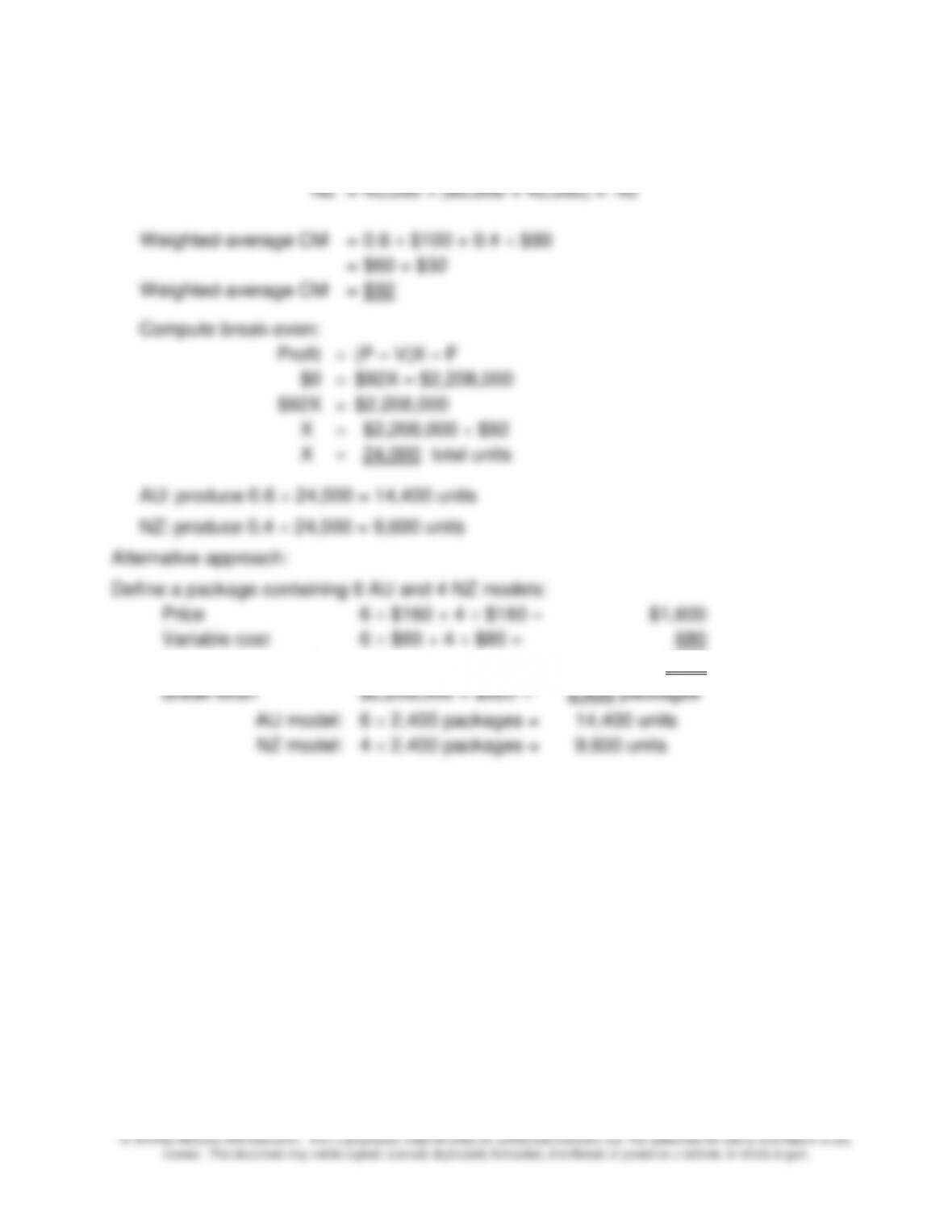
b. Compute the weighted-average contribution margin.
Weights:
AU
=
60,000 ÷ (60,000 + 40,000) = .60
NZ
=
40,000 ÷ (60,000 + 40,000) = .40
Weighted-average CM
=
0.6 $100 + 0.4 $80
=
$60 + $32
Weighted-average CM
=
$92
Compute break-even:
Profit
=
(P – V)X – F
$0
=
$92X – $2,208,000
$92X
=
$2,208,000
X
=
$2,208,000 ÷ $92
X
=
24,000 total units
AU: produce 0.6 24,000 = 14,400 units
NZ: produce 0.4 24,000 = 9,600 units
Alternative approach:
Define a package containing 6 AU and 4 NZ models:
Price
6 $160 + 4 $160 =
$1,600
Variable cost
6 $60 + 4 $80 =
680
Contribution margin
$920
Break-even
$2,208,000 ÷ $920 =
2,400 packages
AU model:
6 2,400 packages =
14,400 units
NZ model:
4 2,400 packages =
9,600 units
Chapter 03 – Fundamentals of Cost-Volume-Profit Analysis
3-51. (continued).
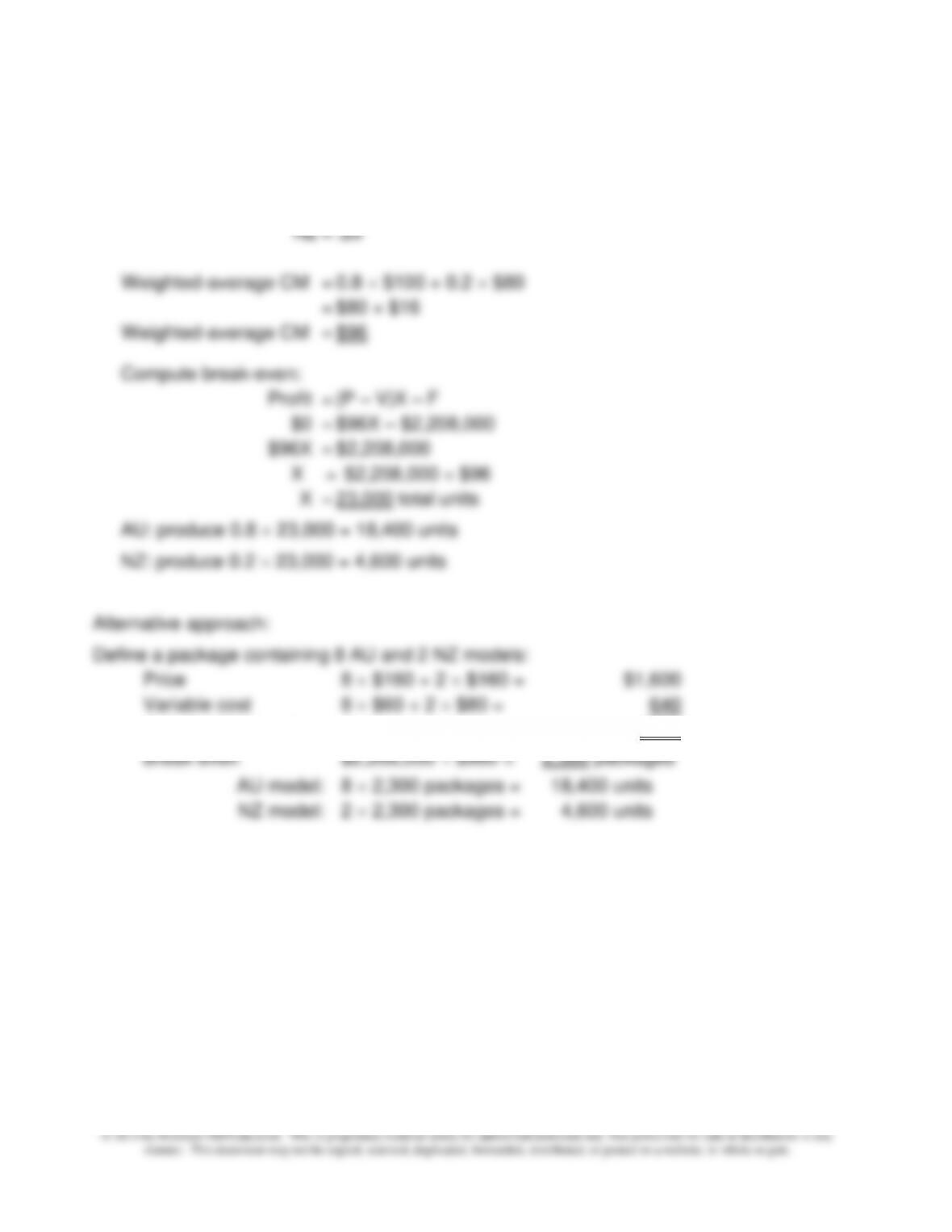
c. New weights:
Weights:
AU
=
.80
NZ
=
.20
Weighted-average CM
=
0.8 $100 + 0.2 $80
=
$80 + $16
Weighted-average CM
=
$96
Compute break-even:
Profit
=
(P – V)X – F
$0
=
$96X – $2,208,000
$96X
=
$2,208,000
X
=
$2,208,000 ÷ $96
X
=
23,000 total units
Price
Variable cost