Chapter 02 – Cost Concepts and Behavior
2-41
2-60. (40 Min.) Find the Unknown Information.
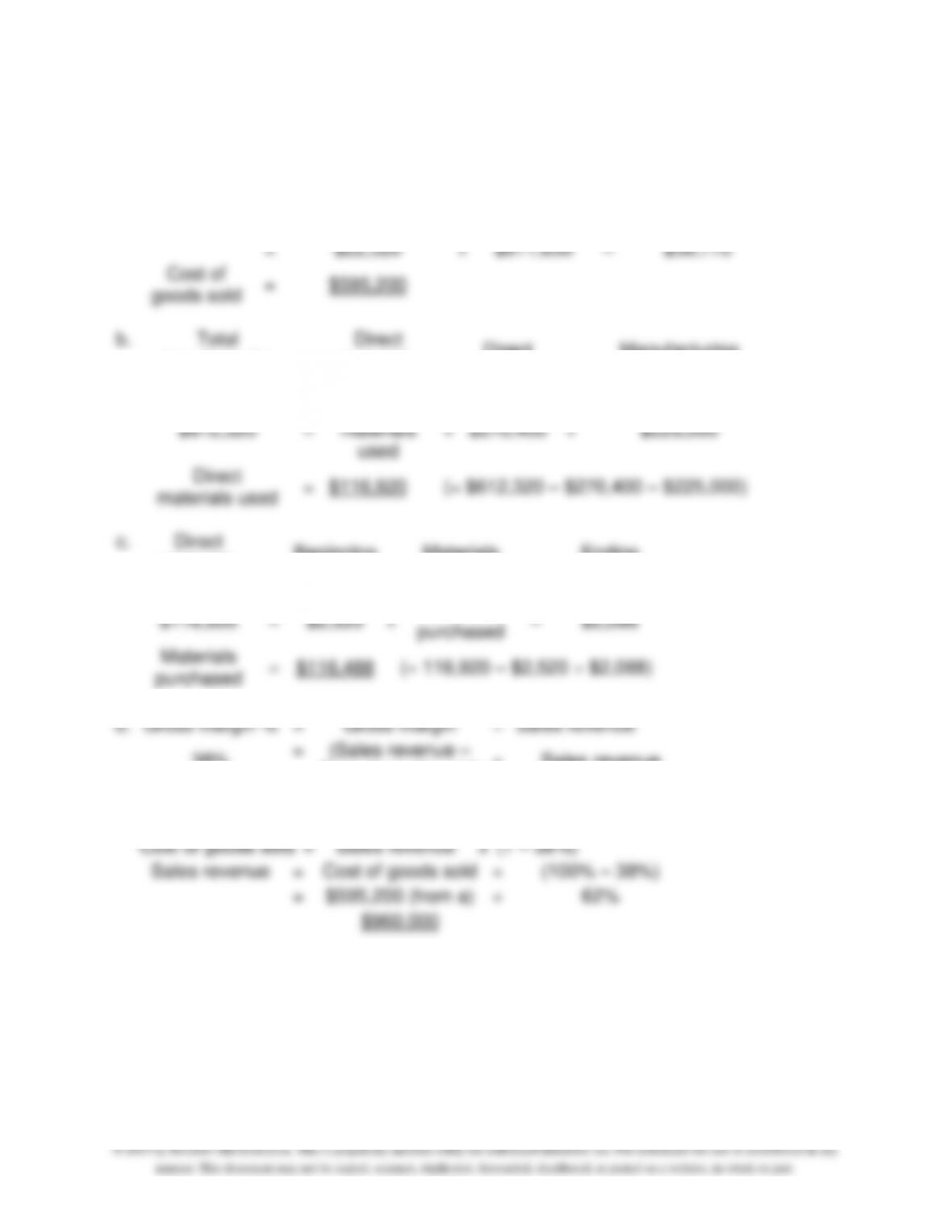
a.
Cost of
goods sold
=
Finished goods
beginning inventory
+
Cost of goods
manufactured
–
Finished goods
ending inventory
=
$22,320
+
$611,650
–
$38,770
Cost of
goods sold
=
$595,200
b.
Total
manufacturing
costs
=
Direct
materials
used
+
Direct
labor
+
Manufacturing
overhead
$612,320
=
Direct
materials
used
+
$270,400
+
$225,000
Direct
materials used
=
$116,920
(= $612,320 – $270,400 – $225,000)
c.
Direct
materials
used
=
Beginning
inventory
+
Materials
purchased
–
Ending
inventory
$116,920
=
$2,520
+
Materials
purchased
–
$2,088
Materials
purchased
=
$116,488
(= 116,920 – $2,520 + $2,088)
d.
Gross margin %
=
Gross margin
÷
Sales revenue
38%
=
(Sales revenue –
Cost of goods sold)
÷
Sales revenue
38% x Sales revenue
=
Sales revenue
–
Cost of goods sold
Cost of goods sold
=
Sales revenue
–
(38% x Sales revenue)
Cost of goods sold
=
Sales revenue
x
(1 – 38%)
Sales revenue
=
Cost of goods sold
÷
(100% – 38%)
=
$595,200 (from a)
÷
62%
$960,000
Chapter 02 – Cost Concepts and Behavior
2-42
2-61. (40 min.) Cost Allocation and Regulated Prices: The City of Imperial Falls.
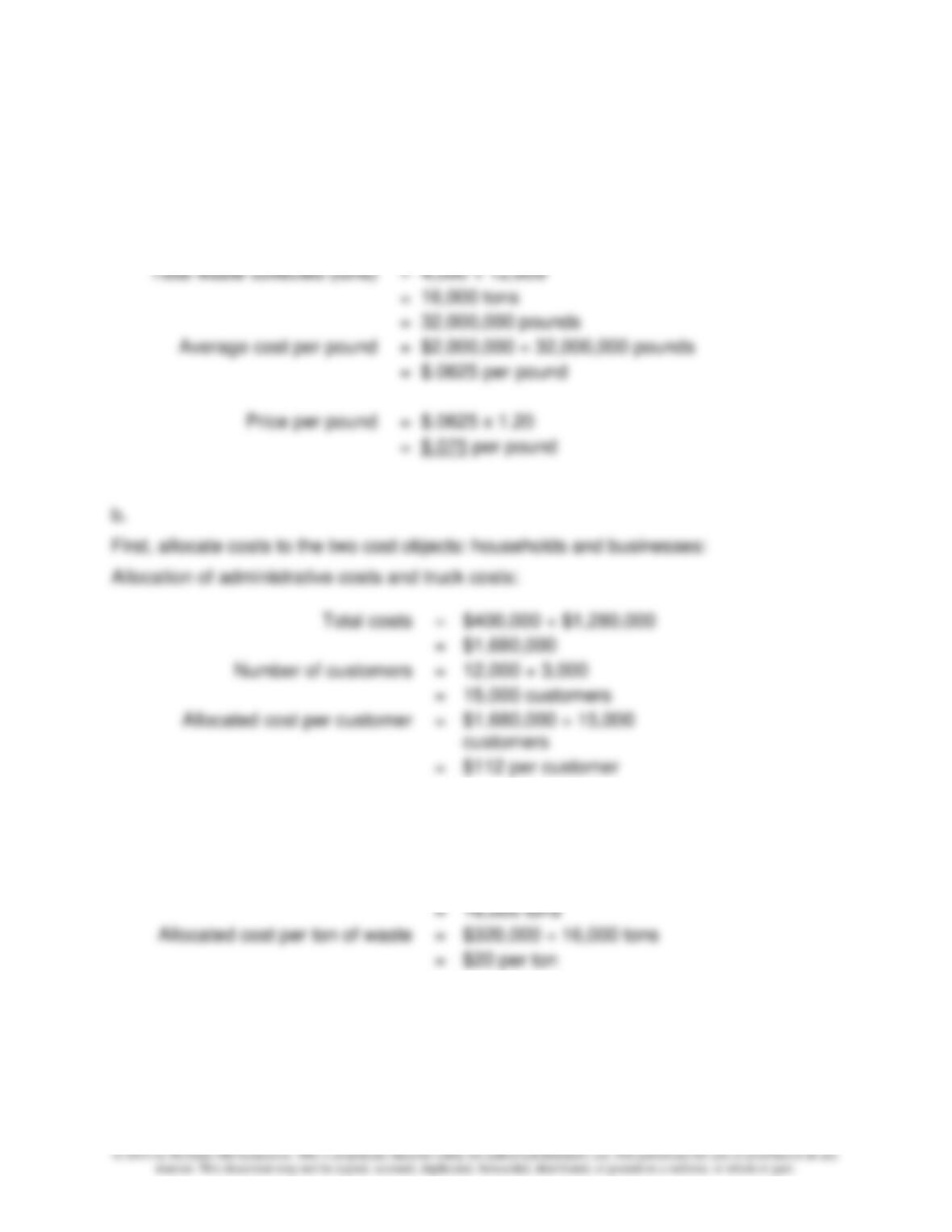
a. The rate is 20 percent above the average cost of collection:
Total cost of collection
=
$400,000 + $1,280,000 + $320,000
=
$2,000,000
Total waste collected (tons)
=
4,000 + 12,000
=
16,000 tons
=
32,000,000 pounds
Average cost per pound
=
$2,000,000 ÷ 32,000,000 pounds
=
$.0625 per pound
Price per pound
=
$.0625 x 1.20
=
$.075 per pound
b.
First, allocate costs to the two cost objects: households and businesses:
Allocation of administrative costs and truck costs:
Total costs
=
$400,000 + $1,280,000
=
$1,680,000
Number of customers
=
12,000 + 3,000
=
15,000 customers
Allocated cost per customer
=
$1,680,000 ÷ 15,000
customers
=
$112 per customer
Allocation of other collection costs:
Total costs
=
$320,000
Total waste collected (tons)
=
4,000 + 12,000
=
16,000 tons
Allocated cost per ton of waste
=
$320,000 ÷ 16,000 tons
=
$20 per ton
Chapter 02 – Cost Concepts and Behavior
2-43
2-61. (continued)
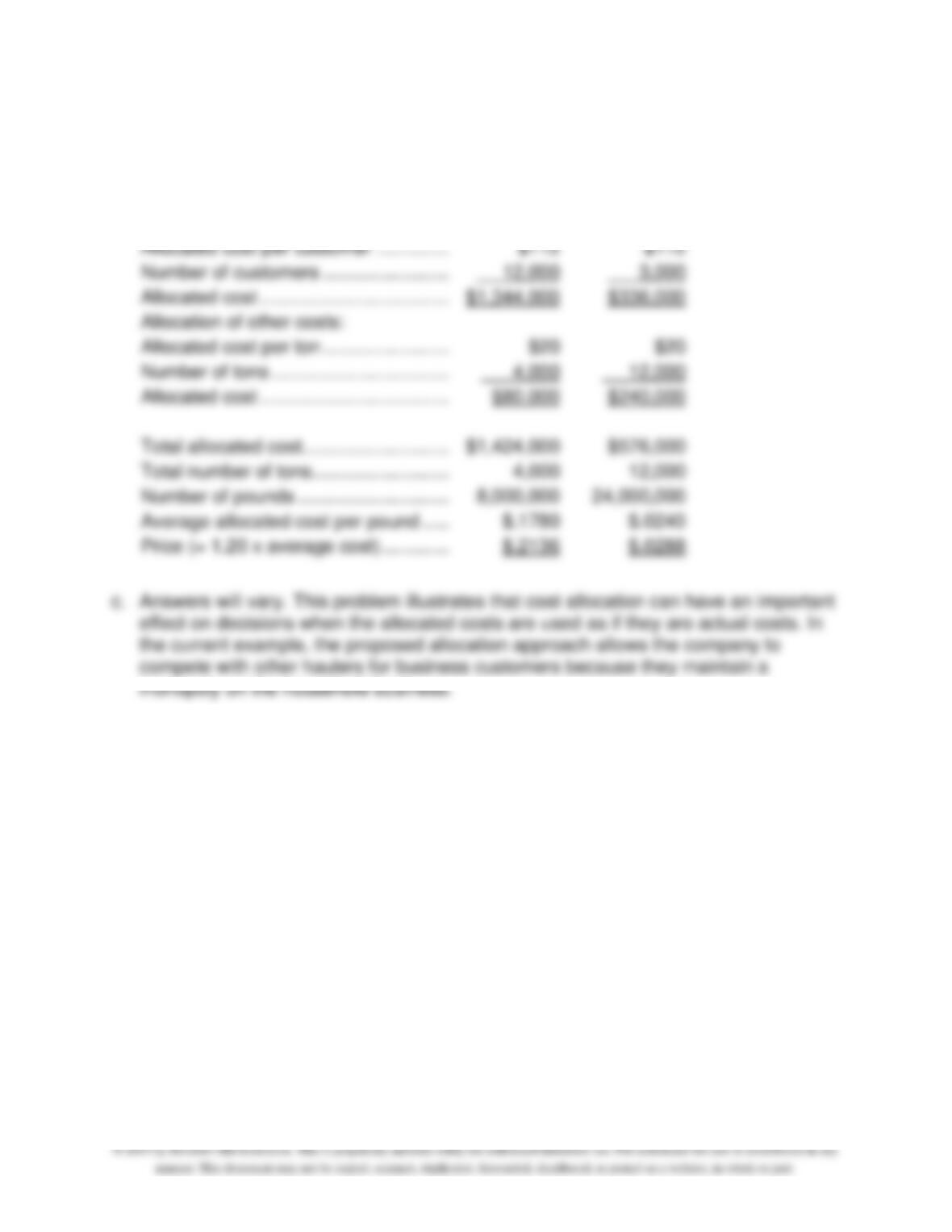
Allocation to customer types:
Households
Business
Allocation of customer cost:
Allocated cost per customer …………....
$112
$112
Number of customers ……………………..
12,000
3,000
Allocated cost ………………………………..
$1,344,000
$336,000
Allocation of other costs:
Allocated cost per ton ……………………..
$20
$20
Number of tons ……………………………...
4,000
12,000
Allocated cost ………………………………..
$80,000
$240,000
Total allocated cost ………………………...
$1,424,000
$576,000
Total number of tons ……………………....
4,000
12,000
Number of pounds ………………………....
8,000,000
24,000,000
Average allocated cost per pound …....
$.1780
$.0240
Price (= 1.20 x average cost) …………...
$.2136
$.0288
c. Answers will vary. This problem illustrates that cost allocation can have an important
effect on decisions when the allocated costs are used as if they are actual costs. In
the current example, the proposed allocation approach allows the company to
compete with other haulers for business customers because they maintain a
monopoly on the household business.
Chapter 02 – Cost Concepts and Behavior
2-44
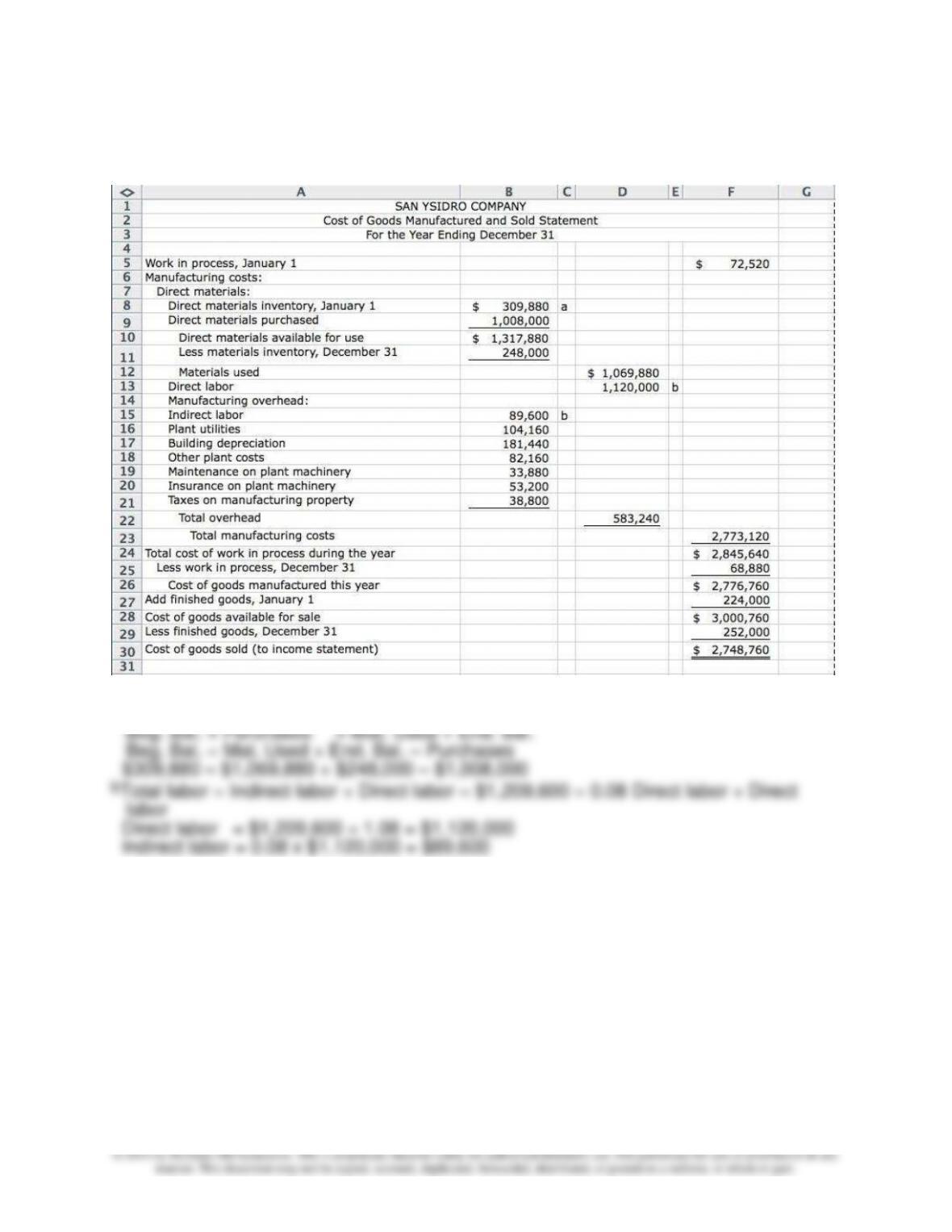
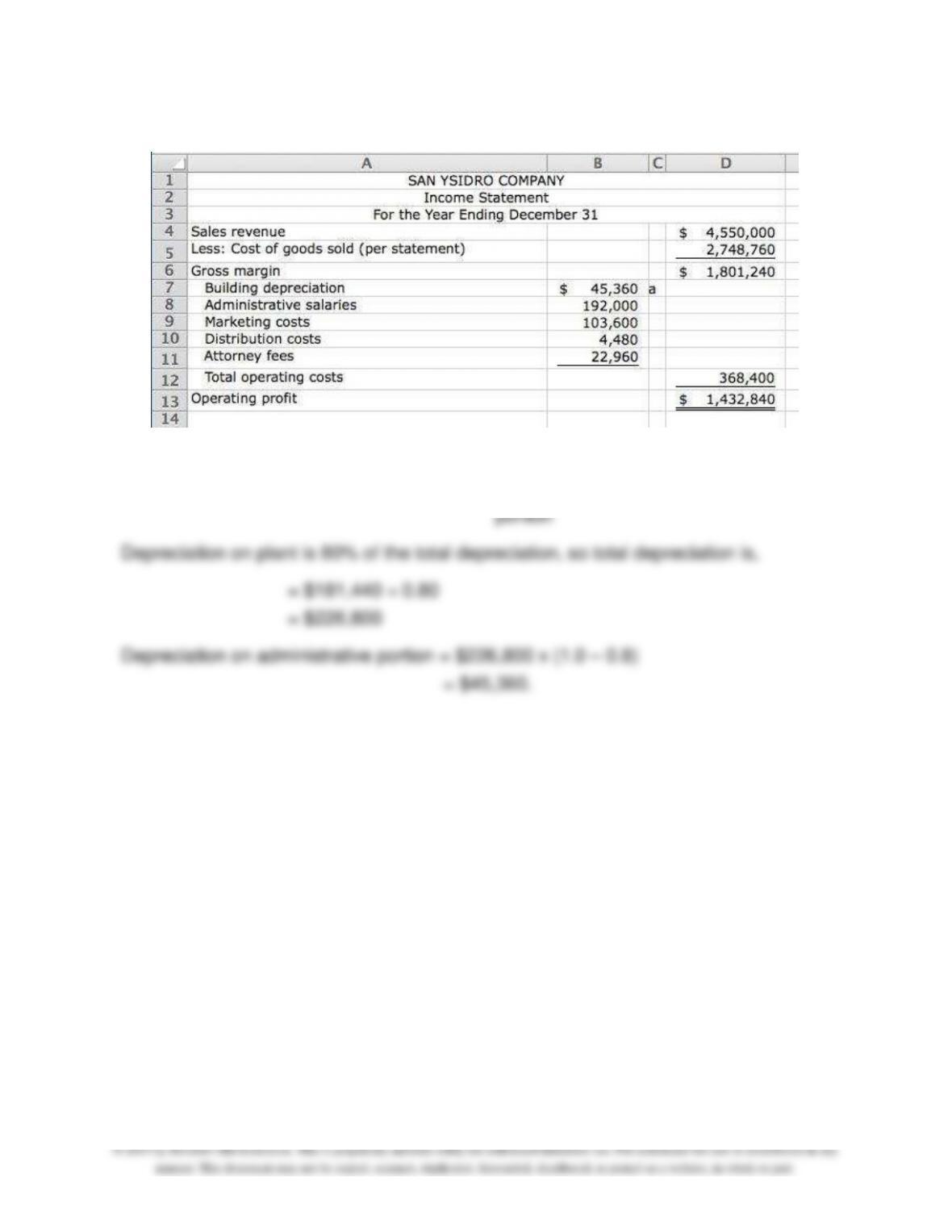
2-62. (30 min.) Reconstruct Financial Statements: San Ysidro Company.
aMaterials used is given, but this number is not. To obtain it,
Chapter 02 – Cost Concepts and Behavior
2-45
2-62 (continued)
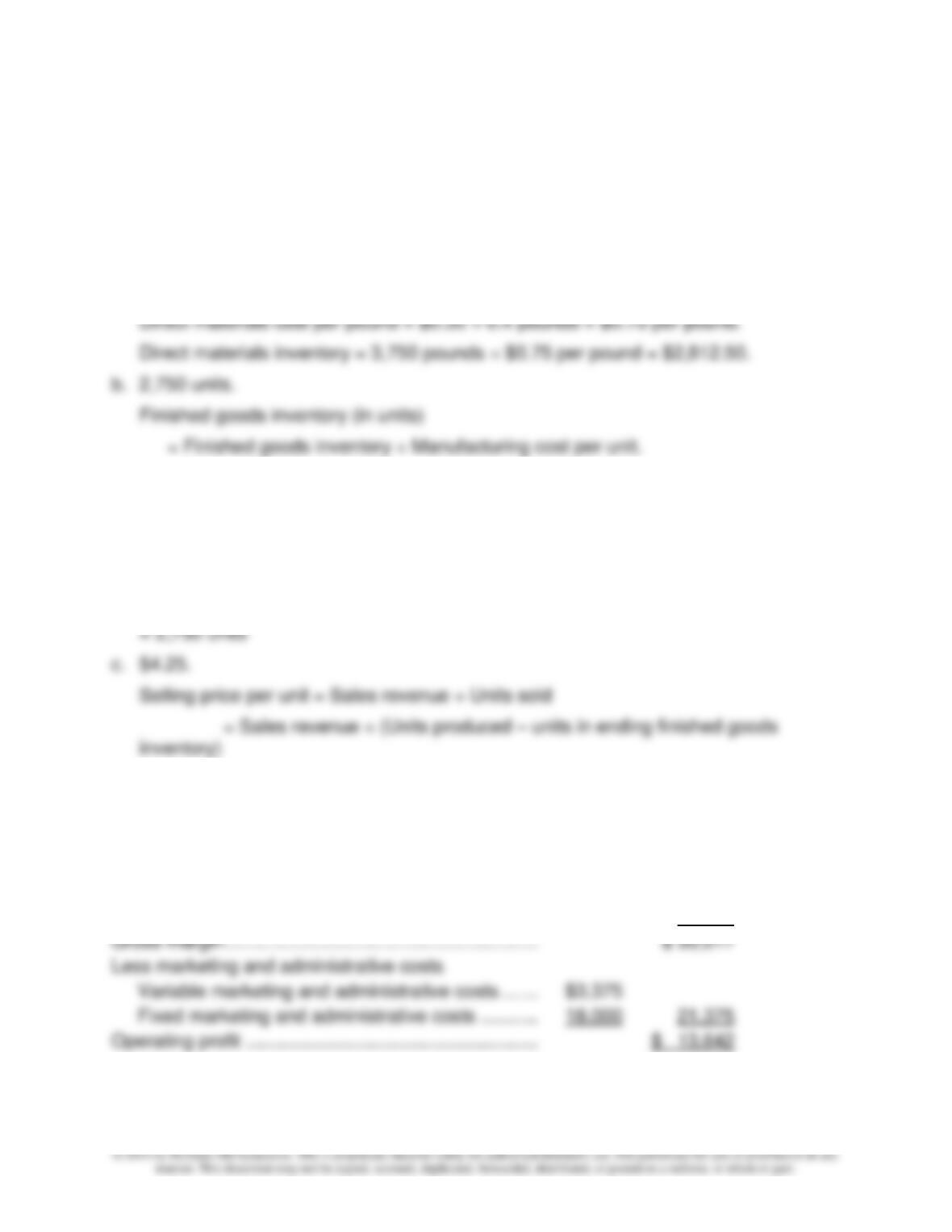
a Total depreciation = Depreciation on plant + Depreciation on administrative building
Chapter 02 – Cost Concepts and Behavior
2-46
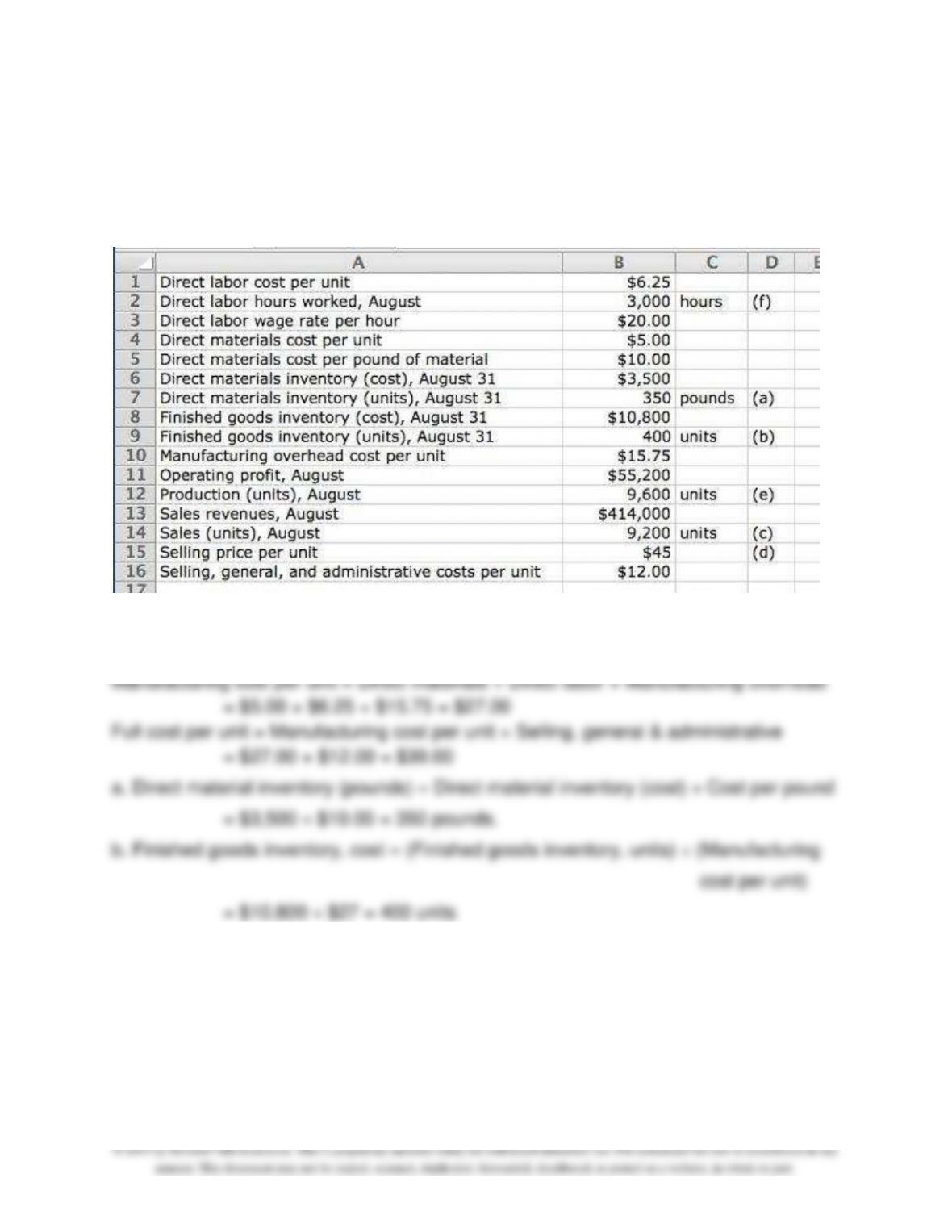
2-63. (20 Min.) Finding Unknowns: Mary’s Mugs.
a. $2,812.50.
Direct materials cost per unit = Direct materials cost ÷ Units produced
= $6,000 ÷ 20,000 units = $0.30 per unit.
Direct materials used per mug = 0.4 pounds.
Manufacturing cost per unit
= (Direct material + Direct labor + Indirect manufacturing cost) ÷ Units produced
= ($6,000 + $27,000 + $5,400 + $6,000) ÷ 20,000 = $44,400 ÷ 20,000
= $2.22 per unit.
Finished goods inventory (in units) December 31, Year 1 = $6,105 ÷ $2.22
= $73,312 ÷ (20,000 – 2,750) = $73,312 ÷ 17,250 = $4.25.
d. $13,642.
Operating income for the year:
Sales revenue ………………………………………………….
$ 73,312
Cost of goods sold (17,250 x $2.22) ……………………
38,295
Gross margin ……………………………………………………
$ 35,017
Less marketing and administrative costs
Variable marketing and administrative costs …….
$3,375
Fixed marketing and administrative costs ………..
18,000
21,375
Operating profit ………………………………………………..
$ 13,642
Chapter 02 – Cost Concepts and Behavior
2-47
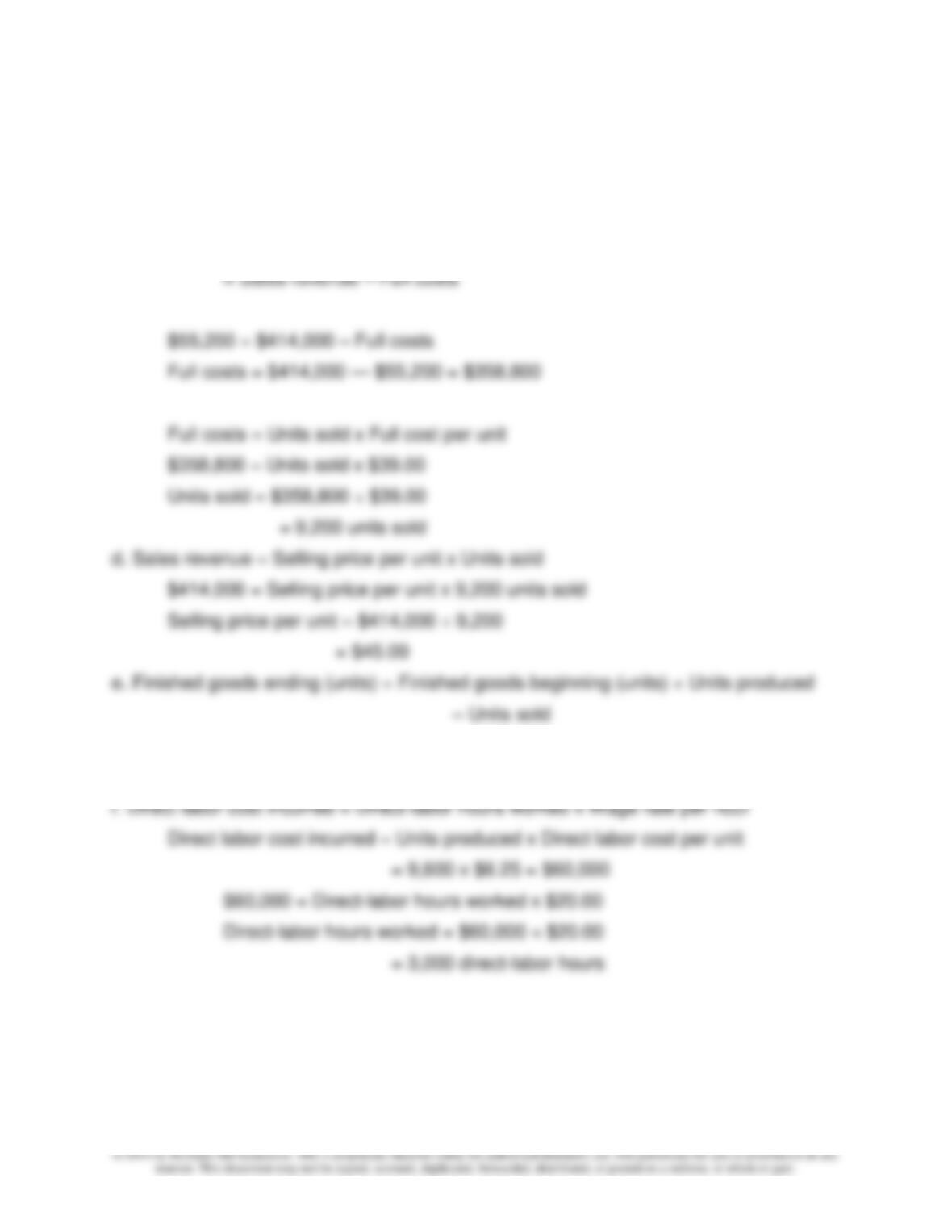
2-64. (40 Min.) Finding Unknowns: BS&T Partners.
Note: This problem is challenging, because there is no indication of how to begin or the
order in which to solve for the unknowns.
We begin by computing the following unit costs:
Chapter 02 – Cost Concepts and Behavior
2-48
2-64 (continued)
c. Full costs = Cost of goods sold + Selling, general, and administrative costs
Then,
Operating profit = Sales revenue – Cost of goods sold – Selling, general, and
administrative costs
400 = 0 + Units produced — 9,200
Units produced = 9,200 + 400 = 9,600
Chapter 02 – Cost Concepts and Behavior
Solutions to Integrative Case
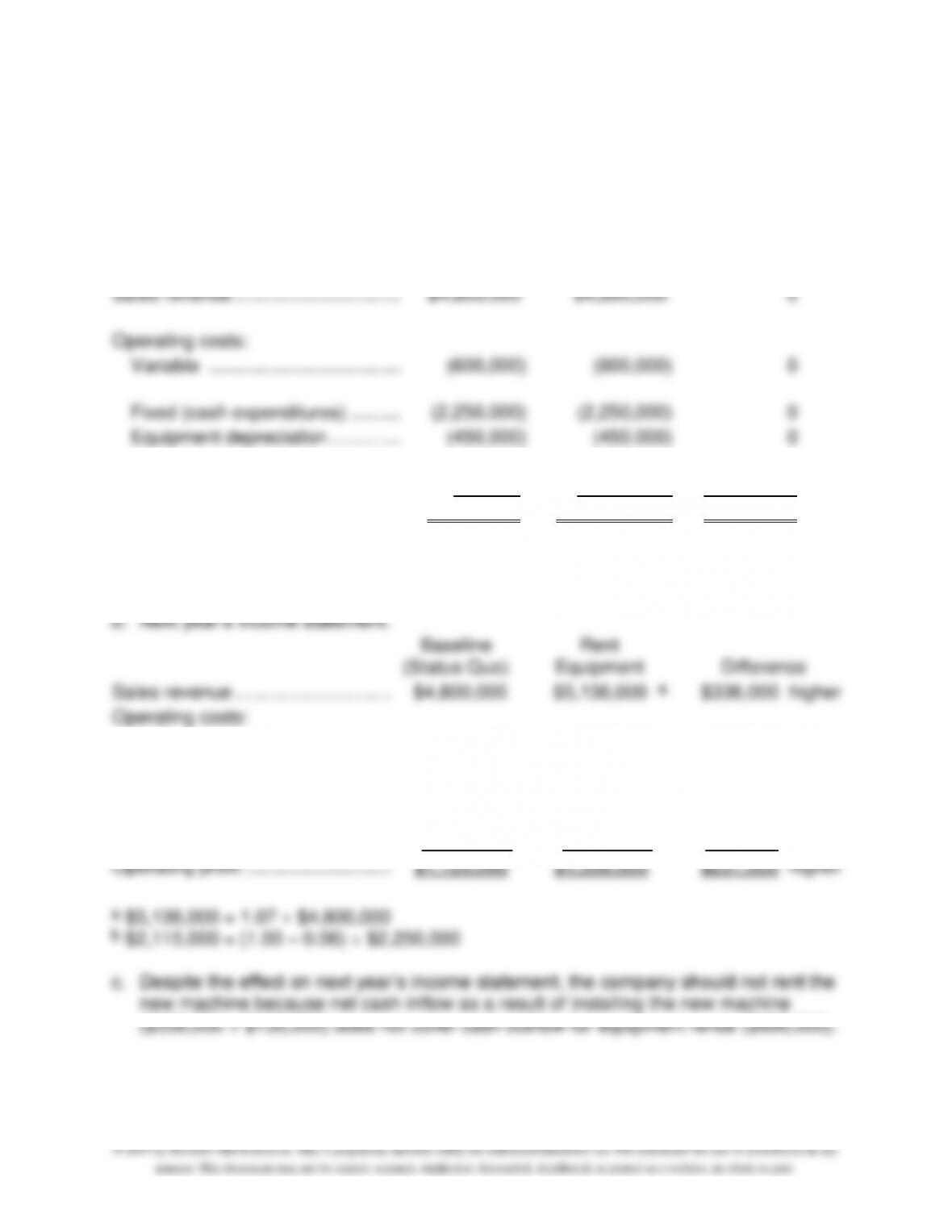
2-65. (30 min.) Analyze the Impact of a Decision on Income Statements:
Tunes2Go.
a. This year’s income statement:
Baseline
(Status Quo)
Rent
Equipment
Difference
Sales revenue …………………………..
$4,800,000
$4,800,000
0
Operating costs:
Variable ……………………………….
(600,000)
(600,000)
0
Fixed (cash expenditures) ……….
(2,250,000)
(2,250,000)
0
Equipment depreciation …………..
(450,000)
(450,000)
0
Other depreciation ………………….
(375,000)
(375,000)
0
Loss from equipment write-off ….
0
(2,550,000)
a
$2,550,000
lower
Operating profit (before taxes) …….
$1,125,000
$ (1,425,000)
$2,550,000
lower
a Equipment write-off = $3 million cost – $450,000 accumulated depreciation for one
year (equipment was purchased on January 1 of the year).
Operating costs:
Equipment rental …………………...
higher
Fixed cash expenditures ………….
b
lower
Equipment depreciation …………..
lower