Chapter 02 – Cost Concepts and Behavior
2-11
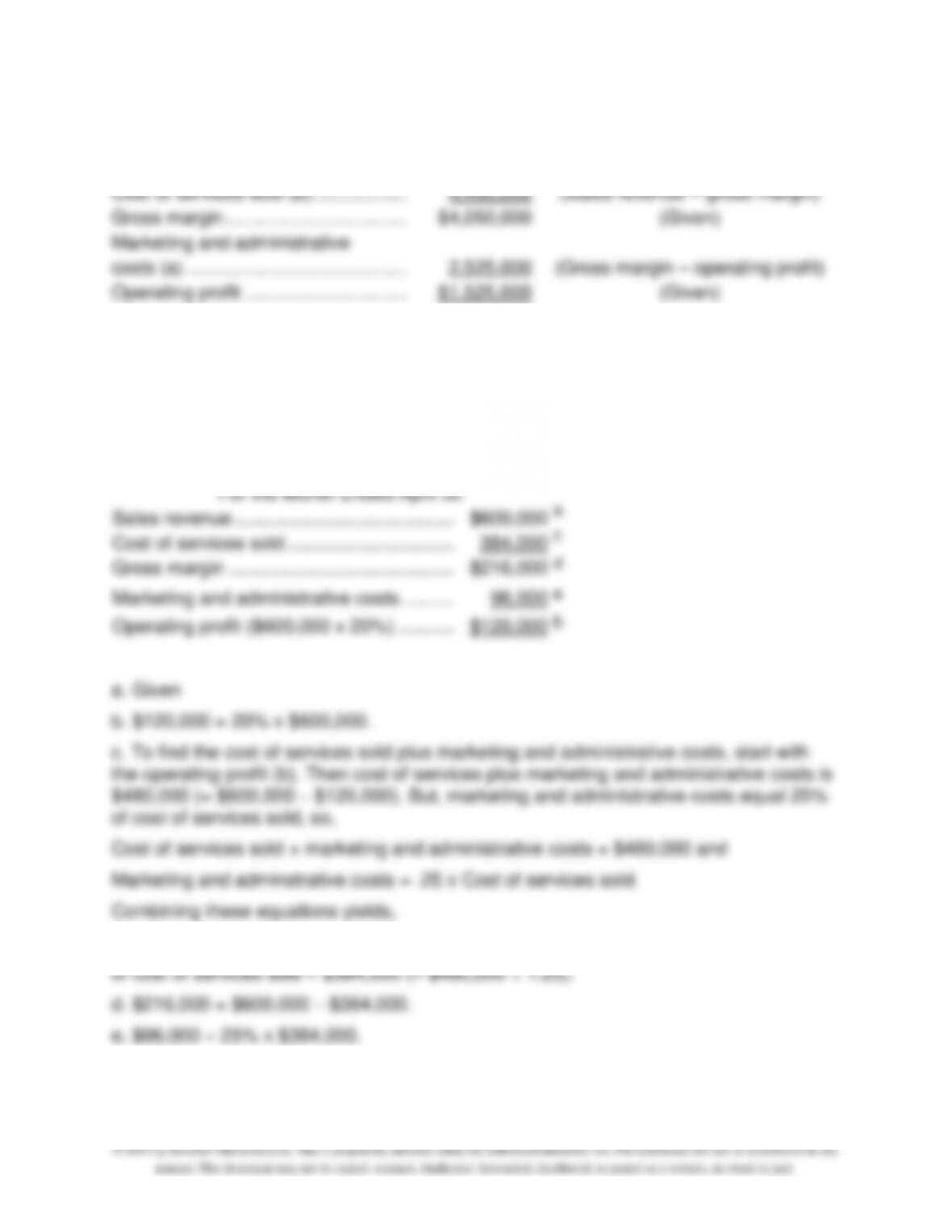
2-34. (10 min.) Prepare Statements for a Service Company: Jupiter Consultants
Sales revenue ……………………………..
$8,500,000
(Given)
Cost of services sold (b) ………………..
4,450,000
(Sales revenue – gross margin)
Gross margin ……………………………....
$4,050,000
(Given)
Marketing and administrative
costs (a) ……………………………………..
2,525,000
(Gross margin – operating profit)
Operating profit …………………………..
$1,525,000
(Given)
2-35. (20 min.) Prepare Statements for a Service Company: Lead! Inc.
You can solve this in the order shown below.
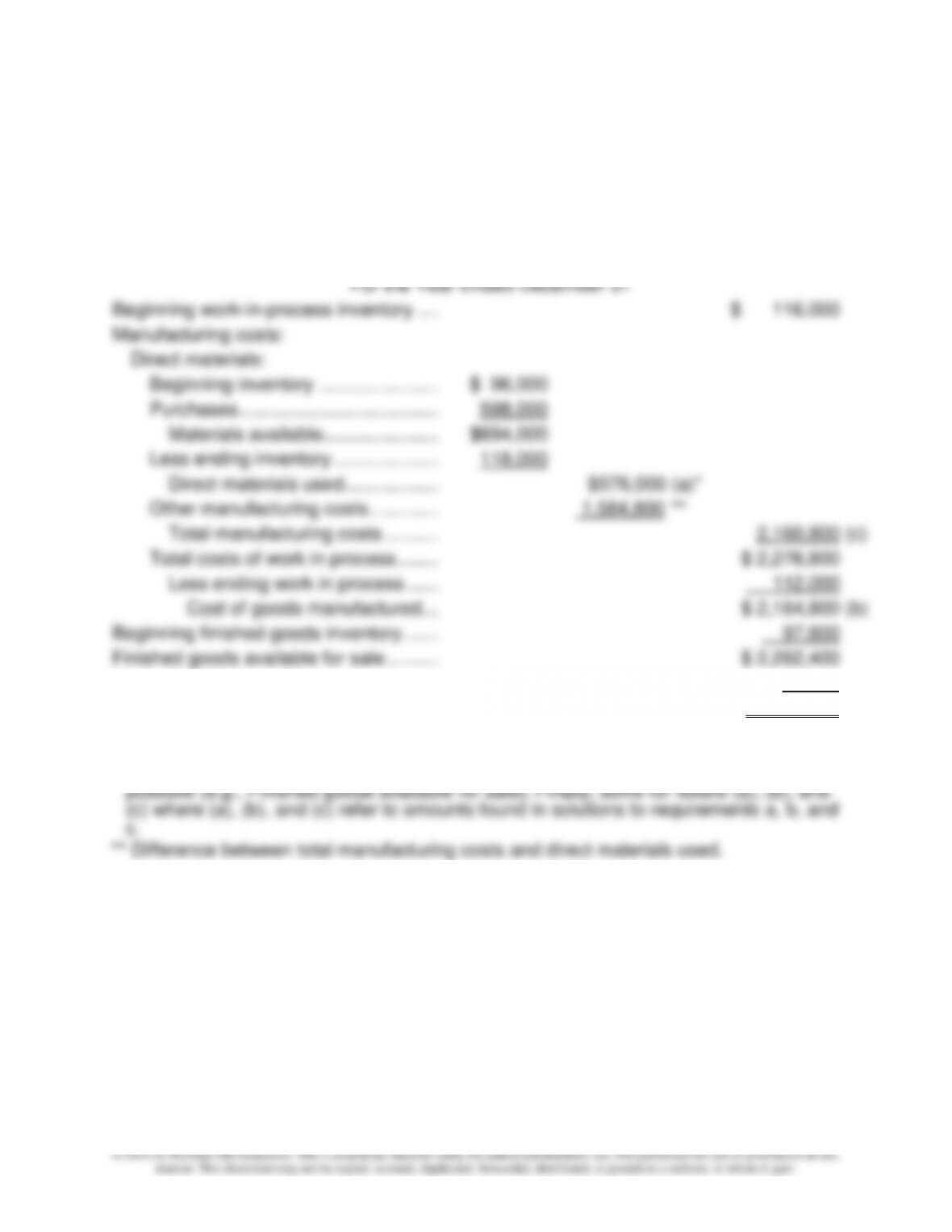
Lead!, Inc.
Income Statement
For the Month Ended April 30
Sales revenue …………………………………….…………………
$600,000
a
Cost of services sold ……………………………………………………….
384,000
c
Gross margin ……………………………………..………………..
$216,000
d
Marketing and administrative costs ………..…………………
96,000
e
Operating profit ($600,000 x 20%) …………………………..
$120,000
b
a. Given
b. $120,000 = 20% x $600,000.
c. To find the cost of services sold plus marketing and administrative costs, start with
the operating profit (b). Then cost of services plus marketing and administrative costs is
$480,000 (= $600,000 – $120,000). But, marketing and administrative costs equal 25%
of cost of services sold, so,
Cost of services sold + marketing and administrative costs = $480,000 and
Marketing and adminstrative costs = .25 x Cost of services sold.
Combining these equations yields,
1.25 x Cost of services sold = $480,000
Chapter 02 – Cost Concepts and Behavior
2-12
2-36. (30 min.) Prepare Statements for a Manufacturing Company: Todd
Machining Company.
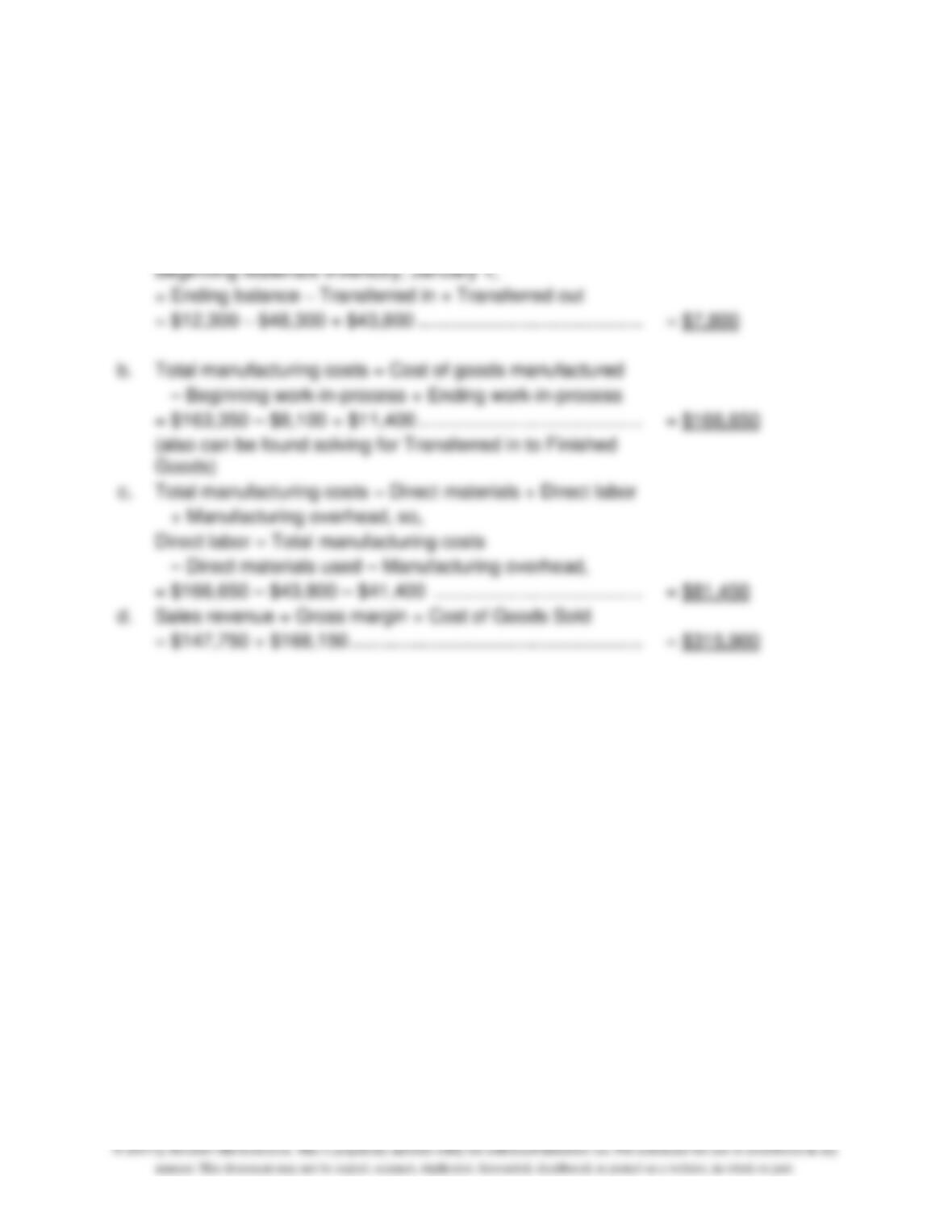
Todd Machining Company
Cost of Goods Sold Statement
For the Year Ended December 31
Beginning work-in-process inventory ….
$ 116,000
Manufacturing costs:
Direct materials:
Beginning inventory …………………..
$ 96,000
Purchases ………………………………..
598,000
Materials available ………………….
$694,000
Less ending inventory ………………..
118,000
Direct materials used ………………
$576,000
(a)*
Other manufacturing costs ………….
1,584,800
**
Total manufacturing costs ……….
2,160,800
(c)
Total costs of work in process ……..
$ 2,276,800
Less ending work in process ……
112,000
Cost of goods manufactured …
$ 2,164,800
(b)
Beginning finished goods inventory …….
97,600
Finished goods available for sale ……….
$ 2,262,400
Ending finished goods inventory ………..
90,000
Cost of goods sold …………………………..
$2,172,400
* The best approach to solving this problem is to lay out the format of the Cost of Goods
Sold Statement first, then fill in the amounts known. Next find the subtotals that are
Chapter 02 – Cost Concepts and Behavior
2-13
2-37. (15 min.) Basic Concepts
a.
From the basic inventory equation,
Beginning Inventory + Transferred in
= Transferred out + Ending Inventory, so
Beginning Materials Inventory, January 1,
= Ending balance – Transferred in + Transferred out
= $12,300 – $48,300 + $43,800 …………………………………….
= $7,800
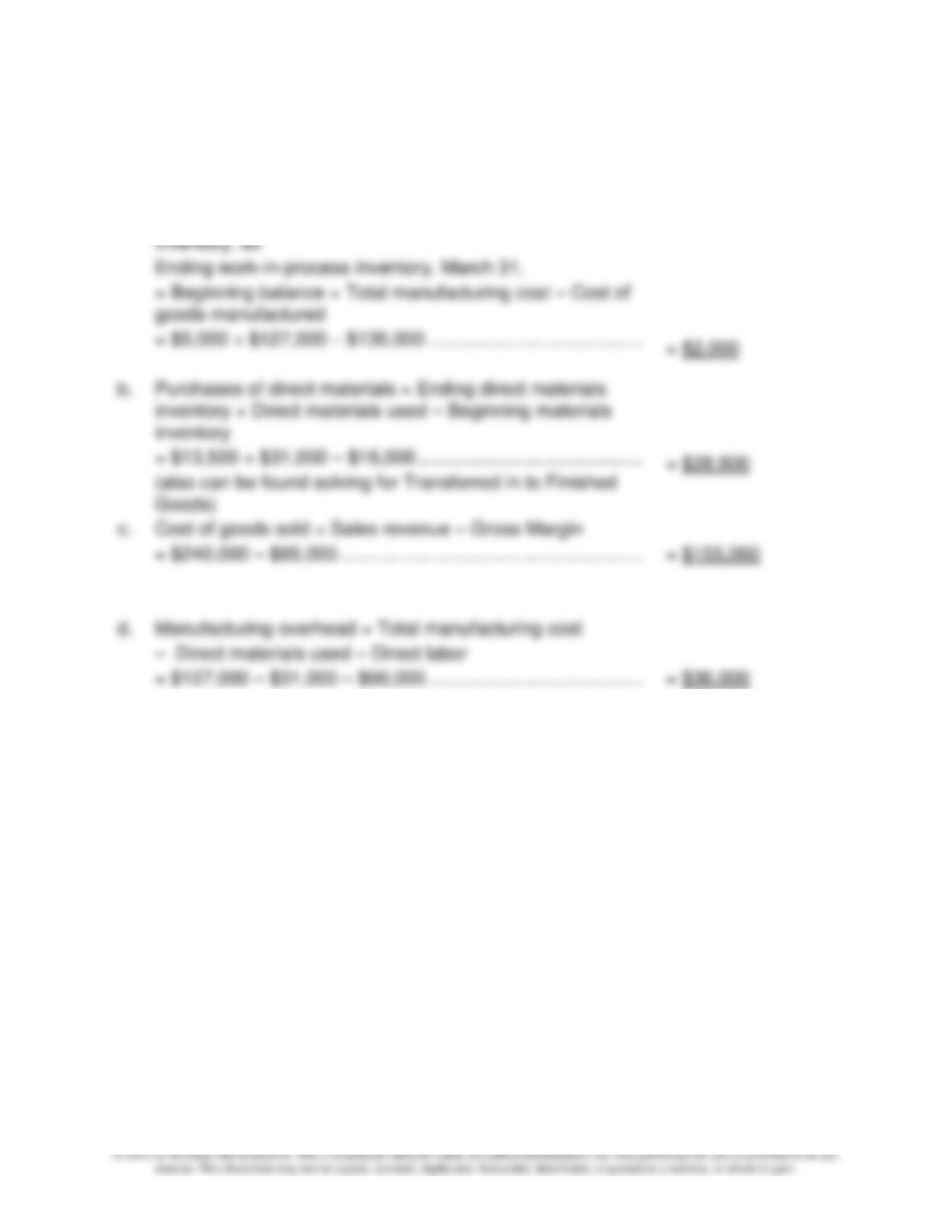
b.
Total manufacturing costs = Cost of goods manufactured
– Beginning work-in-process + Ending work-in-process
= $163,350 – $8,100 + $11,400 …………………………………….
(also can be found solving for Transferred in to Finished
Goods)
= $166,650
c.
Total manufacturing costs = Direct materials + Direct labor
+ Manufacturing overhead, so,
Direct labor = Total manufacturing costs
– Direct materials used – Manufacturing overhead,
= $166,650 – $43,800 – $41,400 ………………………………….
= $81,450
d.
Sales revenue = Gross margin + Cost of Goods Sold
= $147,750 + $168,150 ………………………………………………..
= $315,900
Chapter 02 – Cost Concepts and Behavior
2-38. (15 min.) Basic Concepts.
a.
From the basic inventory equation,
Beginning work-in-process inventory + Total manufacturing
cost
= Cost of goods manufactured + Ending work-in-process
inventory, so
Ending work-in-process inventory, March 31,
= Beginning balance + Total manufacturing cost – Cost of
goods manufactured
= $5,000 + $127,000 – $130,000 …………………………………..
= $2,000
b.
Purchases of direct materials = Ending direct materials
inventory + Direct materials used – Beginning materials
inventory
= $13,500 + $31,000 – $16,000 …………………………………….
(also can be found solving for Transferred in to Finished
Goods)
= $28,500
c.
Cost of goods sold = Sales revenue – Gross Margin
= $240,000 – $85,000 …………………………..……………………..
= $155,000
d.
Manufacturing overhead = Total manufacturing cost
– Direct materials used – Direct labor
= $127,000 – $31,000 – $60,000 …………………………………..
= $36,000
Chapter 02 – Cost Concepts and Behavior
2-15
2-39. (15 min.) Prepare Statements for a Merchandising Company: Angie’s
Apparel.
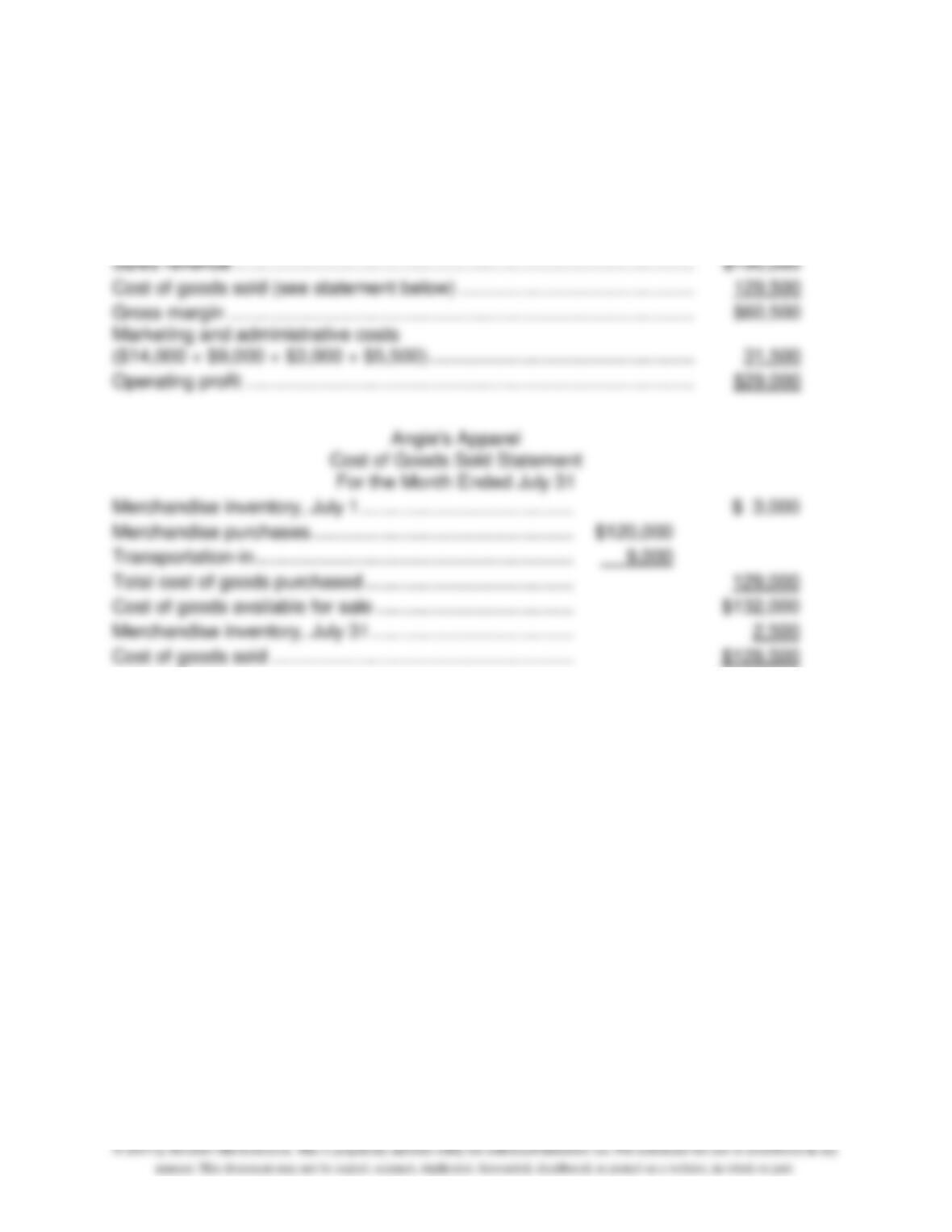
Angie’s Apparel
Income Statement
For the Month Ended July 31
Sales revenue ……………………………………………………………………………..
$190,000
Cost of goods sold (see statement below) ……………………………………….
129,500
Gross margin ……………………………………………………………………………...
$60,500
Marketing and administrative costs
($14,000 + $9,000 + $3,000 + $5,500) …………………………………………….
31,500
Operating profit …………………………..……………………………………………….
$29,000
Angie’s Apparel
Cost of Goods Sold Statement
For the Month Ended July 31
Merchandise inventory, July 1 …………………………………..…..
$ 3,000
Merchandise purchases …………………………………………..…..
$120,000
Transportation-in …………………………………………………….…
9,000
Total cost of goods purchased ………………………………….…..
129,000
Cost of goods available for sale ………………………………..…..
$132,000
Merchandise inventory, July 31 …………………………..…….…..
2,500
Cost of goods sold ………………………………………………….…..
$129,500
Chapter 02 – Cost Concepts and Behavior
2-16
2-40. (15 min.) Prepare Statements for a Merchandising Company: Hill Street
Electronics.
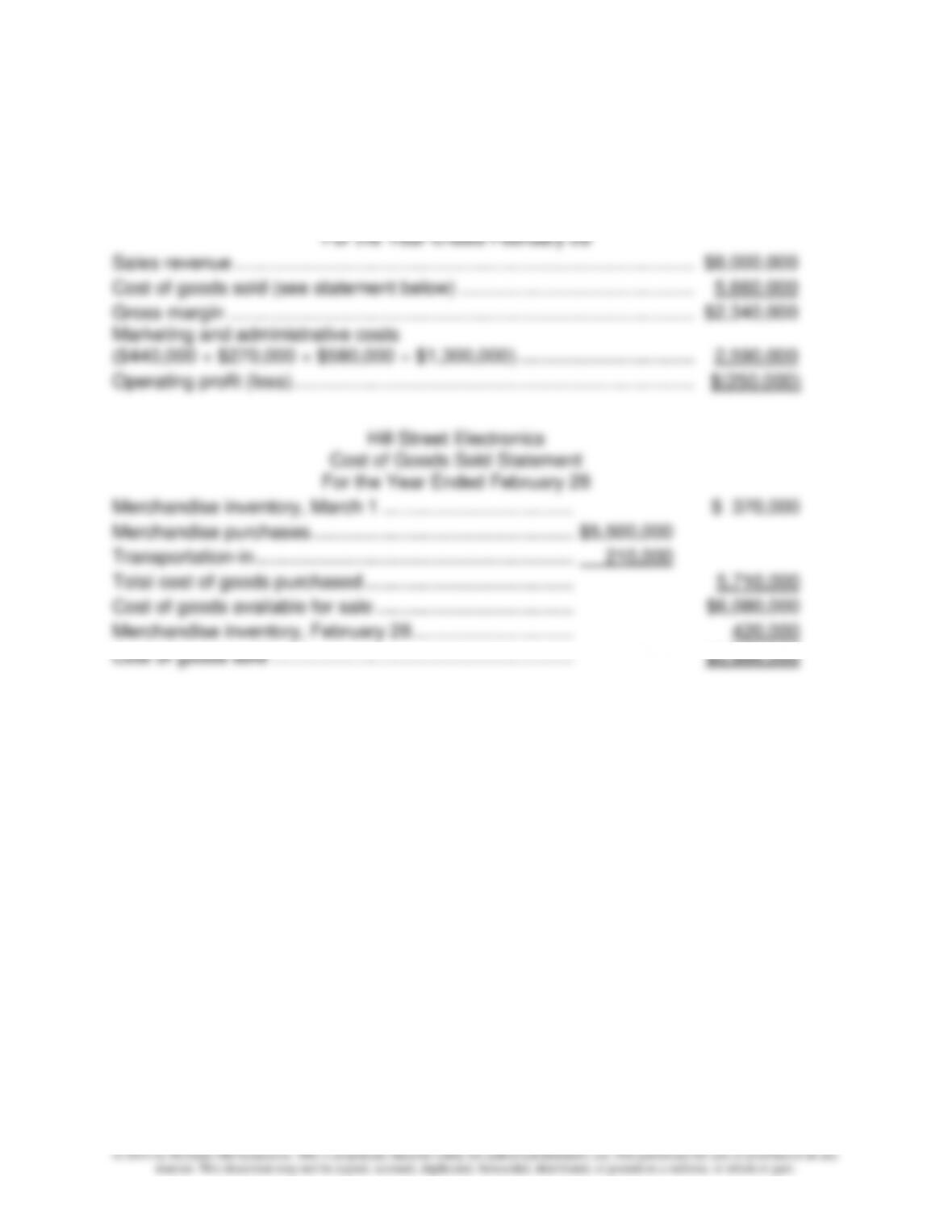
Hill Street Electronics
Income Statement
For the Year Ended February 28
Sales revenue ……………………………………………………………………………..
$8,000,000
Cost of goods sold (see statement below) ……………………………………….
5,660,000
Gross margin ……………………………………………………………………………...
$2,340,000
Marketing and administrative costs
($440,000 + $270,000 + $580,000 + $1,300,000) ……………………………..
2,590,000
Operating profit (loss) …………………………………………………………………...
$(250,000)
Hill Street Electronics
Cost of Goods Sold Statement
For the Year Ended February 28
Merchandise inventory, March 1 ……………………………….…..
$ 370,000
Merchandise purchases …………………………………………..…..
$5,500,000
Transportation-in …………………………………………………….…
210,000
Total cost of goods purchased ………………………………….…..
5,710,000
Cost of goods available for sale ………………………………..…..
$6,080,000
Merchandise inventory, February 28 …………………………..
420,000
Cost of goods sold ………………………………………………….…..
$5,660,000
Chapter 02 – Cost Concepts and Behavior
2-17
2-41. (10 min.) Cost Behavior for Forecasting: Lima Company.
The variable costs will be 1/6 lower because there will be a decrease of 30,000 –
25,000 = 5,000 units (1/6 = 5,000 ÷ 30,000).
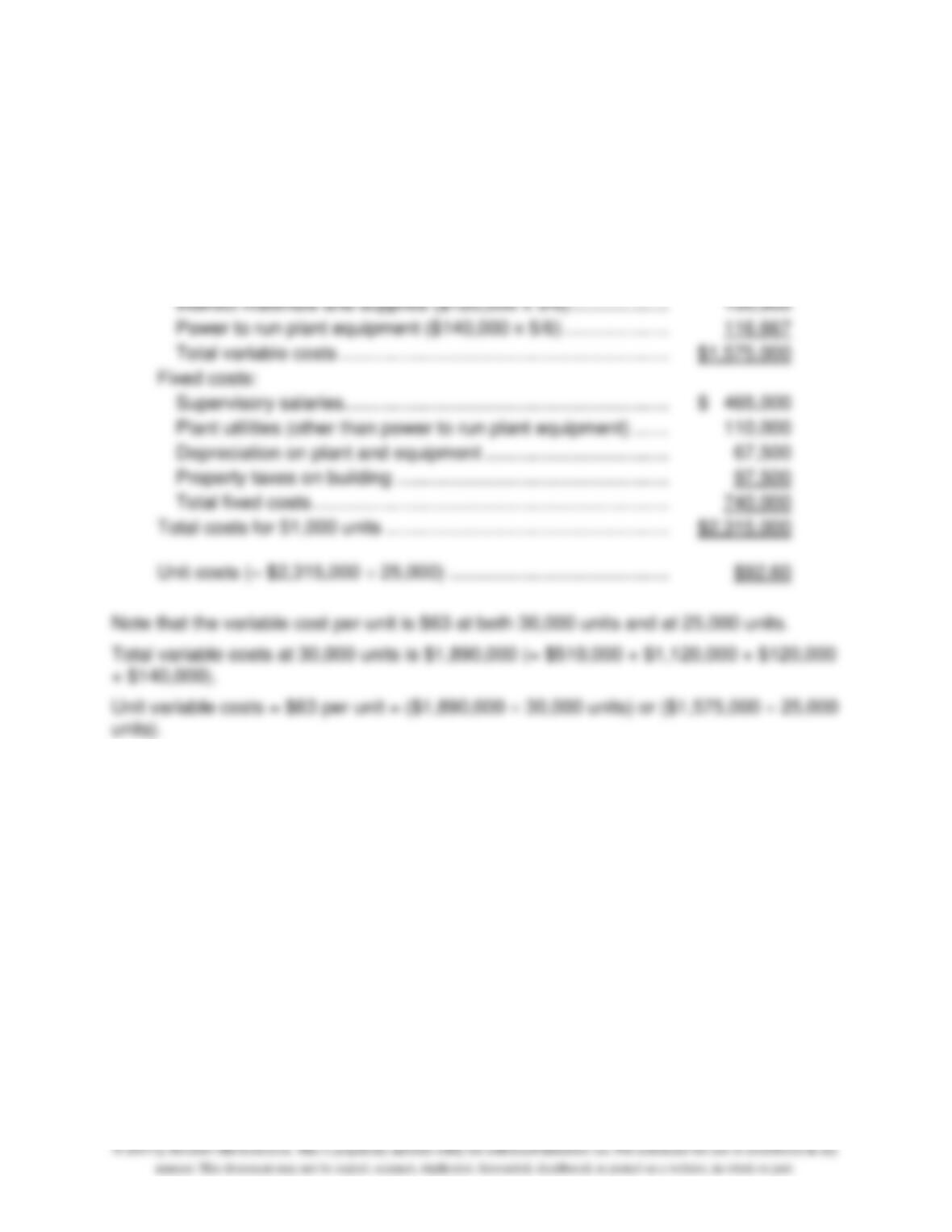
Variable costs:
Direct materials used ($510,000 x 5/6) …………………………...
$ 425,000
Direct labor ($1,120,000 x 5/6)……………………………………….
933,333
Indirect materials and supplies ($120,000 x 5/6) ……………….
100,000
Power to run plant equipment ($140,000 x 5/6) ………………..
116,667
Total variable costs ………………………………………………………
$1,575,000
Fixed costs:
Supervisory salaries ……………………………………………………..
$ 465,000
Plant utilities (other than power to run plant equipment) …….
110,000
Depreciation on plant and equipment ……………………………..
67,500
Property taxes on building …………………………………………….
97,500
Total fixed costs …………………………………………………………..
740,000
Total costs for 51,000 units ………………………………………………
$2,315,000
Unit costs (= $2,315,000 ÷ 25,000) ……………………………………
$92.60
Note that the variable cost per unit is $63 at both 30,000 units and at 25,000 units.
Total variable costs at 30,000 units is $1,890,000 (= $510,000 + $1,120,000 + $120,000
+ $140,000).
Unit variable costs = $63 per unit = ($1,890,000 30,000 units) or ($1,575,000 25,000
units).
Chapter 02 – Cost Concepts and Behavior
2-18
2-42. (30 min.) Components of Full Costs: Karen Corporation
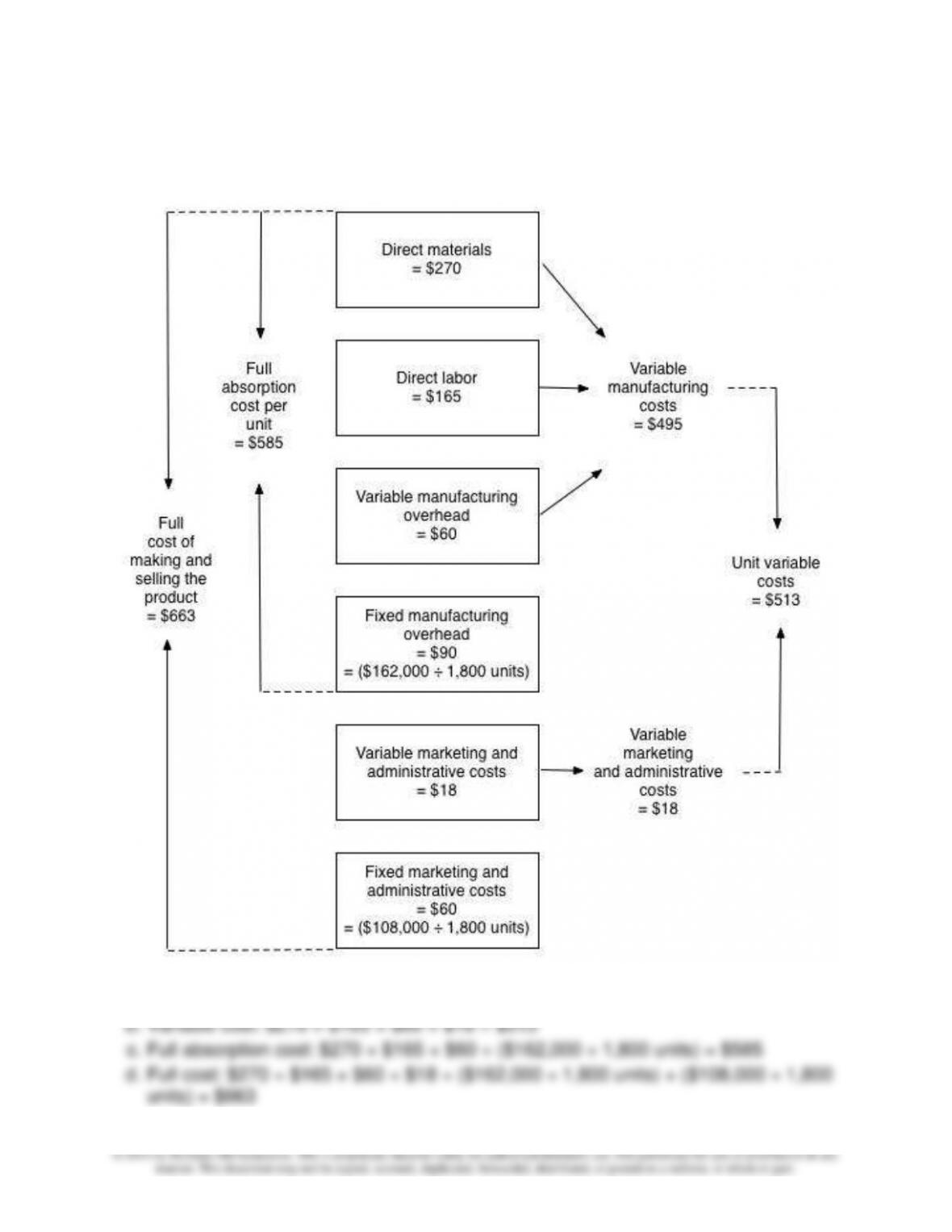
a.
Variable manufacturing cost: $270 + $165 + $60= $495
b.
Variable cost: $270 + $165 + $60 + $18 = $513
c.
Full absorption cost: $270 + $165 + $60 + ($162,000 ÷ 1,800 units) = $585
d.
Full cost: $270 + $165 + $60 + $18 + ($162,000 ÷ 1,800 units) + ($108,000 ÷ 1,800
units) = $663
Chapter 02 – Cost Concepts and Behavior
2-19
2-43. (15 min.) Components of Full Costs: Karen Corporation.
a.
Product cost = Direct materials + Direct labor + Manufacturing overhead.
Product cost per unit: $270 + $165 + $60 + ($162,000 ÷ 1,800 units) = $585
b.
Period costs = Marketing and administrative costs.
Period costs for the period: $108,000 + ($18 x 1,800 units) = $140,400
Chapter 02 – Cost Concepts and Behavior
2-20
2-44. (30 min.) Components of Full Cost: Larcker Manufacturing.