Chapter 02 – Cost Concepts and Behavior
2-1
© 2014 by McGraw-Hill Education. This is proprietary material solely for authorized instructor use. Not authorized for sale or distribution in any
manner. This document may not be copied, scanned, duplicated, forwarded, distributed, or posted on a website, in whole or part.
Chapter 02
Cost Concepts and Behavior
Solutions to Review Questions
2-1.
2-2.
Product costs are those costs that are attributed to units of production, while period
costs are all other costs and are attributed to time periods.
2-3.
Outlay costs are those costs that represent a past, current, or future cash outlay.
Opportunity cost is the value of what is given up by choosing a particular alternative.
2-4.
Common examples include the value forgone because of lost sales by producing low
2-5.
2-6.
Chapter 02 – Cost Concepts and Behavior
Both accounts represent the cost of the goods acquired from an outside supplier, which
2-8.
Direct materials:
Materials in their raw or unconverted form, which become an integral
part of the finished product are considered direct materials. In some
cases, materials are so immaterial in amount that they are considered
part of overhead.
Direct labor:
Costs associated with labor engaged in manufacturing activities.
Sometimes this is considered as the labor that is actually responsible for
converting the materials into finished product. Assembly workers,
cutters, finishers and similar “hands on” personnel are classified as
direct labor.
Manufacturing
overhead:
All other costs directly related to product manufacture. These costs
include the indirect labor and materials, costs related to the facilities and
equipment required to carry out manufacturing operations, supervisory
costs, and all other support activities.
2-9.
Gross margin is the difference between revenue (sales) and cost of goods sold.
Contribution margin is the difference between revenue (sales) and variable cost.
2-10.
Contribution margin is likely to be more important, because it reflects better how profits
will change with decisions.
2-11.
2-12.
Chapter 02 – Cost Concepts and Behavior
2-3
Solutions to Critical Analysis and Discussion Questions
2-13.
The statement is not true. Materials can be direct or indirect. Indirect materials include
2-14.
No. Statements such as this almost always refer to the full cost per unit, which includes
fixed and variable costs. Therefore, multiplying the cost per seat-mile by the number of
2-15.
Marketing and administrative costs are treated as period costs and expensed for
financial accounting purposes in both manufacturing and merchandising organizations.
2-16.
There is no “correct” answer to this allocation problem. Common allocation procedures
would include: (1) splitting the costs equally (25% each), (2) dividing the costs by the
2-17.
The costs will not change. Your allocation in 2-16 was not “incorrect,” because the
purpose of the allocation is not to determine incremental costs.
2-18.
Answers will vary. The major cost categories include servers (mostly fixed), personnel
(mostly fixed), and licensing costs (mostly variable).
2-19.
Chapter 02 – Cost Concepts and Behavior
2-4
2-20.
2-21.
No, R&D costs are relevant for many decisions. For example, should a program of
research be continued? Was a previous R&D project profitable? Should we change our
2-22. (15 min.) Basic Concepts.
a.
False. The statement refers to an expense. For example, R&D costs are incurred
in expectation of future benefits.
b.
True. Each unit of a product has the same amount of direct material (same cost
per unit), but producing more units requires more material (and more cost).
c.
False. Variable costs can be direct (direct materials) or indirect (lubricating oil for
machines that produce multiple products.)
2-23. (15 min.) Basic Concepts.
Cost Item
Fixed (F)
Variable (V)
Period (P)
Product (M)
a.
Depreciation on buildings for administrative staff offices ……
F
P
b.
Bonuses of top executives in the company …………………..…
F
P
c.
Overtime pay for assembly workers …………………………….…
V
M
d.
Transportation-in costs on materials purchased ………………
V
M
e.
Assembly line workers’ wages ………………………………………
V
M
f.
Sales commissions for sales personnel ……………………….…
V
P
g.
Administrative support for sales supervisors ……………………
F
P
h.
Controller’s office rental …………………………………………….…
F
P
i.
Cafeteria costs for the factory …………………………………….…
F
M
j.
Energy to run machines producing units of output in the
Chapter 02 – Cost Concepts and Behavior
2-5
factory…………….. ……………………………………………………....
V
M
2-24. (10 min.) Basic Concepts.
a.
Property taxes on the factory. …………………………………………………………….
C
b.
Direct materials used in production process. ………………………………………..
P
c.
Transportation-in costs on materials purchased. …………………………………..
P
d.
Lubricating oil for plant machines. ………………………………………………………
C
e.
Assembly line worker’s salary. ……………………………………………………………
B
2-25. (15 min.) Basic Concepts.
Concept
Definition
9
Period cost ……………………
Cost that can more easily be attributed to
time intervals.
6
Indirect cost ……………..……
Cost that cannot be directly related to a
cost object.
10
Fixed cost ………………..……
Cost that does not vary with the volume of
activity.
2
Opportunity cost ……….……
Lost benefit from the best forgone
alternative.
11
Outlay cost ……………………
Past, present, or near-future cash flow.
8
Direct cost ……………….……
Cost that can be directly related to a cost
object.
5
Expense ………………….……
Cost charged against revenue in a
particular accounting period.
3
Cost ………………………..…
Sacrifice of resources.
1
Variable cost …………………
Cost that varies with the volume of activity.
4
Full absorption cost …..……
Cost used to compute inventory value
according to GAAP.
7
Product cost …………….……
Cost that is part of inventory.
2-26. (15 min.) Basic Concepts.
Cost Item
Fixed (F)
Variable (V)
Period (P)
Product (M)
a.
Depreciation on pollution control equipment in the plant ..
F
M
b.
Chief financial officer’s salary …………………………………….
F
P
Chapter 02 – Cost Concepts and Behavior
2-6
© 2014 by McGraw-Hill Education. This is proprietary material solely for authorized instructor use. Not authorized for sale or distribution in any
manner. This document may not be copied, scanned, duplicated, forwarded, distributed, or posted on a website, in whole or part.
c.
Power to operate factory equipment …………………………..
V
M
d.
Commissions paid to sales personnel …………………………
V
P
e.
Office supplies for the human resources manager ………..
F
P
2-27. (15 min.) Basic Concepts.
a.
Variable production cost per unit: ($240 + $40 + $10 + $20) ……………..……
$310
b.
Variable cost per unit: ($310 + $30) ……………………………………………….……
$340
c.
Full cost per unit: [$340 + ($100,000 ÷ 1,000 units)] …………………………..
$440
d.
Full absorption cost per unit: [$310 + ($60,000 ÷ 1,000)] …………………..……
$370
e.
Prime cost per unit. (materials + labor + outsource) …………………………..
$290
f.
Conversion cost per unit: (labor + overhead + outsource) ………………………
$360
g.
Contribution margin per unit: ($600 – $340)…………………………………..……
$260
h.
Gross margin per unit: ($600 – full absorption cost of $370)……………..……
$230
i.
Suppose the number of units decreases to 800 units per month,
which is within the relevant range. Which parts of (a) through (h) will
change? For each amount that will change, give the new amount
for a volume of 800 units.
c. Full cost = $340 + ($100,000 ÷ 800) = $465
d. Full absorption cost = $310 + ($60,000 ÷ 800) = $385
f. Conversion costs = $240 + $20 + ($60,000 ÷ 800) + $40 = $375
h. Gross margin = $600 – $385 = $215
c, d, f
and h
will
change,
as
follows
2-28. (15 min.) Basic Concepts: Terracotta, Inc.
a.
Prime cost per unit: (materials + labor) …………………………………………..……
$10
b.
Contribution margin per unit: ($25 – $18) ……………………………………..……
$7
c.
Gross margin per unit: ($25 – full absorption cost of $18.50) …………………
$6.50
d.
Conversion cost per unit: (labor + overhead) …………………………………..……
$12.50
e.
Variable cost per unit: ($15 + $3) …………………………………………………..…..
$18
f.
Full absorption cost per unit: [$15 + ($1,050,000 ÷ 300,000)] …………….……
$18.50
g.
Variable production cost per unit: ($4 + $6 + $5) ……………………………..……
$15
h.
Full cost per unit. [$18 + ($1,350,000 ÷ 300,000 units)] …………………….……
$22.50
i.
Suppose the number of units increases to 400,000 units per month,
which is within the relevant range. Which parts of (a) through (h) will
change? For each amount that will change, give the new amount
for a volume of 400,000 units.
c. Gross margin = $25.00 – $17.63 = $7.37
c, d, f
and h
will
change,
as
follows
Chapter 02 – Cost Concepts and Behavior
2-7
© 2014 by McGraw-Hill Education. This is proprietary material solely for authorized instructor use. Not authorized for sale or distribution in any
manner. This document may not be copied, scanned, duplicated, forwarded, distributed, or posted on a website, in whole or part.
d. Conversion costs = $4 + $5 + ($1,050,000 ÷ 400,000) = $11.63
f. Full absorption cost = $15 + ($1,050,000 ÷ 400,000) = $17.63
h. Full cost = $18 + ($1,350,000 ÷ 400,000) = $21.38
2-29. (15 min.) Cost Allocation—Ethical Issues
This problem is based on the experience of the authors’ research at several companies.
a. Answers will vary as there are several defensible bases on which to allocate the
2-30. (15 min.) Cost Allocation—Ethical Issues
This problem is based on the experience of the authors’ research at several companies.
a. Answers will vary as there are several defensible bases on which to allocate the
Chapter 02 – Cost Concepts and Behavior
2-8
2-31. (30 min.) Prepare Statements for a Manufacturing Company: Hill
Components.
Hill Components
Cost of Goods Sold Statement
For the Year Ended December 31
Beginning work in process inventory …………..
$67,730
Manufacturing costs:
Direct materials:
Beginning inventory …………………………..
$48,100
Purchases ………………………………………..
55,900
(a)*
Materials available ………………………….
$104,000
Less ending inventory ………………………..
44,200
Direct materials used ………………………
$59,800
Other manufacturing costs ………………….
15,470
**
Total manufacturing costs ……………….
75,270
(c)
Total costs of work in process ……………..
$143,000
Less ending work in process ……………
71,500
Cost of goods manufactured …………
$ 71,500
(b)
Beginning finished goods inventory …………….
15,600
Finished goods available for sale ……………….
$ 87,100
Ending finished goods inventory ………………..
18,200
Cost of goods sold …………………………………..
$68,900
* Letters (a), (b), and (c) refer to amounts found in solutions to requirements a, b, and c.
** Difference between total manufacturing costs of $75,270 and direct materials used of
$59,800.
Chapter 02 – Cost Concepts and Behavior
2-9
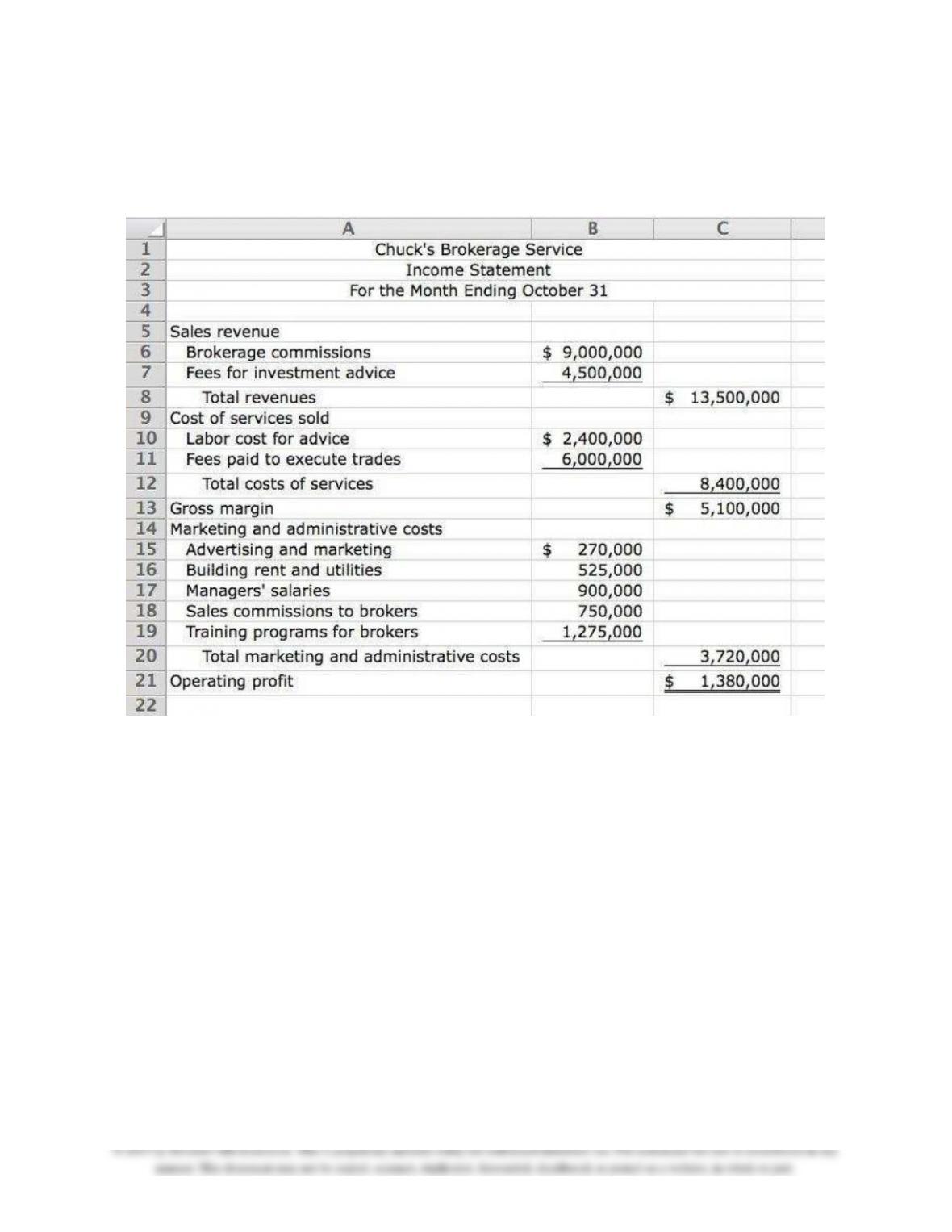
2-32. (10 min.) Prepare Statements for a Service Company: Chuck’s Brokerage
Service.
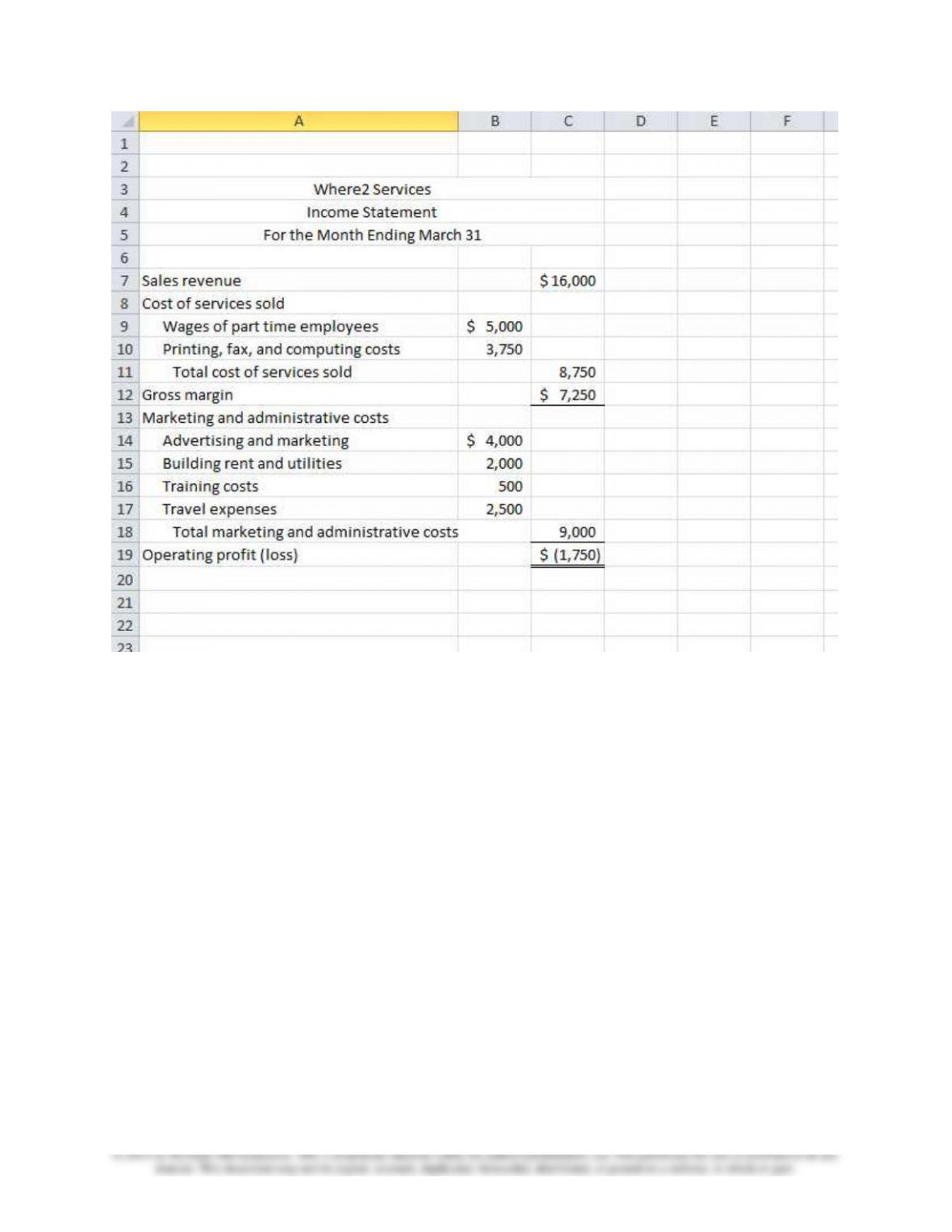
2-33. Prepare Statements for a Service Company: Where2 Services.
Chapter 02 – Cost Concepts and Behavior
2-10